
Vox has created a stir this week with a podcast claiming that Ludwig van Beethoven’s Fifth Symphony is, for some reason, a particular “symbol of exclusion, elitism, and gatekeeping”. It’s not super clear why Vox singled out the Fifth for abuse, and my conscience is frantically reminding me that I am not to provide sustenance to trolls and nitwits who aren’t me, but this is certainly intriguing. Nate Sloan and Charlie Harding suggest that “women, LGBTQ+ people, (and) people of colour” may resent Beethoven, but they conflate two arguments to produce this conclusion.
One is just that Beethoven is a dead white male who is universally deemed an incomparable composer. The other is that concerts of classical music are kind of classist and snooty, and if you showed up with a piercing or anime hair or dark skin, you might get beaten up, or sneered at, or something.
The first accusation attracts an immediate guilty plea, and identifies a real problem: no one (of any colour or creed or sexual orientation) who takes up music composition in 2020 has any real hope of becoming the equal of Beethoven. Vox found musicians to complain about the suffocating centrality of Beethoven within their tradition of creating and performing, but this sentiment isn’t the exclusive property of minorities, or of musicians. It persecutes all indiscriminately. No young mathematician setting out on a career imagines that he is going to give Euclid or even Poincaré a serious run for their money.
[…]
The second charge in Vox‘s indictment — that concerts of classical music discourage outsiders — is something that (surviving) symphony orchestras have been working their fingers to the bone to address, and not without obvious success. At this point there can’t be an ensemble of any size on this continent that hasn’t spent several summers going to battle in public parks, armed with trendy film scores and orchestral pop, to play for people in jogging outfits and tank tops.
Colby Cosh, “Roll over Beethoven, you exclusionary elitist”, National Post, 2020-09-16.
June 24, 2026
QotD: Beethoven’s Fifth Symphony is a “symbol of exclusion, elitism, and gatekeeping”
June 23, 2026
Modern children as human hothouse plants, needing constant care and protection
At Becoming Noble, Johann Kurtz discusses how parents today treat their children in ways they largely never experienced, failing to provide them with enough freedom to allow them to develop personal autonomy as most western children have done for generations:
Giving children the freedom they need to develop agency is now a luxury good. The number of neighborhoods in which it is normal for children to leave the house and roam all day has collapsed. This collapse has come for a variety of reasons relating to security, trust, law, norms, and infrastructure.
Allowing children the privilege of freedom depends on conditions that most families no longer have access to: safe streets — yes — but also neighbors who are known and trusted, and a settled local agreement about what children are and what they are for. These conditions have not vanished, but they have concentrated, and are now a guarded secret, found only in private, privileged, and intentional communities.
This is a curious inversion of an older pattern. For most of history the peasant’s son had the run of the village while the noble’s son was kept under tutors. Now it is the wealthy child who is sent out to enjoy the freedom and adventure of camps and screenless schools, while working and underclass children are kept indoors and screened up.
Photo from Becoming Noble
It is worth being clear about the factors which underlie this transition. Otherwise, parents seeking the nostalgic “free roaming” experience are directed to explanations which are emphasized because they are unproblematic and suggest that a broad solution is available if we just move policy in a sensible direction. This includes discussions of “walkable development” and a rejection of “helicopter parenting”.
This polite framing avoids the reality that the prudent decisions available to parents are mostly made for them by the place they can afford to live, the people they live among, and how radical they are willing to be.
Children develop “agency” — the self-belief that they can independently and effectively manipulate and shape the world in creative ways — through constant experimentation and positive reinforcement.
The “independent” aspect of this formula involves developing internal psychological permission to break from prosaic norms and routines. Developing this is helped by play outside the control of authorities and interacting with the real world in settings unmediated by parents.
The closed systems that now fill children’s hours provide some feeling of agency (open world games, sprawling social media platforms, private chat rooms) without its substance. A child scrolling or playing through the programmatic logic of games is making choices, but they are only the choices that limited systems can accommodate.
Closed-system childhoods teach that there are inviolable hidden structures underneath reality and that the smoothest and most rewarding experiences are to be found when you conform with them. Experiences from boxes teach you to think within boxes. And the vice available online can be as controlling as any parent.

A few years ago, I linked to an article that graphically illustrated how the generations of an English family near Sheffield had experienced continuously diminished “range” for the children to explore:

Graphic showing the diminishing “free ranges” of each generation of an English family.
They don’t do “democracy” in Europe for any important issue: the voters might get it wrong
It used to be a joke that voting never matters because the voters can’t be trusted with that kind of power. Over time, the joke stopped being at all funny, because that’s exactly what has happened in most western countries at the national level, but most blatantly in the European Union, where voters can express their will in a clear majority, yet see exactly the opposite policies implemented by Brussels:

EU delenda est
2005: the day they decided your “no” didn’t count
May 29, 2005. The French vote. Referendum on the European Constitutional Treaty.
Result: 54.68% NO.
Turnout: 69%.
Not a vote of abstainers, not a misunderstanding.
A people speaking out, massively, with full awareness.
Three years later, the same text — or nearly so — came into force. Without asking their opinion again.
Here’s how.
The context.
The Constitutional Treaty was the great federal leap: a text that gave the EU the attributes of a state. A flag, an anthem, a “constitution”, a foreign minister, supremacy written in black and white. Chirac, full of confidence, calls the French to the polls. The “yes” campaign mobilizes everything: the state, the major parties, the media, big business, the institutional unions.
And the French say no. For reasons the elite refused to hear: fear of social dumping (the infamous “Polish plumber”, the Bolkestein directive), a sense of a machine slipping out of their control, rejection of a project decided from on high and ratified by acclamation. Five days later, the Dutch say no in turn. 61%.
The treaty is dead. Officially, it’s called a “period of reflection”. In reality, it’s time to find a workaround.
The workaround has a name: Nicolas Sarkozy.
2007 campaign. Sarkozy proposes a “simplified treaty”. And above all, he lays out the adoption method: it will be the parliamentary route. No referendum. Parliament will vote in place of the people.
That’s his promise. He is elected.
And he keeps it against the people who had already decided.
The sleight of hand: the Lisbon Treaty.
Signed in December 2007.
They remove the symbols that scared people: no more “constitution”, no flag in the text, no “minister”.
They keep the essentials: permanent presidency of the Council, extension of qualified majority voting, retreat from unanimity, the Union’s legal personality, European diplomatic service. The institutional substance of the rejected text, repackaged.
The most cynical part is that they admitted it. Valéry Giscard d’Estaing, the architect of the Constitution, wrote it himself: the tools are the same, we’ve simply changed their order in the box. The stated goal: make the text unreadable so no government would be forced to submit it to a referendum. Technique replacing the popular verdict.
February 2008. Versailles.
Congress convenes to amend the French Constitution and allow ratification. Then Parliament ratifies Lisbon. The government left, which had campaigned for “no”, abstains and lets it pass. The French, they are never consulted again.
The “no” of 2005 has just been converted to “yes” by procedure.
And for those who might doubt the method: Ireland, for its part, was constitutionally required to vote. It says no in June 2008. They make it revote in 2009 until they get the right result. Vote until you get it right.
And that’s where it all connects.
This isn’t a procedural anecdote. It’s the founding act of a legitimacy problem that France has never settled.
Because the question of 2005 is exactly the one today. When Brussels signs 96 billion in development aid, when the NDICI directs billions to foreign “civil societies”, when the Global Gateway promises 300 billion the real question is never “should we do it?”.
It’s: who decided, and with what legitimacy?
The answer, we’ve known it since 2005: an administration that believes the people, when they answer wrong, must be circumvented, not heard. Hayek called it the fatal conceit.
The idea that a center knows better than the peoples what is good for them including against their explicit vote.
The French never accepted Lisbon. They were never asked.
And a structure built by going over the head of a lost referendum doesn’t carry a democratic deficit: it carries a birth defect.
The American Constitution starts with “We the People”.
Ours, the European version, started with a people who said no and an apparatus that decided it didn’t count.
Auto-translated by X from Brivael Le Pogam’s original French post.
The Metric and Imperial systems of measurement
Devon Eriksen explains the different purposes of the metric and Imperial systems:

Okay, time to explain the Imperial system, the metric system, and why attempts to replace either with the other are all retarded.
They have two different purposes.
The metric system is designed around precise measurement of objects. Its goal is to make engineering and scientific calculations simple.
The Imperial system is designed around humans. Its goal is to make calculation unnecessary.
100 degrees is really hot. 0 degrees is really cold. Anything that starts with a 5 is cool, anything that starts with an 8 is warm. No computation.
6 feet is tall, 5 feet is short.
100 pounds is light, 200 pounds is substantial, 300 pounds is heavy.
A 1000 square foot house is small, a 2000 square foot house is medium, a 3000 square foot house is large.
1 mile is a short walk, 2 miles is a medium walk, after that it takes a while.
1 acre of land is a homestead, 10 acres is an estate, 100 acres and up is a ranch or a farm.
Do you see now why it is so strange and awkward to convert from miles to feet?
It’s because converting from miles to feet is not something you’re supposed to do in the first place. Yes, they are both measures of length, so they are technically convertible, and yes, on rare occasions, you might need to do that.
But feet are for measuring humans, and things built around humans, like doorways, and mattresses. Miles are for measuring travel distance.
You wouldn’t measure the distance between Seattle and Portland in feet for the same reason you wouldn’t measure the distance between Tokyo and Osaka in mattress-lengths.
It would be silly.
This is why Americans so fiercely resistant to any notion of “conversion” to the metric system. Because it makes no sense. We already use the metric system for what it’s good for, which is doing physics and chemistry and whatnot.
But converting everyday measurements to the metric system would be less useful, generally inconvenient, and serve no purpose other than to make petty government bureaucrats happy that everything is now tidy, orderly, and worse, three qualities that bureaucrats love.
I thought about this carefully when I wrote my first science fiction novel. In the world of the 22nd century, extraterrestrial settlers (“Orbitals”) use three systems of measurement.
They measure themselves in feet, inches, and pounds.
They measure the spacecraft and habitats they build in meters and centimeters, grams and kilograms.
And they measure space travel distances in light-seconds and light-minutes.
Each system has its own natural scale.
The sole exception to this is when Marcus doses himself with drugs for high-g resistance, Miranda objects that he has taken too much, and Marcus responds by stating his mass … in kilograms.
Why?
Because they’re talking about drug doses, a engineering measurement. Drugs are dosed in milligrams per kilogram.
So, yes, the Imperial system makes perfect sense when you understand what it’s for, and no, we ain’t changing.
And, as a general rule, when an entire civilization of smart people does something for centuries, and it makes no sense to you, they’re probably not being silly.
It’s more likely there’s something you don’t know.
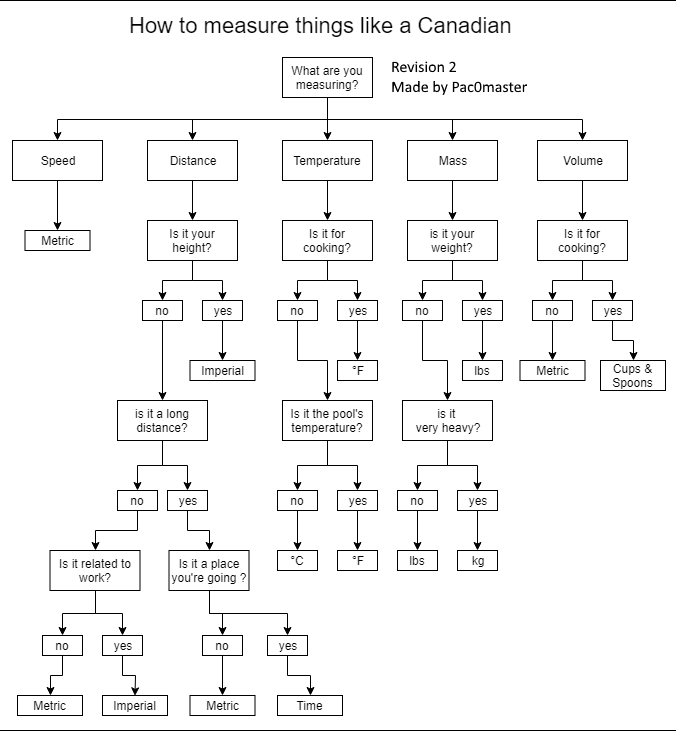
Most of the world switched over to the metric system, but some, like Britain and Canada still use both in a confusing-to-an-outsider idiosyncratic way:
American Gods: Land and Egregores
Feral Historian
Published 20 Feb 2026American Gods (Neil Gaiman, 2001) is, among other things, a layered examination of the role of mythologies, religion, national identities, and some underlying “American-ness” that bends them all into something new. By necessity this meanders a bit (I’m not going to get into Gaiman’s failings as a human being much) but it gives us a lot to think about.
I mention a couple outside references in here, links below if you want to dig into it.
Lilly Wachowski on the role of the Red Pill in The Matrix: https://screenrant.com/the-matrix-mov…
George Lucas on the Rebellion, and Viet Cong (people often quote the line but miss the context) : • JAMES CAMERON’S STORY OF SCIENCE FICTION |…
00:00 Intro
01:56 The Setup
04:48 Spirit of America
07:57 White and Red
10:50 New Gods and the State
12:51 Author, Intent, and Meaning
(more…)
QotD: Addiction
Thus an addict has roughly the same metaphysical status as an addicted rat. He does what he does because, like Luther, he cannot do otherwise. He is a slave of his biochemistry, he is a Zombie whose master is his habit. To blame him for his behaviour is like blaming a leper for his leprosy.
This is all the most lamentable bilge, of course. When you consider what heroin addicts actually have to do to become heroin addicts it is clear that, at least to begin with, they want to be heroin addicts, it is not something that just happens to them or creeps up on them unawares. For example, they have to learn where to get their heroin, how to prepare it, and how to inject it (most people have an aversion to sticking needles into themselves and have to overcome it). They have to learn to disregard or overcome such side-effects as nausea, which is normally extremely aversive. Most of us would go a long way to avoid nausea. As a matter of fact, most addicts take heroin intermittently for some time before taking it regularly. The expression “hooked” is implicitly a lie; the addict has hooked heroin, not the other way round.
Still, it might be argued that, having become addicted, the addict loses all powers of control, but this too is not so. The experience (among many others) of American soldiers returning from Vietnam, who addicted themselves to heroin while there, proves it. They swiftly ceased to be addicts on their return to the US, notwithstanding all of Dr. Volkow’s neurocircuitous and neurochemical blather.
Theodore Dalrymple, “Stigma and Sympathy”, The Iconoclast, 2020-09-23.
June 22, 2026
Two-tier Keir resigns as UK Prime Minister
History will not be kind to Sir Keir Starmer’s time in office, both for his actions and his failures-to-act. The Labour Party will now select the next person to live at Number 10 Downing Street, as they still hold a majority in the House of Commons and are not required to go back to the people for a new mandate, regardless of who is their party leader.
Rupert Lowe, the leader of Restore Britain, greeted the news on the social media site formerly known as Twitter:
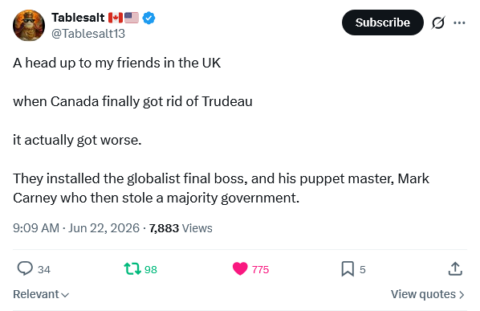
I reposted this on my other social media accounts, saying “Sadly, this is completely true. We belatedly ditched the clown prince of progressivism … only to install Mark Carney, who believes all the same progressive shibboleths that Trudeau did, but he’s far more capable of implementing them by hook or by crook.”
Starmer resigns — he has been a truly disgraceful Prime Minister.
I do not believe him to be a good man or a patriot.
He has deliberately and rapidly accelerated the destruction of our Britain, of our home.
History will not remember him kindly, nor should it.
I sat in Parliament, looking him in the eye, listening to him attempting to justify his decision to block a national inquiry into the mass rape of young British girls.
I will never forgive him. For that, and so much else.
What comes next, I do not know.
Whatever that is, Restore Britain will be ready to offer the British people a democratic route out — a better way, the only way.
But Starmer is gone.
And that is a good thing.
Enjoy it.
Former Manchester mayor and recently elected Member of Parliament for Makerfield Andy Burnham is the most likely successor to Starmer.

Then-Prime Minister Sir Keir Starmer visiting Holy Trinity Church of England Primary School in Manchester on 13 April 2026 with Andy Burnham, Mayor of Greater Manchester.
Picture by Lauren Hurley / No 10 Downing Street via Wikimedia Commons.
Authenticity … if you can fake that, you’ve got it made
Apologies to Ted Gioia for the flippant heading on this item. While I may be going for a cheap laugh, he certainly isn’t doing that in this essay on how to discover authenticity in music in an age of AI slop:
“Authenticity required: password?” by liako is licensed under CC BY-SA 2.0 

 .
.
In my case, I learned about authenticity at home, and from the best possible teacher. Even now, so many years after his death, I’m still learning from Dad’s example. And if I could somehow manage to pass it down on to my children, it would be worth a whole lot more than a gold watch.
I say this in full awareness of the contentiousness and backlash arising from almost any assertion of authenticity, especially in the arts — but in other spheres of life as well. There’s been so much debunking of authenticity in recent years that it’s remarkable that anyone is still willing to use it as a term of praise. Sometimes words in the critic’s lexicon become tainted, defeating the very purpose for which they are applied. The situation is so dire that I might even claim that we are facing an “authenticity crisis” in the arts — especially now with the rapid rise of AI. But even making that statement would spur a meta-backlash against the implicit assumption that there’s any legitimate concern over such a debased concept. After all, why defend authenticity if it doesn’t really exist?
In this regard, authenticity is coming to resemble its kindred word “sincerity”, which now implies the exact opposite of its dictionary definition. As Lionel Trilling points out, in his magisterial Harvard lectures published as Sincerity and Authenticity, the term “has an effect that negates its literal intention — ‘I sincerely believe’ has less weight than ‘I believe’; in the subscription of a letter, ‘Yours sincerely’ means virtually the opposite of ‘Yours’.” [Lionel Trilling, Sincerity and Authenticity, (London: Oxford University Press, 1972, p. 6.]
There’s an humorous quote, well known among actors, circulated in many variants and attributed over the years to everyone from Jean Giraudoux to Groucho Marx: “The secret to success is sincerity. Once you can fake that, you’ve got it made.” That pretty sums up the prevailing elite view of sincerity and authenticity in the creative world—where they are dismissed as poses played out in public as part of the show, without deeper significance.
When Trilling dissected these various terms for his Harvard audience, he saw authenticity as operating at a higher level than sincerity, as demanding a more strenuous allegiance to the dictates of the inner life. You act sincerely, but authenticity must be more than an act. By the same token, the loss of authenticity represents a much deeper malaise than insincerity.
So we ought to be concerned if we have learned to live without the concept of authenticity. If authenticity has truly been debunked, what takes it place? And if there’s nothing to replace it, how do we deal with the empty hole where it was supposed to exist, as a kind of guarantee or validation of our external actions? That poses a problem, and not just for aesthetics and music-making.
ADATS – Air Defense Anti-Tank System; Canada’s high tech cold warrior
Polyus
Published 19 Jun 2026While designed mainly in Switzerland, over the years its identity became distinctly Canadian. It was produced in Toronto by Oerlikon Aerospace Canada and was operated by Canadian forces from 1988 to 2011. This is the story of the Air Defense Anti-Tank System, or ADATS
ADATS was a very interesting and highly advanced air defense system designed to fight a cold war that never materialized. It was operated for a little over 20 years, so it was by no means a flash-in-the-pan. Unfortunately, Canada has since given up its short ranged air defense capability and all of the human expertise that was built up over the years. Hopefully in the future a new system can be acquired and Canada can again expand its sovereign air defense capabilities.
This video was made without the use of Artificial Intelligence (No AI). Long live people power!
0:00 Introduction
0:29 European Background
2:09 Technical Details
4:05 Engagement Sequence
5:38 Comparison to other Systems
6:06 Canadian Adoption
7:48 American Testing
8:32 Thai Adoption
8:57 Advanced Variants
10:23 ConclusionMusic:
“Denmark” – Portland Cello Project
“Your Suggestions” – Unicorn Heads
Progressive intellectual arrogance
John Konrad tries to explain the apparently universal intellectual snobbery of progressives, which has brought pretty much every western country into the era of the expert:

Why is the left so arrogant?
Because they put their trust in a global elite. Not directly, but through the media and the universities the elite manipulate.
My dad always said it the other way around: privilege comes with responsibility. But responsibility is hard. Responsibility requires knowledge.
And in a world growing more complex and unpredictable by the year, understanding what’s happening around you takes more and more of it.
Twenty years ago you could walk through Manhattan around noon on a Sunday and watch half the city reading the Times. The thing was massive, but a fast, educated reader could come away with a decent picture of the whole world in a few hours.
Then two things happened.
Craigslist gutted newspaper revenue, and DEI mandates swapped great reporters for morally indignant j-school hacks. The quality and accuracy of information cratered.
At the same time, the internet roared to life and the world got radically more interconnected overnight.
So the elite grew less informed exactly as complexity exploded.
To cope, they borrowed a trick from NASA. There aren’t enough hours in the day to be the best rocket scientist and the best navigator and the best flight surgeon all at once. So mission control compartmentalized. The best person in each silo got a desk. Thruster problem? Everyone turns to the engine expert. Someone’s hurt? Everyone turns to the flight surgeon. The rocket guy never had to learn a thing about medicine.
The elite copied the model. They switched their brains off for anything outside their lane. Everyone specialized inside their own bubble.
But compartmentalization runs on trust. Put one bad actor in mission control, and the moment everyone turns to him, bad things happen.
To guard against that, they doubled down on credentialism. They learned to trust only the experts minted by certain colleges and blessed by certain think tanks.
And the bad actors had a field day. Fraud, disinformation, theft, all of it could happen inside a silo, unseen. And it did.
Then came a mission control director who told them not to worry. Everything was fine. They didn’t know what was going on, but he did, and he was smarter than all of them. He said so, right there in the meetings.
Everyone loves a brilliant, competent boss, especially a charismatic one who seems kind, because it means they no longer have to worry. He’s got it handled. Just trust him.
And trust Obama they did.
But he had nothing handled except his own aura. And he let Marxist actors run loose inside the silos that mattered, education and HR chief among them.
The right was skeptical, so they kept reading, kept hunting for alternative sources, kept trying to make sense of the complexity themselves. Nobody cracked it completely. But they started seeing the big red anomaly lights blinking across the dashboard.
So the smart people on the right kept building broad knowledge while the left stayed siloed. Ten years passed, and the left’s elite fell far, far behind.
They’re starting to see that Obama was a fool. But they’re stuck. You can’t cram ten years of missed homework into a few months. And they’re rich and powerful and have no interest in going back to school.
They have two options. Admit they were wrong and put in months, maybe years, of hard work to take responsibility for their actions. Or keep acting like sheep. If the rewards weren’t there, some might choose the work.
But the system is so riddled with fraud, so many hollowed-out silos kept on life support, that there’s more than enough money sloshing around the NGOs to fund their posh lives.
They have the privilege with none of the responsibility. It’s a comfortable place to sit. They don’t want to change.
But holding that position requires one thing: they have to believe their mission control director has it all under control and is smarter than anyone on the right.
The bottom line is the have to be arrogant. Or the whole house of cards comes down.
Sparta vs Athens – 2(b): Ostracism, Demagogues, and Why Athenian Democracy Worked (Until Rome)
seangabb
Published 8 Feb 2026Greece: A Brief History, c.700 BC – 500 AD
Athenian democracy is often dismissed as mob rule. This segment explains why that is too simple. Athens developed habits and structures that stabilised debate: frequent Assembly meetings, repeated exposure to the same issues and speakers, and a politically literate citizen body shaped by practical participation.
I also cover the darker logic: fear of tyranny, fear of dominance, and why Athens accepted instability and even injustice as the price of preventing permanent concentrations of power. Ostracism is discussed as a precautionary tool, and demagoguery as a permanent risk that the system managed rather than “solved”.
Finally, I explain how Athenian democracy ended — not because it decayed internally, but because Rome rendered the institutions meaningless. Empire does not tolerate participation.
QotD: When the US switched to the All-Volunteer Force in 1973
This was a huge change. For such a major change, I find that it draws surprisingly little attention. The 50th anniversary of the AVF passed with relatively little fanfare in 2023. I’ve mentioned For the Common Defense (1984, 1994, 2012) as the dominant textbook for introductory American military history: the shift to the All-Volunteer Force is dealt with in a single page (page 568, for the curious). The textbook I’ve seen most recently used for US Naval history (and which I used), J.C. Bradford and J. F. Bradford, America, Sea Power and the World (2016, 2023), doesn’t even give it that much: the shift is discussed in a single paragraph on page 351 (308 in the 2016 edition).1
The likely impacts of the shift to an AVF were studied prior to implementation in the Gates Commission, a report that had a preordained conclusion – it was convened to provide Nixon the cover to do the thing (end the draft) he had promised to do already in his campaign – and which honestly I find disappointing in its approach, which is mostly “happy talk” designed to justify what Nixon had already decided to do. It is striking to me, for instance, that the Gates Commission did not include a single historian to perhaps discuss how the shift towards fully professional militaries had gone for republics in the past. Instead, the focus is on the economics of the shift, with fairly blithe assertions that the civil-military relationship would remain unchanged despite the fairly obvious implausibility of that given the shift from “everyone serves” to “only a small portion of society serves”.2
As I’ve noted elsewhere, the Romans also seem to have thought that they could professionalize their army without reducing its ability to scale up in an emergency or altering the civil-military relationship and for quite a few decades that more or less worked, while the old norms held. But as those old norms decayed, the institution increasingly became what you’d expect from its institutional structure: a permanent political faction, advocating for its own interests, often with violence, to the point that the emperor Septimius Severus’ advice to his sons as he lay dying in 211 was, “Be harmonious, enrich the soldiers, and scorn all other men”,3 a fairly open admission that the soldiery was not just a political constituency, but the most important one. It took time for those norms to shift, but when one is building or rebuilding institutions, the long-term is the term that matters.
I do not think necessarily that this is the direction the All-Volunteer Force must go. It has two and a half centuries of strong norms pushing it away from this direction. But careful maintenance of the civ-mil bargain is made all the more necessary when the military is effectively fully professional. For my own part, all cards on the table, while I greatly value the service of the United States’ military personnel (there’s that third part of the bargain!) and think they serve honorably, I am quite skeptical of the long-term implications of the All-Volunteer Force. Its creators assumed that fully professionalizing the military would not impact the civil-military relationship and that it would always be possible to shift back to a mass-conscript army in the event of a major war, but historical examples suggest it is not so easy.
But the All-Volunteer Force is not the direction from which I see now the principal threat to the civ-mil bargain.
Bret Devereaux, “Collections: The American Civil-Military Relationship”, A Collection of Unmitigated Pedantry, 2025-07-04.
- In that book’s defense, the Navy has a really big set of reforms associated broadly with CNO Elmo Zumwalt that happen at basically the same time and are connected and it opts to focus on those. I will note that the position of the paragraph has changed because the updated 2023 version of the book has opted to grapple more extensively and more successfully with this period as one of increasing diversity in the navy, with a chapter by Kristy N. Kamarck on that specific topic. It is a marked improvement over the first edition, though I think both FtCD and the Bradford and Bradford remain too hagiographic, too willing to sweep the military’s problems under the rug and only comment on military diversity when they can tell the story as a happy tale of progress.
- Especially as that small portion tends to be concentrated, a thing the Commission essentially refuses to consider as a first principle of their analysis; they assume cheerfully that the AVF will naturally continue to reflect a cross-section of the United States. In some ways that is true, but in other ways it is very much not – there certainly are “military families”, where service tends to “run in the family” in the United States now – and the emergence of those patterns would have been a pretty obvious thing to expect, given that the same trend is extremely visible in the Roman army of the early empire.
- Dio 77.16
June 21, 2026
Jean Rapail’s The Camp of the Saints, translated by Robert Laffont
Copernican reviews Jean Raspail’s The Camp of the Saints which was reprinted in an English translation by Robert Laffont earlier this year:

It is time that I throw my own hat into the ring regarding this particular piece of polemic fiction. It’s particularly topical given the recent events in the UK and the Western World. A look at toxic progressive empathy taken its natural conclusion.
Written by Jean Raspail and published in 1973, Camp of the Saints is a book infamous among those the media describes as “Far Right” and virtually unknown outside of that. Were history set upon an even keel, Camp of the Saints would sit on the bookshelf of every high school right next to the classic works of the same genre: notably 1984, Brave New World, and Fahrenheit 451.
This book was so dangerous that for decades, now, the English translation has been out of print, available only as an expensive antique, or through the Internet Archive, [as] a single shoddy .pdf. The corporate owners of the English translation rights have, despite considerable interest, refused to republish it. That was until September of 2025, when a new translation was created and distributed.1
As of now, what was once an antique book is now cheap and in-print. What’s more, it’s been converted to an audiobook available on Audible.2 It took the destruction of Western Culture for us to see published the one work of dystopian fiction that warned us of it.
Given its relevance, it makes sense that over ten percent of the run-time consists of various forwards from the author, translator, and the publisher, that describe the political and cultural push against its own publication. It’s worth it to read (or listen) through the numerous forwards to better understand the context and the author.
An Introduction to the Text
Among the dangerous books written in the late 20th century, Camp of the Saints takes the self-destructive anti-nativism of the neoliberal world order and draws it forward to its own natural conclusion. Like other works of fiction, it takes popular ideas and asks the question: “What if these beliefs are taken to their ultimate logical end?”
The book is written from the perspective of an omniscient historian who witnessed the events of the text; he knows that his work will be censored, silenced, or redacted. In the context of the book, the accurate recollection of the events described is inherently destructive to the (now) dominant anti-racist political regime. The force of political progressivism will destroy any such history on the basis that it may “incite racial hatred” or “create division”.
A fascinating bit of forethought in that those are the exact reasons why Camp of the Saints was itself banished from public view for the last half-century: Liberal cultural diversity transitioned smoothly to violent censure and virulent “anti-White” or “anti-Western” genocidal hatred.
The book is a dramatization of the Fall of the West. Not in pitched battle, but as it has lost its spiritual core to rampant idealism. The “other” is always to be given deference over our own people. The sympathy that is demanded for the “other” is also silenced and denied for our own. At what point do a people become so spiritually deracinated that they lose all legitimacy to exist? At what point do they become so deluded as to lack totally a theory-of-mind of the “other”, and at what point does sympathy for the foreigner overwhelm survival?
Camp of the Saints answers these questions in sometimes graphic detail. Some of the horrors written on those pages hadn’t happened to innocent Western children yet … but now, fifty years on, and they have happened. Many times over, in many places and nations, across the West.3 In comparison to the reality of the West in the 21st Century, Camp of the Saints is a tame warning.
The book begins with a great migrant fleet setting off from Calcutta, India. The poor, the starving, the diseased, and the malformed set out for the West- A land where milk and honey flow freely and where the rivers are rich with Fish. The people of India want a better life for themselves, even if they have to walk, unarmed, onto foreign lands to get it. They, like many peoples, believe that their land is simply poor and that Western nations are simply rich. Failing to understand that it is not some “magic dirt” that made France, England, Australia, and the United States rich, but rather it was the French, English, Australians, and Americans. The West doesn’t horde “magic dirt” but “magic people”, so to speak. Were the West to be flooded with Indians, it would become just like India, not magically make the invading Indians wealthy and intelligent.4
I doubt that it’s possible to explain that fact to third-world migrant retards.
To conclude a spoiler-free version of the review: You should read it. It should have been taught in high schools for the last 50 years. You should probably buy a copy before the beast of Progressivism finds a new way to censor it. If you buy the Audible copy, use a tool to convert it to an .mp3 file so that it can’t be deleted from your personal library after the fact.5 There’s a reason it’s been censored for the last 30 years or so. It’s dangerous, subversive, and intelligent in a way that modern dystopian authors wish they could be.
- Here is a direct link [https://www.amazon.com/Camp-Saints-Jean-Raspail/dp/B0FG4MJS8K] to where you can purchase the book on Amazon. A shoutout to Vauban Books for doing the work that every other publisher has been unable, or too scared, to do.
- I kind of enjoy audiobooks. Though Camp of the Saints can be particularly tricky to listen to over reading directly due to its complex cast and jumping around in the timeline.
- The Rape Gang Inquiry Report by Rupert Lowe is particularly poignant and well-timed here.
- A fact that is in stark relief as of 2026, with over 10% of their population (official sources say it’s close to 7%, but I don’t believe them) now being Skaven imports from India … and the wealth, safety, culture, and prosperity of Canada now vanishing at an alarming rate.
- The “Open Audible” tool is works for this, but it isn’t free.
Gad Saad discovers that Canada has an “exit tax” … and it’s insane
The other day, I shared a post from Gad Saad that alerted me to something I’d never heard of before: a steep tax the federal and provincial governments levy when a Canadian emigrates to another country:
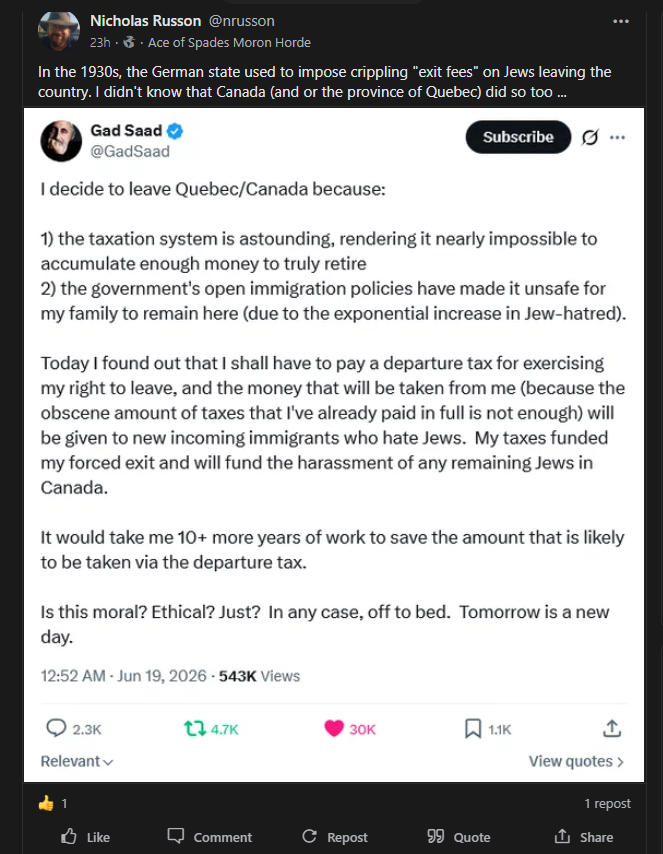
On the social media site formerly known as Twitter, Vesper provides more information:
The Great Scam
After what @GadSaad posted yesterday, something I had no idea existed … an “Exit Tax” I did some digging. This is what I found.
Canada’s departure tax is one of the biggest scam taxes on the books. Apparently when you leave the country, the government treats you as if you sold every investment you own, even if you sold nothing.
You get hit with a tax bill on money you never touched, never withdrew, never spent. They literally invented a fake sale to justify taking your money.
Here’s what makes it even worse. The stocks they’re taxing? Those are foreign companies. Apple, Samsung, whatever you hold, those grew because of what those businesses did in their own countries, their own markets, with their own workers.
Canada had absolutely nothing to do with it. Zero. But they still want a cut just because you happened to live here while you owned them. They did nothing and still want to be paid like they did.
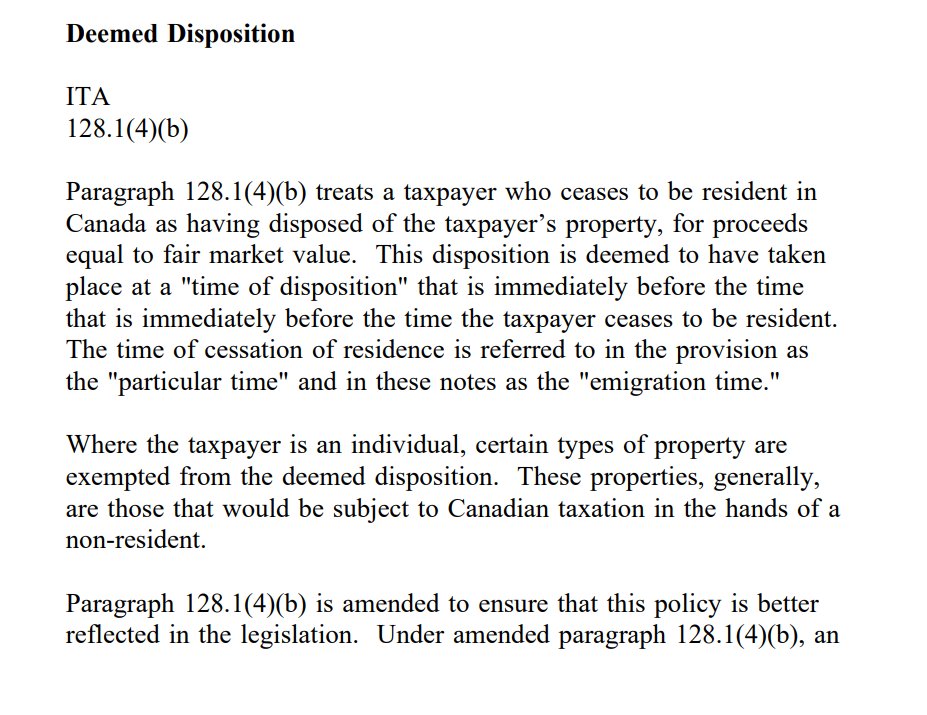
And before 1996 this didn’t even exist the way it does now. Chrétien’s government expanded it that year and buried it in section 128.1(4)(b) of the Income Tax Act like they hoped nobody would notice. Italy doesn’t do this. Portugal doesn’t. Belgium, Switzerland, the UK, none of them pull this shit.
You paid income tax every year. You paid sales tax. Property tax. You held up your end of the deal the whole damn time. And when you decide to go live somewhere else, they hit you with a bill for money that was never real to begin with.
Canada under any Liberal is a Scam!

And followed up with:
FYI- Just to make clear why I posted that image instead of Clause 17 it was meant to make an additional point, that I’m not sure Gad was informed about. The system is one-directional and rigged.
That image explains that The exit tax locks in your gains the day you leave at whatever the market says that day. You have no choice, no timing, no flexibility.
If your portfolio drops 30% the week after you leave, too bad. Canada already took their cut on the higher number. The gain was real to them the moment you packed your bags. The loss that came after is entirely your problem.
If you want to see the stocks section it’s this
You can read it for yourself:
Update: After some online mockery, Gad Saad explains that he’s not just upset on his own behalf.
People are astoundingly stupid. My comments about the departure tax is not that I should be treated differently from anyone else. I am making a point about the extent to which taxes are confiscatory. As I have previously explained, there was a time when ZERO cents of income tax were levied in Canada and the US. Then bit by bit, that “temporary” measure, to be applied to only a few, and at a very low percentage rate of your income, becomes a mammoth monster that takes more than 50% of your earnings. It can occur because there are no repercussions if governments do not balance their budgets (other than voting them out). Hence, what starts off as a small temporary tax on a few becomes an existential theft that is orders of magnitude larger than the so-called illegal extortion tax of the Mafia. It can exist only because the great majority of people BENEFIT from this form of parasitic taxation. But someone has to pay for everyone else, and when you are that someone, you are not necessarily pleased to be funding the ultimate Ponzi scheme. I’m making a moral, philosophical, and ethical argument. It’s not just about me.
How To Make War Inevitable – Death of Democracy 20 – Q4 1937
World War Two and Spartacus Olsson
Published 20 Jun 2026By late 1937, Nazi Germany’s rearmament economy had trapped itself. Autarky was failing. Hjalmar Schacht was pushed aside. Göring’s Four-Year Plan dominated economic policy. And at the secret Hossbach meeting of November 5, Hitler turned economic impossibility into an argument for territorial conquest.
This episode covers Q4 1937: the Hossbach Memorandum, Schacht’s resignation, the Anti-Comintern alignment, Lord Halifax’s visit, Himmler’s police-state consolidation, the December “Preventive Crime Fighting” decree, and the antisemitic propaganda exhibition Der Ewige Jude.
The argument is not that war was metaphysically inevitable. It is that the Nazi regime built an ideological, economic, and police-state machine that made war look increasingly necessary to its own leadership. This is a historical analysis of Nazi dictatorship, antisemitic propaganda, and war planning. It condemns Nazism and uses extremist material only for educational and documentary context.
Chapters:
0:00 Q4 1937 Intro
0:53 The world at the end of 1937
1:36 Germany’s quarter of acceleration
3:30 Himmler Tightens Police Power
6:26 Der Ewige Jude and dehumanization
8:30 Hossbach: autarky fails
11:16 Halifax and diplomatic confidence
13:03 Mood inside Germany
15:09 Mein Kampf has become policy
17:16 Conclusion: the politics of beasts


