
The interest in war elephants, at least in the ancient Mediterranean, is caught in a bit of a conundrum. On the one hand, war elephants are undeniably cool, and so feature heavily in pop-culture (especially video games). In Total War games, elephants are shatteringly powerful units that demand specialized responses. In Paradox’s recent Imperator, elephant units are extremely powerful army components. Film gets in on the act too: Alexander (2004) presents Alexander’s final battle at Hydaspes (326) as a debacle, nearing defeat, at the hands of Porus’ elephants (the historical battle was a far more clear-cut victory, according to the sources). So elephants are awesome.
On the other hand, the Romans spend about 200 years (from c. 264 to 46 B.C.) mopping the floor with armies supported by war elephants – Carthaginian, Seleucid, even Roman ones during the civil wars (Thapsus, 46 B.C.). And before someone asks about Hannibal, remember that while the army Hannibal won with in Italy had almost no war elephants (nearly all of them having been lost in the Alps), the army he lost with at Zama had 80 of them. Romans looking back from the later Imperial period seemed to classify war elephants with scythed chariots and other failed Hellenistic “gimmick” weapons (e.g. Q. Curtius Rufus 9.2.19). Arrian (a Roman general writing in the second century A.D.) dismisses the entire branch as obsolete (Arr. Tact. 19.6) and leaves it out of his tactical manual entirely on those grounds.
This negative opinion in turn seeps into the scholarship on the matter. This is in no small part because the study of Indian history (where war elephants remained common) is so under-served in western academia compared to the study of the Greek and Roman world (where the Romans functionally ended the use of war elephants on the conclusion that they were useless). Trautmann, (2015) notes the almost pathetic under-engagement of classical scholars with this fighting system. Scullard’s The elephant in the Greek and Roman World (1974) remains the standard text in English on the topic some 45 years later, despite fairly huge changes in the study of the Achaemenids, Seleucids, and Carthaginians in that period.
All of which actually makes finding good information on war elephants quite difficult – the cheap sensational stuff often fills in the gaps left by a lack of scholarship. The handful of books on the topic vary significantly in terms of seriousness and reliability.
Bret Devereaux, “Collections: War Elephants, Part I: Battle Pachyderms”, A Collection of Unmitigated Pedantry, 2019-07-26.
April 29, 2023
QotD: The problem of war-elephants
April 28, 2023
Field Marshal Slim’s secret vice – he also wrote articles and short stories under pseudonym
It’s no secret that I have a very high regard for Field Marshal William Slim, so I’m quite looking forward to reading some of Slim’s pre-WW2 writings that have just been gathered together by Dr. Robert Lyman in a three-volume set:
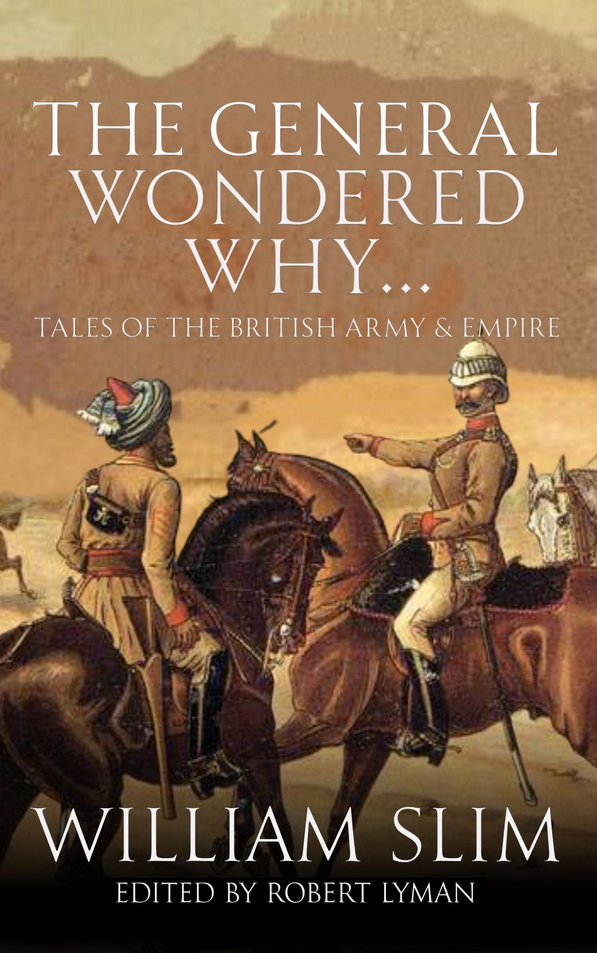
Few people during his lifetime, and even fewer now, know that the man who was to become one of the greatest British generals of all time – and I’m not exaggerating – was in fact a secret scribbler. Now, many people know that he was the author of at least two best selling books. In 1956 he wrote his account of the Burma campaign, Defeat into Victory, described by one reviewer, quite rightly in my view, as “the best general’s book of World War II”. Then, in 1959, he published, under the title of Unofficial History, a series of articles about his military experience, some of which had been published previously as articles in Blackwood’s magazine. This was the first indication that there was an unknown literary side to Slim. The fact that he was a secret scribbler, or at least had been one once, was only publicly revealed on the publication of his biography in 1976 by Ronald Lewin – Slim, The Standard Bearer – which incidentally won the W.H. Smith Literary Award that same year. Lewin explained that Slim had written material for publication long before the war. In fact, between 1931 and 1940 he wrote a total of 44 articles, extending in length between two and eight thousand words – a total of 122,000 words in all – for a range of newspapers and magazines, including Blackwood’s Magazine, the Daily Mail, the Evening Express and the Illustrated Weekly of India. According to Lewin, he did this to supplement his earnings as an officer of the Indian Army. He didn’t do it to create a name for himself as a writer, or because he had pretensions to the artistic life, but because he needed the money. As with all other officers at the time who did not have the benefit of what was described euphemistically as “private means” he struggled to live off his army salary, especially to pay school fees for his children, John (born 1927) and Una (born 1930). Accordingly, he turned his hand to writing articles under a pseudonym, mainly of Anthony Mills (Mills being Slim spelt backwards) and, in one instance, that of Judy O’Grady.
With the war over, and senior military rank attained, he never again penned stories of this kind for publication. With it died any common remembrance of his pre-war literary activities. Copies of the articles have languished ever since amidst his papers in the Churchill Archives Centre at the University of Cambridge, from where I rescued them last year. They have been republished this week by Richard Foreman of Sharpe Books.
During the time Slim was writing these the pseudonym protected him from the gaze of those in the military who might believe that serious soldiers didn’t write fiction, and certainly not for public consumption via the newspapers. He certainly went to some lengths to ensure that his military friends and colleagues did not know of this unusual extra-curricular activity. In a letter to Mr S. Jepson, editor of the Illustrated Times of India on 26 July 1939 (he was then Commanding Officer of 2/7 Gurkha Rifles in Shillong, Assam) he warned that he needed to use an additional pseudonym to the one he normally used, because that – Anthony Mills – would then be immediately “known to several people and I do not wish them to identify me also as the writer of certain articles in Blackwood’s and Home newspapers. I am supposed to be a serious soldier and I’m afraid Anthony Mills isn’t.”
What do these 44 articles tell us of Slim? He would never have pretended that his writings represented any higher form of literary art. He certainly had no pretensions to a life as a writer. He was, first and foremost, a soldier. His writing was to supplement the family’s income. But, as readers will attest, he was very good at it. They demonstrate his supreme ability with words. As Defeat into Victory was to demonstrate, he was a master of the telling phrase every bit as much as he was a master of the battlefield. He made words work. They were used simply, sparingly, directly. Nothing was wasted; all achieved their purpose.
The articles also show Slim’s propensity for storytelling. Each story has a purpose. Some were simply to provide a picture of some of the characters in his Gurkha battalion, some to tell the story of a battle or of an incident while on military operations. Some are funny, some not. Some are of an entirely different kind, and have no military context whatsoever. These are often short adventure stories, while some can best be described as morality tales. A couple of them warned his readers not to jump to conclusions about a person’s character. Some showed a romantic tendency to his nature.
The stories can be placed into three broad categories. The first comprises seventeen stories about the Indian Army, of which the Gurkha regiments formed an important part. The second group are eleven stories about India, with no or only a passing military reference. The third, much smaller group, contains seventeen stories with no Indian or military dimension.
Restoring a forged plane iron with MASSIVE rust and damage
Rex Krueger
Published 27 Apr 2023
(more…)
Use and misuse of the term “regression to the mean”
I still follow my favourite pro football team, the Minnesota Vikings, and last year they hired a new General Manager who was unlike the previous GM in that not only was he a big believer in analytics, he actually had worked in the analytics area for years before moving into an executive position. The first NFL draft under the new GM and head coach was much more in line with what the public analytics fans wanted — although the result on the field is still undetermined as only one player in that draft class got significant playing time. Freddie deBoer is a fan of analytics, but he wants to help people understand what the frequently misunderstood term “regression to the mean” actually … means:

Kwesi Adofo-Mensah, General Manager of the Minnesota Vikings. Adofo-Mensah was hired in 2022 to replace Rick Spielman.
Photo from the team website – https://www.vikings.com/team/front-office-roster/kwesi-adofo-mensah
The sports analytics movement has proven time and again to help teams win games, across sports and leagues, and so unsurprisingly essentially every team in every major sport employs an analytics department. I in fact find it very annoying that there are still statheads that act like they’re David and not Goliath for this reason. I also think that the impact of analytics on baseball has been a disaster from an entertainment standpoint. There’s a whole lot one could say about the general topic. (I frequently think about the fact that Moneyball helped advance the course of analytics, and analytics is fundamentally correct in its claims, and yet the fundamental narrative of the book was wrong.*) But while the predictive claims of analytics continue to evolve, they’ve been wildly successful.
I want to address one particular bugaboo I have with the way analytical concepts are discussed. It was inevitable that popularizing these concepts was going to lead to some distortion. One topic that I see misused all the time is regression/reversion to the mean, or the tendency of outlier performances to be followed up by performances that are closer to the average (mean) performance for that player or league. (I may use reversion and regression interchangeably here, mostly because I’m too forgetful to keep one in my head at a time.) A guy plays pro baseball for five years, he hits around 10 or 12 homeruns a year, then he has a year where he hits 30, then he goes back to hitting in the low 10s again in following seasons – that’s an example of regression to the mean. After deviation from trends we tend (tend) to see returns to trend. Similarly, if the NFL has a league average of about 4.3 yards per carry for a decade, and then the next year the league average is 4.8 without a rule change or other obvious candidate for differences in underlying conditions, that’s a good candidate for regression to the mean the next year, trending back towards that lower average. It certainly doesn’t have to happen, but it’s likely to happen for reasons we’ll talk about.
Intuitively, the actual tendency isn’t hard to understand. But I find that people talk about it in a way that suggests a misunderstanding of why regression to the mean happens, and I want to work through that here.
So. We have a system, like “major league baseball” or “K-12 public education in Baltimore” or “the world”. Within those systems we have quantitative phenomena (like on-base percentage, test scores, or the price of oil) that are explainable by multiple variables, AKA the conditions in which the observed phenomena occur. Over time, we observe trends in those phenomena, which can be in the system as a whole (leaguewide batting average), in subgroups (team batting average), or individuals (a player’s batting average). Those trends are the result of underlying variables/conditions, which include internal factors like an athlete’s level of ability, as well as elements of chance and unaccounted-for variability. (We could go into a big thing about what “chance” really refers to in a complex system, but … let’s not.) The more time goes on, and the more data is collected, the more confidently we can say that a trend is an accurate representation of some underlying reality, again like an athlete’s level of ability. When we say a baseball player is a good hitter, it’s because we’ve observed over time that he has produced good statistics in hitting, and we feel confident that this consistency is the product of his skill and attributes rather than exogenous factors.
However, we know that good hitters have bad games, just as bad hitters have good games. We know that good hitters have slumps where they have bad three or five or ten etc game stretches. We even acknowledge that someone can be a good hitter and have a bad season, or at least a season that’s below their usual standards. However, if a hitter has two or three bad seasons, we’re likely to stop seeing poor performance as an outlier and change our overall perception of the player. The outlier becomes the trend. There is no certain or objective place where that transition happens.
Here’s the really essential point I want to make: outliers tend to revert to the mean because the initial outlier performance was statistically unlikely; a repeat of that outlier performance is statistically unlikely for the same reasons, but not because of the previous outlier. For ease of understanding let’s pretend underlying conditions stay exactly the same, which of course will never happen in a real-world scenario. If that’s true, then the chance of having an equally unlikely outcome is exactly as likely as the first time; repetition of outliers is not made any less likely by the fact that the initial outlier happened. That is, there’s no inherent reason why a repetition of the outlier becomes more unlikely, given consistent underlying conditions. I think it’s really important to avoid the Gambler’s Fallacy here, thinking that a roulette wheel is somehow more likely to come up red because it’s come up black a hundred times in a row. Statistically unlikely outcomes in the past don’t make statistically unlikely outcomes any less likely in the future. The universe doesn’t “remember” that there’s been an outlier before. Reversion to the mean is not a force in the universe. It’s not a matter of results being bent back into the previous trend by the gods. Rather, if underlying conditions are similar (if a player is about as good as he was the previous year and the role of variability and chance remains the same), and he had an unlikely level of success/failure the prior year, he’s unlikely to repeat that performance because reaching that level of performance was unlikely in the first place.
* – the A’s not only were not a uniquely bad franchise, they had won the most games of any team in major league baseball in the ten years prior to the Moneyball season
– major league baseball had entered an era of unusual parity at that time, belying Michael Lewis’s implication that it was a game of haves and have-nots
– readers come away from the book convinced that the A’s won so many games because of Scott Hatteberg and Chad Bradford, the players that epitomize the Moneyball ethos, but the numbers tell us they were so successful because of a remarkably effective rotation in Tim Hudson, Barry Zito, and Mark Mulder, and the offensive skill of shortstop Miguel Tejada – all of whom were very highly regarded players according to the old-school scouting approach that the book has such disdain for.
– Art Howe was not an obstructionist asshole.
Legends Summarized: Journey To The West (Part X)
Overly Sarcastic Productions
Published 30 Dec 2022Journey to the West Kai, episode 7: Double Trouble
(more…)
QotD: The high-water mark of the Panzerarmee Afrika
Even here, however, let us be honest. Smashing 8th Army at Gazala and taking tens of thousands of prisoners at Tobruk did little to solve the strategic problem. Unless the British were destroyed altogether, they would reinforce to a level the Axis could not match. Many later analysts argue that the Panzerarmee should have paused now, waited until some sort of combined airborne-naval operation had been launched against Malta to improve the logistics, and only then acted. Such arguments ignore the dynamic of the desert battle, however; they ignore the morale imperative of keeping a victorious army in motion; above all they ignore the personality of Rommel himself.
Pause? Halt? Wait? Anyone who expected Rommel to ease up on the throttle clearly hadn’t been paying attention. Instead, the Panzerarmee vaulted across the border into Egypt with virtually no preparation. To Rommel, to his men, and even to Hitler and Mussolini, it must have looked like a great victory lay just over the next horizon: Cairo, Alexandria, the Suez Canal, the British Empire itself.
In reality, it is possible today to see what the great Prussian philosopher of war Karl von Clausewitz once called the “culmination point” — that moment in every campaign when the offensive begins to lose steam, run down, and eventually stop altogether. The Panzerarmee was exhausted, its equipment was worn out and in desperate need of repair. Captured British stores and vehicles had become its life-blood, Canadian Ford trucks in particular. The manpower was breaking down. A chronic shortage of potable water had put thousands of soldiers on the sick rolls. Colonel Siegfried Westphal, the Panzerarmee‘s operations chief (the “Ia”, in German parlance), was yellow with jaundice. The army’s intelligence chief (the “Ic”), Colonel Friedrich Wilhelm von Mellenthin, was wasting away with amoebic dysentery. Rommel had a little of both, as well as a serious blood-pressure problem (no doubt stress-induced) and a chronic and bothersome sinusitis condition. While it would be easy to view all these illnesses as simple bad luck, they were, in fact, the price Rommel and all the rest of them were paying for fighting an overseas expeditionary campaign with inadequate resources.
The same might be said for the rest of the campaign. The Panzerarmee made an ad hoc attempt to break thought the British bottleneck at El Alamein in July. It failed, coming to grief against British defenses on the Ruweisat ridge. There was a second, more deliberate, attempt in August. After an initial breakthrough, it crashed into strong British defenses at Alam Halfa ridge and it, too, failed. After yet another long pause, a “third battle of El Alamein” began in late October. This time, it was the well supplied British on the attack, however, and they managed to smash through the Panzerarmee and drive Rommel and company back, not hundreds of miles, but more than a thousand, out of the desert altogether and into Tunisia. There was still fighting to be done in Africa, but the “desert war” was over.
Robert Citino, “Drive to Nowhere: The Myth of the Afrika Korps, 1941-43″, The National WWII Museum, 2012. (Originally published in MHQ, Summer 2012).
April 27, 2023
Spending more on defence requires more than just turning on the financial taps
In The Line, Philippe Lagassé explains why just pouring more money into the Department of National Defence won’t automatically improve our defence capabilities:

Canadian defence spending is back in the news, thanks to an open letter urging the government to spend two per cent of GDP on the military and a leaked document suggesting Canada won’t hit that NATO target. Like ending the monarchy, defence spending is one of those issues that gets lots of attention once or twice a year, only to fade away before any serious discussion takes place. It’s unlikely that this time will be any different.
[…]
Even if the government wanted to greatly increase defence spending, though, it would have trouble spending that money effectively in the short term. While more money is needed over the long term, the Department of National Defence (DND) and Canadian Armed Forces (CAF) have to first build up their capacity to spend a much larger budget. As they do so, however, our historical tendency to reduce defence expenditures after pivotal moments should always be kept in mind.
The DND and CAF are already straining to implement the capital equipment and infrastructure programs that were announced in the 2017 defence policy, Strong, Secure, Engaged. This reflects the fact that department’s capacity to manage procurements has to be built back up after decades of anemic capital spending. There aren’t enough people to move the programs that are currently planned, let alone new ones that could be added. Additional money could be funneled to existing projects, but that wouldn’t be enough to cause an increase to two per cent of GDP in the coming years. The capabilities Canada is currently buying will probably be far more expensive to maintain in the future than the government realizes, which strongly suggests that we do need to gradually get to that number, but this reinforces the need for caution and for managing expectations. If ministers insist that new money be attached to still more new capabilities, DND/CAF will not only have trouble acquiring them, but will be unable to afford them.
One could argue that DND/CAF could get around its capacity challenges by simply buying more equipment “off the shelf”. Instead of getting more people to tackle complex procurements and infrastructure projects, the defence department should focus on simpler acquisitions that require less management. It is important to note, though, that “off the shelf” procurements aren’t an obvious solution either — DND and the CAF don’t specify requirements for the hell of it. Many project requirements reflect the need to integrate new capabilities into the existing force, which is no small feat when mixing new and old technologies and operating from installations across a massive country. Projects that gravitate toward “off the shelf” solutions, moreover, can be challenged by competitors who contend that they can develop a new capability that better meets Canada’s needs. Bombardier‘s response to the government’s plan to buy Boeing’s P-8 Poseidon aircraft to fulfil the Canadian Multi-mission Aircraft (CMMA) project is a recent example.
Canada also tends to favour platforms that can perform various missions, which further complicates “off the shelf” procurements, since the equipment sitting on the shelf may not do everything the CAF needs it to do. Unless we want the CAF to be less capable, the way to address this issue is to acquire more platforms that do specific things. The problem is that the CAF would need more people to acquire, operate, and maintain these additional fleets, still more money to sustain this extra equipment, and yet more infrastructure to store it. This approach promises to exacerbate the very problems it’s supposed to solve.
“… the Department of Defense is rejoicing that Tucker Carlson has been driven off of Fox News”
Chris Bray on the odd phenomenon of the US military formally having opinions on who is sitting at the big desk for Fox News these days:
In 2001, I was a nominal infantryman assigned to some exceptionally tedious duty at Fort Benning, Georgia. That spring, the Chief of Staff of the United States Army decided to symbolically make the whole army feel elite by changing the uniform and putting everyone into the black beret that had been unique to the Ranger battalions. See, now you have a special hat, so morale and esprit de corps and stuff.
Because I was in the infantry, surrounded all day every day by infantrymen, I can report the absolutely rock-solid consensus in the combat arms branches with complete confidence: we wondered why we were being led by idiots.* Quietly, but not quietly enough, we said things like, “See, the lethality of a combat force is tied directly to the quality of its fashion design“. A series of impromptu briefings and formal training sessions reminded us that we were not allowed to express open contempt for our senior leaders, so shut up about the dumbassery with the berets.
In retrospect, I think history shows us that new hats really were the most pressing challenge facing the American military as we rolled into the summer of 2001, but whatever.
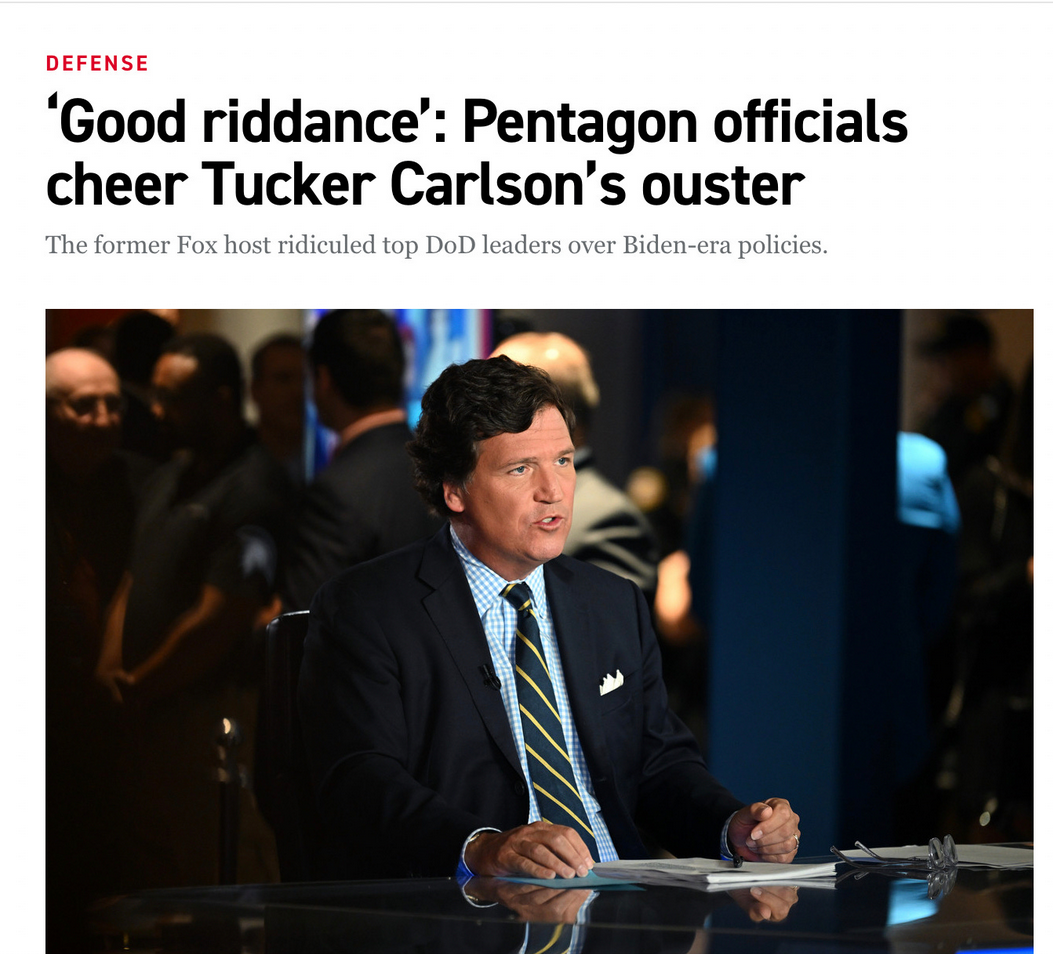
So Politico, the most reliably wrong publication in the history of the known universe, reports this week that the Department of Defense is rejoicing that Tucker Carlson has been driven off of Fox News.
See, Tucker Carlson was an authoritarian, a Trumpian protofascist. For example, he criticized the leadership of the military, who therefore rejoiced in his departure. Anti-authoritarianism, on the other hand, is when the leaders of the armed forces have a hand in shaping the culture and deciding who’s allowed to speak in the public sphere. Fascism is open discourse, so we need the military to say who should be on television so we can have freedom.
[…]
See, it’s good when the military “smites” civilian critics and expresses “revulsion” for them. In fascist countries, critics of the military are just allowed to speak freely. The culture has gone full Alice In Wonderland, and freedom is compliance.
* See also the switch from BDUs and ACUs.
It’s not environmentalism I object to, it’s environmentalists
I thoroughly agree with Tom Knighton here:

I tend to be pretty critical of environmentalism. It’s not that I don’t value things like clean air, clean water, and pristine land free of pollution. I actually do value all of those things. I actually care about the environment.
What I don’t care about, though, are environmentalists.
Much of my issue with them is that they don’t seem to recognize reality or, if they do, they just want everyone to have to pay more and make do with less.
Most evironmentalists I’ve dealt with fail to understand one of the basic tenets of economics: There’s No Such Thing As A Free Lunch. Yes, we can make certain changes to how we do things to reduce our impact on the natural environment, but such changes are almost never free and sometimes the potential cost is significantly higher than any rational expectation of benefit from changing. Economics — and life in general — is all about the trade-offs. If you do X, you can’t do Y. If you specialize in this area, you can’t devote effort in that area, and so on. Time and materials limit what can be done and require a sensible way of deciding … and most environmentalists either don’t understand or refuse to accept this.
For example, take the electric cars that are being pushed so hard by environmentalists and their allies in the government. They’re not remotely ready to replace gas- or diesel-powered vehicles by any stretch of the imagination. They lack the range to really compete as things currently stand, and yet, what are we being pushed to buy?
Obviously, little of this is new. I wrote that post nearly two years ago and absolutely nothing has changed for either better or worse. Not on that front.
But there have been some changes, and they really show me why I’m glad I don’t describe myself as an environmentalist.
Actually, I take back a bit of my accusation that environmentalists don’t see the trade-offs: they do see some of them. They see things that you will have to give up to achieve their goals. That’s the kind of trade-off they’re eager to make.
Even if you don’t think climate change is real and manmade — I don’t, for example — I like the idea of clean, cheap sources of energy. Solar and wind aren’t going to produce all the electricity we need, but nuclear can.
Yet why do so many environmentalists focus on wind and solar? It can’t make what we need. It won’t replace coal power plants, especially with regard to reliability. Coal creates power when it’s overcast and when there’s no wind to speak of.
Nuclear can.
Nuclear, in fact, could create power on a fraction of the footprint, minimize pollution due to power creation, and do it safely. For all the fearmongering over nuclear power, there have been only two meltdowns in history — both of which were at facilities with reportedly abysmal safety records and one of which still needed a massive earthquake and tsunami to trigger it.
But wind and solar don’t just create “clean” energy. They also require Americans to make do with less.
That is the heart of the environmental movement. It’s not so much about saving the planet. If it’s not about a cult of personality, as Lights encountered, it’s about making people step backward in their standard of living.
M1908 Mondragon Semiauto Rifle
Forgotten Weapons
Published 24 Nov 2014The M1908 Mondragon is widely acknowledged to have been the first self-loading rifle adopted as a standard infantry arm by a national military force. There are a couple of earlier designs used by military forces, but the Mondragon was the first really mass-produced example and deserves its place in firearms history.
Designed by Mexican general Manuel Mondragon (who had a number of other arms development successes under his belt by this time), the rifles were manufactured by SIG in Switzerland. They are very high quality guns, if a bit clunky in their handling.
The design used a long-action gas piston and a rotating bolt to lock. Interestingly, the bolt had two full sets of locking lugs; one at the front and one at the rear as well as two set of cams for the operating rod and bolt handle to rotate the bolt with. The standard rifle used a 10-round internal magazine fed by stripper clips, but they were also adapted for larger detachable magazines and drums.
Unfortunately, the rifle required relatively high-quality ammunition to function reliably, and Mexico’s domestic production was not up to par. This led to the rifles having many problems in Mexican service, and Mexico refused to pay for them after the first thousand of their 4,000-unit order arrived. The remaining guns were kept by SIG, and ultimately sold to Germany for use as aircraft observer weapons.
(more…)
QotD: The unexpected sources of musical innovation
These epicenters of musical innovation are always densely populated cities where different cultures meet and mingle, sharing their distinctive songs and ways of life. This intermixing results in surprising hybrids — new ways of making music that nobody can foresee until it actually happens in this hothouse environment.
New Orleans provides a great example. Around the time jazz originated in New Orleans, it was the most diverse city in the world — an intense intermixing of French, Spanish, African, Caribbean, Latin American, and other cultures. And the mixture was enhanced by the huge number of travelers and traders who came to the region because of the prominence of the Mississippi River as a business and distribution hub.
Here’s how I described this process in the appendix to my book Music: A Subversive History, where I shared 40 precepts on the evolution of human songs.
I wish I had time to defend these assertions here with empirical evidence. But we don’t have the space to do that. Let me say, however, that these statements are amply documented and supported with dozens of examples and case studies in the course of that book.
Ted Gioia, “The Most Important City in the History of Music Isn’t What You Think It Is”, The Honest Broker, 2023-01-26.

April 26, 2023
Lowered standards, lowered trust, and the US military
In The Free Press, Rob Henderson considers the changes in how the US military recruits for the various branches now that patriotism is a word only used ironically in scare quotes:

Uncle Sam wants YOU
Iconic recruiting image used in the First and Second World Wars.
The military can’t meet its recruitment goals. Too many young people are too fat, do drugs, or have a criminal record. This has been a problem for years. It’s now approaching a crisis.
To address the recruitment shortfall, the military has reduced previous standards for entry, allowing men to be 6 percent fatter (and women, 8 percent). It is also trying hard to lure recruits by appealing to their self-interest, with a video of individual soldiers speaking to the camera, encouraging candidates to find “the power to discover, to redefine yourself, to improve yourself, to challenge yourself” and “to realize there’s more in you than you ever knew that you could do”. Recruits can also win up to $50,000 bonus money for enlisting.
But this strategy carries a big risk: young adults tend to be less loyal to organizations with lowered standards that target their personal motives. Study after study has shown as much.
As the University of Toronto psychologist Paul Bloom has written, “If entering the group required a thumbs-up and a five-dollar entry fee, anyone could do it; it wouldn’t filter the dedicated from the slackers. But choosing to go through something humiliating or painful or disfiguring is an excellent costly signal, because only the truly devoted would want to do it.”
In other words, by lowering the barrier to entry, the military has opened itself up to more recruits like Jack Teixeira.
No one knows exactly why Teixeira, 21, the Massachusetts Air National Guard airman, allegedly leaked classified information about the CIA, exposing our intelligence on Russia, South Korea, Israel, and Ukraine. He is now cooling his heels in prison, charged with violating the Espionage Act for spilling state secrets on the gaming platform Discord.
The Tucker Carlson right and the Glenn Greenwald left have come to a similar conclusion: that Teixeira is a kind of folk hero. Greenwald recently stated that, much like Edward Snowden, Teixeira aimed to “undermine the agenda of these [intelligence] agencies and prove to the American people what the truth is”. And it’s hard to imagine any Republican ten years ago making the argument that Marjorie Taylor Greene did — that the “Biden regime” considers Teixeira an enemy of the state because he is “white, male, [C]hristian, and antiwar”. Regardless of their specific reasons, this bipartisan agreement that Teixeira should be applauded is emblematic of a broader lack of confidence in the American government and our military.
In recent years, support for the military has plummeted more than in any other American institution — with 45 percent of Americans voicing trust in the armed forces in 2021 versus 70 percent in 2018. This decline is almost entirely due to younger Americans: among those 18 to 44, confidence in all the branches of the military is in the low- to mid-40 percent range; for those 45 and up, it’s in the 80 percent range, according to a 2022 YouGov survey.
This decline in support for the military coincides with declining patriotism among young Americans: 40 percent of Gen Zers (those born from 1997 to 2012) believe the Founding Fathers are more accurately characterized as villains, not heroes, according to psychologist Jean Twenge’s forthcoming book, Generations.
Queen Elizabeth II’s Coronation Chicken
Tasting History with Max Miller
Published 25 Apr 2023
(more…)
HMS Prince of Wales, the media’s favourite target of abuse
Sir Humphrey defends the Royal Navy’s handling of the unplanned repairs to HMS Prince of Wales against the British media’s constant clamour that the ship is somehow cursed and not as good as sister ship HMS Queen Elizabeth by any measure:

HMS Queen Elizabeth (R08) and HMS Prince of Wales (R09) at Portsmouth in December 2019.
It’s never easy being the younger child. You don’t get anywhere near the same level of interest when key development milestones occur, people take your presence far more for granted and you often end up with your older sibling’s “hand me downs” and cast-offs. This is definitely true for warships where there is sometimes a perception that the first of class has a style and elan that other siblings lack. In the case of the QUEEN ELIZABETH class aircraft carriers it could be argued that QE has very much grabbed the headlines and glory while the PRINCE OF WALES (PWLS) has perhaps lacked as exciting an opportunity.
Following an incident which involved a propellor loss (something that befalls other navies too as the French carrier CHARLES DE GAULLE discovered), PWLS has had a challenging year in dry dock. The media are reporting it as the ship is broken, she needs a year in dock for extensive repairs and now todays Mail on Sunday story is that she has effectively become a “scrapyard” for her older sibling, providing parts and materiel as a donor vessel. It has hard to think of a less loved vessel in the eyes of the media. What is actually going on is a little more complex and perhaps boring.
In reality PWLS was sent to Scotland for an unplanned dry docking to resolve the issues with her propellor shaft. It seems to have become clear that this would take some months to resolve – which can feel a long time in a 24/7 newscycle, but realistically feels about right for repairing an extremely complex major warship and in line with historical timescales. The original plan for PWLS was that after she came back from the US last year, she’d not deploy in 2024 before undergoing a major capability upgrade anyway during the year. The purpose of this upgrade, which is standard for all newbuild warships, is to add on the new equipment and capabilities that have entered service since her build design was frozen many years ago.
Part of the challenge of building a complex warship is that at some point you need to lock the design down to enable construction to begin, rather than tinkering it to handle every new “oooh shiny” moment as new technology emerges. To solve this ships will usually enter service as per the specs agreed years before, then a period in refit is planned early in her life once the ship is working and commissioned to add on the various equipment items that have entered use. This is about bringing the ship up to the most modern standard at the time – throughout her life she will then continue to receive regular upgrades like this as new technology is developed.
In this case the plan evolved so that as she was in dry dock anyway the RN seems to have decided to merge the two pieces of work. What this means is that rather than return to sea in a meaningful way, PWLS will have spent about a year in both unplanned repairs and planned refit. Again this period of time out of service isn’t unusual for a major warship – if you look through most vessels lifespans, refits of 1-3 years are entirely common. It can though appear bad news if you interpret this data as saying that the emergency repairs will take a year.
Tanks Chats #169 | Scimitar Mark 1 & Scimitar Mark 2 | The Tank Museum
The Tank Museum
Published 20 Jan 2023In this week’s video, David Willey continues David Fletcher’s CVRT Tank Chats series, delving into the fascinating history of the Scimitar Mark 1 & Scimitar Mark 2. David provides an in-depth look at the development of these two iconic tracked vehicles, exploring their unique features and capabilities. He also examines how they have evolved over the years, and been used in various military operations.
(more…)


