
As I wrote somewhere in the comments below, we’ve done ourselves a real disservice, culturally, by all but abandoning the profession of “entertainer”. Lennon and McCartney could’ve been the mid 20th century equivalent of Gilbert and Sullivan, writing catchy tunes and performing fun shows, but they got artistic pretensions and we, the public, indulged them, so now everyone who gets in front of a camera — which, in the Social Media age, is pretty much everyone — thinks he has both the right and the duty to educate The Masses.
It was still possible — barely — to be an entertainer as late as the early 2000s. Dwayne “The Rock” Johnson was one. Schwarzenegger’s dharma heir, he, along with guys like Jason Statham, made goofy shoot-em-up movies in which improbably muscled men killed a bunch of generic baddies in inventive ways. It’s a lot harder than it looks, since it calls for the lead actor to be fully committed to the role while being fully aware of how silly it all is. The fact that these guys aren’t “actors” in any real sense is no accident.
See also: the only real actor to take on such a role successfully: Liam Neeson, that poor bastard, who uses acting as therapy. (I don’t think it’s an accident that Neeson, too, was an athlete before he was an actor — Wiki just says he “discontinued” boxing at 17, but I read somewhere he was a real contender). Note also that Neeson’s Taken movies have a “real life” hook to them, human trafficking. They’re Schwarzenegger movies, and Neeson acquits himself well in them, but Neeson would fall flat on his face in all-out Arnold-style fantasies — a Conan or a Total Recall. Actors can’t make those movies; only entertainers can [cf. The A-Team, a role Arnold would’ve crushed].
In other words: you can make an “Arnold movie” without Arnold Schwarzenegger, the man, in the lead role, but you absolutely must have an entertainer as a leading man. Nothing could’ve saved the Total Recall “remake”, since it was clearly some other film with a tacked-on subplot to justify using the title, but Dwayne “The Rock” Johnson could’ve saved the Conan remake. It still wouldn’t have been very good — too self-consciously meta and gritty — but as a young guy trying to establish himself, poor ol’ Aquaman wasn’t up to it. He wanted to be a good actor; Arnold, in all his roles, just wanted to make a good movie. Arnold didn’t have to worry about his “performance”, because he was always just being Arnold (this seems to be the secret of Tom Cruise’s success, too). Aquaman had to worry about being taken seriously as an actor.
Severian, “The Entertainer”, Rotten Chestnuts, 2020-10-08.
April 26, 2023
QotD: The vanishing “entertainer” of yore
April 25, 2023
The Grauniad now thinks sailing ships are racist
Henry Getley on the Guardian‘s ongoing crusade to expiate their historical links to the slave trade which now expands to denouncing the badges of the city’s two professional football teams:

But the latest chapter in this bizarre campaign is really scraping the barrel … targeting the city’s football club badges. Feature writer Simon Hattenstone has homed in on the logos of Manchester City and Manchester United, which both include an illustration of a sailing ship. And he has reached what he clearly sees as a “Gotcha!” conclusion – sailing ships were used to carry cotton, which was produced in the southern United States using slave labour. Therefore, displaying sailing ships is shameful. Both clubs must immediately delete the offending vessels from their badges.
I hold no brief for either Man City or Man United (quite the contrary). But I find it absurd and offensive that the clubs should be thus gratuitously assailed in an attempt to shore up the Guardian‘s increasingly crazed crusade.
For the record, the sailing ships are taken from the coat of arms of the Borough of Manchester. They were granted in 1842, 35 years after Britain’s 1807 abolition of the slave trade, and are there simply to symbolise the city’s trade with the rest of the world. In fact, no large ships were seen in Manchester until the opening of the 35-mile-long Manchester Ship Canal in 1894.
Hattenstone’s argument is that the city was still using slave-produced US cotton up to the outbreak of the American Civil War in 1861, so the symbolic use of the vessels must be denounced. Talk about clutching at straws! I wonder if he knows that in 1862 Manchester mill workers supported US President Abraham Lincoln’s call for an embargo on Confederate cotton, even though it meant destitution and starvation for them and their families. He could have read about this selfless gesture in a Guardian article ten years ago.
I’ll tell you what, Mr Hattenstone, if we’re talking about links to slavery, how about demanding that the Guardian abandons its main headline typeface, which is shamefully called “Guardian Egyptian”? After all, slavery was practised in Egypt from ancient times right until the late 19th century. Yes, it’s a ridiculous link to make, but no more ridiculous than calling for the removal of ships from football badges. Sorry, Mr Hattenstone, you may be a self-proclaimed City fan, but this is an own goal.
Planing & Scraping Awkward Grain | Paul Sellers
Paul Sellers
Published 9 Dec 2022I try not to be purposely controversial, but often, the wood demands a completely different tactic when it comes to truing and prepping for further steps like panel making and joinery.
Whereas some will say use this bevel-up or that bevel-down plane, use a York pitch, or whatever, the combination of methods and the addition of a #80 cabinet scraper will get you where you need to be, in very short order, but it might just defy convention.
I show you how to tame some very awkward sycamore in this video.
——————–
(more…)
QotD: What is military history?
The term for works of history in this narrow mold – all battles, campaigns and generals – is “drums and trumpets” history, a term generally used derisively. The study of battles and campaigns emerged initially as a form of training for literate aristocrats preparing to be officers and generals; it is little surprise that they focused on aristocratic leadership as the primary cause for success or failure. Consequently, the old “drums and trumpets” histories also had a tendency to glory in war and to glorify commanders for their “genius” although this was by no means universal and works of history on conflict as far back as Thucydides and Herodotus (which is to say, as far back as there have been any) have reflected on the destructiveness and tragedy of war. But military history, like any field, matured over time; I should note that it is hardly the only field of history to have less respectable roots in its quite recent past. Nevertheless, as the field matured and moved beyond military aristocrats working to emulate older, more successful military aristocrats into a field of scholarly inquiry (still often motivated by the very real concern that officers and political leaders be prepared to lead in the event of conflict) the field has become far more sophisticated and its gaze has broadened to include not merely non-aristocratic soldiers, but non-soldiers more generally.
Instead of the “great generals” orientation of “drums and trumpets”, the field has moved in the direction of three major analytical lenses, laid out quite ably by Jeremy Black in “Military Organisations and Military Charge in Historical Perspective” (JMH, 1998). He sets out the three basic lenses as technological, social and organizational, which speak to both the questions being asked of the historical evidence but also the answers that are likely to be provided. I should note that these lenses are mostly (though not entirely) about academic military history; much of the amateur work that is done is still very much “drums and trumpets” (as is the occasional deeply frustrating book from some older historians we need not discuss here), although that is of course not to say that there isn’t good military history being written by amateurs or that all good military history narrowly follows these schools. This is a classification system, not a straight-jacket and I am giving it here because it is a useful way to present the complexity and sophistication of the field as it is, rather than how it is imagined by those who do not engage with it.
[…]
The technological approach is perhaps the least in fashion these days, but Geoffery Parker’s The Military Revolution (2nd ed., 1996) provides an almost pure example of the lens. This approach tends to see changing technology – not merely military technologies, but often also civilian technologies – as the main motivator of military change (and also success or failure for states caught in conflict against a technological gradient). Consequently, historians with this focus are often asking questions about how technologies developed, why they developed in certain places, and what their impacts were. Another good example of the field, for instance, is the debate about the impact of rifled muskets in the American Civil War. While there has been a real drift away from seeing technologies themselves as decisive on their own (and thus a drift away from mostly “pure” technological military history) in recent decades, this sort of history is very often paired with the others, looking at the ways that social structures, organizational structures and technologies interact.
Perhaps the most popular lens for military historians these days is the social one, which used to go by the “new military history” (decades ago – it was the standard form even back in the 1990s) but by this point comprises probably the bulk of academic work on military history. In its narrow sense, the social perspective of military history seeks to understand the army (or navy or other service branch) as an extension of the society that created it. We have, you may note, done a bit of that here. Rather than understanding the army as a pure instrument of a general’s “genius” it imagines it as a socially embedded institution – which is fancy historian speech for an institution that, because it crops up out of a society, cannot help but share that society’s structures, values and assumptions.
The broader version of this lens often now goes under the moniker “war and society”. While the narrow version of social military history might be very focused on how the structure of a society influences the performance of the militaries that created it, the “war and society” lens turns that focus into a two-way street, looking at both how societies shape armies, but also how armies shape societies. This is both the lens where you will find inspection of the impacts of conflict on the civilian population (for instance, the study of trauma among survivors of conflict or genocide, something we got just a bit with our brief touch on child soldiers) and also the way that military institutions shape civilian life at peace. This is the super-category for discussing, for instance, how conflict plays a role in state formation, or how highly militarized societies (like Rome, for instance) are reshaped by the fact of processing entire generations through their military. The “war and society” lens is almost infinitely broad (something occasionally complained about), but that broadness can be very useful to chart the ways that conflict’s impacts ripple out through a society.
Finally, the youngest of Black’s categories is organizational military history. If social military history (especially of the war and society kind) understands a military as deeply embedded in a broader society, organizational military history generally seeks to interrogate that military as a society to itself, with its own hierarchy, organizational structures and values. Often this is framed in terms of discussions of “organizational culture” (sometimes in the military context rendered as “strategic culture”) or “doctrine” as ways of getting at the patterns of thought and human interaction which typify and shape a given military. Isabel Hull’s Absolute Destruction: Military Culture and the Practices of War in Imperial Germany (2006) is a good example of this kind of military history.
Of course these three lenses are by no means mutually exclusive. These days they are very often used in conjunction with each other (last week’s recommendation, Parshall and Tully’s Shattered Sword (2007) is actually an excellent example of these three approaches being wielded together, as the argument finds technological explanations – at certain points, the options available to commanders in the battle were simply constrained by their available technology and equipment – and social explanations – certain cultural patterns particular to 1940s Japan made, for instance, communication of important information difficult – and organizational explanations – most notably flawed doctrine – to explain the battle).
Inside of these lenses, you will see historians using all of the tools and methodological frameworks common in history: you’ll see microhistories (for instance, someone tracing the experience of a single small unit through a larger conflict) or macrohistories (e.g. Azar Gat, War in Human Civilization (2008)), gender history (especially since what a society views as a “good soldier” is often deeply wrapped up in how it views gender), intellectual history, environmental history (Chase Firearms (2010) does a fair bit of this from the environment’s-effect-on-warfare direction), economic history (uh … almost everything I do?) and so on.
In short, these days the field of military history, as practiced by academic military historians, contains just as much sophistication in approach as history more broadly. And it benefits by also being adjacent to or in conversation with entire other fields: military historians will tend (depending on the period they work in) to interact a lot with anthropologists, archaeologists, and political scientists. We also tend to interact a lot with what we might term the “military science” literature of strategic thinking, leadership and policy-making, often in the form of critical observers (there is often, for instance, a bit of predictable tension between political scientists and historians, especially military historians, as the former want to make large data-driven claims that can serve as the basis of policy and the later raise objections to those claims; this is, I think, on the whole a beneficial interaction for everyone involved, even if I have obviously picked my side of it).
Bret Devereaux, “Collections: Why Military History?”, A Collection of Unmitigated Pedantry, 2020-11-13.
April 24, 2023
Unconventional hiring practices
In The Honest Broker, Ted Gioia recounts tracking down Jazz saxophonist Jimmy Giuffre to interview him for a chapter in the book he was writing and discovering things about team-building that he hadn’t learned at Stanford Business School:

Back when I interviewed Jimmy Giuffre, I was gigging constantly and the format was obvious. The best option was piano, bass, and drum with at least one horn. If I didn’t have enough money to cover that, I brought just a trio — piano, bass, and drums — to the gig. If I couldn’t afford that, I did just piano and bass. And if cash was really tight, I opted for solo piano.
And which players did I hire?
Back then, I wanted to play with the best of the best. I kept careful tabs on all the jazz musicians in the greater San Francisco area, and wanted to play with all the top cats. Even if I didn’t know the musician, I’d make a cold call and try to hire them, provided I could afford it. If I got turned down, I went to the next name on my list.
Didn’t everybody do it that way?
Not Jimmy Giuffre. He explained that musicians played better when they were happier. Now that was a word I’d never heard in organizational theory class.
Giuffre continued to spell it out for me — surprised that I couldn’t figure this out for myself. Didn’t I know that people are always happier when they were with their friends? So group productivity is an easy problem to solve.
In other words, if my three best buddies played bongos, kazoo, and bagpipe, that should be my group.
When I heard this, I thought it made no kind of sense. They don’t call it “show friends” — they call it show business. I couldn’t imagine following Giuffre’s advice.
But over the years, I’ve thought a lot about what Jimmy Giuffre said about group formation—which is not only unusual for a music group but also violates everything I was taught back at Stanford Business School.
[…]
Can I turn this into a rule? And, even more to the point, could you apply this to other settings? Could you start a business with this approach?
That seems like a recipe for disaster, at least at first glance.
But I now think even large corporations could benefit from a dose of Jimmy Giuffre’s thinking. One of the biggest mistakes in hiring practices, as handled by HR (Human Resources) professionals in the current day is an obsession with the “required qualifications” for the job. They won’t even give you an interview unless you mention the right buzz words on your resume. But the best people take unconventional paths, and this checklist approach will exclude precisely those individuals.
(I’ve even heard of a scam for getting interviews — which involves copying and pasting the job description word-for-word at the bottom of your resume. This apparently rings all the bells in their algorithms and gets you moved to the top of the candidate list.)
Giuffre’s quirky theory gets straight to the heart of the problems with contemporary society outlined by Iain McGilchrist in his book The Master and His Emissary. That book is ostensibly a study of neuroscience, but is actually a deep-thinking critique of institutions and cultural biases. The best decisions. McGhilcrhist shows, are made by holistic thinkers who can see the big picture, but the system rewards the detail orientation of people who manage with checklists and jump through all the bureaucratic hoops.
Yet I’ve seen — and I’m sure you have too — amazing people whose skill set can’t be conveyed by their resume. Not even close. I’ve worked alongside visionaries whose education ended with high school, but have ten times the insight and ability as their colleagues with graduate degrees and fancy credentials.
That’s why Duke Ellington is such a great role model for running an organization. He hired people because of their musical character, rather than their sheer virtuosity or technical knowledge. And he certainly paid no attention to formal degrees. I wouldn’t be surprised to learn that Duke went through decades of hiring for his band without looking at a single resume.
That piece of paper wouldn’t have told him a single thing he needed to know.
For all those reasons, I no longer dismiss Jimmy Giuffre’s peculiar views on group formation. I’d recommend them myself — maybe even especially in groups where no music is made.
Even fighter pilots and gunners have love lives
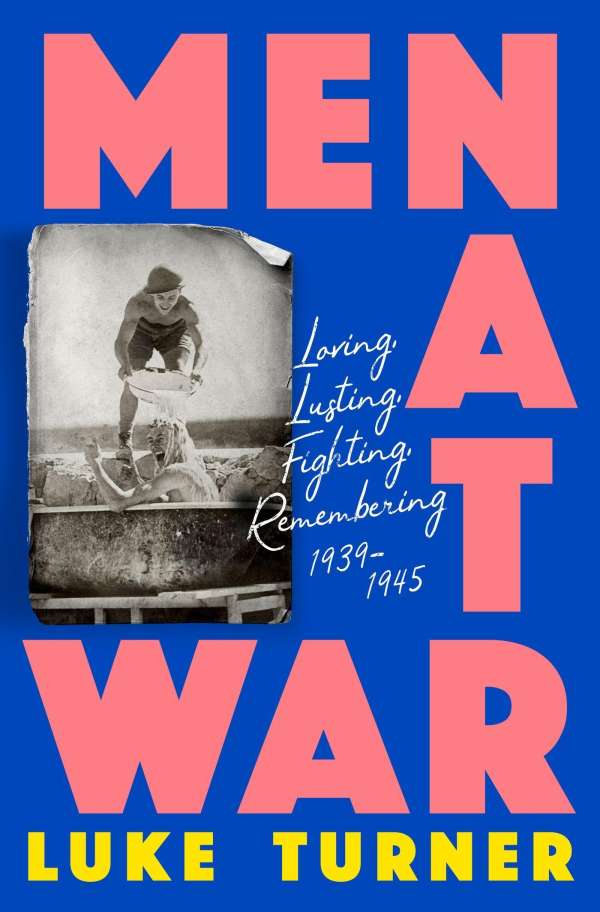
In The Critic, John Sturgis reviews a new book by Luke Turner titled Men at War: Loving, Lusting, Fighting, Remembering 1939-1945, which considers the myths and reality of wartime relationships during the Second World War:
Spitfire pilot Ian Gleed shot down five enemy aircraft in just a week in May 1940 — the fastest time in which this had ever been done, making him an official “ace” who would be quickly promoted to Wing Commander.
Gleed had become a poster boy for “the few”, the hero pilots of the Battle of Britain to whom so many would owe so much. He lived up to the popular image with his talk of “a bloody good show” and shooting down “damned Huns”, after which he’d sink a few warm beers and spend some “wizard” free time recuperating with his girlfriend Pam, whom he “loved now more than ever”.
Gleed’s luck finally ran out over Tunisia in April 1943 when his plane was hit by a German fighter and crashed into dunes. Gleed was killed. He was just 26.
It would only emerge decades later that much of the popular image he had cultivated simply wasn’t true. Gleed was gay. Pam was an imaginary character he had invented as a cover to keep his double life as a sexually active homosexual firmly secret.
Gleed’s story is one of many similar vignettes in this alternative history of the Second World War. Its author Luke Turner’s previous book was a memoir about his own grappling with issues around his identity as a bisexual. Here he takes up the question of how this would have played out for him and other sexual non-conformists in 1939–45.
Turner grew up obsessed with the war — everything from Airfix kits and Dad’s Army to Stalingrad and the Berlin bunker — and here he examines what it was to live through that period as a sexually active person of whatever hue. It proves a particularly rich subject matter as sex seems to have been everywhere in war time: everyone was sleeping with everyone else, apparently. It’s a perennial truth that you or I might be hit by a bus tomorrow — but make that bus a bomb, and suddenly this seems to create a sense of urgency which frequently manifests itself sexually, lending daily life what Turner calls “an aphrodisiac quality”. As Quentin Crisp put it when describing the shenanigans in blacked-out, Blitz London: “As soon as the bombs started to fall, the city became like a paved double bed.”
Whilst war may see an explosion of sex of all kinds, the establishment was not always comfortable with this. A Home Office report on public behaviour in London during the Blitz noted, “In several districts cases of blatant immorality in shelters are reported; this upsets other occupants of the shelters.”
One contemporary account suggests, “In wartime a uniform, whether of the Army, Navy or Air Force, to the average girl ranks as a fetish.” This had consequences in the field: Dear John letters from home could be a real problem in this regard. As an Army report in 1942 put it, morale is often damaged by “the suspicion, very frequently justified, of fickleness on behalf of wives and girls”.
Amongst all this sex was, of course, sex with Americans. Turner cites George Formby who captured this mood in the song “Our Fanny’s Gone All Yankee”: “She don’t wait for the dark when she wants to have a lark/In a bus or train she does her hanky panky.”
Then in a dark reversal of this two-nations-colliding-sexually motif, we get the horror of the Red Army’s organised rape of as many as 1.4 milllion German women during the Russian advance on Berlin, whose residents would later refer to the city’s grandiose monument to Soviet war dead as “the tomb of the unknown rapist”.
Canada won’t meet its defence spending targets, and Trudeau is totally fine saying this to our allies, if not to the public
Canadian defence freeloading has been a hallmark of Canadian government policy since 1968, and as The Line confirms in their weekend dispatch, it should be no surprise that Justin Trudeau is okay continuing his father’s basic policies:

A story we’ve been watching in recent weeks was the remarkable leak of sensitive U.S. national security documents onto the dark web, and from there, widely across social media. A young member of the Air National Guard has been arrested and now faces serious charges. News reports suggest that he had access to classified material at work and began sharing it privately with a small group of online friends, apparently simply to impress and inform them, with no broader political agenda. Some of those friends, in turn, appear to have leaked the documents further afield. It took months before anyone noticed, but once picked up by several individuals with large followings — including some who are none-too-friendly to the U.S. and Western alliance — the story exploded and the full scope of the leak was finally discovered.
This is, for the U.S., a huge embarrassment and a diplomatic nightmare. For us, it was simply a fascinating story. This week, though, we suddenly had the coveted Canadian Angle: the Washington Post claims to have reviewed one of the leaked documents, apparently prepared for the American Joint Chiefs of Staff, that assesses Canada’s military serious military deficiencies, and also reports that Prime Minister Justin Trudeau has privately told fellow NATO leaders that Canada isn’t going to hit NATO’s two-per-cent-of-GDP spending target.
To wit:
“Widespread defense shortfalls hinder Canadian capabilities,” the document says, “while straining partner relationships and alliance contributions.”
The assessment, which bears the seal of the U.S. Joint Chiefs of Staff, says Germany is concerned about whether the Canadian Armed Forces can continue to aid Ukraine while meeting its NATO pledges. Turkey is “disappointed” by the Canadian military’s “refusal” to support the transport of humanitarian aid after February’s deadly earthquake there, the document says, and Haiti is “frustrated” by Ottawa’s reluctance to lead a multinational security mission to that crisis-racked nation.
Your Line editors just sort of sighed heavily and rubbed their temples when they read that. It was, to us, nothing we didn’t know already. It was actually almost some kind of a relief to know that the PM will at least say privately what he won’t admit publicly: we aren’t living up to our pledge, and don’t plan to.
The Post says that Trudeau told NATO that there won’t be much more military spending in this country until the political situation here changes. We aren’t sure if he meant the priorities of the voters or the composition of our parliament. It doesn’t matter — it’s true either way. We are disappointed, but again, in no way surprised, to see Trudeau seeing this as an issue that he’ll just accept as-is, as opposed to attempting the hard work of showing actual leadership. He’s always been more about the easy path of demonstrative gestures instead of working hard to achieve real change.
But hey. In this, he has a lot of company. The Tories under Harper were marginally better on defence, but not nearly good enough. We have little faith — next to none, really — that PM Poilievre would do any better on defence. What bums us out the most about this issue is that we recognize and even agree that the choice to neglect defence and shovel those dollars instead into other, more popular vote-buying files does indeed make political sense. It’s what the voters want. We wish it were otherwise. We’ve spent big chunks of our careers trying to change their minds. Our record to date is one of total, utter failure.
Still, never say die, right? So we’ll make this point: we understand and accept the criticism sometimes made by Canadian commentators, who argue that the two-per-cent-of-GDP target is arbitrary and somewhat meaningless. We don’t entirely agree — targets are useful, and two per cent seems reasonable. But we’d be open to an argument that Canada could still punch above its weight in the alliance, even while spending less, if we could deliver key capabilities.
But … we can’t. We probably could, once upon a time, but we can’t even do that now. The air force is a mess. The navy is a mess. The army is a disaster, and couldn’t even send Nova Scotia all the help it asked for after Hurricane Fiona. Sending a token plane or ship on a quick foreign jaunt is symbolism, not above-weight-punching. And the symbolism taps us out.
So we have to pick what we’re doing here, fellow Canucks. We can meet the two-per-cent target. We can find other ways to meaningfully contribute. Or we can do neither of those things, and admit it, but only in private. Right now, alas, we’ve chosen that third option. We see no sign that’ll be changing any time soon.

Pierre Trudeau discovered that Canadian voters are all too willing to accept “peace dividends” in the form of shorting defence spending to goose non-military spending, and few prime ministers since then have done much more than gesture vaguely at changing it. Worse, it’s also quite accepted practice for defence procurement to prioritize “regional economic benefits” over any actual military requirement, which often means Canada buys fewer items (ships, planes, helicopters, tanks, trucks, etc.) at significantly higher prices as long as there’s a shiny new plant in Quebec or New Brunswick that can be the backdrop for government ministers and party MPs to use as a backdrop during the next election campaign. Military capability barely scrapes into the bottom of the priority list on the few occasions that the government feels obligated to spend new money on the Canadian Armed Forces.
Worse, every penny of “new” spending on the military gets announced many times over before any actual cheques are issued, which helps to disguise the fact that it’s the same thing all over again — sometimes for periods stretching out into years. The Canadian military has a well-deserved reputation for keeping ancient equipment up and running for years (or decades) after all our peer nations have moved on to newer kit. It’s a tribute to the technical and maintenance skills of the units involved, but it probably absorbs far more resources to do it over replacing the stuff when it begins to wear out, and it reduces the number available to, and the combat effectiveness of, the front-line troops when they are needed.
Pedersen Selfloading Rifle
Forgotten Weapons
Published 17 Nov 2014When the US military decided to seriously look at replacing the 1903 Springfield with a semiautomatic service rifle, two designers showed themselves to have the potential to design an effective and practical rifle. One was John Garand, and the other was John Pedersen. Pedersen was an experienced and well-respected gun designer, with previous work including the WWI “Pedersen Device” that converted a 1903 into a pistol-caliber semiauto carbine and the Remington Model 51 pistol, among others.
Pedersen’s rifle concept used a toggle locking mechanism similar in concept to the Borchardt and Luger pistols, but designed to handle the much higher pressure of a rifle cartridge. Specifically, the .276 Pedersen cartridge, which pushed a 125 grain bullet at about 2700 fps. Both Pedersen’s rifle and the contemporary prototypes of the Garand rifle used 10-round en bloc clips of this ammunition.
Ultimately, Pedersen lost out to Garand. Among the major reasons why was that his toggle action was really a delayed blowback mechanism, and required lubricated cartridges to operate reliably. Pedersen developed a hard, thin wax coating process for his cartridge cases which worked well and was not prone to the problems of other oil-based cartridge lubricating systems, but Ordnance officers still disliked the requirement. This combined with other factors led to the adoption of the Garand rifle.
After losing out in US military trials, Pedersen still had significant world-wide interest in his rifle, and the Vickers company in England tooled up to produce them in hopes of garnering contracts with one or more other military forces. About 250 rifles were made by Vickers, but they failed to win any contracts and production ceased — making them extremely rare weapons today.
Pedersen lived until 1951, and was well regarded for his sporting arms development with Remington — none other than John Moses Browning described him as “the greatest gun designer in the world”.
(more…)
QotD: The Baader-Meinhof phenomenon
A little joke for psychologists there.
In 1994, someone left a comment on the website of the St. Paul Pioneer Press (Minnesota) saying that he had heard two references to the Red Army Faction, AKA the Baader-Meinhof gang — a 1970s German terrorist organisation — in the space of 24 hours, having never previously been aware of them. This somehow provided a new name for a cognitive bias. Don’t let anyone tell you that posting online comments on regional newspaper websites is a waste of time.
Otherwise known as frequency bias, the Baader-Meinhof phenomenon is a combination of selective attention bias (paying more attention to some things than to others) and confirmation bias (looking for things that you agree with or which serve your purposes in some way).
Arnold Zwicky added another aspect when he wrote about the significance of things happening recently, describing the “recency illusion” as …
… the belief that things YOU have noticed only recently are in fact recent.
The classic example is people’s tendency to notice a certain type of car once they own one themselves, especially when they bought it recently.
Of course it is possible that the thing you’ve just started noticing is truly becoming more frequent. I have noticed more shirts, flags and other merchandise related to Arsenal FC recently. This may be because the team is doing very well this season and I am more conscious of them as a result. Or it may be that Arsenal fans are less coy about showing their support after years of under-performing. What is less likely is that there are significantly more Arsenal fans than there were before.
Christopher Snowden, “Sudden deaths and the Baader-Meinhof phenomenon”, The Snowden Substack, 2023-01-21.
April 23, 2023
There’s a spectre haunting your pantry – the spectre of “Ultra-Processed Food”
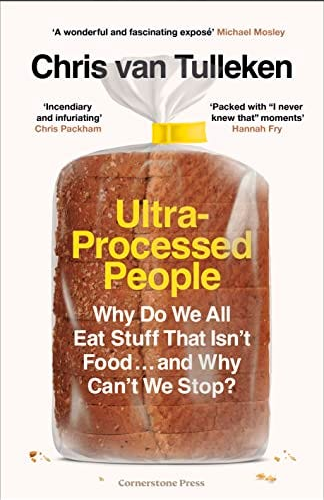
Christopher Snowden responds to some of the claims in Chris van Tulleken’s book Ultra-Processed People: Why Do We All Eat Stuff That Isn’t Food … And Why Can’t We Stop?:
Ultra-processed food (UPF) is the latest bogeyman in diet quackery. The concept was devised a few years ago by the Brazilian academic Carlos Monteiro who also happens to be in favour of draconian and wildly impractical regulation of the food supply. What are the chances?!
Laura Thomas has written some good stuff about UPF. The tldr version is that, aside from raw fruit and veg, the vast majority of what we eat is “processed”. That’s what cooking is all about. Ultra-processed food involves flavourings, sweeteners, emulsifiers etc. that you wouldn’t generally use at home, often combined with cooking processes such as hydrogenation and hydrolysation that are unavailable in an ordinary kitchen. In short, most packaged food sold in shops is UPF.
Does this mean a cake you bake at home (“processed”) is less fattening than a cake you buy from Waitrose (“ultra-processed”)? Probably not, so what is the point of the distinction? This is where the idea breaks down. All the additives used by the food industry are considered safe by regulators. Just because the layman doesn’t know what a certain emulsifier is doesn’t mean it’s bad for you. There is no scientific basis for classifying a vast range of products as unhealthy just because they are made in factories. Indeed, it is positively anti-scientific insofar as it represents an irrational fear of modernity while placing excessive faith in what is considered “natural”. There is also an obvious layer of snobbery to the whole thing.
Taken to an absurd but logical conclusion, you could view wholemeal bread as unhealthy so long as it is made in a factory. When I saw that CVT has a book coming out (of course he does) I was struck by the cover. Surely, I thought, he was not going to have a go at brown bread?
But that is exactly what he does.
During my month-long UPF diet, I began to notice this softness most starkly with bread — the majority of which is ultra-processed. (Real bread, from craft bakeries, makes up just 5 per cent of the market …
His definition of “real bread” is quite revealing, is it not?
For years, I’ve bought Hovis Multigrain Seed Sensations. Here are some of its numerous ingredients: salt, granulated sugar, preservative: E282 calcium propionate, emulsifier: E472e (mono- and diacetyltartaric acid esters of mono- and diglycerides of fatty acids), caramelised sugar, ascorbic acid.
Let’s leave aside the question of why he only recently noticed the softness of fake bread if he’s been eating it for years. Instead, let’s look at the ingredients. Like you, I am not familiar with them all, but a quick search shows that E282 calcium propionate is a “naturally occurring organic salt formed by a reaction between calcium hydroxide and propionic acid”. It is a preservative.
E472e is an emulsifier which interacts with the hydrophobic parts of gluten, helping its proteins unfold. It adds texture to the bread.
Ascorbic acid is better known as Vitamin C.
Caramelised sugar is just sugar that’s been heated up and is used sparingly in bread; Jamie Oliver puts more sugar in his homemade bread than Hovis does.
Hovis Multigrain Seed Sensations therefore qualifies as UPF but it is far from obvious why it should be regarded as unhealthy. According to CVT, the problem is that it is too easy to eat.
The various processes and treatment agents in my Hovis loaf mean I can eat a slice even more quickly, gram for gram, than I can put away a UPF burger. The bread disintegrates into a bolus of slime that’s easily manipulated down the throat.
Does it?? I’ve never tried this brand but it doesn’t ring true to me. It’s just bread. Either you toast it or you use it for sandwiches. Are there people out there stuffing slice after slice of bread down their throats because it’s so soft?
By contrast, a slice of Dusty Knuckle Potato Sourdough (£5.99) takes well over a minute to eat, and my jaw gets tired.
Far be it from me to tell anyone how to spend their money but, in my opinion, anyone who spends £6 on a loaf of bread is an idiot. Based on his description, the Dusty Knuckle Potato Sourdough is awful anyway. Is that the idea? Is the plan to make eating so jaw-achingly unenjoyable that we do it less? Is the real objection to UPF simply that it tastes nice?

Dylan Mulvaney’s “triumph of performance and marketing”
Andrew Sullivan weighs in on the Dylan Mulvaney phenomenon:

Bud Light’s latest brand ambassador, Dylan Mulvaney
I’ve largely ignored the entire Bud Light tempest in a toxic teacup because social media outrages and brand boycotts come and go and tend to leave little trace behind. But the fuss over the beer brand’s brief commercial dalliance with trans newbie Dylan Mulvaney — with her 10.8 million TikTok followers — nonetheless fascinates. It shows, it seems to me, just how much everyone is projecting, and how (almost) everyone is getting it wrong.
There are, it seems, many layers to Dylan. To countless straight people, left and right, Dylan is a transgender star — because she is biologically male, and yet has been saying she is a girl now for more than a year, wears women’s clothes and is pretty and charming and full of manic energy. (I’m mostly using her preferred pronouns here, the least clumsy option). The woke left therefore loves her, and the Matt Walsh right has had a collective aneurysm. But for many gay men, including yours truly, Dylan’s latest, year-long performance as a “girl” looks and sounds like something much more familiar.
Dylan, to us at least, is a pretty classic, child-actor, musical theater queen — an effeminate gay man who finds great joy and relief in Broadway camp and drama, and is liable to burst into song at any moment. (I used to wonder if this very specific manifestation would die out as gays integrated more. But no! It seems to be in our collective DNA. Every generation mints a new variety.) And she’s managed to bait both the woke left and the anti-woke right into making her very famous and a lot richer than a year ago.
It’s a triumph of performance and marketing. It can be frustrating for a young actor among so many. You can do your best, become a finalist in Campus Superstar in 2018, wear only briefs for a performance at Joe’s Pub, perform, however well, in the cast of Book Of Mormon, camp it up for Ellen, or do the exact same ditzy-girl act on The Price Is Right as a man (Dylan’s previous attempts at fame). But become a parody of a “girl” and provide breathless, daily updates on your transition — and nearly 11 million people on TikTok will follow. At the same time brand yourself as a pioneer for greater understanding, love, and civil rights … and you can get an extended interview on The Today Show and an audience at the White House.
The gimmick was simple: a TikTok clip for every day of “becoming a girl.” As Dylan explained:
When the pandemic hit, I was doing the Broadway musical Book of Mormon. I found myself jobless and without the creative means to do what I loved. I downloaded TikTok, assuming it was a kids’ app. … [R]ight before I started creating content with “Days of Girlhood”, I thought, “What am I going to do to afford my rent this month?”
Well, she no longer has to worry about that. Dylan has brand partnerships with Anheuser-Busch, Nike, Crest, Instacart, Ulta Beauty, Kate Spade and many more. And here is what Dylan means by “becoming a girl” in his/her own words. Trigger warning for feminists:
Day One of being a girl and I’ve already cried three times, I wrote a scathing email that I did not send, I ordered dresses online that I couldn’t afford, and then, uh, when someone asked me how I was, I said I’m fine — when I wasn’t fine [applies lip gloss]. How’d I do, ladies? Good? Girl power!
If you think this has to be a joke, a parody making fun of sexist ideas about women, you’re not the only one. (Trans YouTuber Blaire White also assumed it was a spoof at first, and her video on Dylan’s “womanface” is well worth a watch.) But no! Here’s more:
“Hangin with the girlieeees, woohoo! [The camera pans across a series of dolls sitting in chairs] … I almost bought this Audrey [Hepburn] portrait. I just love her, she’s everything I want to be.”
“Day Three of being a girl and I’ve already become a bimbo. … I think it’s a good fit for me. What do you think, ladies?”
“Day Four of being a girl and I’m exhausted — the hair, the makeup, the clothes, the high heels. It’s a lot to keep up with!”
“Day 12 of being a girl and I just picked up some tampons.”She never subsequently seems to put them down. At one point, we see Dylan hiking in high heels, and running hysterically away from a flying bug. In another clip, she dresses up in a skimpy evening gown and fantasizes about her future husband:
I want them to know I’ll be their cheerleader on and off the field. So they can picture me walking down the aisle to be their trophy bride, or trophy wife. I would totally be good at that, don’t you think? “Dinner’s ready! Yoo-hoo!”
Call me a transphobe, but I just don’t think that someone who has been struggling with gender identity her whole life and found a pathway to womanhood … would ever celebrate it quite like that. Yet this firehose of misogynistic tropes was one of a handful of people who were invited to the White House to interview Biden personally.
The only thing more absurd than this was the far right falling for the whole schtick as well. After the Bud Light ad, Kid Rock filmed himself shooting cases of beer with a semi-automatic rifle; a businessman opted for a baseball bat in an ad to promote his new “Ultra Right” beer; bomb threats rattled some Bud factories; countless tweets popped up alleging a collapse in sales of Bud Light; then the Trumps went to war with Matt Walsh because Anheuser-Busch is a major GOP donor; then the former cover-girl, current Fox News star Caitlyn Jenner called Dylan’s act an “absurdity“; and so on. Good times.
The Biggest Offensive in Japanese History – WW2 – Week 243 – April 22, 1944
World War Two
Published 22 Apr 2023Japan Launches Operation Ichigo in China, their largest offensive of the war … or ever, but over in India things are not going well for the Japanese at Imphal and Kohima. The Allies also launch attacks on the Japanese at Hollandia, while over in the Crimea, the German defenses at Sevastopol are cracking under Soviet pressure.
(more…)
From the Encyclopedia Britannica to Wikipedia
In the latest SHuSH newsletter, Ken Whyte recounts the decline and fall of the greatest of the print encyclopedias:
I remembered all this while reading Simon Garfield’s wonderful new book, All the Knowledge in the World: The Extraordinary History of the Encyclopedia. It’s an entertaining history of efforts to capture all that we know between covers, starting two thousand years ago with Pliny the Elder.
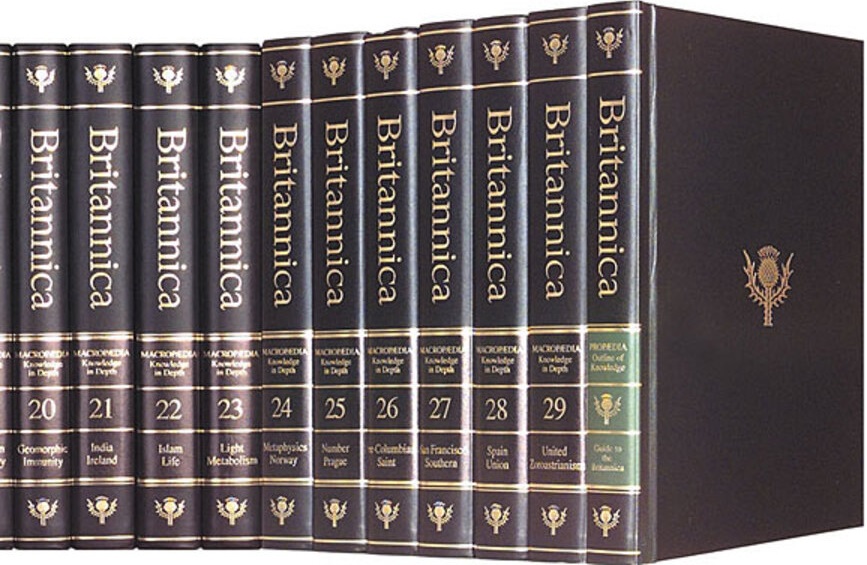
The star of Garfield’s show, naturally, is Encyclopedia Britannica, which dominated the field through the nineteenth and twentieth centuries. By the time of its fifteenth edition in 1989, the continuously revised Britannica was comprehensive, reliable, scholarly, and readable, with 43 million words and 25,000 illustrations on a half million topics published over 32,640 pages in thirty-two beautifully designed Morocco-leather-bound volumes. It was the greatest encyclopedia ever published and probably the greatest reference tool to that time. It was sold door-to-door in the US by a sales force of 5,000.
Just as the glorious fifteenth edition was going to press, Bill Gates tried to buy Encyclopedia Britannica. Not a set — the whole company. He didn’t want to go into the reference book business. He believed that the availability of a CD-ROM encyclopedia would encourage people to adopt Microsoft’s Windows operating system. The Britannica people told Gates to get stuffed. They were revolted by the thought of their masterpiece reduced to an inexpensive plastic bolt-on to a larger piece of software for gimmicky home computers.
Like the executives at Blockbuster, the executives at Britannica eventually recognized the threat of digital technology but couldn’t see their way to abandoning their old business model and their old production standards and the reliable profits that came with large sets of big books. CD-ROMs seemed to them like a child’s toy.
Even as more of life moved online and the company’s prospects for growth dwindled, the Britannica executives could still not get their heads around abandoning the past and favoring a digital marketplace. They figured that their time-honored strategy of guilting parents into buying a shelf of books in service of their kids’ education would survive the digital challenge, not recognizing that parents would soon be assuaging their guilt by buying personal computers for their kids.
By the time Britannica brought out an overly expensive and not-very-good CD-ROM version of its encyclopedia in 1994, Gates had launched Encarta based on the much inferior Funk & Wagnalls. It might not have been the equal of the printed Britannica, but with its ease of use and storage, its much lower price point, and its many photos and videos of the Apollo moon landing and spuming whales, Encarta made a splash. It was selling a million copies a year in its third year of production — a number that no previous encyclopedia had come close to matching.
As it turned out, Britannica‘s last profitable year was 1990 when it sold 117,000 bound sets for $650 million and a profit of $40 million. With the launch of Encarta, its annual sales were reduced to 50,000 sets and it was laying off masses of employees.
Encarta‘s own life was relatively short. It closed in 2009, at which point it was selling for a mere $22.95. The world now belonged to Wikipedia.
My Review of Graham Hancock’s Ancient Apocalypse
Thersites the Historian
Published 17 Jan 2023In this video, I review Graham Hancock’s new series on Netflix, where he presents his case for a globe-spanning prehistoric civilization to a general audience.
(more…)
QotD: Developing “multi-disciplinary teams”
The power struggles are interminable and insoluble, for no one is truly in charge and any instructions are regarded as an infringement of or attack upon the idea of equality of disciplines and equality within disciplines. The pretence that the most junior is equal to the most senior means that supervision scarcely happens, or only retrospectively, after a disaster, when the most junior person who can plausibly be blamed is singled out.
The inevitable squabbles that result lead to accusations of bullying, usually defined in purely subjective terms: you are bullied if you feel you are (in the absence of a requirement of objective correlates of feeling, thought is, of course, quite unnecessary and probably best avoided). Such accusations can result in a Kafka-esque procedure lasting months and occupying days, weeks and months of labour-time.
Meanwhile, neglect of the real work is ascribed to a shortage of “resources” and the object of the team’s attentions, that is to say members of the public, are offered perfunctory services, for example never seeing the same member of the team twice. Between holidays, team meetings and courses on how to make the team function better, there is no time left for the elementary compassion of consistency.
Every public enquiry into every disaster that comes within the remit of the services set up to ameliorate the social pathology brought about by years of social engineering finds the same thing: lack of communication between the various parts of the multi-disciplinary teams. Time, surely, for a course on Communication Skills.
Theodore Dalrymple, “Workshops and why you must avoid them”, The Social Affairs Unit, 2009-11-18.


