
Forgotten Weapons
Published 21 Mar 2026The Remus is the new version of the Laugo Alien pistol. It was released about a year ago, and just recently also made available in a left-handed version — which I have been eagerly awaiting. The Remus is designed to be a more general-purpose and carry-suited pistol in contrast to the competition focus of the original Alien. It adds a manual safety, system for racking the slide with the optic while having a 0.8″ shorter barrel and weighing 25% less. The optics mounting options now include the Aimpoint COA, which I am also a big fan of.
Disclosure: Laugo gave me this pistol, so you will have to judge for yourself if I am being bought or if I genuinely believe this pistol is as good as I say.
(more…)
August 15, 2026
Laugo Alien Remus: Making the Best Pistol Better
Comments Off on Laugo Alien Remus: Making the Best Pistol Better
QotD: “The progressive is a walking paradox”
In economics, we cut through noise with a concept called “Revealed Preference”.
If I loudly claim to love vanilla ice cream, yet every time I return from the Mr Whippy van I’m holding a choc-ice, my revealed preference is evidently for chocolate — not vanilla.
Thus the truth of a person’s preferences is revealed through their actual choices and behaviour, not by what they claim to prefer.
It’s unfortunate we can’t simply listen to their words, but they are so oriented toward the external, the aesthetic, and the performative (“Theater Kid Progressivism”) that we must instead look at their proximal behaviours — where they actually choose to live and raise their families, for example, to extrapolate backwards their true feelings on mass migration and its consequences.
This is the lens through which we should try to understand our Progressive class.
The bitterest irony, the irony of ironies, is this: progressives, especially those who voted for it, self-evidently do not feel at home in the societies they helped create.
If they were genuine believers, they would live contentedly amidst their new friends.
Instead, they scuttle off into the countryside, the leafy suburbs, or gated enclaves, abandoning the very demographic transformation they imposed on others.
It is often said that if liberals didn’t have double standards they wouldn’t have any at all, but while this is very funny (and true), there’s more to it.
It reveals a profound non-confluence between their stated attitudes and their actual behaviours, indicative of extreme cognitive distortion.
They protest performatively that open borders and rapid demographic change are a universal good, even moral imperatives and (admittedly less often nowadays) sources of strength.
Yet when it comes to their most intimate revealed preference — where they opt to live and raise their families — they consistently prioritise homogeneity, good schools, and cultural familiarity.
They lobby and vote without end for policies that maximise immigration into lower- and middle class neighbourhoods, then abandon those very communities for pastures anew, safely insulated by postcodes and house prices.
Their revealed preference is that do not want to live in the Canada (or Britain, or America, or Europe) they are busily helping to construct.
They enjoy the vibes, the moral status, the Instagram aesthetics, while quietly falling back to the leafy, high-trust environments their grandparents took for granted.
Progressives love to speak of taboos (indeed if there is a pastime more alluring and intoxicating to the progressive than “breaking taboos”, I am yet to come across it, but I digress) yet is the greatest taboo of all right in front of us after all, carrying a basket of organic fruit and veg from Waitrose?
To interrupt the Progressive in the midst of his communal dream state, to turn our collective eye away from the brave new world they are building for us and to instead look inwards, to look the Liberal cuckoo directly in the eye and put words to the disparity between their words and their actions …
The subject of lawful and legal deportations is increasingly mainstream, yet what of urban renewal and rewilding by means of progressive importations?
The Progressive is a walking paradox, he is both the centre of attention and the ghost at the feast all at once.
Æthelstan, The social media site formerly known as Twitter, 2026-05-14.
Comments Off on QotD: “The progressive is a walking paradox”
August 14, 2026
Ontario premier doubles-down on provoking Trump. What could go wrong?
At some point you have to ask yourself … if Canada was being run by people who wanted to destroy it, what would they have done differently in the trade negotiations with Donald Trump’s government?
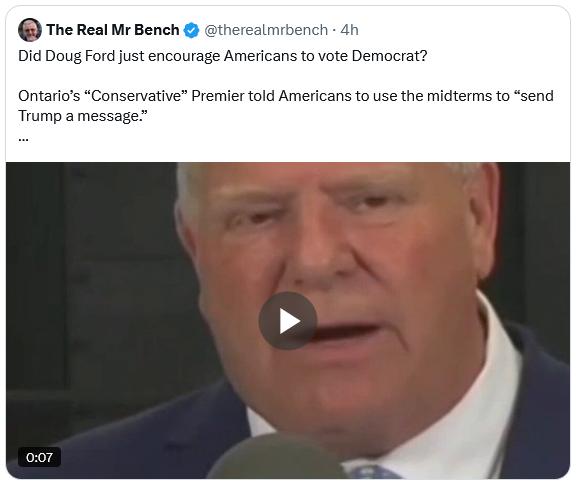
Is Doug Ford the dumbest Canadian?
I know, it is a deep bench. But the tubby premier is extraordinary. You have to appreciate talent.
There are, apparently, two schools of Canadian thought on the trade fracas with the US. “Punch the bully in the nose.” and “For God’s sake get a deal already.” As I prefer a Canada with an economy, I pick door number 2.
Our Chief Trade Negotiator Janice Charette, is more combative. If Trump brings in his retaliatory tariffs in a week she’s packing up and going home. That’ll learn him.
The idle threat school of negotiation enjoys wide currency in both Ottawa and Queens Park. Meanwhile, Canadian businesses are looking [longingly] at the low tax, low reg world inside the Trump tariff wall.
I’m having a beer with a buddy who is in “founder’s mode” on a startup and, frankly, he’d be crazy not to be looking at domiciling his business in the States. Sure, have a Canadian sub, but why put your main business in Canada?
And decisions like this are being made all over Canada and, indeed, the world. People might hate Trump and all his works but the business attractions of Red States make Ontario and BC look pathetic.
You would think that after Ford’s Super Bowl ad fiasco he would have the wit to remain silent as his province’s fate is being negotiated. You know, avoid more damage. But no, the tubby premier likes to “talk tough”.
I actually feel a bit sorry for Carney having to deal with the fallout of this idiot’s remarks. Unless, of course, like the Super Bowl ads, Carney actually encouraged these remarks … In which case the competition for dumbest guy in Canada has tightened up.
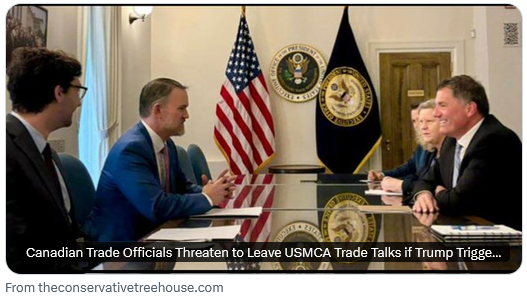
Comments Off on Ontario premier doubles-down on provoking Trump. What could go wrong?
AI’s coming, everyone panic!
At the Foundation for Economic Education, Mani Basharzad suggests we do the exact opposite of my chosen headline in regard to the inevitable collapse of civilization rise of artificial intelligence:
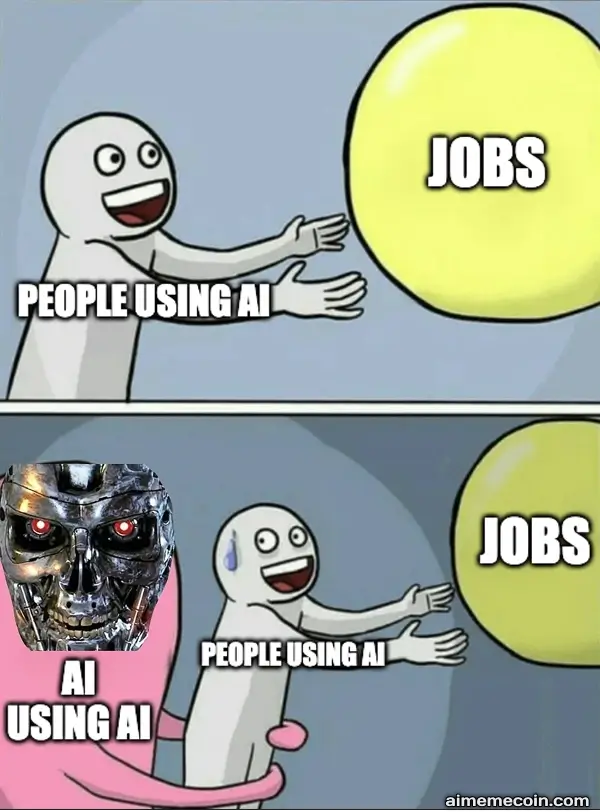
In recent weeks, a letter on AI titled “We Must Act Now” has made headlines. Its list of signatories brought together an unlikely coalition of intellectuals, from Joseph Stiglitz and Paul Krugman to Alex Tabarrok, Tyler Cowen, and Niall Ferguson.
The signatories agree on three key propositions. First, they argue that “AI may become radically more powerful over the next decade”. Second, they argue that it could “transform the economy on a scale larger than the Industrial Revolution, but over a much shorter period, bringing both large-scale job displacement and significant improvements in living standards”. Third, they argue that “economists, policymakers, and technology leaders must act now to create the incentives, guardrails, and institutions needed to ensure AI benefits society”.
These propositions have created an unusual consensus among economists and policymakers. They also reflect a broader public anxiety about AI and its impact on people’s livelihoods. Yet, as Stanford economist John Cochrane remarked in response to the letter, “You see AI everywhere, except in productivity and labor statistics”. That is the first problem with the argument: those are the two places where the letter’s predictions should already be showing up.
The letter makes extraordinary claims, and as the famous saying goes, extraordinary claims require extraordinary evidence. Yet the evidence offered is remarkably thin. The language is dramatic — “large-scale job displacement”, “larger than the Industrial Revolution”, and “major gains in living standards” — but every prediction is qualified by one word: could. There is still little evidence that AI has fundamentally reshaped employment or productivity.
Take the labor market as an example. A widely cited survey claimed that employers plan to reduce graduate hiring because of AI. But the study was forecasting the future, not describing present reality. It found that “four in ten employers believe entry-level roles could disappear within the next five years”. Once again, the evidence rests on expectations and fears rather than observed outcomes.
Now compare that with what is actually happening. Economist Valentin Boboc has argued that entry-level jobs are growing fastest at firms that are aggressively adopting AI. If AI were already eliminating these positions, we would expect to see the opposite.
Consider youth unemployment. Which developed country currently faces one of the most severe youth employment crises? The answer is not a country overwhelmed by AI, but the United Kingdom. More than 1 million people aged 16–24 are classified as NEET (Not in Education, Employment, or Training), at an estimated annual cost of £125 billion ($169 billion) to the economy.
I’m somewhat ambivalent about the “Something must be done! This is something! Therefore we must do it!” reaction to the rise of widely available LLM agents. If all the claims for AI’s disruptive abilities are true, then change is going to happen whether we want it to or not. I’ve had little direct contact with the various agents, having used Grok a couple of times to generate graphics to accompany blog posts, but I’m told by others that they get lots of benefit from using their preferred AI for all sorts of things.
Comments Off on AI’s coming, everyone panic!
“Ultra vires“
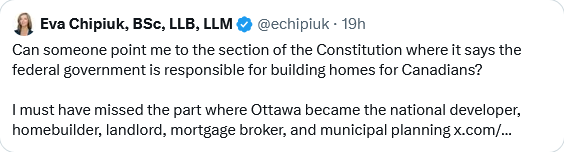
On the social media site formerly known as Twitter, Eva Chipiuk explains why it’s never a good thing to have your government ever extending the things it is involved in:
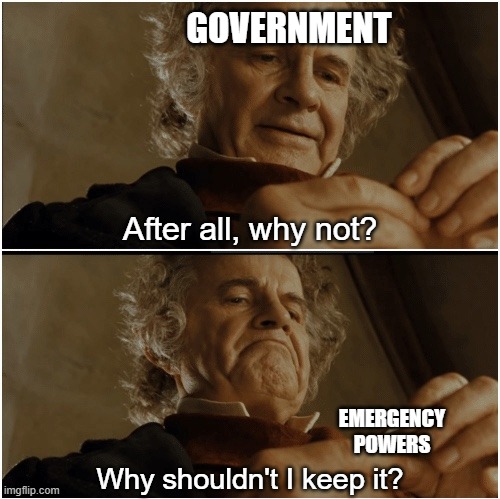
Governments going ultra vires should concern every citizen.
Ultra vires means “beyond the powers”. In a democracy, governments and public institutions do not have unlimited authority. They can only exercise the powers the law actually gives them.
Yet increasingly, we see governments, regulators, agencies, and other public bodies stretching their mandates, assuming powers they were never granted, and acting as though their authority is limited only by what they can get away with.
That turns the rule of law on its head.
The question should never be: “Where does the law say government can’t do this?”
The question is: “Where does the law give government the authority to do this?”
That distinction matters.
Government is not above the law. Public institutions are creatures of law, and their power has boundaries. When those boundaries are ignored, courts must enforce them, legislatures must correct them, and citizens must demand accountability.
Because once we accept government exercising powers it was never given, the limits on government become meaningless.
Staying within your legal jurisdiction is not optional. It is the foundation of the rule of law.
Comments Off on “Ultra vires“
What Did the Builders of Stonehenge Eat?
Tasting History with Max Miller
Published 17 Feb 2026Roasted pork ribs with blackberries and honey with Stonehenge Nettle and Hazelnut Soup
City/Region: Britain
Time Period: 3000-1500 BCEAbout 2 miles from Stonehenge is Durrington Walls, the place that archaeologists believe was the living settlement for the people who built and used Stonehenge. Amongst the evidence of what was eaten, there are a lot of bones, about 90% of them being pig bones. Based on scientific analysis of the pig teeth found there, they were probably fattened on something sweet, which would have probably been honey or berries, so I’m using both to prepare these pork ribs.
This is a simple preparation, but these ribs are so good. The honey is the dominant flavor and the blackberry does come through. The other 10% of bones found at Durrington Walls were mostly cattle, so you could use beef ribs instead if you’d like, you’ll just have to cook them longer.
(more…)
Comments Off on What Did the Builders of Stonehenge Eat?
QotD: Postmodernism’s origins
Leading the way were the French intellectuals, who in the 1960s and 70s questioned the deepest of those assumptions, beginning with truth itself. Was there really such a thing as “objective truth”, or was it simply an invention of the powerful, something declared rather than discovered? Was “progress” a description of reality or just the story told by whoever won? These are serious questions from which they could make fair observations. They were right to point out that institutions serve their own interests, and grand narratives play a defining role in our understanding and interpretation of the world. The trouble is that the same intellectuals didn’t try to place the answers intelligibly within the larger story of our lives. Postmodernism made interrogating power the overriding intellectual move and the answer to its own question.
Postmodernism doesn’t lend itself to a simple explanation, which is appropriate, as we shall see. However, dig beneath the deliberately impenetrable jargon, and the core claims are as follows. There is no objective truth, only competing narratives. What we think of as “knowledge” is just something the powerful tell us is the case. Language doesn’t describe reality but constructs it. Science, reason, and universal liberalism are inventions of Western minds, specifically male ones, while the Enlightenment idea of the individual with supposed natural rights is just another concept made up by those most likely to benefit from it.
There’s an obvious paradox at the outset. In what sense is it true to say there’s no such thing as objective truth? The question is meaningless because the premise is nonsensical. As Roger Scruton put it, “A writer who says that there are no truths, or that all truth is ‘merely relative’, is asking you not to believe him. So don’t.”
Despite the obvious contradiction, it’s an idea that has been pushed aggressively by campus authoritarians for decades. No narrative deserves authority, they say, while demanding intellectual obedience to a narrative of their own.
Frederick Alexander, “Postmodernism: The Idea That Ate Itself”, The Gadfly, 2026-04-03.
Comments Off on QotD: Postmodernism’s origins
August 13, 2026
A minimum 12-year sentence
It’ll probably be no surprise to anyone who’s met me, but I was a terrible student in school. While I quite enjoyed learning (about some things, anyway), I hated the environment where that learning was supposed to be taking place. I did well enough in primary and middle school, but I dropped out of high school and finished my diploma through correspondence. I have a great deal of sympathy for those kids who don’t fit into the institutional framework, as I certainly didn’t feel I fit in during my sentence. (It’s often worse for boys, as it’s more difficult for boys to sit still and stay quiet, and teachers readily interpret distraction and fidgeting as something needing medical intervention rather than signs of normal human development for half the species.) At Without Diminishment, Sam Dagres considers the plight of the vast majority of children locked in to that minimum 12-year incarceration:
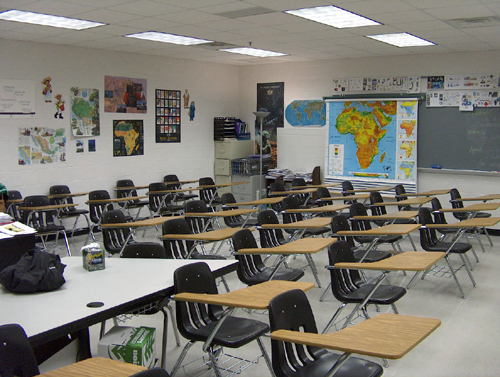
You’re sitting there, one eye on the clock, eagerly waiting for the bell to ring. How you crave the chime of that sweet-sounding bell, a ring marking the start of your allotted outdoor time. You rush outside, feel the sun on your skin, eat a snack reminding you of a world that exists on the other side of the fence. But for most of the day, you are sat, effectively immobile for 8 hours. Stillness is the highest virtue, and any violation leads to punishment and an ADHD diagnosis. Day in and day out, you wait for the last bell.
Most of us will have experienced this kind of imprisonment, befitting what crime, you may wonder? We are punished for the crime of being born into a society where all forms of care are by default institutional, a society whose “child care policy is adult policy, not early childhood policy”, as Katharine B. Stevens noted.
According to Statistics Canada, approximately 5.5 million students are enrolled in K–12 public schools, dwarfing the 67,000 who are home-schooled. Nearly 99 per cent of all school-aged children in Canada are currently institutionalised.
In 2025, 58 per cent of children aged 0 to 5 were in childcare facilities, representing approximately 1.4 million children. One-quarter of those were aged under 1.
As someone who attended public schools all my life, I never thought of it as anything but natural. But as I reach a point in my life where family formation is uppermost in my mind, I wonder whose interests are prioritised whenever I walk by a school and hear, not see, kids playing on the other side of a tall brick wall.
We do not leave it to children to decide very much for themselves, which means their interests are ours to safeguard. Luckily, the research exists: institutional, non-familial care is not what is best for most of our young.
The incomparable Institute for Family Studies recently enumerated the relevant studies, one of which is the NICHD Study of Early Child Care and Youth Development, which followed 1,000 children from infancy through adulthood and found that “children who had spent at least 30 hours per week in those settings beginning in infancy had three times the rate of social-emotional difficulties, including lower social competence, higher externalising behavior, and more conflict with teachers and peers. These effects persisted through elementary school, and by adolescence appeared as impulsivity, risk-taking, and substance use.”
Similarly, studies of Quebec’s universal childcare system have shown that the programme “has been associated with increased anxiety, aggression, hyperactivity, worse parent-child relationships, and lower self-reported life satisfaction in adolescence. By young adulthood, the negative effects extended to a 22% increase in criminal conviction rates.”
The foundations of our emotional and cognitive lives are formed early on while we bond with caregivers, and early institutionalisation disrupts that. The emotional downsides resulting from the systematic separation between the young children and their mothers are not broadly grasped, since the opposite is widely believed. When I share my musings about home-schooling with my friends, without fail, I receive the unanimous response: “Aren’t you worried they’ll turn out weird?” To that I respond, “Have you been paying attention?”
We are living through an era of weird, surrounded by friendless, non-eye-contact-making, socially anxious individuals. Nowadays, most schools encourage gender exploration and, through intense anti-bullying campaigns, demand a near-total embrace of any and all quirks. Not to mention that these tiny balls of anxiety, for some reason, require Vietnam-War-vet-levels of pharmacological intervention. I had someone tell me, “In my current role, I feel more like a pharmacist than a teacher”.
We can attribute the explosion of weirdness to a whole host of factors, notably digital devices and their role in mass social atrophy, but the forced dislocation of young children from their families is the foundation for a lifetime of alienation.
Comments Off on A minimum 12-year sentence
German democracy from the POV of “Our Democracy Enjoyers”
If you’ve been wondering about the state of democracy in Germany, your first move should be to check the latest update from eugyppius:
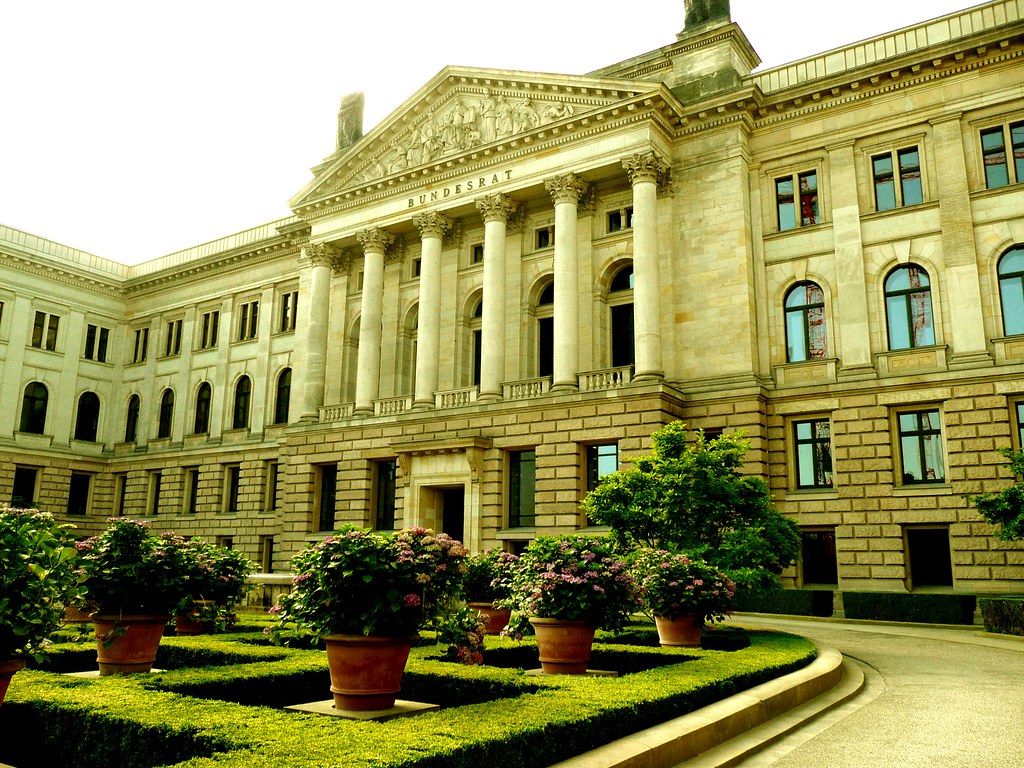
“Bundesrat of Germany” by photosteve101 is licensed under CC BY 2.0 
 .
.
In civics class, parties appear as little more than informal election-winning cooperatives. Now and again “the sovereign” – that is to say, “the people” – may grant one or various parties a limited right to govern, but the state is held to be in some sense public property. Politicians and their parties are at best its temporary custodians.1
Our Democracy Enjoyers particularly deplore state systems in which parties have captured the state – a special political form we might call the “party state”. Germany became a party state after 1933, when the NSDAP seized the entire state apparatus and outlawed all competitors. Contemporary states owned and operated by single parties include China, Cuba and North Korea. Our Democracy Enjoyers hate all single-party states because they are not democratic.
Party states need not however be single-party states. While the Socialist Unity Party (SED) effectively owned the DDR, they tolerated an array of subservient bloc parties from the very beginning. None of these parties ever had any chance of governing; they functioned only as extensions or alternative faces of the SED itself. These parties included gutted, early opposition parties like the CDU (Ost) and the Liberal Democratic Party (LDPD), but also SED concoctions like the Democratic Farmers’ Party (DBD) and the cynically post-Nazi National Democratic Party (NDPD). The SED cultivated these parties both as a democratic figleaf and also to integrate “non-proletarian” (particularly Christian) elements within the communist system. The precedent of the DDR shows that the party state can assume various innovative forms and that multiple parties may be useful for political, propaganda or other purposes.
My thesis of the Federal Republic is that it is also a party state. The only difference between the DDR and the BRD is that, in the BRD, several different parties share ownership of the state among themselves.
The three anecdotes at the head of this piece reveal this party ownership in incidental but telling ways. They show, for example, how a substantial portion of the police consider their oath of office to preclude loyalty to a democratically elected opposition party. Should the voters go rogue and install any such party at the state level, a prominent police union functionary openly hopes for insurrection and federal intervention. Periodically voiced ambitions and campaigns to cleanse the civil service of AfD elements come from a similar place. The ownership parties cannot countenance opposition creep into the bureaucracy, because they correctly regard the bureaucracy as their property.
The hysteria surrounding a thwarted SPD nomination to the Federal Constitutional Court reveals that the parties that own the BRD extend their proprietary interests not only to the executive and legislative branches, but also to the allegedly independent judiciary. The ruling parties have divided the prerogative to nominate judicial candidates informally among themselves. This prerogative is so jealously guarded that a leading Union politician cited a single thwarted SPD nomination to make the case for mass censorship and regulation of “alternative” media.
And while it is a minor incident that hardly matters, the dispute over the Otto-Wels-Saal shows that the proprietary feelings of the state parties extend to physical architecture, even specific rooms and buildings, which the parties of the party state regard not as public property but as their very own chambers – to name, possess and use as they see fit.
While progressive liberal political systems are all oligarchies, and this because of the Iron Law of Oligarchy, they are not all party states – far from it. The party state is a clunky and outmoded political system that historically arose out of accident or necessity, generally following a revolution perpetrated by a single party or political movement in a moment of particular ascendance. The Federal Republic was founded as a party state in 1949, mainly to foreclose the possibility that subversive National Socialist or communist elements might return to influence via democratic processes. This is the basic meaning of German “defensive democracy”, which denotes an array of legal or constitutional tools for the parties that own the state to fend off or criminalise competitors.
- Now, we know this is mostly nonsense. “The people” are an abstraction and as such they cannot grant anybody anything. All political systems ultimately redound to the control of more or less stable oligarchies. “Democracy” describes little more than a set of procedures via which the these oligarchies (or their representatives) assume power and enact their will.
“Defund the police!” from around day five onwards
A grim joke I’ve seen many times on various social media sites features the kind of people who’d agree to defund the police, but not because they want to take it easy on criminals … but because if there are no police enforcing the laws, there’d be no police limiting “bag counts”. With no police to make arrests (and likely no jails or courts to provide some kind of due process), the victims of crime will either surrender to the perps, or get as fully armed as they can manage. You can’t maintain a civil society if everyone has to take on the policing role for themselves everywhere and at all times.

“Defund the Police” by Taymaz Valley – CC BY 2.0
I always laughed at “defunding the police”, because I know how that would go. The people who advocate it are incapable of thinking beyond first-order consequences.
So, let’s suppose major American city X fully defunds its police. How will this play out?
For a short time, criminals will have a field day. They will shoplift, rob, mug, and invade homes to their hearts’ content. Because who’s going to arrest them?
But then their victims are going to arm up. Homeowners, shopkeepers, and ordinary citizens will start open-carrying and shooting criminals. Because who’s going to arrest them?
So far, so good.
Now, here’s the part that isn’t obvious. 60% of index crimes are committed by Black people. Once the shooting phase starts, Black criminals are going to form gangs (if they haven’t already) so they can overwhelm individual targets.
Once Black gang predation becomes routine, the rational strategy for whites and Hispanics and Asians becomes to simply start gunning down groups of multiple Blacks on sight. Because who’s going to arrest them?
The same dynamic applies to any minority with a higher criminal propensity than white people. Which is basically all of them except for Northeast Asians.
Innocents will not be spared. If there are any left — it’s a statistical fact, for, example, that Black women have a higher rate of criminal violence than white men.
The eventual result would be a white nationalist’s wet dream. Minorities dead or keeping very, very quiet in order not to get shot. They might be able to hold mono-ethnic enclaves in the short term, but venturing outside them would be asking for death.
I’m pretty sure this is not what advocates of defunding the police want to happen. But these are the same people who were all gung-ho for police bodycams, and we all know how that turned out.
Update: You can always count on the Babylon Bee to provide timely and informative context for any issues we face in today’s complex world – What If We Abolished Prisons and Defunded the Police?
Comments Off on “Defund the police!” from around day five onwards
The Ancient Greeks 04 – The Persian Invasion 1 – Xerxes Decides
seangabb
Published 23 Mar 2026Greece: A Brief History, c.700 BC – 500 AD
What drove the greatest invasion force of the ancient world to march against Greece?
In this lecture, we move from the aftermath of the Battle of Marathon to the momentous decision of King Xerxes of Persia to launch a full-scale invasion of mainland Greece in 480 BC. We examine the political, strategic, and psychological factors behind the Persian decision, including the legacy of Darius, the revolt in Egypt, and the internal debates within the Persian court.
Drawing on Herodotus and other ancient sources, this video explores:
– The consequences of Marathon for both Persia and Greece
– Xerxes’ consolidation of power
– The famous debate at the Persian court
– The role of honour, revenge, and imperial ideologyThis is the essential starting point for understanding how a regional conflict escalated into one of the defining wars of the ancient world.
Part of a full lecture series on the Persian Wars.
Comments Off on The Ancient Greeks 04 – The Persian Invasion 1 – Xerxes Decides
QotD: Marx was right about “class consciousness”
Marx called religion “the opiate of the masses” for a reason — by dulling their pain, it prevented them from realizing their true class position, thus achieving class consciousness, thus sparking The Revolution. What religion really does, of course, is satisfy a deep yearning in the human soul. There is more to life than shit, shoes, and bread. Karl Marx didn’t want to hear that, because his religious yearning was satisfied by his substitute god, Dialectical Materialism, and the half-assed (but very real) ceremonial it produced. Again, there’s a reason every Leftwinger practically from the French Revolution looked like [this]
I don’t know how you say “fake and gay” in Russian, but every single thing in that photograph is fake and gay. A pose. An affectation. And as with their look, so with their behavior. Leftwingers are, and always have been, famously boorish. They have no idea how longshoremen actually act, but they sure think they know, and so that’s how they act — like the worst caricature of a crude, illiterate, drunken longshoreman.
(I don’t know any longshoremen either, but I do know some folks who make a living from the sweat of their brows, and they’d turn Lenin’s head around for him if he came to their neighborhood and started acting like that. The Laboring Masses might indeed be “rude mechanicals” in Shakespeare’s sense — meaning, without too much formal education — but they’re surely not rude in the behavioral sense, because in their world, running your mouth gets you punched in it).
Dressing and acting like that is, quite literally, a religious ceremony for them … and ceremonial can only take place in a designated space, a liminal space that the community respects. A priest can indeed hold a mass on a street corner, but only if the passersby have enough residual respect for the institution of religion not to beat and rob the worshipers while their backs are turned.
The intelligentsia never understood that consciously. They sure as hell understood it unconsciously, though, which is why they immediately self-segregated — getting “sent down to the countryside, to reconnect with the laboring masses” was one of the worst punishments Mao’s boys could dish out to one of their mandarins, and again, there’s a reason for that. The upshot is, the intelligentsia, the Apparat, the Cloud People, whatever you want to call them, are the only ones who developed “class consciousness” in the Marxist-Leninist revolutionary sense …
… and their class consciousness is entirely oppositional. They are not us. That’s their sole criterion for virtue. Whatever we like, they dislike. Whatever we do, they must not do; and whatever we eschew, they must embrace.
Severian, “On Losing the Cold War”, Founding Questions, 2022-07-02.
Comments Off on QotD: Marx was right about “class consciousness”
August 12, 2026
“It might be Carney’s unconditional surrender to Trump, but it’d be worse under Poilievre”
I exaggerate a tad in my choice of headline, but Canada’s bought-and-paid-for relic media will always choose to present a spectacular Carney faceplant as being somehow better than any theoretical action by Poilievre. If Carney’s going to surrender to the Yanks unconditionally, it would obviously be far worse if the Leader of the Opposition had been PM instead. eLbOwS uP, everyone!:

The new Canadian trade flag – The Line
Well, it looks like our prime minister is losing his nerve, eh?
Reports are now leaking fast and furious that Trump’s surprise August 19 tariffs have worked to break our strategic patience. Canada is working to secure some kind of interim deal, and if the leaks are to be believed, we’re going to give the Americans essentially everything they want while they maintain most tariffs on us. It appears to be a shit deal for us, and one that puts us directly in the glide path toward vassal state.
Worse — and, to be frank, I do think this is the worst part of all of this — it’s the exact opposite of what we elected Mark Carney to do. When facing economic and political aggression from a neighbour and once-ally like the United States, surrender vs. resistance is a valid conversation to have. Given our circumstances, one could make a legitimate case for either choice. However, as a people, we did have that conversation, in the spring of 2025. We did make that choice. We chose resistance. We chose sacrifice. That was the premise of the last election, and that was the value proposition Mark Carney made for himself.
Instead, what we’ve actually done in the past year-and-a-half is a counter-productive middle path: yes, we’ve made moves toward strengthening our economy internally, and this is all to the good. But when it comes to measures that require a willingness to stand up to real power, all we’ve offered has been performative resistance in the form of angry social media sputtering and grandiose global speeches, followed in private by concession after concession. This has left us with the worst of both options. We’ve demonstrated that we lack the collective will to sustain real economic sacrifice. And we’ve just annoyed the Americans, which has clearly only increased their desire to make an example of us.
What we absolutely did not vote for was the prediction offered by Ian Bremmer of the Eurasia Group, a political risk analysis firm with long ties to Carney and the Liberals. Last year, Bremmer wrote: “Canadian leaders have a political incentive to put up a bigger fight because Trump’s threats toward Canada’s economy and sovereignty have sharply inflamed nationalist sentiment north of the border in the run-up to the April 28 elections. However, I expect Ottawa will quietly fold shortly after the vote to ensure that ongoing relations with the U.S. remain functional.”
Congratulations, Canada. You got punk’d.
In honesty, I can’t think of a worse strategy for achieving a remotely fair trade deal with the United States than the one Carney chose to follow. If he’d been dealing with George W. Bush, this plan might have worked, but I think that Bush was the last US president who would put up with the juvenile performative “strategy” Canada used. Barack Obama would have easily turned the tables, as the relic media loved (and still love) Obama more than they love maple syrup and oxygen. Even Joe Biden’s handlers could have highlighted just how J.V. Canada was acting. But for some reason, the Liberals decided that constantly pissing in Donald Trump’s cornflakes was a winning strategy. And now we’re looking at a maple-flavoured Appomattox Court House meeting … and Trump has no interest — quite the opposite, in fact — in being as generous to a defeated foe as Ulysses S. Grant was to Robert E. Lee.
The Korean War Week 112 – The Chinese Take Siberia – August 11, 1952
The Korean War by Indy Neidell
Published 11 Aug 2026There’s heavy fighting in the field this week for a position the US Marines call Siberia. Behind the scenes there’s worry, though, as the US Army is more and more facing a manpower crisis. They are, however, training ever more South Korean troops to one day hopefully bring all their own troops home from the Korean peninsula, and leave it defended by the locals.
Comments Off on The Korean War Week 112 – The Chinese Take Siberia – August 11, 1952
“Hitler’s socialism wasn’t just an internal economic policy – it was the cause of the war”
On the social media site formerly known as Twitter, Krzysztof Szczawinski explains why socialism — of the left (the Soviet Union) and the right (Nazi Germany) — was the economic driver that pushed Europe into war in 1939. German socialism (in one state) could only continue to grow by annexing resources and manufacturing capabilities from neighbouring states, and by August 1939 it was Poland’s turn:
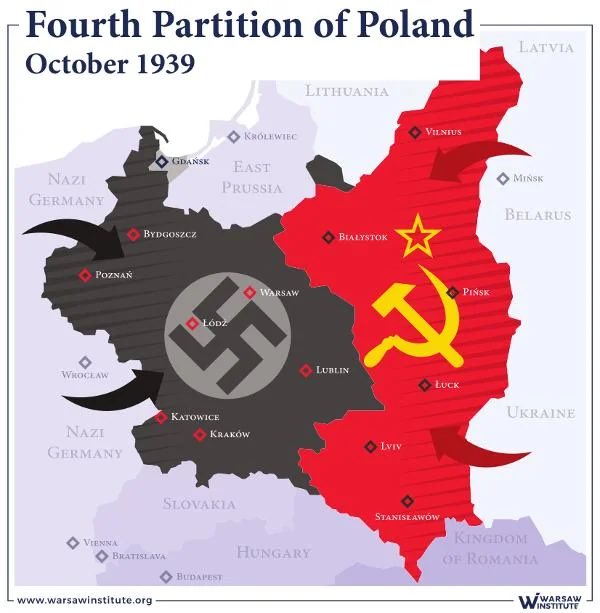
Socialism was at the origin of the war. Not as a coincidence. As a necessity. The socialist economic model generates contradictions it cannot resolve internally – the calculation problem, the misallocation, the stagnation, the mounting failure. War is the exit. It provides the external enemy that explains the internal failure. It justifies the total mobilization the system always wanted. It consumes the surplus population the economy cannot employ. It redirects the resentment outward.
Does this remind you of anything?
The evidence is not subtle. The NSDAP program of 1920 reads like a standard socialist manifesto. The economic reality confirmed it – price controls, industrial planning, state allocation of raw materials, entrepreneurs reduced to government functionaries. Private property in name only. Mises called it Zwangswirtschaft – coercive economy. Hayek dedicated a chapter of The Road to Serfdom to the socialist roots of Nazism. Both writing from observation, not retrospect.
After 1945 the Soviet victors imposed their version and attached the capitalist label to every rival. Western textbooks followed. The lie became the curriculum.
The real divide has never been left versus right. It is collective control versus individual freedom. Once you place National Socialism correctly within the family of collectivisms, the political spectrum becomes legible – and the war becomes explicable.
When the system fails — and it always fails — it needs an enemy. The bigger the failure, the bigger the enemy required.
Imagine being Poland. Squeezed between two socialist systems, both searching for their enemy.
We were it.
Comments Off on “Hitler’s socialism wasn’t just an internal economic policy – it was the cause of the war”


