
Tasting History with Max Miller
Published Jul 23, 2024Sautéed mushrooms in a honey, long pepper, and garum glaze
City/Region: Rome
Time Period: 1st CenturyFood tasters checking for poison aren’t around so much anymore, but it was an important job for thousands of years. But what happens when the food taster is the one adding in the poison?
Emperor Claudius found this out the hard way when he supposedly ate some of his favorite mushrooms, and then became the victim of a double-poisoning by his taster and his physician.
We can’t know for sure what Emperor Claudius’s favorite mushroom dish was, but I wouldn’t be surprised if it was this. I don’t care for the texture of mushrooms, but the flavor is excellent. The sweetness from the honey, spiciness from the long pepper, and the earthiness of the mushrooms combine for a complex dish that is delicious.
Another Method for Mushrooms
Place the chopped stalks in a clean pan, adding pepper, lovage, and a little honey. Mix with garum. Add a little oil.
— Apicius de re coquinaria, 1st century
November 27, 2024
The Deadly Job of Royal Food Taster
QotD: The Great Library and its competitors
One of the odder elements of the New Atheist myths about the Great Library is the strange idea that its (supposed) destruction somehow singlehandedly wiped out the (alleged) advanced scientific knowledge of the ancient world in one terrible cataclysm. It doesn’t take much thought, however, to realise this makes absolutely no sense. The idea that there was just one library in the whole of the ancient world is clearly absurd and, as the mentions of other rival libraries above have already made clear, there were of course hundreds of libraries, great and small, across the ancient world. Libraries and the communities of scholars and scribes that serviced them were established by rulers and civic worthies as the kind of prestige project that was seen as part of their role in ancient society and marked their city or territory as cultured and civilised.
The Ptolemies were not the only successors to Alexander who built a Mouseion with a library; their Seleucid rivals in Syria also built one in Antioch in the reigns of Antiochus IX Eusebes (114-95 BC) or Antiochus X Philopater (95-92 BC). Roman aristocrats and rulers also included the establishment of substantial libraries as part of their civic service. Julius Caesar had intended to establish a library next to the Forum in Rome but this was ultimately achieved after his death by Gaius Asinius Pollio (75 BC – 4 AD), a soldier, politician and scholar who retired to a life of study after the tumults of the Civil Wars. Augustus established the Palatine Library in the Temple of Apollo and founded another one in the Portus Octaviae, next to the Theatre of Marcellus at the southern end of the Field of Mars. Vespasian established one in the Temple of Peace in 70 AD, but probably the largest of the Roman libraries was that of Trajan in his new forum beside the famous column that celebrates his Dacian wars. As mentioned above, this large building probably contained around 20,000 scrolls and had two main chambers – one for Greek and the other for Latin authors. Trajan’s library also seems to have established a design and layout that would be the model for libraries for centuries: a hall with desks and tables for readers with books in niches or shelves around the walls and on a mezzanine level. Libraries also came to be established in Roman bath complexes, with a very large one at the Baths of Caracalla and another at the Baths of Diocletian.
Several of these libraries were substantial. The Library of Celsus at Ephesus was built in c. 117 AD by the son of Tiberius Julius Celsus Polemaeanus in honour of his father, who had been a senator and consul in Rome, and its reconstructed facade is one of the major archaeological features of the site today. It was said to be the third largest library in the ancient world, surpassed only by the great libraries of Pergamon and Alexandria. The Great Library of Pergamon was established by the Attalid rulers of that city state and it was the true rival of the library of the Alexandrian Mouseion. It is said that the Ptolemies were so threatened by its size and the reputation of its scholars that they banned the export of papyrus to Pergamon, causing the Attalids to commission the invention of parchment as a substitute, though this is most likely a legend. What is absolutely clear, however, is that the idea that the Great Library of Alexandria was unique, whether in nature or even in size, is nonsense.
The weird idea that the loss of the Great Library was some kind of singular disaster is at least partially due to the fact that none of the various other great libraries of the ancient world are known to casual readers, so it may be easy for them to assume it was somehow unique. It also seems to stem, again, from the emphasis in popular sources on the mythical immense size of its collection which, as discussed above, is based on a naive acceptance of varied and wildly exaggerated sources. Finally, it seems to stem in no small part from (yet again) Sagan’s influential but fanciful picture of the institution as a distinctively secular hub of scientific research and, by implication, technological innovation.
Tim O’Neill, “The Great Myths 5: The Destruction Of The Great Library Of Alexandria”, History for Atheists, 2017-07-02.
November 26, 2024
Orwell is more relevant now than at any time since his death
I’m delighted to find that Andrew Doyle shares my preference for Orwell the essayist over Orwell the novelist:
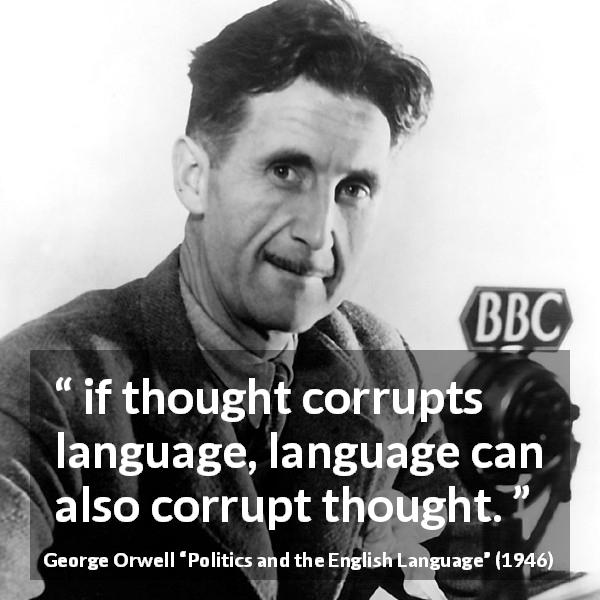
It is not without justification that Animal Farm (1945) and Nineteen Eighty-Four (1949) have become the keystones of George Orwell’s legacy. Personally, I’ve always favoured his essays, more often quoted than read in full. I recently wrote an article about his essays for the Washington Post, focusing on their relevance to today’s febrile political climate. You can read the article here. I would draw particular attention to the multitude of comments from left-wing readers who are apparently outraged at my argument (actually, Orwell’s argument) that authoritarianism is not specific to any one political tribe. They seem oddly determined to prove the point.
Orwell is unrivalled on the topic of the human instinct for oppressive behaviour, but his essays are far more wide-ranging than that. In these little masterworks, one senses a great thinker testing his own theses, forever fluctuating, refining his views in the very act of writing. The essays span the last two decades of his life, offering us the most direct possible insight into this unique mind.
[…]
I find Orwell’s disquisitions on literature to be among his most rewarding. “All art is propaganda”, he declares in his extended piece on Charles Dickens (1940) [link]. This conviction, flawed as is it, accounts for his determination to focus less on Dickens’s literary merits and more on his class consciousness, which is found wanting. Even better is Orwell’s rebuttal to Tolstoy’s strangely literal-minded reading of Shakespeare (1947’s “Lear, Tolstoy and the Fool” [link]), which is so rhetorically deft that it seems to settle the matter for good.
Another impressive essay, “Inside the Whale” (1940) [link], opens with a glowing assessment of Henry Miller’s Tropic of Cancer (1935) but soon broadens its range to cover many contemporary novelists and their approach to social commentary. The title is a reference to Miller’s remarks on the Biblical tale of Jonah, suggesting that life inside the whale has much to recommend it. Orwell puts it this way:
There you are, in the dark, cushioned space that exactly fits you, with yards of blubber between yourself and reality, able to keep up an attitude of the completest indifference, no matter what happens.
Orwell invites us to imagine that the whale is transparent, and so writers of Miller’s ilk may snuggle contentedly within, observing without interacting, recording snapshots of the world as it bounces by. This kind of inaction is anathema to Orwell, whose every written word seems to be driving towards the enactment of social change.
Orwell’s essays often serve as a cudgel to batter his detractors. He dislikes homosexuals, or those “fashionable pansies” who lack the masculine vigour to take up arms in defence of their country. He displays a similar lack of patience for the imperialistic middle-class “Blimps” and the anti-patriotic left-wing intelligentsia, or indeed anyone who adheres slavishly to any given political ideology. His work bears much of the stamp of the old left; that mix of social conservatism and economic leftism that we see most powerfully expressed in his 1941 essay “The Lion and the Unicorn” [link]. Bad writing is also a recurring bugbear; Orwell’s loathing of cliché and “ready-made metaphors” is one of the reasons his own prose style is so effervescent.
[…]
When Orwell pessimistically refers to “the remaining years of free speech”, one cannot help but be reminded of the increasingly authoritarian tendencies of today’s British government. He expresses irritation that more writers are not wielding their pens in the service of improving society. His own work, by contrast, is what he would term “constructive”, profoundly moral, and purposefully crafted in the hope of actuating real-world change. While other writers resigned themselves to a life inside the whale, Orwell was determined to cut his way out.
“Bluesky is going to give us hours of amusement as a platform full of wannabe school prefects all report each other”
I don’t mean to make poking fun at Twit/X alternative sites like Bluesky a regular thing, but the performative flouncing as progressives announce they’re leaving Twit/X for a more congenial — for which read “censorious” — site continues to amuse.
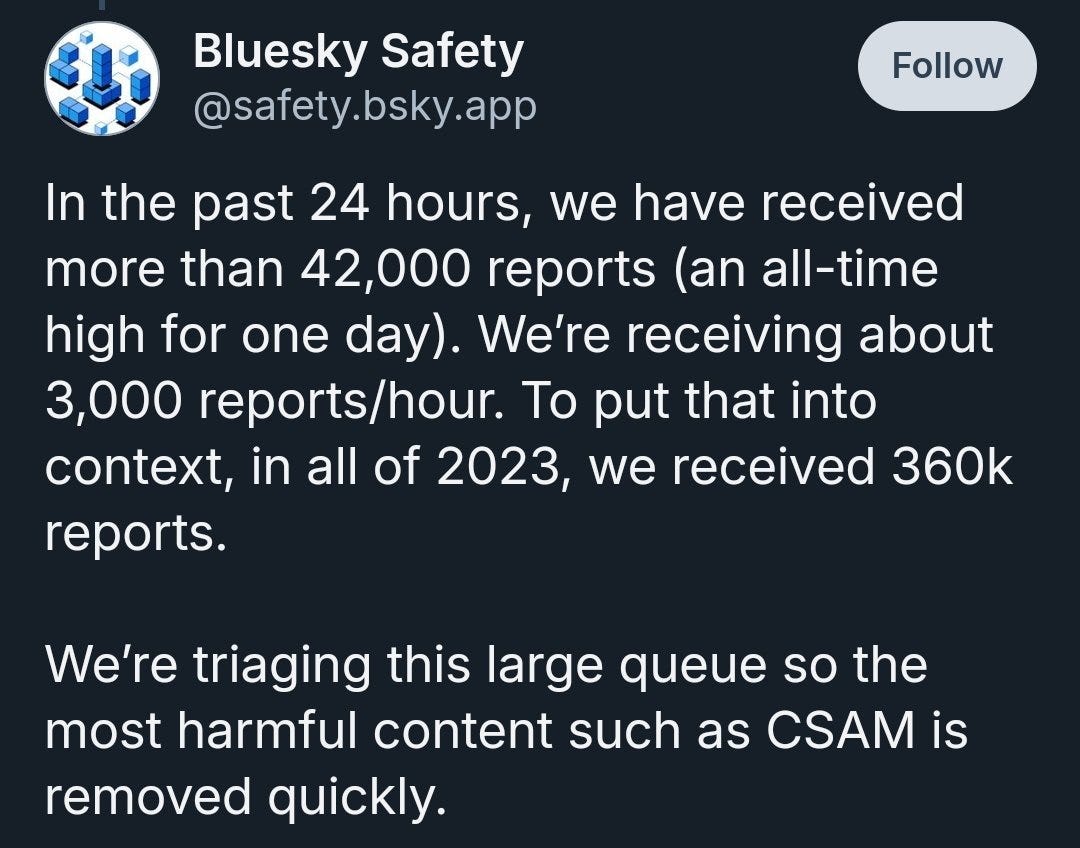
Bluesky welcomes former Twitter/X luminaries
I’m going to take a pop at a sub-group of flouncers, though, the ones moaning about being called hurty words. This includes a number of individuals who genuinely seem to think it’s their role in life to go looking for nasty bigoted shite, then report it to Twitter’s overlords (and now Bluesky’s overlords as well, if things like [the image on the right] are anything to go by).
“Bluesky is going to give us hours of amusement as a platform full of wannabe school prefects all report each other” seems a fair assessment.
And yes, I have to engage in a little ritual genuflection here, because I have genuinely been called a large number of nasty names in my life. And despite that, dibber-dobbers still give me hives.
If I had a quid for every use of “dyke” (and related) sent my way, I would be matching millions with sundry oil sheiks, and that’s before we get to the ire directed at any columnist with whom ordinary members of the public disagree. I am old enough to have received thousands of abusive letters (about both novels and columns), some of them written in green ink. People are allowed to dislike me and my kind, or to argue that I’ve written a load of cobblers. They’re also allowed to dislike you and your kind. It would be astonishingly easy for me to wander over to Arabic Twitter and report lots of sincere Muslims for saying bigoted things about homosexuals. I don’t engage in this behaviour because I don’t expect the world to be my friend.
Relatedly (and this is directed at ethnic minorities as well as fellow gayers), a lot of folks from “historically disadvantaged groups” have become dab hands at dishing it out over the last twenty or so years. A necessary corollary of this behaviour is “learn to take it”. Yes, that means you. People are not going to stop saying hurty words to each other. People are also going to judge you based on the behaviour of your worst activists and vote accordingly (see recent US election results).
What of the core claims being made? Is Twitter genuinely worse now, a victim of what goes by the name “social media enshittification“?
Well, yes and no. I know many people dislike what Musk has done to Twitter, but when he made “likes” private, he stopped his site being used as a vector for HR vindictiveness (something about which HR mavens have complained, by the way, at least privately). It’s also now substantially more difficult to generate a pile-on using a quote-tweet, as well as possible to read tweets (but without interaction) from people who are hot on the block button.
The latter change has allowed me to establish why Baroness Nicholson had me blocked. I’d always wondered, because she’s had me blocked for as long as I can remember, yet like me, she can legitimately be described as “sex realist” or “gender-critical”. Musk’s change meant I was able for the first time to see an entire thread underneath one of her tweets, so learned that she blocks anyone — friend and foe alike — for swearing. Women who know her socially and get on with her well “IRL” have been blocked for saying “bugger” and “shite” on Twitter.
Well, glad that’s cleared up. Good to know.
The worst change Musk has made involves deboosting external links. This first emerged in April last year, in response to Substack releasing Notes (which Musk considered so derivative of Twitter’s code as to be a “clone”). At first only direct links to Substack were affected. If you had your own domain — as I do — you were fine. However, external link deboosting is now being applied uniformly. Everyone from a local tradesman selling new driveways and conservatories to the BBC and the Spectator now has to make use of some tedious version of “link in following tweet” or “link in bio”.
If Musk doesn’t fix this, he will legitimately lose the journalists and commentators currently on the site. Those people came, originally, to share stuff from their mastheads, and this applies regardless of politics. I first gained a following thanks to professional experience — yes, it was once fine for commercial solicitors to natter on the socials about the Enterprise Investment Scheme and how it related to start-ups and spin-outs etc — and later through Speccie columns along with a couple of books. A tweet from Tim Harford praising my second novel (with a link, bless him) went “viral” and led to thousands of sales. Pieces for the magazine proved popular. Just as I enjoyed Twitter for other people’s links, other people paid me the same courtesy.
Spotted on Instapundit:
Crony Capitalist Canada – “Conservative Leader Pierre Poilievre … has vowed to protect Big Dairy just like every other party leader”
In the National Post, Chris Selley discusses the latest attempt to further protect the outrageous profits our dairy companies make by overcharging Canadians for milk, butter, cheese, and other dairy products:

That unelected senators should not overrule the will of the House of Commons has always struck me as a rule most Canadians could agree on, whatever they think ought to happen with Canada’s upper chamber. Senators can propose amendments to bad bills, rake ministers over the coals at committee, call witnesses the House wasn’t interested in for whatever reason, raise red flags that haven’t yet been raised, all to the good. But gutting a bill, as the Senate has done with proposed legislation that would protect supply management in Canadian dairy, poultry and eggs even more than it’s already protected, is not kosher.
Not all violations of this policy are equally appalling, however. When the House of Commons is clearly not operating for the benefit of Canadians, when its focus demonstrably isn’t the public good but rather coddling and currying favour with special interests, it behooves the Senate to intervene as strenuously as possible while still at the end of the day respecting the lower chamber’s democratic legitimacy.
Coddling and currying favour is exactly what C-282, a private member’s bill from Bloc Québécois Luc Thériault, does: It proposes to make it illegal for a future government to lower the tariff rate for foreign products in supply-managed industries. You could call it the “no to cheaper groceries act.” Some senators wish to neuter it, such that it wouldn’t apply to any existing trade deals or deals already in negotiation. Bloc Leader Yves-François Blanchet had originally demanded the bill passed as one condition of keeping the Liberals afloat (although his deadline to do so has passed).
Fifty-one MPs of 338 opposed the pricey-groceries act at third reading. I would have said “only 51” except that’s a shocking number: 49 Conservatives and two Liberals, Nathaniel Erskine-Smith and Chandra Arya. It’s almost reason for hope … except of course that Conservative Leader Pierre Poilievre voted for it, and has vowed to protect Big Dairy just like every other party leader. It goes without saying that Prime Minister Justin Trudeau not only supported it, but has come out against the Senate’s amendments.
“We will not accept any bill that minimizes or eliminates the House’s obligation to protect supply management in any future trade agreement,” Trudeau reassured Blanchet in the House on Wednesday. ” No matter what the Senate does, the will of the House is clear.”
I mean, what elected politician in Ottawa gives a shit about Canadians being gouged on grocery staples every week? They’d rather get the support of the milk, poultry and egg crony capitalists than help ordinary Canadians, and they’re terrified of being portrayed as anti-Quebec in an election year. Spineless cowards, the lot of them.
The ghost airport of Nicosia: Rare glimpse inside the abandoned 1974 battleground
Forces News
Published Jul 20, 2024Nicosia International Airport was once a busy hub full of holidaymakers but since the Cyprus conflict of 1974, it has been frozen in time.
Today, the disused airport resembles a ghost town as it sits abandoned in the 180km buffer zone dividing the Republic of Cyprus and the Turkish-occupied north.
On the 50th anniversary of the conflict, Forces News goes inside the eerie airport and learns how it became the site of a major battle.
(more…)
QotD: Hesiod’s five ages of man
Hesiod is the seventh century BC management book writer. He didn’t write about digital strategy, but his poems drone on in the earnest monotone of an old-school sociology lecturer who — after years of correcting student papers — decides to try his hand at fine letters. Hesiod is ace at conveying fact, but not at re-inventing it. This makes him a fine chronicler, but not a poet. I cannot imagine anyone reading Works and Days today for anything other than anthropological curiosity.
I don’t remember all eight hundred lines of Works and Days — just five stanzas: one for each of the Five Ages of Men. First came the Golden Age, in which the land was bounteous, the forests were rich with game, and men were decent, happy, and favoured by the gods. But this state of bliss didn’t last. Cracks began to appear during the next generation with the emergence of the Silver Race — small crooks and delinquents who “could not keep from sinning and from wrongdoing one another”. Zeus didn’t like them and eventually killed them off. The third generation, the Bronze Race, managed to be an even greater disgrace, a bunch of hoodlums of great physical strength with “unconquerable arms which grew from their shoulders on their strong limbs.” (I find this image rather powerful. It reminds me of my gym on a Friday night.) Things looked up momentarily during the subsequent Heroic Age, as Zeus created a “god-like race of hero-men called demi-gods”. But everything went definitively, irrevocably tits-up in the fifth and final age: the Iron Age. Land became barren, crops wilted, stock died of disease; men were poor, men were bitter, son betrayed father, neighbour killed neighbour, chaos and treachery ruled.
As a story of decline and fall, it’s a nice one (although I’ve seen better). In terms of literary merit, it’s nowhere near Homer. So why am I harping on Hesiod? (Now do pay attention, as here comes the point of this essay.) The key variable between the time when men were happy and the time when they were not, according to Hesiod, is work. “In the Golden Age,” he writes, men “lived like gods … remote and free from … hard toil …” But in the Iron Age, “men never rest from labour …” Writing about the Iron Age — the age of hard work and misery — Hesiod wrote about his own time, but he also wrote about our time. We live in the Iron Age. It is a sad age. It is the age when people have to work. And work kills the spirit.
Elena Shalneva “Work — the Tragedy of Our Age”, Quillette, 2020-01-29.
November 25, 2024
Andrew Sullivan as an (unconscious?) exemplar of the mentalités school
I sent the URL to Andrew Sullivan’s article I linked to yesterday to Severian to see what he’d make of it. He certainly didn’t disappoint me:

Founding Questions coat of arms by “urbando”.
The Latin motto translates to “We are so irrevocably fucked”.
Because someone like Andrew Sullivan is the kind of guy he is, we might have a good example to hand of a mentalités approach to History [Wiki]. We can all play along, because the key to a mentalités approach is a version of our favorite game, “For That to Be True”. Let’s see if we can’t ferret out some of Sullivan’s cultural assumptions here, and what that might tell us about our world.
There was something truly surreal about President Biden suddenly changing course and agreeing to give Ukraine advanced long-range missiles to attack deep inside Russian territory in the last two months of his administration. There was no speech to the nation; no debate in the Senate; just a quiet demonstration of unilateral presidential fuck-you power. You know: the kind we’ve long worried about with Donald Trump.
A couple things stand out immediately. The great thing about fags and chicks as pundits is that they’re hyper-emotional, so they always go for the big splashy adjectives. “Surreal”, for instance (and not just surreal, “truly surreal”). Let us instead return to the cool, rational prose of 18th century diplomacy, and term this a volte-face.
They happen all the time, of course. Indeed it’s one of the standard criticisms of representative government — they’re impossible to deal with, long term, because the volte-face is baked into the system. No agreement is so airtight that it’s not at immediate risk of repudiation if one of the other guys wins the next election. This is Diplomacy 101.
So, there’s the first assumption we need to examine: Since this kind of thing does, in fact, happen all the time — as any professional political analyst surely knows — why does this particular volte-face seem so “truly surreal?”
Moreover, it’s not as if the Biden Administration has been the model of consistency up to now. Not only is the diplomatic volte-face pretty common, so is the domestic — again, it’s a standard criticism of parliamentary-style government. And not just during election season. Domestic policy changes with the winds, because that’s kinda what it’s supposed to do. Vox populi, vox dei, at least as far back as the early 18th century, and the populi are notoriously fickle.
So why is this one “truly surreal”? If I were one of those Peter Turchin or Steve Sailer types, I’d plug all the Biden Administration’s policy decisions, foreign and domestic, into an Excel sheet and graph the changes. You know, plotting “variance ratios” against “consistency coefficients” and whatnot. It’d be all over the damn place, for reasons we here in this clubhouse call “The Do Long Bridge” — Brandon is the titular head of government, but there ain’t no fuckin’ CO, and if you look at the spastic incoherence of “Biden’s” policy decisions you’d see it plain as day.
It seems extremely unlikely, to put it no stronger, that a paid political analyst like Andrew Sullivan doesn’t see that. So either he does see it, but is pretending not to, for fun and profit — possible cultural assumption #1 — or he truly doesn’t see it, which would be revealing of cultural assumption #2.
I can’t decide which is which yet, but I can see a common denominator for both. It’s the last sentence I quoted in that paragraph:
You know: the kind we’ve long worried about with Donald Trump.
There’s a whole world full of embedded assumptions there. Does Trump actually do that — “a quiet demonstration of unilateral presidential fuck-you power”? […] To me, it sure looks like Trump was actually remarkably restrained when it came to unilateral demonstrations of presidential fuck-you power, alas, compared to Biden and especially Obama (he of the infamous pen and phone). And the few times he tried, he got Hawaiian Judged to hell and back. But since I don’t have my Steve Sailer graph to hand, I’m not going to assert that (maybe it’s one of my assumptions — I really want to see Trump exercise some fuck-you power).
And the verb is extremely interesting. They’re worried about Trump doing it; they’ve heretofore not been bothered by Biden doing it.
In search of bluer skies
In The Critic, Benedict Spence channels his inner David Attenborough to document the majestic migration of American progressives from their habitual grazing lands to friendlier territory:

What will Twitter do without its smuggest inhabitants?
And so we come to it again. It is that time of year when we put on our David Attenborough voices, and talk in low, slightly wistful tones about the great migration that is about to unfold. Everywuh you look, creatures great and small are beginning their treacherous juhneys across a vast and inhospitable wilduhness to happiuh hunting grounds and more pleasant pastures under the clear blue skies. The hullabaloo that accompanies them is impossible to miss — across the plains, the cries go up from elders to alert the rest of the herd of the imminent departure.
Though some may never return from this arduous trek, most will. Disavow yourself of the mental image of elephants and zebras crossing the African savannah — that’s not what we’re here for. This migration is metaversical in nature: it is time, once more, for people to announce they are leaving Twitter.
This year’s exodus came later than usual, prompted by Donald Trump’s bulldozer of a victory over Kamala Harris in the US presidential election, with grown men and women across the country — and its second largest airbase, the UK — deciding that Elon Musk, the platform’s owner and the Orange Man’s endorser-in-chief, was at least partly responsible for this travesty. Not the economy, you understand, oh no. Nor immigration, nor the preoccupation by Democrats with shoulder-chewingly stupid culture war issues the average voter thinks are at best mad and at worst satanic.
No, no, it is all about Musk — who is at once the world’s wealthiest evil genius and also a gibbering moron, according to people who thought Cacklin’ Kamala was a born winner. Musk, we are told, has ushered in a stream of “hate” ever since buying Twitter and rebranding it 10, warping the minds of the impressionable and irreparably damaging the future of the West by facilitating Trump’s return.
This is not Musk’s only crime, though. He has also tweaked other aspects of X’s features, including the block function, making it possible for those on the receiving end of this internal exile to see the posts of their nemeses again without being able to interact with them. This was for a fair few blockees how they were reminded of the existence of their blockers, many of whom they had long since forgotten. Often, in the same instance, it was also how they learned said blocker was off somewhere else.
Musk has also moved to erode the power of institutions and individuals who lived their lives high on the power of credentialism, and the authority this brought them. The changing of blue tick criteria and the emphasis on community notes now means many who were once feted on the site by virtue of who they were must now work harder for their dopamine. But above all else, Musk has refused to silence a swathe of right wing voices who always existed but lived their X lives in the shadows. The platform became more right wing, and for many that was just too much. Having been reliably told throughout the past year that the crude reply guys were just Russian bots and that their gal would ride over them on a wave to victory, they and their allies over here — the infamous adults back in charge of the UK — are doing the grownup thing and going off in a huff to play somewhere else.
Looking toward the first order effects of 47
At Postcards From Barsoom, John Carter is delighted that his pessimistic election forecast turned out to be wrong and considers what the incoming Trump administration will be doing in the short-term:
There are obvious parallels between the 2024 election, the 2016 election, and the Brexit vote, all of which are a bit awkward for elite theory maximalists. Their position, taken to its extreme, seems to be that only the elite can actually do things, that all political phenomena are ultimately a consequence of elite machinations. Which makes elite theory in many ways the highbrow version of conspiracy theory, the main difference being that they talk about the Cathedral’s systems of power instead of the Illuminati, the Freemasons, and smoky backrooms. And yet, the elite clearly don’t always get their way. In the case of Brexit, the elite were absolutely unanimous in their support for Remain … and the elite lost. Similarly in the case of the 2016 US election. Elite preferences carry an enormous amount of weight; it’s generally much better for a cause to have elite support than suffer elite opposition. But elites are not actually decisive. They can be beaten.
It’s obviously much too early to judge the 47th US presidency, which hasn’t started yet. Cynics expect a repeat of 2016: just as Trump’s promises to drain the swamp and build the wall came to, if not nothing, then very little, so will his promises to deport them all, replace the income tax with tariffs, reign in the universities by going after their accreditation and endowments, drain the swamp for real this time, and so on prove to be so much hot air. So far all we know are Trump’s cabinet picks and other appointments, which suggest that this cynicism might be premature. […]
The new Trump admin shows every sign of gearing up for a Dark MAGA rampage through the Beltway.
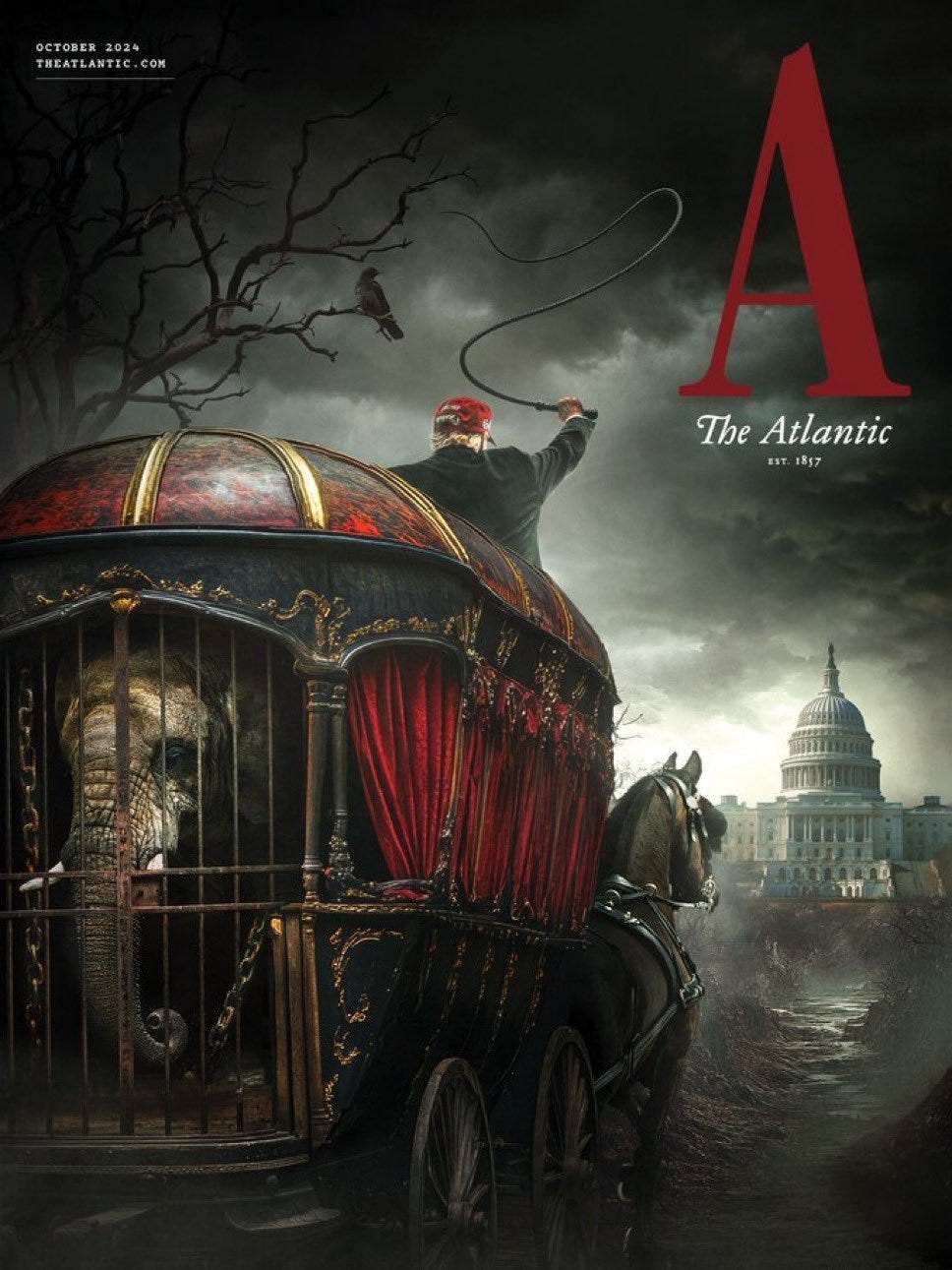
If you’re curious about where Dark MAGA came from, why yes it was memed into reality. Aristophanes
tells the wild saga: from in-joke to shitcoin to the hat on Elon Musk’s head.They aren’t going to just drain the swamp. They’re going to drain it, dry it, soak it in gasoline, and set it on fire. They are going to purge the US government of the useless, the incompetent, the subversive, and the criminal. At least, that seems to be the intention … and given the way the rats are scrambling to escape the ship before it sinks, the regime’s minions, at least, seem to think that plan has a good chance of succeeding. […]
Of course, a lot could happen between now and January. The Democrats might find some convoluted legal pathway to deprive The Insurrectionist of the Oval Office, as Tree of Woe suggested, which of course would initiate a constitutional crisis and probably a civil war. They could assassinate him, which would also probably start a civil war, and which is probably why Trump has been holed up in Mar-a-Lago since the election. Either of these outcomes would probably place JD Vance in the presidency, which is probably much worse for the regime than Trump: Vance is marine corps combat vet who reads Curtis Yarvin and is fluent enough in meme that he probably has a frog alt on Twitter.
[…]
News that suicides spiked after the election is apparently fake, though crisis call centres catering to the Pronoun Jugend did experience a massive increase, and one guy apparently unalived his entire family. They’re still in a state of shock: shaving their heads, vowing to start a sex strike, fleeing to Canada (I do not recommend).
The left are religious fanatics, and religious fanatics don’t give up just because it looks hopeless. It’s also worth recalling that the last time Trump won, the riots didn’t start until inauguration. There’s plenty of time yet, and there are a lot of very wealthy and very influential people who probably feel they have nothing to lose as their precious oxen are in danger of being lethally gored by Dark MAGA on the Washington Mall as a sacrifice to America’s Founding gods, after which they themselves will be hanged from Wotan’s Tree of Liberty. Note that it doesn’t matter if Trump will really follow through with all of this; what matters is if the other side thinks that he will. Ruling out a dramatic escalation in civil violence in the US is almost certainly hasty.
[…]
Another play the regime could make is to just start World War III before Trump takes office, either in order to justify a military coup d’etat, or just to dump a catastrophe in Trump’s lap so that he’ll be too busy dealing with that to drain the swamp. They definitely seem to be ramping things up in Ukraine, with the new strategy of long-distance missile strikes deep into Russian territory. The idea is probably to provoke the bear so badly that it starts mauling NATO countries directly, rather than just chewing through their exhausted national arsenals in the mud of the Donbass. That might work; then again, Putin knows full well that all he has to do is wait a couple months and he’ll be dealing with Trump directly, and Trump is on record as wanting to wind down hostilities as a top priority as soon as he’s in office. Vlad may be a bad man, but he is a very patient bad man.
Assuming that the regime is unsuccessful in baiting Russia into a direct attack on Europe, Trump’s victory probably has very big, tumultuous, and positive implications for European politics. Positive, at least, for anyone who doesn’t hate Europe … and therefore very bad implications for the people currently running the civilizational centre of the human species into the dirt.
The Germans, at least, seem to think so.
Yes, it’s real.
Chancellor Scholz’ unstable “traffic light” coalition disintegrated almost immediately after Trump was elected, sending Germany into its own election … in which the AfD is poised to do very well for itself, much to the consternation of Germany’s political class. eugyppius has been doing invaluable work covering Germany’s politics for the anglosphere audience; he provides an excellent overview of the reasons for the coalition’s collapse in this recent interview on the J Burden show.


The Experimental SOE Welrod MkI Prototype
Forgotten Weapons
Published Aug 12, 2024The Welrod was a program to develop a silent assassination pistol for British SOE (Special Operations Executive) late in 1942. It needed to be chambered in the .32 ACP cartridge, be effective to a range of 15m, and have its firing not recognizable as a firearm at 50m distance. The project was led by Major Hugh Quentin Reeves, who developed much of SOE’s inventory of gadgets.
The Welrod concept was ready in January 1943, and it was not quite the Welrod that we recognize today. This initial MkI design used a fixed internal 5-round magazine and a thumb trigger, along with a rifle style bolt action mechanism. Samples were produced in April 1943, and testing showed that it was rather awkward to use. A MkII version was quickly developed in June 1943 with a more traditional style of grip and magazine, and formal trials led to the adoption of that MkII design. Incidentally, this is why the first Welrod produced was the MkII, and the later production version in 9mm was designated the MkI (it was the first mark of 9mm Welrod).
Eventually many thousands of Welrod pistols were manufactured, and they almost certainly remain in limited use to this day. This example we have today is the only surviving MkI example, however.
(more…)
QotD: Le Corbusier
But most bureaucrats aren’t evil, just ignorant … and as Scott shows, this ignorance isn’t really their fault. They don’t know what they don’t know, because they can’t know. Very few bureaucratic cock-ups are as blatant as Chandigarh, where all anyone has to do is look at pictures for five minutes to conclude “you couldn’t pay me enough to move there”.
Severian, “The Finger is Not the Moon”, Rotten Chestnuts, 2021-09-14.
November 24, 2024
“… if Russia were found to have had its own troops assemble a long-range missile and help launch it into the United States, do you think a US president would feel able to let it slide?”
It probably tightened a lot of already tight sphincters when it was announced that President Biden had authorized the Ukrainian government to use US-supplied long-range missiles to attack targets on Russian soil:

There was something truly surreal about President Biden suddenly changing course and agreeing to give Ukraine advanced long-range missiles to attack deep inside Russian territory in the last two months of his administration. There was no speech to the nation; no debate in the Senate; just a quiet demonstration of unilateral presidential fuck-you power. You know: the kind we’ve long worried about with Donald Trump. The missiles up the ante considerably against a nuclear power for a simple reason. As Putin noted:
experts are well aware, and the Russian side has repeatedly emphasized this, that it is it is impossible to use such weapons without the direct involvement of military specialists of the countries producing such weapons.
The tiny tsar continued:
We consider ourselves entitled to use our weapons against the military facilities of those countries that allow to use their weapons against our facilities. And in case of escalation of aggressive actions we will respond also decisively and mirrored.
And he looked on edge, bedraggled and belligerent, his arms and hands not moving a millimeter in what sure looks like AI.
There was a time when a NATO missile strike on Russian territory, followed by a Russian threat to attack NATO “military facilities” in response, would have caused the world to stop dead, paralyzed by the fear of nuclear armageddon. Yet here we are, blithely preoccupied by Pete Hegseth’s sexual exploits and Congressional bathrooms.
Others are not so sanguine. “I believe that in 2024 we can absolutely believe that the Third World War has begun,” Ukraine’s former military chief, Valery Zaluzhny, warned yesterday, noting both the new involvement of NATO troops and the involvement of North Korea. Our own president, having brought us much closer to the brink as a lame duck, seemed unconcerned. He was last seen wandering off-stage in the vague direction of the Brazilian rainforest. Not optimal.
The UK prime minister, Keir Starmer, was even punchier, and pledged to allow Ukraine to use British long-range missiles as well: “We need to double down. We need to make sure Ukraine has what is necessary for as long as necessary, because we cannot allow Putin to win this war”. When asked if he was prepared to risk the UK forces or Ukraine or a third country like Poland being nuked in response, as Putin has threatened, Starmer simply ignored the question.
Meanwhile, just to keep things from escalating, the deputy chief of the British defense staff told a parliamentary committee yesterday:
If the British Army was asked to fight tonight, it would fight tonight. I don’t think anybody in this room should be under any illusion that if the Russians invaded Eastern Europe tonight, then we would meet them in that fight.
There seems to be a general impression that Putin is of course bluffing, that NATO can keep lobbing missiles into Russian territory with minimal consequences, and nothing could possibly go wrong.
But Putin has responded by launching a long-range missile that could be used to carry a nuke but didn’t, as well as lowering the bar for the use of nukes in his military “doctrine“. And ask yourself: if Russia were found to have had its own troops assemble a long-range missile and help launch it into the United States, do you think a US president would feel able to let it slide? Here’s what the British missile, the Storm Shadow, did in hitting an underground military facility in Kursk, according to unverified Russia media sources:
[The strike] resulted in the Death of 18 Russian Officers, including a Senior Commander, as well as 3 North Korean Officers. In addition, a Dozen other Soldiers and Officers were Wounded in the Attack, including one of North Korea’s most Senior Generals.
I can’t verify that, but it’s perfectly possible. To have NATO’s fingers on the targeting and launch of that missile puts us in a whole new category of conflict.
The job of a president is to keep us far, far away from any risk of nuclear conflict, as Biden seemed to understand until now. And any student of history will know that blithe complacency as two sides trade military escalations is often exactly the precursor to something going very, very wrong. Accidents happen; misjudgments occur; the point of never getting to this point is that this point contains a host of unknowables, some of them globally existential.
I assume that this is all about strengthening Kyiv’s hand in what will be grueling negotiations to end the conflict once Donald Trump gets back into office. Or the intelligence is worse than we know and it’s about avoiding an Ukraine collapse before Biden leaves office — which, after Afghanistan, would be a final, damning verdict on his foreign policy. Or the intelligence is better than we know and the Russian economy is so weak and his military so depleted that NATO thinks this extra pressure will force Putin to crack. Or it’s a norm-defying attempt from an outgoing administration to derail any peace process the incoming one might want to start. The latter possibility — with Biden rolling the dice because he thinks someone else will have to face the music — is not a minimal risk.
How Allied and Nazi Generals Created the Clean Wehrmacht Myth
World War Two
Published 23 Nov 2024After the fall of the Third Reich, many of Hitler’s generals are convicted as war criminals by the Allies and condemned to prison and disgrace. Yet, within a few years, the Western Powers embrace them Cold War partners against the Soviet Union. In this new alliance, they rewrite history and create the enduring myth of the “clean Wehrmacht“.
(more…)
Trump breaks the electoral pattern that had persisted for decades
In Quillette, Jason Garshfield outlines the “traditional” pattern of presidential elections and identifies the relatively few breaks in that pattern and how Donald Trump represents a major disruption compared to what outside observers might have expected to see:

How The New Republic saw Donald Trump during the 2024 election campaign.
… Yet the symbolic power of the presidency is paramount. We speak of the 1980s as the Reagan Era and the 1990s as the Clinton Era, not the “Tip O’Neill Era” or the “Newt Gingrich Era”. The presidency represents control over the federal government, and ultimately over the spirit and the direction of the nation. It is the highest political prize, and a party consistently denied the presidency will not remain a satisfied player in the system, even if they achieve political success on other meaningful fronts. This is dangerous in a nation where mutual assent is a prerequisite for the smooth functioning of a free and fair electoral system.
Trump’s 2024 victory does not feel as shocking as his 2016 victory did. After all, we’ve seen this show before. But 2024 is a more remarkable coup than 2016. Back then, Trump’s victory did not buck the prevailing trend. This time, he won against that trend and shattered the pattern.
Some have argued that Trump’s indomitable force of personality, demonstrated in the way in which he has refashioned American politics in his image over the past decade, vindicates the Great Man Theory of History. For instance, Yair Rosenberg, writing for The Atlantic in 2022, commented that Trump’s “personal idiosyncrasies — and, I would argue, malignancies — altered the course of American history in directions it otherwise would not have gone”. To Rosenberg, this represented a turn for the worse, but many of Trump’s supporters would say the same, while casting it in a more positive light. As with Napoleon Bonaparte, one cannot confidently state that if Trump had never been born, someone like him would have done what he did.
Elsewhere in this magazine, I compare Donald Trump to the Mule, a character in Isaac Asimov’s Foundation stories who, with his unique superpower of mind control, manages to undo the entire Seldon Plan which had been designed to direct the future of the galaxy. In Asimov’s fictional social science of psychohistory, humans are compared to molecules within a gas: the path of each individual molecule is unpredictable, but the movement of the gas as a whole can be predicted. But the psychohistorians assume that no one molecule can ever have a significant effect on the whole — and they are mistaken.
Trump is a particle that defies measurement. It is as though Heisenberg’s Uncertainty Principle applies to him: you can know where he is, or how fast he is going, but never both at the same time. Once you think you have him pinned down to a fixed point in the cosmos, he throws your calculations into chaos. This drives his opponents crazy and imbues his most fervent supporters with a near-messianic belief that he will triumph against any odds.
Social scientists tend to hate the Great Man Theory of History because it renders their work entirely meaningless. No matter how strong certain social forces may be, they can ultimately be dispensed with at any time by unpredictable mighty figures. As a result, the future is frighteningly unknowable. But both Great Man Theory and historical determinism have dire implications. Either individuals are irrelevant, or else we live in an unknowable and irrational universe, which unfolds according to no fixed laws. Neither theory allows rationalism and individualism to coexist.
The durability of the eight-year pattern in American politics seems to provide strong evidence against the Great Man Theory. Many of the leaders and almost-leaders of the United States since 1952 have been outsized personalities, yet the sociological paradigm suggests that their personal charisma had little impact on their success or failure. In this view, neither Barack Obama’s charm nor John McCain and Mitt Romney’s lack of charm radically influenced the outcomes of the 2008 and 2012 elections. It was simply time for a Democrat to win, and McCain and Romney might as well not have run. For that matter, both parties might as well have saved their energy and agreed to simply exchange places every eight years — that is, if we accept historical determinism as the driving factor.
Before Trump, only two other figures in postwar America came close to being Great Men. They were the finalists of the 1980 election: Ronald Reagan, who managed to win against the pattern and usher in twelve straight years of Republican control, and Jimmy Carter, who lost the election he should have won. It is debatable as to whether the 1980 election was more a story of Carter’s weakness or Reagan’s strength, but both undoubtedly played a role. Now Trump has become both Carter and Reagan, the unexpected loser of one election and the unexpected winner of another.


