
Black unemployment, which had been the same as that of whites in the 1950s, from the early 1960s rose above white unemployment. The gap between black and white unemployment widened. Welfare programs funded by presidents Johnson and Nixon expanded rolls to an appalling extent — appalling because welfare fostered a new sense of hopelessness and disenfranchisement among those who received it. “Boy, were we wrong about a guaranteed income!” wrote that most honest of policy makers, Daniel Patrick Moynihan in 1978, looking back on a pilot program that had prolonged unemployment rather than met its goal, curtailing joblessness. The “worker versus employer” culture promoted by the unions and tolerated by the automakers suppressed creativity on the plant floor and in executive officers. Detroit built shoddy autos — the whistleblower Ralph Nader was correct when he charged that American cars were not safe. Detroit failed to come up with an automobile to compete with those made by other foreign automakers. Whereas in the 1930s American automakers’ productivity amounted to triple that of their German competitors, by the late 1960s and 1970s, German and Japanese automakers were catching up to it or pulling ahead. In the end the worker benefits that union leaders in their social democratic aspirations extracted from companies rendered the same companies so uncompetitive that employers in our industrial centers lost not merely benefits but jobs themselves. Vibrant centers of industry became “the rust belt”, something to abandon. […] What the 1960s experiment and its 1970s results suggest is that social democratic compromise comes close enough to socialism to cause economic tragedy.
Amity Shlaes, Great Society: A New History, 2020.
November 30, 2024
November 29, 2024
Dr. Jay Bhattacharya nominated as Director of the US National Institutes of Health
From the point of view of the establishment, the barbarians are well and truly inside the gates, as President-elect Donald Trump has nominated Stanford epidemiologist Dr. Jay Bhattacharya as the next director of the National Institutes of Health:

Dr. Jay Bhattacharya, Donald Trump’s nominee as Director of the National Health Institutes.
Photo by Taleed Brown, 2020, via Wikimedia Commons.
Four years ago, Jay Bhattacharya was ostracized by his colleagues at Stanford and censored on social media platforms thanks to a campaign against him by the public-health establishment. The director of the National Institutes of Health, Francis Collins, sent an email to another NIH official, Anthony Fauci, urging a “quick and devastating published takedown” of Bhattacharya and his fellow “fringe epidemiologists”.
Bhattacharya is far from the fringe today. Donald Trump nominated him this week for Collins’s old job, director of the NIH. Assuming the Senate confirms him, it will be a major victory for science and academic freedom — and a serious threat to the universities that suppressed scientific debate and promoted disastrous policies during the pandemic, causing public trust in science to plummet. Academic researchers and administrators have mostly refused to acknowledge their mistakes, much less make amends, but Bhattacharya promised yesterday to “reform American scientific institutions so that they are worthy of trust again”.
As NIH director, he would wield a potent tool to induce reform: money. Stanford and more than a dozen other universities each get more than $500 million annually in grants from the NIH, the world’s largest funder of biomedical research. The NIH grants support not only researchers but also their universities’ bureaucracies, which collect a hefty surcharge to cover supposed overhead costs. The federal largesse has helped finance the administrative bloat at universities, including the expansion of diversity, equity, and inclusion bureaucracies under the Biden administration, which took into account a university’s commitment to DEI principles when deciding whether to award grants from the NIH and other agencies.
Those priorities are about to change. Trump has vowed to rescind immediately Biden’s executive order directing federal agencies to promote DEI. During his first term, Trump threatened to issue an executive order barring universities from receiving federal funds if they suppressed free speech. He didn’t issue that order, but whether or not he does so in his next term, the NIH director will already have the power to consider a university’s commitment to academic freedom in deciding whether or not to award funds.
“For science to thrive and progress, we must be open-minded and allow vigorous and passionate debate,” says Martin Kulldorff, a former professor of medicine at Harvard. “Why should taxpayers subsidize universities that don’t allow that?” Kulldorff, an eminent epidemiologist, lost his job at Harvard after he became an early and outspoken critic of pandemic policies. In 2020, he joined with Bhattacharya and Sunetra Gupta, an epidemiologist at Oxford, to write the Great Barrington Declaration, a critique of lockdowns that was signed by tens of thousands of scientists and physicians.
Bhattacharya, who has a Ph.D. in economics as well as an M.D. from Stanford, hung on to his job as professor of health policy at the latter’s medical school, but his views were taboo on campus. After he and colleagues did a field study at the start of the pandemic showing that the Covid fatality rate was much lower than the doomsday number used to justify lockdowns, they were vilified by academics and journalists, and Stanford subjected them to a two-month inquiry by an outside legal firm. (They were vindicated by the inquiry and also by subsequent research confirming their findings.)
Why the Communists subjugated half of Europe
World War Two
Published 28 Nov 2024From the Bolshevik Revolution to post-war dominance, Stalin’s plans forever changed Europe’s political landscape. Discover how the Soviet Union used ideology, diplomacy, military power, and ruthless suppression to control Eastern Europe and establish a new world order.
(more…)
Trump is a deals guy … and Canadian politicians need to negotiate with him on that basis
In what has turned out to be his final column for TVO, Matt Gurney says that Canadian views on Trump need to evolve if we hope to preserve the overall amicable relationship between the two countries. Trump made his career on making deals … but not many of our political leaders seem to have clued in that this means we need to approach all our post-Biden American affairs with that in mind:
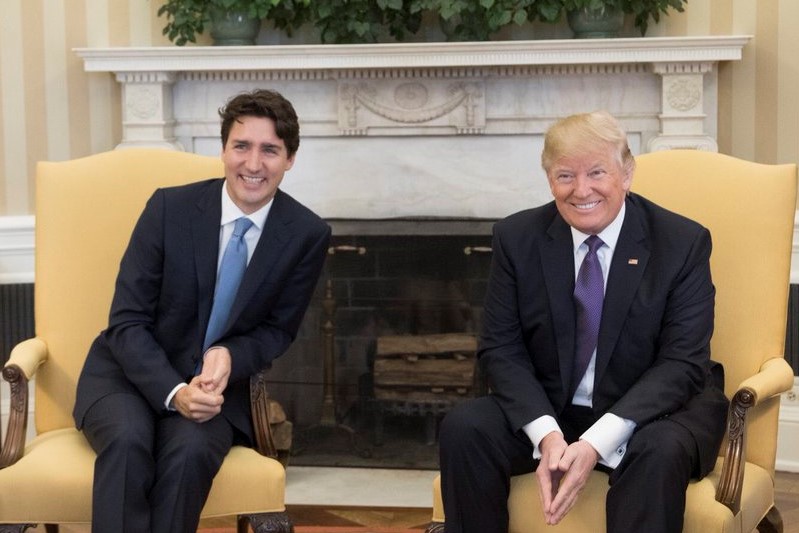
Justin Trudeau meets with President Donald Trump at the White House, 13 February, 2017.
Photo from the Office of the President of the United States via Wikimedia Commons.
Ever since the re-election of Donald Trump earlier this month, the most interesting question in Canadian politics has been “Who gets it?” That’s the main thing I’ve been looking for, and I think some of our leaders get it — or are starting to, at least.
Doug Ford doesn’t get it. Or didn’t, anyway, up until Tuesday afternoon.
On Monday night, president-elect Trump announced via a post on his Truth Social app that, as one of his first acts upon retaking the Oval Office in January, he would levy a 25 per cent tariff against all goods coming in from Canada and Mexico until those two countries fix the problems Trump says exist along the border. That’s a careful bit of phrasing on my part, so let me explain: I don’t disagree that there are issues for the United States along both borders. I don’t necessarily accept that the issues are the same on both borders or that Trump has accurately characterized the overall situation. But, in any case, Canada now has less than two months to figure out what it can do, assuming it can do anything, to satisfy the president-elect’s demands.
It’s very possible that we can do enough. Trump is a negotiator and a dealmaker, and we have to see his social-media post through that lens. He is establishing a strong opening position, and we’ll negotiate him down from there. That’s the good news, such as it is. The bad news, though, is that there’s no reason to assume Trump is going to do this only once. After we meet his demands on the border, he could demand that Canada take on more of the burden of the military defence of North America and the Western alliance. After we’ve drafted a bunch of people and launched a fleet of new warships and sent a heavily armed stabilization force to Haiti, he could come after us for our dairy subsidies. Once we give way on that, it’ll be getting tough on white-collar crime or telecom access or airline access. And so on and so on and so on. It’ll be one damned thing after another.
The broad contours of this were clear to me by about 1:30 in the morning on the day after (or night of, if you prefer) the U.S. election. As I keep saying, the party is over. Some of Trump’s demands will be basically utterly bogus, and others may be arguably unreasonable, but some of them are absolutely going to be fair, and Canada has, to my enormous frustration, left itself very, very vulnerable to his brand of pressure. We have utterly failed as a country to adapt to a changing world order by getting this country onto a more serious footing on any number of fronts, especially trade and defence. We were warned by friendlier U.S. administrations, including by presidents Barack Obama and Joe Biden. We didn’t listen. That was idiotic, and I can only hope not suicidal on our parts. Trump is going to get his way.
Greek History and Civilization, Part 8 – The Hellenistic Age
seangabb
Published Jul 17, 2024This eighth lecture in the course covers the Hellenistic Age of Greece — from the death of Alexander in 323 BC to about the death of Cleopatra in 30 BC.
(more…)
QotD: Why nothing gets done in the Current Year
Having pumped billions of dollars into building the next generation of computer chip factories in the US, the Biden administration is facing new pressure over the health and safety risks those facilities could pose. Environmental reviews for the new projects need to be more thorough, advocates say. They lack transparency around what kinds of toxic substances factory workers might handle, and plans to keep hazardous waste like forever chemicals from leaching into the environment have been vague.
A coalition of influential labor unions and environmental groups, including the Sierra Club, have since submitted comments to the Department of Commerce on draft environmental assessments, saying that the assessments fall short. The coalition’s comments flag lists of potential issues at several projects in Arizona and Idaho, including how opaque the safety measures that manufacturers will take to protect both workers and nearby residents are.
This is not a serious complaint. This is actually the national association of environmental studies writers spotting a gravy train passing by and desiring to dip their ladle in. And that’s all it is too. But it’s also that excellent example of why fuck all ever gets built. We’ve an entire — and politically powerful — class that makes their living producing the hundred tonne reports that accompany building anything. And they’re not going to allow anything to be built unless they get paid for writing hundred tonne reports. And, to complete the circle, if every activity requires a hundred tonne report then fuck all will ever get done.
There was, back a time, a law passed about blood minerals. The law said anyone who might use them must write to all suppliers to ask if they do. Then those said anyones must tell consumers whether they do. This cost $4 billion just in the first year. From what I’ve heard — and might take the trouble to prove one day — the bloke who led the campaign for the law requiring the letters now runs a very profitable consultancy advising large corporates on how to write the letters. $4 billion spent by society so that one bloke can gain a minor summer place in the Hamptons. This doesn’t make us richer as a whole, it’s pissing the wealth of the nation up the wall.
Carthage, it’s the only solution. The biggest problem who is who the hell would buy our nice new stock of enslaved environmental bureaucrats? Razing, salt, ploughs, these are easy but who’s mad enough to offer a positive price for the last part of the process?
Tim Worstall, “Why Fuck All Ever Gets Done In This Modern World”, It’s all obvious or trivial except …, 2024-08-28.
November 28, 2024
“Fly the flag, you bigoted rural cis scum!” said the Human Rights Tribunal of Ontario
Apparently just failing to vote for a “voluntary” observation of Pride season is enough to get the Human Rights Tribunal of Ontario to impose fines and mandatory re-education sentences on elected municipal officials here in the most tolerant province in Canada:
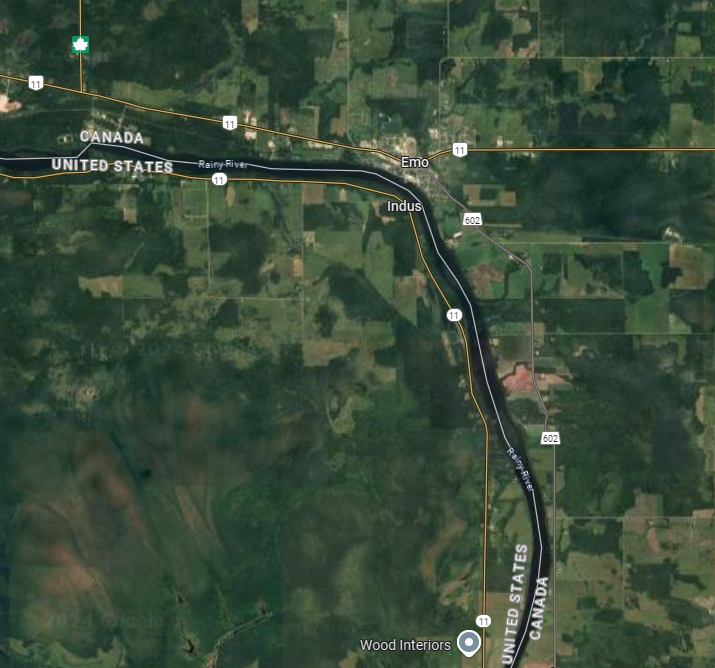
Emo is a township of about 1,300 people located in the far west of Ontario, along the border with Minnesota.
In a decision handed down last week, the Human Tribunal of Ontario ruled that Emo, its mayor and two of its councillors had violated the Ontario Human Rights Code by refusing to proclaim June as “Pride Month”.
The town was also cited for failing to fly “an LGBTQ2 rainbow flag”, despite the fact that they don’t have an official flag pole.
The dispute began in 2020 when the township was approached by the group Borderland Pride with a written request to proclaim June as Pride Month.
Attached to the letter was a draft proclamation including clauses such as “pride is necessary to show community support and belonging for LGBTQ2 individuals” and “the diversity of sexual orientation, gender identity, and gender expression represents a positive contribution to society”.
Emo was also asked to fly an “LGBTQ2 rainbow flag for a week of your choosing”.
Borderland Pride then asked Emo to “email us a copy of your proclamation or resolution once adopted and signed”.
[…]
The claim of discrimination ultimately hinged on a single line uttered by Emo Mayor Harold McQuaker. When the proclamation came up for consideration, McQuaker was heard to say in a recording of the meeting, “There’s no flag being flown for the other side of the coin … there’s no flags being flown for the straight people”.
As Human Rights Tribunal vice-chair Karen Dawson wrote in her decision, “I find this remark was demeaning and disparaging of the LGBTQ2 community of which Borderland Pride is a member and therefore constituted discrimination under the Code”.
Dawson also ruled that given the “close proximity” of McQuaker’s comment to his nay vote — that too “constituted discrimination under the Code”.
[…]
The Human Rights Tribunal ultimately ordered the Township to pay $10,000 to Borderland Pride, and for McQuaker to personally pay them another $5,000.
This was lower than what Borderland Pride had been seeking; they wanted $15,000 from the township and $10,000 each from the three councillors who voted no.
But McQuaker and Emo’s chief administrative officer were also ordered to complete an online course known as “Human Rights 101” and “provide proof of completion … to Borderland Pride within 30 days”.
The course is offered by the Ontario Human Rights Commission, and their latest edition opens with an animated video telling viewers that the Human Rights Code “is not meant to punish”.
How is Argentina doing after a year under Javier Milei?
I don’t normally follow South American news all that closely, as despite being in the same hemisphere, little that happens there has much importance to us here in Canada or the United States. The election of Argentinian President Javier Milei, however, has made Argentina a much more interesting place to watch as Milei valiantly attempts to turn the economy around from its near-century-long decline. Here, Dan Mitchell provides his assessment of Milei’s efforts so far:
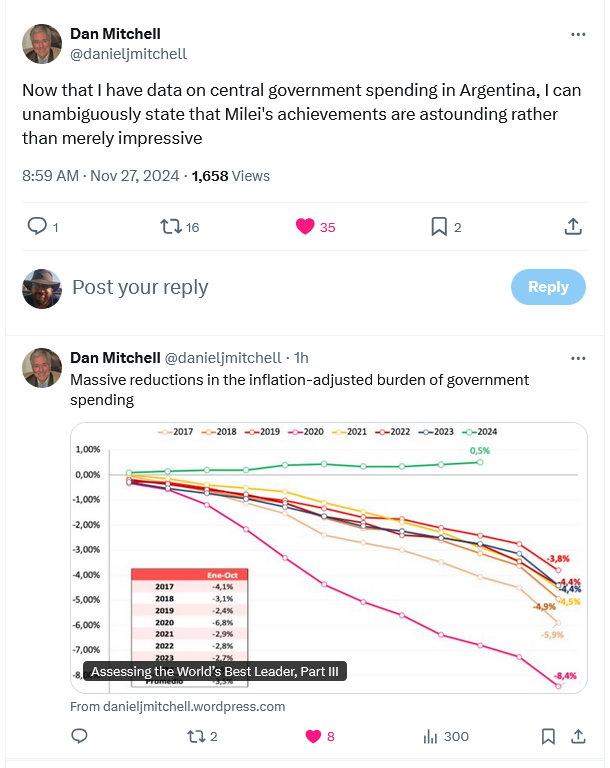
… let’s focus today on Milei’s goal of maximizing economic liberty.
The bad news is that if he wants Argentina to become the new Hong Kong, Milei has a long journey. According to Economic Freedom of the World, Argentina ranked a lowly #159 out of 165 nations in 2022.
As you can see from the EFW rankings, Milei’s country gets especially bad scores for Sound Money, Trade and Regulation (dead last for Sound Money and in the bottom-10 percent of the world for the other two categories!).
The good news is that you don’t have to be libertarian Nirvana (or even Liberland) to make a big jump in the rankings.
You don’t even need to be Hong Kong (which used to be very good with scores above 9 but has now declined to 8.58 thanks to Beijing’s intervention).
Heck, almost every country in the western world has experienced a significant decline in economic liberty this century.
Milei actually could put Argentina in first place today merely by achieving the same level of economic liberty (8.67) that the United States had in 2004.
For what it’s worth, I think it would take several years of good reforms to climb that high.
That being said, dramatic improvements are nonetheless possible in a very short period. Here’s my back-of-the-envelope estimate of where Argentina could be by the end of next year.

A thought about “Second Thanksgiving”
Real Thanksgiving happened over a month ago, but our American friends constantly mis-read the calendar and schedule their event near the end of November instead. Just another one of those minor differences between the two countries, I guess. One thing that is similar, regardless of the month the holiday is celebrated, is the eternal Thanksgiving dilemma: is it best to be a host or a guest?

I don’t know what’s better: hosting Thanksgiving, or being a guest. And I don’t know which is worst, either. Each has its perils and pleasures.
Hosting: it’s so draining, so exhausting. I mean, watching your wife work so hard, it just takes it right out of you. Kidding: I help as best as I can, but it’s with the non-food jobs. My Thanksgiving culinary skills are limited to spanking the cranberry cylinder out of its can. I do the Cleaning. I make sure the wine glasses out, and the right ones — can’t have people drinking red out of white glasses, or the world as we know it would come to an end. I get the water pitcher down from the top shelf. No, not that one, the good one. The other good one. I vacuum and dust, in case guests want to push the piano away from the wall and check out our housekeeping.
[…]
Being a guest is hard because you just sit and wait and talk, and periodically say “anything I can do?” No. There is nothing you can do. So you drift to the living room where the kids are playing – all these small children, where did they come from? Just a few years ago their Mom or Dad was at your house at the kid’s table. And now they’ve reproduced. Hey, there’s football! You sit with the other guys and share the overhanging cloud of guilt — the womenfolk are doing everything, and you’re in here watching the Lions (why is it always the Lions). Occasionally one of the sisters or daughters who’s not doing anything at the moment wanders in and requests that someone explain football to her, and then she picks a team and gets excited when a player makes a great catch. Then she goes back to the kitchen and will not think about football for another year.
If I had to choose, I’d host, rather than be a guest. For some odd reason my wife at this point in life probably thinks the obverse. But I’ve noted over the years that even if you’re a guest at a family member’s thanksgiving, all the women end up in the kitchen anyway, talking amongst themselves about mysteries no man will ever know.
There’s a third option between guesting and hosting. For a few years we drove up to Fargo and had Thanksgiving Buffet at the Holiday Inn. Nothing to clean up. Turkey galore and unstinting stuffing. The hall was loud with communal consumption, and that somehow felt marvelously America. When you were done you just … got up and walked away and left the dishes where they were. Nothing more to do but digest, which brings an entirely new quality to the idea of gratitude.
Anyway: Happy Thanksgiving, be you guest or host. Here’s to lumpy potatoes and slabs of noble fowl. Gratitude is one of those things we figure we’ll get around to, and it’s marvelous to have a day where it’s absolutely required.
Town-class destroyers – Guide 400
Drachinifel
Published Aug 3, 2024The Town class destroyers, old Wickes, Clemson and Cadwell class vessels of the US Navy, transferred to the British Royal Navy and others, are today’s subject.
(more…)
QotD: The trace italienne in fortification design
Since the goal remains preventing an enemy from entering a place, be that a city or a fortress, the first step has to be to develop a wall that can’t simply be demolished by artillery in a good afternoon or two. The solution that is come upon ends up looking a lot like those Chinese rammed earth walls: earthworks are very good at absorbing the impact of cannon balls (which, remember, are at this point just that: stone and metal balls; they do not explode yet): small air pockets absorb some of the energy of impact and dirt doesn’t shatter, it just displaces (and not very far: again, no high explosive shells, so nothing to blow up the earthwork). Facing an earthwork mound with stonework lets the earth absorb the impacts while giving your wall a good, climb-resistant face.
So you have your form: a stonework or brick-faced wall that is backed up by essentially a thick earthen berm like the Roman agger. Now you want to make sure incoming cannon balls aren’t striking it dead on: you want to literally play the angles. Inclining the wall slightly makes its construction easier and the end result more stable (because earthworks tend not to stand straight up) and gives you an non-perpendicular angle of impact from cannon when they’re firing at very short range (and thus at very low trajectory), which is when they are most dangerous since that’s when they’ll have the most energy in impact. Ideally, you’ll want more angles than this, but we’ll get to that in a moment.
Because we now have a problem: escalade. Remember escalade?
Earthworks need to be wide at the base to support a meaningful amount of height, tall-and-thin isn’t an option. Which means that in building these cannon resistant walls, for a given amount of labor and resources and a given wall circuit, we’re going to end up with substantially lower walls. We can enhance their relative height with a ditch several out in front (and we will), but that doesn’t change the fact that our walls are lower and also that they now incline backwards slightly, which makes them easier to scale or get ladders on. But obviously we can’t achieved much if we’ve rendered our walls safe from bombardment only to have them taken by escalade. We need some way to stop people just climbing over the wall.
The solution here is firepower. Whereas a castle was designed under the assumption the enemy would reach the foot of the wall (and then have their escalade defeated), if our defenders can develop enough fire, both against approaching enemies and also against any enemy that reaches the wall, they can prohibit escalade. And good news: gunpowder has, by this point, delivered much more lethal anti-personnel weapons, in the form of lighter cannon but also in the form of muskets and arquebuses. At close range, those weapons were powerful enough to defeat any shield or armor a man could carry, meaning that enemies at close range trying to approach the wall, set up ladders and scale would be extremely vulnerable: in practice, if you could get enough muskets and small cannon firing at them, they wouldn’t even be able to make the attempt.
But the old projecting tower of the castle, you will recall, was designed to allow only a handful of defenders fire down any given section of wall; we still want that good enfilade fire effect, but we need a lot more space to get enough muskets up there to develop that fire. The solution: the bastion. A bastion was an often diamond or triangular-shaped projection from the wall of the fort, which provided a longer stretch of protected wall which could fire down the length of the curtain wall. It consists of two “flanks” which meet the curtain wall and are perpendicular to it, allowing fire along the wall; the “faces” (also two) then face outward, away from the fort to direct fire at distant besiegers. When places at the corners of forts, this setup tends to produce outward-spiked diamonds, while a bastion set along a flat face of curtain wall tends to resemble an irregular pentagon (“home plate”) shape [Wiki]. The added benefit for these angles? From the enemy siege lines, they present an oblique profile to enemy artillery, making the bastions quite hard to batter down with cannon, since shots will tend to ricochet off of the slanted line.
In the simplest trace italienne forts [Wiki], this is all you will need: four or five thick-and-low curtain walls to make the shape, plus a bastion at each corner (also thick-and-low, sometimes hollow, sometimes all at the height of the wall-walk), with a dry moat (read: big ditch) running the perimeter to slow down attackers, increase the effective height of the wall and shield the base of the curtain wall from artillery fire.
But why stay simple, there’s so much more we can do! First of all, our enemy, we assume, have cannon. Probably lots of cannon. And while our walls are now cannon resistant, they’re not cannon immune; pound on them long enough and there will be a breach. Of course collapsing a bastion is both hard (because it is angled) and doesn’t produce a breach, but the curtain walls both have to run perpendicular to the enemy’s firing position (because they have to enclose something) and if breached will allow access to the fort. We have to protect them! Of course one option is to protect them with fire, which is why our bastions have faces; note above how while the flanks of the bastions are designed for small arms, the faces are built with cannon in mind: this is for counter-battery fire against a besieger, to silence his cannon and protect the curtain wall. But our besieger wouldn’t be here if they didn’t think they could decisively outshoot our defensive guns.
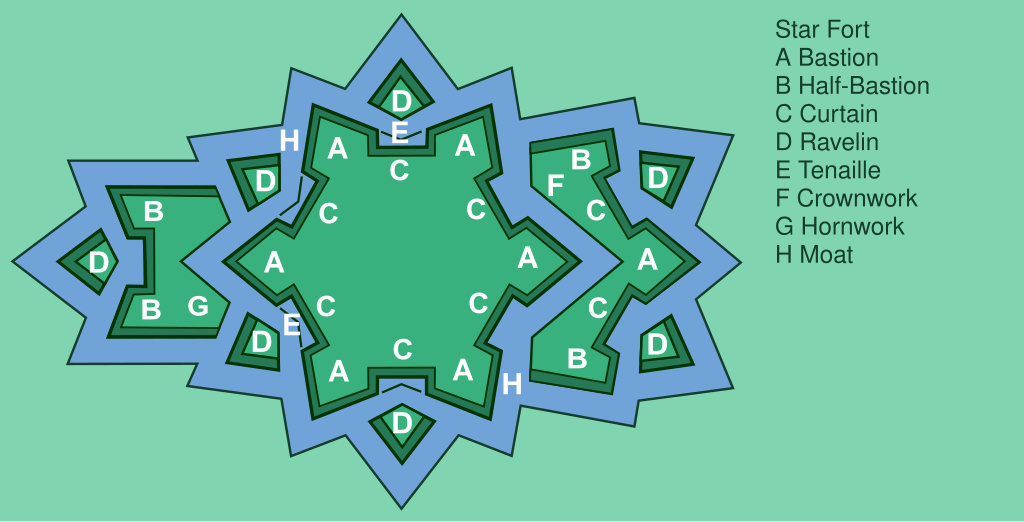
But we can protect the curtain further, and further complicate the attack with outworks [Wiki], effectively little mini-bastions projecting off of the main wall which both provide advanced firing positions (which do not provide access to the fort and so which can be safely abandoned if necessary) and physically obstruct the curtain wall itself from enemy fire. The most basic of these was a ravelin (also called a “demi-lune”), which was essentially a “flying” bastion – a triangular earthwork set out from the walls. Ravelins are almost always hollow (that is, the walls only face away from the fort), so that if attackers were to seize a ravelin, they’d have no cover from fire coming from the main bastions and the curtain wall.
And now, unlike the Modern Major-General, you know what is meant by a ravelin … but are you still, in matters vegetable, animal and mineral, the very model of a modern Major-General?
But we can take this even further (can you tell I just love these damn forts?). A big part of our defense is developing fire from our bastions with our own cannon to force back enemy artillery. But our bastions are potentially vulnerable themselves; our ravelins cover their flanks, but the bastion faces could be battered down. We need some way to prevent the enemy from aiming effective fire at the base of our bastion. The solution? A crownwork. Essentially a super-ravelin, the crownwork contains a full bastion at its center (but lower than our main bastion, so we can fire over it), along with two half-bastions (called, wait for it, “demi-bastions”) to provide a ton of enfilade fire along the curtain wall, physically shielding our bastion from fire and giving us a forward fighting position we can use to protect our big guns up in the bastion. A smaller version of the crownwork, called a hornwork can also be used: this is just the two half-bastions with the full bastion removed, often used to shield ravelins (so you have a hornwork shielding a ravelin shielding the curtain wall shielding the fort). For good measure, we can connect these outworks to the main fort with removable little wooden bridges so we can easily move from the main fort out to the outworks, but if the enemy takes an outwork, we can quickly cut it off and – because the outworks are all made hollow – shoot down the attackers who cannot take cover within the hollow shape.
An ideal form of a bastion fortress to show each kind of common work and outwork.
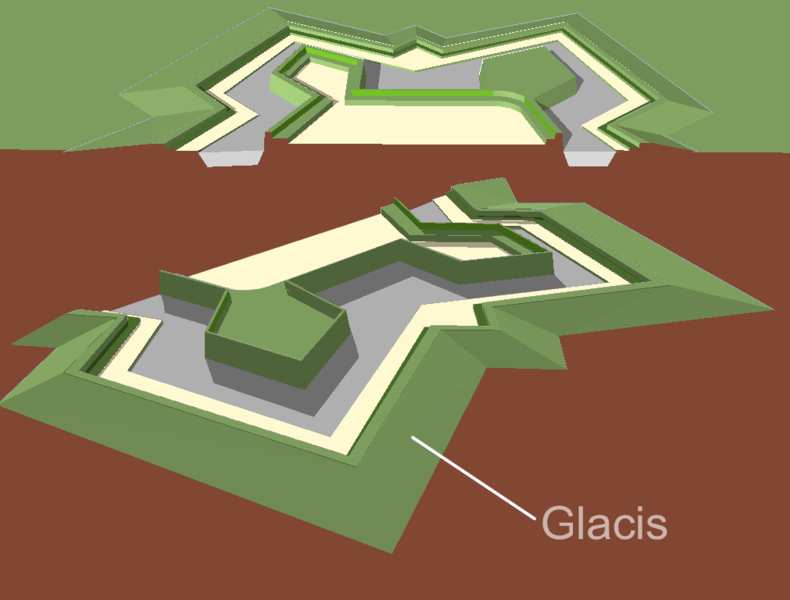
Drawing by Francis Lima via Wikimedia Commons.We can also do some work with the moat. By adding an earthwork directly in front of it, which arcs slightly uphill, called a glacis, we can both put the enemy at an angle where shots from our wall will run parallel to the ground, thus exposing the attackers further as they advance, and create a position for our own troops to come out of the fort and fire from further forward, by having them crouch in the moat behind the glacis. Indeed, having prepared, covered forward positions (which are designed to be entirely open to the fort) for firing from at defenders is extremely handy, so we could even put such firing positions – set up in these same, carefully mathematically calculated angle shapes, but much lower to the ground – out in front of the glacis; these get all sorts of names: a counterguard or couvreface if they’re a simple triangle-shape, a redan if they have something closer to a shallow bastion shape, and a flèche if they have a sharper, more pronounced face. Thus as an enemy advances, defending skirmishers can first fire from the redans and flèches, before falling back to fire from the glacis while the main garrison fires over their heads into the enemy from the bastions and outworks themselves.
A diagram showing a glacis supporting a pair of bastions, one hollow, one not.
Diagram by Arch via Wikimedia Commons.At the same time, a bastion fortress complex might connect multiple complete circuits. In some cases, an entire bastion fort might be placed within the first, merely elevated above it (the term for this is a “cavalier“) so that both could fire, one over the other. Alternately, when entire cities were enclosed in these fortification systems (and that was common along the fracture zones between the emerging European great powers), something as large as a city might require an extensive fortress system, with bastions and outworks running the whole perimeter of the city, sometimes with nearly complete bastion fortresses placed within the network as citadels.
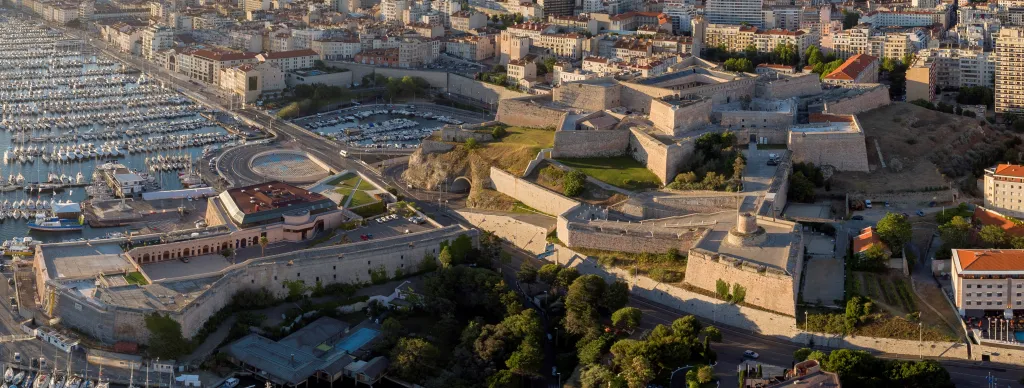
Fort Saint-Nicolas, which dominates the Old Port of Marseille. The fort forms part of a system with the low outwork you see here and also an older refitted castle, Fort Saint-Jean, on the other side of the harbor.
Photo via Wikimedia Commons.All of this geometry needed to be carefully laid out to ensure that all lines of approach were covered with as much fire as possible and that there were no blindspots along the wall. That in turn meant that the designers of these fortresses needed to be careful with their layout: the spacing, angles and lines all needed to be right, which required quite a lot of math and geometry to manage. Combined with the increasing importance of ballistics for calculating artillery trajectories, this led to an increasing emphasis on mathematics in the “science of warfare”, to the point that some military theorists began to argue (particularly as one pushes into the Enlightenment with its emphasis on the power of reason, logic and empirical investigation to answer all questions) that military affairs could be reduced to pure calculation, a “hard science” as it were, a point which Clausewitz (drink!) goes out of his way to dismiss (as does Ardant du Picq in Battle Studies, but at substantially greater length). But it isn’t hard to see how, in the heady centuries between 1500 and 1800 how the rapid way that science had revolutionized war and reduced activities once governed by tradition and habit to exercises in geometry, one might look forward and assume that trend would continue until the whole affair of war could be reduced to a set of theorems and postulates. It cannot be, of course – the problem is the human element (though the military training of those centuries worked hard to try to turn men into “mechanical soldiers” who could be expected to perform their role with the same neat mathmatical precision of a trace italienne ravelin). Nevertheless this tension – between the science of war and its art – was not new (it dates back at least as far as Hellenistic military manuals) nor is it yet settled.
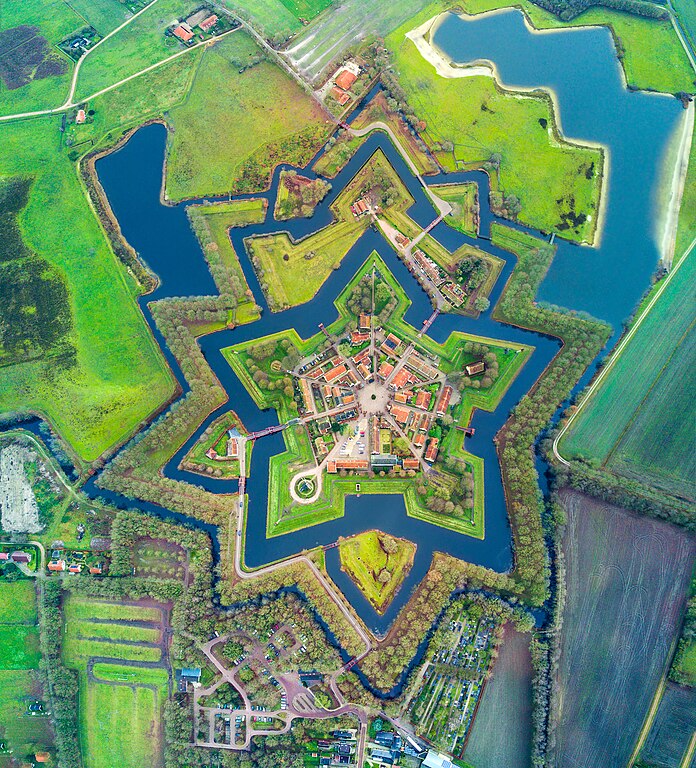
An aerial view of the Bourtange Fortress in Groningen, Netherlands. Built in 1593, the fort has been restored to its 1750s configuration, seen here.
Photo by Dack9 via Wikimedia Commons.But coming back to our fancy forts, of course such fortresses required larger and larger garrisons to fire all of the muskets and cannon that their firepower oriented defense plans required. Fortunately for the fortress designers, state capacity in Europe was rising rapidly and so larger and larger armies were ready to hand. That causes all sorts of other knock on effects we’re not directly concerned with here (but see the bibliography at the top). For us, the more immediate problem is, well, now we’ve built one of these things … how on earth does one besiege it?
Bret Devereaux, “Collections: Fortification, Part IV: French Guns and Italian Lines”, A Collection of Unmitigated Pedantry, 2021-12-17.
November 27, 2024
Trump’s plan to dismiss transgender troops will apparently “gut” the US military
As if the US military services hadn’t suffered enough from their own government, it’s now being widely asserted in the media that Trump’s declared plan to get rid of all current transgender service members will be a desperately hard blow to an already over-stressed military structure:
The news media is calmly warning that Donald Trump is planning to ban transgender servicemembers from the American military, which will absolutely gut the armed forces.
Sample claim, from Newsweek, quoting the leader of an LGBT advocacy nonprofit:
Abruptly discharging 15,000-plus service members, especially given that the military’s recruiting targets fell short by 41,000 recruits last year, adds administrative burdens to war fighting units.
There would be a significant financial cost, as well as a loss of experience and leadership that will take possibly 20 years and billions of dollars to replace.
We’ll practically have no military left! It would be like a whole infantry division suddenly just vanishing: 15,000-plus transgendered service members.
You’re going to see this number a lot in the weeks ahead. The New Republic, today: “Donald Trump’s plan to ban transgender people from the military would have a devastating effect: At least 15,000 members would be forced to leave.”
That number comes from a 2018 report by the now-defunct Palm Center, a pro-LGBT independent research institute in California, which reached this conclusion: “Transgender troops make up 0.7% (seven-tenths of one percent) of the military (Active Component and Selected Reserve)”. Their best guess about a total number: 14,707. The media is just rounding that number up to the next thousand.
The Palm Center … extrapolated a lot, let’s say, in good part by multiplying their guess about a percentage, derived from a grossly inadequate survey of a select number of active duty troops, times the total number of servicemembers. Page 4:
Assuming that the distribution of transgender men and women is roughly equivalent in the Active and Selected Reserve Components, it is possible to derive an estimate of the number of transgender troops in the Selected Reserve as follows. The number of transgender women is .0066 x 652,623 = 4,307 and the number of transgender men is .0091 x 156,080 = 1,420. The total number of transgender members of the Selected Reserve is 4,307 + 1,420 = 5,727. And, the total number of transgender troops is 8,980 (active) + 5,727 (reserve) = 14,707.
Assuming the distribution, it is possible to derive an estimate. That’s the basis of the 15,000 number that you’ll see in news stories. Remember that language.
Similarly, a 2016 RAND study offered these findings (among others), and note the remarkable thing that happens between the first and second paragraph:
It is difficult to estimate the number of transgender personnel in the military due to current policies and a lack of empirical data. Applying a range of prevalence estimates, combining data from multiple surveys, and adjusting for the male/female distribution in the military provided a midrange estimate of around 2,450 transgender personnel in the active component (out of a total number of approximately 1.3 million active-component service members) and 1,510 in the Selected Reserve.
Only a subset will seek gender transition–related treatment. Estimates derived from survey data and private health insurance claims data indicate that, each year, between 29 and 129 service members in the active component will seek transition-related care that could disrupt their ability to deploy.
So studies indicate that there are 3,960 transgendered servicemembers, and also that there are 14,707 transgendered servicemembers, and “between 29 and 129 service members in the active component” who will actively seek gender transition services in a typical year.
So it’s definitely somewhere between 29 and 15,000.

The Korean War 023 – The Eagle Versus the Dragon – November 26, 1950
The Korean War by Indy Neidell
Published 26 Nov 2024Thanksgiving 1950 comes and goes in the snowy north of Korea, and Eighth Army’s push to the Yalu River begins the following day. It soon becomes apparent, though, that the Communist Chinese are ready and waiting for them, in numbers greater than anyone on the UN side have predicted. After weeks of preamble and preparation, the two forces finally collide in full strength.
Chapters
00:00 Intro
00:51 Recap
01:16 X Corps
03:14 Turkey Time
05:50 The US Offensive
09:05 The Second Phase Offensive
12:39 East Flank Disaster
15:27 Summary
15:47 Conclusion
(more…)
Scolianormativity
At FEE, Michael Strong defines the neologism and provides evidence that it has been a long-term harm to children forced into the Prussian-originated school regimentation regime:

Scolianormative (adj.): The assumption that behaviors defined by institutionalized schooling are “normal”. An assumption that became pervasive in industrialized societies in which institutionalized schooling became the norm that resulted in marginalizing and harming millions of children. Once society began to question scolianormativity, gradually people began to realize that the norms set by institutionalized schooling were perfectly arbitrary. It turned out that it was not necessary to harm children. The institutions that led to such widespread harms were dismantled, and humanity transcended the terrible century of institutionalized schooling.
The conventional educational model, government-enforced and subsidized, is based on 13 years of schooling consisting of state-defined curriculum standards and exams leading to a high school diploma.
Young human beings are judged as either “normal” or not based on the extent to which they are “on track” with respect to grade level exams and test scores. Students who are not making the expected progress may be diagnosed with learning differences (formerly known as disabilities). Students who can’t sit still adequately may be diagnosed with ADD/ADHD. Students who find the experience soul-killing may be diagnosed with depression or anxiety. Students who can’t stand to be told what to do all day may be diagnosed with Oppositional Defiant Disorder (ODD). Students who score higher on certain tests are labeled “gifted”.
Massive amounts of research and institutional authority have been invested in these and other diagnoses. When a child is not progressing appropriately in the system, the child is often sent to specialists who then perform the diagnosis. When appropriate, then the child is given some combination of medication, accommodations, and/or sent to a special program for children with “special needs”.
Many well-intentioned people regard this system as life-saving for the children who might otherwise have “not had their needs met” in the absence of such a diagnosis and intervention. And this is no doubt often true, but our fixation on scolianormativity blinds us to the fact that an entirely different perspective might actually result in better lives for more children.
How could one possibly deny mountains of evidence on behalf of such a life-saving system?
Scolianormativity
The Prussian school model, a state-led model devoted to nationalism, is only about two hundred years old. For much of its first century it was limited to a few hours per day, for a few months per year, for a few years of schooling. It has only gradually grown to encompass most of a child’s waking hours for nine months a year from ages 5 to 18. Indeed, in the U.S., it was only in the 1950s that a majority of children graduated from high school (though laws requiring compulsory attendance through age 16 had been passed in the late 19th and early 20th century). In addition, for most of its first century, it was far more flexible than it has become in its second. The increasing standardization and bureaucratization of childhood is a remarkably recent phenomenon in historical terms.
In his book Seeing Like a State, the political scientist James C. Scott documents how governments work to create societies that are “legible”, that can be perceived and managed by the state to suit the needs of the state’s bureaucrats and political leaders. Public schools are one of the most pervasive of all state institutions. The structure of public schooling has grown to suit the needs of the state bureaucrats who monitor it.
The Deadly Job of Royal Food Taster
Tasting History with Max Miller
Published Jul 23, 2024Sautéed mushrooms in a honey, long pepper, and garum glaze
City/Region: Rome
Time Period: 1st CenturyFood tasters checking for poison aren’t around so much anymore, but it was an important job for thousands of years. But what happens when the food taster is the one adding in the poison?
Emperor Claudius found this out the hard way when he supposedly ate some of his favorite mushrooms, and then became the victim of a double-poisoning by his taster and his physician.
We can’t know for sure what Emperor Claudius’s favorite mushroom dish was, but I wouldn’t be surprised if it was this. I don’t care for the texture of mushrooms, but the flavor is excellent. The sweetness from the honey, spiciness from the long pepper, and the earthiness of the mushrooms combine for a complex dish that is delicious.
Another Method for Mushrooms
Place the chopped stalks in a clean pan, adding pepper, lovage, and a little honey. Mix with garum. Add a little oil.
— Apicius de re coquinaria, 1st century


