The Tank Museum
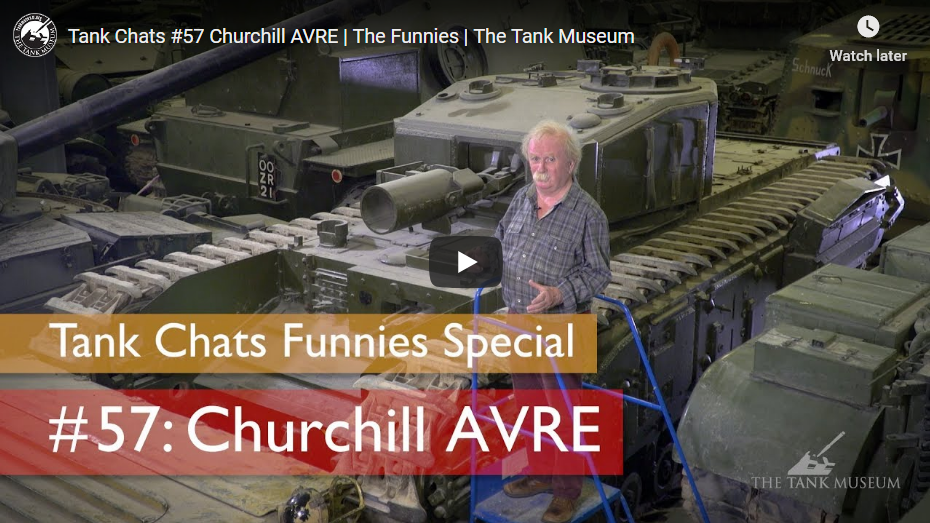
Published 20 Sep 2018Another episode in the Tank Chats Funnies Specials, with David Fletcher looking at the weird and wonderful vehicles of 79th Armoured Division led by Major General Percy Hobart, known as “Hobart’s Funnies”.
The Churchill AVRE (Armoured Vehicle Royal Engineers). The Churchill was the basis for a number of Funnies. David Fletcher looks at the Fascine, Bobbin, Small Box Girder bridge, Bullshorn plough, Conger, the Churchill ARK and Bridgelayer.
Support the work of The Tank Museum on Patreon: ► https://www.patreon.com/tankmuseum
Or donate http://tankmuseum.org/support-us/donateVisit The Tank Museum SHOP: ► https://tankmuseumshop.org/
Twitter: ► https://twitter.com/TankMuseum
Tiger Tank Blog: ► http://blog.tiger-tank.com/
Tank 100 First World War Centenary Blog: ► http://tank100.com/ #tankmuseum #tanks #tankchats
January 2, 2020
Tank Chats #57 Churchill AVRE | The Funnies | The Tank Museum
December 31, 2019
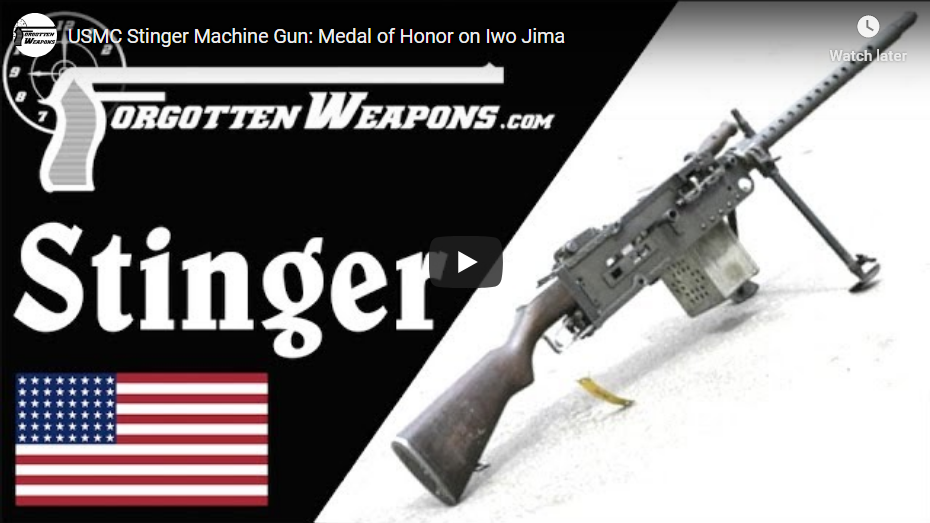
USMC Stinger Machine Gun: Medal of Honor on Iwo Jima
Forgotten Weapons
Published 30 Dec 2019Corporal Tony Stein
United States Marine Corps ReserveFor conspicuous gallantry and intrepidity at the risk of his life above and beyond the call of duty while serving with Company A, First Battalion, Twenty-Eighth Marines, Fifth Marine Division, in action against enemy Japanese forces on Iwo Jima, in the Volcano Island, 19 February 1945. The first man of his unit to be on station after hitting the beach in the initial assault, Corporal Stein, armed with a personally improvised aircraft-type weapon, provided rapid covering fire as the remainder of his platoon attempted to move into position and, when his comrades were stalled by a concentrated machine-gun and mortar barrage, gallantly stood upright and exposed himself to the enemy’s view, thereby drawing the hostile fire to his own person and enabling him to observe the location of the furiously blazing hostile guns. Determined to neutralize the strategically placed weapons, he boldly charged the enemy pillboxes one by one and succeeded in killing twenty of the enemy during the furious single-handed assault. Cool and courageous under the merciless hail of exploding shells and bullets which fell on all sides, he continued to deliver the fire of his skillfully improvised weapon at a tremendous rate of speed which rapidly exhausted his ammunition. Undaunted, he removed his helmet and shoes to expedite his movements an ran back to the beach for additional ammunition, making a total of eight trips under intense fire and carrying or assisting a wounded man back each time. Despite the unrelenting savagery and confusion of battle, he rendered prompt assistance to his platoon whenever the unit was in position, directing the fire of a half-track against a stubborn pillbox until he had effected the ultimate destruction of the Japanese fortification. Later in the day, although his weapon was twice shot from his hands, he personally covered the withdrawal of his platoon to the company position. Stouthearted and indomitable, Corporal Stein, by his aggressive initiative, sound judgment and unwavering devotion to duty in the face of terrific odds, contributed materially to the fulfillment of his mission, and his outstanding valor throughout the bitter hours of conflict sustained and enhanced the highest traditions of the United States Naval Service.
Harry S. Truman
President of the United StatesThe Stinger was a Browning aircraft machine gun adapted to use an M1 Garand buttstock and BAR bipod, used as a light machine gun by the US Marine Corps during the invasion of Iwo Jima in 1945. The gun was the creation of Sergeant Mel J Grevich oof the 5th Marine Division. Six were built and used on the attack on Iwo, including one by Corporal Tony Stein, whose outstanding bravery is documented in the Medal of Honor citation above. None of the original guns survive today, but I have the privilege of showing you this reproduction created by the Canadian Historical Arms Museum with the assistance of O’Dell Engineering.
http://www.patreon.com/ForgottenWeapons
Cool Forgotten Weapons merch! http://shop.bbtv.com/collections/forg…
Contact:
Forgotten Weapons
6281 N. Oracle #36270
Tucson, AZ 85704
The DeLisle: Britain’s Silenced .45 ACP Commando Carbine
Forgotten Weapons
Published 16 Sep 2017Armament Research Services (ARES) is a specialist technical intelligence consultancy, offering expertise and analysis to a range of government and non-government entities in the arms and munitions field. For detailed photos of the guns in this video, don’t miss the ARES companion blog post:
The DeLisle carbine was a conversion of a standard SMLE rifle to the .45 ACP cartridge, feeding from modified 1911 pistol magazines. It was fitted with a 7″ (175mm) barrel and a very large integral suppressor. The combination of the subsonic cartridge, the large suppressor volume, and even a sound-dampening pad on the bolt handle made for an extremely quiet firearm. Although often compared to the Welrod silenced pistol, the DeLisle was intended specifically for special forces (Commando) use, and not for dropping into occupied territories.
The conversions were done by the Sterling company, and an order of 550 was placed, with 500 of those using a fixed wooden stock and 50 using a folding metal stock. The contract was cancelled in 1943, however, with only about 130 having been made (and only a single prototype of the folding stock model).
Today we will take a look at one of the prototypes, two of the standard production models, and the only existing folding stock example. While a number of companies have made reproduction DeLisles of varying quality, originals are very rare, and none of the reproduction have duplicated them entirely correctly.
http://www.patreon.com/ForgottenWeapons
Cool Forgotten Weapons merch! http://shop.bbtv.com/collections/forg…
If you enjoy Forgotten Weapons, check out its sister channel, InRangeTV! http://www.youtube.com/InRangeTVShow
December 29, 2019
Winter is coming, peace is not – the frozen fronts – WW2 – 070 – December 28, 1940
World War Two
Published 28 Dec 2019Italy finds itself in a dire position in Albania as Christmas is celebrated in a war-torn Europe and fighting continues in China.
Join us on Patreon: https://www.patreon.com/TimeGhostHistory
Or join The TimeGhost Army directly at: https://timeghost.tvFollow WW2 day by day on Instagram @World_war_two_realtime https://www.instagram.com/world_war_t…
Join our Discord Server: https://discord.gg/D6D2aYN.
Between 2 Wars: https://www.youtube.com/playlist?list…
Source list: http://bit.ly/WW2sourcesWritten and Hosted by: Indy Neidell
Produced and Directed by: Spartacus Olsson and Astrid Deinhard
Executive Producers: Bodo Rittenauer, Astrid Deinhard, Indy Neidell, Spartacus Olsson
Creative Producer: Joram Appel
Post-Production Director: Wieke Kapteijns
Research by: Indy Neidell
Edited by: Iryna Dulka
Map animations: Eastory (https://www.youtube.com/c/eastory)Colorizations by:
– Dememorabilia – https://www.instagram.com/dememorabilia/
– Julius Jääskeläinen – https://www.facebook.com/JJcolorization/
– Adrien Fillon – https://www.instagram.com/adrien.colo…Sources:
– IWM: CH 251, A12882, FL 1905, A 1732, H 6285, D 717Soundtracks from Epidemic Sound:
– “March Of The Brave 4” – Rannar Sillard
– “March Of The Brave 9” – Rannar Sillard
– “Walk With Legends” – Bonnie Grace
– “The End Of The World 2” – Håkan Eriksson
– “March Of The Brave 10” – Rannar Sillard
– “Easy Target” – Rannar Sillard
– “Guilty Shadows 4” – Andreas Jamsheree
– “Deviation In Time” – Johannes BornlofArchive by Screenocean/Reuters https://www.screenocean.com.
A TimeGhost chronological documentary produced by OnLion Entertainment GmbH.
December 28, 2019
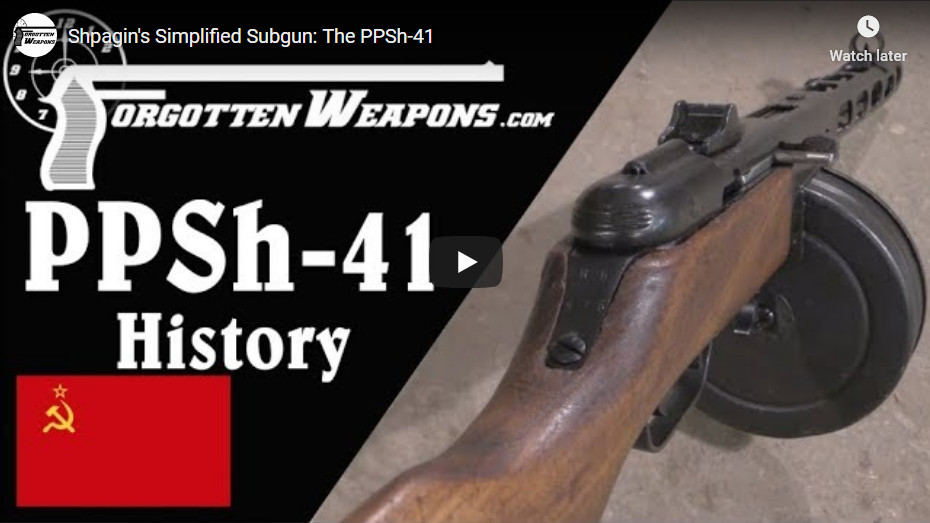
Shpagin’s Simplified Subgun: The PPSh-41
Forgotten Weapons
Published 15 Dec 2017http://www.patreon.com/ForgottenWeapons
Cool Forgotten Weapons merch! http://shop.bbtv.com/collections/forg…
After making the decision to mass produce a submachine gun, the Soviet Union adopted the Degtyarev PPD-38 and PPD-40, but this design was too expensive for the huge scale of production that the USSR intended. A new design was needed, and was put into development almost as soon as the PPD was entering production.
Shpagin won the design competition with the PPSh-41, a weapon which required virtually no lathe work at all. It was assembled from a combination of heavy-gauge stampings and simple milled parts, and it fit the Soviet requirements quite well. Shpagin retained the high rate of fire and large drum magazines from the PPD, and even had a semiauto selector switch in his submachine gun, a bit unusual in a weapon intended for minimum expense.
The drum magazines proved to be the weak point of the design, being only somewhat interchangeable between weapons and being rather complex to manufacture as well as bulky to carry and fairly easy to damage. A 35-round box magazine was introduced later on which ameliorated some of these issues, although not all of them. The PPSh-41 would go on to be deemed itself too complex, and supplemented by the PPS-43 submachine gun, although it was never fully replaced during World War Two. In addition to Soviet service, it would be copied and manufactured by several other nations.
Thanks to Marstar for letting me examine and shoot their PPSh-41!
If you enjoy Forgotten Weapons, check out its sister channel, InRangeTV! http://www.youtube.com/InRangeTVShow
December 23, 2019
QotD: British meals – puddings
Suet crust, which appears in innumerable combinations, and enters into savoury dishes as well as sweet ones, is simply ordinary pastry crust chopped beef suet substituted for the butter or lard. It can be baked, but more often is boiled in a cloth or steamed in a basin covered with a cloth. Far and away the best of all suet puddings is plum pudding, which is an extremely rich, elaborate and expensive dish, and is eaten by everyone in Britain at Christmas time, though not often at other times of the year. In simpler kinds of pudding the suet crust is sweetened with sugar and stuck full of figs, dates, currents or raisins, or it is flavoured with ginger or orange marmalade, or it is used as a casing for stewed apples or gooseberries, or it is rolled round successive layers of jam into a cylindrical shape which is called roly-poly pudding, or it is eaten in plain slices with treacle poured over it. One of the best forms of suet pudding is the boiled apple dumpling. The core is removed from a large apple, the cavity is filled up with brown sugar, and the apple is covered all over with a thin layer of suet crust, tied tightly into a cloth, and boiled.
British pastry is not outstandingly good, but there are certain fillings for pies and tarts which are excellent, and which are hardly to be found in other countries. Treacle tart is a delicious dish, and the large or small mince pies which are eaten especially at Christmas, but else fairly frequently at other times, are almost equally good. The mince-meat with which they are filled is a mixture of various kinds of dried fruits, chopped fine, mixed up with sugar and raw beef suet, and flavoured with brandy. Other favourite fillings are jams of various kinds, lemon curd – a preparation of lemon juice, yolk of egg and sugar – and stewed apples flavoured with lemon juice or cloves. An apple pie is often given an exceptionally fine flavour by including one quince among about half a dozen apples.
The other main category of puddings – milk puddings – is the kind of thing that one would prefer to pass over in silence, but it must be mentioned, since these dishes are, unfortunately, characteristic of Britain. They are preparations of rice, semolina, barley, sago or even macaroni, mixed with milk and sugar and baked in the oven. The one made with barley is somewhat less bad then the others: the one made with macaroni is intolerable to any civilised palate. As all of these puddings are easy to make, they tend to be a stand-by in cheap hotels, restaurants and apartment houses, and they are one of the chief reasons why British cookery has a bad name among foreign visitors.
There are, of course, XXX countless other sweet dishes, including the whole range of jellies, blancmanges, custards, soufflés, ice puddings, meringues and what-nots, which are much the same in all European counties. A few oddments which do not fit into any of the above categories are pancakes – British pancakes are thinner than those of most countries, and are always eaten with lemon juice, – batter pudding, which is made of much the same ingredients as Yorkshire pudding, but is steamed instead of being baked and is eaten with treacle, and baked apples. The apples are cored but not peeled, filled up with butter and sugar, and cooked in the oven: it is important that they should be served in the dish in which they are cooked With cooked fruit of any kind British people always eat cream, if they can get it. In the West of England a particularly delicious kind of clotted cream is made by slowly simmering large pens of milk and skimming off the cream as it comes to the surface.
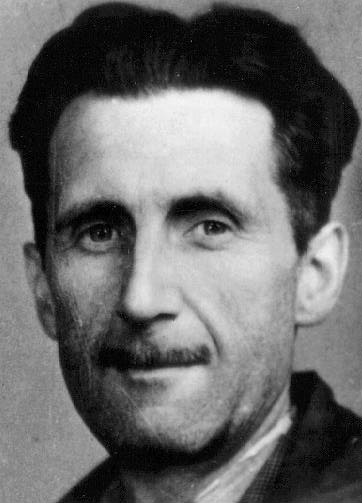
George Orwell, “British Cookery”, 1946. (Originally commissioned by the British Council, but refused by them and later published in abbreviated form.)

December 22, 2019
December 21, 2019
Christmas In Tobruk (1943)
British Pathé
Published 13 Apr 2014Full title reads: “CHRISTMAS IN TOBRUK”.
Tobruk, Libya.
Several shots of Pathe cameraman Terry Ashwood in his pyjamas as he gets up from his bed in the desert. He looks into his Christmas stocking and reads his cards. Bell on Tobruk Church ringing. Various shots of sacks of mail being sorted at desert sorting post. Several shots of ruined buildings in Tobruk where the Tommies are having their own. They write Merry Xmas on the wall and seem to be enjoying themselves. Soldiers ironing their clothes, “dress up” set the table and serve dinner. Men sitting at table with “Merry Christmas” written on the wall behind them. Christmas feast. Christmas pudding with a twig instead of piece of holly. Men drinking. Terry Ashwood leaving building and it is “snowing”. Pan up to show the men ripping paper into small pieces and throwing it from the balcony.
(Mute & Track Negs.)
FILM ID:1071.21A VIDEO FROM BRITISH PATHÉ. EXPLORE OUR ONLINE CHANNEL, BRITISH PATHÉ TV. IT’S FULL OF GREAT DOCUMENTARIES, FASCINATING INTERVIEWS, AND CLASSIC MOVIES. http://www.britishpathe.tv/
FOR LICENSING ENQUIRIES VISIT http://www.britishpathe.com/
British Pathé also represents the Reuters historical collection, which includes more than 136,000 items from the news agencies Gaumont Graphic (1910-1932), Empire News Bulletin (1926-1930), British Paramount (1931-1957), and Gaumont British (1934-1959), as well as Visnews content from 1957 to the end of 1984. All footage can be viewed on the British Pathé website. https://www.britishpathe.com/
December 19, 2019
Vive la Résistance! well, not really… French Resistance 1940 – WW2 – War Against Humanity 007
World War Two
Published 18 Dec 2019Immediately after France is occupied by the Nazis in 1940, the French are divided about what to do; resist for collaborate? To put it mildly, it’s complicated.
Join us on Patreon: https://www.patreon.com/TimeGhostHistory
Or join The TimeGhost Army directly at: https://timeghost.tvFollow WW2 day by day on Instagram @World_war_two_realtime https://www.instagram.com/world_war_t…
Join our Discord Server: https://discord.gg/D6D2aYN.
Between 2 Wars: https://www.youtube.com/playlist?list…
Source list: http://bit.ly/WW2sourcesWritten and Hosted by: Spartacus Olsson
Produced and Directed by: Spartacus Olsson and Astrid Deinhard
Executive Producers: Bodo Rittenauer, Astrid Deinhard, Indy Neidell, Spartacus Olsson
Creative Producer: Joram Appel
Post-Production Director: Wieke Kapteijns
Research by: Spartacus Olsson and Francis van Berkel
Edited by: Wieke Kapteijns
Map animations: Eastory (https://www.youtube.com/c/eastory)Colorizations by: Julius Jääskeläinen – https://www.facebook.com/JJcolorization/
Sources: Bundesarchiv, Mémorial de la Shoah
Icons via the Noun Project: collaboration by Pause08, protester by Blaise Sewell, Dove by Luis Prado, confused by LlisoleArchive by Screenocean/Reuters https://www.screenocean.com.
A TimeGhost chronological documentary produced by OnLion Entertainment GmbH.
From the comments:
Spartacus Olsson
16 hours ago
In the aftermath of WW2, everyone was probably pretty tired of the whole tragedy, and ready to just move on. Many of the people that I have met that lived through the war didn’t like talking about the war much. But somehow I had the privilege of getting many of the them that I met to open up and talk about it to me. Maybe not so much because of any personal quality I have other than being very persistent and curious — a pain in the neck is another way of putting it.Anyway, we talked about many things, terrible things, great things, sad, and happy stories. But there was one thing I never heard anybody talk about, and that was indecision. Fear and regret, yes — everyone spoke of that, but not indecision. There was always an undertone of manifest destiny or complete meaninglessness.
But, when you think about it, how could you not be indecisive when faced with this kind of calamity? How can you not wonder if this is destiny, or just bad luck? How can you not be shocked into a stupor, at least at first? And even if you’re an ideologically convinced partisan or combatant, how do you know for sure what the right thing to do is? Well, when you start looking into it all, those questions were pretty much what gripped France in 1940 after the sudden, tragic loss of independence.
I think that indecision is not something we want to remember, perhaps we shouldn’t if we want to stay our course, perhaps we’re wired not to, so that we can focus better on what we finally decide. But for others who want to learn from our mistakes, and our successes — it is in the moment of indecision that we display our thinking, our reasoning, the true origin of our cause.
I should also tell you that I grew up in France, so this is in many ways the story of the adults around me when I was a child.
December 18, 2019
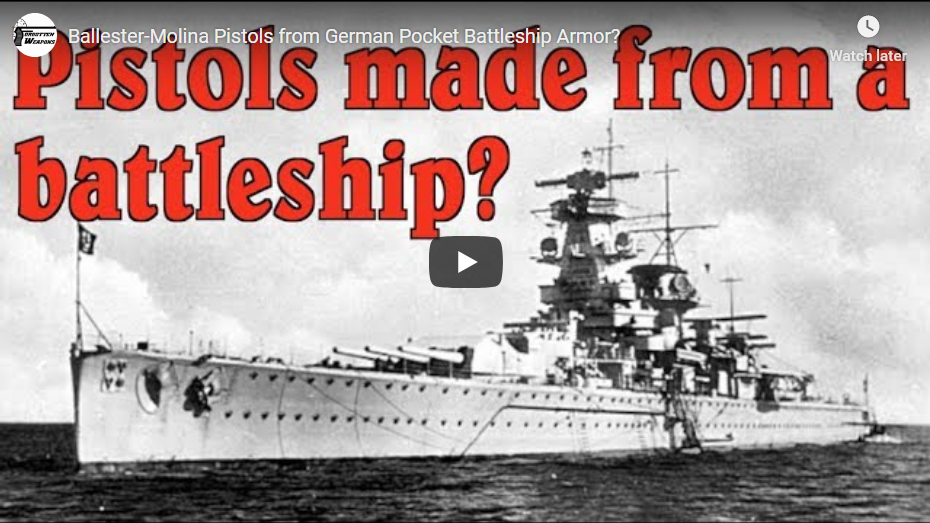
Ballester-Molina Pistols from German Pocket Battleship Armor?
Forgotten Weapons
Published 17 Dec 2019http://www.patreon.com/ForgottenWeapons
Cool Forgotten Weapons merch! http://shop.bbtv.com/collections/forg…
There is an old gun shop tale that Argentine Ballester-Molina pistols were made form the salvaged armor plate of the pocket battleship Admiral Graf Spee. The Graf Spee was scuttled in the Rio de la Plata estuary in December 1939, only a few miles from the HAFDASA factory in Buenos Aires, and Argentina did not have the domestic steel reserves to make enough pistols…
See Michael Parker’s full article on this, including the exact results of his metallurgical analysis, here:
https://www.americanrifleman.org/arti…
Contact:
Forgotten Weapons
6281 N. Oracle #36270
Tucson, AZ 85704
December 15, 2019
The Empire Strikes Back – Britain’s Operation Compass – WW2 – 068 – December 14, 1940
World War Two
Published 14 Dec 2019The First British offensive of the War begins in North Africa. Meanwhile, the German Knickebein system is designed for bombers to accurately bomb British targets at night. This is what the Brits do to stop them.
Join us on Patreon: https://www.patreon.com/TimeGhostHistory
Or join The TimeGhost Army directly at: https://timeghost.tvFollow WW2 day by day on Instagram @World_war_two_realtime https://www.instagram.com/world_war_t…
Join our Discord Server: https://discord.gg/D6D2aYN.
Between 2 Wars: https://www.youtube.com/playlist?list…
Source list: http://bit.ly/WW2sourcesWritten and Hosted by: Indy Neidell
Produced and Directed by: Spartacus Olsson and Astrid Deinhard
Executive Producers: Bodo Rittenauer, Astrid Deinhard, Indy Neidell, Spartacus Olsson
Creative Producer: Joram Appel
Post-Production Director: Wieke Kapteijns
Research by: Indy Neidell
Edited by: Iryna Dulka
Map animations: Eastory (https://www.youtube.com/c/eastory)Thumbnail Colorization (Archie Wavell) by:
– Julius Jääskeläinen – https://www.facebook.com/JJcolorization/Colorizations by:
– Dememorabilia – https://www.instagram.com/dememorabilia/
– Adrien Fillon – https://www.instagram.com/adrien.colo…Sources:
– IWM: F 4539, B 10600, CM 355, E 6600, E 3720E, E 1416, E 1378, E 4792
– Tropenmuseum, part of the National Museum of World Cultures– Prison icon by FORMGUT. from the Noun Project; Compass by RULI from the Noun Project.
Archive by Screenocean/Reuters https://www.screenocean.com.
A TimeGhost chronological documentary produced by OnLion Entertainment GmbH.
December 13, 2019
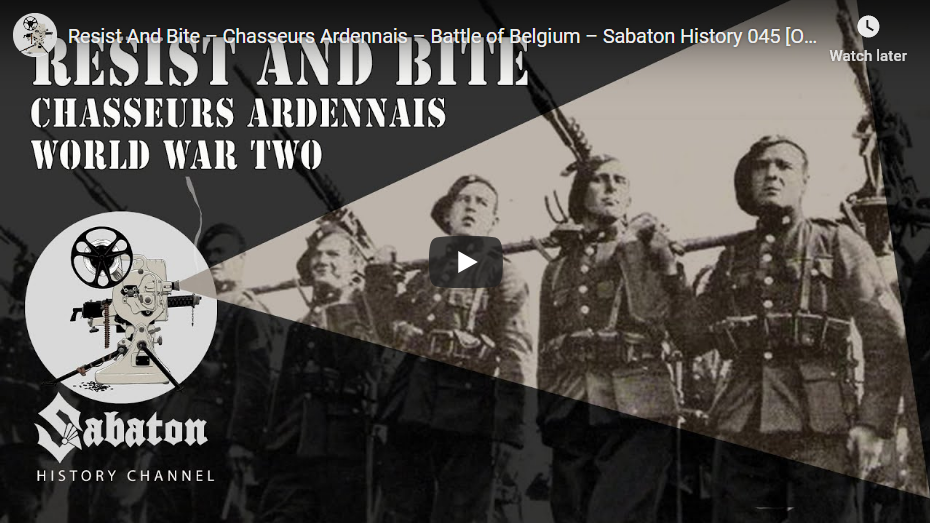
“Resist And Bite” – Chasseurs Ardennais – Battle of Belgium – Sabaton History 045 [Official]
Sabaton History
Published 12 Dec 2019As Germany invades France and the Benelux countries in May 1940, the main bulk of their panzers are heading towards the Ardennes and the Meuse River in an effort to cut the Allied forces in half. However, two small units of Belgian infantry are standing in their way. They are the Chasseurs Ardennais and have one objective: To delay the Germans by every means necessary…
Support Sabaton History on Patreon: https://www.patreon.com/sabatonhistory
Listen to Heroes (where “Resist And Bite” is featured):
CD: http://bit.ly/HeroesStore
Spotify: http://bit.ly/HeroesSpotify
Apple Music: http://bit.ly/HeroesAppleMusic
iTunes: http://bit.ly/HeroesiTunes
Amazon: http://bit.ly/HeroesAmz
Google Play: http://bit.ly/HeroesGooglePWatch the official lyric video of “Resist And Bite” here:
https://www.youtube.com/watch?v=iGtEH…Listen to Sabaton on Spotify: http://smarturl.it/SabatonSpotify
Official Sabaton Merchandise Shop: http://bit.ly/SabatonOfficialShopHosted by: Indy Neidell
Written by: Markus Linke and Indy Neidell
Directed by: Astrid Deinhard and Wieke Kapteijns
Produced by: Pär Sundström, Astrid Deinhard and Spartacus Olsson
Creative Producer: Joram Appel
Executive Producers: Pär Sundström, Joakim Broden, Tomas Sunmo, Indy Neidell, Astrid Deinhard, and Spartacus Olsson
Post-Production Director: Wieke Kapteijns
Production Intern: Rune Væver Hartvig
Edited by: Iryna Dulka
Sound Editing by: Marek Kaminski
Maps by: Eastory – https://www.youtube.com/c/eastoryArchive by: Reuters/Screenocean https://www.screenocean.com
Music by Sabaton.Colorizations:
– Julius Jääskeläinen – https://www.facebook.com/JJcolorization/
– Olga Shirnina, a.k.a. Klimbim – https://klimbim2014.wordpress.com/An OnLion Entertainment GmbH and Raging Beaver Publishing AB co-Production.
© Raging Beaver Publishing AB, 2019 – all rights reserved.
From the comments:
Sabaton History
2 days ago (edited)
Today we again turn towards the Second World War — to be more specific the 1940 German invasion of France and the Benelux. Here two small Belgian units bravely attempted to delay the advance of the Wehrmacht. We hope you all appreciate this video! And much like the Chasseur Ardennais supported the war effort of the Belgians, our awesome Patrons support the war effort of us, the Sabaton History team! So if you haven’t, you most certainly should consider supporting us on https://www.patreon.com/sabatonhistory.Oh and if you’re interested in World War Two, you should definitely check out Indy’s World War Two Channel (http://www.youtube.com/c/worldwartwo) where he covers WW2 Week-by-week. Last May, he covered the invasion of the Benelux and France, which you can check out right here: https://youtu.be/DLN8NHXiMy0
Cheers, the Sabaton History team!
December 12, 2019
The Few Who Opposed Hitler – German Resistance in 1940 – WW2 – War Against Humanity 006
World War Two
Published 11 Dec 2019Where all German faithful Nazis? Not by a stretch, but a resounding majority approved of the Nazis, especially before the war, and again after the victory in France. Anyone that actively opposed Hitler and his gang were not only risking their life, but faced an uphill battle against public opinion. And yet … some people did.
Join us on Patreon: https://www.patreon.com/TimeGhostHistory
Or join The TimeGhost Army directly at: https://timeghost.tvFollow WW2 day by day on Instagram @World_war_two_realtime https://www.instagram.com/world_war_t…
Join our Discord Server: https://discord.gg/D6D2aYN.
Source list: http://bit.ly/WW2sourcesHosted by: Spartacus Olsson
Written by: Spartacus Olsson and Joram Appel
Produced and Directed by: Spartacus Olsson and Astrid Deinhard
Executive Producers: Bodo Rittenauer, Astrid Deinhard, Indy Neidell, Spartacus Olsson
Creative Producer: Joram Appel
Post-Production Director: Wieke Kapteijns
Research by: Joram Appel and Spartacus Olsson
Edited by: Mikołaj Cackowski
Map animations: Eastory (https://www.youtube.com/c/eastory)Colorizations by:
Cassowary Colorizations – https://www.flickr.com/photos/cassowa…
Julius Jääskeläinen – https://www.facebook.com/JJcolorization/
Dememorabilia – https://www.instagram.com/dememorabilia/
Norman Stewart – https://oldtimesincolor.blogspot.com/Sources:
Archive of I. M. Bondarenko
Archive by Screenocean/Reuters https://www.screenocean.com.A TimeGhost chronological documentary produced by OnLion Entertainment GmbH.
From the comments:
World War Two
5 hours ago
This is the first episode of five War Against Humanity videos that will focus on Resistance in 1940. In this episode we look at Germany, then France, after that the Benelux countries and Scandinavia, then Poland and finally China. The first two episodes will come out before Christmas and the next will follow at the beginning of the new year. These episodes are all introductions to a recurring coverage of the war behind the lines. Resistance and collaboration with the occupying enemy was an essential component of WW2, but because it was clandestine, often private enterprises, the records are less detailed than the ones of the official war machines of the belligerents. Thus, resistance is not always as easy to organize on a weekly time line. Therefore we will return irregularly to the events behind each frontline to look at the developments over a somewhat longer timespan. We will do our best to follow the individuals who played a central part in the events and machinations. We hope that in this way we can give you more insight into WW2 events that are often overlooked, or covered in a less cohesive way.
December 10, 2019
QotD: British breakfast – “Not a snack but a serious meal”
First of all, then, breakfast. Ideally for nearly all British people, and in practice for most of them even now, this is not a snack but a serious meal. The hour at which people have their breakfast is of course governed by the time at which they go to work, but if they were free to choose, most people would like to have breakfast at nine o’clock. In principle the meal consists of three courses, one of which is a meat course. Traditionally it starts with porridge, which is made of coarse oatmeal, sodden and then boiled into a spongy mess: it is eaten always hot, with cold milk (better still, cream) poured over it, and sugar. Breakfast cereals, which are ready-cooked preparations of wheat or rice, taken cold with milk and sugar, are often eaten instead of porridge. After this comes either fish, usually salt fish, or meat in some form, or eggs in some form. The best and most characteristically British form of salt fish is the kipper, which is a herring split open and cured in wood-smoke until it is deep brown colour. Kippers are either grilled or fried. The usual breakfast meat dishes are either fried bacon, with or without fried eggs, grilled kidneys, fried pork sausages, or cold ham. British people favour a lean, mild type of bacon or ham, cured with sugar and nitre rather than with salt. At normal time it is not unusual to eat grilled beef steaks or mutton chops at breakfast, and there are still old-fashioned people who like to start the day with cold roast beef. In some parts of the country, for instance in East Anglia, it is usual to eat cheese at breakfast.
After the meat course comes bread, or more often toast, with butter and orange marmalade. It must be orange marmalade, though honey is a possible substitute. Other kinds of jam are seldom eaten at breakfast, and marmalade does not often appear at other times of [the] day. For the great bulk of British people, the invariable breakfast drink is tea. Coffee in Britain is almost always nasty, either in restaurants or in private houses; the majority of people, though they drink it fairly freely, are uninterested in it and do not know good coffee from bad. Of tea, on the other hand, they are extremely critical, and everyone has his favourite brand and his pet theory as to how it should be made. Tea is always drunk with milk, and it is usual to brew it very strong, about one spoonful of dry tea leaves being allowed for each cup. Most people prefer Indian to Chinese tea, and they like to put sugar in it. Here, however, one comes upon a class distinction, or more exactly a cultural distinction. Virtually all British working-people put sugar in their tea, and indeed will not drink tea without it. Unsweetened tea is an upper-class or middle-class habit, and even in those classes it tends to be associated with a Europeanised palate. If one made a list of the people in Britain who prefer wine to beer, one would probably find that it included most of the people who prefer tea without sugar.
After this solid breakfast – and even now, in a time of rationing, it is usual to eat a fairly large bulk of food, chiefly bread, at breakfast – it is natural that the midday meal should be somewhat lighter than it is in many other countries.
George Orwell, “British Cookery”, 1946. (Originally commissioned by the British Council, but refused by them and later published in abbreviated form.)
December 9, 2019
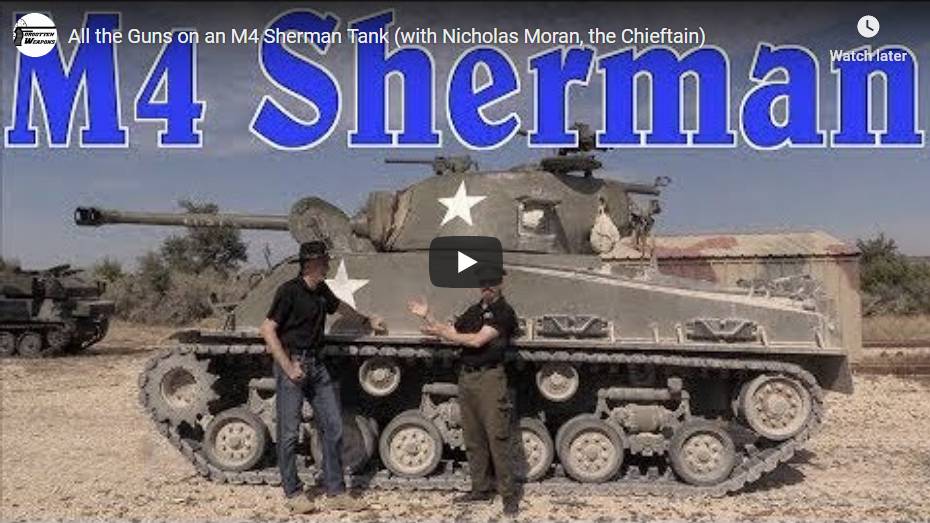
All the Guns on an M4 Sherman Tank (with Nicholas Moran, the Chieftain)
Forgotten Weapons
Published 7 Dec 2019Try out World of Tanks with a special bonus tank using this link!
https://tanks.ly/ForgottenWeapons
Today Nicholas Moran (the Chieftain) and I are at DriveTanks.com courtesy of Wargaming.net, to show you around a World War Two Sherman tank and all its various armaments. We will discuss and shoot the bow machine gun, coaxial machine gun, commander’s hatch machine gun, antiaircraft .50 cal M2 machine gun, 76mm high velocity main gun, and the crew’s small arms, an M3 Grease Gun and a 1911 pistol.
If you enjoy this video, check out World of Tanks – and maybe they will send Nicholas and I back again to do the same thing for a different tank!
http://www.patreon.com/ForgottenWeapons
Cool Forgotten Weapons merch! http://shop.bbtv.com/collections/forg…
Contact:
Forgotten Weapons
6281 N. Oracle #36270
Tucson, AZ 85704