
I hate to say “it’s a generational thing”, but it’s a generational thing.
Those of us who came of age before Endless September still regard the Internet as a tool. I can do online in two minutes what used to take me two hours in meatspace. For instance, when I first started working full time, I’d have to waste my entire lunch break on the first Monday of every month taking my physical paycheck down to the brick-and-mortar bank, where I’d fill out a bunch of paper to move money around, which I’d hand to a real person who took her sweet goddamn time filing it, and so on. Fight traffic all the way there, fight traffic all the way back, and yeah, that’s a full hour, even when the bank is relatively close. If that bank is closed, or there’s road construction or something, I’d have to spend all Saturday morning doing it, because banks kept bankers’ hours and so I’d better get there and get it done during the three-hour window the brick-and-mortar place was open. And since everyone else on earth was in the same situation …
These days, I’m hard pressed to remember the last time I stepped a real foot inside a physical bank. There’s simply no need. Everything is automatic. Which is convenient, no doubt, but that’s ALL it is: I’ve saved X minutes / hours in my day, which I can use to do other stuff. Other stuff like “see my friends” or “take a walk” or “read a book”. You know, real person stuff. I might read the book online; I might check my email if there’s nothing else to do; but there too the Internet is just a boredom-alleviation tool; something conveniently to hand that passes the time when there’s no other easily accessible way to pass the time.
I would find it inconvenient, sometimes extremely so, to throw the Pocket Moloch in the nearest lake, but the thought doesn’t fill me with dread. Oh, the Net’s down? Shrug.
Not so with the younger generations. I have friends I haven’t seen in weeks, months, years, but when we get together again, it’s like we were never apart, because we met in meatspace and have so much real, personal interaction to fall back on. Younger generations have “friends” they’ve never met in the flesh. Not once. Tell me “Hey, you’re not going to be able to see Tim for a few months” and it’s no big thing. I can still call Tim, or write Tim a letter, or just catch up with him when he gets back, to hear all the cool stories he has. Tell the younger folks “Tim is offline” and they freak the fuck out. Tim is inseparable from the Pocket Moloch in a way we oldsters can only dimly grasp.
They would, I’m sadly sure, prefer to interact with Tim entirely digitally. If you haven’t done it yet, try to find some young people hanging out in a group. It’s actually not the easiest thing to do – which should tell you something right there – but if you manage it, you’ll notice that they spend more time texting than they do talking to each other. And here’s the real kicker: Half the time, they’re texting each other. The same people who are physically right there.
That’s a mentality I can’t begin to grasp. I wonder if it can be broken. I’m not optimistic.
Severian, “Friday Mailbag”, Founding Questions, 2023-07-07.
October 8, 2023
October 7, 2023
“Many people who hold ‘luxury beliefs’ … are oblivious to the consequences of their views”
Rob Henderson, guest-posting at The Free Press, illustrates several recent examples of well-connected people holding what he coined as “luxury beliefs” being suddenly introduced to the real-world consequences of their beliefs:

Recently, two high-profile supporters of “justice reform” were murdered.
At 4 a.m. on Monday, Ryan Carson, a 32-year-old social justice and climate change activist, was walking with his girlfriend in Bedford–Stuyvesant, Brooklyn, when he was stabbed to death by a stranger. Only a few hours earlier in Philadelphia, activist and journalist Josh Kruger was shot and killed in his home.
And two Democratic lawmakers who voted to “redirect funding to community-based policing reforms” have been recent victims of violent crime.
On Monday night, blocks away from the Capitol in Washington, D.C., Congressman Henry Cuellar was carjacked by three armed men. (The lawmaker survived the incident unscathed.) In February, Angie Craig was attacked in an elevator at her apartment building in Capitol Hill. A homeless man demanded she allow him into her home to use the restroom, then he punched her and grabbed her around the neck. She escaped after throwing hot coffee on him.
Of course, these people did not deserve harm because of their support for soft-on-crime policies. But I’ve long argued that many people who hold “luxury beliefs” — ideas and opinions that confer status on the upper class, while often inflicting costs on the lower classes — are oblivious to the consequences of their views. Support for defunding the police is a classic example.
Luxury beliefs can stem from malice, good intentions, or outright naivete.
But the individuals who hold those beliefs, the people who wield the most influence in policy and culture, are often sheltered when their preferences are implemented.
Some online commenters have said that my luxury beliefs thesis is undermined by these tragic events, because the victims were affluent and influential — and they still suffered the consequences of their beliefs.
But the fact remains that poor people are far more likely to be victims of violent crime. For every upper-middle-class person killed, 20 poor people you never hear about are assaulted and murdered. You just never hear about them. They don’t get identified by name in the media. Their stories don’t get told.
October 5, 2023
The Soviet Spies who Kickstarted the Nuclear Arms Race
World War Two
Published 4 Oct 2023Last episode we saw Klaus Fuchs steal details of the American atomic bomb for the Soviet Union. But he’s only one component of a much bigger conspiracy. Today, Astrid introduces you to the mysterious web of Soviet atomic spies. Their work changed our world forever.
(more…)
From Hilaire Belloc’s sailboat to your nearest international airport terminal
The most recent review at Mr. and Mrs. Psmith’s Bookshelf considers Hilaire Belloc’s The Cruise of the “Nona”:
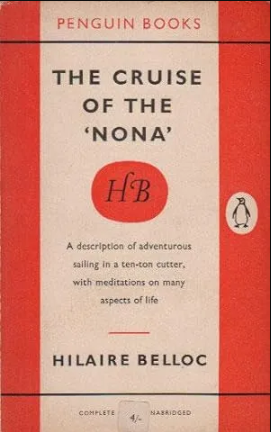
Late in the May of 1925, around midnight, Hilaire Belloc climbed into a tiny boat and put out to sea so that he would have some time to think. The sea gives ample time to think, especially if like Belloc you disdain the use of a motor. Some wag once jested that sailing is like being at war: long stretches of boredom punctuated by moments of abject terror. I suppose in some sense that’s correct, but give me the boredom of the sailboat any day over the boredom of the trench, the boredom of the cubicle, the boredom of endless doomscrolling.
Sailing is productive boredom, and seems unusually well calibrated for causing the mind to wander in interesting or delightful or just plain ridiculous directions. Maybe it’s the stimulating effects of the wind in your face and the smell of salt in the air, or maybe it’s the weird altered state of consciousness that comes from staring at the ocean. I think it’s because sailing is the human condition in miniature. It places you perfectly-balanced on a knife’s edge between agency and helplessness, and in so doing it both spurs the mind to activity and gives it space to relax and reflect.1
[…]
Anybody who’s travelled extensively in the third world has seen the modern version of this. There’s nothing intrinsic to being a reformer or a liberalizer that makes you an agent of American power, and yet … there’s a better than even chance that you are. After a while these people all blend together — the idealistic students, the LGBT activists, the NGO staffers, the embassy employees recruited from amongst the locals. They come from a hundred nations, from every conceivable race and religion, and yet something invisibly and inexorably molds them all into the same shape, like iron filings lining themselves up in the presence of a powerful magnet.
Soon they have American souls, and divided loyalties to match. The local regime panics and views them as an internal enemy, which only furthers their alienation from their motherland and their flight into the bosom of Global America. Most empires rule primarily though influence, not coercion, and this class of people is one of America’s most powerful weapons for maintaining and extending its hegemony.
A related phenomenon is the awful sameness that is slowly taking over the whole world. Perhaps your cruise ship docks at a dozen ports over the course of its journey, and every one of them looks exactly the same — the same tiki bar with the same sign, the same shops selling the same ornamental kitsch probably all made in the same factory. You aren’t visiting a place, you’re visiting a psychic manifestation of the Buffetverse, another outpost of Margaritaville, a Potemkin seaport with frozen daiquiris. You all know what I’m talking about. We make fun of it all the time, because cruise ships are for chuds. But it doesn’t just happen with cruise ships.
The cancer usually starts in an international airport. Form follows function, so it’s superficially reasonable that every airport on earth should look and feel exactly the same. But the real reason is that it follows in the wake of the kinds of people who fly into those airports, praising the broadening effects of foreign travel whilst terraforming everything they touch until it resembles the “arts district” of a midsize American city, replete with distressed wood finishes, gravid with craft beers. Real foreignness would cause these people to recoil in shock, or to demand a peacekeeping intervention. It’s not unusual for the imperial functionary class to be parochial, but what’s surreal about ours is how they combine the blinkered innocence of a farm boy with an ideology of weary cosmopolitanism.
None of this was as far along when Belloc took his little cruise, but the seeds had been planted, and he could feel in his bones that something horrible lay across the horizon. So he fights it the only way he knows how — by noticing and celebrating everything distinctive and local and weird about every place he visits. No island is too small for him to mention by name and recall a ghost story or two associated with it. No village is too commonplace for him to remark on the habits, physiognomy, and vices of the people who live in it. It’s the same spirit as that which animates Chesterton’s essay on cheese, but applied to a hundred hamlets and fishing ports, a paean to the regional diversity and distinctiveness that was already slipping away.
1. Oh hey, it’s the focused-mode and diffuse-mode of cognition! The best way to think deeply about anything is to toggle between them.
The Great War: Its End and Effects, Lecture by Prof Margaret MacMillan
McDonald Centre
Published 25 Jan 201922 January 2019, “How far did the Versailles Treaty make Peace?”, Professor Margaret MacMillan, Warden of St Antony’s College, Oxford. The lecture was sponsored by Christ Church Cathedral and the McDonald Centre for Theology, Ethics, and Public Life, Oxford.
QotD: The Wuhan Coronavirus pandemic was a “propaganda masterpiece”
Dr. Miller goes on to say, “I know a lot about propaganda, and this is unprecedented in the history of mass persuasion. There has never been anything like this because this is global. This has never happened before. We had Stalin’s crimes … We had Hitler’s aggression and the Holocaust. We had 911 and the ‘War on Terror’. None of those actually begin to compare to what we have now because what we have now is planetary. It’s worldwide.”
Dr. Miller does not call the CV19 bioweapon/vax a genocide. He says it is really a global democide. Meaning everyone and anyone is being murdered with the CV19 bioweapon/vax. Dr. Miller says, “My Substack is called ‘Died Suddenly’. I started it in February of 2022 when I noticed many, many people were dying suddenly for no given reason. In the history of obituaries, certainly in the United States, that is unprecedented. Obituaries always tell you why somebody died. Even if the person is very, very old, you have a cause of death. Now, all kinds of people are dropping dead for no reason and often very young … We do a weekly overview with as many pictures of these people as possible. This is the point. There are many statistical claims of the numbers of people who are dying … But as Stalin said, ‘One death is a tragedy, a million deaths is a statistic’. This is brutal, cynical wisdom, and he was absolutely right. If you read 1 million people starved in Ukraine, you say that’s too bad. If you look at page after page after page of people’s faces and names with the names of their survivors, it’s not so easy to shrug off.”
Greg Hunter, “CV19 – A Propaganda Masterpiece – Mark Crispin Miller”, USAWatchdog, 2023-06-10.
October 4, 2023
“John Adams said that a republican constitutional structure didn’t guarantee republican virtue in government”
Chris Bray reflects on the 17th amendment to the US Constitution in light of the appointment of California’s new senator:

California Governor Gavin Newsom speaking at the 2019 California Democratic Party State Convention in San Francisco, California on 1 June, 2019.
Photo by Gage Skidmore via Wikimedia Commons.
… the Senate was supposed to be the national storehouse of wisdom, restraint, discipline, and worldly experience. You may already be seeing that we wandered away from this idea at some point.
The 17th Amendment, ratified in 1913, gave voters the power to directly elect senators, reducing the influence of state legislatures and opening the upper house to mass media popularity contests. The 16th Amendment — “Congress shall have power to lay and collect taxes on incomes” — was ratified the same year, a one-two punch of Progressive centralization of power.
The democratizing and centralizing character of the 17th Amendment gave us a parade of powerful idiots that culminated in John Fetterman, passing through Mazie Hirono and the professional Ted Baxter impersonator Sheldon Whitehouse, so it looks like a failure. But we’ve just run an experiment, thanks to Dianne Feinstein’s white-knuckled grip on her personal status, and the results are … interesting.
The California legislature, in its infinite wisdom, has given the governor the unilateral authority to appoint Feinstein’s replacement, so we’re not quite seeing the exact duplicate of the original constitutional design for the Senate. But we’re seeing something like it: a senator chosen by something other than the popular vote, elevated to the Senate after selection by a longtime state official who has deep personal familiarity with the pool of people who might do the job. You know, a statesman.
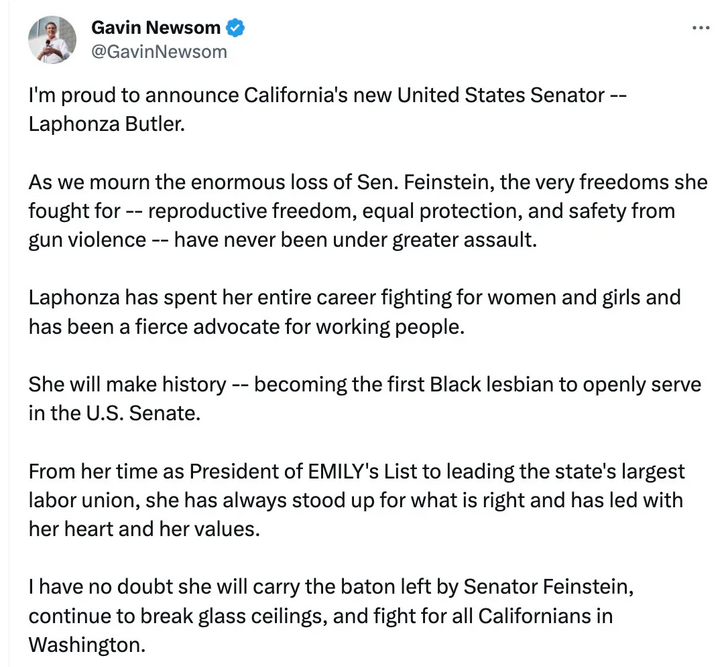
Newsom’s choice for Feinstein’s seat is almost miraculous in its awfulness, an appointment distinguished by cravenness and sleazy insiderism. Naming a new senator from a state with 39 million people in it, he has chosen the Maryland resident Laphonza Butler — who has never held any elected office anywhere.
Butler is a career activist and party hack, an SEIU official who went on to run the abortion PAC EMILYs List. She is, in other words, one of the people whose function in life has been to raise money for the Democratic Party. She’s an ATM, and she’s never been anything else. She’s being appointed to the United States Senate without having ever convinced any voters anywhere to elect her to anything, and she’s rising to the upper house of the national legislature with no experience of any kind in any relevant field. Advice and consent on foreign policy? Confirmation of judicial nominees? Well, she has experience raising money for candidates, so. It’s a straight payoff: generate cash for the party for twenty years, get a free high-status ride in the Senate.
Here’s how Newsom explains the choice:
She’s a black lesbian who gives us money, end of statement. California’s idiot politicians find the choice exciting.
October 3, 2023
The William Tell Aerial Gunnery Competitions; The CF-101 Voodoo in action
Polyus
Published 23 Aug 2021William Tell: an aerial gunnery competition to assess NORAD’s interceptor squadrons. Canadian CF-101s entered 7 of these competitions and won 3 overall “Top Gun” awards as well as one “Top Unit” award. Pretty impressive results when considering how few squadrons Canada fielded as compared with the vast United States Air Force. Results confirmed that the CF-101s on quick reaction alert at bases across the country were indeed useful in their defense.
(more…)
QotD: The meteorologically mild 20th century
[…] I read a lot of history and thus know a fair bit about how weather impact has been perceived by humans over time. It is a fact that the 20th century was an abnormally lucky hundred years, meteorologically speaking. The facts I managed to jam into tweets included (a) the superstorm that flooded 300 square miles of the Central Valley in California in the 1860s, (b) rainfall levels we’d consider drought conditions were normal in the U.S. Midwest before about 1905, and (c) storms of a violence we’d find hard to believe were commonly reported in the 1800s. I had specifically in mind something I learned from the book Wicked River: The Mississippi When It Last Ran Wild, which relays eyewitness accounts of thunderstorms so intense that travelers had to steeple their hands over their noses in order to breathe air instead of water; but a sense that storms of really theatrical violence were once common comes through in many other histories.
We had a quiet century geophysically as well – no earthquakes even nearly as bad as the New Madrid event of 1812, which broke windows as far north as Montreal. And no solar storms to compare with the Carrington Event of 1859, which seriously damaged the then-nascent telegraph infrastructure and if it recurred today would knock out power and telecomms so badly that we’d be years recovering and casualties would number in the hundreds of thousands, possibly the millions.
(I’m concentrating on 19th-century reports because those tended to be well-documented, but earlier records tell us it was the 20th century calm that was unusual, not the 19th-century violence.)
The awkward truth is that there are very large forces in play in the biosphere, and when they wander out of the ranges we’re adapted to, we suffer and die a lot and there really isn’t a great deal we can do about it; we don’t operate at the required energy scales. For that matter, I can think of several astronomical catastrophes that could be lurking just outside our light-cone only to wipe out all multicellular life on Earth next week. Reality is like that.
But none of this would fit in a tweet, so what I said in summary was that this may be the new normal – or, rather, the old normal returning. Humans didn’t do it.
Eric S. Raymond, “Heavy weather and bad juju”, Armed and Dangerous, 2011-02-03.
October 2, 2023
Why France Lost Vietnam: The Battle of Dien Bien Phu
Real Time History
Published 29 Sept 2023After the French success in the Battle of Na San, the battle of Dien Bien Phu is supposed to defeat the Viet Minh once and for all. But instead the weeks-long siege becomes a symbol of the French defeat in Vietnam.
(more…)
Glenn Reynolds explains “why leftist groups use underage kids as their stalking-horses, shock troops, and human shields”
In his most recent Substack post, Glenn Reynolds (aka the “Instapundit”) grants the late Senator Dianne Feinstein a kind mention before digging into the widespread phenomenon of progressive groups using children and younger teens as their public face:
One reason is the “culture of youth”, with dates back to around the time I was born. The notion – alien to human civilization for almost its entirety – was that younger people know more, are more insightful, and deserve more attention than older people.
The problem with this argument is that it is absurd. (There’s a reason why it’s alien to pretty much all previous human civilization, and it’s not because previous human civilization didn’t know what it was doing). Well, that’s one problem. Another problem is that it is manipulative and dishonest. And it’s sufficiently damaging for the young people involved that it borders on abuse.
First, the manipulative and dishonest part. Kids are cute; people instinctively (literally) like them. Associating them with your ideology is intended to produce a halo effect. (Even the Nazis did this.)
But people’s natural feelings toward adorable kids, like their feelings for puppies, baby goats, etc., have nothing to do with policy. Relying on something like that is practically an admission that your views lack substance.
Likewise, the fact that kids believe your views means nothing. Kids believe in Santa Claus, the Tooth Fairy, and superheroes. The very essence of kidhood is the inability to reliably make rational choices. We recognize this with laws setting the age of consent for sex, a drinking age, and a voting age, as Sen. Feinstein pointed out.
The really manipulative part, though, lies in sending kids to express your views, then calling it abusive if people point out that the views they’re expressing are stupid. (We got this all the time with children’s crusaders like David Hogg and Greta Thunberg until they became too old for it to work, at which time their stars began to set.)
If your ideas need to be expressed by people that others aren’t allowed to criticize, that’s a solid indicator that your ideas can’t withstand criticism, because they’re stupid.
It’s also abusive to put kids through this. Telling kids that they’re needed to save the world may fit Harry Potter / Percy Jackson childhood fantasies – but putting that pressure on them in the real world is enormously stressful. Turning kids to crusaders tends to end badly – see, e.g., the original Children’s Crusade – and is likely to be emotionally draining and damaging for them at the very least. Kids shouldn’t take responsibility for the world. That’s adults’ job. Encouraging them to do so for political ends is abusive and wrong.
Nonetheless political groups do this all the time, and usually don’t get a lot of pushback. I think it’s time for that to end.
October 1, 2023
The End of Market Garden – WW2 – Week 266 – September 30, 1944
World War Two
Published 30 Sep 2023This week, Operation Market Garden comes to its unsuccessful conclusion, but there’s a lot more going on — the Soviets launch an offensive in the Estonian Archipelago, the Warsaw Uprising is on the ropes, the Allies advance in Italy, the Americans on Peleliu, and Tito and Stalin make plans to clear Yugoslavia of the enemy.
(more…)
September 30, 2023
The Man Who Stole the Atomic Bomb
World War Two
Published 29 Sep 2023In the New Mexico desert, a secret team of scientists is working flat out to develop atomic bombs. It’s the most important American military project in history. But one of those scientists lives a double life. Klaus Fuchs has decided to betray his country and share America’s most secret technology with the Soviet Union. But is he the only person who has turned traitor?
(more…)
QotD: Incentives matter, college student edition
Which is an odd position for someone who spent as long as I did toiling in the groves of academe to take, I realize. So let me explain: As with the Vibrancy, I dislike their behavior – intensely. But I don’t blame them for acting that way. If you want to know what’s wrong with our entire Postmodern, homo economicus way of looking at the world, there you go. I don’t blame them, because they have every rational incentive to behave that way, and none not to (indeed, acting other than they do comes with a considerable cost).
College kids don’t read, don’t study, don’t do anything other than attempt, insofar as possible, to regurgitate lectures word-for-word on the “exam”, after which they promptly forget everything. Once more, with feeling: I do not blame them for this, since pretty much everything they “learn” is so worthless, it’s antimatter education. I’m not joking when I say it’s all just Social Justice Mad Libs: “The [group] was oppressed by Whitey through [adjective] [adjective] [noun], and that’s why Pale Penis People are evil.”
For example, I taught for a few semesters at a college that tried very hard to run “African-American” versions of core classes as a marketing stunt. There was “US History to 1865”, for example, and, in parallel, “African-American History to 1865.” Leaving aside the fact that you could cover the whole fucking course in about five minutes – “there sure was a lot of slavery back then!” – even the faculty, all of whom were of course raving SJWs, laughed at the sheer pointlessness of it. “US to 1865” was already nothing but “Negroes and Lesbians save the Republic!”, or vice versa, depending on whether or not the prof teaching the course this semester was the Angry Black Feminist Marxist, or the Angry Marxist Feminist Lesbian.
Severian, “College Kids”, Rotten Chestnuts, 2020-12-12.
September 28, 2023
QotD: “Tenure Track” positions in an American university
A tenure-track position begins with a national (or international) search and a fairly long hiring process (from job-posting to job-offer usually takes around 6-8 months). A newly hired professor is an assistant professor, which means they are on the tenure track but do not yet have tenure. Instead, after about five to six years, they’ll go up for tenure review, where a committee of faculty in their department along with some external reviewers will look at all of the work the professor has done since their appointment and either recommend them for tenure or not; the university leadership structure typically has a role in confirming a grant of tenure but this is generally a rubber-stamp role. By far the most important part of tenure review at large universities is research; this is the part of the system that is “publish or perish”.1 Untenured tenure-track faculty (so, assistant professors) represent roughly 9% of all faculty members in the United States, according to the AAUP.
A professor that passes tenure review becomes an associate professor, which confers tenure (making it difficult to fire them) as well as a bump in pay. After another few years, they can go up for review again for promotion to the next rank, simply professor (often termed “full professor” for clarity), which comes with another bump in pay. This second transition is different from the first though; whereas the review from assistant to associate professor is an “up or out” moment (you either get tenure and stay or get rejected for tenure and leave the department), some professors can and do remain associate professors forever. Finally, a handful of professors who really distinguish themselves may wind up with an endowed chair and we tend to call these folks distinguished professors, though their actual job title will usually be something like “the so-and-so Professor/Chair of this-and-that” where the ‘so-and-so’ is the name of the donor that endowed the money being used for the distinguished professorship. Tenured professors represent roughly 24% of all university professors according to the AAUP, meaning that the total slice of tenured or tenure-eligable professors in higher education is just 33% – one third.
Let me say that again: only one third of all faculty work the way all of you think all faculty works. Just one third. This is a big part of what I mean when I say that the United States’ university system is being pillaged without the public knowing; if you told most people “only one third of college instructors are actually professors, most of your little Johnny’s classes are taught by non-professors now“, they’d be shocked! But that’s the current situation.2
Tenure-track professors generally teach a fixed course-load, expressed in most cases as a load over semesters, so a “2/2” (pronounced “two-two”) load is four courses a year (two in each semester). Tenure-track faculties at research-focused universities (which are all of the flagship state schools) generally teach a 2/2 load; mixed research/teaching schools (your third-string state schools and less well-funded private schools) often have 3/3 loads. Teaching-focused institutions may have 4/4 or 5/5 teaching loads (or more) and of course fractional loads (like a 2/3, etc.) do exist, but are less common.
In addition to teaching, tenure-track faculty are expected to publish research and do “service”. We’ll talk in another post more about these demands (indeed, we’ve talked about research already), but they deserve a few words here. The amount of research demanded varies by the level of institution; at an R1 the general expectation for a faculty member going for tenure in a humanities department is that their book is out3 and they have a good number of articles and other publications besides. At less research-focused universities, you might see instead that tenure is set at a certain number of articles and the book is instead at the jump to full professor.
Meanwhile “service” refers to all of the non-teaching roles faculty fill in a department. The university is predicated on self-governing departments of academics (“colleges” in the literal sense of an association of colleagues) and so departments are effectively run by committees and faculty appointed to do various key roles: student advising, graduate admissions committees, hiring committees, committees on teaching, and of course department chair (and possibly vice or assistant chairs) who steers the department. Of course faculty are assisted in those roles by the department staff who handle much of the paperwork, compliance and book-keeping. Some, but by no means all, of these service jobs come with a “course release” which is to say the faculty member teaches less in order to do the extra service, but there is an expectation of a certain amount of service work always being part of the workload mix.4
Finally, the more important service positions are often restricted to either associate or full professors – you have to get tenure first before you get a particularly loud voice in the running of the department. Nevertheless, even assistant professors are going to be “in the room” when decisions about courses, resource allocation, scheduling, and so on are made, which matters quite a lot. Moreover, because even assistant professors are expected to become permanent members of the department, their interests tend to be considered because, well, frankly, the tenured professors have to live with them for the next few decades, so you might as well be friends. This fact is really important for understanding why departments can be so callous to anyone not on the tenure-track (and why tenure-track faculty can be so oblivious to how callous they are being), because NTT faculty are usually not in the room when decisions are made.
Bret Devereaux, “Collections: Academic Ranks Explained Or What On Earth Is an Adjunct?”, A Collection of Unmitigated Pedantry, 2023-04-28.
1. A phrase that I am sick to death of hearing, but it seems to be functionally the only thing most people in the public know about academia and also the thing that select members of the public seem to think we need repeated to us at every possible opportunity, as if we’re not aware. It’s useless in any case, in history at least. Which hiring numbers being what they are now, by far the most common career path is in fact, “publish and then perish”.
2. In fact, COVID made these numbers look better than they had in the years previously, not because universities hired more tenure-line professors (they didn’t), but because they fired a lot of non-tenure line professors due to COVID, taking advantage of their lack of job protection.
3. In yesteryear, a book simply forthcoming was good enough. These days, that might not even be good enough to get hired as this entire system breaks down. By the end of 2022, I had actually qualified for tenure at the institutions which did not hire me in 2020; I still do not have a tenure track job.
4. So for instance being department chair often comes with a course release, but being on a committee or serving as an undergraduate or graduate advisor often doesn’t.


