What lessons can we draw from this book [The Grand Strategy of the Roman Empire by Edward Luttwak] for today? There are many, but I will leave you with one. Reading about the Roman client state system gave me an uncomfortably familiar feeling. Can we think of another empire that outsources governance to vestigial polities that pretend to be sovereign, and even get called “allies”, but are actually clients? An easy example is the Warsaw Pact. A more controversial one is present-day America and her dependencies. Consider Canada: a normie friend of mine once remarked that Canada pretended to be an independent country, but that if the present world were translated into a computer strategy game its territory would be shaded in the same color as America’s. Indeed, Canada’s sovereignty is exceedingly virtual — it exists only so long as it isn’t tested, just like the sovereignty of a Roman client. Canada is self-governing and self-administering, it passes its own laws and collects its own taxes. But if its foreign policy objectives ever diverged one micrometer from America’s, then Canada would cease to exist. Seriously, imagine Canada offering to host a Chinese or Russian military base and what would immediately occur. There is a real sense in which America rules the land that we know as “Canada”, but has outsourced governance to local elites in a highly federalized structure.
Luttwak has a charmingly racist bit about how some client states have the IQ and sophistication to understand the true nature of the arrangement, while others are too dumb or barbaric to remember who’s boss without having their faces regularly rubbed in it. In the Roman case, the former camp contained the various Hellenistic kingdoms in Asia Minor and the Levant, who didn’t need legionaries standing around and supervising them, because they could imagine the existence of those legionaries and what they would do to them if provoked. The latter camp included many of the Germanic tribes, who tended to forget their place if the legions weren’t garrisoned within eyeshot, and even then would rise up in fruitless rebellion every couple of generations. We can make this marginally less racist by positing something more like a spectrum of how tolerable the client arrangement was, and consequently a spectrum of how coercive it had to be. The Greeks were relatively compatible culturally with the Romans, and the warrior spirit of their ancestors had been sufficiently sanded down that they didn’t mind being told what to do. The Germans were more foreign, and also retained the barbarian’s yearning for freedom, so a careful eye had to be kept on them.
A true cynic might think that there was something similar going on with America’s imperial dependencies … sorry, with America’s “allies”. There are no American garrisons in Canada, because the Canadians are culturally-compatible, and also because they’ve been thoroughly cowed and do not dream of an independent national destiny. But look overseas, for instance at some of our Middle Eastern “allies”, and you will see a situation more analogous to the Germanic tribes. What a coincidence that these same “allies” host a much heavier American military presence! Even here, however, the situation isn’t strictly coercive, and insofar as it is, the coercion is mostly outsourced to local elites. Those elites, in turn, can mostly be handled with carrots: the imperial power subsidizes their trade and security arrangements, not to mention keeps them in charge of their respective countries! The Romans commonly rewarded loyal clients with citizenship and a cushy sinecure for a job well done. It would be rude of us to do otherwise.
Maybe this was already obvious to everyone else, but reading the “rules-based international order”1 as a concealed hegemon/client system feels a bit like having the skeleton key to understanding current events. Like why do European countries so often act in ways contrary to their own economic or geopolitical self-interest, but consonant with America’s interest? How do the political and business elites of these countries maintain such an impressive unified front in the face of popular discontent? Why do the rulers of all these very different countries have seemingly identical tastes, worldviews, and mannerisms? What is the meaning of “populism,” and why do people treat it like it’s a single, consistent thing, despite the fact that “populist” parties in different countries often seek diametrically opposite policies?
Just pretend, imagine with me, that these European “allies” are client kingdoms. They are permitted a certain amount of latitude, but when the chips are down they do not have an independent foreign policy. Their ruling classes are client rulers that administer certain territories, and there is tacit agreement with the imperial overlord on what they may and may not do. Over time, the client rulers identify less and less with their countrymen, more and more with their counterparts in other client states, and most of all with the distant metropole, whose social approval they desperately desire. The “populists” are simply the anti-imperial party, in whatever country. The thing the “populists” have in common is a desire to be free of the suffocating imperial embrace,2 but they all have a thousand different stupid ideas about what to do with that freedom. This includes the “populists” in the United States itself, by the way. The American Empire is called that because it started here, but it has long-since burst free of the host in which it incubated, and the rot of our own political institutions can be understood as our transformation into the biggest client kingdom of them all.
None of what I’ve said above is meant to be a value judgment. I think many people resist the notion that America is an empire because empires are “bad” and we’re obviously the good guys. But others, including myself not too long ago, resist it because we have an overly-simplistic notion of what an empire looks like, especially what it looks like from the inside. Empires exist on a spectrum — America’s subjects certainly have more ability to act independently than Rome’s did. But many empires also go to some lengths to conceal their true nature. Around the time of the birth of Christ, the official story in many of the lands ruled by Rome was that Rome was merely their largest trading partner and a staunch military ally. Some of them might even have believed it.
John Psmith, “REVIEW: The Grand Strategy of the Roman Empire by Edward Luttwak”, Mr. and Mrs. Psmith’s Bookshelf, 2023-11-13.
1. The rules-based international order which has no rules, isn’t based, and opposes order.
2. They may also have in common the payments made to their bank accounts by the empire’s enemies.
February 17, 2024
QotD: Lessons for today from the decline of the Western Roman Empire
February 16, 2024
Regional Power: North Korea
Army University Press
Published Feb 13, 2024This film examines the current political and military situation in North Korea. Subject matter experts discuss Korean history, DPRK current affairs, and KPA military doctrine. Topics include the rise of the Kim family to political leadership of the DPRK, its influence in the region, and how the U.S. works in partnership with the Republic of Korea.
QotD: The PUA (Pick-up artist)
This was two decades or more ago, and College Town was in Podunkville. Imagine what they’re charging to get into the hot nightspots on the Sunset Strip. I bet just getting into the clubs costs these aspiring PUAs a couple hundred bucks, every week, for months. Then there’s all the other stuff Strauss said he did to transform himself into “Style” — laser-whitening his teeth, tanning beds, classes on elocution and posture, a whole new (and ever-changing) wardrobe, surfing. I can’t even begin to calculate it, but at one point he and three other PUAs are living in a Hollywood Hills mansion that once belonged to one of the Rat Pack — monthly rent, $50K. Then throw in the fact that all of this takes a tremendous amount of time, and consider the toll that must take on your body. I hit the sauce pretty hard back in my day, and one of the reasons I stopped was that the hangovers really started hurting — one night of bar-hopping now, and I’d be bedridden for days. I’m getting exhausted just typing this, and do you see what I mean?
And all this without getting a single girl. I think everyone here has been in at least one relationship, so we know that no matter how casual you keep it, bare-bones relationship management, even of pump-and-dumps, takes a fairish bit of time (so I’ve heard, anyway). I might be misremembering, but at one point Strauss claims he was managing something like four or five more or less long-term hookups simultaneously. I don’t think there are enough hours in the day …
Much better, then, to just say you’re a PUA. To do it Tyler Durden style, in other words. I’m pretty sure you could sell the illusion of yourself as a hardcore PUA with one not-too-expensive night on the town. Just dress up like one of these goobers, hit up one bar, and take selfies with a bunch of girls, making sure to alter the shot angles enough that no one can tell you’re in the same bar the whole time. Post one or two stories of your conquests a week, and you could portray yourself as some kind of pickup master in no time at all.
Of course, that’s if you want to consciously fake it. I have no idea what “Tyler Durden” was doing, not being a sociopath myself, but as Strauss tells it, his disciples got snookered into it. They really did want to learn how to pick up girls, but since dressing up like a PUA and talking about getting girls is much easier than actually getting girls, a night on the town with those guys ended up being an endless series of “approaches”. Again, it’s how you define “effective”, and Strauss lets the cat out of the bag a bit when he informs us of the PUA’s weird lingo for “closing”. There’s the “f-close”, of course, which should be obvious, but there’s also the “kiss close” and even the “phone number close” … and both of those count as complete successes.
Severian, “Mental Middlemen”, Rotten Chestnuts, 2021-05-05.
February 15, 2024
Artillery! A WW2 Special
World War Two
Published 14 Feb 2024The modern artillery of the Great War was responsible for the vast majority of military deaths in that conflict, but how has artillery developed from that war to this one? Today we take a look at some of the artillery of WW2.
(more…)
Tune in for the propaganda, stay tuned for the epic meltdowns
Are you old enough to remember when “news” in the legacy media was, well, calmly presented factoids (accurate or not) that might get you upset, but the emotional content wasn’t heightened or enacted by the hairspray heads in front of the camera? Those days are long enough past that they might never have happened, as Chris Bray illustrates:
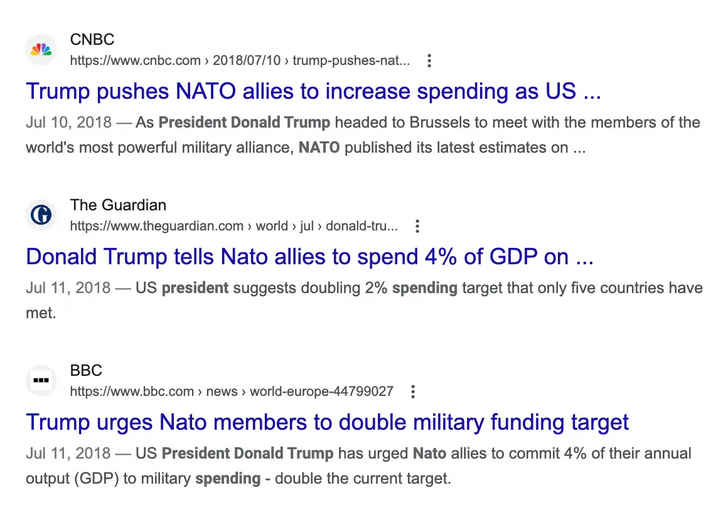
Spend a minute of your life looking at a chart that shows how much countries spend on their militaries as a percentage of GDP. The US spends about 3.5%, while Germany spends about 1.4%. For years, hawks have argued that the US should spend 4% of GDP on defense, in a well-known debate about reasonable funding for security. NATO members commit to a target of 2% or better, and many don’t make that goal. Donald Trump says he told the leaders of NATO countries that they should make or beat their military spending targets to ensure their own security, and as a negotiating ploy he poked at them and said that he wouldn’t bother to defend people who wouldn’t bother to pay for their own defense.
You can agree with his argument or disagree with his argument, and make whatever argument you want about the carefulness or recklessness of Trump’s rhetorical style, but none of this is obscure.
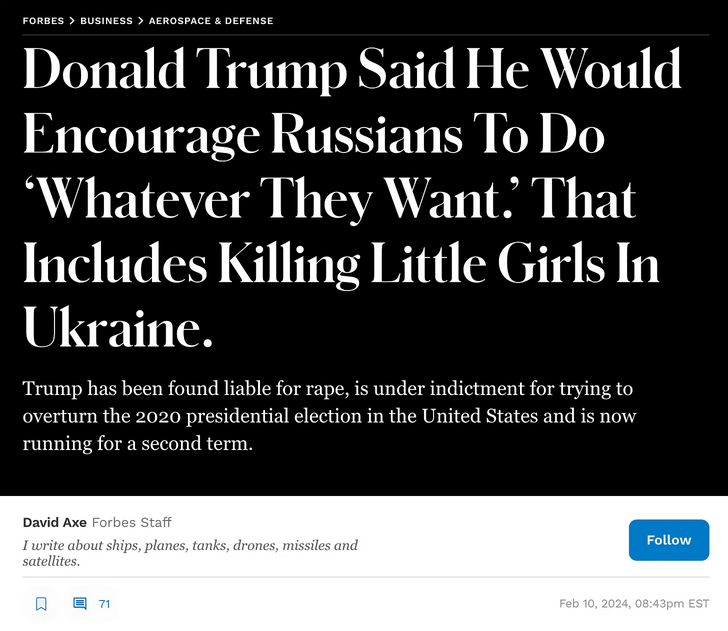
And so now we’re living through an ORANGE MAN LITERALLY HITLER CRISIS, as Orange Satan Drumpf tells the Putin Devil to absolutely MURDER all the Europeans and the world teeters in agony at the very brink of a harvest of slaughter. Here, let Forbes just give you the news, straight and factual and to-the-point:
THE MEAN MAN SAYING FOR THE PUTIN DEVIL TO MURDER ALL THE LITTLE BABIES professional journalists calmly explain, absolutely biting through the rubber nipple on their pacifiers. Sackcloth, ashes, endlessly refillable SSRI prescription: journalist starter kit.
In the car a few minutes ago, I turned on the radio mid-interview to hear a hysterical NPR anchor begging a European pundit to agree that Trump is a vicious monster, and the European — I missed his name — sighed and said that look, this is a debate that we’ve been having for a while, it’s a pretty normal discussion. BUT DON’T YOU THINK HE’S AN ORANGE MURDER DEVIL!?!?!? Then they played an important clip of Slow Joe Biden slurring and fake-shouting about Trump’s un-American cruelty, sounding almost as angry as he was when he talked about how many actual chips they put in the potato chip bags. This is why I listen to NPR in short bursts, like a gun run from an A-10. Brrrrrrrrrt, and off.
But what’s inescapable about this extremely dull moment, yet again, is that an allegedly elite layer of political, academic, and media figures are taking something routine and willfully inflating it into a five-alarm global crisis. It … must be a day ending in -y? Nothing is ever bad, or disagreeable, or arguable; every event is The Absolute Worst. Every development must be discussed in hyperemotional terms; every objectionable act is devastating, terrifying, destructive, ruinous, treasonous, unforgivable. No one disagrees with us; rather, they are ENEMIES OF EVERYTHING WE STAND FOR!!!!!
The Big Picture – NATO: Partners in Peace (1954)
Army University Press
Published Nov 13, 2023NATO: Partners in Peace follows the creation and impact of the North Atlantic Treaty Organization (NATO). Created in April 1949 with twelve founding members, this organization’s goal was to protect the inherent rights of individual states through collective defense. In this episode from The Big Picture series, General Dwight D. Eisenhower offers a speech before he deploys to Europe to become the first Supreme Allied Commander Europe (SACEUR). This is followed with footage of the buildup and training of European forces. Once Eisenhower leaves NATO to campaign for the presidency, General Matthew Ridgway replaces him as NATO commander. One significant problem NATO forces faced was the fact that each nation had its own weapon systems and ammunition, an issue the U.S. wanted to address with the standardization of the 7.62mm cartridge. Perhaps as a deterrent to the Soviet Union, NATO: Partners in Peace depicts new weapons that could be used against a large enemy force such as remote-controlled missiles, napalm bombs, and the massive atomic cannon.
February 13, 2024
Step aside, puny humans, here comes “the new Marxist Homo tabularasa“
At Postcards from Barsoom, John Carter considers what might occupy the god-shaped space in the new secular religion of wokeness:

Ryan T. Hancock, via Postcards from Barsoom
It’s trite to observe that the Great Awokening is a fundamentally religious phenomenon, representing a sort of secular Abrahamic heresy mining the latent guilt swirling within the hearts of post-Christian whites and thereby activating the messiah complexes of the Anglosphere’s Protestant populations, who have exhibited other similarly self-destructive enthusiasms throughout their ethnoreligious histories. It’s trite because it’s so obviously apt, but it raises an obvious question: if Woke is a cult, what is its god?
I don’t mean whichever symbols or causes they flock to from one moment to the next. These are merely mortal embodiments of archetypal forms, rising perhaps to the level of heroes or saints should their celebration become widespread enough. George Floyd was not deified but beatified, not because of anything he did in his life (which no one really argues wasn’t a sewer of petty criminality), but because in his death he was filled with a holy spirit of some kind. What spirit was that?
One answer to this question is provided in the title of Lorenzo Warby‘s ongoing series “Worshipping the Future“. As Warby explains in “The Deep Appeal of Marxism“, progressivism is besotted with the transformational future, an imaginary utopia qualitatively different from and superior to the Tartarus of antiquity in every way – an Elysium of peace, stability, equality, wealth, ease, comfort, and bliss, existing in a perpetual state of liberatory ecstasy in which the war, chaos, poverty, strife, suffering, and misery of the past have been permanently eradicated.
As Warby writes, there is no limit to the delights of the transformational future:
As a thing imagined, it can be imagined to be as perfect as one likes. This means politics grounded in an imagined future can be as morally grandiose as one likes, with whatever moral urgency goes with such imaginings.
This is deeply intoxicating.
Grounding one’s politics in an imagined future also provides huge rhetorical advantages, precisely because said future is as perfect as one wants it to be. Anyone who wishes to defend some actually existing thing has the problem that it will be the product of trade-offs and human failings.
An “imagined future” believer, by contrast, can just wish all that away for political purposes while hanging current imperfections on those who wish to defend what exists. In any contest between the actual and the imagined, the imagined sparkles ever so more brightly.
This utopia is of course always at some point just over the horizon. Just one more revolution, bro, and we’ll reach the Promised Land! Just one more gulag, and we’ll get to utopia, I swear! C’mon bro, just one more mass grave, we’re almost there, you gotta believe me!
There is a fatal epistemic flaw at the heart of this faith: no information can be extracted from the future, because information can only be obtained from the past.
Not only does the imagined future have no reality test, it distorts one’s use of the information to which we do have access. The past is profoundly discounted by its distance and difference from the imagined future. It is both morally discounted — a record of sin and depravity — and structurally discounted, because it has not undergone the social transformations that are imagined to change everything.
If the imagined future is a secular heaven, then the past becomes a moral hell from which we must escape. All information from it is tainted as profoundly impure and corrupt: the record of sin.
This means that when policies fail to obtain the desired result, for example erasing ethnic and sexual distinctions through affirmative action and thereby producing the new Marxist Homo tabularasa, no corrective action is possible. Policy failure exists in the past, which is ignored as sinful, and which therefore cannot be learned from. The only permissible answer to failed progress is to progress faster, with the only possible consequence being to fail harder.
February 12, 2024
Yalta, When Stalin Split the World – a WW2 Special
World War Two
Published 11 February 2024Indy and Sparty take you through the negotiations at Yalta as The Big Three thrash out the shape of the postwar world. As the splits between East and West continue to deepen, who will come out on top?
(more…)
Find Me The Votes
Elizabeth Nickson has a giggle while reading through Find Me The Votes by Michael Isikoff and Daniel Klaidman, which presents the other side of the narrative about Bad Orange Man trying to steal the election in Georgia in 2020:

I admit I giggled all the way through the research of this, breaking out in helpless laughter by the end, hoping that I wasn’t going completely mad. First it was the book, Find Me The Votes, written by Michael Isikoff and Daniel Klaidman, about the Crazed Crackers who think the Georgia election was stolen and the Noble Black Woman who was putting things to right.
I persisted in calling the book in my head, The Ballad of Fani Willis, and kept waiting for the melody and lyrics, but I am not a musician and only the title came. Annoyingly, on repeat.
Isikoff, most remembered for writing for Newsweek when it was respectable, and others when they were respectable, is now head of Yahoo News, and has gone completely bonkers with Trump Derangement Syndrome. His associate in This Noble Task wrote, I believe, the first third which was all about the Noble Black Woman and her Noble Career and her Noble Father who was an entirely nice and not-murderous-at-all Black Panther, and how she felt that the massive uptick in violent crime in Atlanta should not take precedence over fighting the Crazed Crackers whose Awful Leader was Donald Trump. Fani gets the full-on-dripping-sentimentality treatment invented by Bill Clinton, her nobility and hard work, and wonderfulness and Godliness percolates all the way through it. I love how complete atheists like Isikoff like to work the God angle thinking that evangelicals will fall under his dark spell. Yeah, it just makes you look sleazy, buddy.
Willis thought her RICO case was her ticket to the Big Show. The White House. The First Noble Black Woman President of the United States of America. Apparently the Georgia Senate gathered the same and charged her with 23 Articles of Impeachment, mostly having to do with using said RICO case for her political career, not to mention paying the inexperienced, still-married, lover-lover $625,000 over 18 months. Charged with “the misuse of her office for political gains rather than the pursuit of justice”, this really needs a western ballad, with a zydeco vibe.
The second part introduced me to Trump Derangement Syndrome, which I mostly have managed to avoid. God in heaven this is awful stuff, purely hate-fueled madness. This part was written by Isikoff and I’d bet a million bucks he was drunk or on edibles all through it. In my opinion. Anyway, he trots out the usual villains and their wild accusations NONE OF WHICH HAVE ANY MERIT WHATSOEVER. THE ELECTION WAS NOT STOLEN. THIS IS ALL RIGHT WING GARBAGE. Even Rudy Guiliani who shut down the Mafia plaguing New York and managed New York through 9/11 is treated with zero respect and a lot of hateful mockery that anyone on the right is not allowed to use because hate, but lefties can express virulent hate all day with impunity.
Look at Life – Amphibian DUKW (1962)
Classic Vehicle Channel
Published Apr 23, 2020The military have finished with their amphibious truck know as the DUKW. They’re sold off to the general public for use in civilian life, including divers and even a group of monks.
February 11, 2024
To “protect our democracy”, we’re only going to have one name on the ballots
Chris Bray chronicles the efforts of the brave men, women, and the other 57 genders to protect our democracy by keeping would-be dictators, wreckers, and looters off the ballot in as many states as possible (perhaps all 57 if things go well):

“Polling Place Vote Here” by Scott Beale is licensed under CC BY-NC-ND 2.0 


 .
.
As Democrats try to force Donald Trump off the ballot, and Democratic prosecutors charge him with crimes, they’ve also just opened an effort to keep Robert F. Kennedy, Jr. off the ballot with a complaint that could lead to civil penalties, an injunction against signature-gathering activity for ballot access, and criminal charges. You see where this is going.
The Democratic National Committee has filed a complaint with the Federal Election Commission (FEC) against Kennedy., alleging violations of federal campaign finance law. The complaint also names the Kennedy campaign and a PAC, American Values 2024, alleging that the PAC and the campaign are illegally coordinating campaign activities. You can read that complaint by clicking here, or by opening the PDF file below:
The heart of the complaint is on pg. 2 (footnotes removed, but available at the link or in the PDF):
American Values 2024 has stated it will spend approximately $15 million to assist Mr. Kennedy’s efforts to earn a place on the ballot in the states in which it is most difficult for Mr. Kennedy to achieve that goal, including Arizona, California, Georgia, Illinois, Michigan, New York, Colorado, Nevada, Indiana, West Virginia, South Carolina, Maryland, Massachusetts, and Texas. American Values 2024 will do this by collecting signature petitions in each state to assist Mr. Kennedy’s efforts to qualify for a place on the ballot.
In all the states in which American Values 2024 has announced it will assist Mr. Kennedy’s efforts to get on the ballot, state law presumes – and in most states requires – that the candidate or the campaign committee will take the steps necessary to qualify for the ballot…Put simply, to qualify for the ballot under state law, American Values 2024 must coordinate its activity with Mr. Kennedy and his campaign in a way that violates federal campaign finance laws.
The FEC has civil enforcement authority, and the DNC complaint asks the FEC to “seek such monetary, declaratory or injunctive relief as necessary to remedy these violations.”

The Battle of Manila Begins – WW2 – Week 285 – February 10, 1945
World War Two
Published 10 Feb 2024The American advance on Luzon has reached the Philippine capital, and it looks like they have a real fight on their hands with the Japanese there. There are supposed to be two new Allied operations starting in Western Europe, but one is delayed by flooding. The Allies do manage to eliminate the Colmar Pocket in the west, though. On the Eastern Front, there are new Soviet attacks in Pomerania and East Prussia, as well as out of the Steinau Bridgehead to the south, and in Budapest, it looks like the Soviet siege might soon end in victory.
(more…)
QotD: Learning and re-learning the bloody art of war
The Athenian commanders before Salamis, it is reported, talked of art and of the Acropolis, in sight of the Persian fleet. Beside their own campfires, the Greek hoplites chewed garlic and joked about girls.
Without its tough spearmen, Hellenic culture would have had nothing to give the world. It would not have lasted long enough. When Greek culture became so sophisticated that its common men would no longer fight to the death, as at Thermopylae, but became devious and clever, a horde of Roman farm boys overran them.
The time came when the descendants of Macedonians who had slaughtered Asians till they could no longer lift their arms went pale and sick at the sight of the havoc wrought by the Roman gladius Hispanicus as it carved its way toward Hellas.
The Eighth Army, put to the fire and blooded, rose from its own ashes in a killing mood. They went north, and as they went they destroyed Chinese and what was left of the towns and cities of Korea. They did not grow sick at the sight of blood.
By 7 March they stood on the Han. They went through Seoul, and reduced it block by block. When they were finished, the massive railway station had no roof, and thousands of buildings were pocked by tank fire. Of Seoul’s original more than a million souls, less than two hundred thousand still lived in the ruins. In many of the lesser cities of Korea, built of wood and wattle, only the foundation, and the vault, of the old Japanese bank remained.
The people of Chosun, not Americans or Chinese, continued to lose the war.
At the end of March the Eighth Army was across the parallel.
General Ridgway wrote, “The American flag never flew over a prouder, tougher, more spirited and more competent fighting force than was Eighth Army as it drove north …”
Ridgway had no great interest in real estate. He did not strike for cities and towns, but to kill Chinese. The Eighth Army killed them, by the thousands, as its infantry drove them from the hills and as its air caught them fleeing in the valleys.
By April 1951, the Eighth Army had again proved Erwin Rommel’s assertion that American troops knew less but learned faster than any fighting men he had opposed. The Chinese seemed not to learn at all, as they repeated Chipyong-ni again and again.
Americans had learned, and learned well. The tragedy of American arms, however, is that having an imperfect sense of history Americans sometimes forget as quickly as they learn.
T.R. Fehrenbach, This Kind of War: A Study in Unpreparedness, 1963.
February 10, 2024
The War Goals to End WW2 in 1945 – a WW2 Special
World War Two
Published Feb 8, 2024While World War Two looks like it is about to end, the belligerent powers have vastly different goals for that end. Differences that may or may not prolong the war, will decide the survival of tens of millions of people, and the future fate of all of Humanity.
(more…)
February 9, 2024
You can’t pro-actively synergize action-oriented metrics in the heat of battle
No, I’m not sure if that headline makes any sense, as I was never particularly receptive to the latest buzzwords of any given management fad that went through from the 70s onwards. They all seemed to share a few characteristics along with a bespoke sheaf of buzzwords, PowerPoint slides galore, and lots of spendy courses you had to send all your employees to endure. Is there anything more dispiriting to staff morale than a VP or director who’s just returned from a week-long training seminar in an exotic location on this year’s latest “revolutionary” “transformational” management fad?
It’s bad when companies that make widgets or smartphone apps or personal hygiene products fall for these scams, but it’s terrifying to discover that your military isn’t immune … and in fact revel in it:
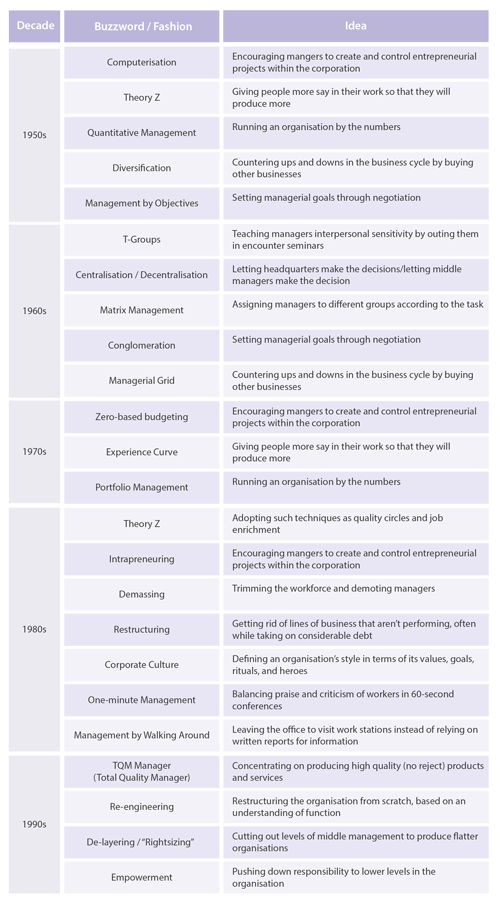
Image from “Fads and Fashions in Management”, The European Business Review, 2015-07-20.
https://www.europeanbusinessreview.com/fads-and-fashions-in-management/
We spent these last few decades since the fall of the Soviet Union weaving a comfortable web of CONOPS and implemented “efficiencies” constructed of consultant-speak, weekend-MBA jargon, and green eyeshade easy-buttons bluffed from the podium by The Smartest People in the Room™ to an audience on balance populated by people who already had the short list of jobs they wanted once they shrugged off their uniform in a PCS cycle or two.
Agree, endorse, parrot, prepare …. profit!
War is New™!, Revolutionary™!, Transformational™!. Hard power is Offset™! If we change a bunch of simple words in to multi-syllabic cute acronyms … then the future will be ours, our budgets will be manageable, and our board seats will be secured! Efficiency to eleventy!
Facing the People’s Republic of China on the other side of the International Date Line … how efficient do you feel? How effective?
Something very predictable happened in our quarter century roadtrip on the way to Tomorrowland; we realized instead we wound up on Mr. Toad’s Wild Ride instead.
I would like the record to show here in 2QFY24 that this exact problem was discussed in detail back when I was a JO in the mid-1990. This is not shocking to anyone who is wearing the uniform of a GOFO. They lived the same history I did.
We knew we were living a lie that we could sustain a big fight at sea. An entire generation of Flag Officers led this lie in the open and ordered everyone else to smile through it. Ignore your professional instincts, and trust The Smartest People in the Room™.
Once again, Megan Eckstein brings it home;
If U.S. military planners’ worst-case scenario arose in the Pacific — having to defend Taiwan from a Chinese invasion — American military forces would target Chinese amphibious ships.
Without them, according to Mark Cancian, who ran a 2022 wargame for the Center for Strategic and International Studies that examined this exact scenario, China couldn’t invade the neighboring island.
…
U.S. submarines would “rapidly fire everything they have” at the multitude of targets, Cancian said, “using up torpedoes at a much, much higher rate than the U.S. has expected to do in the past.”
Navy jets, too, would join in — but they’d run out of Long Range Anti-Ship Missiles within days, …
It’s this nightmare scenario that’s driving the Navy to increase its stockpile of key munitions: the LRASM, the MK 48 heavyweight torpedo, the Standard Missile weapons and the Maritime Strike Tomahawk, among others.
Over a decade after the Pacific Pivot, a couple of years after the US Navy became the world’s second largest navy after being the worlds largest for living memory of 99% of Americans, and two years after the Russo-Ukrainian War reminded everyone that, yeah … 3-days wars usually aren’t.
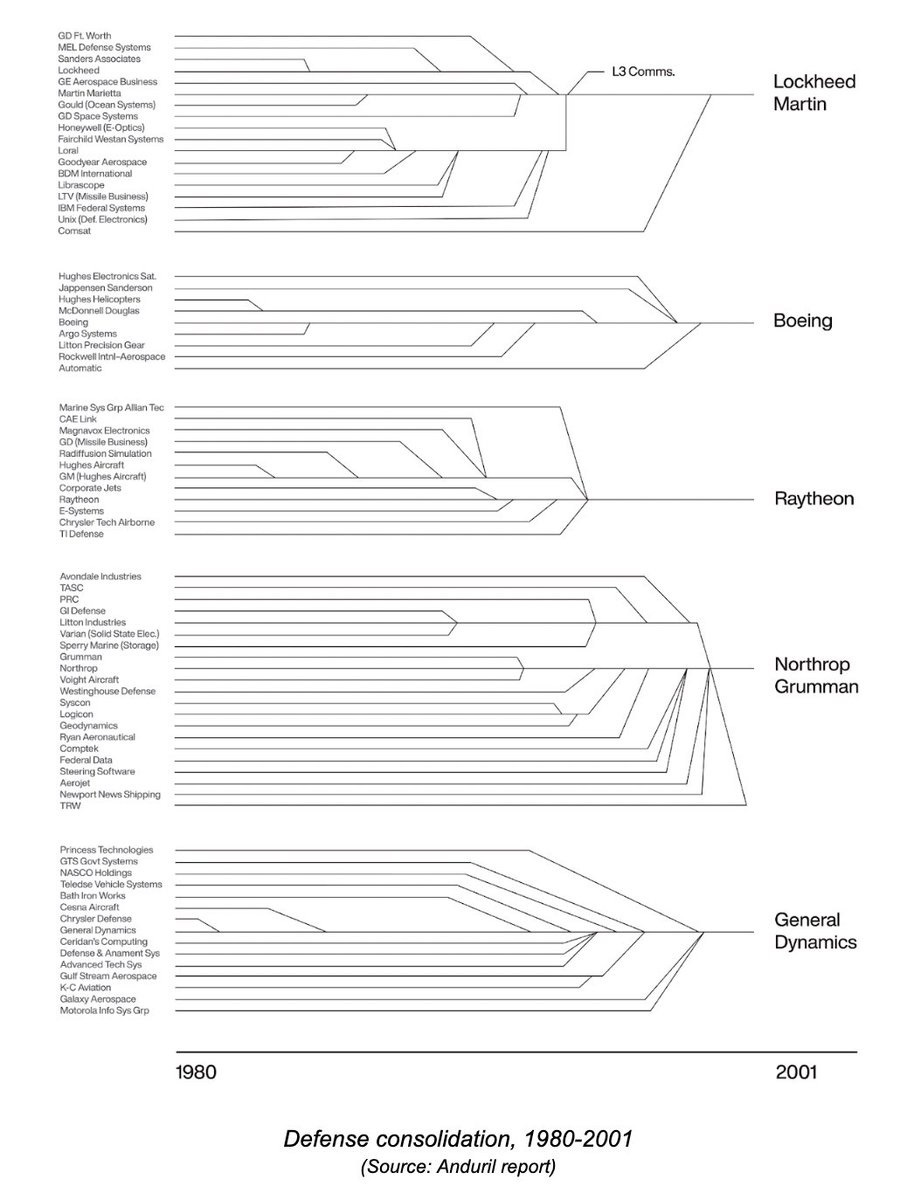
And the defence industries of the 1980s and 90s have all swallowed up smaller competitors — again following “normal” business practices of the time, seeking economies of scale and manufacturing efficiencies and closing down less-profitable assembly lines or entire lines of business.
Let’s go back to SECDEF Perry’s 1990s “Last Supper”, you know, the one that was all about the efficiencies of consolidation of the defense industry.
Three decades later, what is the solution to the strategic risk we find ourselves in due to our inability to arm ourselves?
… “the bottleneck is rocket motors” because so few companies are qualified to build them for the United States, Okano explained. To help, the Navy issued a handful of other transaction agreement contracts to small companies who will learn to build the Mk 72 booster and the Mk 104 dual-thrust rocket motor so prime contractors have more qualified vendors to work with, she added.
LOLOLOL … what “small companies?” That ecosystem is “old think”. If we need to go back to that structure, that will take decades not just to build, but decades of a viable demand signal.
Looks like we have started that as “small companies” perhaps repurpose part of their company to a military division. If we can just stop them from being gobbled up by the primes, it might be nice to return to a more robust, competitive ecosystem. Soviet-like consolidation and McNamaraesque efficiencies got us here, perhaps time to try something old as new again.
Nothing is less efficient to go to war with than a military designed for an efficient peace.