
Extra Credits
Published on 24 Apr 2018Sci fi “pulp” stories sometimes have a reputation for being cheesy and over-dramatic, but they were extremely important for building up the sci fi genre as something *anyone* could write for AND get paid for — not just famous authors.
April 25, 2018
Hugo Gernsback – Pulp! Amazing Stories – Extra Sci Fi
Comments Off on Hugo Gernsback – Pulp! Amazing Stories – Extra Sci Fi
April 20, 2018
Food for thought on those “second US civil war” comments
Tom Kratman, Mil-SF author and former US Army officer responds to a Quora article titled “Why does the 2nd Amendment bother Europeans so much?” and shared some of his answer on Facebook:
More fun on Quora:
https://www.quora.com/Why-does-the-2nd-Amendment-bother-Europeans-so-much/answer/Pietro-Del-Buono#
A Sample: And here; since you’re not apparently ambitious enough to read it, I’ll copy you what I sent Stafford on just this question:
The Viet Cong, the Taliban, and the Iraqi resistance would all, at this point in time, be terribly surprised to learn of the omnipotence of the US Army, Navy, Air Force, and Marine Corps (retired lieutenant colonel, Infantry, former faculty of the war college, to boot; yes, I’ve had a varied and fun life). It isn’t, remember, a million citizens with arms, it’s probably over 80 million, just to begin with, most of us armed to deck out the wives, children, grandchildren, and no small number of the neighbors. I can, personally, outfit at least one short platoon while my former law firm, when I was in practice, could have fielded a company, less mortars and anti-tank, yes, to include with automatic weapons (machine guns, which are also legal here, though pricey).
How they would do this is perhaps more detailed and more bloody minded than you want, but, basically, tanks do not move when small arms dominating the roads mean they don’t get fuel delivered (no, aerial resupply is highly problematic). Neither do aircraft fly when no trucks or rail bring aviation fuel. Police, who are actually the decisive arm of counter-insurgency (see your own Sir Robert Thompson), pretty much require a disarmed citizenry to exercise control. Facing an armed citizenry willing to kill them, their risks and losses are too great for effectiveness. And then there’s sheer terror: “Nice family you have, Officer Quigley; be a damned shame if, say, you didn’t look the other way when we tell you to and they all ended up dead, don’t you think?”
Most of the US military preponderance is technological. Martin van Creveld has an interesting observation on that, which goes to the effect that high tech really only works well in very simple environments, air, open desert, at sea, and that a) it tends to fail badly when the environment gets more complex, while b) the human heart is the most complex environment of all. In other words, the forces of government would rarely know just who their enemies were in order to bring that tech to bear.
And then there’s the last aspect, an aspect, I think, Euros have the greatest difficulty understanding. Our police and armed forces are simply not reliable, over most of the country (remember, too, we have no real national police force or gendarmerie, not of any size and power, anyway) to the federal government. No, I don’t mean only the state based National Guards; the _regular_ forces actually draw most of their personnel from areas where folk revere the country and the constitution, but tend to detest the federal government. Called on to suppress a rebellion with which they by and large agreed, they’d defect in droves.Indeed, they might be at the forefront of rebellion. You may recall Obama talking about a civilian force, equal in size, budget, and power to DoD? I’ve never been able to shake the feeling that he had Pinochet and Allende in mind when he spoke those words, because he knew, deep down, that he and the left (our left, which is, of course, to the right, generally, of the Euro left) could not rule out a coup in the event of their pushing their agenda just that little bit too far.
Comments Off on Food for thought on those “second US civil war” comments
April 13, 2018
The free speech views of “Gen Z”
Sean Stevens and Jonathan Haidt argue that despite many nay-sayers, there really is a freedom of speech crisis on university campuses:
In our first post responding to the skeptics, we showed that the skeptics support their skepticism primarily by relying on data about the Millennial generation (those born 1982-1994). The skeptics are correct that Millennials are not much different than previous generations when asked about free speech issues. We also argued that this debate has nothing to do with Millennials; it is about CURRENT college students, who are not Millennials. By the fall of 2015, most college students (especially at elite four year schools) were members of iGen, the “Internet generation” (sometimes called “Gen Z”), which begins around birth year 1995, and which first arrived at college around 2013.
We noted that the new attitudes about speech — including the idea that speech can be violence (even when it includes no threat), and corresponding requests for safe spaces and trigger warnings — only began to appear on select campuses around 2013 or 2014, and we noted that these ideas only became widely known after the wave of student protests that began at the tail end of 2015. Therefore, we pointed out, it is unlikely that nationally representative samples, drawing on students in America’s 4,700 institutions of higher education, could have picked up any changes before 2015, when colleges were still full of Millennials who had never heard of trigger warnings and microaggressions. We proposed that the best way to evaluate whether or not things have changed on campus is to examine data collected on current college students in 2016 or later, and compare it to data on current college students from 2014 and before.
When we performed such comparisons, we found some evidence that in fact things are changing. There is not yet much data available to make direct comparisons, but the GSS does show a change for the little bit of iGen data that it has (see figure 1 in post 1), and the larger Knight study showed a change just from 2016 to 2017. In this post we do a much deeper dive. We present far more data on current college students and we assess whether the campus climate has changed in the last few years with regard to speaking up and sharing one’s views.
The key question is this: are students and professors today more reluctant than they were a few years ago to share their views or to question dominant views? If so, then there is a climate or culture problem on campuses where that change has occurred. We note that the overall climate can change rapidly even if there has been no change in average attitudes about speech. All that needs to happen is that a small group of students begins imposing social costs on those who say things they don’t like, while at the same time college administrators do nothing to stop them. (For a fuller explanation, see this essay by Lee Jussim, or this one by Nassim Taleb, whose title explains the key point: The most intolerant wins: The dictatorship of the small minority.) If college students are more likely to report the feeling of “walking on eggshells” in the years after 2015 than they did in the years before 2015, then there has been a change in the campus culture, even if the average student’s support for free speech has not changed.
Comments Off on The free speech views of “Gen Z”
India and the “Quad”
At Strategy Page, Austin Bay discusses India’s position, both geographically and militarily with respect to China:
As the Cold War faded, a cool aloofness continued to guide India’s defense and foreign policies. Indian military forces would occasionally exercise with Singaporean and Australian units — they’d been British colonies, too. Indian ultra-nationalists still rail about British colonialism, but the Aussies had fought shoulder to shoulder with Indians in North Africa, Italy, the Pacific and Southeast Asia, and suffered mistreatment by London toffs. Business deals with America and Japan? Sign the contracts. However, in defense agreements, New Delhi distanced itself from Washington and Tokyo.
The Nixon Administration’s decision to support Pakistan in the 1971 Indo-Pakistani War [Wikipedia link] embittered India. Other issues hampered the U.S.-India relationship. Indian left-wing parties insisted their country was a “Third World leader” and America was hegemonic, et cetera.
However, in the last 12 to 15 years, India’s assessments of its security threats have changed demonstrably, and China’s expanding power and demonstrated willingness to use that power to acquire influence and territory are by far the biggest factors affecting India’s shift.
In 2007, The Quad (Quadrilateral Security Dialogue), at the behest of Japan, held its first informal meeting. The Quad’s membership roll sends a diplomatic message: Japan, Australia, America and India. Japan pointed out all four nations regarded China as disruptive actor in the Indo-Pacific; they had common interests. Delhi downplayed the meeting, attempting to avoid the appearance of actively “countering China.”
No more. The Quad nations now conduct naval exercises and sometimes include a quint, Singapore.
The 2016 Hague Arbitration Court decision provided the clearest indication of Chinese strategic belligerence. In 2012, Beijing claimed 85 percent of the South China Sea’s 3.5 million square kilometers. The Philippines went to court. The Hague tribunal, relying on the UN Convention on the Law of the Sea treaty, supported the Filipino position that China had seized sea features and islets and stolen resources. Beijing ignored the verdict and still refuses to explain how its claims meet UNCLOS [Wikipedia link] requirements.
That is the maritime action. India and China also have mountain issues. In 1962, as the Cuban Missile Crisis diverted world attention, the two Asian giants fought the Indo-Chinese War [Wikipedia link] in the Himalayas. China won. The defeat still riles India.
Comments Off on India and the “Quad”
From Billions to Zero in 50 Years – The Extinction of the Passenger Pigeon
Today I Found Out
Published on 23 Aug 2017Book: A Feathered River Across the Sky: The Passenger Pigeon’s Flight to Extinction
In this video:
Martha was a very lonely bird. She had once been part of a pair, with her male counterpart George, but he had died several years before. So, for the final years of her life, Martha sat in her one-bird cage alone. The Cincinnati Zoo offered a thousand dollar reward (about $23,000 today) to anyone who could track down a mate for Martha. Unfortunately, there were no mates left for her.
Comments Off on From Billions to Zero in 50 Years – The Extinction of the Passenger Pigeon
QotD: Reynolds’ Law
The government decides to try to increase the middle class by subsidizing things that middle class people have: If middle-class people go to college and own homes, then surely if more people go to college and own homes, we’ll have more middle-class people. But homeownership and college aren’t causes of middle-class status, they’re markers for possessing the kinds of traits — self-discipline, the ability to defer gratification, etc. — that let you enter, and stay, in the middle class. Subsidizing the markers doesn’t produce the traits; if anything, it undermines them.
Glenn Reynolds, Instapundit.com, 2010-09-23.
Comments Off on QotD: Reynolds’ Law
April 10, 2018
New Year’s Day in 2019 will be a big day for works finally entering public domain
The US government messed around with the copyright laws so that from 1998 until the end of this year, very little material was allowed to slip out of copyright protection and into the public domain. (Many people point their fingers at the Disney corporate lawyers and their pliable friends in Washington DC for this oddity.) In The Atlantic, Glenn Fleishman explains some of the legal issues that will finally begin to allow works to enter public domain status in the US normally next year:
The Great American Novel enters the public domain on January 1, 2019 — quite literally. Not the concept, but the book by William Carlos Williams. It will be joined by hundreds of thousands of other books, musical scores, and films first published in the United States during 1923. It’s the first time since 1998 for a mass shift to the public domain of material protected under copyright. It’s also the beginning of a new annual tradition: For several decades from 2019 onward, each New Year’s Day will unleash a full year’s worth of works published 95 years earlier.
This coming January, Charlie Chaplin’s film The Pilgrim and Cecil B. DeMille’s The 10 Commandments will slip the shackles of ownership, allowing any individual or company to release them freely, mash them up with other work, or sell them with no restriction. This will be true also for some compositions by Bela Bartok, Aldous Huxley’s Antic Hay, Winston Churchill’s The World Crisis, Carl Sandburg’s Rootabaga Pigeons, e.e. cummings’s Tulips and Chimneys, Noël Coward’s London Calling! musical, Edith Wharton’s A Son at the Front, many stories by P.G. Wodehouse, and hosts upon hosts of forgotten works, according to research by the Duke University School of Law’s Center for the Study of the Public Domain.
Throughout the 20th century, changes in copyright law led to longer periods of protection for works that had been created decades earlier, which altered a pattern of relatively brief copyright protection that dates back to the founding of the nation. This came from two separate impetuses. First, the United States had long stood alone in defining copyright as a fixed period of time instead of using an author’s life plus a certain number of years following it, which most of the world had agreed to in 1886. Second, the ever-increasing value of intellectual property could be exploited with a longer term.
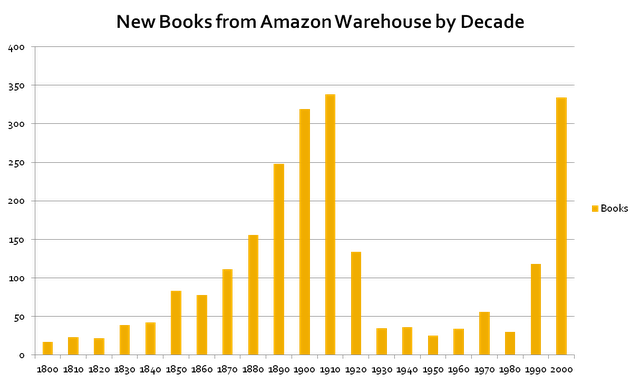
Here’s a graphical representation of how the copyright laws interact with Amazon’s ability/interest in stocking or otherwise making available older still-in-copyright works (graphic from 2015):
So, what’s the Disney connection?
The details of copyright law get complicated fast, but they date back to the original grant in the Constitution that gives Congress the right to bestow exclusive rights to a creator for “limited times.” In the first copyright act in 1790, that was 14 years, with the option to apply for an automatically granted 14-year renewal. By 1909, both terms had grown to 28 years. In 1976, the law was radically changed to harmonize with the Berne Convention, an international agreement originally signed in 1886. This switched expiration to an author’s life plus 50 years. In 1998, an act named for Sonny Bono, recently deceased and a defender of Hollywood’s expansive rights, bumped that to 70 years.
The Sonny Bono Act was widely seen as a way to keep Disney’s Steamboat Willie from slipping into the public domain, which would allow that first appearance of Mickey Mouse in 1928 from being freely copied and distributed. By tweaking the law, Mickey got another 20-year reprieve. When that expires, Steamboat Willie can be given away, sold, remixed, turned pornographic, or anything else. (Mickey himself doesn’t lose protection as such, but his graphical appearance, his dialog, and any specific behavior in Steamboat Willie — his character traits — become likewise freely available. This was decided in a case involving Sherlock Holmes in 2014.)
The reason that New Year’s Day 2019 has special significance arises from the 1976 changes in copyright law’s retroactive extensions. First, the 1976 law extended the 56-year period (28 plus an equal renewal) to 75 years. That meant work through 1922 was protected until 1998. Then, in 1998, the Sonny Bono Act also fixed a period of 95 years for anything placed under copyright from 1923 to 1977, after which the measure isn’t fixed, but based on when an author perishes. Hence the long gap from 1998 until now, and why the drought’s about to end.
Comments Off on New Year’s Day in 2019 will be a big day for works finally entering public domain
Structural Unemployment
Marginal Revolution University
Published on 8 Nov 2016Unemployment comes in many forms. Sometimes, like we saw with short-term, frictional unemployment, it can actually indicate a healthy, growing economy. But what about persistent, long-term unemployment? That’s not so good.
When a large percentage of those who are considered unemployed have been without a job for a long period of time and this has been true for many years, it’s considered structural unemployment.
Structural unemployment can result from shocks to an economy that drastically alter the labor market. These shocks are not all bad – the rise of the Internet is one such example. Regardless, it can take a while for an economy to adjust to big changes.
These adjustments tend to happen faster in the United States than in Europe. This is most likely due to differences in labor regulations, and how those regulations affect a country’s ability to respond to shocks.
The United States’ employment law known as the “at-will doctrine” makes it so that an employee can quit, or an employer can fire, at any time for any reason. It’s legally much harder to terminate an employee in many European countries. This makes hiring riskier in Europe, resulting in a less dynamic labor market that isn’t able to quickly respond to shocks.
As you might guess, structural unemployment tends to count for a higher percentage of total unemployment in Europe than in the United States. This remains one of the most serious issues facing many European economies today.
Comments Off on Structural Unemployment
April 9, 2018
The Triangle Shirtwaist Fire – Horror in Manhattan – Extra History
Extra Credits
Published on 7 Apr 2018A throwaway cigarette landed on a pile of cloth. 146 workers died from the resulting fire. But this tragedy motivated citizens and politicians to take a stand from workers’ rights, creating a far safer world that we still live in over a century later.
Comments Off on The Triangle Shirtwaist Fire – Horror in Manhattan – Extra History
Portrait of a protectionist
The latest of a long-running series by Don Boudreaux, all entitled “A Protectionist is Someone Who…”:
… if he is among the many protectionists (such as Donald Trump or Peter Navarro) who, finding meaning in bilateral trade accounts, detects danger for country A if country A has a trade deficit with country B, should also find danger for each private producer that has a trade deficit with another private producer. That is, if this protectionist were consistent in his views, the same reasoning that leads him to worry about America’s trade deficit with China should also lead him to worry about, say, The Trump Organization, Inc.’s trade deficit with each of its many suppliers, including with each of any janitors that The Trump Organization, Inc. has on its payroll or otherwise contracts to hire. (After all, I’m quite certain that no janitor hired by The Trump Organization, Inc., buys as much from The Trump Organization, Inc., and The Trump Organization, Inc., buys from any janitor.)
So why does the allegedly genius businessman who is now president of the United States – and whose many fans believe him to “tell it like it is” – not judge his own private company by the same standards that he so confidently insists are appropriate for judging Americans’ trade with non-Americans? After all, if China’s trade surplus with America really is evidence either of Chinese chicanery or of the incompetence of American leaders (or both), then it must also be true that a Trump Organization janitor’s trade surplus with The Trump Organization, Inc. is evidence either of that janitor’s chicanery or of the incompetence of Trump Organization leaders (or both).
Comments Off on Portrait of a protectionist
April 7, 2018
Car rental agencies look to government to quash upstart “personal vehicle sharing” companies
Steven Greenhut discusses yet another entrenched industry trying to get the government to protect them from disruptive competitors:
Real capitalism is a tough sport where entrepreneurs risk their capital in hopes of winning customers.
The “crony” version of it involves politicians rigging the rules to assure that the “right” people are winners. We see this ugly process on high-profile national issues, such as when Donald Trump promotes tariffs to boost steel makers at the expense of companies that use steel products. But most of this nonsense proceeds quietly in legislative committees, without garnering any headlines or vocal opposition.
One awful but illustrative example popped up recently in the California state Capitol. Assembly Bill 2246, by Assemblywoman Laura Friedman, D-Glendale, apparently is part of a national effort by rental-car companies to snuff out a burgeoning industry that just happens to be threatening its business model. The bill would redefine “personal vehicle sharing” companies as “car rental companies” — and then slam them with reams of new regulations. Similar measures have been proposed in Idaho, New Hampshire, Maryland and Maine.
Rental-car companies are facing the same challenges as other established business models in this internet and app-based age. Capitalism — the real sort — is defined by “creative destruction,” as economist Joseph Schumpeter called it. New companies are free to offer better products and services that appeal to customers. This is creative as new ideas flourish and consumers get a broader choice and lower prices thanks to competition. But it’s also destructive. Complacent old companies suddenly are forced to improve their offerings or shut their doors. The consumer is king.
For example, I recently grabbed a taxicab rather than my usual Uber and noticed the oddest thing. The cabbie had a modern app-based system for taking my credit-card payment. Until recently, paying by credit card was a hassle because cab services didn’t really want to take your card. I’ve also noticed a fleet of nice new cabs around my city. And the cab I took even sent an email with a receipt and a rating system. Sound familiar?
Comments Off on Car rental agencies look to government to quash upstart “personal vehicle sharing” companies
April 6, 2018
Kevin Williamson fired for expressing a view shared by at least 40% of Americans
Katherine Mangu-Ward responds to Williamson’s short tenure at The Atlantic after they found themselves shocked and horrified when it was discovered that he really was an outspoken anti-abortion conservative:
Williamson expressed the view that abortion is murder and should be punished to the full extent of the law (although he also later indicated that he has mixed feelings about capital punishment). I do not share his view. But by declaring Williamson to be outside the Overton window of acceptable political discourse because he believes strongly that abortion is a serious, punishable crime, The Atlantic is essentially declaring that it cannot stomach real, mainstream conservatism as it actually exists in 21st century America.
Williamson uses colorful and sometimes rash language. He didn’t have to detail the grisly form of punishment he would inflict on women who decide to terminate their pregnancies. He chose to do so because he enjoys provoking a reaction. But The Atlantic knew that about him before it hired him.
[…]
It is, of course, the perfect right of The Atlantic‘s editors to publish whomever they wish. Reason staffers are all libertarian, under a big-tent understanding of that term (not to brag, but we are repping the pro-life view). That’s written into our mission as a magazine. But if The Atlantic purports to capture a broad spectrum of American political views, Williamson’s firing is a sign that it hasn’t yet figured out how to do so. And the reader outcry against him (and his rightish heterodox kinfolk at The New York Times) is a sign of a market that has grown increasingly squeamish about a genuinely inclusive journalistic vision.
I have personally been the beneficiary of this doublethink on ideological diversity for years. When institutions recognize the need to have a nonliberal somewhere in their midst, they look across the landscape and discover that the closest thing to conservatism that they can tolerate is a relatively mild-mannered, young(ish), female, pro-choice libertarian. Which is to say, not a conservative at all.
The Atlantic publishes lots of interesting heterodox voices, of course. And I’d like to think I do provide ideological diversity in situations where I’ve been called in. But putting me on a panel is not nearly the same thing as giving the conservative side of the American political spectrum a hearing.
Comments Off on Kevin Williamson fired for expressing a view shared by at least 40% of Americans
QotD: Bordertown, USA
Welcome to Bordertown, USA. Population: 200 million. Expect occasional temporary population increases from travelers arriving from other countries. Your rights as a US citizen are indeterminate within 100 miles of US borders. They may be respected. They may be ignored. But courts have decided that the “right” to do national security stuff — as useless as most its efforts are — trumps the rights of US citizens.
Tim Cushing, “Wall Street Journal Reporter Hassled At LA Airport; Successfully Prevents DHS From Searching Her Phones”, Techdirt, 2016-07-22.
Comments Off on QotD: Bordertown, USA
April 5, 2018
Mark Steyn on the YouTube shooting in San Bruno
The shooting at the YouTube offices in San Bruno, California may not be in the headlines for long, as the story is so off-beat compared to other recent events that it doesn’t easily fit the model the media prefers for reporting gun crime (or high tech stories). Mark Steyn calls it the “grand convergence”:
The San Bruno attack also underlines a point I’ve been making for over a decade, ever since my troubles with Canada’s “human rights” commissions: “Hate speech” doesn’t lead to violence so much as restraints on so-called “hate speech” do – because, when you tell someone you can’t say that, there’s nothing left for him to do but open fire or plant his bomb. Restricting speech – or even being perceived to be restricting speech – incentivizes violence as the only alternative. As you’ll notice in YouTube comments, I’m often derided as a pansy fag loser by the likes of ShitlordWarrior473 for sitting around talking about immigration policy as opposed to getting out in the street and taking direct action. In a culture ever more inimical to freedom of expression, there’ll be more of that: The less you’re permitted to say, the more violence there will be.
Google/YouTube and Facebook do not, of course, make laws, but their algorithms have more real-world impact than most legislation – and, having started out as more or less even-handed free-for-alls, they somehow thought it was a great idea to give the impression that they’re increasingly happy to assist the likes of Angela Merkel and Theresa May as arbiters of approved public discourse. Facebook, for example, recently adjusted its algorithm, and by that mere tweak deprived Breitbart of 90 per cent of its ad revenue. That’s their right, but it may not have been a prudent idea to reveal how easily they can do that to you.
What happened yesterday is a remarkable convergence of the spirits of the age: mass shootings, immigration, the Big Tech thought-police, the long reach of the Iranian Revolution, animal rights, vegan music videos… But in a more basic sense the horror in San Bruno was a sudden meeting of two worlds hitherto assumed to be hermetically sealed from each other: the cool, dispassionate, dehumanized, algorithmic hum of High Tech – and the raw, primal, murderous rage breaking through from those on the receiving end.
Comments Off on Mark Steyn on the YouTube shooting in San Bruno
Amtrak decides to abandon one of its few profitable sidelines
Kevin Keefe discusses the recent Amtrak announcement that it will be discontinuing support for private railcar movements on Amtrak trains:
Amtrak’s announcement last week that it intends to shut down most of its haulage of private cars and its support for special trains was a stunner. Within hours, hundreds or perhaps thousands of people working in the heritage end of railroading scrambled to react.
It hasn’t taken long for a credible protest movement to take root. An official objection was made to Amtrak on behalf of the American Association of Private Car Owners, and a similar move is expected from the Rail Passenger Car Alliance. Railfan social media has erupted with protest exhortations. As of this morning, more than 7,000 people have signed a petition at change.org.
Meanwhile, in this moment of limbo, a number of plans have been put on hold. The Fort Wayne Railroad Historical Society has postponed ticket sales for its September 15-16 “Joliet Rocket” trips on Chicago’s Metra, featuring Nickel Plate 2-8-4 No. 765. The operators of West Virginia’s famed New River Train fall foliage trips — a 51-year tradition — are faced with closing up shop. Like all private-car owners, the Washington, D.C., Chapter, NRHS, might wonder when its heavyweight Pullman Dover Harbor might once again turn a wheel. Countless other organizations face the same dilemma.
In announcing the new policy, Amtrak President and CEO Richard Anderson cited three main reasons why the company feels this move is necessary: operational distractions from providing for special moves, a failure to capture “fully allocated profit margins,” and delays to paying customers on scheduled trains.
One thing Anderson didn’t mention in his announcement, but should have: the subsidy the American taxpayer gives to prop up his corporation every year. In 2017, that largesse amounted to $1.495 billion.
Anderson’s complaints about the effects of special moves are specious. Amtrak has plenty of “operational distractions,” but most of them have little to do with factors related to private cars or special trains, the grateful operators of which strive mightily to make their moves seamless. As for delays, why isn’t Anderson pointing the finger at the real culprits, some of their Class I partners for whom delaying a passenger train is second nature? As for relative profitability, if it’s true that the “special trains” business operates in the black, how can Amtrak walk away from it? Where else does Amtrak make a profit?
Comments Off on Amtrak decides to abandon one of its few profitable sidelines


