American universities have problems, but the solutions they choose do not seem to be addressing those problems (screencapped, in case the tweet doesn’t load correctly):
June 3, 2019
The state of US academia in juxtaposed tweets
June 1, 2019
2020 Presidential Candidate Blowout!
ReasonTV
Published on 31 May 2019Election season is heating up, which means Republicans and Democrats are ready to sell you the candidate of your dreams. Whether it’s government intrusion into your private life or government intrusion into your economic life, they’ve got you covered.
——————
Subscribe to our YouTube channel: http://youtube.com/reasontv
Follow us on Twitter: https://twitter.com/reason
Subscribe to our podcast at Apple Podcasts: https://goo.gl/az3a7aReason is the planet’s leading source of news, politics, and culture from a libertarian perspective. Go to reason.com for a point of view you won’t get from legacy media and old left-right opinion magazines.
—————-Written by Austin Bragg. Starring Andrew Heaton and Austin Bragg. Video produced by Bragg.
Happy Happy Game Show Kevin MacLeod (http://incompetech.com)
Licensed under Creative Commons: By Attribution 3.0 License
http://creativecommons.org/licenses/b…Photo credit: Richard B. Levine/Newscom
Experimental social media link thumbnail thingy:
May 30, 2019
Moving the Overton window, illustrated
The Wikipedia entry for Overton window reads:
The Overton window is a term for the range of ideas tolerated in public discourse, also known as the window of discourse. The term is named after Joseph P. Overton, who stated that an idea’s political viability depends mainly on whether it falls within this range, rather than on politicians’ individual preferences. According to Overton, the window contains the range of policies that a politician can recommend without appearing too extreme to gain or keep public office in the current climate of public opinion.
Overton described a spectrum from “more free” to “less free” with regard to government intervention, oriented vertically on an axis, to avoid comparison with the left-right political spectrum. As the spectrum moves or expands, an idea at a given location may become more or less politically acceptable. Political commentator Joshua Treviño postulated that the degrees of acceptance of public ideas are roughly:
- Unthinkable
- Radical
- Acceptable
- Sensible
- Popular
- Policy
The Overton window is an approach to identifying which ideas define the domain of acceptability within a democracy’s possible governmental policies. Proponents of policies outside the window seek to convince or persuade the public in order to move and/or expand the window. Proponents of current policies, or similar ones, within the window seek to convince people that policies outside it should be deemed unacceptable.
There’s also a helpful illustration of the concept:

Diagram of the “Overton Window”, based on a concept promoted by Joseph P. Overton (1960–2003), former director of the Mackinac Center for Public Policy. The term “Overton Window” was coined by colleagues of Joe Overton after his death. In the political theory of the Overton Window, new ideas fall into a range of acceptability to the public, at the edges of which an elected official risks being voted out of office.
Illustration by Hydrargyrum via Wikimedia Commons
To move the Overton window is to shift how the public considers certain ideas, making once unthinkable things merely radical, then acceptable, and so on. Shifting the window is usually something that takes time and media preparation, as a series of tweets from Zach Goldberg handily illustrates:
1/n Spent some time on LexisNexis over the weekend. Depending on your political orientation, what follows will either disturb or encourage you. But regardless of political orientation, I'm sure we can all say 'holy fucking shit'
— Zach Goldberg (@ZachG932) May 28, 2019
2/n Here's 'holy fucking shit' #1 pic.twitter.com/KRVBl6ucIo
— Zach Goldberg (@ZachG932) May 28, 2019
The full thread can be viewed at this Thread Reader link.
May 29, 2019
US Soldiers Fighting in Russia – The End of the “Polar Bear Expedition” I THE GREAT WAR May 1919
The Great War
Published on 28 May 2019The so called Allied intervention into the Russian Civil War suffered from no clear operational goals and mandate and when US President Woodrow Wilson pulled out the American soldiers that were fighting in Northern Russia in May 1919, the operation suffered another setback. Public pressure against US foreign intervention was increasing now that Germany had been beaten and many people didn’t understand what American soldiers were doing in Russia anyway. At the same time Winston Churchill and his supporters maintained that it was vital to defeat the Bolsheviks in Russia once and for all.
» SUPPORT THE CHANNEL
Patreon: https://www.patreon.com/thegreatwar
Merchandise: https://shop.spreadshirt.de/thegreatwar/» SOURCES
Crownover, Roger. The United States Intervention in North Russia, 1918-1919: The Polar Bear Odyssey. Edwin Mellen Press, 2001.Wright, Damien. Churchill’s Secret War With Lenin: British and Commonwealth Military Intervention in the Russian Civil War, 1918-20, Helion and Company, 2017
Long, John W. “American Intervention in Russia: the North Russian Expedition, 1918-1919,” in Arthur Dudden, ed. American empire in the Pacific: from trade to strategic balance 1700 – 1922 (Aldershot: Ashgate, 2004): 321-344.
Mawdsley Evan. The Russian Civil War, Pegasus Books, 2019
Moore, Joel. The History of the American Expedition Fighting the Bolsheviki Campaigning in North Russia 1918-1919 (1920)
»CREDITS
Presented by: Jesse Alexander
Written by: Jesse Alexander
Director: Toni Steller & Florian Wittig
Director of Photography: Toni Steller
Sound: Toni Steller
Editing: Toni Steller
Mixing, Mastering & Sound Design: http://above-zero.com
Motion Design: Christian Graef – GRAEFX
Maps: Daniel Kogosov (https://www.patreon.com/Zalezsky)
Research by: Jesse Alexander
Fact checking: Florian WittigChannel Design: Alexander Clark
Original Logo: David van StepholdA Mediakraft Networks Original Channel
Contains licensed material by getty images
All rights reserved – Real Time History GmbH 2019
May 28, 2019
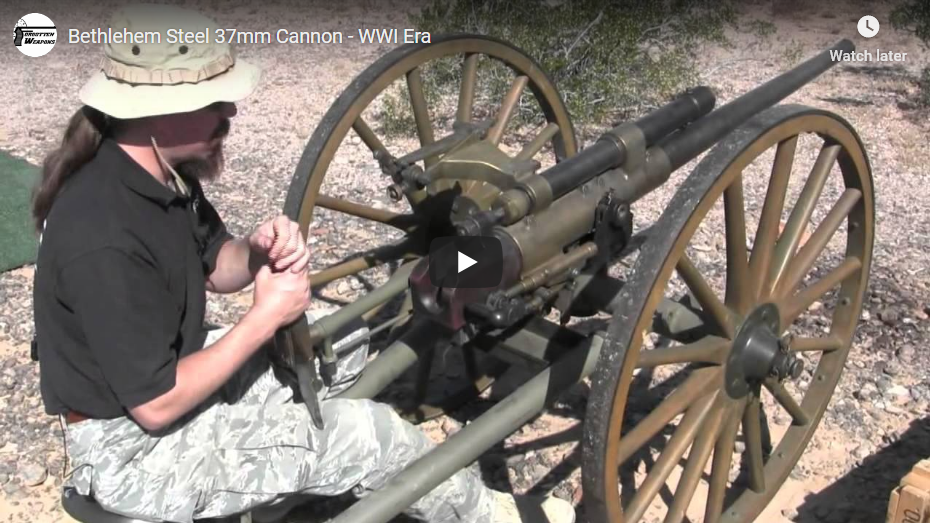
US Navy Driggs Mk IX 37mm Quickfire Cannon
Forgotten Weapons
Published on 23 Apr 2019This Driggs cannon and its accessories are lot #1117 at Morphy’s April 2019 auction:
https://www.forgottenweapons.com/us-n…
Developed between 1883 and 1889 by Lt. William Driggs and Commander (later Admiral) Seaton Schroeder, the Driggs cannon was an improvement on the market-standard Hotchkiss quick-fire cannon of the day. By quick-fire, I am referring to a single-shot cannon that has a recoil mechanism and ejects its empty case automatically, leaving the breech open for rapid reloading and subsequent shot. This was the standard type of naval armament for allowing large vessels to combat small and quick torpedo boats in the late 19th century. The Driggs guns were made in many variations and calibers but limited total quantities until about 1908. This example is a Mk IX type in 37mm, made in 1897.
http://www.patreon.com/ForgottenWeapons
Cool Forgotten Weapons merch! http://shop.bbtv.com/collections/forg…
Contact:
Forgotten Weapons
PO Box 87647
Tucson, AZ 85754
May 27, 2019
A genuine, bona fide electrified, six-car Fisking!
Once upon a time, in the primordial early days of blogging, an artform was evolved that perfectly suited the ecological niche occupied by bloggers: the Fisking. Thanks to his great respect for the ways of the past, David Thompson is a highly skilled modern practitioner of that ancient artform:
Here’s an idea! Change your parents’ bad voting habits by refusing to breed.
In the pages of Slate, Christina Cauterucci, whose enthusiasms include “gender and feminism,” wishes to share her wisdom:
The prospect of harnessing one’s sexual and reproductive powers for social good is a tempting one. So, I’d like to present what I humbly consider a much better proposal: Instead of a sex strike, let’s try a grandkid strike.
It’s a “brilliant new weapon of progressivism,” says Ms Cauterucci, and “exactly the kind of radical response today’s radical threats to equity, justice, and humanity demand.” Specifically,
It’s time to demand that baby boomers and Gen Xers decide which they’d rather have: their vague attachments to policies that have poisoned the earth and will soon make it difficult for anyone but the obscenely wealthy to live healthy, happy lives, or a pack of adorable munchkins in itty-bitty suspenders ready for unlimited tickle fights and cookie-baking sessions.
This is followed almost immediately by,
I’ve already decided that I’m not having kids,
Which, for the purposes of Ms Cauterucci’s article, is somewhat convenient. This reproductive decision was, we’re told, arrived at because,
Child care is extravagantly expensive, and paid family leave is a rare luxury. Bringing a new set of chubby cheeks and wonderfully incomprehensible babblings into the world is the most destructive thing one couple can do to the planet. It seems certain that today’s babies will be tomorrow’s survivors of famine, water shortages, unprecedented natural disasters, and refugee crises.
And furthermore,
It’s unethical, what with climate change and all. And it’s too dangerous — you’ve seen the news reports on school shootings and know how easy it is for violent men to get their hands on guns.
Um, okay then. Apparently, the thought of becoming a parent immediately conjures mental images of famine, earthquakes, shootings and death. Proof, if more were needed, that the exquisitely woke are just like thee and me. Not unhinged in any way.
May 24, 2019
“No Bullets Fly” – Charlie Brown and Franz Stigler – Sabaton History 016
Sabaton History
Published on 23 May 2019Heroism isn’t always measured in blood or danger. Sometimes, to spare your foe is the honourable thing to do. A dramatic example comes in the shape of the American Charlie Brown and German Franz Stigler. Brown was flying his heavily damaged B17 “Flying Fortress” bomber home after a demanding bombing run on Bremen when Franz Stigler in his fighter plane caught sight of its tail. This story is about the encounter between the two enemies and the song that Sabaton wrote about it, called “No Bullets Fly” (on the Heroes album).
Support Sabaton History on Patreon: https://www.patreon.com/sabatonhistory
Find A Higher Call, the book that inspired “No Bullets Fly” here: https://www.valorstudios.com/a-higher…
Check out the trailer for Sabaton’s new album The Great War right here: https://www.youtube.com/watch?v=HCZP1…
Listen to Sabaton on Spotify: http://smarturl.it/SabatonSpotify
Official Sabaton Merchandise Shop: http://bit.ly/SabatonOfficialShopHosted by: Indy Neidell
Written by: Markus Linke and Indy Neidell
Directed by: Astrid Deinhard and Wieke Kapteijns
Produced by: Pär Sundström, Astrid Deinhard and Spartacus Olsson
Creative Producer: Joram Appel
Executive Producers: Pär Sundström, Joakim Broden, Tomas Sunmo, Indy Neidell, Astrid Deinhard, and Spartacus Olsson
Maps by: Eastory
Edited by: Iryna Dulka
Sound Editing by: Marek Kaminski
Eastory YouTube Channel: https://www.youtube.com/channel/UCEly…
Archive by: Reuters/Screenocean https://www.screenocean.com
Music by Sabaton.Sources:
IWM: CL 3395
Plane drawing by EmoscopesAn OnLion Entertainment GmbH and Raging Beaver Publishing AB co-Production.
© Raging Beaver Publishing AB, 2019 – all rights reserved.
QotD: Politics and culture
… sometimes Mark Steyn seems like the only conservative you can discuss these issues with, because most Republicans think popular culture is beside the point, if not downright dangerous. Steyn, on the other hand, has performed “Kung Fu Fighting” before thousands of people in civic auditoria more accustomed to Mary Kay Cosmetics conventions, so he gets it.
“Social conservatives are always editing pop culture,” says Steyn, “and it’s completely pathetic. Conservatives play to the caricature. Mention a French movie and the crowd turns on you. It’s a reductive view of the world. There are ideological enforcers casting aside works of art because they contain bad words or uncomfortable associations. It’s one of the biggest abdications of the American right. Who gives a crap about who gets elected to the Congressional district in Ohio? — that’s not going to change the culture. It’s movies that move the culture. And if you abdicate that space, you lose. Jeb Bush spent a billion dollars to get 2.8 per cent of the vote in Iowa. Mitt Romney and people like him who have a billion dollars — don’t spend it on politics, buy a TV network! Theatre, movies, music, that’s where the battles are fought. They’ve abdicated that space in the schools. As a result, my kid had to sit through Al Gore’s lousy movie three times. All effective storytelling is inherently conservative — because your choices have consequences. For the Left, nothing has consequences. But the trends are all in the Left’s direction, because the Right got out of the game — they chose to make themselves culturally irrelevant. If you’re not in the same room, having the conversation, there’s not gonna be a solution.”
Mark Steyn, interviewed by John Bloom, “Mark Steyn, Cole Porter and Free Speech”, Quadrant, 2017-05-11.
May 23, 2019
Those “theories of history”
At Rotten Chestnuts, Severian starts off talking great-man versus vast-impersonal-forces-of-history then segues into passivity (not Severian’s, but the widespread use of the passive voice):

Lionel Royer (1852-1926). Vercingetorix jette ses armes aux pieds de Jules César (Vercingetorix throws down his arms at the feet of Julius Caesar)
The painting depicts the surrender of the Gallic chieftain after the Battle of Alesia (52 BC). The depiction of Gauls with long hair and mustaches is also called into question today. The horse is a Percheron, although at this time this breed was not in Gaul. The rectangular shield also does not accord with the time when they were mostly oval.
Musée CROZATIER du Puy-en-Velay. — http://www.mairie-le-puy-en-velay.fr/ via Wikimedia Commons.
Academics, of course, are all in on “social” explanations of historical phenomena. Being weak, ineffective people themselves, with no experience of life, the very idea of a Caesar frightens and repels them… so they construct theories of History in which it is impossible for a Caesar to exist. On this view, “social forces” (what they used to call “the relations of the means of production”) tore the Roman Republic apart; the Empire was its inevitable next stage. Assign whatever name you like to the Imperator — whether Caesar, Marius, Sulla, or Miles Gloriosus, he’s just the temporary face of the vast, impersonal social forces that control our fate. None of this “History is just the biographies of great men” for them!
The eggheads have a point, though, albeit not the one they think they’re making. The Roman elite’s social system was designed to produce a certain type of man. Whether Gaius Julius Caesar was personally the embodiment of that system, or a perversion of it, is irrelevant — the system was designed to produce men like Caesar, fellows with a very particular set of skills. Eggheads have never seen one, but anyone who has kicked around the world outside the ivory tower for a bit has met that type of guy. The skills themselves are fairly common, at least in embryo. Whether a potential Caesar becomes actual might well be merely a question of opportunity and scale.
A terrifying notion, that, when you look around the modern West. The one characteristic all effective elites have in common is the self-knowledge that they are the elite. The British, for instance, thought nothing of sending some 19 year old kid, whose slim formal education was mostly Latin and Greek, off to govern the Punjab. It worked, largely because that kid, whatever his defects of intellect and ability, had character, of the kind you just don’t get without a pedigree stretching back to Hastings.
Again, if you’ve ever met one of the horsey set you know what I’m talking about. If you haven’t, the most accessible American equivalents are the sons and grandsons of career army officers. Think of Lieutenant Dan in Forrest Gump, as played by Gary Sinise in the movie. That kind of guy always completes the mission, or dies trying, because it’s simply unthinkable that he won’t. After five generations, West Point is in his DNA…
May 22, 2019
May 21, 2019
May 19, 2019
Malcom McLean’s container shipping revolution
At the Foundation for Economic Education, Alexander Hammond recounts the tale of a former truck driver who was instrumental in revolutionizing the way we ship products around the world:
In 1937, McLean made a routine delivery of cotton bales to a port in North Carolina for shipment to New Jersey. As McLean couldn’t leave until his cargo had been loaded onto the ship, he sat for hours watching dozens of dockhands load thousands of small packages onto the ship. McLean realized that the current loading process wasted enormous amounts of time and money, and he began to wonder if there could be a more productive alternative.
In 1952, McLean thought of loading entire trucks onboard a ship to be transported along the American Atlantic coast (i.e., from North Carolina to New York). Although this idea would dramatically reduce loading times, he soon realized that these “trailer ships” would not be very efficient due to the large amount of wasted cargo space.
Mclean modified his original design so that just the containers—and not the trucks’ chassis—were loaded onto the ship. He also developed a way for the containers to be stacked on top of one another. That was the origin of the modern-day shipping container.
In 1956, McLean secured a bank loan for $22 million. He used the money to buy two World War II tanker ships and convert them to carry his containers. Later that year, one of his two ships, the SS Ideal-X, was loaded with 58 containers and sailed from New Jersey to Houston, Texas. At the time, McLean’s shipping company offered transport prices that were 25 percent lower than those of his competitor as well as the ability to lock the containers in order to prevent cargo theft, which also appealed to many new customers.
By 1966, McLean launched his first transatlantic service and three years later, McLean had started a transpacific shipping line. As the advantages of McLean’s container system became clear, bigger ships, more sophisticated containers, and larger cranes to load cargo were developed.
Update 21 May: Here’s a breathtaking example of just how much McLean’s containers changed the world:
In 1956, hand-loading cargo onto a ship in a U.S. port cost $5.86 per ton ($55.58 in today’s money). By 2006, shipping containers reduced that price to just 16 cents per ton ($0.21 in today’s money). https://t.co/zuMMqOuiAl #HumanProgressData
— Timothy Aeppel (@TimAeppel) May 20, 2019
May 18, 2019
6 Wartime Foods | British Pathé
British Pathé
Published on 20 Sep 2016BON APPETIT – FOOD MONTH ON BRITISH PATHÉ (SEPTEMBER 2016): 6 Wartime Foods.
War and postwar changed the perception of foods that we now may consider as ordinary and basic. Here is a list of 6 Wartime Foods.
Check the newsreels used to make this video here: https://www.youtube.com/playlist?list…
Music:
The Show Must Be Go (incompetech.com)
Licensed under Creative Commons: By Attribution 3.0 License
http://creativecommons.org/licenses/b…A NEW THEME EVERY MONTH!
Each month, a range of new uploads and playlists tell the story of a particular topic through archive footage. Let us know what themes you’d like to see by leaving us a comment or connecting with us on social media.BRITISH PATHÉ’S STORY
Before television, people came to movie theatres to watch the news. British Pathé was at the forefront of cinematic journalism, blending information with entertainment to popular effect. Over the course of a century, it documented everything from major armed conflicts and seismic political crises to the curious hobbies and eccentric lives of ordinary people. If it happened, British Pathé filmed it.Now considered to be the finest newsreel archive in the world, British Pathé is a treasure trove of 85,000 films unrivalled in their historical and cultural significance.
ALL RIGHTS RESERVED
A VIDEO FROM BRITISH PATHÉ. EXPLORE OUR ONLINE CHANNEL, BRITISH PATHÉ TV. IT’S FULL OF GREAT DOCUMENTARIES, FASCINATING INTERVIEWS, AND CLASSIC MOVIES. http://www.britishpathe.tv/
FOR LICENSING ENQUIRIES VISIT http://www.britishpathe.com/
British Pathé also represents the Reuters historical collection, which includes more than 120,000 items from the news agencies Gaumont Graphic (1910-1932), Empire News Bulletin (1926-1930), British Paramount (1931-1957), and Gaumont British (1934-1959), as well as Visnews content from 1957 to the end of 1979. All footage can be viewed on the British Pathé website.
QotD: “Revenue neutral” tax cuts
Real men (as well as pull-no-punches women) cut taxes. The lesser mortals that tend to inhabit Washington wring their hands and get all weak in the knees when it comes to cutting taxes. Rumors are President Trump will propose a real tax cut. I certainly hope so.
Once upon a time, most Republicans believed in tax cuts. Somewhere along the way, inside the beltway especially, Republicans forgot about the benefits of cutting taxes. Republicans became more concerned with government keeping “its” revenue than letting the people keep their money.
Too many Republican have become timid about tax cuts, often spouting the milquetoast line of “revenue neutral tax cuts.”
Let me translate that little bit of Washington-speak for you. “Revenue neutral” tax cuts aren’t really tax cuts. It’s more like tax shifting. Some will pay more. Some will pay less. And the net effect will be that government will collect the same amount of taxes.
If revenue neutral tax shifting is what Republicans stand for, maybe it’s time we re-evaluated what we really stand for.
What will “revenue neutral” tax cut mean to your business? Well, that may depend on how expensive your lobbyist is. Which side of the “revenue-neutral” ledger you wind up on may depend on how well the skids are greased, hardly, a pleasant scenario to anticipate.
I believe as John F. Kennedy and Ronald Reagan did, that the best way to stimulate our economy, promote job growth, and give our ailing middle class a raise is to cut taxes for all.
Rand Paul, “Real Men Cut Taxes”, Breitbart.com, 2016-04-25.