Quotulatiousness

August 31, 2025

Didn’t we once have “conflict of interest” rules for politicians?

Filed under: Business, Government, Media, Politics, USA — Tags: , , , , — Nicholas @ 03:00

It’s become a commonplace that politicians leave office vastly wealthier than they went in, far in excess of their official salaries. Once upon a time, even though it probably still happened, the fat cats managed to stay below the event horizon with their ill-gotten gains. Today, they no longer care if you find out that this or that senator has consistently beaten the market on their investments during their entire time in office. After all, what are you going to do about it, punks? Maybe something like this:

Paul and Nancy Pelosi, 16 February, 2022.
Detail of a photo by Amos Ben Gershom via Wikimedia Commons.

The original research was on how Senators seem to make 12% annually. That’s, erm, a lot.

Markets — something that always comes as a surprise to politicians — react:

    American lawmakers are so consistently successful that a flurry of new platforms and apps now compile filing data from US politicians as a key input in strategies for retail investors and even hedge funds.

    The number of people using these so-called “copy trading” strategies has exploded. Tens of thousands of Americans now follow and imitate trades made by members of Congress, and they are making millions of dollars in the process.

OK, what fun, eh?

Even more fun would be Megan McArdle’s suggestion, that the CongressThieves must announce that they intend to trade an hour before they do so that everyone else can front run them.

Because, you know, Ms. Pelosi:

    She beat every single hedge fund last year.

But there’s something even more fun:

    Dub launched in March 2024 as America’s first regulated brokerage to offer copy trading accounts to mimic politicians and star traders.

    “It’s been absolutely insane in terms of growth,” says Steven Wang, the founder and chief executive who dropped out of his freshman year at Harvard to build the platform. Today, it has 1.5 million users across America.

    Of the $100m or so invested across Dub, nearly $23m is in its Pelosi tracker account. Since its launch in early 2024, its paper gains are 172pc.

Stock prices do not move “because”. Interest rates change, profits go up, or down, or tariffs or … stock prices change because people buy and or sell more of them. That may be in reaction to those other things but the actual price movement is that buy and sell stuff.

Which means that if we copy Nancy’s trades — after she’s done them — then we’re making money for Nancy. Because we are piling in our weight of money into a position she already holds.

Which, when you think about it, is really pretty shitty. Sure, it’s nice to make money ourselves by trading upon that congressional information. But there is that very, very, heavy cost of making Ms. Pelosi even richer as a consequence.
Military-Issue Colt Model 1839 Paterson Revolving Rifle

Filed under: History, Military, USA, Weapons — Tags: , , , , , — Nicholas @ 02:00

Forgotten Weapons
Published 23 Apr 2025

The first rifle made in Sam Colt’s Paterson NJ factory was the 1837 “ring lever” rifle. These were rather fragile and underpowered and while they were used successfully in the First Seminole War, they needed improvement. Colt set about doing this with his 1839 pattern, which was more robust and more powerful. It had six chambers of .525″, with much greater powder capacity than the first Colt revolving rifles. A total of about 950 were made before the Paterson company failed in 1842, and nearly 700 of those were military sales. The US War Department bought 360 (including this example), the Republic of Texas bought 300, and the State of Rhode Island bought 46 — the rest were sold to private companies or individuals. Despite its improvements, though, the 1839 revolving rifle was still not a mature design and was not successful enough to keep Colt in business.

Colt 1837 Ring-Lever Rifle: Sam Colt’s Paterson No1 Model Carbine

Colt 1847 Walker Revolver: 1847 Walker Revolver: the Texas Behemoth
(more…)

August 30, 2025

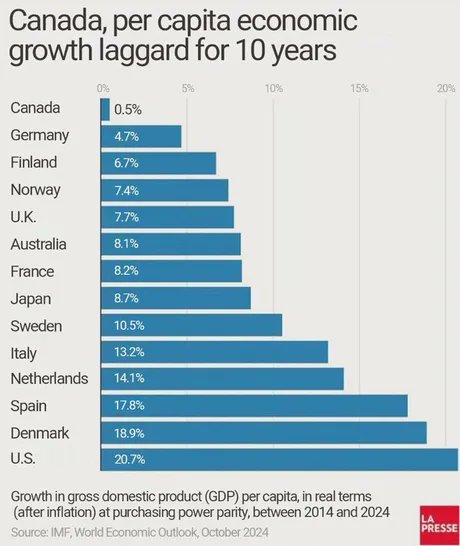
Canada’s economy is going the wrong way

Filed under: Cancon, Economics, Government, Media, Politics, USA — Tags: , , , — Nicholas @ 03:00

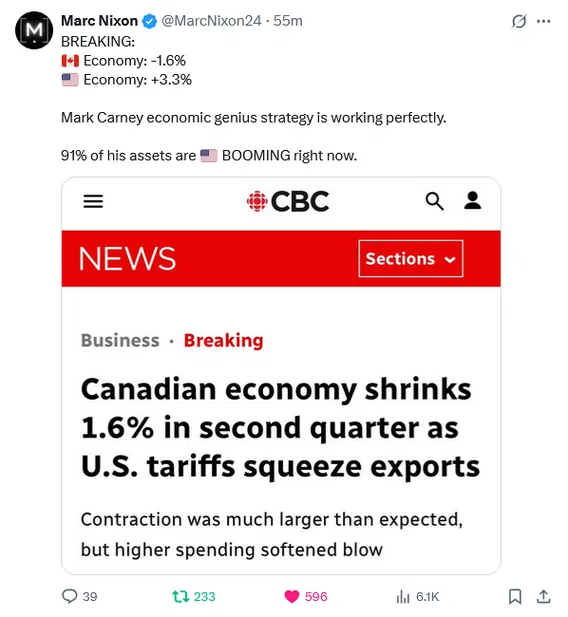
The latest figures show the US economy growing by 3.3% while Canada’s shrank by 1.6% in the same period. It’s bad news for Canadians, except those like Prime Minister Mark Carney who have the bulk of their investments in the United States (91% for Carney, according to various sources). On X, Dan Knight explains what is happening:

Canada’s economy just shrank. That’s the headline. In the second quarter of 2025, real GDP fell 0.4%. On a per-person basis, it was the same. Canadians are poorer than they were three months ago. That’s not speculation. That’s Statistics Canada’s official number.

So, here’s what happened. The government and its media allies spent the spring bragging that the Canadian economy “grew” in the first quarter of 2025. Real GDP was up half a percent. Sounds good, right? But if you read the fine print, if you look at the numbers it wasn’t real growth at all. It was panic.

Exporters rushed to push product into the United States before tariffs came down. Automakers. Machinery producers. Parts suppliers. They all jammed as much across the border as they could, knowing the window was closing. That sugar high showed up in the Q1 GDP number. It made the economy look like it was humming along.

Then the tariffs hit. And in the second quarter, the bottom fell out. Exports collapsed down 7.5% overall. Passenger cars and light trucks? Down nearly 25%. Machinery and equipment? Down 18.5%. Travel services? Down 11%. The result: GDP fell 0.4%. On a per-capita basis, it was exactly the same. Canadians are literally poorer than they were three months ago.

This is the story you’re not hearing: Q1 wasn’t proof of a healthy economy. It was proof of a desperate one. Businesses scrambling to get ahead of trade barriers, because they knew Ottawa wasn’t going to stop them. Q1 was fake growth, and Q2 was the crash.

Meanwhile, households are spending more, saving less, and wages are barely moving up just 0.2%, the slowest since 2016 outside of COVID. Corporate profits are falling. Government revenues are down since the carbon tax was lifted. And Ottawa’s answer? Spend more. Borrow more. Pretend it’s all fine.

So the question is simple: if this is what “growth” looks like under Mark Carney’s Liberal government front-loaded exports, collapsing investment, rising debt what does the next quarter look like?

On her Substack, Melissa Lantsman says that the economic situation in Canada is discouraging investors from putting money into Canadian companies:

You don’t need to be a foreign investor to see that putting your money into Canada is not a winning move.

Recently, Statistics Canada reported “strong foreign divestment in Canadian shares” across many sectors, including energy, mining, and manufacturing. At the same time, Canadian buyers also moved their money stateside, purchasing $13.4 billion of foreign securities in just one month.

If this were a small, short-term blip, it would be easy to dismiss it as market noise or an aberration. But that’s not the case: Statistics Canada found four consecutive months of net divestment from the Canadian economy, adding up to $62 billion in lost capital.

And that’s not to mention that every year since 2015 has seen more Canadian investment going abroad than foreign investment coming here. For those keeping track, this is the fastest rate of divestment in Canada since the Great Recession.

What does this all mean?

From an investor’s point of view, there’s no sugar-coating it. Canada is, simply put, an unattractive place to invest hard-earned cash. People making financial decisions for the future don’t have confidence in the Canadian economy to make them money.

From a government’s point of view, it should mean alarm bells ringing left, right, and centre. Lower investment in Canada translates into lower productivity, fewer employment opportunities, less government revenue, and a weaker Canadian dollar, leaving us all worse off.

But why is this happening in the first place?

According to the C.D. Howe Institute, the culprits are familiar: high taxes, regulatory barriers, policy uncertainty, and anti-growth mindsets that penalize success and demonize the private sector.

Anyone who has been paying attention for the last ten years knows that’s exactly what’s been happening. Nothing says “Welcome to Canada” to investors quite like a hike in the capital gains tax at the last minute, chaos at the CRA, multi-year project approval processes, and the highest deficits on record.

And anyone serious about fixing the problem would do the exact opposite of what the last government did. But when your new government is the same as the old one, it’s hard to believe Canadians will get the bold economic transformation this country desperately needs.

August 29, 2025

The dangers of joining the online hive mind of social media

Filed under: History, Media, Military, USA — Tags: , , , , , — Nicholas @ 03:00

At The Freeman, Nicole James discusses the experience of being immersed in a social media swarm or hive mind phenomenon:

Ever noticed how your social media feed doesn’t sound like “independent thought” so much as a stadium of people chanting, “Yaasss, queen!” in matching sequins? One minute you’re scrolling idly, the next you’ve been recruited into a sect with better lighting filters and the odd ironic dog meme. All it takes is clicking on one video of a dachshund in a raincoat, and suddenly you’ve been ordained High Priest of Sausage Dogs, condemned to a lifetime of puddle-splash reels and algorithmic sermonizing. That’s the hive mind. It’s the Internet’s favorite parlor trick, turning ordinary humans into synchronized swimmers thrashing about in a soup so murky it makes the Hudson on a hot July afternoon look like Perrier.

Bees and ants nailed this millennia ago: buzzing, working in lockstep, worshipping a terrifying queen—basically the Kardashians of the insect world. But instead of honey, humanity now churns out TikTok dances, Reddit debates about whether Die Hard was a Christmas movie (it wasn’t), and Facebook is where your uncle accidentally joins a cult.

Yet this collective buzz can tip into something darker. Collaboration can harden into groupthink, flattening individuality like a raccoon on the New Jersey Turnpike.

Cristina Dovan, a life coach based in the UK, calls the hive mind “group decision-making where individuals meld into one big throbbing consciousness”. Which sounds noble, and also like the worst hangover imaginable.

Collective intelligence can shine. Wikipedia (on a good day), Reddit’s problem-solving posters, Kaggle competitions, GitHub fixes. It’s a brainstorming session without the burnt office coffee and stale biscuits.

But history, and the Internet, remind us there’s a darker wing.

Psychologist Irving Janis, who coined “groupthink,” pointed to the Bay of Pigs invasion as Exhibit A.

Let’s return to 1961 where JFK is young, popular, and surrounded by Very Serious Men in suits. The CIA pitches a plan to topple Fidel Castro that went roughly like this:

  1. Train a ragtag bunch of Cuban exiles.
  2. Drop them on a swampy stretch of coastline actually called the Bay of Pigs (because nothing says “stealth” like announcing your arrival in Pork Bay).
  3. Hope the Cuban people spontaneously rise and overthrow Castro, preferably in a neat anti-communist conga line.

Everyone in the room knew it sounded dodgy. The beaches were wrong, the surprise was nonexistent, Castro’s army was enormous and very much awake. But instead of saying, “Excuse me, Mr. President, this is bananas”, the advisors all nodded along as if they were trapped in a corporate retreat exercise called Let’s Pretend We’re Bold Visionaries.

The result? A fiasco. Castro’s forces crushed the invaders in three days flat. America looked ridiculous, Kennedy was humiliated, and “Bay of Pigs” became shorthand for “the world’s worst team-building activity”. In short, a textbook case of groupthink, or as we’d call it today, “watching as your drunk mate climbs onto the shed roof, yells that he can backflip, and you cheer instead of calling an ambulance”.

August 27, 2025

The Korean War Week 62: Chinese Break Off Peace Talks! But Whose Fault Is It? – August 26, 1951

Filed under: China, History, Military, USA — Tags: , , , , — Nicholas @ 04:00

The Korean War by Indy Neidell
Published 26 Aug 2025

The Chinese claim that American bombers have attacked the Kaesong conference area and break off the peace talks. The UN delegation smells a set up. Meanwhile, the Battle of Bloody Ridge is in full swing and earning its name, as the casualties mount on both sides.

Chapters
00:41 Recap
01:11 A ROK Success
01:47 Bloody Ridge
06:17 Soviet Reinforcements
07:08 Operation Strangle
11:06 Summary
11:45 Conclusion
13:37 Call to Action
(more…)

M1922 BAR Cavalry Light Machine Gun

Filed under: History, Military, USA, Weapons — Tags: , , , , — Nicholas @ 02:00

Forgotten Weapons
Published 21 Apr 2025

After World War One, there was a lot of tinkering with the BAR by the US military. It was recognized as being a very good platform, but the original M1918 configuration left a lot to be desired. It was deemed too heavy to use effectively from the shoulder, but also not really well suited to sustained fire. In an effort to optimize it for use as a dynamic support weapon by a small squad, the Infantry & Cavalry Board requested a model with a heavier barrel and lightweight bipod in 1920. Six experimental examples were made form existing BARs, and the design was formalized two years later as the Model 1922.

This pattern of BAR has a heavy finned barrel to give it more sustained fire capacity and a folding bipod and rear monopod for more accurate use prone. The Board also experimented with larger magazines, and ended up recommending a 30-round size — although this was never put into production. In total, 500 of the Model 1922 guns were made, all converted from existing BARs. Experimentation continued slowly, and eventually in 1937 a lighter pattern was adopted as the M1918A1. The Model 1922 was formally declared obsolete in April 1941, and virtually all of them were rebuilt to the new M1918A2 pattern for use in World War Two. Surviving examples like this one are extremely rare — this is the only known example in private hands.
(more…)

August 26, 2025

Table saws, technological patents, and rent-seeking

Tom Knighton, who I’ve “met” on my favourite woodworking forum, celebrates a small victory in the never-ending battle against the rent-seekers of the corporate world:

“SawStop” by Comfr is licensed under CC BY-SA 4.0 .

What does this have to do with rent-seeking?

Well, there’s a company called SawStop. They make really great table saws with a unique safety feature. They’re equipped with a brake and sensor that, when it detects moisture such as one might find in a human finger, it locks the saw and drops the blade down into the saw’s body.

It’s a really great bit of technology, and the saws happen to be really good saws, too, so the company has done well for itself.

However, it started out as a company seeking to license the technology, only no one wanted it at the time.

SawStop decided to try and press the United States government to mandate their technology on all new table saws, and the government was going to.

Was.

This video has a good rundown of the whole thing. (I’d embed it, but the channel doesn’t allow it for some reason.)

The short of it is that the rule that was being considered has now been tossed because it would specifically give SawStop a monopoly on table saw sales in the United States, legally. Yes, they were going to offer up a patent for the public domain, but it wouldn’t be enough to replicate the technology in and of itself.

Plus, at a time when woodworking isn’t the biggest hobby in the world, even if it had been enough, driving up the cost for a central piece of tooling that most consider essential for woodworkers ain’t the way to change that.

For example, Skil makes a jobsite saw that typically runs under $300. SawStop’s equivalent is around three times that much, and that’s a lot of money to spend on something you’re not sure you’ll even enjoy.

Especially since just being careful can prevent the need for the brake in the first place, to say nothing of the fact that if you cut wet wood, it’ll trigger the brake, which is a pain for a lot of people, especially building contractors whose lumber isn’t super dry to begin with.

Seeing the rug pulled out from under SawStop is great, but the real issue here is that it doesn’t happen often enough. Rent-seeking is all too common and all too often works.

August 24, 2025

Much of our prosperity is based on trust, and we’re rapidly losing it

Ted Gioia foresees a precipitous fall in trust coming at us very soon, and I’m afraid he might be being too optimistic:

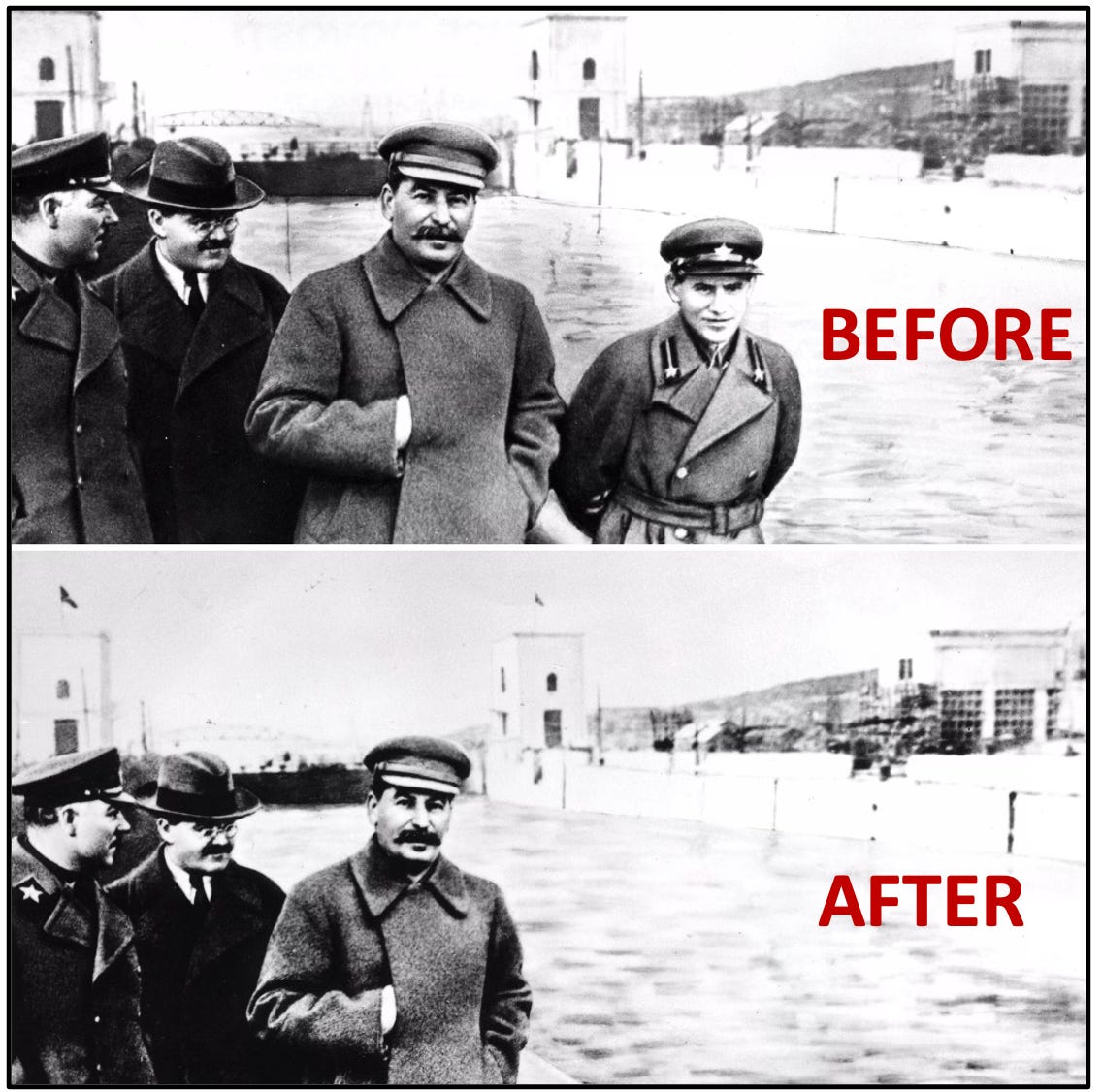
During the great purges of the 1930s, Stalin ordered the execution of a million people, including some of his closest associates. But it wasn’t enough to kill these victims — they also had to disappear from photographs.

In a famous case, Nikolai Yezhov got removed from his position next to Stalin in a photo taken by the Moscow Canal. This erasure alarmed many party elites because Yezhov, head of the secret police, had been one of the most feared men in the Soviet Union.

And now he got totally deleted.

Well, not totally. In those days of print media, original photos survived, and a paper trail made it difficult to erase history.

So this photo was later used to mock Stalin, and the pretensions of dictators. They can try to change reality, but that’s not possible.

Or is it? Maybe dictators now get the last laugh. Because in the last few months, reality has been defeated — totally, completely, unquestionably.

It is now possible to alter reality and every kind of historical record — and perhaps irrevocably. The technology for creating fake audio, video, and text has improved enormously in just the last few months. We will soon reach — or may have already reached — a tipping point where it’s impossible to tell the difference between truth and deception.

  • Can I tell the difference between a fake AI video and a real video? A few months ago, I would have said yes. But now I’m not so sure.
  • Can I tell the difference between fake AI music and human music? I still think I can discern a difference in complex genres, but this is a lot harder than it was just a few months ago.
  • Can I tell the difference between a fake AI book and a real book by a human author? I’m fairly confident I can do this for a book on a subject I know well, but if I’m operating outside my core expertise, I might fail.

At the current rate of technological advance, all reliable ways of validating truth will soon be gone. My best guess is that we have another 12 months to enjoy some degree of confidence in our shared sense of reality.

But what happens when it’s gone?

Back in 2023, I asserted that trust is the most scarce thing in society. But that was before all these tech deceptions came online. Trust will soon get even more scarce — or perhaps disappear completely from the public sphere.

This is not a small matter.

Most discussions of this issue focus on the technology. I believe that’s a mistake. The real turmoil will take place in social cohesion and individual psychology. They will both fracture in a world where our shared benchmarks of truth and actuality disappear.

We will be — already are — in desperate need of Robert Heinlein’s Fair Witnesses:

A Fair Witness is an individual trained to observe events and report exactly what is seen and heard, making no extrapolations or assumptions. While wearing the Fair Witness uniform of a white robe, they are presumed to be observing and opining in their professional capacity. Works that refer to the Fair Witness emphasize the profession’s impartiality, integrity, objectivity, and reliability.

An example from the book [Stranger in a Strange Land] illustrates the role of Fair Witness when Anne is asked what color a house is. She answers, “It’s white on this side.” The character Jubal then explains, “You see? It doesn’t occur to Anne to infer that the other side is white, too. All the King’s horses couldn’t force her to commit herself … unless she went there and looked – and even then she wouldn’t assume that it stayed white after she left.”

QotD: Police culture

Filed under: Law, Liberty, Quotations, USA — Tags: , , — Nicholas @ 01:00

Cops live and operate within a strict hierarchy, usually with titles like “sergeant”, “lieutenant”, “captain”, and so forth. Most of them wear military-style uniforms, and an argument can be made that so-called “plainclothes” operations ought to be outlawed. Increasingly, they wear military battledress and carry military weapons.

Cops form a culture all to themselves, like professional soldiers, and usually have little to do with those who are not cops. They do call us “civilians”. […] They also call us “assholes” and say that the public just consists of criminals who haven’t been caught yet. I know because I was there at one time.

Yeah, I understand the theory that they’re civilians, too. I repeat that it’s bullshit. What they are, in fact, is an occupying military force, with strategic bases in every hamlet in the nation — which is why they and their hangers-on lie to us and possibly to themselves about being civilians, too.

They are the very standing army that the Founding Fathers were afraid of.

L. Neil Smith, “Letter from L. Neil Smith” Libertarian Enterprise, 2005-05-01.

August 23, 2025

“Trump … sees transshipment and nearshoring as sneaky workarounds”

Filed under: China, Economics, Government, Politics, USA — Tags: , , , — Nicholas @ 05:00

At the Foundation for Economic Education, Jake Scott explains Donald Trump’s latest anti-trade moves:

President Donald Trump’s executive order of July 31st, effective August 7th, has upended global trade dynamics in a single stroke. Slapping a 40% tariff on all “transshipped goods” — products rerouted through third countries to dodge US duties — this is merely the natural development of his evolving protectionist agenda.

Just a week after the order, the move is a clear shot at China’s sprawling manufacturing empire, which has long exploited methods like transshipment and “nearshoring” to skirt American tariffs in general, and Trump’s tariff policies in particular.

While applied globally, China stands to take the biggest hit (and likely already is), with its vast factory networks and knack for rerouting goods through Southeast Asia, Mexico, and beyond. This isn’t just a tariff hike; it’s a calculated escalation in Trump’s ongoing crusade to reshape US trade policy and the global economy in the United States’ favor. But ripple effects that bruise consumers are already visible — and this move is likely to strain relationships with key allies as well.

The new tariffs build on Trump’s first-term strategy — so extensive that it now has a Wikipedia entry — when he wielded America’s economic heft like a sledgehammer to renegotiate or smash trade deals he deemed unfair. Back then, Chinese firms sidestepped US tariffs by setting up shop in countries like Vietnam and Mexico, funneling goods through these hubs to mask their origins.

This nearshoring strategy buoyed many economies that had pre-existing arrangements with the United States or were treated more favorably than China, such as Canada and Latin American nations. It is also seen as a natural part of globalization: shipping parts from where they are constructed (like China), assembling them in developing nations (like Mexico), and then exporting to high-value markets (like the United States). Nearshoring has a long history, but the fragility of extended global supply chains was exposed in the Covid pandemic; since then, manufacturers have sought to mitigate their damage.

The US trade deficit with China (roughly $295 billion) has long been a sore point for Trump, who sees transshipment and nearshoring as sneaky workarounds. The 40% duty on these goods, layered atop existing tariffs, aims to plug this loophole. As Stephen Olson, a former US trade negotiator, noted in the New York Times, China will likely view this as a direct attempt to “box them in”, potentially souring already tense talks.

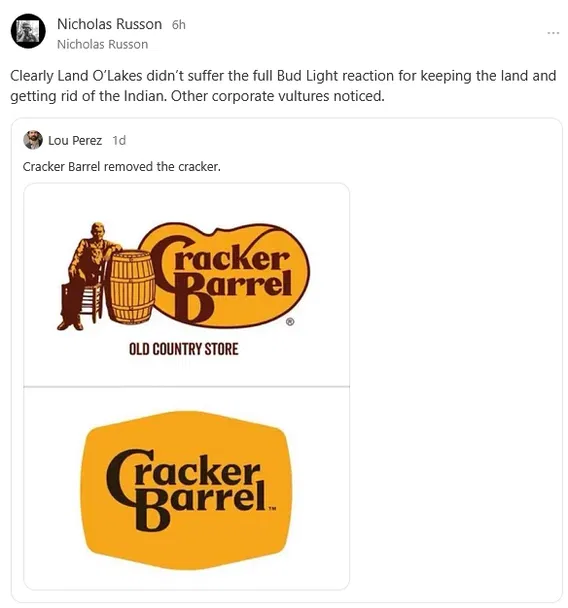
Another Bud Light moment: Cracker Barrel gets rid of the cracker

Filed under: Business, Media, Politics, USA — Tags: , , — Nicholas @ 03:00

I haven’t been to the United States for more than a decade — not for political reasons, just for financial ones … I haven’t had the money to travel since 2015 — so it’s at least that long since I visited a Cracker Barrel. On our usual driving holidays, we’d stop somewhere like a Cracker Barrel to get a big breakfast to tide us over to our next destination a few hundred miles further down the road. I’d heard that the food quality had dropped after Covid, but I can’t confirm that from personal experience. Here’s ESR’s take on the latest rebranding that has riled up the online commentariat and apparently tanked the company’s stock price:

Today I’m here to talk about why I dislike Cracker Barrel, but dislike the Cracker Barrel rebrand even more.

My first reaction to the outpouring of social-media sentimentality about the destruction of CB’s comfortable old-timey ambience was to stare and wonder if these boosters had gone entirely out of their minds.

Yes, CB was designed to evoke a sort of folk memory of what rural country stores used to be like. But it’s, at best, a gigantized, commoditized, kitschy simulacrum of what they were — Hee Haw as filtered through the mind of an urban-corporate bugman.

Exhibit A for this is the gauntlet you have to run through to get to the food — gift shops that are unrivaled for the utter tastelessness and worthlessness of the cheesy crap on their shelves.

Once you get to the food, well … they serve a decent breakfast. Everything else is bland, homogenized slop.

And yet, I find that I dislike the rebranded look and feel even more. Because at least CB as it was gestured feebly in the direction of something authentic and American. The new look strips out all those vestiges — it has all the character of a generic airport lounge.

If you’re reading this and getting hot under the collar because I’ve impugned an experience that has sentimental value for you … look, I get it, okay? Old CB wasn’t designed for me, nor for anybody else who can unironically describe themselves as urbane, sophisticated cosmopolitans. But in its own pastiched way it had value, value which is now being destroyed.

Certainly the stock market thinks so. CB’s share price has been dropping like a rock — the rebrand is a failure even by corporate-bugman standards.

If the chain needed saving, the right thing to do would have been to double down on the attractive parts. Keep the local memorabilia on the walls, improve the menu, turn down the wince-inducing tackiness of the gift shop. Make it more like the mythical olden days, not less.

But no. Because the CEO is an idiot. I’ve been on a corporate board of directors and I’m here to confirm that if CB’s doesn’t convene an emergency meeting to fire her before the end of the week they are not doing their job.

KH-9: B&T Remakes the SITES Spectre Just Because It’s Cool

Filed under: Europe, USA, Weapons — Tags: , , , , — Nicholas @ 02:00

Forgotten Weapons
Published 9 Apr 2025

Karl Brügger, CEO of B&T, is a true gun nerd and avid competitive shooter. When he got his hands on the Spectre SMG with its quad-stack magazine and weird DA/decocker fire control system, he thought it was really neat. So neat that he decided to buy the project from its Italian creators and put it back into production. But they had thrown out all the drawings and tooling when the gun wasn’t successful, and so Brügger had to recreate it from scratch on his own. Cue the Karl’s Hobby 9!

Without Spectre magazines to use, or the tooling to make them, B&T instead found a batch of quad-stack Suomi magazines and used those. They faithfully recreated the DA firing system and decocker, and decided to make a limited back of 222, because this was just a fun side project and not something that would be commercially popular. Except that they sold out really fast. And so another batch was done, this time using APC-9 magazines, since the supply of Suomi mags had been exhausted. Then when they found some Suomi drums, they did another limited batch for those. All of these sold out rapidly, and so the project grew legs. Next up, it became the KH-9 Covert, because what makes a gun cooler than adding folding bits to it?

It remains a limited-production item made in both Switzerland and in the US. Turns out that Karl Brügger isn’t the only guy who thinks they are really neat …
(more…)

August 22, 2025

QotD: “White fragility”

Filed under: Books, Media, Politics, Quotations, USA — Tags: , , , — Nicholas @ 01:00

White fragility is the sort of powerful notion that, once articulated, becomes easily recognizable and widely applicable … But stare at it a little longer and one realizes how slippery it is, too. As defined by [White Fragility author Robin] DiAngelo, white fragility is irrefutable; any alternative perspective or counterargument is defeated by the concept itself. Either white people admit their inherent and unending racism and vow to work on their white fragility, in which case DiAngelo was correct in her assessment, or they resist such categorizations or question the interpretation of a particular incident, in which case they are only proving her point. Any dissent from “White Fragility” is itself white fragility. From such circular logic do thought leaders and bestsellers arise. This book exists for white readers. “I am white and am addressing a common white dynamic,” DiAngelo explains. “I am mainly writing to a white audience; when I use the terms us and we, I am referring to the white collective”. It is always a collective, because DiAngelo regards individualism as an insidious ideology. “White people do not exist outside the system of white supremacy,” DiAngelo writes, a system “we either are unaware of or can never admit to ourselves”. … Progressive whites, those who consider themselves attuned to racial justice, are not exempt from DiAngelo’s analysis. If anything, they are more susceptible to it. “I believe that white progressives cause the most daily damage to people of color,” she writes. “[T]o the degree that we think we have arrived, we will put our energy into making sure that others see us as having arrived …” … It is a bleak view, one in which all political and moral beliefs are reduced to posturing and hypocrisy.

Carlos Lozada, “White fragility is real. But ‘White Fragility’ is flawed,” Washington Post, quoted by Ann Althouse, 2020-06-19.

August 21, 2025

Most of us learned the “pull my finger” gag around grade 2, so why are so many of us still gullible about “scientists warn”?

Filed under: Media, Science, USA — Tags: , , , , — Nicholas @ 03:00

At Watts Up With That?, Willis Eschenbach warns us yet again about believing headlines that say things like “Scientists Warn!”

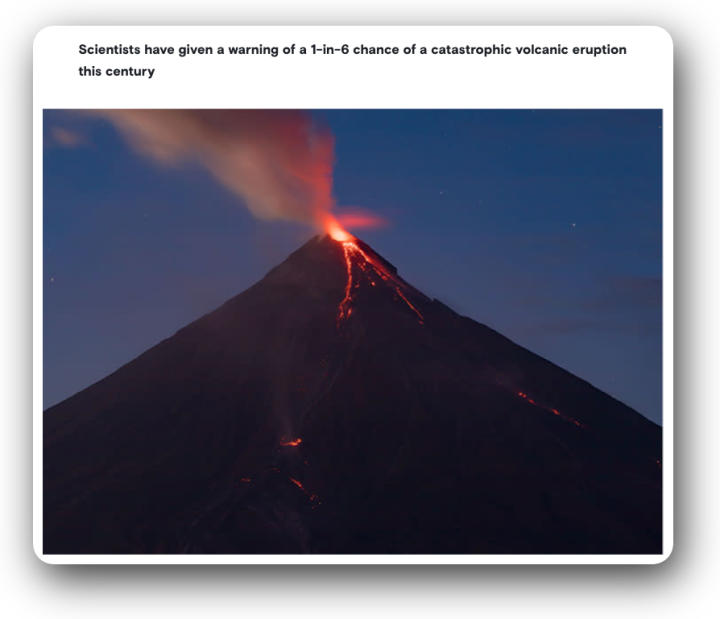
Only a journalist truly committed to the ancient art of panic-clickbait could squeeze all the world’s existential dread into a headline like, A Giant, Destructive Volcanic Eruption Is Set to Shake the World in the Coming Months, Bringing About the End of Mankind, Scientists Warn. They’ve accompanied it with the following graphic, in case you weren’t adequately terrified.

The dead giveaway? “Scientists Warn“. Whenever you see those two words sandwiched together above the fold, you know you’re about to step into a wonderland of wild extrapolation, qualified maybes, and models run so far into the future they boomerang back with “robots take over” as the y-axis.

They start out as follows:

    A detailed geophysical study published in Nature in by the U.S. Geological Survey (USGS) has refined our understanding of the Yellowstone supervolcano, uncovering new insights into its subsurface magma dynamics. Concurrently, climatological assessments by researchers such as Markus Stoffel (University of Geneva) have renewed discourse around the global systemic risks posed by a potential super-eruption — not only at Yellowstone, but at several other active volcanic complexes worldwide.

There’s an oddity here to start with. They’ve pushed together into one paragraph an actual scientific study of the Yellowstone caldera, and a paywalled puff piece by some random guy trying to frighten people about future eruptions. Unless you’re watching very closely to see which walnut the pea is under, it’s likely to be successful in making you think “Wow, a predicted super-eruption at Yellowstone, and the odds are high in other locations as well“.

Which does sound scary. So keep that thought in mind while we look at the first of the two parts they’ve pushed into one paragraph — the actual Yellowstone scientific study.

It’s the latest USGS study published in Nature under the very boring title “The progression of basaltic–rhyolitic melt storage at Yellowstone Caldera“. It gives us an upgraded, high-res CAT scan of Yellowstone’s magma plumbing. Instead of a giant pool of liquid doom sloshing under Wyoming, the new imaging shows a club sandwich: scattered blobs of partially molten rock, unevenly distributed, with most of the melt sitting in the northeast sector. The scale is impressive — 400–500 cubic kilometers of rhyolitic magma waiting for its cosmic moment. The heat just keeps bubbling up from below, slow and relentless, and with enough time, these melt zones might even hook up into a larger reservoir. But spoiler: no scientist anywhere is claiming that’s on tomorrow’s chore list.

Which brings us to the great, headline-grabbing “16% chance (one in six) of apocalypse by 2100” further down in the popular reports — a number that, if ever printed on a lottery ticket, would bankrupt Las Vegas. From the article:

    Still, climatologist Markus Stoffel and affiliated risk researchers estimate a ~16% probability of a VEI 7 or higher eruption occurring globally before the year 2100.

Except that particular prediction is not referred to by the scientists of the actual Yellowstone study, and has nothing to do with the Yellowstone study.

It comes from a some gentleman yclept Markus Stoffel. And he’s not even talking about Yellowstone. He’s talking about the entire planet. Nothing to do with Yellowstone.

And who is Markus when he’s at home? Is he a member of the team of authors of the Yellowstone study?

Nope.

Well, is he a vulcanologist?

Nope again.

He’s a climate professor at the University of Geneva. He’s published a lot, almost entirely regarding the effects of “climate change” on glaciers, mountain landslides, and mountain lakes.

Six Reasons Operation Market Garden FAILED

Filed under: Britain, Germany, History, Military, USA, Weapons, WW2 — Tags: , , , , — Nicholas @ 02:00

The Tank Museum
Published 3 April 2025

Operation Market Garden failed because the tanks of XXX Corps did not reach the Paras in Arnhem in time. Many historians have argued that the British armoured column “let the side down”. But is this actually true?

We reckon there are six reasons why the operation was a total disaster. It was a poor plan from the get-go, relying on a rate of advance that would outmatch the German invasion of France in 1940. Bad weather prevented the deployment of badly-needed reinforcements, and the terrain Guards Armoured were expected to traverse – a single road with impassable conditions on either side – significantly hampered the efforts of the tank crews.

Poor intelligence also meant that the British column was not prepared for resistance from a retreating and desperate German Army. It was a combination of all these factors that caused Market Garden to unravel completely.

Despite the complications, many acts of valour were carried out by both the airborne and armoured divisions, including the legendary assault across the Waal by the US 82nd Airborne.

So, join us as we explore these six reasons why Operation Market Garden failed and decide for yourself whether XXX Corps could have done anymore.

00:00 | Introduction
02:23 | #1 – A Bad Plan
06:22 | #2 – Poor Intelligence
07:51 | #3 – Difficult Terrain
11:27 | #4 – Determined Resistance
13:45 | #5 – Bad Weather
14:38 | #6 – Loss of Surprise
19:45 | What Went Wrong?
(more…)

« Newer PostsOlder Posts »

Powered by WordPress