
Whenever some crime becomes prominent in the public eye, some politician inevitably promises to fix it by getting really tough on criminals. No more of this namby-pamby mollycoddling! This time, we’re going to make it so miserable to be a criminal that no one will dare.
It is a bipartisan habit; progressives may talk enthusiastically about ending mass incarceration, but switch the topic to male sex offenders (or, say, 2008 bankers) and what you’ll hear often sounds like a recap from some Republican law-and-order conference, circa 1984. The belief that crime is a soluble problem if we’re willing to be mean enough is apparently nestled deep in the human psyche.
Megan McArdle, “Killing drug dealers won’t stop the opioid epidemic”, Washington Post, 2018-03-20.
July 12, 2020
QotD: “Getting tough on crime”
July 11, 2020
The Real James Bond was Balkan – Duško Popov – WW2 Biography Special
World War Two
Published 9 Jul 2020The career of Duško Popov is probably more exciting than any work of fiction. A glamorous and brave spy who plays a central role in the underground intelligence war of the time.
Join us on Patreon: https://www.patreon.com/TimeGhostHistory
Or join The TimeGhost Army directly at: https://timeghost.tvFollow WW2 day by day on Instagram @World_war_two_realtime https://www.instagram.com/world_war_two_realtime
Between 2 Wars: https://www.youtube.com/playlist?list…
Source list: http://bit.ly/WW2sourcesHosted by: Indy Neidell
Written by: Francis van Berkel
Director: Astrid Deinhard
Producers: Astrid Deinhard and Spartacus Olsson
Executive Producers: Astrid Deinhard, Indy Neidell, Spartacus Olsson, Bodo Rittenauer
Creative Producer: Joram Appel
Post-Production Director: Wieke Kapteijns
Research by: Scott Grimwood
Edited by: Karolina Dołęga
Sound design: Marek Kamiński
Map animations: Eastory (https://www.youtube.com/c/eastory)Colorizations by:
Jaris Almazani (Artistic Man), https://instagram.com/artistic.man?ig…
Carlos Ortega Pereira, BlauColorizations, https://www.instagram.com/blaucoloriz…
Dememorabilia, https://www.instagram.com/dememorabilia/Music:
“Try and Catch Us Now” – David Celeste
“Too Close for Comfort” – Jon Bjork
“Epic Adventure Theme 4” – Håkan Eriksson
“Moving to Disturbia” – Experia
“Other Sides of Glory” – Fabien Tell
“Underlying Truth” – Howard Harper-Barnes
“Spy Game” – Jon SumnerVisual Sources:
National Archives NARA
Library of Congress
Imperial War Museum: CH1461
US Holocaust Memorial Museum
Alexander Altenhof https://commons.wikimedia.org/wiki/Fi…
Icons from The Noun Project: Marco Livolsi, faisal, Smalllike, Adrien Coquet, Fiona OM, Businessman with Suitcase by Fiona, Nick Novell, Luis Prado, Samy Menai, Nithinan, designer468, Marco Livolsi, ProSymbols, Milinda Courey,Icons Producer, Halfazebra, Leona Grande, Vectors Point, Arthur Dias,MRK, Becris, iconcheese, Likous, Markus, ProSymbols, Michael Fischer, priyanka, Adnen Kadri, Baboon designs and LaymikArchive by Screenocean/Reuters https://www.screenocean.com.
A TimeGhost chronological documentary produced by OnLion Entertainment GmbH.
WTF?! Destroy Cuba or Don’t! | The Cuban Missile Crisis I Day 04
TimeGhost History
Published 10 Jul 2020President John F. Kennedy faces off with the Joint Chiefs of Staff, including General Curtis LeMay (his arch-enemy), who demand more freedom for military action.
Join us on Patreon: https://www.patreon.com/TimeGhostHistory
Hosted by: Indy Neidell
Written by: Spartacus Olsson
Director: Astrid Deinhard
Producers: Astrid Deinhard and Spartacus Olsson
Executive Producers: Astrid Deinhard, Indy Neidell, Spartacus Olsson, Bodo Rittenauer
Creative Producer: Joram Appel
Post-Production Director: Wieke Kapteijns
Research by: Spartacus Olsson
Edited by: Daniel Weiss
Sound design: Marek KaminskiColorizations:
– Dememorabilia – https://www.instagram.com/dememorabilia/Sources:
Photos from Bejucal, Cuba: History and Festivities – Havana Times
Andy Garcia – Mireille Ampilhac
Photo from chernobylguide.com – Chernobyl Mutations in Humans and Animals
PX 65-105:179 from LOOK Magazine 8405-1-26
Photo from WDR – 23. Juni 1963 – John F. Kennedy kommt in Deutschland anSoundtracks from Epidemic Sound:
– “Cold Eyes” – Elliot Holmes
– “Scope” – Got Happy
– “Juvenile Delinquent” – Elliot Holmes
– “Moving to Disturbia” – Experia
– “From the Depths” – Walt Adams
– “Symphony of the Cold-Blooded” – Christian AndersenArchive by Screenocean/Reuters https://www.screenocean.com.
A TimeGhost chronological documentary produced by OnLion Entertainment GmbH.
Truncating the state of Oklahoma
Colby Cosh on what might turn out to be the most important US Supreme Court decision in recent history:
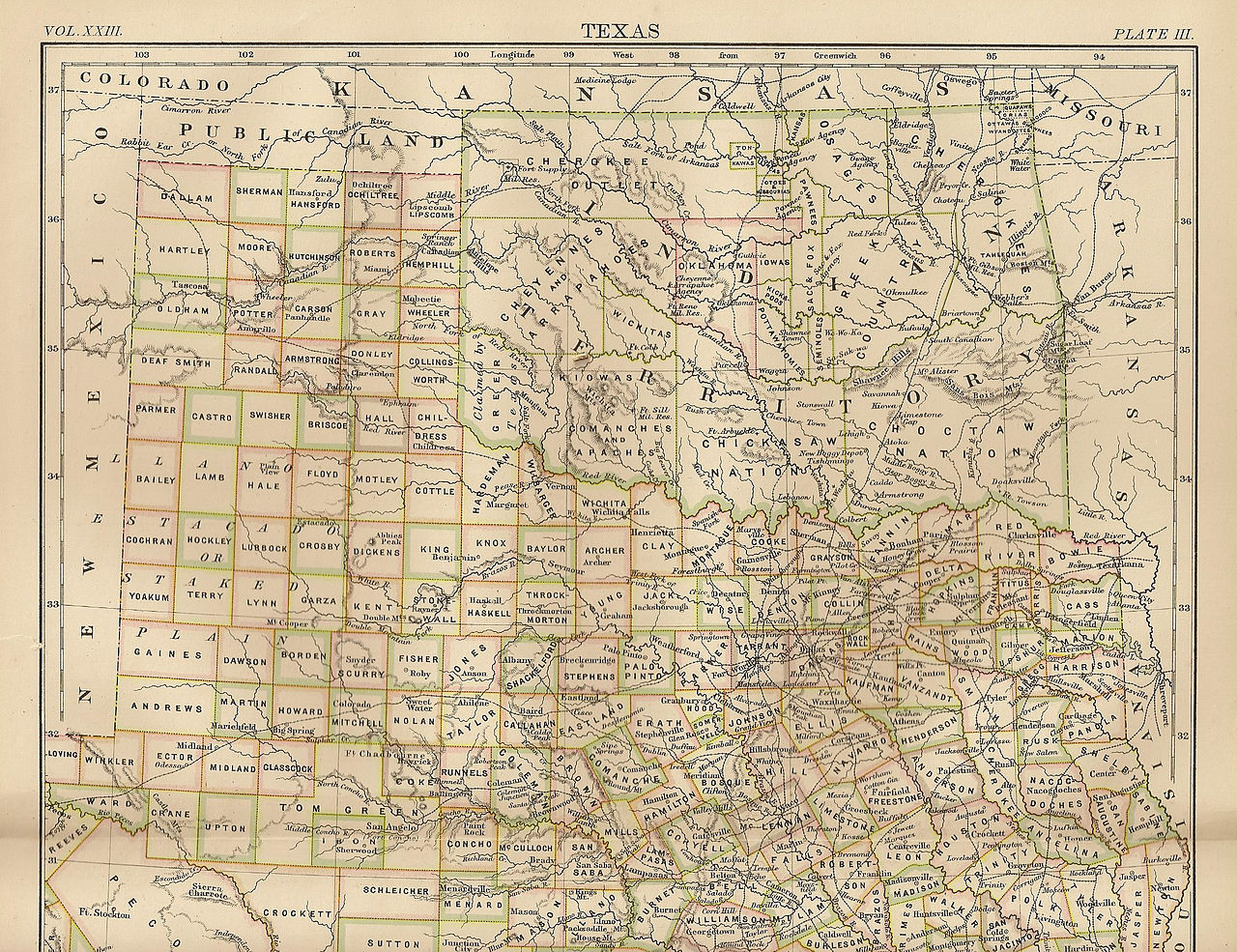
A map of Oklahoma from the mid-1880s showing county boundaries and the tribal areas of Indian Territory.
Encyclopedia Britannica, 9th edition, 1888 via Wikimedia Commons.
On Thursday the court published its judgment in the case of McGirt v. Oklahoma [PDF]. McGirt is Jimcy McGirt, a man convicted in state court in 1997 of heinous sex crimes against a four year old. A creative public defender had tried to argue for years in lower courts that, as McGirt was a member of the Seminole Nation and his crimes had occurred on territory set aside in the 19th century for Creek Indians, he was never subject to state prosecution.
He should have been tried, the argument ran, under the federal Major Crimes Act of 1885, which specifies that accusations of serious felonies against Indians in “Indian country” go immediately to federal court. Under an 1856 treaty between the U.S. and the Creeks, the Creek lands were to be a “permanent home” for the displaced nation for as long as it existed (at a time when Aboriginal-Americans were still widely expected to diminish and disappear as a race).
The formalized concept of an Indian reservation did not yet exist, but the theory, then and now, is that some Aboriginal nations have direct relationships, albeit ones of “dependence,” with the federal government. Sometimes it is said that the U.S. is the “suzerain,” the overlord, of otherwise sovereign Indian nations. The Creeks, and the other four “Civilized Tribes” who had been forced into the “Indian Territory” that once covered the eastern part of future Oklahoma, were given strong written promises that they would be held apart from the U.S. states proper and would have jurisdiction over crimes and civil matters on their lands. Only the United States Congress, as a power contracting with sovereign nations, could act to encroach upon this jurisdiction.
In a fashion familiar to anyone who has read even a shred of the history of the American Indian, these promises just kind of got … misplaced. In the early 20th century the Oklahoma tribes were encouraged by Congress to abandon communal property holding and take up individual “allotments” of Indian-held land. This ought not to have changed the underlying nation-to-nation relationship, any more than assigning homesteading parcels to settlers busted up or negated the ultimate sovereignty of the U.S. elsewhere in the American West. But that constitutional framework was more easily ignored once a contiguous bundle of territory began to be bought and sold. (Some of it became part of the city of Tulsa.) This history has helped to make similar allotment action in Canada impossible, whatever advantages it might have.
July 10, 2020
“Primo Victoria” – The D-Day Landings – Sabaton History 075 [Official]
Sabaton History
Published 9 Jul 2020On D-Day, 6th June 1944, Operation Overlord began. The Western Allies unleashed their gigantic amphibious landing on the coast of Normandy. Preluded by a nightly airborne attack and supported by a massive armada of bombers and fleet artillery, their landing-craft reached the fortified beaches. Against a hail of machine-gun bullets, the Allied soldiers stormed the beaches and overran the German bunkers and trenches. A new front was opened and the battle for France began.
Support Sabaton History on Patreon: https://www.patreon.com/sabatonhistory
Listen to “Primo Victoria” on the album Primo Victoria:
CD: http://bit.ly/PrimoVictoriaStore
Spotify: http://bit.ly/PrimoVictoriaSpotify
Apple Music: http://bit.ly/PrimoVictoriaAppleMusic
iTunes: http://bit.ly/PrimoVictoriaiTunes
Amazon: http://bit.ly/PrimoVictoriaAmzn
Google Play: http://bit.ly/PrimoVictoriaGooglePlayWatch the Official Lyric Video of “Primo Victoria” here: https://www.youtube.com/watch?v=qVHyl…
Listen to Sabaton on Spotify: http://smarturl.it/SabatonSpotify
Official Sabaton Merchandise Shop: http://bit.ly/SabatonOfficialShopHosted by: Indy Neidell
Written by: Markus Linke and Indy Neidell
Directed by: Astrid Deinhard and Wieke Kapteijns
Produced by: Pär Sundström, Astrid Deinhard and Spartacus Olsson
Creative Producer: Joram Appel
Community Manager: Maria Kyhle
Executive Producers: Pär Sundström, Joakim Broden, Tomas Sunmo, Indy Neidell, Astrid Deinhard, and Spartacus Olsson
Post-Production Director: Wieke Kapteijns
Edited by: Karolina Dołęga
Sound Editing by: Marek Kaminski
Maps by: Eastory – https://www.youtube.com/c/eastory
Archive by: Reuters/Screenocean – https://www.screenocean.com
Colorizations by: Julius Jääskeläinen – https://www.facebook.com/JJcolorization/
Music by: SabatonSources:
National Archives NARA
Bundesarchiv
US Holocaust Memorial Museum
Imperial War Museums: IWM H 39183, H38244 IWM, 1944_B5234, 944_TR1631, IWM A70 31-1, IWM A70 31-2,EA25734, B 5218, 1944_MH9509, IWM A70 29-1-2, B5225, B5089
Icons from The Noun Project by zidney and Norbert de GraaffAn OnLion Entertainment GmbH and Raging Beaver Publishing AB co-Production.
© Raging Beaver Publishing AB, 2019 – all rights reserved.

Freedom of speech – a tool to be discarded when your opponents try to use it
Arthur Chrenkoff discusses the recent uproar among progressives over an open letter calling for respect for free speech … when the “wrong kind of people” started signing on:
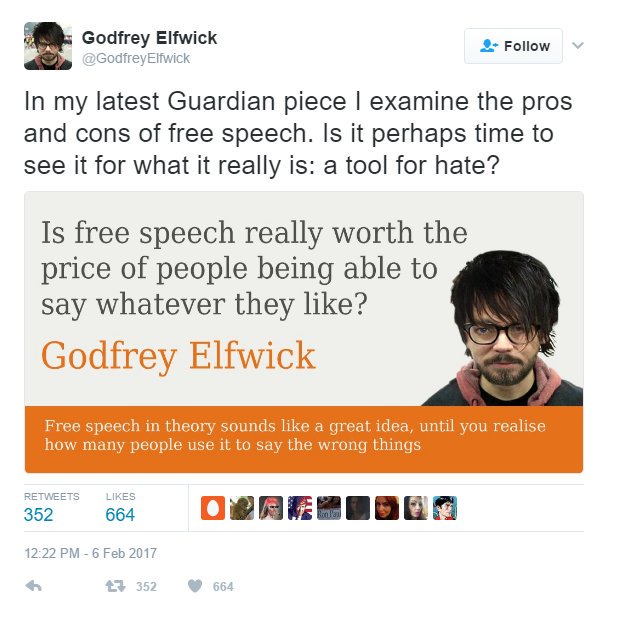
Godfrey Elfwick’s disturbingly accurate summary of free speech support among the woke.
So how did it come to this on a meta-level – how did the left, which for a long time championed ideas like freedom of speech, come to be the new censors and book burners?
The answer is short and simple: power.
Thanks to its Marxist heritage, the left is all about power. Who has it, who doesn’t (Lenin’s famous ur-question “who whom?”), how to get it. Power and power relationship is the ultimate touchstone and lodestar, the prism through everything else is seen and judged. Everything, including morality – what’s right, what’s wrong – flows from the position in this binary system (and with power it is a zero-sum game: you either have it all or you have none).
Turkish Islamist president Recep Erdogan has once famously said “Democracy is like a streetcar. When you come to your stop, you get off.” The stop – the end – is power; democracy is the mean to the end.
So it is with the left and freedom. The left was pro-freedom when it was on the way up. Being pro-freedom helped them achieve their objectives. Freedom of speech, for example, was important because it guaranteed them the ability to spread their ideas.
Now the left has the power, if not in all respects and in equal measure, certainly as far as culture is concerned, where it enjoys near hegemony. Being on top it doesn’t need freedom of speech anymore. Quite the contrary: freedom of speech now enables its critics to challenge their ideas and their position. Debate is a waste of time and effort, much better and more efficient is to silence any dissenting voices.
It’s never about principle – it’s about the side (yours) and power (yours to gain and keep).
A Secret Soviet Nuclear Transport Operation | The Cuban Missile Crisis | Day 03
TimeGhost History
Published 9 Jul 2020On October 18 1962, President Kennedy meets with USSR Foreign Minister Andrei Gromyko, one of the architects of placement of missiles on Cuba. While the two beat around the bush, Khrushchev and Gromyko’s execution of the Soviet military and nuclear build up on Cuba continues.
Join us on Patreon: https://www.patreon.com/TimeGhostHistory
Hosted by: Indy Neidell
Written by: Spartacus Olsson
Director: Astrid Deinhard
Producers: Astrid Deinhard and Spartacus Olsson
Executive Producers: Astrid Deinhard, Indy Neidell, Spartacus Olsson, Bodo Rittenauer
Creative Producer: Joram Appel
Post-Production Director: Wieke Kapteijns
Research by: Spartacus Olsson
Edited by: Daniel Weiss
Sound design: Marek KaminskiColorizations:
– Carlos Ortega Pereira (BlauColorizations) – https://www.instagram.com/blaucoloriz…Sources:
Color by KlimbimFrom the Noun Project:
Termometer – By Andi Nur AbdillahSoundtracks from Epidemic Sound:
– “Cold Eyes” – Elliot Holmes
– “Zoot Suit” – Elliot Holmes
– “Juvenile Delinquent” – Elliot Holmes
– “Scope” – Got Happy
– “Nightclub Standoff” – Elliot Holmes
– “When They Fell” – Wendel Scherer
– “Moving to Disturbia” – Experia
– “From the Depths” – Walt Adams
– “Car Chase in Virginia” – White Bones
– “Kissed by Thunder” – Elliot HolmesArchive by Screenocean/Reuters https://www.screenocean.com.
A TimeGhost chronological documentary produced by OnLion Entertainment GmbH.
July 9, 2020
Top Secret U-2 Spy Planes | The Cuban Missile Crisis I Day 02
TimeGhost History
Published 8 Jul 2020On October 17th, 1962, the U2 Dragon Lady spy plane yield more alarming pictures of Cuban missile sites and President Kennedy is urged to restrain his dogs of war.
Join us on Patreon: https://www.patreon.com/TimeGhostHistory
Hosted by: Indy Neidell
Written by: Spartacus Olsson
Director: Astrid Deinhard
Producers: Astrid Deinhard and Spartacus Olsson
Executive Producers: Astrid Deinhard, Indy Neidell, Spartacus Olsson, Bodo Rittenauer
Creative Producer: Joram Appel
Post-Production Director: Wieke Kapteijns
Research by: Spartacus Olsson
Edited by: Daniel Weiss
Sound design: Marek KaminskiColorizations:
– Carlos Ortega Pereira (BlauColorizations) – https://www.instagram.com/blaucoloriz…Soundtracks from Epidemic Sound:
– “Cold Eyes” – Elliot Holmes
– “Car Chase in Virginia” – White Bones
– “Moving to Disturbia” – Experia
– “Zoot Suit” – Elliot Holmes
– “From the Depths” – Walt Adams
– “When They Fell” – Wendel SchererArchive by Screenocean/Reuters https://www.screenocean.com.
A TimeGhost chronological documentary produced by OnLion Entertainment GmbH.

July 8, 2020
Harry Potter fandom, Millennials, and the continued decline of traditional religious beliefs
In The Critic, Oliver Wiseman talks to Tara Isabella Burton about her book Strange Rites:

J.K. Rowling’s Harry Potter books have been pivotal for many Millennials in encouraging them to move away from traditional religious beliefs.
I want to start with Harry Potter, which is — perhaps surprisingly — central to the argument you make in the book, so, as an introduction to your broader thesis, what does Harry Potter have to do with America’s new religions?
It’s funny. When Harry Potter first came out in the nineties, there was a flurry American Christian voices saying “This book promotes witchcraft. There’s going to be a whole new religious movement devoted to Harry Potter books.” In the way they meant it, that was absolutely not true. But I think that there was something to it in terms of an inadvertent change to the religious landscape.
What Harry Potter did, or, more accurately, what it was the canary in the coal mine for, was a transformation, linked to the rise of at-home internet access, in how we talk about cultural properties andhow we relate to cultural properties. The transition to an internet space defined by user-generated content and what is often called participatory culture coincided with the publication of the Harry Potter books.
Between the first Harry Potter book’s release in 1997 and the fourth book’s publication in 2000 we went from 19 million Americans with internet access to more than 100 million. It’s that backdrop that really explains the shift. You did have fan cultures before. There were Star Wars conventions, for example, but there was quite a high bar to entry. You had to get on the right mailing list and it was done via post. It was quite a lot of work. You couldn’t just log on and enter a community, which is really what could happen with Harry Potter fandom.
J.K. Rowling was also one of the first major writers to openly accept and embrace fan fiction. So what you ended up seeing was something that started with Harry Potter fandom that then became an element of fandom online more broadly which in turn, I would argue, shaped millennial-and-younger culture. It was this idea that you weren’t just a reader of consumer of texts. It wasn’t just a top down hierarchical thing. Instead, mediated through the anonymity of the internet, you a kind of tribalism from talking to people in different geographical areas as well as things like fan fiction and later meme culture that meant you could change, shift, reimagine a text in your own way. And what’s so interesting about that is that sensibility — the sensibility that we have not only the right but the responsibility, the authority as consumers to also be creators, to rework ideas outside of existing texts — has spilled over into all aspects of our political life and of our religious life. And that is really something that is the product of user generated content and the internet.
To bring this to religion more specifically, 36 per cent of Americans born after 1985 are religiously unaffiliated, compared to about 23 per cent of the national average. That’s a huge generational shift in religious affiliation and organisation. That is not the same thing as saying that these are atheists or that these people are not religious. Some 72 per cent of them say they believe in some sort of higher power. About 17 per cent say they believe in the Judaeo-Christian God.
We’re in a religious or spiritual landscape that privileges mixing and matching, and unbundling — a bit of tarot here, a bit of meditation there. And a resistance to institutional and authoritative declarations in terms of how religion should be practised is very much something that has its roots in internet culture, of which Harry Potter was a forerunner.
Shall we wipe Cuba off the Map? | The Cuban Missile Crisis I Day 01
TimeGhost History
Published 7 Jul 2020On 16 October 1962, the Cuban Missile Crisis begins. President Kennedy assembles his advisors in EXCOMM to find an adequate response to the threat posed by Soviet nuclear missiles on Cuba.
Join us on Patreon: https://www.patreon.com/TimeGhostHistory
Hosted by: Indy Neidell
Written by: Spartacus Olsson
Director: Astrid Deinhard
Producers: Astrid Deinhard and Spartacus Olsson
Executive Producers: Astrid Deinhard, Indy Neidell, Spartacus Olsson, Bodo Rittenauer
Creative Producer: Joram Appel
Post-Production Director: Wieke Kapteijns
Research by: Spartacus Olsson
Edited by: Daniel Weiss
Sound design: Marek KaminskiColorizations:
– Carlos Ortega Pereira (BlauColorizations) – https://www.instagram.com/blaucoloriz…Soundtracks from Epidemic Sound:
– “Cold Eyes” – Elliot Holmes
– “Zoot Suit” – Elliot Holmes
– “Juvenile Delinquent” – Elliot Holmes
– “Scope” – Got Happy
– “Nightclub Standoff” – Elliot Holmes
– “When They Fell” – Wendel SchererArchive by Screenocean/Reuters https://www.screenocean.com.
A TimeGhost chronological documentary produced by OnLion Entertainment GmbH.
US M2/M2A1 Flamethrower
Forgotten Weapons
Published 12 May 2016http://www.patreon.com/ForgottenWeapons
After a dismal first attempt at designing a flamethrower (the M1) in 1941, the US Chemical Corps along with several universities and industrial partners put in a lot of research to develop a more usable and effective flamethrower. The result was the M2, which went into production in early 1944. It would prove to be an exceptionally effective weapon in the island-hopping campaign towards the end of the war.
The M2 was arguably the best flamethrower fielded by any military during the war, with a number of excellent design features. These included:
* A constant-pressure regulator to ensure that the range stayed the same from the first to the last shot of a tank of fuel
* An on/off main valve easily accessible to the operator
* A supremely waterproof and reliable pyrotechnic cartridge ignition system
* An auto-shutoff valve which sealed at the nozzle, preventing dribble (and cutting off fuel flow should the operator lose control of the weapon)The M2 would see service into the Vietnam War even as its successor the M9 was being issued. It was a truly outstanding design, and remains viable to this day.
Thanks to Charlie Hobson for showing us the unit and teaching me to fire it, and also thanks to Adaptive Firearms for letting us use their range facilities!
You can find Charlie Hobson’s book, US Portable Flamethrowers here:
http://amzn.to/1SP9yc5

QotD: Telecommuting in the post-Wuhan Coronavirus era
For two decades now, telecommuting and distance learning have been perfectly possible and even, frankly, beneficial. What has held it back is managers afraid they don’t know how to manage at a distance, corporations who think mega cubicle farms are a great way to be “important” and a general sense that only us, ne’er do wells, work in our pajamas on the sofa (I’ll have you know I’m wearing a sweatshirt and yoga pants. Never mind.)
If the panic lasts even two months (and the press will ensure it does before it collapses under its own weight) that reluctance to telecommute is going to be blown to hell. For one, once workers taste of THAT fruit, just anecdotally, 90% of them LOVE it. (The other 10% have very annoying children or spouses.)
And in the wake of the financial panic and wobbles, corporations are going to notice that they spend a lot less money when most of the workers work from home. At some point, they’ll also realize that they need much smaller facilities if they need facilities at all. And hey, money.
This will cause all sorts of other things, which I think will lead within two years to an exodus from the big cities everyone has crammed into because it’s where the jobs are. I think in turn this will lead to a world the social engineers really don’t like.
Sarah Hoyt, “Unintended Consequences”, According to Hoyt, 2020-03-12.
July 7, 2020
L. Neil Smith on the Progressive agenda
His latest article in the Libertarian Enterprise:
For the full length of the last century, Western culture has been commanded by the blind, deaf, but never speechless entities who see things stubbornly as they prefer to see them, and “dream the impossible dream”, rather than see them as they really are. This mental habit has led to various messes that we find ourselves in today. To any extent that it might help us to get out of those messes, it might help to understand how we got into them.
Don’t look to the wrong assistance. Psychology, for example, is nothing at all like a science and those who practice it are nothing at all like scientists. Mostly they’re hyper-opinionated liberals. No two shrinks ever agree on a diagnosis, and official definitions of various mental illnesses are a grammatical and logical laugh riot. The great truth of life is that understanding character is an art, best left to master novelists and story-tellers.
Although they’ll seldom admit it, even to themselves, so-called Progressives know by now that they are wrong, that they have always been wrong. You might say that their wrongness has stood the test of time. So what is it that they really want? Their high-flown theories and values having failed them embarrassingly — a good example of that is the minimum wage, which destroys employment for entry-level and minority youth — rather than seeking new theories and values that might serve them and everybody better, they have turned to a kind of bitter nihilism. They hate and fear the society that has stubbornly refused to bend to their wills, and so it must die. Every single policy recommendation that they make — like the $15 minimum wage, for example, or defunding the police — is directed to that purpose.
Another good example would be “gun control”, which its opponents correctly label “victim disarmament”. As unconstitutional political pressures on private gun ownership increased, and self-defense culture was forced to organize itself (contrary to liberal belief, gun companies and the National Rifle Association were followers in this, not leaders) existing gun laws were gradually weakened. It became easier to obtain and carry a weapon — and necessary, in the view of those of us “delorables” who were constantly being threatened by left-wing political figures. During the Obama-Biden regime, at least 100 million guns were sold. And as they were, violent criminality began to decrease in double digits.
Today, except for many liberal-dominated hell-holes like Chicago, New York, San Francisco, Atlanta, Baltimore, Detroit, and a dozen others, Americans are headed to 19th century crime levels. Did Progressives ever notice or admit that crime had diminished? They did not. The process conflicted with their erroneous belief system, so they still call today for various measures punishing firearms manufacturers and retailers, and disarming individuals who have solved the problem that the politicians and the police have only made much worse for decades.
And so it goes, in all such matters as economics, education, the environment, nutrition, and everything else. Psychologists (who, like a broken clock, are right just this once) call the phenomenon projection: if Progressives can’t run their own lives (and very largely, judging from the kids they raise, they can’t), naturally that makes them and the rest of the bizarre menagerie that was typical of the Obama-Biden Administration qualified to run everybody else’s lives. And because Progressive policies are (at least one hopes) unconsciously suicidal, the rest of us are in for a rough ride.
If Paris Was Nuked | The Cuban Missile Crisis | Day 00
TimeGhost History
Published 6 Jul 2020The year before Soviet Premier Nikita Khrushchev places nuclear missiles on Cuba, the Soviets blow up the biggest atomic bomb ever detonated. If it blew up over Paris, millions would die.
Join us on Patreon: https://www.patreon.com/TimeGhostHistory
Try Nukemap here: https://nuclearsecrecy.com/nukemap/
Hosted by: Indy Neidell
Written by: Spartacus Olsson
Director: Astrid Deinhard
Producers: Astrid Deinhard and Spartacus Olsson
Executive Producers: Astrid Deinhard, Indy Neidell, Spartacus Olsson, Bodo Rittenauer
Creative Producer: Joram Appel
Post-Production Director: Wieke Kapteijns
Research by: Spartacus Olsson
Edited by: Daniel Weiss
Sound design: Marek KaminskiColorizations:
– Carlos Ortega Pereira (BlauColorizations) – https://www.instagram.com/blaucoloriz…Sources:
RIA Novosti archive, image #35173, image #793499.
https://flickr.com/photos/102221463@N…From the Noun Project:
Mountain – By Harold Weaver
Mushroom Cloud – By yanti, ID
destroyed house – by Gan Khoon Lay
Hospital – By Hare Krishna, IN
Fire Station – By Florian Maier
School – David
Church – by Karla Design
Paris – By Vonn WeisenbergerSoundtracks from Epidemic Sound:
– “Cold Eyes” – Elliot Holmes
– “Scope” – Got Happy
– “Juvenile Delinquent” – Elliot Holmes
– “Moving to Disturbia” – Experia
– “Zoot Suit” – Elliot Holmes
– “From the Depths” – Walt Adams
– “Car Chase in Virginia” – White BonesArchive by Screenocean/Reuters https://www.screenocean.com.
A TimeGhost chronological documentary produced by OnLion Entertainment GmbH.
Taking stock after the worst of the Wuhan Coronavirus epidemic
David Warren discusses an intractable “problem”:

I do not suppose it makes any practical difference what I have to say about a public health problem that invades the lives of billions; nor that readers will take me for a reliable epidemiologist when I say that the worst danger of that Batflu has now passed. (Infection rates spike, but the power of the virus to torture and kill has relented. The death rates continue downward.)
Nevertheless, I think there is some value in stating, even restating, the obvious — when what is obvious is in conflict with sensational reports, and the aggressive distortions of mass media, profiting from panic.
This Batflu became — more than any previous epidemic — a political issue, instantaneously. This is evident in the way it was spread, quite intentionally, by the Communist Party of China. (They shut down everything in Wuhan, except flights to Europe and America.) In all countries with democratic institutions, the disease became the centre of political attention, and unprecedented lockdowns were ordered. Likewise, unprecedented schemes of surveillance have significantly changed the relation between governments and governed, entirely for the worse. By means of current technology, the former will be able to perpetuate these changes, leaving those who wish to recover old liberties nowhere to hide.
Moreover, this is done by public demand. “The peeple” are easy to manipulate, once they have been frightened. The great majority of men, now and through the past, never cared about freedom. It has always been a minority concern, “for the intellectuals.” The “silent majority” will take their freedom, but only after their comfort and safety have been assured. The right to choose among consumer products is enough for them.
There are revolutions, such as the one that is now being attempted by the Left, but these never last. Either they are extinguished, under the wet blanket of public apathy, or the revolutionists succeed in installing a truly monstrous regime. Only thus, can they prolong their evil. Two generations of half-educated, indoctrinated, university grads favour a doctrinal dictatorship. Those still young are full of malign energy.


