Quotulatiousness

July 6, 2020

Cold War Two is upon us, but it’s not all Trump’s fault (believe it or not)

Niall Ferguson on the rapid drop in temperature in US/Chinese relations in the last eight years:

President Donald Trump and PRC President Xi Jinping at the G20 Japan Summit in Osaka, 29 June, 2019.
Cropped from an official White House photo by Shealah Craighead via Wikimedia Commons.

“We are in the foothills of a Cold War.” Those were the words of Henry Kissinger when I interviewed him at the Bloomberg New Economy Forum in Beijing last November.

The observation in itself was not wholly startling. It had seemed obvious to me since early last year that a new Cold War — between the U.S. and China — had begun. This insight wasn’t just based on interviews with elder statesmen. Counterintuitive as it may seem, I had picked up the idea from binge-reading Chinese science fiction.

First, the history. What had started out in early 2018 as a trade war over tariffs and intellectual property theft had by the end of the year metamorphosed into a technology war over the global dominance of the Chinese company Huawei Technologies Co. in 5G network telecommunications; an ideological confrontation in response to Beijing’s treatment of the Uighur minority in China’s Xinjiang region and the pro-democracy protesters in Hong Kong; and an escalation of old frictions over Taiwan and the South China Sea.

Nevertheless, for Kissinger, of all people, to acknowledge that we were in the opening phase of Cold War II was remarkable.

Since his first secret visit to Beijing in 1971, Kissinger has been the master-builder of that policy of U.S.-Chinese engagement which, for 45 years, was a leitmotif of U.S. foreign policy. It fundamentally altered the balance of power at the mid-point of the Cold War, to the disadvantage of the Soviet Union. It created the geopolitical conditions for China’s industrial revolution, the biggest and fastest in history. And it led, after China’s accession to the World Trade Organization, to that extraordinary financial symbiosis which Moritz Schularick and I christened “Chimerica” in 2007.

How did relations between Beijing and Washington sour so quickly that even Kissinger now speaks of Cold War?

The conventional answer to that question is that President Donald Trump has swung like a wrecking ball into the “liberal international order” and that Cold War II is only one of the adverse consequences of his “America First” strategy.

Yet that view attaches too much importance to the change in U.S. foreign policy since 2016, and not enough to the change in Chinese foreign policy that came four years earlier, when Xi Jinping became general secretary of the Chinese Communist Party. Future historians will discern that the decline and fall of Chimerica began in the wake of the global financial crisis, as a new Chinese leader drew the conclusion that there was no longer any need to hide the light of China’s ambition under the bushel that Deng Xiaoping had famously recommended.

Time to end US military deployments to Afghanistan?

Filed under: Asia, Military, Politics, USA — Tags: , , , , — Nicholas @ 03:00

Brad Polumbo reports on the split between Republican voters and Republican Senators on ending the US military involvement in Afghanistan:

Leopard 2A6M in Afghanistan

Applied to the Middle East, the America First framework is intuitive — our military misadventures in countries like Iraq, Libya, and Afghanistan have cost the U.S. tremendously yet failed to further our interests. Once the party of hawks and idealists, Republican voters are now firmly in the America First camp. According to The Intercept, 81% of 2016 Trump voters support removing troops from Afghanistan.

Unfortunately, this shift in views has not been represented in Congress. Most Senate Republicans just explicitly voted against ending the war in Afghanistan.

On Wednesday evening, Sen. Rand Paul, a libertarian-leaning Kentucky Republican, introduced an amendment to the National Defense Authorization Act that would have brought our troops home from Afghanistan, given those soldiers who served a bonus, and repealed the authorization of force Congress passed in 2001. But in a 60 to 33 vote, the Senate shot it down, with only three Republicans in addition to Paul — Sens. Mike Lee, Mike Braun, and Steve Daines — backing the amendment.

“Our amendment [would] finally and completely end the War in Afghanistan,” Paul said on the Senate floor. “Over 4,000 Americans have died in Afghanistan and over 20,000 have been wounded. It’s time to bring our soldiers home.”

“It is not sustainable to keep fighting in Afghanistan generation after generation,” he continued. “In fact, we now have soldiers who were born after 9/11 serving in Afghanistan.”

“We’ve been there for 20 years,” the senator said. “How can we characterize withdrawal after 20 years, after we defeated the enemy, as ‘precipitous’? It’s crazy. The American people say, ‘Come home,’ and this is your chance.”

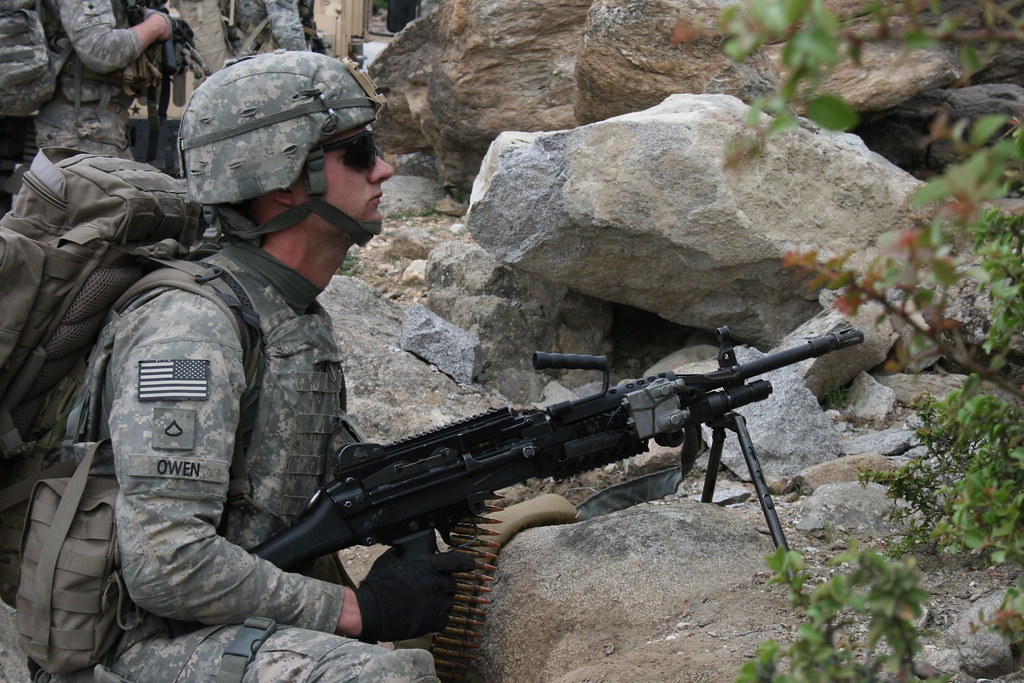
“Afghanistan 2010 43” by david_axe is licensed under CC BY-NC 2.0

Sober Sailors – Rum Rations In The Navy: Grog

Filed under: Britain, Food, Health, History, Military, USA — Tags: , , — Nicholas @ 02:00

Townsends
Published 24 Feb 2020

Visit Our Website! ➧ http://www.townsends.us/ ➧➧

Help support the channel with Patreon ➧ https://www.patreon.com/townsend ➧➧

Instagram ➧ townsends_official

QotD: The special moral insight of children

Filed under: Liberty, Politics, Quotations, USA — Tags: , , , , — Nicholas @ 01:00

The idea that children, in their innocence, have special moral insight goes back a long way in Western culture — perhaps to the biblical injunction that, “Except ye be converted, and become as little children, ye shall not enter into the kingdom of heaven.” It has, of course, always warred with some variant of the belief that “children should be seen and not heard” — that children are not yet ready to hold up their end in adult conversations.

So when does the special moral insight of children manifest itself? When they are telling us that algebra is a stupid waste of time and the drinking age should be 14? No, funnily enough, children are only gifted with these special powers when they agree with the adults around them. Our long-standing cultural dichotomy lets adults use them strategically in political arguments, to push them forward as precious angels speaking words of prophecy to make a point, and then say, “hush, they’re just kids” when the children mar that point by acting like, well, children.

Adult organizations helped organize the walkouts, while casting them as a pure expression of youthful insight. Liberal communities proudly enabled the walkouts; liberal parents posted gushing accounts of their children’s protests on Facebook; liberal elite universities rushed to assure kids that walking out wouldn’t hurt them on college applications. Conservative communities, meanwhile, threatened to enforce the rules against disrupting class time. So the protests often ended up a better reflection of adult priorities than childish wisdom.

[…]

That is not to say that gun-control advocacy is stupid. But if you wouldn’t be swayed by a 17-year-old’s passionate advocacy for a lower drinking age — or for that matter, their ideas about Federal Reserve policy — then you should probably apply those same cautions to their other views, especially when they’re under so much pressure to conform. There’s nothing particularly wrong with Wednesday’s mass walkouts. But there’s nothing especially right about them either.

Megan McArdle, “The student walkout said more about adults than kids”, Washington Post, 2018-03-15.

July 5, 2020

With Christianity on its last legs, westerners seem to be looking for secular replacement beliefs

In Reason, John McWhorter discusses the pseudo-religious trappings of modern day Social Justice devotions:

Over the past several years, a social justice philosophy has arisen that is less a political program than a religion in all but name. Where Christianity calls for people to display their moral worth through faith in Jesus, modern Third-Wave Antiracism (henceforth TWA) calls for people to display their moral worth through opposition to racism. In the wake of the murder of George Floyd, this vision has increasingly been expressed through procedures, routines, and phraseology directly patterned on Abrahamic religion.

America certainly has work to do on race. For one, while racism does not explain why cops kill more black than white people — poverty makes all people more likely to be killed by the cops, hundreds of poor whites are killed annually, but more black people are poor — they harass and abuse black people more than white people, and the real-life impact of this is in its way just as pernicious as the disparity in killings would be. If the tension between black people and the cops were resolved, America’s race problem would quickly begin dissolving faster than it ever has. But making this happen will require work, as will ending the war on drugs, improving educational opportunities for all disadvantaged black children, and other efforts such as steering more black teenagers to vocational programs training them for solid careers without four years of college.

These are real things, upon which we must behold scenes like in Bethesda, where protesters kneeled on the pavement in droves, chanting allegiance with upraised hands to a series of anti-white privilege tenets incanted by what a naïve anthropologist would recognize as a flock’s pastor. On a similar occasion, white protesters bowed down in front of black people standing in attendance. In Cary, North Carolina, whites washed black protesters’ feet as a symbol of subservience and sympathy. Elsewhere, when a group of white activists painted whip scars upon themselves in sympathy with black America’s past, many black protesters found it a bit much.

Such rituals of subservience and self-mortification parallel devout Christianity in an especially graphic way, but other episodes tell the same story. Many conventional religious institutions are now rejecting actual Christianity where it conflicts with TWA teachings. At the Massachusetts Institute of Technology, a chaplain was forced to resign after writing a note exploring the contradiction between roasting the police as racist and the Christian call for love of all souls. Unitarianism has been all but taken over in many places by modern antiracist theology, forcing the resignation of various ministers and other figures.

The new faith also manifests itself in objections to what its adherents process as dissent. A friend wrote on Facebook that they agreed with Black Lives Matter, only to have another person — a white one, for the record — post this reply: “Wait a minute! You ‘agree’ with them? That implies you get to disagree with them! That’s like saying you ‘agree’ with the law of gravity! You as a white person don’t get to ‘agree’ OR ‘disagree’ when black people assert something! Saying you ‘agree’ with them is every bit as arrogant as disputing them! This isn’t an intellectual exercise! This is their lives on the line!”

This objection seems studiously hostile until we compare it to how a devout Christian might feel about someone opining that he “agrees” with Jesus’ teachings, as if the custom were to think one’s way through the liturgy in logical fashion and decide what parts of it makes sense, rather than to suspend logic and have faith.

The religious analogies pile higher by the week.

July 4, 2020

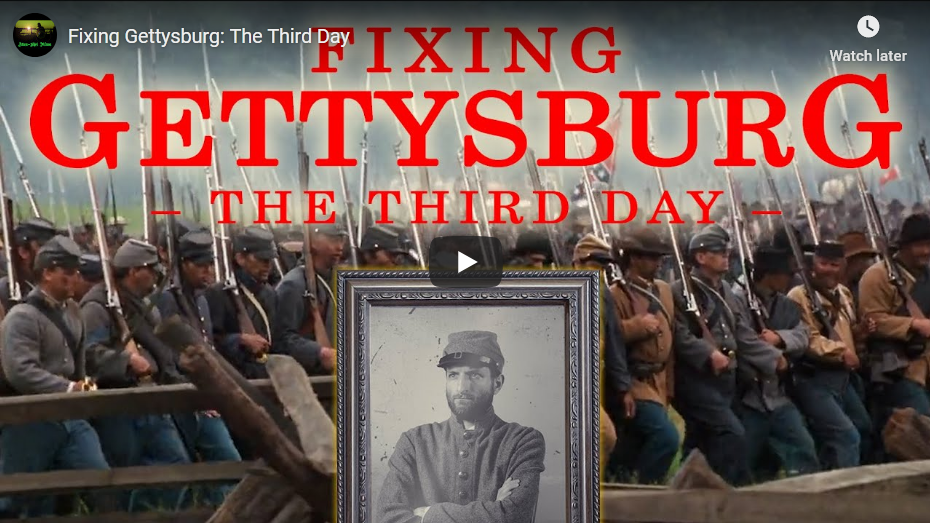
Fixing Gettysburg: The Third Day

Filed under: Books, History, Humour, Media, Military, USA — Tags: , , , — Nicholas @ 06:00

Atun-Shei Films
Published 3 Jul 2020

In this three-part series, I review a classic Ron Maxwell film about a little known historical event that no one talks about called the Battle of Gettysburg. I also present an abbreviated and oversimplified history of the battle, while simultaneously criticizing the movie for presenting an abbreviated and oversimplified history of the battle.

In the third episode, I discuss the third day of fighting on July 3, 1863 – including the morning scrap on Culp’s Hill, East Cavalry Field, and Pickett’s Charge.

Support Atun-Shei Films on Patreon ► https://www.patreon.com/atunsheifilms

Leave a Tip via Paypal ► https://www.paypal.me/atunsheifilms (Between now and October, all donations made here will go toward the production of The Sudbury Devil, our historical feature film)

#Gettysburg #CivilWar #VideoEssay

Watch our film ALIEN, BABY! free with Prime ► http://a.co/d/3QjqOWv
Reddit ► https://www.reddit.com/r/atunsheifilms
Twitter ► https://twitter.com/atun_shei
Instagram ► https://www.instagram.com/atunsheifilms
Merch ► https://atun-sheifilms.bandcamp.com

~REFERENCES~

[1] Frederick Tilberg, Scott Hartwig, John Heiser: Gettysburg National Military Park Handbook (2013). Historic Map and Print Company, Page 49

[2] James Longstreet: From Manassas to Appomattox, Da Capo Edition (1992). Da Capo Press, Page 392

[3] “Haskell’s Account of the Battle of Gettysburg”. Bartleby: Great Books Online https://www.bartleby.com/43/3504.html

[4] “East Cavalry Battlefield – Ranger John Nicholas” (2014). GettysburgNPS https://youtu.be/AfwBOOFFlXQ

July 3, 2020

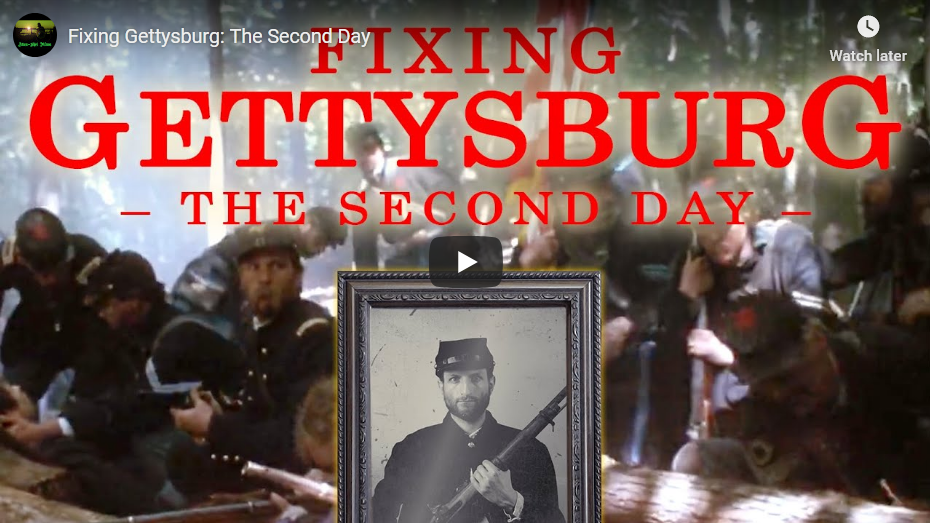
Fixing Gettysburg: The Second Day

Filed under: Books, History, Humour, Media, Military, USA — Tags: , , , — Nicholas @ 06:00

Atun-Shei Films
Published 2 Jul 2020

In this three-part series, I review a classic Ron Maxwell film about a little known historical event that no one talks about called the Battle of Gettysburg. I also present an abbreviated and oversimplified history of the battle, while simultaneously criticizing the movie for presenting an abbreviated and oversimplified history of the battle.

In the second episode, I discuss the first day of fighting on July 2, 1863 – including Dan Sickles’ shenanigans on the left, the 20th Maine on Little Round Top, the 1st Minnesota, and the night battle on Culp’s Hill.

Support Atun-Shei Films on Patreon ► https://www.patreon.com/atunsheifilms

Leave a Tip via Paypal ► https://www.paypal.me/atunsheifilms (Between now and October, all donations made here will go toward the production of The Sudbury Devil, our historical feature film)

#Gettysburg #CivilWar #VideoEssay

Watch our film ALIEN, BABY! free with Prime ► http://a.co/d/3QjqOWv
Reddit ► https://www.reddit.com/r/atunsheifilms
Twitter ► https://twitter.com/atun_shei
Instagram ► https://www.instagram.com/atunsheifilms
Merch ► https://atun-sheifilms.bandcamp.com

~REFERENCES~

[1] Stephen W. Sears: “General Longstreet and the Lost Cause” (2005). American Heritage Magazine https://www.americanheritage.com/gene…

[2] W.C. Storrick: The Battle of Gettysburg (1931). J Horace McFarland Company, Page 26

[3] Frederick Tilberg, Scott Hartwig, John Heiser: Gettysburg National Military Park Handbook (2013). Historic Map and Print Company, Page 31-32

[4] Storrick, Page 27

[5] William B. Styple: Generals in Bronze (2005). Belle Grove Publishing Company, Page 222

[6] “The 1st Minnesota Infantry at Gettysburg” (2014). Iron Brigader https://ironbrigader.com/2014/01/03/1…

[7] Storrick, Page 29-30

[8] Tilberg, Hartwig, Heiser, Page 45

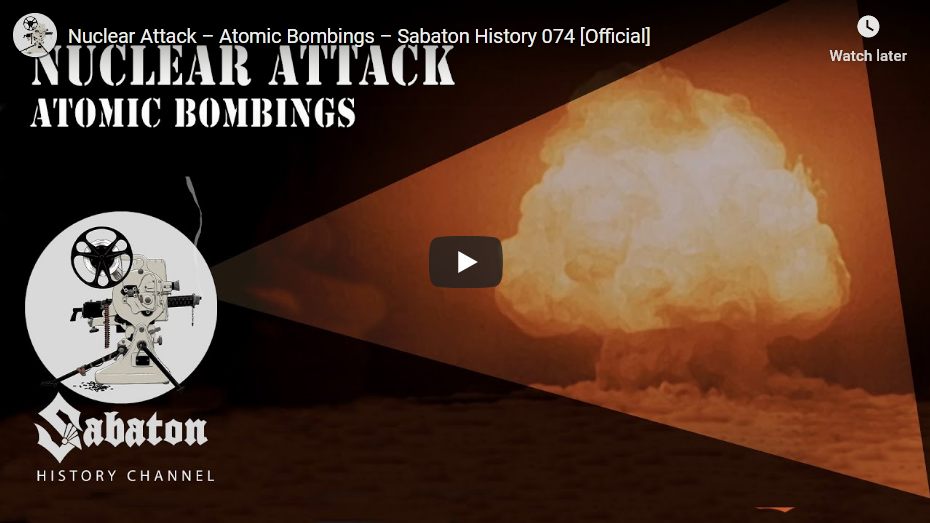
“Nuclear Attack” – Atomic Bombings – Sabaton History 074 [Official]

Sabaton History
Published 2 Jul 2020

At 0815 on 6 August 1945, the first atomic bomb, nicknamed “Little Boy”, was dropped out of the B-29 Enola Gay and descended towards the Japanese city of Hiroshima. 43 seconds later, the city was engulfed in a flashing bright light and a shockwave of unimaginable heat and deadly pressure. From the hypocenter of the resulting mushroom-cloud, a blue-green fireball burned and blinded the city and its inhabitants with unprecedented power. 140,000 people were killed in the first few moments. Tens of thousands would die from wounds and radiation. The age of atomic warfare had begun.

Support Sabaton History on Patreon: https://www.patreon.com/sabatonhistory

Listen to “Nuclear Attack” on the album Attero Dominatus
CD: http://bit.ly/AtteroDominatusStore
Spotify: http://bit.ly/AtteroDominatusSpotify
Apple Music: http://bit.ly/AtteroDominatusAppleMusic
iTunes: http://bit.ly/AtteroDominatusiTunes
Amazon: http://bit.ly/AtteroDominatusAmzn
Google Play: http://bit.ly/AtteroDominatusGooglePlay

Listen to Sabaton on Spotify: http://smarturl.it/SabatonSpotify
Official Sabaton Merchandise Shop: http://bit.ly/SabatonOfficialShop

Hosted by: Indy Neidell
Written by: Markus Linke and Indy Neidell
Directed by: Astrid Deinhard and Wieke Kapteijns
Produced by: Pär Sundström, Astrid Deinhard and Spartacus Olsson
Creative Producer: Joram Appel
Community Manager: Maria Kyhle
Executive Producers: Pär Sundström, Joakim Broden, Tomas Sunmo, Indy Neidell, Astrid Deinhard, and Spartacus Olsson
Post-Production Director: Wieke Kapteijns
Edited by: Iryna Dulka
Sound Editing by: Marek Kaminski
Maps by: Eastory – https://www.youtube.com/c/eastory

Archive by: Reuters/Screenocean https://www.screenocean.com
Music by Sabaton.

Colorizations:
– Dememorabilia – https://www.instagram.com/dememorabilia/

Sources:
– U.S. Department of Energy
– Bomb icon by P Thanga Vignesh from the Noun Project
– bockelsound from freesound.org
– Vilna Gaon State Jewish Museum

An OnLion Entertainment GmbH and Raging Beaver Publishing AB co-Production.

© Raging Beaver Publishing AB, 2019 – all rights reserved.

From the comments:

Sabaton History
2 days ago

August 6, 1945. On this fateful Monday morning our world changed forever.

Nuclear weapons were now a reality, destruction on a whole new level a possibility. International power dynamics, foreign politics and conflict handling would never be the same once this new kind of weapon of mass destruction had entered the scene. The threat of potentially world-ending nuclear war, the fear that the men in power would push “the red button”, would hang over people like a dark cloud from this day on. The Nuclear Age had begun.

If you’re interested in how politics developed during The Nuclear Age, you can explore that in the day-by-day coverage of The Cuban Missile Crisis over on TimeGhost History. The first introduction, “USA Starts the Atomic Arms Race”, is already up and you can watch it right here: https://youtu.be/zEXjoBe5ZdI

July 2, 2020

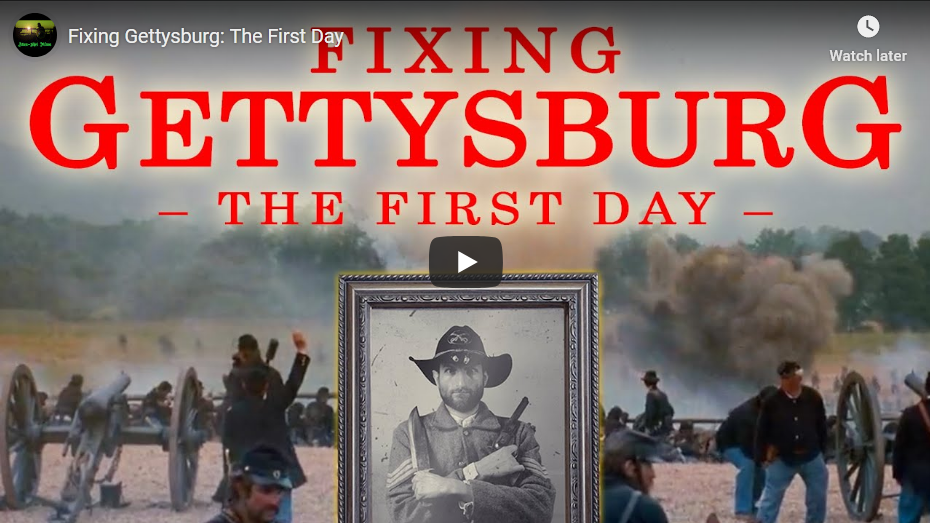
Fixing Gettysburg: The First Day

Filed under: Books, History, Humour, Media, Military, USA — Tags: , , , — Nicholas @ 06:00

Atun-Shei Films
Published 1 Jul 2020

In this three-part series, I review a classic Ron Maxwell film about a little known historical event that no one talks about called the Battle of Gettysburg. I also present an abbreviated and oversimplified history of the battle, while simultaneously criticizing the movie for presenting an abbreviated and oversimplified history of the battle.

In this first episode, I discuss the first day of fighting on July 1, 1863 – including Buford’s cavalry, the Iron Brigade, the Railroad Cut, and John Burns.

Support Atun-Shei Films on Patreon ► https://www.patreon.com/atunsheifilms

Leave a Tip via Paypal ► https://www.paypal.me/atunsheifilms (Between now and October, all donations made here will go toward the production of The Sudbury Devil, our historical feature film)

#Gettysburg #CivilWar #VideoEssay

Watch our film ALIEN, BABY! free with Prime ► http://a.co/d/3QjqOWv
Reddit ► https://www.reddit.com/r/atunsheifilms
Twitter ► https://twitter.com/atun_shei
Instagram ► https://www.instagram.com/atunsheifilms
Merch ► https://atun-sheifilms.bandcamp.com

~REFERENCES~

[1] “General John Buford’s Report of his Cavalry’s Action at Gettysburg” (2015). Iron Brigader https://ironbrigader.com/2015/06/22/g…

[2] W.C. Storrick: The Battle of Gettysburg (1931). J Horace McFarland Company, Page 11

[3] “The First Day at Gettysburg: Then and Now.” American Battlefield Trust https://www.battlefields.org/learn/ar…

[4] “Lt. Colonel Rufus Dawes Describes the Fighting of the 6th Wisconsin Infantry at Gettysburg” (2013). Iron Brigader https://ironbrigader.com/2013/06/13/l…

[5] “Civilian John Burns at the Battle of Gettysburg (2018)”. C-Span https://www.c-span.org/video/?447809-…

[5 1/2] Allen C. Redwood: “The Confederate in the Field”. Civil War Home https://www.civilwarhome.com/confeder…

[6] Codie Eash: “The Wounded Wisconsinite Who Witnessed Pickett’s Charge” (2018). National Museum of Civil War Medicine https://www.civilwarmed.org/reed/?fbc…

[7] Cooper Wingert: “The Confederate ‘Slave Hunt’ and the Gettysburg Campaign” (2020). Emerging Civil War https://emergingcivilwar.com/2020/05/…

Kennedy, the Lying Politician | The Cuban Missile Crisis I Prelude 2

TimeGhost History
Published 1 Jul 2020

The Cold War grows gets more and more tense as both the USSR and the US try to get the upper hand through the volume of nuclear weapons and strategic launching sites – including Cuba.

Join us on Patreon: https://www.patreon.com/TimeGhostHistory

Hosted by: Indy Neidell
Written by: Spartacus Olsson
Director: Astrid Deinhard
Producers: Astrid Deinhard and Spartacus Olsson
Executive Producers: Astrid Deinhard, Indy Neidell, Spartacus Olsson, Bodo Rittenauer
Creative Producer: Joram Appel
Post-Production Director: Wieke Kapteijns
Research by: Spartacus Olsson
Edited by: Daniel Weiss
Sound design: Marek Kaminski

Colorizations:
– Carlos Ortega Pereira (BlauColorizations) – https://www.instagram.com/blaucoloriz…
– Daniel Weiss

Sources:
– New Georgia Encyclopedia

Soundtracks from Epidemic Sound:
– “Cold Eyes” – Elliot Holmes
– “Juvenile Delinquent” – Elliot Holmes
– “Nightclub Standoff” – Elliot Holmes
– “Scope” – Got Happy
– “Zoot Suit” – Elliot Holmes
– “Car Chase in Virginia” – White Bones
– “When They Fell” – Wendel Scherer
– “Kissed by Thunder” – Elliot Holmes

Archive by Screenocean/Reuters https://www.screenocean.com.

A TimeGhost chronological documentary produced by OnLion Entertainment GmbH.

Early Automatic Pistol Cartridges – What, When & Why?

Filed under: Europe, History, Military, USA, Weapons — Tags: , , , , — Nicholas @ 02:00

Forgotten Weapons
Published 12 Oct 2016

http://www.patreon.com/ForgottenWeapons

Cool Forgotten Weapons Merch! http://shop.bbtv.com/collections/forg…

In discussion with a friend recently, the topic of early automatic pistol cartridges came up. Specifically, looking at the context of which cartridges were actually available at which times, and how this might provide helpful context for understanding why particular cartridges were adopted (or commercially successful) or were not.

I decided to see if I could put together a useful video on the subject, and this is the result. We will look at the cartridges available prior to 1900, the ones developed or introduced between 1900 and 1904, and then a few followups which appeared between 1905 and 1910.

Some cartridges became popular because of their ballistic characteristics — like the 7.63mm Mauser and the C96 “Broomhandle” — while others became popular because of the handgun much more than the cartridge itself — like the Browning 1900 and the .32ACP / 7.65mm Browning.

July 1, 2020

Parler, pro and con

Filed under: Business, Liberty, Media, Politics, Technology, USA — Tags: , , , — Nicholas @ 05:00

The latest social media challenger to Twitter has been getting a fair bit of attention over the last couple of weeks, as many British and American conservative Twitter users have announced they’ll be relocating to the newer service due to their concerns over Twitter’s progressive bias and very uneven-handed moderation. In The Critic, David Scullion points out that Parler may not be the dream social network for the unwoke:

The avowedly “unbiased” social media site based in Nevada has been around for two years but has rapidly gained traction amongst Trump supporters in the US, Brexit and Conservative supporters in the UK, and pro-monarchists in Saudi Arabia. (Yes really).

The raison d’être is free speech and in its “Declaration of Independence” Parler outlined the injustices, as they see it, of the existing big tech firms:

    They manipulate their platform to hide information. They shadow ban, trick and deceive. They have become enablers, and often leaders, of the vicious cancel-culture mob who goose-step through our online communities and scream down those who dare to disagree.

The document ends by calling on users to “#Twexit to Parler” – i.e. leave Twitter and join them.

But will they succeed?

[…]

It seems like Parler’s popularity is a symptom of censorship in big tech, but building a rival “free speech” network has its own problems.

For a start, Parler will throw you to the wolves if they get sued over your posts.

Parler requires users to “agree to defend and indemnify Parler, as well as any of its officers, directors, employees, and agents, from and against any and all claims, actions, damages, obligations, losses, liabilities, costs or debt, and expenses (including but not limited to all attorneys fees) arising from or relating to your access to and use of the Services.”

And in order to use Parler, individuals must also forfeit their right to sue it in court or join a class-action claim. Instead they must settle disputes in arbitration.

It’s also worth pointing out that Twitter once branded itself as “the free speech wing of the free speech party” and said it took a “neutral” view of tweets posted by users because of the company’s founding principles. Those principles are now gone, gradually removed in response to a need to protect their bottom line.

June 29, 2020

Today on NeoNaziHuntingExpeditions, we track down Neo Nazi Bronies

Filed under: Media, Politics, USA — Tags: , , , , , , , — Nicholas @ 05:00

In Quillette, Daniel Friedman examines the claims made in a recent Atlantic investigation into Nazis in the My Little Pony community (that is, adult fans of the show, not little girls … I think):

Image found by searching for “Neo Nazi Bronies”, listed URL – http://www.democraticunderground.com/1014960111

The evidence of this Nazi problem in the My Little Pony fandom is that, on a My Little Pony imageboard called Derpibooru, over 900 images were tagged as “racist,” and images mocking Black Lives Matter were upvoted by users while images supporting the movement were downvoted, even as the site’s administrators made a statement of support for the protests. After much controversy, the imageboard banned uploading images “created for no reason other than to incite controversy” and removed the 926 images tagged “racism” or “racist.” This move was extremely controversial within the Derpibooru community, many members of which oppose any moderation.

Atlantic reporter Kaitlyn Tiffany suggests that the strong free-speech norms of the Derpibooru boards stem from its origins on 4Chan, which Tiffany describes as “the largest den of chaos and toxic beliefs available on the Internet.” She describes the Brony community as being divided between those who “genuinely enjoy My Little Pony and the wholesome escapism it provides” and trolls who think it is “edgy and provocative to be an adult obsessed with cartoon ponies.” This frames the Derpibooru imageboard as a place where innocent cartoon fans are unknowingly subjected to subversive, racist memes and images that may send people down a rabbit hole of far-right content.

However, claims that a significant portion of the Brony community are Nazis, or that a significant amount of the content on Brony imageboards is right-wing propaganda or racist memes has to be put in the proper context. First of all, the 926 images tagged “racist” exist on a board that hosts over two million images. If you order all the site’s various tags by how many images fall within their categories, there are 12 full pages of other, more popular tags you have to scroll through to find the “racism” tag. One thousand two hundred and seventy-five images are tagged “politics” and include images both supporting and opposing Black Lives Matter. Discussion of these issues is a tiny fraction of one percent of the content on the My Little Pony imageboard.

By contrast, 315,867 images on the Derpibooru forum are tagged as sexually explicit, a further 127,414 images are tagged as sexually suggestive and 105,521 images are tagged as containing “questionable” sexual content. The truth is that Derpibooru’s lax moderation norms and anti-censorship culture don’t exist to protect objectionable political content; this imageboard is unmoderated because it is an enormous repository of fan-made My Little Pony pornography.

The Atlantic article fails to place the 926 racist images in the context of the larger scope of the two million images hosted by the Derpibooru board, because less than one-quarter of one percent of the site’s content is of a political nature. And the Atlantic article avoids mentioning the half-million pornographic images the site hosts, because doing so reveals that the community’s widespread opposition to content moderation on their imageboard is about protecting sexually explicit content rather than creating a space for hateful politics to flourish, and it further reveals that the Bronies are 500 times more interested in having sex with My Little Pony characters than they are in spreading racist pony memes.

The article creates an impression that the alt-Right is using seemingly-innocent cartoon fandoms as a Trojan horse to conceal and spread a sinister ideology, but the truth is that the only thing these guys are interested in hiding inside a horse is their dicks.

June 27, 2020

Andrew Sullivan on revolution in the current year

Filed under: History, Politics, USA — Tags: , , , , , , — Nicholas @ 05:00

The people involved in the protests — some of them would-be revolutionaries — may not know about prior revolutionary movements, and if they succeed then they’ll ensure that nobody will be able to remember what life was like before their longed-for Year Zero moment:

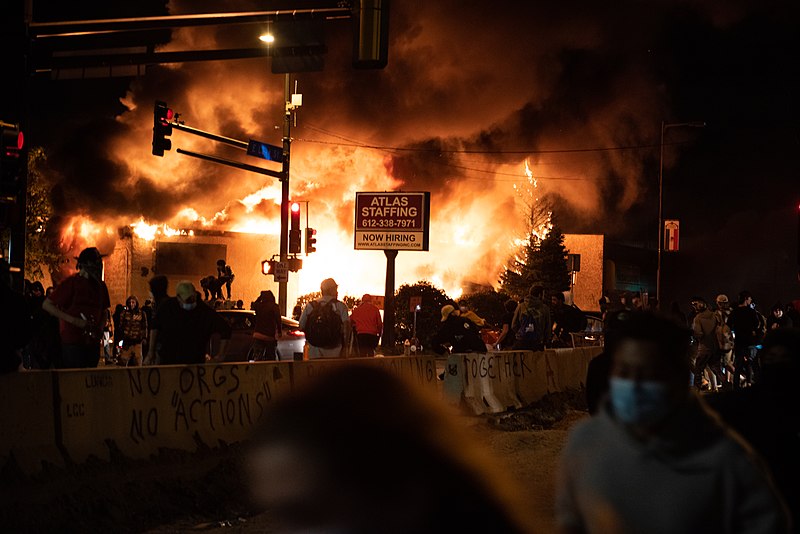
A building burning in Minneapolis following the death of George Floyd.
Photo by Hungryogrephotos via Wikipedia.

Revolutions also encourage individuals to take matters in their own hands. The distinguished liberal philosopher Michael Walzer recently noted how mutual social policing has a long and not-so-lovely history — particularly in post–Reformation Europe, in what he has called “the revolution of the saints.” “The ‘saints’ were very strong on the work of neighborhood committees. In Calvin’s Geneva, law and order were maintained through ‘mutual surveillance.’ Church members (ideally all Genevans were church members) ‘watched, investigated, and chastised’ each other.” Imagine what these Puritans could have done with cell phones and Twitter histories.

Revolutionaries also create new forms of language to dismantle the existing order. Under Mao, “linguistic engineering” was integral to identifying counterrevolutionaries, and so it is today. The use of the term “white supremacy” to mean not the KKK or the antebellum South but American society as a whole in the 21st century has become routine on the left, as if it were now beyond dispute. The word “women,” J.K. Rowling had the temerity to point out, is now being replaced by “people who menstruate.” The word “oppression” now includes not only being herded into Uighur reeducation camps but also feeling awkward as a sophomore in an Ivy League school. The word “racist,” which was widely understood quite recently to be prejudicial treatment of an individual based on the color of their skin, now requires no intent to be racist in the former sense, just acquiescence in something called “structural racism,” which can mean any difference in outcomes among racial groupings. Being color-blind is therefore now being racist.

And there is no escaping this. The woke shift their language all the time, so that words that were one day fine are now utterly reprehensible. You can’t keep up — which is the point. (A good resource for understanding this new constantly changing language of ideology is Translations From the Wokish.) The result is an exercise of cultural power through linguistic distortion.

So, yes, this is an Orwellian moment. It’s not a moment of reform but of a revolutionary break, sustained in part by much of the liberal Establishment. Even good and important causes, like exposing and stopping police brutality, can morph very easily from an exercise in overdue reform into a revolutionary spasm. There has been much good done by the demonstrations forcing us all to understand better how our fellow citizens are mistreated by the agents of the state or worn down by the residue of past and present inequality. But the zeal and certainty of its more revolutionary features threaten to undo a great deal of that goodwill.

The movement’s destruction of even abolitionist statues, its vandalism of monuments to even George Washington, its crude demonization of figures like Jefferson, its coerced public confessions, its pitiless wreckage of people’s lives and livelihoods, its crude ideological Manichaeanism, its struggle sessions and mandated anti-racism courses, its purging of cultural institutions of dissidents, its abandonment of objective tests in higher education (replacing them with quotas and a commitment to ideology), and its desire to upend a country’s sustained meaning and practices are deeply reminiscent of some very ugly predecessors.

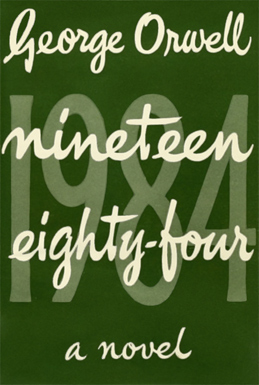
But the erasure of the past means a tyranny of the present. In the words of Orwell, a truly successful ideological revolution means that “every record has been destroyed or falsified, every book rewritten, every picture has been repainted, every statue and street building has been renamed, every date has been altered. And the process is continuing day by day and minute by minute. History has stopped. Nothing exists except an endless present in which the Party is always right.” We are not there yet. But unless we recognize the illiberal malignancy of some of what we face, and stand up to it with courage and candor, we soon will be.

June 26, 2020

The rise of the Karenfinder General

Filed under: Media, Politics, USA — Tags: , , , , — Nicholas @ 05:00

Brendan O’Neill on the recent phenomena of the Karens and the anti-Karens:

The most important thing here is the question of where the Karenfinder Generals derive their power from. It comes from the insatiable appetite among identitarian reactionaries for mis-speakers or wrongthinkers they can ritualistically denounce and destroy. It is this warped social-media appetite for spectacles of shaming, for being part of a virtual mob that takes to task an allegedly evil person, that bolsters and empowers people like Karlos Dillard. It is reported that he has a strange obsession with Karens and he is even selling anti-Karen t-shirts through his Instagram page. This speaks to the extent to which Karen-shaming has become a kind of industry. There are memes, there is branded clothing, and there are of course the videos of exposed and shattered Karens which are watched and shared millions of times. Dillard was able to reduce Leah to a weeping wreck desperately trying to remain anonymous because of this broader, entrenched and increasingly misogynistic culture of seeking out white women to revile and tear down.

One of the great ironies of the witch-hunting of Karens is that the people doing the filming and public shaming are far more Karen-like than the women they humiliate. The Karen prejudice is built on a view of certain middle-class, often middle-aged, white women as uncouth and arrogant and given to complaining. They always want to “speak with the manager”. But no one wants to “speak with the manager” as gleefully as the Karenfinder Generals. Their entire mission is to report on “problematic” people to the managers of acceptable thought, to the bosses of correct-think: the new PC elites. Their thirst for tearing people down for doing or saying something wrong utterly overshadows the instinct to complain that any middle-class white woman might have.

Consider the recent Central Park incident in which a woman called Amy Cooper called the cops on a black man called Christian Cooper (no relation) and claimed that he was harassing her when in truth he was reprimanding her for letting her dog off its leash in a part of the park where you’re not meant to do that. Amy behaved badly in this incident. But as Robert A George argued in the New York Daily News: “[Christian] is the ‘Karen’ in this encounter, deciding to enforce park rules unilaterally and to punish ‘intransigence’ ruthlessly.” Amy Cooper’s life has been shattered by this Karen-shaming incident: she lost her job and her dog.

Or consider the case of Lisa Alexander, the CEO of a San Francisco-based cosmetics company who was recently filmed by a Filipino man after she asked him why he was writing “Black Lives Matter” on the wall outside a private residential property. Alexander may have been wrong to presume that this Filipino man couldn’t possibly live in one of these plush private residences, but she is polite, patient and not remotely racist during their encounter. At one point the man even suggests that she call the police and she looks shocked and says: “I don’t want to call the police.” And yet she was put online, shamed across the world, lost business as a result, and then issued a self-denouncing confession in which she accepts, essentially, that she is a witch. “I did not realise at the time that my actions were racist”, she said. “I am taking a hard look at the meaning behind white privilege and am committed to growing from this experience.”

It all gets more Salem-like by the day. Just as accused witches of old could never deny the accusations against them – denial often carried a greater penalty than confession – so Karens today must immediately confess to the sin of racism if they want any hope of at least partially saving their reputations and their futures. As in earlier outbreaks of witch-hunting, Karen-hunting puts women into a bind. If they deny the charge of racism, that is held up as proof of just how racist they are. If they confess to the charge of racism, that is of course also proof of their foul, evil minds, of their possession by the demon of race-hatred. Lisa Alexander’s confession of wickedness and promise to re-educate herself on the evils of white privilege sums up how religious the identitarian outlook has become. She is in essence on her knees begging for salvation, pleading for redemption, offering to do the intellectual penance of learning the horrible truth about her “white privilege” – that is, her sinful state, her fallen nature.

« Newer PostsOlder Posts »

Powered by WordPress