Quotulatiousness

September 18, 2020

QotD: Heinlein’s “Crazy Years”

It’s become a thing among Heinlein fans, writers and readers alike. We get together for a good talk, and a glass of wine, and one of us will mention something nuts and the others will go “Well, these are the crazy years.”

Things like the girl who had to remove a decoration from her purse before boarding a plane because the decoration was in the shape of a revolver, though about finger sized and evidently cut in half lengthwise. The TSA thought the ban on guns applied to this too. (Of course, she’d flown with it before, so it was just this TSA station, but nonetheless its rulings were absolute.)

Things like the little deaf boy who can’t sign his name because one of the letters looks like a gun.

Things like kids getting in trouble because of a fictional story they wrote. Things like my younger son – it’s a theme, yes. The boy is lightning rod on his mother’s side. More on that later – getting sent to the school psychiatrist because he used the following sentence in an essay “Some people think I’m crazy.”

[…]

There’s half (half?) of our literature and movies, which glorify behaviors that in real life get you killed or make you a bum. There’s the fact that being thrifty, hard working and honoring your contracts makes you “uncool.” There the fact our women are taught to hate all men and men are finally learning to avoid women. There’s …

You say it in groups of Heinlein fans, and people go “Well, these ARE the crazy years.” And you move on.

Sarah Hoyt, “These Are The Crazy Years”, According to Hoyt, 2013-07-17.

September 16, 2020

The Canadian echo chamber on American political issues

Filed under: Cancon, Media, Politics, USA, Weapons — Tags: , , , , , — Nicholas @ 05:00

Ben Woodfinden’s latest for The Dominion looks at the weird effects political passions in the United States have on political stances in Canada:

Restricted and prohibited weapons seized by Toronto police in a 2012 operation. None of the people from whom these weapons were taken was legally allowed to possess them.
Screen capture from a CTV News report.

Participatory media increasingly defines and shapes our discourse. It submerges us in a broader reality but only does so by filtering it into a digital reality that offers a distorted reflection rather than picture of the real world. This has been going on for at least a decade now, but the pandemic has accelerated this transformation of our discourse and politics. By locking us in our homes the pandemic forces us to view the world through a digital lens even more than we already did, and in a world where we’re all viewing everything through our screens that digital reality becomes closer and closer to our primary reality.

One of the specific, and most pernicious effects of this, as I lamented in The Critic is that it turns us all into online Americans participating in their politics through the digital medium, rendering us virtual participants and not just foreign observers. I won’t repeat myself too much, I’d recommend just reading the piece [link], but the online realm is American, and what digital politics does is make politics everywhere more American. We participate in it as a game and a form of entertainment. This bleeds back into our own politics.

Americanized Discourse

Gun politics is one particular political issue where Americanized discourse is most pronounced. It captures perfectly how Americanization plays out. Every time there is some sort of tragic shooting or discussion of gun violence in Canada the debates play out in depressingly predictable ways. Progressives and Liberals paint a picture in which Canada suffers from the kind of rampant gun violence and mass proliferation of firearms as in America. This is the framing used to justify often highly symbolic or ineffective new gun laws and restrictions that, while often not all that effective, make the Liberals and progressives seem like the party for gun control in the face of this rampant violence. But only if you pretend we live in America.

And it’s not just the Liberals and progressives who play this game. Listen to some of the more vocal advocates of “gun rights” in Canada and you’d think we have a second amendment in the Charter. One side wants to make it seem like Canadians are walking around with and easily able to acquire assault weapons, the other side wishes it were so! The reality of course lies somewhere in between. Gun possession is heavily regulated, but lawful citizens can still buy firearms if they want to, and there is no explicit right in the Charter that prevents the government from regulating and restricting firearms. Talking about gun “rights” in Canada is itself quite a foreign and imported concept. At the same time we don’t have an epidemic of gun violence, and while we have experienced some horrific mass shootings, like the recent Nova Scotia tragedy, gun violence in Canada pales in comparison to the United States.

But because both sides are essentially happy to help paint a phantasmic picture of gun violence and/or gun regulations in Canada, we end up with a surreal politics around guns. Sensible debates around guns are made harder by this because debates take place on top of a framing and narrative that draws explicitly on American political culture more than it does Canada’s. Both sides want to take on American roles and are happy to contribute to this framing.

Gun politics is just one example, and there are so many others. Our discourse is so often built around framings that make it seem as if the issues and political cleavages here are indistinguishable from American ones, but it only happens because we import American framing and narratives into our own discourse and then build are arguments around these phantasms. We, like many other countries around the world, are in the middle of a moment of racial reckoning, or whatever you want to call it, because of something that happened in Minneapolis, not in Canada.

Racism is a real thing in Canada, no honest person should deny this, because there is racism in absolutely every country and society. But in the wake of George Floyd’s killing we ended up having a conversation about racism that reflected the particular ways racism works in America.

QotD: Firearms apocrypha

Filed under: Business, History, Quotations, USA, Weapons — Tags: , , — Nicholas @ 01:00

Certain models of Smith & Wesson have bits of apocryphal lore that become permanently entwined with them. You can’t see a top-break .44 Russian without someone telling you that the weird hook on the trigger guard was to parry saber slashes.

People like to repeat the myth that the tiny M-frame .22 “Ladysmith” was discontinued because a puritanical D.B. Wesson heard that it was popular with “ladies of the night”, because that’s sexier than the fact that it was selling poorly, expensive to make, and constantly broke when people ran the then-new .22 Long Rifle cartridges through the fragile little guns.

Similarly, there’s a legend involving Mr. Wesson that’s attached to the final iteration of the .38 Double Action […] In this case, the story goes, D.B. heard the tale of a police officer who, while arresting a miscreant, had the offender reach over and pop the latch on his top-break Smith, dumping the rounds on the ground, like Jet Li with the slide of a movie prop Beretta. The officer, goes the legend as it was told to yours truly, was killed in the ensuing struggle.

Moved by the fate of the dead officer, the apocryphal tale has Mr. Wesson designing the Perfected Model top-break. This model features a Hand-Ejector style cylinder latch that must be operated in conjunction with the more normal “T”-shaped barrel toggle in order to break the revolver open.

This origin myth is almost certainly, to use the technical term, a load of hooey.

Tamara Keel, “Sunday Smith #60: .38 Double Action Perfected Model”, The Arms Room, 2020-06-14.

September 15, 2020

Critical Race Theory

Filed under: Government, Politics, USA — Tags: , , , — Nicholas @ 05:00

Dan Sanchez, Tyler Brandt, and Brad Polumbo discuss President Trump’s recent Executive Memo banning the use of federal government funds for Critical Race Theory training:

Critical Race Theory is a branch of Critical Theory, which began as an academic movement in the 1930s. Critical Theory emphasizes the “critique of society and culture in order to reveal and challenge power structures,” as Wikipedia states. Critical Race Theory does the same, with a focus on racial power structures, especially white supremacy and the oppression of people of color.

The “power structure” prism stems largely from Critical Theory’s own roots in Marxism — Critical Theory was developed by members of the Marxist “Frankfurt School.” Traditional Marxism emphasized economic power structures, especially the supremacy of capital over labor under capitalism. Marxism interpreted most of human history as a zero-sum class war for economic power.

“According to the Marxian view,” wrote the economist Ludwig von Mises, “human society is organized into classes whose interests stand in irreconcilable opposition.”

Mises called this view a “conflict doctrine,” which opposed the “harmony doctrine” of classical liberalism. According to the classical liberals, in a free market economy, capitalists and workers were natural allies, not enemies. Indeed, in a free society all rights-respecting individuals were natural allies.

Classical Race Theory arose as a distinct movement in law schools in the late 1980s. CRT inherited many of its premises and perspectives from its Marxist ancestry.

The pre-CRT Civil Rights Movement had emphasized equal rights and treating people as individuals, as opposed to as members of a racial collective. “I look to a day when people will not be judged by the color of their skin, but by the content of their character,” Martin Luther King famously said.

In contrast, CRT dwells on inequalities of outcome, which it generally attributes to racial power structures. And, as we’ve seen from the government training curricula, modern CRT forthrightly judges white people by the color of their skin, prejudging them as racist by virtue of their race. This race-based “pre-trial guilty verdict” of racism is itself, by definition, racist.

The classical liberal “harmony doctrine” was deeply influential in the movements to abolish all forms of inequality under the law: from feudal serfdom, to race-based slavery, to Jim Crow.

But, with the rise of Critical Race Theory, the cause of racial justice became more influenced by the fixations on conflict, discord, and domination that CRT inherited from Marxism.

Social life was predominantly cast as a zero-sum struggle between collectives: capital vs. labor for Marxism, whites vs. people of color for CRT.

When you mix up cause and effect

In the Continental Telegraph, Esteban remembers a Reagan bon mot that is still observably true today:

US President Ronald Reagan and Soviet General Secretary Mikhail Gorbachev at the Hofdi House in Reykjavik, Iceland during the Reyjavik Summit in 1986.
Official US government photograph via Wikimedia Commons.

Ronald Reagan once observed that “the trouble with our liberal friends isn’t that they are ignorant, it’s that so much they know isn’t so”. I am repeatedly surprised by Leftists’ ability not to just get something wrong, but to get it spectacularly, 180 degrees wrong.

First, a couple of examples from the archives – some years ago there was an article in the NY Times (or WaPo perhaps) quite distressed that even though crime rates in the U.S. were at historically low levels the percentage of the population in prison was quite high. “Why are we putting so many people in prison when the crime rate is low?” they wondered, seriously. Hmm, how about this – when we put more bad people in prison the crime rate goes down? Keep in mind that the crime rate is what’s happening now, the prison population is who we caught and locked up over the past several years.

Then we had an article in a West Coast newspaper wondering why the homeless population in San Francisco had grown dramatically in recent years despite all the wonderful things the city had done to help them – weekly stipends, free shopping carts, etc. Note that none of this assistance to the homeless enabled them to become independent or required them to better themselves, they were all handouts. How is it that offering lots of goodies to homeless people attracts more of them here?

My point in bringing up these old stories is that it seems impossible that someone could fail to see they had cause and effect reversed. How could someone intelligent enough to write a column get these stories so backwards. The only answer I can see is that their worldview, at least in these areas, flows in only one direction and the underlying premise can never be questioned – putting people in prison is bad, there can be no possible upside, giving homeless people stuff is good, there can be no downside. So, when things get worse it’s a mystery, we can’t reconsider our starting point.

QotD: Racism and the minimum wage

Filed under: Africa, Economics, History, Quotations, USA — Tags: , , , — Nicholas @ 01:00

During South Africa’s apartheid era, racist unions, which would never accept a black member, were the major supporters of minimum wages for blacks. In 1925, the South African Economic and Wage Commission said, “The method would be to fix a minimum rate for an occupation or craft so high that no Native would be likely to be employed.” Gert Beetge, secretary of the racist Building Workers’ Union, complained, “There is no job reservation left in the building industry, and in the circumstances, I support the rate for the job (minimum wage) as the second-best way of protecting our white artisans.” “Equal pay for equal work” became the rallying slogan of the South African white labor movement. These laborers knew that if employers were forced to pay black workers the same wages as white workers, there’d be reduced incentive to hire blacks.

South Africans were not alone in their minimum wage conspiracy against blacks. After a bitter 1909 strike by the Brotherhood of Locomotive Firemen and Enginemen in the U.S., an arbitration board decreed that blacks and whites were to be paid equal wages. Union members expressed their delight, saying, “If this course of action is followed by the company and the incentive for employing the Negro thus removed, the strike will not have been in vain.”

Our nation’s first minimum wage law, the Davis-Bacon Act of 1931, had racist motivation. During its legislative debate, its congressional supporters made such statements as, “That contractor has cheap colored labor that he transports, and he puts them in cabins, and it is labor of that sort that is in competition with white labor throughout the country.” During hearings, American Federation of Labor President William Green complained, “Colored labor is being sought to demoralize wage rates.”

Walter E. Williams, “Minimum Wage and Discrimination”, Creators Syndicate, 2017-02-08.

September 14, 2020

That Time the Ladies of New Orleans Peed on Union Soldiers

Filed under: History, Humour, Military, USA — Tags: , , , — Nicholas @ 02:00

Atun-Shei Films
Published 24 Sep 2019

In 1862, shortly after the capture of New Orleans by Union forces during the Civil War, General Benjamin “the Beast” Butler issued the infamous “woman order” because the wealthy ladies of the city wouldn’t stop dumping pee on his men.

Support Atun-Shei Films on Patreon ► https://www.patreon.com/atunsheifilms

#NewOrleans #CivilWar #BenjaminButler #AmericanHistory

Watch our film ALIEN, BABY! free with Prime ► http://a.co/d/3QjqOWv
Reddit ► https://www.reddit.com/r/atunsheifilms
Twitter ► https://twitter.com/alienbabymovie
Instagram ► https://www.instagram.com/atunsheifilms
Merch ► https://atun-sheifilms.bandcamp.com

September 12, 2020

Andrew Sullivan on a “genetic case for communism”

Filed under: Books, Education, Politics, Science, USA — Tags: , , , , , — Nicholas @ 03:00

Actually, this isn’t the case Sullivan himself is making, but he’s summarizing a recent book by Fredrik deBoer, The Cult of Smart: How our broken education system perpetuates social injustice:

There aren’t many books out there these days by revolutionary communists who are into the genetics of intelligence. But then there aren’t many writers like Freddie DeBoer. He’s an insistently quirky thinker who has managed to resist the snark, cynicism and moral preening of so many others in his generation — and write from his often-broken heart. And the core of his new book, The Cult of Smart, is a moral case for those with less natural intelligence than others — the ultimate losers in our democratic meritocracy, a system both the mainstream right and left have defended for decades now, and that, DeBoer argues, gives short shrift to far too many.

This isn’t a merely abstract question for him. He has grappled with it directly. As a school teacher he encountered the simple, unavoidable fact that some humans are more academically gifted than others, and there’s nothing much anyone can do about it. He recalls his effort to teach long division to a boy who had managed to come a long way socially (he’d gone from being a hell-raiser to a good student) but who still struggled with something as elemental as long division: “At one point he broke into tears, as he had several times before … I exhaled slowly and felt myself give up, though of course I would never tell him so. I tried to console him, once again, and he said, ‘I just can’t do it.’ And it struck me, with unusual force, that he was right.”

What DeBoer tries to do is explain how our current culture and political system is geared to torment, distress and punish this kid for no fault of his own. “This is the cult of smart,” DeBoer proclaims. “It is the notion that academic value is the only value, and intelligence the only true measure of human worth. It is pernicious, it is cruel, and it must change.” It has become un-American — or perhaps it always was? — to say that an individual has natural limits, that, even with extremely hard work, he won’t always be able to realize his dreams. And this is not because of anything he has done or failed to do — but simply because of his draw in the genetic lottery of life. The very American cult of education is supposed to end this injustice — except that it doesn’t, because it can’t, and its brutal logic actually exposes and entrenches the least defensible inequality of all, the inequality of nature.

This genetic reality — in fact, the very idea of nature existing at all — is currently a taboo topic on the left. In the most ludicrously untrue and yet suffocatingly omnipresent orthodoxy of our time, critical theory leftists insist that everything on earth is entirely socially constructed, that all inequality is a function of “oppressive systems”, and that human nature itself is what John Locke called a “white paper, void of all characters” — the famous blank slate. Freddie begs to differ: “Human behavioral traits, such as IQ, are profoundly shaped by genetic parentage, and this genetic influence plays a larger role in determining human outcomes than the family and home environment.”

People are not just born unequally and unfairly into class, and culture, and place, they are inherently unequal in various ways in their very nature: “not everyone has the same ability to do calculus; not everyone has the same grasp of grammar and mechanics … we can continue to beat our heads against the wall, trying to force an equality that just won’t come. Or we can face facts and start to grapple with a world where everyone simply can’t be made equal.” And this is not a counsel of despair. What Freddie is arguing is that, far from treating genetic inequality as a taboo, the left should actually lean into it to argue for a more radical re-ordering of society. They shouldn’t ignore genetics, or treat it as unmentionable, or go into paroxysms of fear and alarm over “eugenics” whenever the subject comes up. They should accept that inequality is natural, and construct a politics radical enough to counter it.

[…]

This genetic case for communism can leave a reader a little disoriented, I have to say, if only for its novelty. But it is more coherent, it seems to me, than a leftism that assumes that genes are irrelevant to humans and society, that the ultimate goal is to be as smart and thereby wealthy as possible, and that we can set up an educational system where everyone, regardless of their genetic inheritance, can succeed or fail by their own efforts. What sounds like a meritocratic dream is, in practice, a brutal and unforgiving formula for most who can’t achieve it — and has obviously failed if its task is to foster equality. In fact, mass education appears to have increased the gulf between rich and poor. As Freddie notes, “education is not a weapon against inequality; it is an engine of inequality.”

September 11, 2020

QotD: “Karen” and other stereotypes

Filed under: Humour, Media, Quotations, USA — Tags: , , — Nicholas @ 01:00

When I first saw the name “Karen,” used in the plural, apparently for a whole class of women, I did not look it up. Context told me that I wouldn’t have to; that a Karen was simply the updated term for what I formerly knew as a Becky. There are related, more focused terms, such as “Trixie” for a Karen from upscale white Chicago, and so forth. It is one of many reasons to celebrate the black urban lexical culture from which it emerged. The image of a passive-aggressive blonde, with a pony tail, disputing her order at Starbucks, comes quickly to mind. She will be married to a “Chad” whom she met in law school.

I love stereotypes. They help us understand what the Greeks called syndromes, carrying them beyond the narrow world of medical jargon. “Karen” began as the stereotype for the woman who “wants to see the manager,” but was soon extended through a gallery of related traits. One thinks affectionately through a shortlist of the Karens one has known. For the Christian, it can impact one’s prayer life. (I found myself once praying for a certain Karen Surname, then spontaneously extending it to “Karens everywhere,” with a memorial for the Beckies. I noticed as I searched my memory that many of these Karens were biologically male.)

And today I wonder, as I have often done, at the genius of colloquial language, and the unerring way with which it uncovers fresh stereotypes, that enhance our perception of reality, in a way like painting and the other fine arts. (In a lost portrait, Leonardo depicted a Karen of the Renaissance.)

David Warren, “Karens & their kind”, Essays in Idleness, 2020-06-10.

September 10, 2020

QotD: The power and wisdom of the voters

Filed under: Politics, Quotations, USA — Tags: , — Nicholas @ 01:00

According to American theory, all power is in the hands of the plain people, and according to American legend they always exercise it wisely. The theory, of course, is almost as absurd as the legend. The plain people, in fact, can only exert their power through agents, and in the election of those agents they seldom face a clear choice between a good candidate and a bad one, or a wise idea and a foolish one. In the normal case both candidates are frauds and both ideas are idiotic.

H.L. Mencken, Minority Report, 1956.

September 9, 2020

Today’s intelligentsia: helpless captives of their uber-woke disciples

Filed under: Education, Media, Politics, USA — Tags: , , , , — Nicholas @ 05:00

Theodore Dalrymple on the temptations of power:

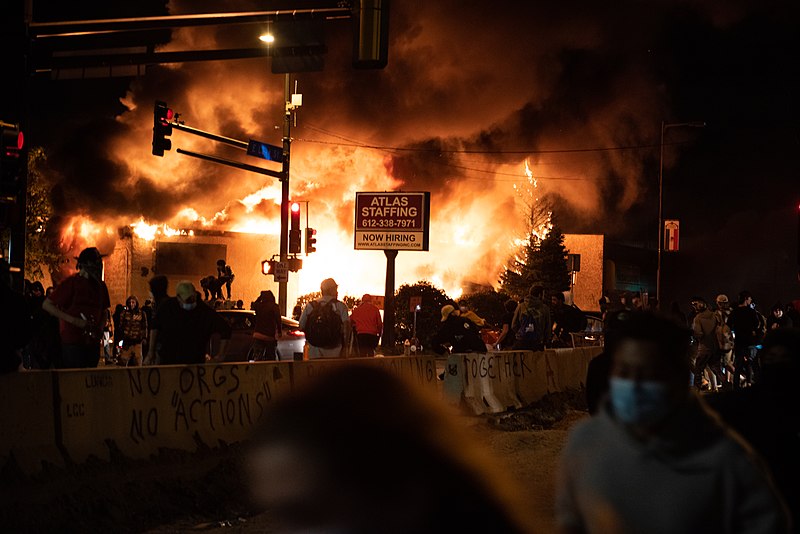
A building burning in Minneapolis following the death of George Floyd.
Photo by Hungryogrephotos via Wikipedia.

One must not exaggerate, of course. We do not yet live under a Soviet-type tyranny in which every university thesis, on no matter how arcane a subject, was obliged by hook or by crook to quote Lenin. It is still possible, though not at all easy, to live as a scholar in our societies outside the university system. But it does not require the tyranny of the complete police state to obtain a high degree of intellectual conformity, as we can now observe at our leisure. Young university academics of my acquaintance in several countries tell me that they are now afraid to speak their mind, not because they would fear for their lives, but fear for their promotion. This is not the same, or as terrible, as fearing for their lives, but it is nonetheless very far from the Millian ideal of freedom of thought and speech.

There is much worse. It is not merely that they must keep their mouth shut and not say what they think, bad enough as this must be for those who have chosen the life of the mind; it is that they must positively subscribe to things that they believe to be bad or false. And this is a mark of totalitarianism. They must subscribe to doctrines they believe absurd, for example by describing in job applications their future efforts to promote diversity, so-called. By making the expression of untruth the condition of employment, probity is destroyed in advance. Those who lack it are easier to control.

Increasingly, social movements do not allow any neutrality with regard to the causes that they promote. Non-adherence is no different from enmity and derogation is evil: if you are not part of the solution you are part of the problem. In vain might you argue that your interest is elsewhere, in the taxonomy of grasshoppers, for example, or in the biochemistry of acorns, or in the bibliography of Alexander Pope: there is one subject that trumps all others in importance, and on it only one opinion is permissible. You must pass a test of loyalty.

The latest of these movements is, of course, Black Lives Matter, and its success in cowing so large a part of the intelligentsia is in a way admirable, a model of political organization for the future, though one much to be feared. By claiming that silence is violence, it has made hand-wringing (to avoid its anathema) the mark, and almost the whole, of virtue. It has successfully reversed Martin Luther King’s goal, such that the colour of a man’s skin is once again more important than the content of his character, and it has made respectable that most Stalino-Maoist of notions, that people should be promoted and rewarded according to their social (in this case, racial) origins. And anyone who disagrees is an Enemy of the People, the word People being here used in a severely technical sense, to mean the arbiters of the allocation of rewards.

How have you enjoyed your six-month visit to Neil deGrasse Tyson’s “Rationalia” (rule by experts)?

Filed under: Bureaucracy, Government, Health, Media, Science, USA — Tags: , , , — Nicholas @ 03:00

Tabitha Alloway clearly isn’t a fan of technocratic “experts” running our lives — and who can blame her?

Cropped photo of Neil deGrasse Tyson on stage with Richard Dawkins at Howard University in Washington D.C. on 28 September 2010.
Photo by Bruce F. Press via Wikimedia Commons.

Expert advice has ping-ponged on COVID-19 like a bead in a pinball machine. Even the medical literature itself has been rife with contradictions and retractions. Lawmakers have tripped over themselves trying to outdo one another in creating the most laws and regulations during the lockdowns in response to the nebulous (and ever-changing) “science” of the coronavirus.

Meanwhile, suicides, domestic violence, hunger and starvation, and economic difficulty have been on the rise. The Nobel Prize-winning Michael Levitt has said, “There is no doubt in my mind that when we come to look back on this, the damage done by lockdown will exceed any saving of lives by a huge factor.” Stacey Lennox, writing for PJ Media said, “COVID-19 may go down as history’s most devastating example of expert arrogance and media malfeasance.”

[…]

A few years ago Neil deGrasse Tyson made waves with his “Rationalia” government proposal: Create a world in which all policies are based on “weight of evidence.” Let science rule us.

This utopian proposal was quickly criticized by a number of voices. Popular Science charged that such a misguided idea would lead to “vast human suffering,” and pointed out some obvious problems:

    “Scientists study what they want, and they study what they can get paid to study, so the work of science is not free from the pressures of money, nor interaction with the business world … In a hypothetical world where a single person (let’s call him ‘Neil’) decided policy based on precisely measuring the weight of evidence, how that person selected evidence would matter a great deal, and would likely come down to values.”

But of course.

The idea that science could be wholly objectively applied, free from the biases, personal values, and limited understanding of the expert legislating (or proposing) it is a childish fantasy. While Tyson dreams of an unerring scientific principle formulated as a rule for society, his Rationalia proposal makes no room for human error, passion, and prejudice. Our application of science is necessarily limited by our ever-changing understanding of it. And while science can tell us what happens when X meets Y, it cannot tell us if it is moral and good for X to meet Y.

We have more than a little evidence from history that science (or what was accepted at the time as science) has most certainly caused “vast human suffering” when wielded by unscrupulous men and fascist dictators. From the murder of Aboriginal Australians to the forced sterilizations in America, eugenics, genocide, and racism have sprung from (or found their apology in) social Darwinism. As Robert F. Graboyes noted in U.S. News & World Report, “Nazi Deputy Fuhrer Rudolf Hess stated — probably sincerely — that ‘National Socialism is nothing but applied biology.'”

Bumbling do-gooders and their victims are not immune to unintended consequences either, as we have so lately observed.

September 8, 2020

2020 is a cracking year

Filed under: Books, Liberty, Media, Politics, USA — Tags: , , , , , — Nicholas @ 03:00

And by “cracking” I don’t mean the old Victorian expression for “very good”. Sarah Hoyt explains the cracks at the Libertarian Enterprise:

“Covid 19 Masks” by baldeaglebluff is licensed under CC BY-SA 2.0

It’s 2020 and we’re all cracking.

And no, by that I don’t mean that we’re cracking like crazy on our writing. Most of us are having trouble writing. A lot of us are having trouble reading. Though I’ve finally got out of the Pride and Prejudice fanfic jag.

I’ve seen people suddenly lose it and start crying over dirty dishes. Or the fact we ran out of peanut butter.

Okay, that was me. Yesterday. But I’ve been watching signs of just that much fragility in everyone I know.

Part of it is the lockdown. Man — and verily, woman — is a social animal. Not only is it not good for Man — do I need to say “and woman again?” — to be alone, it’s not good for us, when going out to be confronted with “truncated” human faces.

It is instinctive in humans to see human faces in everything. Don’t believe me? Look at a random pattern long enough, and you’ll find faces. Truncated human faces, the mouth gone, are deeply unsettling to the back of our brain. It is wrong, mutilated.

Suicides are through the roof. Mental health issues abound. The young are suffering particularly badly, because on top of all they believe they’re going to die. (The rest of us are already dead from the ice age, acid rain, fossil fuel depletion, alar, global warming, ozone depletion … I’m sure I’m forgetting some things. After so much death, one becomes resilient. Those of us forty and over won’t die. Even if they kill us.)

But the other part of it is that in a contentious political year there’s nowhere to escape.

Remember when you used to have friends that believed exactly the opposite of what you did, and you both knew it, but you were still friends? You couldn’t talk politics, but you could talk knitting, embroidery, kids, gardening, furniture refinishing, science fiction? You could sit down and have a cup of coffee with someone whose political views you considered despicable and not mention politics? Not even once?

But that was before the invasion of those for whom everything is political. Oh, cancel culture already existed. Before social media, I was terrified of saying the wrong word and revealing my real thoughts, and getting blacklisted by publishing houses.

But there were spaces you could draw a breath. Places where you didn’t have to talk and/or think about politics.

September 5, 2020

Kareem Shaheen on the shame of mask-shaming

In The Line, Kareem Shaheen — who is a mask-wearer and was one before they were made mandatory — explains why shaming anti-maskers is a terrible way to encourage compliance, but a great way to virtue-signal:

“Covid 19 Masks” by baldeaglebluff is licensed under CC BY-SA 2.0

The mask shaming mirrors the way social media has warped our culture. The Twitter and ‘gram “in crowd” flaunt its mask use to demonstrate an ostensibly superior grasp of morals and science — and to bully those who don’t follow its cues. Those who perceive themselves to be on the outside of this circle can’t help but cringe at the manipulation and grandstanding behind these seemingly well-intentioned gestures.

Mask resistance, then, becomes a virtue signal of its own.

And, of course, Twitter itself has been a cesspool of counter-productive shame. Back in July, the hashtag #NoMasks trended, which gave the illusion of a groundswell of opposition against mandatory masking laws. But an analysis by First Draft, a nonprofit based in the United Kingdom, examined 8,000 Twitter accounts that used the hashtag. It found that the majority of people who tweeted #NoMasks were actually pro-mask. Their condemnation of the supposed anti-mask contingent actually boosted #NoMasks, bringing more people in contact with related conspiracy theories and arguments against wearing masks.

The moralizing is all the more galling because our own governments were forced to do an embarrassing about-face on their efficacy.

In the early weeks of the pandemic, health agencies in Canada and the United States recommended against wearing masks because there was insufficient evidence that they could prevent the spread of the virus, remember? They said that masks would provide a sense of false security, and suggested that we were all too dumb to know how to wear them properly.

This despite widespread use of masks in Asia, and while there was a growing consensus in hard-hit parts of Europe that they were effective and necessary.

With so much confused messaging, it’s no mystery that so many people are now skeptical about wearing masks. Sure, some of the most ardent mask-haters are also Q-Anon-spouting, anti-vaxxer crystal-healing masks-are-fascism conspiracy theorist kooks. But not all them fit that description.

And the problem with all of this is that if you’re actually trying to convince people to wear masks — as opposed to merely demonstrating your own superior morality via the veil — shame is one of the least effective methods of persuasion.

September 4, 2020

“They have insurance”

Filed under: Business, Economics, Government, Politics, USA — Tags: , , , — Nicholas @ 03:00

Brad Polumbo debunks the notion that it’s somehow “okay” to loot and vandalize businesses “because they have insurance” and that somehow means that nobody suffers.

A building burning in Minneapolis following the death of George Floyd.
Photo by Hungryogrephotos via Wikipedia.

Since the death of George Floyd in late May, violent riots and looting have broken out in many major cities, eventually overshadowing peaceful protests and calls for criminal justice reform. From Portland to Chicago to Kenosha, rioters have smashed windows, lit fires, attacked government properties, assaulted people in the streets, and looted storefronts.

In Minneapolis alone, vandals have destroyed at least 1,500 properties, many of them minority-owned businesses, and caused billions of dollars in property damage. Many people have been injured or killed during the chaos.

[…]

Even if all the affected property was fully insured — and it wasn’t — rioting has taken a vast human toll as well.

Consider that at least 15 people were killed during the initial riots after Floyd’s death, and that more have died in the unrest since. When arson and looting consume the streets, people inevitably get hurt and caught in the crossfire. That’s why the Minneapolis police found a burnt corpse in a pawn shop days after arsonists had passed through.

Insurance might fund that property’s restoration, but it can’t bring a dead man back to life.

[…]

Big companies like Walmart and Target generally have expensive, premium insurance plans. But many of the mom-and-pop enterprises and small businesses targeted in the riots didn’t have expensive insurance plans. In some cases, their more modest plans don’t cover damage from riots or don’t cover it in full.

“Situations where there’s a lot of devastation like this, a lot of times people find they’re underinsured and don’t have enough coverage,” Illinois Insurance Association Hotline President Janet Patrick told CBS Minnesota. “And so once the damage has been done, it’s too late. You can’t buy more coverage.”

According to Insurance Journal, 75 percent of US businesses are under-insured. And according to the New York Times, about 40 percent of small businesses have no insurance at all.

« Newer PostsOlder Posts »

Powered by WordPress