
Pascal-Emmanuel Gobry @pegobry_en
This is obvious, but: Elon breaks libs’ brains because he is the living vindication of the Great Man theory of history. Literally nothing he built would have existed without him, and without him clearly exhibiting superior intelligence and indomitable will.Not so fast.
I’m here to tell you, because I lived it, that the experience of being the “Great Man” who changed history can feel very different from the inside.
I’m not going to try to speak for Elon. Maybe he feels like a colossus out of Thomas Carlyle. I’ll just say that I didn’t feel like that when I was doing my thing, and I’m doubtful that he does more than a small part of the time.
Somebody was going to take the concept of “open source” to the mainstream fairly soon after general access to the Internet started to happen in the mid-1990s. But it didn’t have to be me; you get steam-engines when it’s steam-engine time, and it was time. Dennard scaling and cheap wide-area networking were the underlying drivers. Conditions like that generate ESR-equivalents.
Now it’s time for rockets to Mars. The drivers include extremely cheap and powerful computing, 3-D printing, and advances in both metallurgy and combustion chemistry. Conditions like this generate Elon-equivalents.
It is more than possible to look like the Great Man from the outside but to feel like — to know — that you are almost at the mercy of currents of change much larger than yourself. Yes, you have some ability to shape outcomes. And you can fail, leaving the role to the next person to notice the possibilities.
If Elon is like me, he sometimes plays the autonomous Great Man in order to get the mission done, because he knows that the most effective way to sell ideas is to be a charismatic prophet of them. But if he’s like me, he also feels like the mission created him to make itself happen, and if he fails or breaks the mission will raise up another prophet by and by.
I’m not claiming the Great Man theory is entirely wrong — it takes some exceptional qualities to be an Elon, or even a lesser prophet like me — but it’s incomplete. Great Men don’t entirely create themselves, they are thrust upwards and energized by missions that are ready to happen.
ESR, Twitter, 2024-10-31.
February 24, 2025
QotD: Great Men when it’s time to do x
February 21, 2025
Tech enshittification continues
Ted Gioia notes that even the world’s biggest search engine provider is doing almost everything it can to make your search experiences worse and worse:

Almost everything in the digital world is turning into its opposite.
- Social media platforms now prevent people from having a social life.
- ChatGPT makes you less likely to chat with anybody.
- Relationship apps make it harder for couples to form lasting relationships.
- Health and wellness websites make it almost impossible to find reliable health advice — instead peddling products of dubious efficacy.
- Product review sites now prevent people from reading impartial reviews by actual users of the product, instead operating as pay-for-play vehicles.
- Etc. etc. etc.
You can often tell by the name. PayPal will never pay you a penny, and it’s certainly not your pal. Microsoft Teams only works if you stay away from your team. If you keep using Safari, you will never go on an actual Safari.
But the worst reversal is happening with search engines. They now prevent you from searching.
I’ve known Google up close and personal from the start. I initially found the company quirky and endearing — but those days ended long ago. The company is now clueless and creepy.
Almost every day I read some ugly news story about Google. Here are a few headlines from a typical week:
- “Google ditches promise not to develop AI weapons” (February 12)
- “Millions of Google users alarmed after discovering new AI tool they can’t turn off” (February 14)
- “Google facilitated Russia and China’s censorship requests” (February 15)
- “Google’s new fingerprinting policy sparks privacy backlash as ads become harder to avoid” (February 17)
- “Google data centers used nearly 6 billion gallons of water in 2024” (February 11)
This company goes out of its ways to do mischief. Messing with people is in its DNA.
Meanwhile, its base business is degrading at an alarming rate. The company doesn’t seem to care.
In a strange turnaround, search engines don’t want you to search for anything. That’s because searching leads you on a journey — and Google doesn’t want you to leave their platform.
The search engine was invented as your gateway to the web. The inventors of this technology tried to index every page on the Internet — so that you could find anything and everything.
That was an exciting era. Search engines were like train stations or airports. They took you all over the world.
At Google today, the goal is the exact opposite. You never leave the station.
Techies once described the Internet as a digital highway. But we need a different metaphor nowadays. Web platforms want to trap you on their app, and keep you there forever.
So, instead of a digital highway, we have a digital roach motel. They let the roaches check in — but not check out.
February 12, 2025
Electric vehicles and cold Canadian weather
The Canadian government has been a noisy proponent for Canadians replacing their internal combustion vehicles with electric-powered alternatives, but unlike places like California it gets cold in Canada … very cold indeed at times. The CAA conducted some tests on popular EVs to find out how typical cold conditions impact the range of the cars:
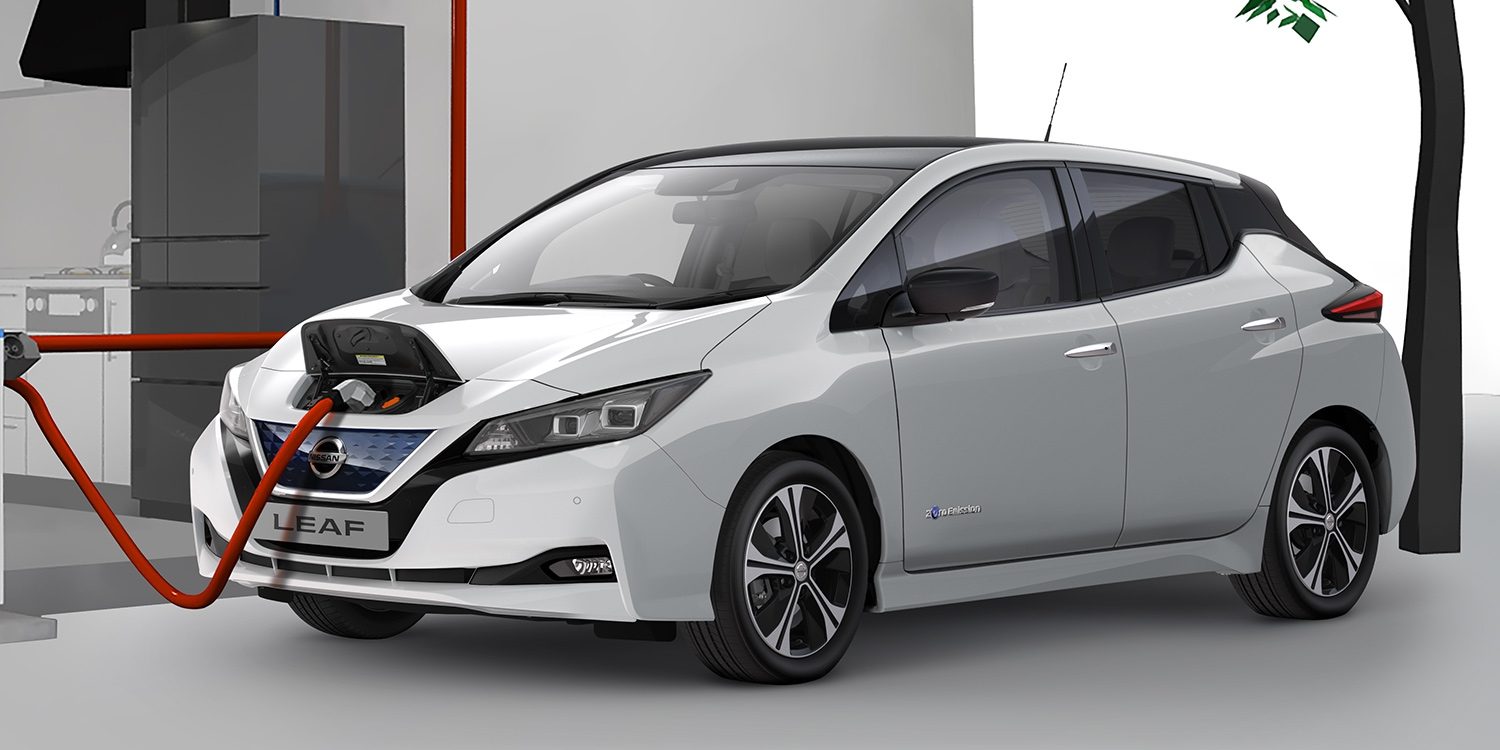
Nissan Leaf electric vehicle charging.
Photo by Nissan UK
CAA is out with the results from their first ever road tests of how electric vehicles (EV) charge and perform in a Canadian winter.
They tested out 14 electric vehicles which included seven of the top 10 sellers in Canada. They were driven from Ottawa to Mont Tremblant and the temperatures during the drive ranged from -7 to -15 degrees Celsius.
Each vehicle was driven until the battery completely died to determine the range in winter conditions. The results were compared to the estimated driving range published by Natural Resources Canada. CAA says officially posted EV ranges (below) in Canada are based on overall, year-round numbers.
“CAA is responding to a top concern of Canadians when it comes to EVs,” said Ian Jack, vice-president, public affairs, CAA National. “We measured the effective range of electric vehicles in cold weather and how quickly they charge. These insights are critical for both current EV owners and those considering making the switch.”
The association says a recent poll revealed more than two-thirds of Canadians say the drop in driving range during winter is the top barrier to purchasing an EV. Out of those who own an EV, 65 per cent said they experienced a lower battery range in extreme cold weather.
The rest results showed the vehicles drove 14 to 39 per cent less than their official range.
“The vast difference in results really highlights the importance in truth and advertising when it comes to EV range and making sure that Canadians are comparing numbers when it comes to winter performance,” said Kristine D’Arbelles, Senior Director of Public Affairs for CAA National.
February 1, 2025
China produced DeepSeek, Britain is mired in deep suck
In the Sean Gabb Newsletter, Sebastian Wang discusses the contrast between China’s recent release of the DeepSeek AI platform that appears to be eating the collective lunches of the existing LLM products by US firms and the devotion of the British Labour government to plunge ever deeper into their Net Zero dystopian vision:

Net Zero image from Jo Nova
For those few readers who may be unaware, DeepSeek is an advanced open-source artificial intelligence platform developed in China. Released in late 2024, it has set a new standard in AI, outperforming American counterparts in adaptability and capability. It excels in natural language processing, machine learning, and data analysis, and — critically — it is open source. Unlike the proprietary models that dominate the American tech landscape, DeepSeek allows anyone to adapt, improve, and use it as he sees fit. It’s not just a technological triumph for China; it’s a serious challenge to American domination of information technology and an opportunity for those who want to break free from the stranglehold of Silicon Valley.
As a Chinese person, I take pride in this achievement. It’s a testament to what my people can achieve with focus and ambition. But my concern is less about taking pride in what China has done and more about lamenting how little Britain has contributed to this revolution. Britain, the birthplace of the Industrial Revolution, seems to have no place in this new world of AI-driven progress. The question is why?
The answer is simple: The people who rule Britain have chosen decline. Crushing taxes on income and capital gains, and inheritance taxes, punish those who want to create wealth. Endless regulations stifle ambition, making it easier to conform than to innovate. Worst of all, there are the net zero policies, which have made energy costs the highest in the world, making electricity unaffordable and unreliable. Industries that depend on energy have been priced out of existence, and the dreamers and doers who might have built the next DeepSeek are being ground down by a system designed to reward mediocrity.
Net zero is not a noble goal born of misconception; it’s a disaster by design. It’s a wealth transfer scheme that takes from ordinary working people and hands billions to a small clique of green profiteers. The winners are the wind farm builders, the financiers running opaque carbon trading schemes, and the activists cashing in on government handouts. The losers are everyone else — families struggling to pay energy bills, businesses forced to close, and an entire country left unable to compete.
Compare this to China. DeepSeek wasn’t luck — it was the product of a system that rewards innovation. Electricity in China is cheap and reliable. Regulations focus on enabling progress, not blocking it. Ambition is celebrated, not treated as a threat. The ruling class there, for all its many and terrible faults, understands the value of creating wealth and technological self-reliance. Britain’s ruling class, by contrast, has abandoned the idea of building anything. They’d rather sit in the City of London, counting money made elsewhere, than see industry and innovation flourish in the country at large. They have chosen decline — not for them, but for us.
January 28, 2025
AI, the iPhone, and other tech whizzery are not the most important inventions ever
Freddie deBoer reacts to so, so many technically illiterate hot takes about this or that latest bit of techno-woo bling being given accolades as “the most important invention”:

Years ago, I think in 2010, Business Insider invested a great deal of hype and hoopla into a list they developed of the one hundred most important inventions of all time. I have tried and tried to find a link, including via the Internet Archive, but no dice; I’ll chalk it up to linkrot, the endless deterioration of the web over time, Business Insider‘s paywall, and their convoluted publishing history. You’ll have to take my word for it that, in a list that was released with great fanfare, they rated the iPhone as the most important invention of all time. Not antibiotics, the plow, or alternating current, not anesthesia or the lightbulb, but the iPhone, which took a bunch of things that already existed (cellular telephone service, email on the go, a touchscreen) and put them in one remarkably profitable package. The Business Insider list isn’t alone in putting the iPhone so high on ranked lists of human achievement. There’s plenty you can find, including a British survey that put the iPhone at number eight, ahead of the internal combustion engine, or this New York Times podcast which puts the iPhone at number three, although the list seems to be partially tongue in cheek. There’s a lot you could ask about such a choice, including epistemological questions inherent to putting a cellphone above the electricity-generating technologies that power it. But my visceral response to this kind of thinking — and even aside from ordinal lists of importance, the smartphone-supremacy attitude is very common — is to say, wow, these people must really enjoy shitting in the yard.
Plumbing — bringing fresh water from one place to another and disposing of human waste via engineering — goes back to antiquity, and you occasionally find claims of affordances like flush toilets in ancient times. Today, modern people in most developed parts of the world have constant access to free-running clean water and toilets that can remove physical waste to a secure processing facility or holding unit, with heated water on demand a very nice extra. That’s largely a 20th-century and forward phenomenon. There were pretty sophisticated sewer systems in Victorian London, the White House got running water in the Jackson administration, and as usual major metropolitan areas in rich countries were ahead of the game generally. But it wasn’t until the 1920s or so that indoor plumbing became a true mass phenomenon, again only in wealthy countries, and it was perfectly common for a soldier coming home from World War II in 1945 to be coming home to a house with a well and an outhouse. It wasn’t until the 1960s that a majority of American homes had indoor plumbing, which means that the beginning of the Space Age overlapped with a period where most Americans couldn’t wash their hands whenever they wanted to. And, as cool as NASA and launching satellites and orbiting the Earth and traveling to the Moon are, their practical impacts on human life pale in comparison to modern plumbing.
So when I read people putting the iPhone as the pinnacle of human ingenuity, I have to imagine that they’re big fans of shitting in their yard. Because if faced with a choice, they’ve indicated that they’d choose their smartphone over their toilet! And that’s quite a choice. It might be worth doing a little reality check in that regard by spending a month without one and then a month without the other. So you see how life feels without your smart phone for 30 days, and then you see what it’s like to not be able to access indoor plumbing for 30 days. You have to piss and shit outside. You have to walk to a well, if you can find one, to get (hopefully clean) water, and then you have to heat it up on your stove if you want it hot. You can’t shower, and taking a bath would be a remarkably laborious process that still left you with tepid water. And this isn’t just a question of comfort but a question of essential hygiene, by which I mean medically-relevant hygine — cholera, typhoid, gastrointestinal worms, scarlet fever, hepatitis, and many more diseases were massively harder to avoid before mass indoor plumbing. I don’t know you, personally, but I feel considerable confidence in suggesting that your desire to avoid those diseases is greater than your attachment to Instagram.
That’s the shitting in the yard test, or the indoor plumbing test, for those who prefer to avoid vulgarity. The test requires you to compare the hype about a particular tech product up against the actual brick-and-mortar changes wrought in the great period of human advancement that began sometime in the late 19th century and ended sometime in the late 20th; the modern flush toilet is just a particularly relevant example. Is Zoom really a bigger part of your life than food refrigeration, a technology that has saved untold millions of lives over the decades by dramatically reducing deaths from foodborne illness? Is cloud storage really a bigger deal than infant vaccines, which save six lives a minute? Does Android Auto really rate when compared to the airbag? You can call these questions obtuse, and some do, but they are natural and necessary things to think about in an era of obsession with artificial intelligence. (By which people mean LLM/neural net-based artificial intelligence, which is a whole other thing.) When you say that AI is the most important invention in human history, you’re making some really, really powerful claims. And yes, you have to then justify saying that AI is more important than, for example, the transistor, self-negating claims that deny the importance of technologies that make large language models possible. But you also have to justify saying that AI is more important than, like, the bowl. By which I mean, bowls. To put food in. To eat out of. Try and spend the rest of your life without ever using another food container and get back to me about whether ChatGPT is more important. Food containers are inventions!
January 18, 2025
Is the World Really Running Out of Sand?
Practical Engineering
Published 1 Oct 2024Sand: a treatise …
There’s a lot changing in the construction industry, and a lot of growth in the need for materials like sand and gravel. But I don’t think it’s fair to say the world is running out of those materials. We’re just more aware of all the costs involved in procuring them, and hopefully taking more account for how they affect our future and the environment.
(more…)
January 15, 2025
QotD: Innovations hiding in plain sight
This sentence, from the Wall Street Journal, strikes me as being profoundly wrong:
Today, another half-century later, a coast-to-coast flight still takes you as long as it took your father in the 1970s. And with the major exception of computers, nothing in your luggage is likely to be much more useful or valuable than dad’s equivalent.
It may well be the case that aeroplanes fly at the same speeds that they did in the 1970s. I don’t know for sure, but my understanding is that supersonic speeds were banned due to noise factors. No doubt someone in the thread will clear that up. Let’s also concede the point about “major exception of computers” – like wow, let’s ignore the single greatest area of human innovation in the past 20 years.
Okay – the material your luggage is made out of is very strong and very light weight compared to luggage in the 1970s. Your luggage will have wheels on it now. Luggage with wheels would have been a luxury item in the 1970s. The entertainment on the flight will be much better than what it was in the 1970s. Remember the single movie in the cabin? That was a feature of flying until the late 1990s. I reckon the food the would be better too, today. Hard to believe, but yes.
Then what about the computers? Paper tickets? Movies on demand on your own device? Books loaded on your own device?
So while it may be true that the experience of flying is very similar – hurry up and wait, fly through the air, and arrive at a destination faster than all alternatives. But many, many aspects of the experience are very different and much improved. Cheaper too.
When thinking of innovation, it’s not just gadgets and new-fangled things that we should think about – it’s improved business models and improvements in pre-existing gadgets that we should think about too.
Sinclair Davidson, “Has innovation stalled?”, Catallaxy Files, 2019-12-14.
January 14, 2025
The deliberate enshittification business plan of every “tech” company
It may be hard to believe, but once upon a time we actually used to look forward to new technology releases and updated software. I know, I know, that’s asking you to believe fairy tales in our current “enshittification-as-a-service” technology dystopia. The Bone Writer — who worked in the same tech field that I once did — clearly understands why the promise of new technology has turned so negative:

Dead technology. Not because they’re broken, but because they’re no longer supported and THEREFORE no longer work.
I was straightening some stuff/junk up and came upon a pile of my e-Waste. It’s a damn shame that electronics devices are a planned obsolesce when they shouldn’t be. Especially the tablets and e-readers that would still work if the mothership, the corpo HQ, the evil Tech Bros, actually cared about their customers at all.
Do we need legislation that offers up some sort of tax write off incentive to get companies to support their shit for at least 10 years? I know what you’re saying … “That’s not a free market economy.” Yeah … well … The tech sector broke the free market economy a long time ago and now they actively hurt everyone with their greed and drive to force people into what comes next, every month to 3 months to 1 year.
That’s another reason prices never come down on tech stuff. They put out something new monthly to yearly, with just a small addition to the software or the design. Then they push it on people as if it is the BEST thing there ever was, creating FOMO. Then, some people will upgrade with every new device or software version sold.
[…]
Agile is the Devil’s Tool for Creating More Waste
Agile is the method that is used to push new software and updates out continuously. Get those updates out there and keep that device or software looking shiny but hold back the good stuff for the next big release. Even though the current iteration can likely support the next big release, we’re not going to do that. This way we can sell more shit to people and they will have FOMO so they will buy it up. Even though, the next big release isn’t all that great anyway… They consumer will eat it up.
Recycle It
The activist techies will just say, “Go ahead and recycle the old stuff.” As if it really gets recycled. More often than not (only 10% of recycled stuff actually gets recycled), it gets buried or sent to other countries to be disassembled and buried there, out of site. Both the tech sector and fashion industry are guilty of this. Meanwhile, YOU are told that if you recycle, you are doing your part to clean up the world, when you’re really just sending stuff elsewhere to pollute a third world country. Sleep easy though, it isn’t in YOUR backyard.
January 5, 2025
“Everything humans build starts with human and social capital. This includes everything economic.”
Lorenzo Warby explains why he has always disagreed with the “standard model” of economic growth, as it fails to include the biggest cultural variables that matter enormously for economic development:

“Hyderabad bazaar” by ruffin_ready is licensed under CC BY 2.0 
 .
.
The seminal theory of economic growth is the Solow Growth Model (technically, the Solow-Swan model). The model can be easily expressed mathematically.
I have never liked the model, nor its later variations.1 The intuition behind my dislike was that societies — and indeed different ethnic groups within societies — obviously varied enormously in their capacity to use, to “put together”, the factors of production. They also vary enormously in their capacity to generate factors of production: specifically capital, the produced means of production. The model implies that there will be a general convergence between economies that has not happened.
Updating the model by including human capital was a gesture in that direction but did not fix the problem with the model, which is much more basic. The update attempted to grapple with the failure of investment to flow to poorer countries and, by implication, the long-term, systematic failures of foreign aid. The failures of foreign [aid] also supported my intuition.
The most recent (2024) Nobel memorial was for work that also directly supports my intuition — how much institutions matter for economic growth. The long-term economic growth literature — identifying culture as very much mattering for economic growth — also supports my intuition.
Skills and knowledge (human capital) are basic
To explain why the entire approach — basically, fiddling with some version of the Cobb-Douglas production function — is fundamentally mistaken, we need to go back to the origins of human economic growth. I mean, right back — all the way to foragers.
What are the original forms of capital? Well, there are tools, which are the original form of physical capital. But without the skills to make and use the tools, they either do not exist, or they are useless.
So, we start with skills and knowledge, with human capital. It takes almost 20 years to train a young human forager to be a subsistence adult — that is, to forage as much nutrition as they consume. The need to stuff the human brain with skills and knowledge — and the need to grow a brain that can be so stuffed — is why we have the most biologically expensive children in the biosphere. The need to impart skills to biologically expensive children is fundamental to the dynamics of all human societies.
Human capital — skills and knowledge — is not an “add on”. It is basic.
So are social connections (social capital)
Foragers do not live as atomistic individuals. They live in families and (fluid) foraging bands. Families and foraging bands are vehicles for our highly cooperative subsistence and reproduction strategies.
That we are the tool-making and tool-using species lacking tearing teeth and claws with the most biologically expensive offspring is why we have highly cooperative subsistence and reproduction strategies. It is also why we are so much the normative species — enabling robust cooperation based on convergent expectations — and why we have prestige and propriety as forms of status.
Both these forms of status represent currencies of cooperation. Prestige grants people status for doing things which are risky, clever, hard, entertaining. It is status by conspicuous competence. It provides a way to reward people for engaging in activities which generate wider social benefits — what economists call positive externalities. It also encourages people to want to associate with you.2
The other form of status — propriety — grants status to those who uphold the norms of the group. In particular, it wields stigma against those deemed to have violated those norms. It provides a way to punish people for engaging in activities which generate wider social costs — what economists call negative externalities. It helps solve the free-rider problem regarding the effort to enforce norms.
Reversing (i.e. perverting) status patterns so that people get prestige from victimhood — extending to various forms of failures of competence or even wildly anti-social behaviour — while stigmatising people who conspicuously successful (as oppressors or exploiters) is deeply destructive of human flourishing.3 We can see this pattern currently operating in “progressive” US states, and especially cities, but murderous versions of it operated in various Communist states. These things affect economic activity, but cannot be discerned by a Cobb-Douglas production function.
It is not true that scientists have never discovered Homo economicus. Unfortunately, Homo economicus is not a member of genus Homo. It is Pan troglodytes (chimpanzees) playing strategy games in a lab. It is precisely because we Homo sapiens are more normative, allowing us to encapsulate the social conquest of the Earth, that there are billions of us and only a few thousand of them.
We — as a highly social, indeed ultra-social, species — engage in both individual and social calculations. Different cultures notoriously generate different patterns for, and balances between, such calculations.
1. The model has some utility for short-term calculations of growth.
2. As with any social benefit, the knock-on dynamics of prestige can be complex, but status from conspicuous competence is at the heart of it.
3. The November 2014 Shirtgate controversy — where a rocket scientist who had led the technically incredibly difficult task of landing a probe on a comet was publicly humiliated over the shirt he wore (a gift from a female friend it turned out) — represented conspicuous achievement (prestige) being trumped by feminist stigmatisation (propriety).
January 1, 2025
The EU emulates King Canute
The headline is a bit misleading, as Canute’s failed attempt to control the tides was intended to refute courtiers’ exaggerations about his royal powers. The EU, on the other hand, is determined to impose stasis on a very dynamic and changing field:
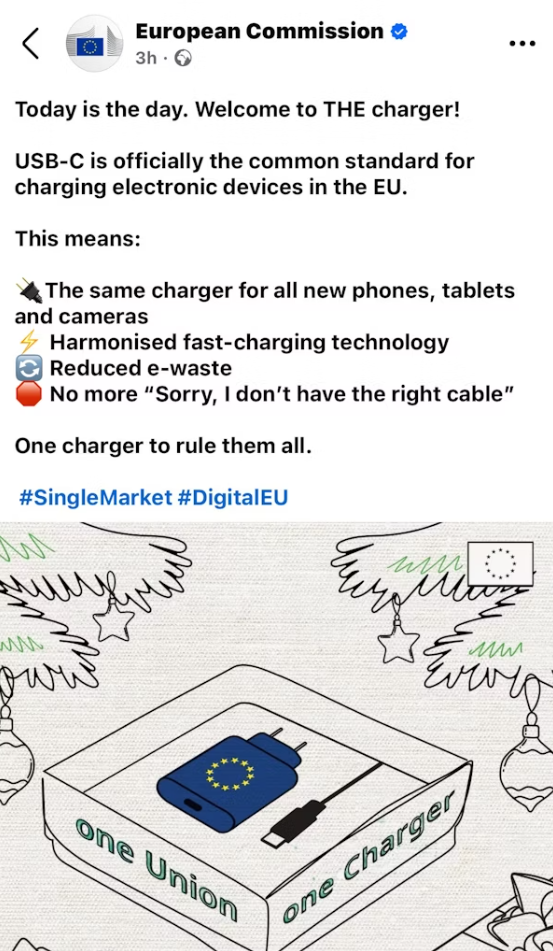
The European Union will have the continent-wide standard for the buggy whip real soon now. That’s the logical conclusion to draw from that recent announcement about USB-C.
For those who’ve not been following along at home the European Commission is very proud of itself. They’ve managed to pass a law mandating that USB-C (don’t worry, it’s a shape of cable) be the only flavour of connector now allowed within the EU. This has caused the less intellectual of our own rulers — St Stella for example — to just quiver, gasp, with excitement. This is proof of the ability of the collective bureaucracy to really stick one to The Man or something. A vast victory over Big Cable it seems.
Well, yes. Those with a little history to their name will know that the EU has been trying to do this for some time now. So much time that they’d originally intended to make Micro-USB the Europe-spanning insistence but it took them so long to make their rules that USB-C had already superseded it.
At which point we might draw a couple of conclusions. Even, suggest an insistence or two. That first insistence would be that a time of rapid technological change is really not quite le moment juste to be insisting upon only the one way of doing things. Because change, d’ye see? No, this is important for we know, absolutely, that there’re people out there just itching to insist upon the one connector for electric vehicles. Who would, in the name of a vapid uniformity, insist upon freezing technology at its current state rather than allow it to develop.
We could, should, also go on to insist that such a legal insistence on the only form allowed means that technological development cannot happen any more. For, in order to advance or even just change it will be necessary to change that law, that definition.
Legal changes in the European Union are not easy. Of course, the Parliament cannot do it — they are not allowed to even propose law changes, let alone enact them. It is necessary first to convince the European Commission of the need for a change. That means convincing the bureaucracy of course. Once that’s done it must pass the Council of Ministers, which is all the national governments. Parliament is then allowed to say yes. Then, and only then, would it be possible to put the new technology — say, a new cable — on the market.
But the only method we’ve got of testing whether a new cable is better is by putting it on the market. That is — no, really — the only process by which we find out whether consumers desire this new cable with all its delights, at the price that suppliers are willing to make it. But in the European system they cannot undertake the basic usefulness test until they’ve convinced a continent full of politicians that the new is in fact necessary and compulsory.
QotD: The OG internet moguls
The schlubby chic look was part of the con. Made him seem like someone who didn’t care about the money, which sends a subtle anti-capitalist, anti-consumerist, anti-finance bro NLP type message.
https://twitter.com/esaagar/status/1603015654206066688Posted by Noam Blum (neontaster) on Thursday, December 15th, 2022 1:25pm
Then it became sort of a cosplay thing for vaporware charlatans targeting FOMO investors.
“psst, Bob, should we really give $20 million to this guy? He’s picking his nose and wiping it on his cargo shorts rn”
“But remember that last nosepicker we passed on? He made $10 billion”
*fun fact: 8 years ago nosepicking guy was a Ralph Lauren-wearing chairman of the Delta Chi party committee, majoring in Entrepreneurship. And then he took the Silicon Valley Dress Down for Success seminar
There are other stylistic variations on pure slovenliness; the Black Turtleneck Next Steve Jobs gambit, and the coffee-clutching Patagonia Vest & Untuckits Next Steve Bezos thing
Oh, and the hoodies, so many hoodies.
For everybody thinking “tech people need to start wearing IBM suits again”: if you showed up to work or a VC meeting in one you would be thought deranged, building security, or a lunch caterer
For me the peak of Silicon Valley style will always be the pre-internet Assembly Language programmer polyester clip-on tie & short sleeve Sears Towncraft dress shirt look. The effortless nonchalance told you “I can trust this person not to run to the Carribean with my money”
David Burge (@Iowahawk), Twitter, 2022-12-15.
December 24, 2024
David Friedman on elegant solutions to problems
Sometimes the solution to a problem is obvious … at least once someone else has pointed it out:
Recently, when writing a check, it occurred to me that requiring the amount to be given separately in both words and number was a simple and ingenious solution to the problem of reducing error. It is possible, if your handwriting is as sloppy as mine, to write a letter or number that can be misread as a different letter or number. If redundancy consisted of writing the amount of the check twice as numbers or twice as words the same error could appear in both versions. It is a great deal less likely to make two errors, one in letters and one in numbers, that happen to produce the same mistaken result. It reduces the risk of fraud as well, for a similar reason.
That is one example of a simple and elegant solution to a problem, so simple that until today it had never occurred to me to wonder why checks were written that way. Another example of the same pattern is a nurse or pharmacist checking both your name and date of birth to confirm your identity.1
That started me thinking about other examples:
The design of rubber spatulas, one bottom corner a right angle, the other a quarter circle. One of the uses of the device is to scrape up the contents of containers, jars and bowls and such. Some containers have curved bottoms, some flat bottoms at a right angle to the wall. The standard design fits both.
Manhole covers are round because it is the one simple shape such that there is no way of turning it that lets it fall through the hole it fits over.
Consider an analog meter with a needle and a scale behind it. If you read it at a slight angle you get the reading a little high or low. Add a section of mirror behind the needle and line up the image behind the needle. Problem solved.
If you try to turn a small screw with a large screwdriver it doesn’t fit into the slot. Turning a large screw with a small screwdriver isn’t always impossible but if the screw is at all tight you are likely to damage the screwdriver doing it. The solution is the Phillips screwdriver. The tip of a large Phillips screwdriver is identical to a smaller one so can be used on a range of screw sizes.2
Ziplock bags have been around since the sixties. Inventing them was not simple but a new application is: packaging that consists of a sealed plastic bag with a Ziplock below the seal. After you cut open the bag you can use the ziplock to keep the contents from spilling or drying. I do not know how recent an innovation it is but I cannot recall an example from more than a decade ago.
1. This one and some of the others were suggested by posters on the web forum Data Secrets Lox.
2. I am told that the solution is not perfect, doesn’t work for very small screws, which require a smaller size of driver.

December 20, 2024
The legacy “mainstream” media is not going to be replaced with a new monolithic competitor
Ted Gioia says the transition is almost complete and what used to be the mainstream is rapidly becoming a fringe to the new, much more chaotic mainstream:

Last week, a cable news pundit struggled to understand the new media landscape. So he sought advice from his teenage son.
He asked the youngster to name the most influential people in the world today.
Can you guess the names he picked?
Here’s what happened:
I’m thinking to myself he’s going to say Barack Obama, Oprah Winfrey, Jay-Z.
He says Kai Cenat, Adin Ross, Jynxzi, and Sketch. I don’t know who he is talking about.
I said ‘What platforms are you on?’
He said ‘I’m on Twitch, Kick, and Rumble.’
I said ‘That sounds like you need to go to the hospital’.
What are these platforms? I’m telling you guys, the mainstream has become fringe, and the fringe has become mainstream …
There are people out there that are getting 14 million streams. And we are on cable news getting one or two million.
This is the new reality. The future of media has arrived — but people above a certain age won’t even recognize the names.
Check out the list below of the most watched streamers in the US and Canada.
Jynxzi? Zackrawrr? Summit1g?
A few days ago, I’d have told you these are passwords, not people.
Now I know better. I’ve watched videos from each of these individuals—and it’s shocking how different they are from mainstream media fare.
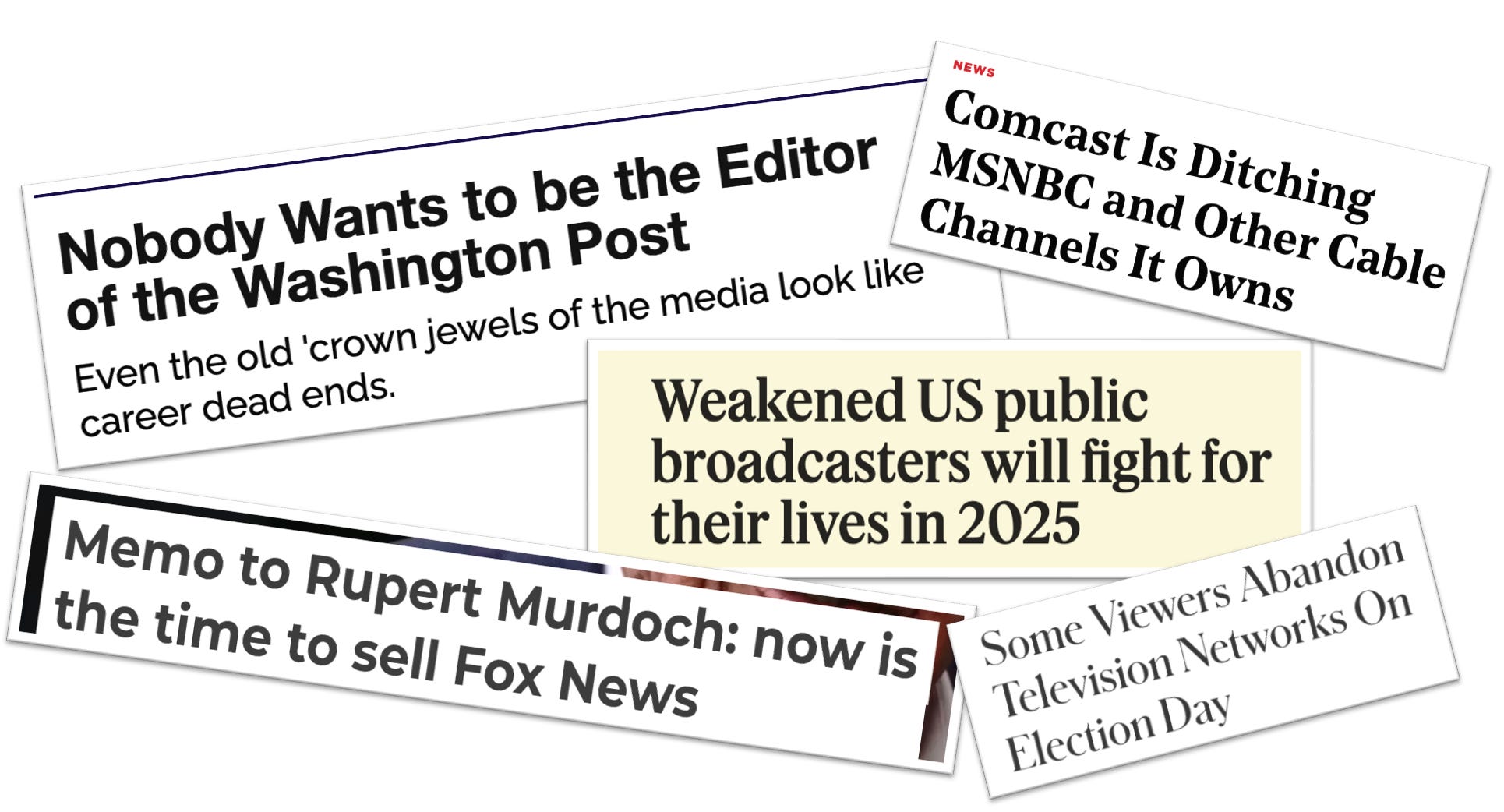
Media empires are getting defeated, but not by their corporate competitors. They’re finding themselves replaced by a ragtag assortment of podcasters, pranksters, pundits, gamers, gadflies, and influencers.
Who would have believed these headlines just a few months ago?

December 17, 2024
The rejection-in-advance of Bovaer as a “climate-friendly” “solution” to the “problem” of climate change
At Watts Up With That?, Charles Rotter documents yet another imposed-from-above bright idea that consumers are already eager to reject:

When global elites and bureaucrats decide they must “fix” the world, the results often speak for themselves. Take the latest technocratic debacle: Bovaer, a feed additive designed to reduce methane emissions from cows, marketed as a “climate-friendly” solution. It’s now being shelved by Norwegian dairy producer Q-Meieriene after consumers flatly rejected its so-called “climate milk”.
This is more than a simple story of market rejection. It’s a cautionary tale of what happens when governments, corporations, and globalists push policies and products that tamper with the food supply to address a problem that may not even exist.
The Quest to Solve a “Crisis”
Bovaer, developed by DSM-Firmenich, has been touted as a game-changer in the fight against methane emissions — a major target of climate policies. The additive is said to suppress a key enzyme in the cow’s digestive process, reducing methane emissions by up to 30%. Regulatory bodies in over 68 countries, including the EU, Australia, and the U.S., have approved its use.
But let’s step back for a moment. Why are we targeting cow burps and farts in the first place? Methane is indeed a greenhouse gas, but it’s also a short-lived one that breaks down in the atmosphere within about a decade. Moreover, cows and bison have been emitting methane for millennia without triggering apocalyptic climate shifts. Yet suddenly, livestock emissions are treated as a planetary emergency demanding immediate action.
This myopic focus on cow methane is a prime example of how climate zealotry warps priorities. Rather than addressing real and immediate issues — like the energy crises their own policies create — governments and globalists have decided to micromanage how your milk is produced, all to reduce emissions by an imperceptible fraction of a percentage point.
Consumer Rebellion
The backlash against Bovaer has been swift and fierce. In Norway, Q-Meieriene began using the additive in 2023, branding the resulting product as “climate milk”. The response? Consumers overwhelmingly rejected it, leaving supermarket shelves stocked with unsold cartons while Bovaer-free milk flew off the shelves.
Facing dismal sales, Q-Meieriene recently announced it would discontinue the use of Bovaer, stating:
Demand for Q climate milk has not been high enough to continue production … we phased out the use of methane suppressants in cow feed and are putting this project on pause.
https://www.nettavisen.no/nyheter/ville-redde-klimaet-med-prompe-fri-kumelk-snur/s/5-95-2166980
This is not merely a marketing failure. It reflects a broader consumer revolt against the technocratic imposition of “solutions” no one asked for. People are increasingly skeptical of being told that their daily choices — what they eat, how they travel, how they heat their homes — must be sacrificed on the altar of climate orthodoxy.
December 16, 2024
The Price of Victory by N.A.M. Rodger
In The Critic, Phil Weir reviews the final volume in N.A.M. Rodger’s three-book study of the history of the Royal Navy:

This October a major scholarly achievement was realised with the publication of The Price of Victory, the third and final instalment of N.A.M. Rodger’s great trilogy on the naval history of Britain from 660 AD to 1945. It has been an odyssey, albeit one that to complete took more than three times longer than Homer’s hero took to journey home.
The first volume, Safeguard of the Sea, was published back in 1997, some six years after Rodger had left his job as Assistant Keeper of the Public Records at the then Public Records Office to join the National Maritime Museum. Having moved to Exeter University, he completed the second volume, Command of the Ocean, covering the period from 1649 to 1815, in 2004.
Mindful of the fates of others who have attempted grand, multi-volume naval histories of Britain, Nicholas Rodger, now aged 74, was known to quip that one of his key aims was to become the first historian to live to see it completed. What he describes as “an exciting episode of brain surgery” delayed the completion of the final volume for several years, and left achieving this a closer-run thing than was — one suspects — entirely comfortable.
To the immense relief of all, Rodger recovered to complete his great work, and it has, emphatically, been well worth the wait. The Price of Victory is, like its predecessors, a most substantial work in both physical and scholarly senses.
At the outset of his task, Rodger aimed to create “not a self-contained ‘company history’ of the Royal Navy, but a survey of the contribution which naval warfare with all its associated activities has made to national history”. In doing so, he sought to link naval warfare “to political, social, economic, diplomatic, administrative, agricultural, medical, religious and other histories which will never be complete until the naval component of them is understood”.
He has succeeded handsomely, firmly entwining naval and naval-related matters into the core fabric of the history of the British Isles. The Price of Victory is a worthy conclusion to an epic series that will both stand in its own right and, as he hopes, serve as a baseline for future scholarly endeavours.
The vast, polyglot erudition underpinning Rodger’s prose wears no disguise. Yet, for all its great length and the density of knowledge each page imparts, The Price of Victory is, like its two preceding volumes, a lively read, leavened with the author’s dry wit.


