
HardThrasher
Published 13 Oct 2023To see more on the Fairey Battle go here – The Fairey Battle – Light Bomber, Hea… also subscribe to Rex’s channel, he’s ace
Selected Online Resources
https://en.m.wikipedia.org/wiki/Point…
https://en.m.wikipedia.org/wiki/Butt_…
https://en.m.wikipedia.org/wiki/Area_…
https://en.m.wikipedia.org/wiki/Casab…
https://discovery.nationalarchives.go… – Western War Plan W5a and W6Selected Bibliography
America’s Pursuit of Precision Bombing 1910-1945 – McFarland et al.
Dresden – Sinclair McKay
Dresden; Tuesday … – Fredrick Taylor
Absolute War – The Firebombing of Tokyo – Chris Bellamy
Black Snow –
Bomber Command – Max Hastings
Bomber Command’s War Against Germany, An Official History – Nobel Franklin et al.
The Bomber Mafia – Malcolm Gladwell
Undaunted and Through Adversity (Vol 1 &2) – Ben Kite
United States Strategic Bombing Survey (European War) (USSBS) Sept 1945 – Var. – https://collections.nlm.nih.gov/catal…
America’s Pursuit of Precision Bombing 1910-1945, McFarland
Big Week – James Holland
May 7, 2025
Boldly Bombing Bugger All – The Bomber War Episode 1
May 6, 2025
Online tools for the curious autodidact
Like many people, I was generally not a good student and in primary and middle school, I was notorious for reading the “wrong” parts of books because they were closer to my interests than the assigned readings, but I generally was able to scrape together enough marks to pass the tests on the stuff I skimmed or ignored. This is hardly the way to make an academic career — not that I would ever have done so, unless they just let me study what I wanted to learn about. A useful Substack for my fellow autodidacts [Wiki] is a side project of military historian Bruce Ivar Gudmundsson called Extra Muros, and his latest post provides some information on tools for online research that you may find helpful:

Gustav Wenzel – “A Carpenter’s Workshop” (1881)
The “advanced search” page of the Internet Archive allows you to …
- download copies, in various electronic formats, of
– books and magazines published before 1929
– works (such as those created by the US Federal Government) that have always belonged to the public domain
– relatively recent works uploaded by people in countries (such as India) with less restrictive copyright laws
- examine books that you might want to acquire for enjoyment the old-fashioned way
- find higher-quality copies of items that you found on Google Books
- obtain an overview of the works (to include foreign language translations)
– of a particular author
– on a particular subject
The “advanced search” page on the website of the Hathi Trust allows you to do many of the things you might otherwise do on the Internet Archive. Alas (and, indeed, alack), the interface restricts the direct download of complete volumes to “participating institutions”. As a result, mere mortals must either seek the PDF in question on Google Books (to which Hathi provides a direct link) or use a bit of freeware called Hathi Download Helper.
The Hathi Trust search engine also makes it easy for you to search within books for specific words and phrases, as well as the mention of particular places and personalities. Doing the former turns the Hathi Trust database into a kind of dictionary, a way of discovering ways that people in various climes and times have used the expression. Doing the latter converts that cornucopia into an encyclopedia.
The NGram Viewer performs a similar service. However, as it sits atop a smaller collection and suffers from a number of irritating defects, it has proved less useful to me than the website of the Hathi Trust.
April 29, 2025
QotD: The confidence game
… the basics of the confidence game have not changed all that much with the new technology. The confidence man gets his name because he is adept at winning the confidence of the mark. The mark then lowers his defenses and foolishly trusts the con man, rather than his own natural skepticism. The mark is manipulated into thinking the con man is a friend or at least someone who can be trusted. The con man then uses that trust to exploit the mark.
The way in which the con men does this is by flattery. The mark trusts the con man, because the con man finds small ways to confirm the beliefs of the mark. The adept grifter will be a good listener and pick up the little things that the mark thinks are important, like religious beliefs or opinions about personal matters. Seemingly out of the blue, the con man will express those same opinions, which flatters the mark. After all, everyone likes being told that their private opinions are smart.
That’s something you see with the internet grifters. They often have worn a lot of masks as they seek out on-line audiences. […]
Another aspect of the con that remains constant is how the con man uses his alleged status as a victim to work the mark. Con men will use their mark’s natural empathy to win their confidence. Today that often means claiming the big bad tech companies are censoring them. Alternatively, they will claim evil trolls are haunting their internet activity, causing them harm. The term troll has been changed from meaning someone seeking attention to something almost supernatural.
The Z Man, “Carny Town”, The Z Blog, 2019-12-29.
April 28, 2025
A potential positive to the explosion of AI-generated fake porn
The one thing we have always been able to predict with 100% confidence is that every new media will be used for pornography and crime, often in the same product. However, No Pasaran makes a case for there being a socially useful side to the ever-increasing realism of fake porn from popular LLM generators:

Seriously?! Am I the only person that sees the benefits of this “troubling trend” of online bullying?!
Think about it.
Blackmail is now a thing of the past.
That’s it.
It’s over.
Whether you are a teen or an adult, whether the photos are real or not, you can simply pass all of them off — indeed, you can do so nonchalantly — as fakes or deepfakes. To your classmates, to your spouse, to your constituents. Who will know whether you are fibbing or telling the truth? (Maybe you hardly know yourself …)
(In a totally different context, of course, that is exactly what Joe Biden’s White House did …)
As it happens, a considerable size of the audience for these sex photos/videos — maybe far more than half — will already be assuming that they’re fakes … (Thanks for the Instalink, Sarah.)
Depression at 16? Suicide at 17? Why fear sextortion at this point? Compliment instead the (anonymous) photo/video creators for doing a good job — for doing an outstanding job.
On my phone I keep receiving photos of Donald Trump tenderly cuddling with Joe Biden or Vladimir Putin or Stormy Daniels. Lots of apps now make you “repair” snapshots that are decades or (over) a century old, colorize them, and make them into mini-movies (the latest one I saw delighted me as it involved Civil War daguerreotypes from the 1860s).
I also keep receiving AI ads where, by combining a couple of photos of myself and of any girl (someone I know and am perhaps infatuated with or some rock or movie star or someone — Marilyn Monroe? Rudolph Valentino? Che Guevara? Queen Victoria? — who has been dead for decades) I can make myself hug or kiss that person — hungrily — on the mouth.
Years ago (long before AI), I was writing a TV script imagining a politician who was on national television and who was all of a sudden ambushed with private photos of him in a compromising position (with a woman other than his wife, with a man, with many women, with many men, at an orgy, in a BDSM cave, with a money shot, whatever …). Talk of falling victim; talk of bullying; talk of harassment (justified or otherwise)!
How should he react?
Ignore the content. And, with an admiring voice, let out a whistle and praise the work: “Wow, that’s well done!”
“What do you mean?!” interrupts the TV presenter, visibly frustrated. “No no no! Don’t tell me you are claiming they’re fake?! We have proof that you were seen at—”
Again, this was before AI, needless to say, which only made the politician’s next words even more startling: “It is so how admirable the degree to which studios have made progress with special effects!”
April 15, 2025
Learning from history can be helpful … if you learn the correct lessons
Tim Worstall explains why Donald Trump and his advisors pointing to the historical experience of high tariffs after the US civil war fails to take into account all the technological changes that happened during that time:

Trump and his economics team clearly believe that tariffs work (at least for certain values of “work”)
Post US Civil War tariffs rose strongly. Doubled and in some cases more than that. It’s also true that the US economy expanded remarkably in that period. Went from the exploitative frontier (and slave) economy to the world’s richest manufacturing one in fact. So, yay for tariffs, obviously.
Except US trade kept increasing over this period. So, tariffs were not reducing imports. Or rather, the total level of imports did not fall because tariffs even as tariffs obviously had an effect upon limiting imports — without tariffs there would have been more.
So, what happened here? The answer is the ocean going steamship.
Tariffs are only one barrier to trade, one cost of trade. Paperwork is another, local standards a third, the theft by rapacious dockside unions a fourth and, obviously enough, the cost of transport a fifth. And we can go on — the cost of information flow a sixth and soon enough we’ll be Richard Murphy shouting eleventhly.
The ocean going steamship reduced the total costs of trade by more than the tariffs raised it. Therefore trade carried on increasing.
Now forward a century, the 1970s and following. We’re told that there’s been some grand policy turn to free trade. That everyone decided to gut the rich world of real manly jobs and ship them off to sweating coolies who could be paid peanuts. The GATT, WTO, just proof of the contention and look, look, they lowered tariffs!
But the container ship (which did for those rapacious dockside unions in most places other than the US), the jet liner, the telephone and now the internet have lowered all those other costs of trade massively. The total costs of trade have dropped massively whatever we could have, should have, done about tariffs. Global trade was going to expand by multiples whatever GATT or WTO did that is.
Which is why these tariffs now have to be so large and bigly. Because to get back to that 1970s – let alone 1870s — it’s necessary to raise total costs of trade to where they were, not just tariffs.
April 13, 2025
They really are trying to shut down “wrong” speech on the internet
I’ve always been a huge fan of free speech, which has been under continuous and escalating threat by many governments both in person and online. A side-note in the ongoing Canadian federal election has been Liberal leader Mark Carney’s commitment to addressing “online harm” as he defines it:

At a campaign rally in Hamilton, Ontario, Liberal leader Mark Carney unveiled what can only be described as a coordinated assault on digital freedom in Canada. Behind the slogans, applause lines, and empty rhetoric about unity, one portion of Carney’s remarks stood out for its implications: a bold, unapologetic commitment to controlling online speech under the guise of “safety” and “misinformation”.
We announced a series of measures with respect to online harm … a sea of misogyny, anti-Semitism, hatred, conspiracy theories — the sort of pollution that’s online that washes over our virtual borders from the United States.
He then made clear his intention to act:
My government, if we are elected, will be taking action on those American giants who come across [our] border.
The former central banker, who now postures as a man of the people, made it clear that if the Liberals are re-elected, the federal government will intensify efforts to regulate what Canadians are allowed to see, say, and share online. His language was deliberate. Carney condemned what he called a “sea of misogyny, anti-Semitism, hatred, conspiracy theories” polluting Canada’s internet space — language borrowed directly from the Trudeau-era playbook. But this wasn’t just a moral denunciation. It was a legislative preview.
Carney spoke of a future Liberal government taking “action on those American giants who come across our borders”. Translation: he wants to bring Big Tech platforms under federal control, or at least force them to play the role of speech enforcers for the Canadian state. He blamed the United States for exporting “hate” into Canada, reinforcing the bizarre Liberal narrative that the greatest threat to national unity isn’t foreign actors like the CCP or radical Islamists — it’s Facebook memes and American podcasts.
But the most revealing moment came when Carney linked online speech directly to violence. He asserted that digital “pollution” affects how Canadians behave in real life, specifically pointing to conjugal violence, antisemitism, and drug abuse. This is how the ground is prepared for censorship: first by tying speech to harm, then by criminalizing what the state deems harmful.
What Carney didn’t say is just as important. He made no distinction between actual criminal incitement and political dissent. He offered no assurance that free expression — a right enshrined in Canada’s Charter of Rights and Freedoms — would be respected. He provided no definition of what constitutes a “conspiracy theory” or who gets to make that determination. Under this framework, any criticism of government policy, of global institutions, or of the new technocratic order could be flagged, throttled, and punished.
And that’s the point.
Mark Carney isn’t interested in dialogue. He wants obedience. He doesn’t trust Canadians to discern truth from fiction. He believes it’s the job of government — his government — to curate the national conversation, to protect citizens from wrongthink, to act as referee over what is and isn’t acceptable discourse. In short, he wants Ottawa to become the Ministry of Truth.
In Britain, their equivalent to Canada’s “online harms” legislation has induced Bitchute to discontinue service to users in the UK:

A READER alerted us to this statement posted on the Bitchute homepage, visible to geolocated UK users:
After careful review and ongoing evaluation of the regulatory landscape in the United Kingdom, we regret to inform you that BitChute will be discontinuing its video sharing service for UK residents.
The introduction of the UK Online Safety Act of 2023 has brought about significant changes in the regulatory framework governing online content and community interactions. Notably, the Act contains sweeping provisions and onerous corrective measures with respect to content moderation and enforcement. In particular, the broad enforcement powers granted to the regulator of communication services, Ofcom, have raised concerns regarding the open-ended and unpredictable nature of regulatory compliance for our platform.
The BitChute platform has always operated on principles of freedom of speech, expression and association, and strived to foster an open and inclusive environment for content creators and audiences alike. However, the evolving regulatory pressures — including strict enforcement mechanisms and potential liabilities — have created an operational landscape in which continuing to serve the UK market exposes our company to unacceptable legal and compliance risks. Despite our best efforts to navigate these challenges, the uncertainty surrounding the OSA’s enforcement by Ofcom and its far-reaching implications leaves us no viable alternative but to cease normal operations in the UK.
Therefore, effective immediately, BitChute platform users in the UK will no longer be available to view content produced by any other BitChute user. Because the OSA’s primary concern is that members of the public will view content deemed unsafe, however, we will permit UK BitChute users to continue to post content. The significant change will be that this UK user-posted content will not be viewable by any other UK user, but will be visible to other users outside of the UK. Users outside the UK may comment on that content, which the creator will continue to be able to read, delete, block, reply and flag. Users outside the UK may share UK-user produced content to other users outside of the UK as normal. In other words, for users in the UK, including content creators, the BitChute platform is no longer a user-to-UK user video sharing service.
This is the exactly the kind of consequence we at TCW feared a result of the overly restrictive and poorly written Online Safety Act 2023, which has now come into force.
The way the technology works is that websites can use a geolocation service to analyse the IP address your internet service provider has given your service, and use this to determine where you are. Google does this to tailor ads to you, Amazon does this to get you the most convenient version of their website.
Now Bitchute are using this service to protect themselves from the UK Government’s overreach.
The good news: there is a way round this.
April 3, 2025
English Electric Lightning – the F-22 of 1958
HardThrasher
Published 14 Jul 2023In which we explore one of the more bonkers aircraft of the Cold War and all the reasons it made no sense whatsoever whilst being awesome in practically every way.
(more…)
March 28, 2025
The argument to keep the F-35 for the RCAF, despite Trump’s tariff war
About a week ago, I linked to Alex McColl’s argument for splitting the Royal Canadian Air Force’s new fighter program into a small tranche of F-35s (because we’d already paid for the first 16 of an 88-plane order) and a much larger number of Swedish Gripen fighters from Saab, which on paper would give the RCAF enough aircraft to simultaneously meet our NATO and NORAD commitments. In the National Post, Andrew Richter makes the case to stick with the original plan, pointing to Canada’s truly horrifying history of cancelled military equipment and the costs of running two completely different fighter aircraft:

Canada does not have a very good track record when it comes to cancelling military contracts. About 30 years ago, the Liberal government of Prime Minister Jean Chrétien decided to cancel a contract that the Mulroney government had negotiated to purchase helicopters from a European consortium. Chrétien likened the new aircraft to a “Cadillac”, and maintained that our existing helicopters, the venerable Sea Kings, were still airworthy (despite their advancing age).
So the contract was torn up and the Canadian government paid a total of $500 million in cancellation fees. It would be another decade before a replacement helicopter was finally purchased (the American-made CH-148 Cyclones), and it was only in 2018 that the last Sea King was retired from service. The whole episode has been described by more than one observer as the worst defence procurement project in history. Which brings us to the tortured history of the F-35 purchase.
There is no need here to review the astonishing array of twists and turns that have taken place over the past few decades with regards to it. Suffice to note that when the F-35 contract was signed a few years ago, numerous defence analysts were in disbelief; many had long since concluded that it would never happen, and that Canada would continue flying our CF-18s until they literally could not fly anymore.
Any decision at this point to overturn the contract and go with the second-place finisher in the fighter jet competition — the Swedish Gripen — would have serious consequences. First, as with the helicopter cancellation decades ago, there will likely be financial penalties to pay, although so far the government has not commented on this.
In addition, a decision to buy the Gripen would mean that our Armed Forces would operate two fighter jets moving forward, because the first tranche of 16 F-35s is already bought and paid for. This would necessitate a wide range of additional costs, including training, maintenance and storage. Over decades, these costs would add billions (likely tens of billions) to the defence budget.
There are also issues of bilateral military co-operation, potential loss of affiliated contracts and force inter-operability to consider. The Canadian military has been primarily buying American military equipment for decades. This has been done both because our military generally prefers U.S. equipment and because it helps strengthen defence ties between our two countries. Deciding to buy a foreign aircraft would jeopardize these ties.
March 24, 2025
Postcards from academia’s zombie apocalypse
Ted Gioia points out exactly why them there kids ain’t learnin’ no more:

[High school students] just care about the next fix — because that’s how addicts operate. They have no long term plan, just short term needs.
They can’t get back to their phones fast enough.
How bad is it for educators right now?
Check out this commentary from one experienced teacher, who finds more engaged students in prison than a college classroom.
This comes from Corey McCall, a member of The Honest Broker community who recently posted this comment:
I saw this decline in both reading ability and interest occur firsthand between 2006 and 2021 … I had experience teaching undergrads who hadn’t comprehended the material before, but hadn’t faced the challenge of students who could read it but who simply didn’t care …
Since 2021 I’ve been teaching part-time in prison, and incarcerated students really want to learn. They love to read and think along with authors such as Plato, Descartes, and Simone de Beauvoir. I am teaching Intro to Theater this semester (the story of how this happened is interesting, but is irrelevant here) and students have been poring over Oedipus the King and asking why this amazing play isn’t performed more regularly alongside plays like Hamilton and The Lion King.
I believe that there is hope for the humanities and perhaps for culture more generally, but it will be found in unusual places.
I’ve made a similar claim in this article — where I look outside of college for a rebirth of the humanities. It would be great if it happened in classrooms, too, but I fear that they are now the epicenter of the zombie wars.
Alas, I fear the number of zombie students is still growing — and at an accelerated pace.
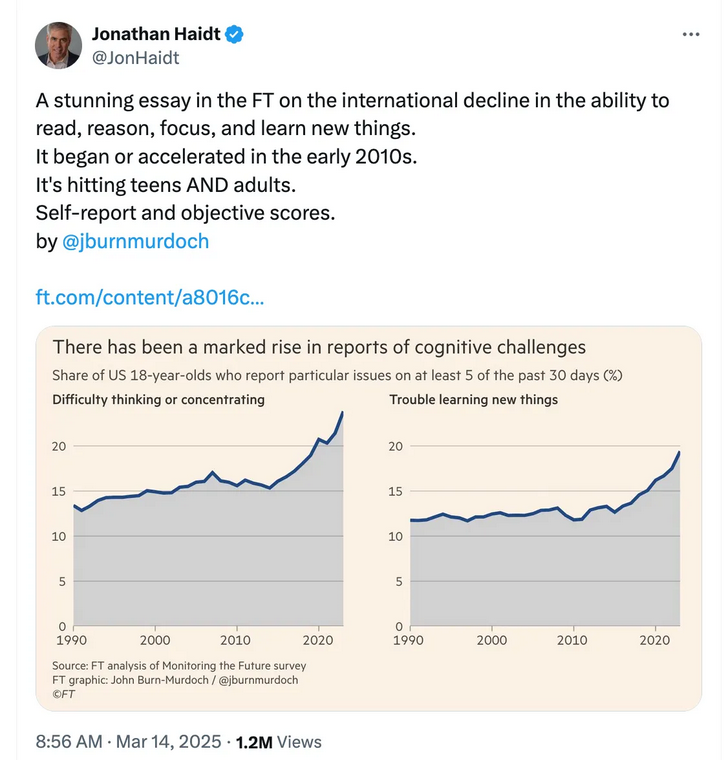
Jonathan Haidt, who has taken the lead in exposing this crisis — and thus gets attacked fiercely by zombie apologists — shares horrifying trendlines from Monitoring the Future.
This group at the University of Michigan has studied student behavior since 1975. But what’s happening now is unprecedented.
Students are literally finding it too hard to think. So they can’t learn new things.
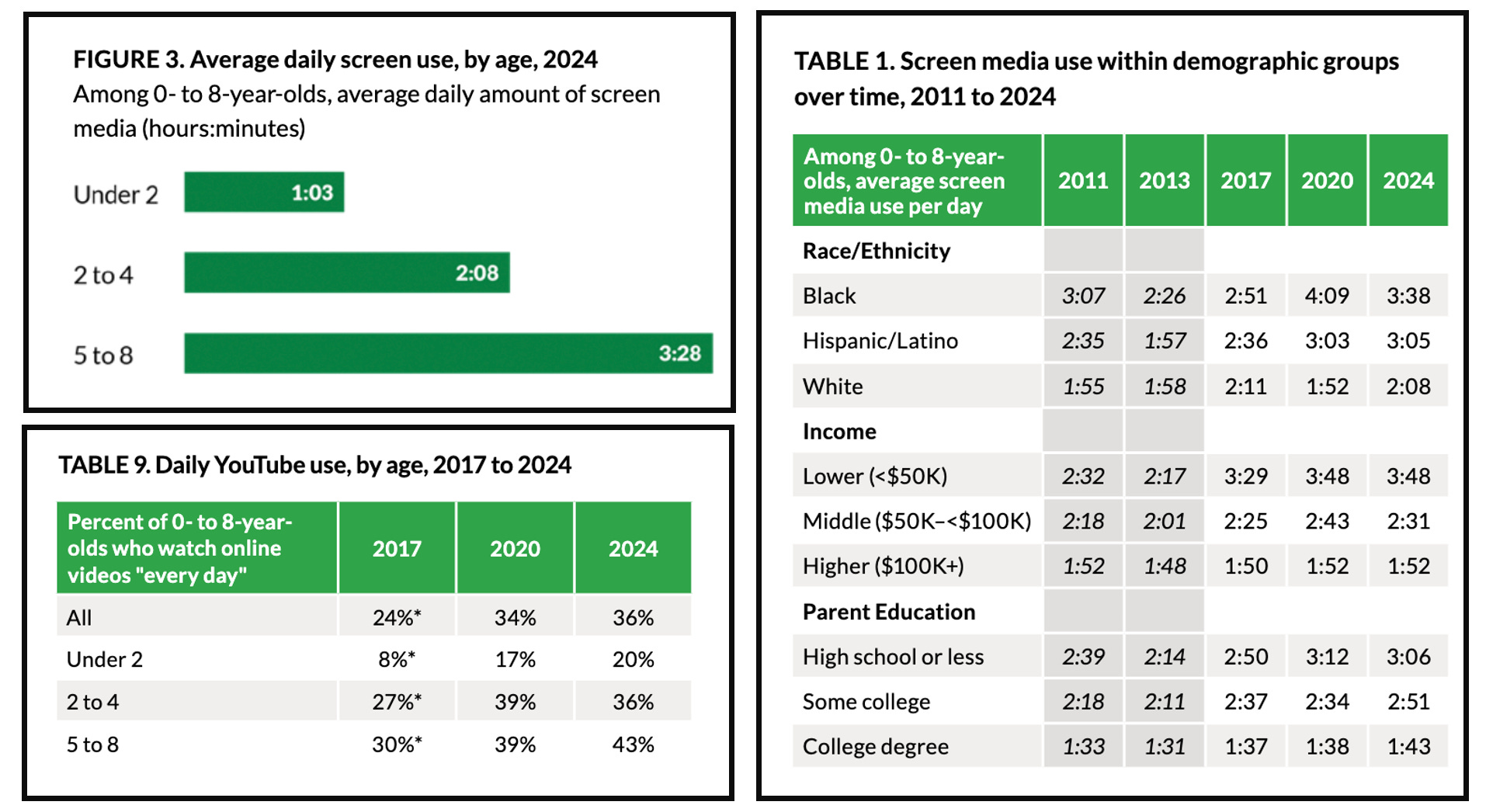
Below are more ugly numbers from another in-depth study — which looks at how children spend their day. It reveals that children under the age of two are already spending more than an hour per day on screens.
YouTube usage for this group has more than doubled in just four years.
Poor and marginalized communities are hurt the most. As your income drops, your children’s screen time more than doubles.
Source: 2025 study by Common Sense
In other words, these children are getting turned into screen addicts long before they enter the school system.
This is why teachers are speaking out. They see the fallout every day in their classrooms.
The Concorde of the English Channel – Hoverspeed
Ruairidh MacVeigh
Published 23 Nov 2024Hello all! 😀
In something a little different from cars, trains and planes, we take a look at what has often been considered the Concorde moment for cross-channel ferry operations, the introduction of routine hovercraft services between Britain and France by the Hoverlloyd and Seaspeed companies, and later the Hoverspeed firm following their merger.
Hoverspeed was a truly exceptional mixture of speed and technological prowess, skirting across the surface of the English Channel and reducing journey times to but a fraction of what they were aboard regular ferry boats, but due to increasing costs, a fragile business case, and the arrival of the Channel Tunnel, Hoverspeed, much like Concorde, is now but a fading memory of a bygone era for international travel.
Chapters:
0:00 – Preamble
0:44 – Rise of the Hovercraft
3:04 – Tapping an Untapped Market
7:15 – Into Service
10:33 – Heyday of the Hovercraft
13:05 – Fragile Foundations
17:21 – Coming to the End
21:55 – Conclusion
(more…)
March 19, 2025
Solving the “Spotify problem”
Sadly, as Tim Worstall explains, it probably can’t be done:

It’s that time of year for the ritual complaints about Spotify. Woes, musicians can’t get any money.
The reason for this is that we out here, the Great Unwashed, value recorded music at something just above toss. Therefore musicians get paid, on average, just above toss. And there we have it, there’s the whole and the complete of the thing.
Spotify is trumpeting big paydays for artists – but only a tiny fraction of them are actually thriving
Yep.
$10bn is a hefty number, but it needs to be closely examined. This money, around two-thirds of its total income, is what Spotify has paid through to record labels and music publishers. Spotify cannot be held responsible for egregious label and publisher contracts, but it needs reiterating that only a portion of that $10bn will make its way to the people who wrote and recorded the music.
The company also says this $10bn is “more than any single retailer has ever paid in a year” and is “10x the contribution of the largest record store at the height of the CD era”. That may be true, but it says less about Spotify’s benevolence and more about how streaming’s market share has mostly consolidated into the hands of four global heavyweights – Spotify, Apple, YouTube and Amazon.
Only one part of that has any relevance. The $10 billion and the 2/3rds.
Obviously there are costs to running a company. To running the servers which hold near all of all recorded music. Of being able to get that out onto the internet.
The $10 billion (OK, 15) is about what people think music is worth to them.
[…]
The reason your really important socially relevant indie band is touring the upper peninsula, still after all these years, the bogs are your changing room and the only rider you’ve been able to achieve is access to tap water, is that the general public values your output at some fraction above toss. Therefore you earn that fraction above toss.
Really, that’s it. It’s not capitalism it’s general public indifference. Really, folk just don’t care.
March 13, 2025
This explains a lot … IRS employees aren’t issued personal computers (in 2025!)
You sometimes read a small item and the information in it is so unexpected, it’s like being suddenly dumped into icy cold water, like this little item from Reason‘s “Morning Roundup” email:

Everything’s computer! But not at the IRS.
“The upheaval at the IRS is already having real impacts,” reports The Washington Post, referring to plans (already underway) to reduce the workforce by half. “Sources familiar with the agency report that its level of phone service is falling, in part because employees are spending their time waiting to use shared computers to respond to [the Department of Government Efficiency’s] requests for weekly emails detailing their work. (Not all IRS employees are issued their own computers.) And they report that taxpayer behavior is already adjusting to the reality of a diminished IRS workforce: IRS receipts — taxes paid already and taxes the agency is scheduled to receive from those who have already filed — are significantly lower than they were at this point last filing season.”
Wait, back up. They don’t have their own computers? And they’re sitting in a queue like schoolchildren in the library, waiting to use a single shared computer to respond to Musk’s five-things-you-did-last-week emails? How long does it take to write those emails? And why don’t they have computers?
Look, I’m worried by the slapdash approach Elon Musk’s Department of Government Efficiency has taken. But the continued federal employee freakout over being asked to justify their jobs by detailing what they’ve done at work makes no sense to me.
I know a girl from college who is a “Work-Life Specialist and Mindfulness Facilitator” at the U.S. Department of Transportation. She leads yoga sessions and “meditation made simple” workshops for federal employees, per her LinkedIn. This is a job I don’t want my taxpayer dollars funding. For Musk to apply scrutiny to this type of thing is a huge win for the American people.
There are lots of legitimate criticisms to make about whether cuts in staffing will actually lead to a better IRS. Taxpayer services will surely suffer if there are fewer people available to answer phone calls and emails; refunds might be delayed, which comes at a real cost to people. Worse tax collection means less revenue for the government, and it’s not like spending is under control — expect the fiscal hole we’re in to get worse if this continues. But “we just can’t figure out how to ration computer use in the year 2025 to craft a bullet-pointed email” is an absurd line that elicits no sympathy, and just leaves me confused about what the hell they’ve been doing all this time. Everything’s not, in fact, computer in the federal government.
March 7, 2025
Bricking the internet
In The Line, Phil A. McBride explains how the “net giants” have steadily nibbled away at the built-in resilience of the original internet design so that we’re all far more vulnerable to network outages than ever before:
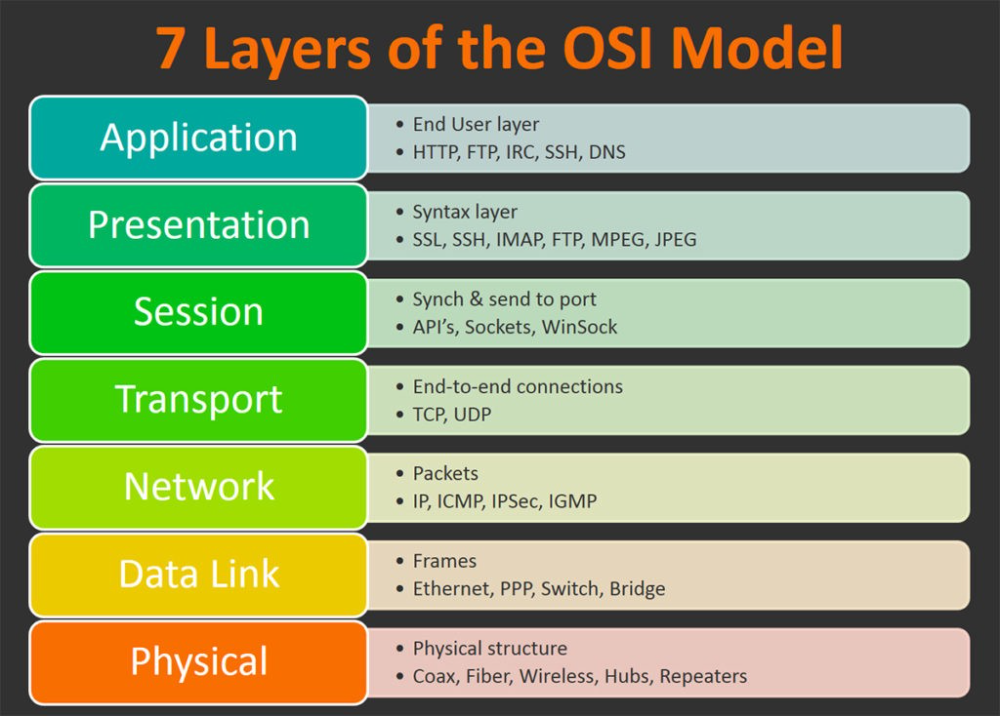
The Internet was originally conceived in the 1960s to be a resilient, disparate and distributed network that didn’t have any single point of failure. This is still true today. While there are large data centres around the world that aggregate traffic, we don’t depend on them. If one were to go offline, things would slow down, but the data would still flow.
The advent of the cloud, though, has completely changed how we use the Internet, especially in the worlds of business, education and government. And the cloud, alas, is not nearly as resilient.
Fifteen years ago, your average small or medium business would have their own servers. Those servers would be used to send/receive email, store files, and run various business or collaborative applications. Some of these servers may have been hosted offsite at a data centre to provide better security or speed of access, but the physical infrastructure belonged to someone — it was something you could touch and, more importantly, account for. Many companies kept their servers on site.
If a company’s server or network went down, it affected that company. They couldn’t send or receive email, they couldn’t open files, collaborate with staff or clients. They were offline.
But only they were offline.
Fast forward to today. Microsoft 365 dominates the corporate productivity services market with an estimated 45-50 per cent market share worldwide, with Google Workspace coming second, with around 30-35 per cent. This means that approximately 80 per cent of businesses are dependent on one of two vendors for their ability to transact business and communicate at even the most basic level.
Government and government-provided services, like education, health care and defence, are just as reliant on these services as the business world.
In today’s world, when Microsoft’s or Google’s services suffer a hiccup, it doesn’t affect one business. Or ten, or a hundred. Tens of thousands of business, and government offices and civil society institutions, all go offline. Simultaneously. Mom-and-pop stores, multi-billion-dollar corporations, elementary schools, hospitals, entire governments, all go out, all at once.
And we haven’t even talked about how Amazon, Microsoft and Google control almost two-thirds of the world’s web/application hosting market share. If one or all of those services go down, most of the websites you go to on a regular basis would suddenly become unreachable.
Kinda-sorta related to the above is Ted Gioia‘s “State of the Culture” post:
So remember the first rule: The culture always changes first. And then everything else adapts to it.
That’s why teens plugged into the most lowbrow culture often grasp the new reality long before elites figure it out. This was true 50 years ago, and it’s still true today.
So that’s our second rule: If you want to understand the emerging culture, look at the lives of teens and twenty-somethings — and especially their digital lives. (In some cases those are their only lives.)
The web has changed a lot in recent years, hasn’t it? Not long ago, the Internet was loose and relaxed. It was free and easy. It was fun. There wasn’t even an app store.
We made our own rules.
The web had removed all obstacles and boundaries. I could reach out to people all over the world.
The Internet, in those primitive days, put me back in touch with classmates from my youth. It reconnected me with friends I’d made during my many trips overseas. It strengthened my ties with relatives near and far. I even made new friends online.
It felt liberating. It felt empowering.
But it also helped my professional life. I had regular exchanges with writers and musicians in various cities and countries—without leaving the comfort of my home.
I made new connections. I opened new doors.
And this didn’t just happen to me. It happened to everybody.
“The world is flat,” declared journalist Thomas Friedman. All the barriers were gone — we were all operating on the same level. It felt like some imaginary Berlin Wall had fallen.
That culture of flatness changed everything. Ideas spread faster. Commerce moved more easily. Every day I encountered something new from some place far away.
But then it changed.
Twenty years ago, the culture was flat. Today it’s flattened.
I still participate in many web platforms — I need to do it for my vocation. (But do I really? I’ve started to wonder.) But now they feel constraining.
Even worse, they now all feel the same.
Instead of connecting with people all over the world, I now get “streaming content” 24/7.
Facebook no longer wants me stay in touch with friends overseas, or former classmates, or distant relatives. Instead it serves up memes and stupid short videos.
And they are the exact same memes and videos playing non-stop on TikTok — and Instagram, Twitter, Threads, Bluesky, YouTube shorts, etc.
Every big web platforms feels the exact same.
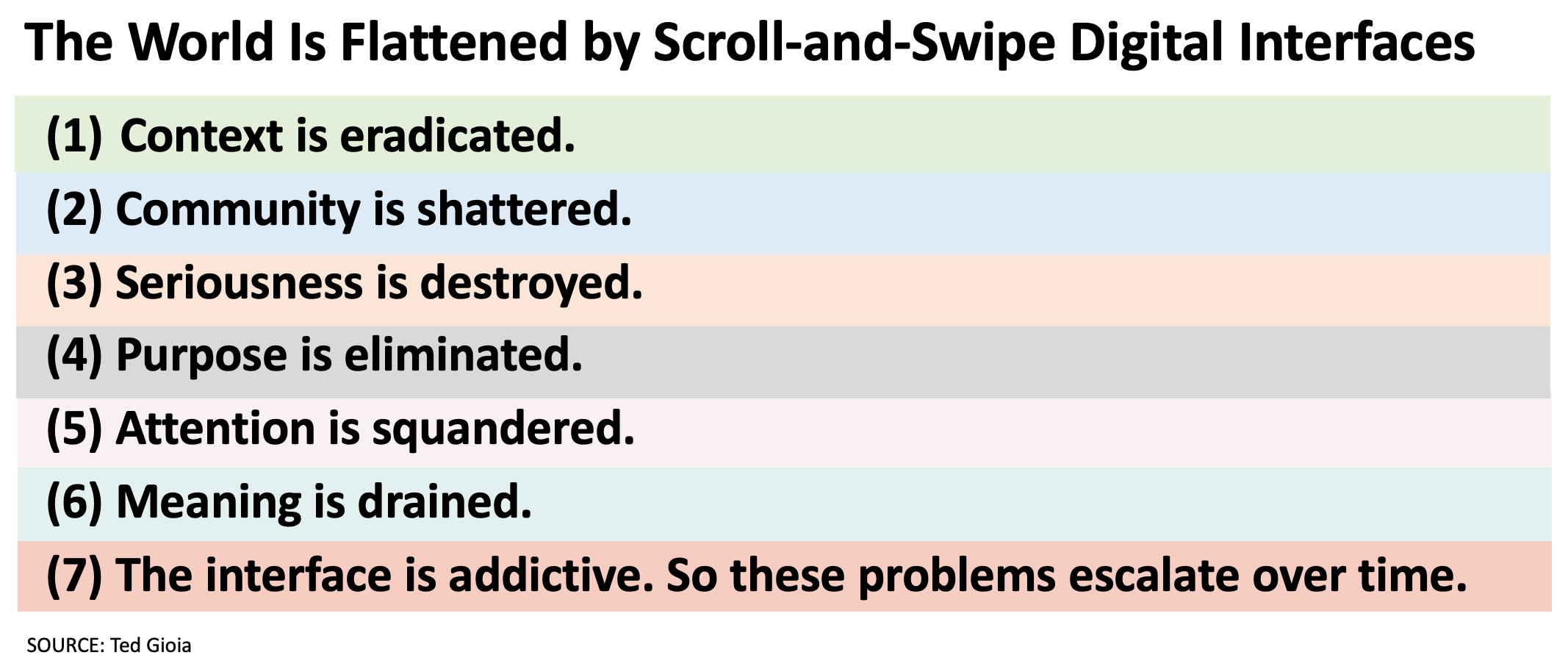
That whole rich tapestry of my friends and family and colleagues has been replaced by the most shallow and flattened digital fluff. And this feeling of flattening is intensified by the lack of context or community.
The only ruling principle is the total absence of purpose or seriousness.
The platforms aggravate this problem further by making it difficult to leave. Links are censored. Intelligence is punished by the dictatorship of the algorithms. Every exit is blocked, and all paths lead to the endless scroll.
All this should be illegal. But somehow it isn’t.
March 4, 2025
“Rare metals” are not really rare at all
On the social media platform formerly known as Twitter, John Ringo explains why the US doesn’t exploit its own vast reserves of “rare metals”:

I love every single time someone goes ‘CHINA HAS A LOCK ON RARE METALS! WE NEED TO ALLY WITH COUNTRY X TO GET RARE METALS! WE NEED RARE METALS!’
The US has huge deposits of pretty much everything we need. Lithium? Got it. Neodymium? Got it. Silver? Spades. Montana’s practically made of it.
The reason we don’t mine it here is the stupid ways our laws are written and allowing the Chinese to play us.
There’s an area in TX that has as much neodymium as the Chinese deposits that supply 98% of the world’s neodymium. (Critical material in rare earth magnets which are in turn critical in … so many things. Drones. Electric cars. Etc.)
There’s even a registered mine. Which was open.
Why is it closed?
The Chinese drop the prices below production cost (dumping) every time they open. Then jack the price and play political games with it when it closes.
There’s a silver mine in Montana (critical in modern solar) which has been trying to open for FIFTEEN YEARS.
Why can’t it open?
Tied up in environmental lawsuits because Congress won’t amend the EPA act that allows anyone to sue for any reason whatsoever and damn having mining or manufacturing WE DON’T NEED THAT WE NEED TO SAVE THE WORLD!
AND SLAVA UKRAINE YOU MAGA BASTARDS! TRUMP IS PUTIN’S COCK HOLSTER! WE NEED TO MANUFACTURE MORE WEAPONS TO SEND TO UKRAINE BUT ONLY IN A PERFECTLY ENVIRONMENTAL FASHION!
‘Environmental’ emphasis on the ‘mental’.
Autarchy is the idea of a country neither importing nor exporting. Just keep everything in the country. Ourselves alone.
A few have tried it from time to time. India did at one point.
Nobody can do it. There’s ‘something’ that you need from outside.
Except the US. We more or less need some tropical stuff. Like coffee, tea, sugar. Palm oil. (Super important in soap.)
But we can, in reality, even dispense with tree rubber. We can make it all from artificial.
Which comes from oil.
And we have enough oil. Thank a fracker. We’ve got enough oil in Southwest Texas to supply the WORLD for a thousand years.
(Touch expensive compared to Persian Gulf. But the price is constantly coming down.)
All we need to do is change laws, and we can almost go it without any other country. Without import or export.
I’m not suggesting we do.
But I am suggesting we dedicate some serious attention to things like China manipulating trade to ensure they have a lock on rare metals.
That we prioritize internal production.
That we decouple critical issues from other countries.
Cause the way the world is going, we’re reaching a point we’re gonna have to go it alone and if we have allies and trade partners, I’d suggest they be in the Western Hemisphere.
Cause those fuckers cross the pond be crazy.
Fifteen years ago, Tim Worstall explained why China’s rare earth monopoly won’t stand up in the long run.
QotD: Twitter-thought and the basic university student
Alas, Twitter is still a thing that exists, so even though I tried it for about five minutes and promptly forgot all about it, my students didn’t … which explains, like nothing else can, their bizarre approach to classwork. For every quiz I gave, no matter how straightforward the question, I’d have at least one barracks lawyer coming to me afterwards, trying to weasel her (always her, mentally if not biologically) way back into some points, with some elaborate rationale why her picking the wrong answer was really my fault, because in class I said “The Russians won the Battle of Stalingrad” and the question on the quiz was “Who lost the Battle of Stalingrad?” and how is she supposed to be expected to recognize that “lost” is the opposite of “won” when it comes to battles and blah blah blah (thanks, Greta!).
Or the other depressingly common thing, which was when that same kid, who went to the fucking mattresses for one point on one quiz — which amounts to something like 0.01% of her final semester grade — just didn’t turn in the term paper. This happened at all academic levels, from community college (where you often lose half a class or more by the end of a semester) all the way up through the SPLACs, which cost something in the neighborhood of $70K a year all in. I never could figure this out — I mean, how can they not know that the term paper is 30% of your final grade, while all the quizzes put together amount to 10%? — but then it hit me: Twitter.
Everything on social media has, of necessity, equal weight, in that whatever’s in your feed at the present time is the only thing that exists. So when Snowflake was in “schoolwork” mode and missed that one question on that one quiz, it was the only thing that mattered in her world. My quiz was at the top of her Twitter feed, so she had to put all her energy into battling me for it. By the end of the semester, though, she was in “sorority” mode, or “getting ready for that kickass ski vacation” mode, or “beefing with that basic bitch Becky” mode, so my term paper barely registered — if she bothered to turn anything in at all, it was copy-pasted straight from wikipedia, because who cares, when Becky is out there on Twitter, h8ing?
Severian, “Also Sprach Froggy”, Founding Questions, 2021-09-30.


