Quotulatiousness

December 12, 2024

The Canada Post strike is achieving one thing … strangling the use of cheques

Filed under: Business, Cancon, Technology — Tags: , , — Nicholas @ 04:00

In The Line, Phil A. McBride outlines the one palpable achievement of the postal workers’ strike in the likely fatal blow to the use of paper cheques in Canada:

Bank of Montreal sample cheque

For more than a century, Canadian businesses have been using cheques and the post office to send and receive money across the country and the world. It’s easy: you write a cheque, you put it in the mail, the recipient deposits the cheque at their bank, you wait five business days for it to clear and voila — you’ve got the money.

Except, right now, of course, that’s not happening, due to the ongoing postal strike. In fact, a great number of cheques that are in the mail are stuck there, leaving businesses and Canadians with money stranded in transit. I am increasingly convinced that this strike will be remembered in the future as the death of cheques in Canada, at least as a major medium of business exchange.

The banks won’t miss cheques, if so. Cheques are expensive. In 2015, Scotiabank estimated that the writing and processing of a cheque cost anywhere between $9 and $25. In 2023, approximately 379 million cheques were issued for a combined value of $2.9 trillion dollars. That’s an average value of $7,650.00 per cheque, at an averaged cost of $6.44 billion dollars to the banks and their customers. Very little of that cost is incurred if a payment is made electronically.

But it’s not just the money. Cheques are prone to fraud. Cheques can be counterfeited, signatures can be forged and cheques can be written against accounts that can’t cover the amount they’re issued for. The customer is responsible for sending and receiving them, which means they are prone to loss or interception, which adds further time and cost to an already expensive process.

As a business owner, I happen to agree with the banks: I don’t like cheques. I’m made to wait five business days to access my money, and that’s after I’ve waited for the client to issue the cheque and for the postal service to (once upon a time) deliver it to my office.

Today, all of Canada’s charter banks, as well as most Credit Unions, offer many options for electronic payment. Electronic Funds Transfer (EFT), Interac Electronic Money Transfer (EMT), debit cards, credit cards, even SWIFT wire transfers for international payment. All of these institutions have the ability allow for multiple layers of approval that satisfy corporate accounting, security and reporting requirements. All of these forms of payment are faster, cheaper and more secure than cheques — in most cases, I get access to my money inside 24 hours, rather than waiting for a full week for a cheque to clear.

So why has the cheque endured as long as it has?

Some combination of “If it ain’t broke, don’t fix it” and “It’s always been done this way”.

CHEVROLET with Cartoonist Rube Goldberg: Something for Nothing (1940)

Filed under: History, Technology, USA — Tags: , , , , — Nicholas @ 02:00

Charlie Dean Archives
Published Aug 27, 2013

Cartoonist Rube Goldberg creates a little animation to explain how fuel is converted to power in the modern automobile engine.

CharlieDeanArchives – Archive footage from the 20th century making history come alive!

December 11, 2024

Norway finds the perfect tool to drive away those pesky entrepreneurs

Filed under: Business, Europe, Government, Technology — Tags: , , , , — Nicholas @ 03:00

Don’t you just hate having all these bothersome start-up companies in your country, creating new jobs and new investment opportunities? Norway sure does, but good news: they’ve found an almost perfect way to not only deter existing entrepreneurs but to punish those who try to leave after they’ve been successful:

Norway is a fantastically beautiful country, but lately they’ve decided they want as few new companies as possible.
“Norway” by Nouhailler is licensed under CC BY-SA 2.0 .

Norway’s entrepreneurs are disappearing. In the past two years alone, 100 of Norway’s top 400 taxpayers, representing about 50 percent of that group’s wealth, have fled the country to protect their businesses.

In Atlas Shrugged, Ayn Rand paints a vivid picture of a dystopian society where government overreach and socialist policies kill innovation and demonize entrepreneurs. Present-day Norway mirrors this scenario in unsettling ways. The Nordic countries have long operated on an egalitarian ideal—citizens pay high tax rates for a generous safety net and effective public services. But Norway has taken the ideal to destructive and bizarre extremes.

Norway spends 45 percent more than Sweden on healthcare per capita with approximately the same health outcomes. Norway spends 50 percent more than Finland on primary and secondary school with worse results. And it splurges on green virtue-signaling with, for example, a $3.2 billion offshore wind project that industry experts believe is financially unworkable. That $3.2 billion, by the way, is roughly equivalent to the total revenue raised by the wealth tax.

To socialist politicians in Norway, entrepreneurs are mere piggy banks to be raided for ever more spending. When confronted with the reality that you can’t pay taxes with money you don’t have, the response is a vague moralism like “those with the broadest shoulders must bear the heaviest burdens.” Any dissent is waved away, deemed invalid because. . . free healthcare.

Earlier this year, instead of scaling back the tax blowout, the government doubled down, not only increasing the wealth tax but adding a vise grip on business owners in the form of an “exit tax” on unrealized gains as well. That means if you move from Norway, you’re immediately liable to pay 38 percent of the market value of your assets. It doesn’t matter if you have no cash on hand, if your assets are risky and could plummet in value, or even if your company fails after you leave—you still owe the tax. (Luckily for me, I left before this tax became law.)

The intent is to corral entrepreneurs inside Norway, impeding them from heading for the exits. The inevitable result: They’ll leave even before starting their businesses. After shooting itself in one foot, the government is now aiming a bazooka at the other one.

December 10, 2024

Microsoft has launched a publishing arm called “8080 Books” – AI-generated books anyone?

Filed under: Books, Business, Technology — Tags: , , , — Nicholas @ 03:00

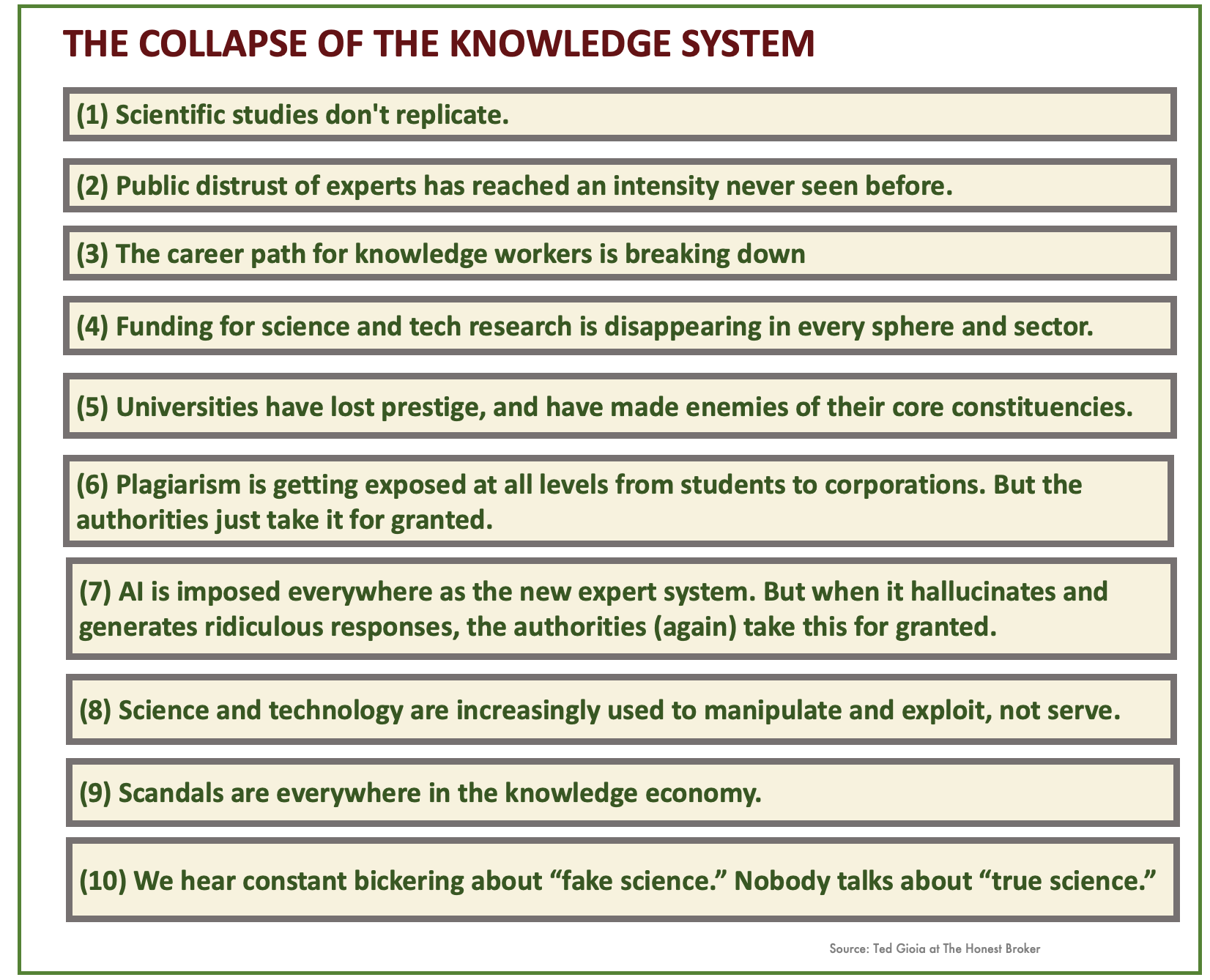
Ted Gioia notices that Microsoft and other tech companies are moving into book publishing, likely as a way to generate some additional revenue from their vast investments in artificial intelligence ventures over the last several years:

I never expected Microsoft to enter the book business.

But on November 18, this huge tech company quietly announced that it is now a publisher. But there was an interesting twist.

Microsoft is “not currently accepting unsolicited manuscripts”.

Let’s be totally fair. Nobody at Microsoft claims that it plans to replace human writers with AI slop. But this company has invested a staggering $13 billion in AI — it’s their top priority as a corporation.

So what you do think their goals are in the book business?

If you’re looking for a clue, I note that Microsoft’s publishing arm is called 8080 Books. Yes, they named it after the 8080 microprocessor.

How charming!

And just a few hours after Microsoft announced this move, TikTok did the exact same thing.

According to The Bookseller:

    ByteDance, the company behind the video-sharing platform TikTok, has announced that it will start selling print books in bookshops from early next year, published under its imprint, 8th Note Press. 8th Note Press will work in partnership with Zando to publish print editions and sell copies in physical bookstores starting early 2025.

Here, too, nobody is claiming that they will replace humans with bots. But why would a company that has built its empire with online social media have any interest in the slow and stodgy business of selling printed books on paper?

Oh, by the way, TikTok’s parent is investing huge sums in AI. The company has even found a way around export controls on Nvidia chips. Just a few weeks before entering the book business, ByteDance’s sourcing of AI tech from Huawei was leaked to the press.

And as if these coincidences weren’t enough to alarm you, another AI publishing development happened at this same time — but (here too) with very little coverage in the media.

Tech startup Spines raised $16 million in seed financing for an AI publishing business that aims to release 8,000 books per year.

Here, too, the company says that it wants to support human writers. Maybe it will run a new kind of vanity publishing business. But is that a sufficient lure to attract $16 million in seed financing?

It’d be a rearguard action, but it’d be nice to have a requirement that publishers disclose when published works are partly or wholly AI-extruded, wouldn’t it? It would certainly help me to avoid buying books or magazines where AI hallucinations may occur in key sections …

December 3, 2024

Evolution of Airborne Armour

The Tank Museum
Published Jul 19, 2024

Lightly armed airborne troops are at a huge disadvantage when faced with regular troops with heavy weapons and armour. In World War II this led to huge losses for paratroops on Crete and at Arnhem. Since then, many attempts have been made to level the playing field, to give airborne soldiers a fighting chance.

From the Hamilcar gliders of World War II to the C17 Globemaster, we look at how to make a tank fly.

00:00 | Intro
00:47 | The Origins of Airbourne Operations
02:34 | Gliders
07:20 | A Tank Light Enough to Fly?
09:02 | Success & Failure
14:24 | Post-War Solutions
17:41 | Better Aircraft – Better Tanks?
20:15 | Strategic Deployment
21:39 | Conclusion

This video features archive footage courtesy of British Pathé. This video features imagery courtesy of http://www.hamilcar.co.uk/

#tankmuseum

December 2, 2024

Mars? Yes, Mars.

Filed under: Space, Technology — Tags: , , , — Nicholas @ 03:00

At Postcards From Barsoom, John Carter discusses the pros and cons of colonizing Mars:

… we’re on the good timeline now.

Not everyone appreciates the good timeline. A persistent current of discourse holds that we shouldn’t go to Mars, that it is a misbegotten ambition, unrealistic, unprofitable, and even counterproductive. “Antarctica would be easier”, they say, “We should start there if we start anywhere”. Mars is too difficult; the technology doesn’t exist; it’s fantastically expensive, with no conceivable profit to be derived from a frigid desert littered with dead rocks, where the clouds themselves are made of red dust, where the air is too thin and toxic to breathe, where nothing can possibly grow. Therefore, they pronounce, we shouldn’t go. We shouldn’t even try to go. We should use our limited resources to solve our pressing problems down here on Earth – climate change, poverty, racism, the gender pay gap, the refusal of the chuds to use the correct pronouns.

Leave aside that if Europeans had waited to solve Europe’s problems, they never would have left.

Leave aside that “we” aren’t doing anything. Some people will use their resources to try this audacious thing; others will use their resources to do other things. The oft-heard phrasing of “we” presupposes that “our” resources are a collective property, their usage to be decided on the basis of utilitarian calculations carried out, presumably, by panels of self-selected technocratic experts. That collective ownership and central planning has been calamitous every time it has been applied in earnest is no barrier to the appeal of the idea over a great many minds.

Leave aside also the economic case for Martian settlement. That case has been made, and made well, by Devon Eriksen in his essay “The Trillionaires of Mars“.

Briefly, Mars is valuable because its shallow gravity well and proximity to the asteroid belt provides an ideal planetary surface on which to build the industrial infrastructure necessary to refine asteroids into useful metals and finished manufactured products, which can then be sent back to the terrestrial market (or shipped elsewhere in the solar system). As to the comparisons to Antarctica, planetary scientist Peter Hague
has addressed this in detail.

As Hague points out, Antarctica’s geography means that it receives a vanishingly small amount of solar radiation (and during the winter, none at all). In contrast, while Mars’ greater distance from the Sun (an average of 1.5 Astronomical Units) means that it only gets about 44% of Earth’s irradiance, this is still a lot more than Antarctica. Growing crops is a lot easier on Mars than it is on Antarctica, where it can only be done hydroponically. Setting up shop on Mars means that we can use this solar energy not only to generate electricity, but also for agriculture. On Mars, in principle, one merely mixes human waste with the regolith (after removing the perchlorates) to turn it into topsoil, puts it in a transparent dome, fills the dome with air, and plants the potatoes.

Mars is certainly the easiest extraterrestrial body in the solar system to settle, occupying a sweet spot with its combination of proximity to the Earth, low gravity, an atmosphere, and abundant local resources. It therefore makes perfect sense that it would be prioritized for colonization. It’s Level 1 in the game of becoming multiplanetary. Other bodies may offer much richer prizes in the long run, but they’re also far more challenging.

Still, pace Devon, it’s unlikely that Mars will be profitable in the short run. Even asteroid mining will, at least initially, be far more useful for in situ space manufacturing than it will be for the terrestrial market. As Eriksen points out, correctly, if you strip-mine a quadrillion-dollar asteroid of nickel, iron, and platinum group metals and ship them back to Earth all at once, you’ll just crash the value of those metals. Supply and demand 101. Then again, as Eriksen also points out, raw materials aren’t just numbers on a commodity exchange: they’re actual, physical stuff that you can use to build things, and when society has more of it, society is wealthier in real terms … something that we often forget in our hypothecated financial economy. This is a point I’ve made myself, in the context of a wider discussion about why we should fix our gaze upon the heavens, and ignore those who demand that we wallow perpetually in the mud.

November 29, 2024

QotD: Why nothing gets done in the Current Year

… we do gain a lovely illustration of why nothing ever really gets done in this modern world. Sure, the politicians have demanded more [advanced logic] chips in a country that doesn’t have any spare chip technicians — TSMC has had to import their own from Taiwan — and so on and so on. But there’s also this:

    Having pumped billions of dollars into building the next generation of computer chip factories in the US, the Biden administration is facing new pressure over the health and safety risks those facilities could pose. Environmental reviews for the new projects need to be more thorough, advocates say. They lack transparency around what kinds of toxic substances factory workers might handle, and plans to keep hazardous waste like forever chemicals from leaching into the environment have been vague.

    A coalition of influential labor unions and environmental groups, including the Sierra Club, have since submitted comments to the Department of Commerce on draft environmental assessments, saying that the assessments fall short. The coalition’s comments flag lists of potential issues at several projects in Arizona and Idaho, including how opaque the safety measures that manufacturers will take to protect both workers and nearby residents are.

This is not a serious complaint. This is actually the national association of environmental studies writers spotting a gravy train passing by and desiring to dip their ladle in. And that’s all it is too. But it’s also that excellent example of why fuck all ever gets built. We’ve an entire — and politically powerful — class that makes their living producing the hundred tonne reports that accompany building anything. And they’re not going to allow anything to be built unless they get paid for writing hundred tonne reports. And, to complete the circle, if every activity requires a hundred tonne report then fuck all will ever get done.

There was, back a time, a law passed about blood minerals. The law said anyone who might use them must write to all suppliers to ask if they do. Then those said anyones must tell consumers whether they do. This cost $4 billion just in the first year. From what I’ve heard — and might take the trouble to prove one day — the bloke who led the campaign for the law requiring the letters now runs a very profitable consultancy advising large corporates on how to write the letters. $4 billion spent by society so that one bloke can gain a minor summer place in the Hamptons. This doesn’t make us richer as a whole, it’s pissing the wealth of the nation up the wall.

Carthage, it’s the only solution. The biggest problem who is who the hell would buy our nice new stock of enslaved environmental bureaucrats? Razing, salt, ploughs, these are easy but who’s mad enough to offer a positive price for the last part of the process?

Tim Worstall, “Why Fuck All Ever Gets Done In This Modern World”, It’s all obvious or trivial except …, 2024-08-28.

November 24, 2024

QotD: Wood

Filed under: Quotations, Technology, Woodworking — Tags: , , — Nicholas @ 01:00

If someone today invented wood, it would never be approved as a building material. It burns, it rots, it has different strength properties depending on its orientation, no two pieces are alike, and most cruelly of all, it expands and contracts based on the relative humidity around it. However, despite all of these problems, wood is the material of choice when building houses. In fact, we can use wood better than we can use steel, masonry and concrete.

Joseph Lstiburek, Builder’s Guide to Cold Climates, 2000.

November 21, 2024

1966: Chieftain Tank Simulator | Tomorrow’s World | Retro Tech | BBC Archive

Filed under: Britain, History, Military, Technology — Tags: , , , — Nicholas @ 02:00

BBC Archive
Published Jul 15, 2024

“All the tension, the excitement, and indeed the technical demands of driving a modern tank into battle … but, in fact, I haven’t moved a yard.”

Raymond Baxter test drives the British Army’s Chieftain tank simulator, used for training tank drivers. The illusion is created using a large 1:300 scale model of the battlefield, a computer, and a roving mirror connected to a television camera. The battlefield can be altered simply by swapping out the model trees and buildings.

Mr Baxter can attest to how realistic the experience is, and it costs just one tenth of the price of training in a real Chieftain tank.

Clip taken from Tomorrow’s World, originally broadcast on BBC One, 28 September, 1966.

November 19, 2024

The state and society

Filed under: China, Europe, Government, History, Technology — Tags: , , , — Nicholas @ 04:00

Lorenzo Warby explains why Karl Marx was wrong about the origins of what he called “the three great inventions” and therefore also mistaken about the societal impact of those inventions:

    Gunpowder, the compass, and the printing press were the 3 great inventions which ushered in bourgeois society. Gunpowder blew up the knightly class, the compass discovered the world market and founded the colonies, and the printing press was the instrument of Protestantism and the regeneration of science in general; the most powerful lever for creating the intellectual prerequisites.

    Karl Marx, “Division of Labour and Mechanical Workshop. Tool and Machinery” in Economic Manuscripts of 1861-63, Part 3) Relative Surplus Value.

With this quote we can see what is wrong both with Marx’s notion of the role of technology in social causation and with a very common notion of the relationship between state and society.

The false — but very common — view of the relationship of state and society is that the state is a product of its society, that the state emanates from its society. This gets the dominant relationship almost entirely the wrong way around. It is far more true to say that the state is a fundamental structuring element of the social dynamics of the territory it rules rather than the reverse.

It is perhaps easiest to see this by noting the glaring flaw in Marx’s reasoning. The gunpowder, the compass and the printing press were all originally Chinese inventions. Indeed, Europe acquired — via intermediaries — gunpowder and the compass from China. (Gutenberg’s printing press appears to have been an independent invention.)

Source: Nova Reperta Frontispiece, 1588.

Yet, as Marx was very well aware, China did not develop a bourgeoisie in his sense. Indeed, Marx’s notion of the Asiatic mode of production grappled with precisely that lack.1

In 1620, Sir Francis Bacon wrote in his Instauratio magna that

    … printing, gunpowder, and the nautical compass … have altered the face and state of the world: first, in literary matters; second, in warfare; third, in navigation …

This was true of the effect of these inventions in European, but not Chinese, hands.

Why were these inventions globally transformative in European, but not Chinese hands? Because of the differences in the structure of European state(s) compared to the Chinese state.

Unified China …

The first difference is that the European states were states, plural. Europe had competitive jurisdictions, it had centuries of often intense inter-state conflict. From the Sui (re)unification (581) onwards China was, with brief interruptions, a single polity.2 What the evidence — both Chinese and Roman — shows quite clearly is that civilisational unity in a single polity is bad for institutional, technological and intellectual development.

The second difference is with the internal structure of European states compared to the Chinese state. The Sui dynasty, by introducing the Keju, the imperial examination — refining the use of appointment by exam that went back to the Warring States period — created a structure that directed Chinese human capital to the service of the Emperor.

There were three tiers of examinations (local, provincial, palace). You could sit for them as often as you wished. So a significant proportion of Chinese males devoted decades of their lives to attempting to pass the exams. Over time, the exams became more narrowly Confucian — probably because it required a high level of detailed mastery, so had more of a sorting effect — thereby promoting intellectual conformism.

[…]

… and divided Europe

Conversely, when gunpowder, the compass and the printing press came to Europe, European states already had a military aristocracy; self-governing cities; an armed mercantile elite; organised religious structures; so a rich array of cooperative institutions. Moreover, kin-groups had been suppressed across manorial Europe, forcing — or giving the social space for — alternative mechanisms for social cooperation to evolve.3, 4 In particular, due [to] its self-governing cities with armed militias, medieval Europe had an (effectively) armed mercantile elite before gunpowder, the compass or printing reached Europe.

Alfonso IX of Leon and Galicia (r.1188-1230) first summoned the Cortes of Leon in 1188. This became the start of the first institutionalised use of merchant representatives in deliberative assemblies. Emperor Frederick Barbarossa (r.1155-1190) had tried something similar earlier, but the mercantile elites of North Italy preferred de facto independence, defeating him at the Battle of Legnano in 1176.

The first European reference to the compass is in a text written some time between 1187 and 1202, with its use appearing to expand over the 1200s. The first reference to gunpowder in Europe is not until 1267 and it took centuries before gunpowder played a major role in European warfare.

Both the compass and gunpowder really only have transformative effects from the late C15th onwards, which is also when the printing press is spreading across Latin Europe. By that time, medieval Europe has already become a machine culture and it had been for centuries the civilisation with the most powerful mercantile elite. A reality driven by competitive jurisdictions, a rural-based military aristocracy, law that was not based on revelation (so it could entrench social bargains), suppression of kin-groups, and self-governing cities.

Competition between European states was a powerful driver of the transformative use of technologies. But so was the level of striving within such states: adventurers able to mobilise resources — and seeking wealth, power, prestige — had far more room to operate (and receive official sanction) in Europe than in China.

In other words, the differences in the development and use of technology — and in social dynamics and formations — between China and medieval Europe was fundamentally driven by the differences in state structures, in how the relevant polities worked.


    1. Marx was not an honest intellectual reasoner:

    As to the Delhi affair, it seems to me that the English ought to begin their retreat as soon as the rainy season has set in in real earnest. Being obliged for the present to hold the fort for you as the Tribune’s military correspondent I have taken it upon myself to put this forward. NB, on the supposition that the reports to date have been true. It’s possible that I shall make an ass of myself. But in that case one can always get out of it with a little dialectic. I have, of course, so worded my proposition as to be right either way.
    Marx to Engels, [London,] 15 August 1857, (emphasis in the original).

    2. The Song (960-1279) failed to fully unify China, but they were the only significant Han polity. That the Song were effectively within a mini-state system does seem to have affected their policies, including the unusually — for a Chinese imperial dynasty — strong focus on trade and technological development.

    3. Kin-groups had already been suppressed in the city-states of the Classical world, including Rome. They re-emerged with the incoming Germanic peoples, and then were suppressed again by the Church and the manorial elite, remaining in the agro-pastoralist Celtic fringe and Balkan uplands.

    4. Economists Avner Greif and Guido Tabellini define clan (i.e. kin-group) as “a kin-based organization consisting of patrilineal households that trace their origin to a (self-proclaimed) common male ancestor“. They contrast this with a corporation: “a voluntary association between unrelated individuals established to pursue common interests“. They note they perform similar functions: “they sustained cooperation among members, regulated interactions with non-members, provided local public or club goods, and coordinated interactions with the market and with the state“. Triads, tongs and cults can also perform these functions.

November 15, 2024

“OK, you’re here to accuse me of causing offence but I’m not allowed to know what it is. Nor can I be told whom I’m being accused by? How am I supposed to defend myself, then?”

Filed under: Britain, Law, Technology — Tags: , , , , — Nicholas @ 05:00

At the current rate, future generations will have to be persuaded that Franz Kafka wasn’t actually and Englishman:

Franz Kafka’s The Trial opens with the novel’s protagonist, Josef K., being arrested early in the morning by two officers of the law. When he asks them to explain their reasons, one of the men tells him: “That’s something we’re not allowed to tell you. Go into your room and wait there. Proceedings are underway and you’ll learn about everything all in good time.” He never finds out, of course. Even after the story’s abrupt and chilling end, the reader is none the wiser as to why any of this has occurred.

And so it is hardly surprising that Telegraph columnist Allison Pearson described it as “Kafkaesque” that she was visited by two police officers on the morning of Remembrance Sunday. She was informed that she had been accused of “stirring up racial hatred” by means of an unspecified social media post from a year ago. Anyone who is familiar with Allison’s writing will understand just how improbable this is. Her account of the discussion that followed could have been lifted directly from The Trial itself:

    “What did this post I wrote that offended someone say?” I asked. The constable said he wasn’t allowed to tell me that.

    “So what’s the name of the person who made the complaint against me?”

    He wasn’t allowed to tell me that either, he said.

    “You can’t give me my accuser’s name?”

    “It’s not ‘the accuser’,” the PC said, looking down at his notes. “They’re called ‘the victim’.”

    Ah, right. “OK, you’re here to accuse me of causing offence but I’m not allowed to know what it is. Nor can I be told whom I’m being accused by? How am I supposed to defend myself, then?”

The term “Kafkaesque”, like “Orwellian”, has become something of a cliché, precisely the kind of writing that Orwell continually urged us to avoid. But what else are we to call it? I am reminded of Christopher Hitchens’s account of his visit to Prague in 1988 to report on the Communist regime. He had decided in advance that he would be “the first visiting writer not to make use of the name Franz Kafka”. As it transpired, this resolution was impossible to fulfil. During one of Václav Havel’s “Charter 77” committee meetings, police burst into the building, threw Hitchens against a wall, and arrested him. When he asked for the details of the charge, he was told that he “had no need to know the reason”. How else could he describe this other than “Kafkaesque”? As he was later to say at a lecture at the University of Western Ontario: “They make you do it”.

This is all very well for the Státní bezpečnost, but I’m not sure even Hitchens could have imagined that such behaviour would become routine in the United Kingdom in the twenty-first century. I have written previously on my Substack about the phenomenon of “non-crime hate incidents” (NCHIs), but it’s worth repeating here the key points. Estimates suggest that the police in England and Wales have recorded over a quarter of a million NCHIs since the practice began in 2014. Those who are so branded are often not informed, and these can show up on DBS (Disclosure and Barring Service) checks, thereby impeding their employment prospects. According to the Times, three thousand people are arrested each year in the UK for offensive comments posted online, even in cases where a joke had clearly been intended. This is because Section 127 of the Communications Act 2003 criminalises online speech that can be deemed “grossly offensive”. Whatever that means.

November 14, 2024

Germans are perfectly free to post anything to the internet as long as it doesn’t criticize politicians

Once again, eugyppius helpfully illustrates the broad range of freedoms German citizens enjoy in their online activities and the totally reasonable and not-at-all-insane restrictions to those rights:

“German flag” by fdecomite is licensed under CC BY 2.0 .

It’s been a while since I last wrote about the highly advanced democratic freedoms that we enjoy in Germany. Here in the Federal Republic, the police will never fine you or harass you or raid your house for criticising the government – except, of course, when they do all of these things, because you happened not even to tweet, but merely to retweet, the wrong image.

Stefan Niehoff is a 64 year-old retiree who lives in the small town of Burgpreppach in Lower Franconia. He runs an X account with 1,200 followers, where he occasionally expresses his dissatisfaction with the present state of German politics and with the Greens in particular.

In June 2024, he retweeted this image …

… which appropriates the logo of a popular cosmetic brand to suggest that Robert Habeck, our Green Minister of Economic Affairs, might be a “professional moron”.

Habeck and his associates are notorious for pursuing internet users who share highly illegal content of this nature. They brought Niehoff’s retweet to the attention of authorities, and the Bamberg public prosecutor’s office decided that Niehoff was indeed guilty of a criminal speech offence. The Bamberg District Court then issued an order permitting the police to search Niehoff’s residence and confiscate his electronic devices.

In this order, reproduced by NiUS, the judges explained their rationale as follows:

    On the basis of the investigations to date – in particular the screenshots of the posts and the investigations into the user of the X-account “IchbinFeinet” – there exists the following suspicion of a criminal offence:

    The accused is the user of the account “IchbinFeinet” on the internet platform X with approx. 901 followers.

    At a time that cannot now be determined more precisely, in the days or weeks before 20 June 2024, the accused published an image file using his account that showed a portrait of the Federal Minister of Economic Affairs with the words “professional moron” … in order to defame Robert Habeck in general and to make his work as a member of the federal government more difficult.

    The public prosecutor’s office affirms the public interest in criminal prosecution.

    This is punishable as defamation directed against persons of political life in accordance with §§ 185, 188 para. 1, 194 StGB. …

    The measures ordered are proportionate to the severity of the offence and the strength of the suspicion and are necessary for the investigation …

Armed with this document, Schweinfurt police showed up at Niehoff’s house at 6:14am yesterday morning and took his tablet. Police later told the press that the raid was one in a series of enforcement actions – part of something called “an action day against cybercrime”. By harassing a lot of cybercriminals all at once, police and prosecutors hope to send a message to the people of Germany that they cannot just retweet anything, and that they may only retweet the right things.

November 12, 2024

John Carter – “We can all sense the vibe shift”

At Postcards From Barsoom, John Carter tries to explain the “vibe shift” in western culture:

The Course of Empire – Destruction by Thomas Cole, 1836.
From the New York Historical Society collection via Wikimedia Commons.

Underneath the medical tyranny of COVID, the stolen elections, the Internet censorship, the inflation, the hypermigration, the gender psychosis, the polarized rancor of sexual politics, and all of the rest of the symptoms of our decaying mismanagerial order, a countercurrent has flowed through the deep and hidden places of our collective psyche, hot and slow, like a chthonic river of magma rising implacably to the surface.

It isn’t just frustration with the intolerable imposition of Woke into every aspect of our lives, as though we could reset the clock to 90s liberalism and get fresh again with the Prince of Bel Air. It isn’t just anger at the invasion of our countries by the third world, nor is it limited to impatient disgust with the glossolalic babble of an incompetocracy comprised of credentialed midwits who seem to feel that word-shaped noises confer all the legitimacy they need to misrule our countries into oblivion.

It isn’t purely negative.

There’s a sense, somehow, of hope.

Hope, that after decades in which it seemed that history has stalled, that the culture has been frozen in permafrost, that nothing new could ever really be done again, that Nothing Ever Happens, that the only thing we can look forward to is a long, cold decline into technocratic surveillance, demographic implosion, green energy poverty, and final, irrecoverable collapse … hope that maybe this insipid fate isn’t so inevitable as we thought. Hope, that the building tectonic pressure of those buried psychological forces might finally break through and crack the shell of a dead future.

The sudden birth of artificial intelligence and the renewed enthusiasm for the conquest of space are two very obvious signs of this abrupt return of novelty. This is not a purely positive thing – AI is regarded with anxiety by almost everyone, but it is the raw fact of its sudden transition from science fiction to mundane tool of everyday life that is significant here.

There are other signs of this sense of renewal. The proliferation of self-improvement culture amongst many of the youth, particularly on the Very Online Right. The rise of the digital nomad, a modern re-enactment of the Romantic wanderjahr. The quiet birth of the network state, for instance in the form of Praxis. The renaissance of thoughtful, long-form essays right here on Substack. Surging interest in the religious traditions of our ancestors, whether in the form of Orthodox Christianity or paganism. The transformation of warfare by drones, promising a revolution in military affairs every bit as epochal as the firearm. The rise of a contradictorily global sense of national particularism. The steady refinement of 3D printing technologies.

Trump’s victory in 2024 seems a sure sign of this vibe shift. In a plot arc that could have been lifted straight from the original Star Wars trilogy, Trump brought A New Hope to America – and the world – in 2016; his forces were shattered and scattered to the winds in 2020 when The Empire Struck Back; only for the rebel forces, tempered by the lessons learned in defeat and strengthened with the assistance of new allies, to Return With the Jedi in 2024 and once again blow up the Death Star. This time around, Trump represents not simply the desperate holding action of an underground resistance to granny state totalitarianism, but the coalescence of a new and vigorous counter-elite, as embodied most of all by the ambitious hectobillionaire space lord who built auctoritas by buying the digital public square out from under the Empire so he could shitpoast in peace with the chuds.

Each of these has their good and bad aspects – the point, again, is not to dwell on whether any given development will be to our benefit or our detriment. As always, the ramification of second and third-order effects through the social order will result in both advantage and disadvantage. The point is simply that things are changing, that we can all feel it, and that this fuels a sense of nervous excitement that permeates the atmosphere like electrical buzz of a high-tension wire. Perhaps there will be disaster, and we shall drive ourselves to ruin and extinction; perhaps our descendants will walk the stars as near-gods. Either way, we are here, now, at this most interesting of nexus points in the unfolding history of our species. Would you rather be anywhen else?

The pessimism of recent years naturally generated an interest in cyclical theories of history – the empirical Strauss-Howe model of generational turnings, Turchin’s mechanical cliodynamics with its elite overproduction and wealth pumps, Spengler’s mythopoetic conception of cultures as vast organisms whose lifecycles progress through predictable seasons. Hard times make strong men; strong men make good times; good times make weak men; weak men make hard times. Whichever model one favours, the invariable conclusion is that Western civilization is in its terminal winter – fragile, ossified, decadent, corrupt, exhausted, and doomed. Desolation awaits.

“The Course of Empire – Desolation” by Thomas Cole, one of a series of five paintings created between 1833 and 1836.
Wikimedia Commons.

Yet a cycle is not defined by its final product, no more than a symphony is defined by its concluding note, a life by its last moment, a wheel by a single turn, or a circle by a single point. Viewed from another angle, the death of Faustian civilization is also the birth of a new civilization … and even as we are here to live through the death of one, we plant the seeds for the other. With the tempo of history moving faster than ever before due to the global interconnectivity of instantaneous telecommunications and high-speed travel, it may be that our children will live in the savage springtime of that new civilizationperhaps one animated by the Aenean rather than the Faustian soul, which “will go Mars, not because it is hard, but because it is necessary”. You should read the essay at that last link, by the way. It isn’t long, it’s extremely interesting, and it’s new.

November 8, 2024

“The Science™, that thing we’re supposed to believe in and obey – is distinctly and increasingly political”

President-elect Donald Trump has a vast array of options to tackle in the traditional first hundred days of his administration. Chris Bray says that one of the very first of these should be the depoliticization of the federal science agencies:

Donald Trump has spoken very clearly about his day-one determination to end the mutilation of children in the service of gender ideology, but let’s look for the roots of that poison tree. Via Billboard Chris, here’s a sample descriptive section from a National Institutes of Health grant given to a pediatric gender physician in Los Angeles, and read this carefully to find the most important sentence:

Dr. Johanna Olson-Kennedy has worked to push gender hormone treatment down to eight year-olds, with research funding from the federal government. Now, big finish: the dates on the NIH grant that Billboard Chris highlighted:

This is a project — gender hormones for eight year-olds — that operated with federal funding during the first Trump administration. Policy expressed in words meets policy expressed in cash. This is what matters, year after year, through Republican and Democratic administrations alike (click to enlarge):

The money, the money, and the money. What you fund is what you’re doing. It may not seem like a big target, but the politicization of federal science funding is a root cause of institutional decay and pathological narrative-making, and cutting the money pipeline to politicized science is the policy action that will matter for decades. Remaking the funding pipeline for federal science grants is a day one priority, because the money will shape policy far more than any declaration of intent.

The problem is everywhere: the NIH, the NSF, NASA, NOAA, and so on. SpaceX is catching rockets; NASA is funding this: “21-EEJ21-0020 ASSESSMENT OF THE GULF COAST ENVIRONMENTAL JUSTICE LANDSCAPE FOR EQUITY.”

And this: “EXPLORING SYNERGISTIC OPPORTUNITIES BETWEEN CHARLOTTE-AREA ENVIRONMENTAL JUSTICE INITIATIVES AND NASA EARTH SCIENCE INFORMATION.”

Pick a federal science grant website and spend some time exploring it. Here’s the National Science Foundation’s funding opportunities page. Sample grant program: “Growing Research Compliance Support and Service Infrastructure for Nationally Transformative Equity and Diversity”.

Today’s funded program for transformative science equity and environmental justice is tomorrow’s new policy measures. This is the pipeline to programs. What you fund today is what you’re going to do in five years.

The McDonald’s ice cream machines are always broken because of bad IP laws

Even if you never to to a McDonald’s yourself, you’ve undoubtedly heard that the ice cream machines are always broken. I hadn’t really given it any thought — it’s been years since I visited one of the restaurants and I don’t eat much ice cream — but Peter Jacobsen explains the weird and infuriating reason for the phenomenon:

Image Credit: Magnus D via Wikimedia | CC BY 2.0

How could it be that the ice cream machines at McDonald’s are so consistently broken? It turns out that, until just recently, it was illegal to hire most people to fix them. To understand why, we’re going to have to take a detour into the world of intellectual property.

DMCA Woes

So why has it been illegal for McDonald’s to hire people to fix their ice cream machines? Well, that’s where the Digital Millennium Copyright Act (DMCA) comes in. If you’re familiar with the DMCA, this is probably confusing to you.

Generally the DMCA is a big concern on content creation platforms like YouTube. If someone uses copyrighted music, he or she gets DMCAed. This is slang for when a video gets its monetization redirected to the owner of whatever copyrighted content was used.

DMCA takedowns draw a lot of ire, because the law is clumsily applied and often even legitimate uses of copyrighted content (e.g., fair use) are punished.

But the DMCA extends beyond content creation, as chronicled by Elizabeth Chamberlain of iFixit, an organization dedicated to ensuring that product owners have the right and ability to fix their property. Many machines ranging from phones to ice cream machines utilize copyrighted software to function. Sometimes, this software limits product users more than they’d like.

For example, iPhone software locks users into particular user interfaces. If a user wants to customize past some point, he’s going to have to modify the software more than the company intends. This process, called jailbreaking, involves breaking through “digital locks”. The DMCA often interprets breaking these locks as a violation of the intellectual property of the copyright holder.

The problem gets even worse when you recognize that fixing things — say, McDonald’s ice cream machines — means breaking past those digital locks. This means anyone hired to repair the machine would need an official blessing from the manufacturer.

However, things have changed. As of October 18th, the opening of digital locks for “retail-level commercial food preparation equipment” is now exempt from this DMCA rule. McDonald’s will now be able to hire from a larger group of people to fix their ice cream machines.

DMCA has allowed a lot of intellectual property owners to collect unearned rents while neglecting the needs of the customers who’ve bought, leased, or rented things that incorporate their IP.

Note, this is only an exemption to the rule. The rule itself has not changed. Second, other regulations still hamper McDonald’s franchise owners from fixing their own machines. As Chamberlain points out:

    While it’s now legal to circumvent the digital locks on these machines, the ruling does not allow us to share or distribute the tools necessary to do so. This is a major limitation … few will be able to walk through it without significant difficulty.

    It is still a crime for iFixit to sell a tool to fix ice cream machines, and that’s a real shame … Without these tools, this exemption is largely theoretical for many small businesses that don’t have in-house repair experts.

So your chance of getting a McFlurry has improved, but you can’t quite celebrate a total win yet.

The battle against these DMCA laws isn’t limited to ice cream machines. The “right to repair” movement spearheaded by organizations including iFixit has already battled for exemptions for medical devices, consumer devices like phones and tablets, vehicles, and assistive technologies for people with disabilities.

« Newer PostsOlder Posts »

Powered by WordPress