
I’m back to my old gripe about people who dress like slobs. Theodore Dalrymple takes up the cause:
Indeed, if there is one thing that unites mankind today it is casual slobbery in dress. This is rather odd, considering that so many people seem to spend a lot of their spare time shopping for clothes. The fact is, though, that however much time they spend on shopping, they will always look just as much a mess as ever. They choose, but they do not discriminate. Our unwillingness, and increasing inability, to dress elegantly represents the triumph of self-esteem over self-respect. We dress to please ourselves, not others, and not looking like a slob takes effort, especially keeping it up through the day. Convenience is all, and it is easier to throw on a few casual clothes than to dress well.
What sparked Dalrymple’s ire was his experience at a couple of airports:
Sitting in two airports last week, in Paris and Riga, it suddenly occurred to me that I had not seen a single person who was smartly, let alone elegantly, dressed.
Now I seldom disagree with Teddy about much, but I do on this occasion. Imagine this scenario:
You get dressed to go to an important business meeting, so you do it properly: ironed shirt, tie, decent navy-blue suit, leather belt and shiny black lace-up Oxfords. You check yourself in a mirror and damn, you look good.
But did I mention that the important business meeting was out of town, and you’d need to catch a flight there?
Now go back and reflect how difficult it’s going to be when you’re confronted by the surly TSA apparatchiks at the airport. Belt? Take it off. Shoes? Unlace them, and take ’em off. Jacket? Run it through the X-ray. And that gold tie-clip? We’re going to pat you down and run you through our Magical Cancer-Generating Full-Body Scanner, bub.
All of a sudden, a tee shirt, sweatpants and slip-on moccasins make a lot more sense, don’t they? And the net result is that you look like a slob, because it’s a big enough chore to dress properly in the first place without having to do it all over again at the airport in front of hundreds of people.
Kim du Toit, “Slobbery”, Splendid Isolation, 2018-09-06.
December 31, 2022
QotD: Casual (aka slobby) clothing at the airport
December 30, 2022
QotD: If AT&T had used the Google model
Guess what? That still may happen. The only reason Apple hasn’t already started force-feeding ads on your iPhone is a fear that competitors may not do the same — and they might lose a few market share points. But all it takes is one backroom meeting of dubious legality between smartphone providers, and you will soon start hearing a pitch from the GEICO gecko before you even say hello.
Ted Gioia, “YouTube May Force You to Watch 10 (or More) Unskippable Ads in a Row”, The Honest Broker, 2022-09-19.
December 29, 2022
QotD: That foolish optimism of the early days of the internet
Those we call the left were sure that the internet would help democratize American society by opening the floor to marginalized voices. The people we call the right were sure this new medium would follow the pattern of talk radio. Free of progressive control, normal people could challenge the opinions of the liberal media. The internet was going to be an open debating society that worked on democratic principles.
Thirty years on and people old enough to remember the before times think that maybe the internet was a mistake. Giving a platform to millions of talking meat sticks, banging away at their phones, has just made life noisy. Worse yet, the range of allowable opinion has become much narrower. We now live in an age of censorship that was unimaginable before the internet.
The Z Man, “Coercion and Consensus”, Taki’s Magazine, 2022-09-25.
December 28, 2022
QotD: Collective guilt
Viktor Frankl, Man’s Search for Meaning, 1946.
December 27, 2022
QotD: Pedantry
I suppose one is either born pedantic or not, though of course there are different degrees of pedantry. Just as one may be mildly or cripplingly obsessional, so one may be slightly or fulminatingly pedantic. I daresay that one day neuroscientists will put pedants in scanning machines and discover the part of their brains that lights up when they discover an error in a text, and then claim that they have found the pedantry center in the brain.
Theodore Dalrymple, “To Err Is Human, to Detect Divine”, Taki’s Magazine, 2019-01-19.
December 26, 2022
QotD: Christmas gluttony
Brain: THERE’S STILL CHEESE LEFT, PUSSY!
Body: But I hurt.
Brain: EAT MORE CHOCOLATE NOW!
Body: *cries*
Brain: WASH IT DOWN WITH A PINT OF BAILEYS.
Body: I’m begging you. Please stop.
Body: SNORT THAT PURPLE QUALITY STREET, BITCH.Amanda (Pandamoanimum), Twitter, 2018-09-13.
December 25, 2022
QotD: The best thing about Christmas
Amanda (Pandamoanimum), Twitter, 2021-12-24.
December 24, 2022
QotD: Auberon Waugh on Christmas shopping
Auberon Waugh, Diary, 1975-12-18.
December 23, 2022
QotD: Wokeness as a lifestyle
For Gen X, think of my personal candidate for “everything that’s wrong with the 90s, all in one place,” the 1994 movie Reality Bites. Don’t rent it unless you’re current on your blood pressure meds. It’s four of the 1990s’ most insufferable people (Winona Ryder, Ethan Hawke, Ben Stiller, Janeane Garofalo) quipping about being slackers. Well, except Stiller (also the director), who plays the grasping, uptight, sold-his-soul-to-The-Man yuppie foil to the other three. Stiller is the Gen Xer who chose to compete in the oversaturated career arena; he’s cartoonishly evil. The rest of them hang out in coffee houses, polishing their image. They’re lifestyle competitors.
For Millennials, and whatever we’re calling the upcoming generation (“The Lobotomized Snowflake Posse” is my suggestion, brevity be damned), well, just look at social media. Even lounging-around-Starbucks lifestyle competition is out of reach for people who went $100K in the hole for a Gender Studies degree. The only currency they’ve got is effort — hey, didn’t Karl Marx say something about that? — so Twitter becomes their full time job. Xzhe with the most followers wins.
Severian, “Why So #Woke?”, Rotten Chestnuts, 2020-01-07.
December 22, 2022
QotD: Sparta as the pre-eminent foe of tyranny
It also matters exactly how tyranny is understood here. For the ancient Greeks, tyranny was a technical term, meaning a specific kind of one-man rule – a lot like how we use the word dictatorship to mean monarchies that are not kingdoms (though in Greece this word didn’t have quite so strong a negative connotation). Sparta was pretty reliable in opposing one-man rule, but that doesn’t mean it supported “free” governments. For instance, after the Peloponnesian War, Sparta foisted a brutal oligarchy – what the Athenians came to call “The Thirty Tyrants” – on Athens; their rule was so bad and harsh that it only lasted eight months (another feat of awful Spartan statecraft). Such a government was tyrannical, but not a tyranny in the technical sense.
But the Spartan reputation for fighting against tyrannies – both in the minds of the Greeks and in the popular consciousness – is predicted on fighting one very specific monarchy: the Achaemenids of Persia. […] This is the thing for which Sparta is given the most credit in popular culture, but Sparta’s record in this regard is awful. Sparta (along with Athens) leads the Greek coalition in the second Persian war and – as discussed – much of the Spartan reputation was built out of that. But Sparta had largely been a no-show during the first Persian war, and in the subsequent decades, Sparta’s commitment to opposing Persia was opportunistic at best.
During the late stages of the Peloponnesian War, Sparta essentially allied with Persia, taking funding and ships first from the Persian satrap Tissaphernes and later from Cyrus the Younger (a Persian prince and satrap). Sparta, after all, lacked the economic foundation to finance their own navy and the Spartans had – belatedly – realized that they needed a navy to defeat Athens. And of course the Persians – and any Spartan paying attention – knew that the Athenian navy was the one thing keeping Persia out of Greek affairs. So Sparta accepted Persian money to build up the fleets necessary to bring down the Athenian navy, with the consequence that the Ionian Greeks once again became subjects to the Persian Empire.
Subsequent Spartan diplomatic incompetence would lead to the Corinthian War (395-387), which turned into a nasty stalemate – due in part to the limitations of Spartan siege and naval capabilities. Unable to end the conflict on their own, the Spartans turned to Persia – again – to help them out, and the Persians brokered a pro-Spartan peace by threatening the Corinthians with Persian intervention in favor of Sparta. The subequent treaty – the “King’s Peace” (since it was imposed by the Persian Great King, Artaxerxes II) was highly favorable to Persia. All of Ionian, Cyprus, Aeolia and Carnia fell under Persian control and the treaty barred the Greeks from forming defensive leagues – meaning that it prevented the formation of any Greek coalition large enough to resist Persian influence. The treaty essentially made Sparta into Persia’s local enforcer in Greece, a role it would hold until its defeat in 371.
If Sparta held the objective of excluding Persian influence or tyranny from Greece, it failed completely and abjectly. Sparta opened not only the windows but also the doors to Persian influence in Greece – between 410 and 370, Sparta probably did more than any Greek state had ever or would ever do to push Greece into the Persian sphere of influence. Sparta would also refuse to participate in Alexander’s invasion of Persia – a point Alexander mocked them for by dedicating the spoils of his victories “from all of the Greeks, except the Spartans” (Arr. Anab. 1.16.7); for their part, the Spartans instead tried to use it as an opportunity to seize Crete and petitioned the Persians for aid in their war against Alexander, before being crushed by Alexander’s local commander, Antipater, in what Alexander termed “a clash of mice”.
Bret Devereaux, “Collections: This. Isn’t. Sparta. Part VII: Spartan Ends”, A Collection of Unmitigated Pedantry, 2019-09-27.
December 21, 2022
QotD: The Spoon Theory
Since then, the theory has ballooned into an illness kingdom filled with micro-celebrities offering discounts on supplements and tinctures; podcasts on dating as a spoonie; spoonie clubs on college campuses; a weekly magazine; and online stores with spoonie merch. In the past few years, spoonie-ism has dovetailed with the #MeToo movement and the ascendance of identity politics. The result is a worldview that is highly skeptical of so-called male-dominated power structures, and that insists on trusting the lived experience of individuals — especially those from groups that have historically been disbelieved. So what do spoonies need from you? “To believe; Be understanding; Be patient; To educate yourself; Show compassion; Don’t question”.
Spoonie illnesses include, but are not limited to, serious diseases like multiple sclerosis and Crohn’s disease, but also harder-to-diagnose ones that manifest differently in different people: polycystic ovary syndrome (PCOS), Rheumatoid arthritis (RA), endometriosis, postural orthostatic tachycardia syndrome (POTS), Ehlers-Danlos syndrome, dysautonomia, Guillain-Barré Syndrome, gastroparesis, and fibromyalgia. Another spoonie illness is myalgic encephalomyelitis — or chronic fatigue syndrome — which has now been linked to long Covid.
These illnesses are often “invisible”: To most people, spoonies may appear healthy and able-bodied, especially when they’re young. Many of the conditions affect women more frequently, and most are chronic illnesses that can be managed, but not cured. A diagnosis often lasts for a lifetime, while symptoms come, go, morph, and multiply.
Spoonies find community in having complicated conditions that are often hard to identify and difficult to treat. That’s why a lot of spoonies include a zebra emoji in their social media bios, borrowed from the old doctor’s adage: “When you hear hoof beats, look for horses, not zebras.” In other words: assume your patient has a more common illness, rather than a rare one.
The spoonie mantra might be: I am the zebra.
Although the term is relatively new, the spoonies fit into a long history of women having amorphous, hard-to-diagnose conditions. Since ancient times, women who were diagnosed under the general category of “hysteria” were prescribed treatments such as sex, hanging upside down, and the placement of leeches on the abdomen. Then, in the 19th century, the new field of psychoanalysis concluded that women with hysteria were not suffering from physical disorders, but mental ones. Whether the women’s inexplicable pain was a function of their brains or of their bodies — or of each other (see mass hysteria), or of the devil (see Salem, 1692) — has always been a fraught subject.
And then the internet arrived and created a 21st century version of Freud’s Vienna, in which everyone was always on the couch, perpetually the patient.
Suzy Weiss, “Hurts So Good”, Common Sense, 2022-09-06.
December 20, 2022
QotD: Myrna Loy
She goes on to provide a short list: John Barrymore (“just because he felt like a little redhead now and then didn’t incline me to join the club …”), Clark Gable (she shoved him off her back porch one night after he made a pass “and, boy, did he punish me for that!”), Spencer Tracy (“he chased me for years, then sulked adorably when I married someone else …”) and Leslie Howard (despite both of them being married he “wanted to whisk me off to the South Seas, and, believe me, that was tempting …”).
“These days you’re made to feel dull and defensive if you weren’t the Whore of Babylon,” Loy writes. “Well, succumbing isn’t the only interesting aspect of a relationship.”
It’s no surprise that a woman who understands this much was such a natural in screwball comedies, where succumbing is usually held at bay until the last shot, the better to draw out the difficulties, obstacles and improbabilities set up like an obstacle course along the way.
Of the over 120 films she made, most of the first half of her career – largely bit parts, vamps and “exotics” – is forgotten, her reputation based on the fourteen she made with William Powell (six of which were Thin Man pictures), along with titles like The Best Years of Our Lives, The Bachelor and the Bobby Soxer, Mr. Blandings Builds His Dream House and Cheaper by the Dozen.
If she had a type onscreen – and Loy tried hard to avoid becoming a type – she would become Nora Charles, the paragon of wives: supportive but not obsequious, the equal of any spouse, ready with a wisecrack and a bit of fun, and always beautifully turned out. Quite a stretch, she’d admit, for a woman divorced four times, childless and openly dismissive of her domestic skills.
Rick McGinnis, “Do You Take This Woman? Myrna Loy and Third Finger, Left Hand“, Steyn Online, 2022-09-17.
December 19, 2022
QotD: When reality fails to follow the model, ditch reality
I get that, man. On some fundamental level. But that makes me a generally unhappy guy. So it is, so it has always been.
For whatever reason, the Leftist is able to externalize that. If there are no more worlds to conquer, well, that’s the world’s fault. I remember hanging out with some of the Political Science goofs at Flyover State. For whatever reason, they rank pretty high for Poli Sci — their department developed some measure of whatzit to better analyze the doodad, you know how it goes, the Karl Roves and James Carvilles of the world all use it.
Anyway, this was 2004, when George W. Bush won his reelection campaign against Kerry. Exactly zero of the Flyover State Poli Sci goofs predicted that. They were all certain that Kerry was cruising to victory. When I pointed out that this seems to be a BIG flaw in their precious model — the election wasn’t even particularly close — their response was instructive: It wasn’t the model’s fault. Rather, it’s that the American public chose to throw a temper tantrum.
That’s seriously what they went with. There’s the actual, observed behavior of 70 million people; and there’s your model; and when the one contradicts the other, the only possible explanation is: All those people are idiots.
(One of those grad students I was talking to ended up doing something “unofficial” yet fairly important for the Hillary Clinton campaign in 2016; if I’d known that, I could’ve called it for Trump at the very start of election and made a fortune on prop bets).
It’s probably genetic for them, too. Which is either hopeful or depressing, depending, but I think it answers the question: Why does society end up being ruled by Very Clever Boys? They just can’t do anything else. They can’t internalize; they have game the system. Have to. A society that wants to survive must find a system for them to game, somewhere far isolated from the real affairs of people.
Severian, “Me vs. The World”, Founding Questions, 2022-09-14.
December 18, 2022
QotD: Citation systems and why they were developed
The first thing that needs to be noted here is that systems of citation are for the most part a modern invention. Pre-modern authors will, of course, allude to or reference other works (although ancient Greek and Roman writers have a tendency to flex on the reader by omitting the name of the author, often just alluding to a quote of “the poet” where “the poet” is usually, but not always, Homer), but they did not generally have systems of citation as we do.
Instead most modern citation systems in use for modern books go back at most to the 1800s, though these are often standardizations of systems which might go back a bit further still. Still, the Chicago Manual of Style – the standard style guide and citation system for historians working in the United States – was first published only in 1906. Consequently its citation system is built for the facts of how modern publishing works. In particular, we publish books in codices (that is, books with pages) with numbered pages which are typically kept constant in multiple printings (including being kept constant between soft-cover and hardback versions). Consequently if you can give the book, the edition (where necessary), the publisher and a page number, any reader seeing your citation can notionally go get that edition of the book and open to the very page you were looking at and see exactly what you saw.
Of course this breaks down a little with mass-market fiction books that are often printed in multiple editions with inconsistent pagination (thus the endless frustration with trying to cite anything in A Song of Ice and Fire; the fan-made chapter-based citation system for a work without numbered or uniquely named chapters is, I must say, painfully inadequate.) but in a scholarly rather than wiki-context, one can just pick a specific edition, specify it with the facts of publication and use those page numbers.
However the systems for citing ancient works or medieval manuscripts are actually older than consistent page numbers, though they do not reach back into antiquity or even really much into the Middle Ages. As originally published, ancient works couldn’t have static page numbers – had they existed yet, which they didn’t – for a multitude of reasons: for one, being copied by hand, the pagination was likely to always be inconsistent. But for ancient works the broader problem was that while they were written in books (libri) they were not written in books (codices). The book as a physical object – pages, bound together at a spine – is more technically called a codex. After all, that’s not the only way to organize a book. Think of a modern ebook for instance: it is a book, but it isn’t a codex! Well, prior to codex becoming truly common in third and fourth centuries AD, books were typically written on scrolls (the literal meaning of libri, which later came to mean any sort of book), which notably lack pages – it is one continuous scroll of text.
Of course those scrolls do not survive. Rather, ancient works were copied onto codices during Late Antiquity or the Middle Ages and those survive. When we are lucky, several different “families” of manuscripts for a given work survive (this is useful because it means we can compare those manuscripts to detect transcription errors; alas in many cases we have only one manuscript or one clearly related family of manuscripts which all share the same errors, though such errors are generally rare and small).
With the emergence of the printing press, it became possible to print lots of copies of these works, but that combined with the manuscript tradition created its own problems: which manuscript should be the authoritative text and how ought it be divided? On the first point, the response was the slow and painstaking work of creating critical editions that incorporate the different manuscript traditions: a main text on the page meant to represent the scholar’s best guess at the correct original text with notes (called an apparatus criticus) marking where other manuscripts differ. On the second point it became necessary to impose some kind of organizing structure on these works.
The good news is that most longer classical works already had a system of larger divisions: books (libri). A long work would be too long for a single scroll and so would need to be broken into several; its quite clear from an early point that authors were aware of this and took advantage of that system of divisions to divide their works into “books” that had thematic or chronological significance. Where such a standard division didn’t exist, ancient libraries, particularly in Alexandria, had imposed them and the influence of those libraries as the standard sources for originals from which to make subsequent copies made those divisions “canon”. Because those book divisions were thus structurally important, they were preserved through the transition from scrolls to codices (as generally clearly marked chapter breaks), so that the various “books” served as “super-chapters”.
But sub-divisions were clearly necessary – a single librum is pretty long! The earliest system I am aware of for this was the addition of chapter divisions into the Vulgate – the Latin-language version of the Bible – in the 13th century. Versification – breaking the chapters down into verses – in the New Testament followed in the early 16th century (though it seems necessary to note that there were much older systems of text divisions for the Tanakh though these were not always standardized).
The same work of dividing up ancient texts began around the same time as versification for the Bible. One started by preserving the divisions already present – book divisions, but also for poetry line divisions (which could be detected metrically even if they were not actually written out in individual lines). For most poetic works, that was actually sufficient, though for collections of shorter poems it became necessary to put them in a standard order and then number them. For prose works, chapter and section divisions were imposed by modern editors. Because these divisions needed to be understandable to everyone, over time each work developed its standard set of divisions that everyone uses, codified by critical texts like the Oxford Classical Texts or the Bibliotheca Teubneriana (or “Teubners”).
Thus one cited these works not by the page numbers in modern editions, but rather by these early-modern systems of divisions. In particular a citation moves from the larger divisions to the smaller ones, separating each with a period. Thus Hdt. 7.234.2 is Herodotus, Book 7, chapter 234, section 2. In an odd quirk, it is worth noting classical citations are separated by periods, but Biblical citations are separated by colons. Thus John 3:16 but Liv. 3.16. I will note that for readers who cannot access these texts in the original language, these divisions can be a bit frustrating because they are often not reproduced in modern translations for the public (and sometimes don’t translate well, where they may split the meaning of a sentence), but I’d argue that this is just a reason for publishers to be sure to include the citation divisions in their translations.
That leaves the names of authors and their works. The classical corpus is a “closed” corpus – there is a limited number of works and new ones don’t enter very often (occasionally we find something on a papyrus or lost manuscript, but by “occasionally” I mean “about once in a lifetime”) so the full details of an author’s name are rarely necessary. I don’t need to say “Titus Livius of Patavium” because if I say Livy you know I mean Livy. And in citation as in all publishing, there is a desire for maximum brevity, so given a relatively small number of known authors it was perhaps inevitable that we’d end up abbreviating all of their names. Standard abbreviations are helpful here too, because the languages we use today grew up with these author’s names and so many of them have different forms in different languages. For instance, in English we call Titus Livius “Livy” but in French they say Tite-Live, Spanish says Tito Livio (as does Italian) and the Germans say Livius. These days the most common standard abbreviation set used in English are those settled on by the Oxford Classical Dictionary; I am dreadfully inconsistent on here but I try to stick to those. The OCD says “Livy”, by the by, but “Liv.” is also a very common short-form of his name you’ll see in citations, particularly because it abbreviates all of the linguistic variations on his name.
And then there is one final complication: titles. Ancient written works rarely include big obvious titles on the front of them and often were known by informal rather than formal titles. Consequently when standardized titles for these works formed (often being systematized during the printing-press era just like the section divisions) they tended to be in Latin, even when the works were in Greek. Thus most works have common abbreviations for titles too (again the OCD is the standard list) which typically abbreviate their Latin titles, even for works not originally in Latin.
And now you know! And you can use the link above to the OCD to decode classical citations you see.
One final note here: manuscripts. Manuscripts themselves are cited by an entirely different system because providence made every part of paleography to punish paleographers for their sins. A manuscript codex consists of folia – individual leaves of parchment (so two “pages” in modern numbering on either side of the same physical page) – which are numbered. Then each folium is divided into recto and verso – front and back. Thus a manuscript is going to be cited by its catalog entry wherever it is kept (each one will have its own system, they are not standardized) followed by the folium (‘f.’) and either recto (r) or verso (v). Typically the abbreviation “MS” leads the catalog entry to indicate a manuscript. Thus this picture of two men fighting is MS Thott.290.2º f.87r (it’s in Det Kongelige Bibliotek in Copenhagen):
MS Thott.290.2º f.87r which can also be found on the inexplicably well maintained Wiktenauer; seriously every type of history should have as dedicated an enthusiast community as arms and armor history.
And there you go.
Bret Devereaux, “Fireside Friday, June 10, 2022”, A Collection of Unmitigated Pedantry, 2022-06-10.
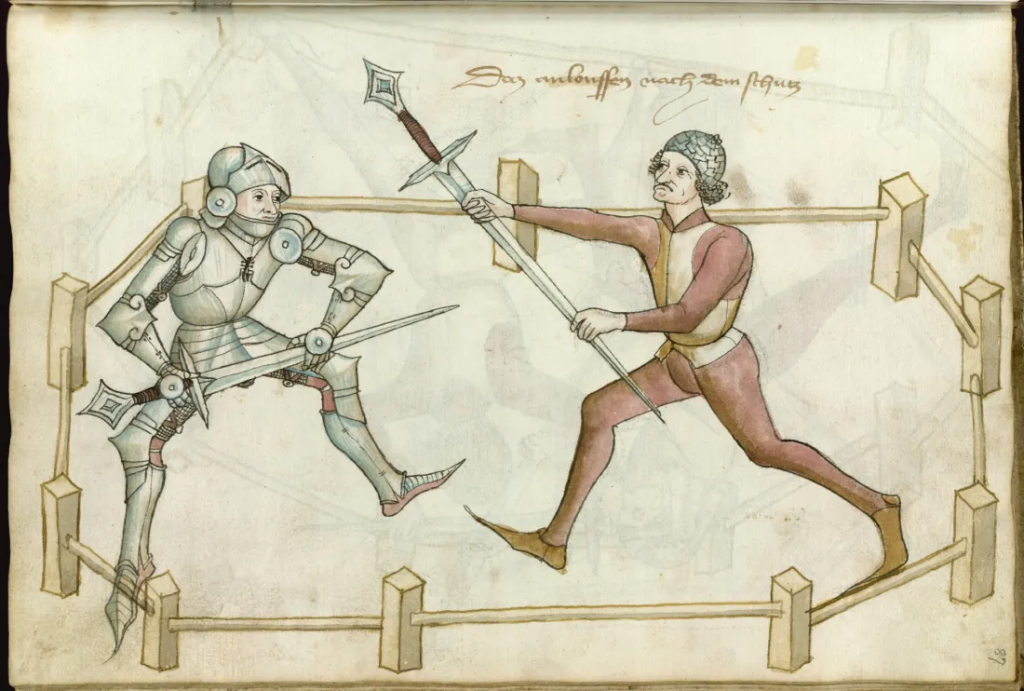
December 17, 2022
QotD: The female murderer
The woman who murders her husband has nearly always ceased to think of him as such, and cannot really believe that he ever stood in that relationship towards her. It is only a tiresome insistence on the part of the law that makes her drastic step necessary. She loves another man who is her husband “in the sight of God”, and it is to her both unreasonable and indecent that the first man should be obstructing her path.
Jesse writes things that I think would nowadays call down upon her all the anathemata of which right-thinking intellectuals are capable. In describing the trial of a Mrs. Carew, who poisoned her husband in order to join her illicit lover, Jesse says:
Her counsel made a point that did not succeed in weighing the scales in her favour … but which shows him to have been a man of some penetration in the matter of female psychology. He said: “It must be borne in mind that a woman never thinks it wrong for a man to be in love with her”, and when he said that he said something profoundly true. A woman may think it shows a lack of pride, utter shamelessness, complete lack of all decent feeling for another woman to be in love with her husband, but she will always feel convinced that it is a sign of something nice and perspicacious in a man for him to be in love with her.
This was written in 1924. Subsequently, it seems to me, male psychology has — in this regard, anyway — become feminized; what once applied specially to women now applies equally to men.
Theodore Dalrymple, “A Quiet Evening’s Reading: Notable British Trials is as complete an inventory of human depravity as has ever been assembled”, City Journal, 2018-06-24.


