
A lunar eclipse occurs when the Earth gets between the Moon and the Sun.
A solar eclipse occurs when the Moon gets between the Earth and the Sun.
A terrestrial eclipse occurs when the Earth gets between you and the Sun. Happens once per 24 hours.
An atmospheric eclipse occurs when an asteroid gets between you and the sky. Generally fatal.
A reverse solar eclipse occurs when the Sun gets between the Moon and the Earth. Extremely fatal.
A motivational eclipse occurs when the Moon gets between you and your goals. You can’t let it stop you! Destroy it! Destroy the Moon!
A marital eclipse occurs when the Moon gets between you and your spouse. You’re going to need to practice good communication about the new celestial body in your life if you want your relationship to survive.
A capillary eclipse occurs when your hair gets between your eyes and the Sun. Get a haircut.
A lexicographic eclipse occurs when “Moon” gets between “Earth” and “Sun” in the dictionary. All Anglophone countries are in perpetual lexicographic eclipse.
A filioque eclipse occurs when the Holy Spirit gets between the Father and the Son.
An apoc eclipse occurs when the Great Beast 666, with seven heads and ten horns, and upon the horns ten crowns, and upon its heads the name of blasphemy, gets between the Earth and the Sun. Extremely fatal.
Scott Alexander, “Little Known Types of Eclipse”, Slate Star Codex, 2019-05-02.
December 16, 2022
QotD: Little-known types of eclipse
December 15, 2022
QotD: From The Stepford Wives to The Handmaid’s Tale
Why feminist horror novel The Stepford Wives is still relevant, 50 years on
But before we get to the fisking (I’m running on fumes, y’all; the end of the summer is always the worst time for me), let’s pause for a moment to consider the TV show. You’d think there’d be one, right? Either that, or this is stoyak — The Stepford Wives, coming fall 2022 to Disney Plus. But it doesn’t appear to be. I googled “stepford wives tv show” and got this, which looks trashy enough, but in no way related to the book or movie. There was a remake of the 1970s movie back in 2004, but it bombed.
Odd, no? You’d think that shit would be chick crack — all those Strongk Confidant Wahmens digging into conspiracies and Sticking it to the Man ™. At least, that’s what I thought back in 2004. I thought the casting was dodgy — Kidman was too old (and too glamorous; you really need a pretty-but-not-Hollywood-pretty type) and Matthew Broderick too nebbishy. Nonetheless, I thought the premise would be strong enough to overcome it — oh, you poor, put-upon ladies! But nope.
And then The Handmaid’s Tale happened, as my students would’ve written back in the days, and now I understand why I’m wrong. I should’ve seen it 20 years ago, but better late than never, right? Let’s all have a good laugh at the really obvious thing I missed back in 2004: Strongk, Confidant Wahmens are neither strong nor confident, nor do they want to be either. They want the thinnest veneer of the pretense of the fantasy of those things, delivered to them by a man who comes on like Chad Thundercock, but always somehow has the time to listen to her.
The Handmaid’s Tale, that’s the real chick crack. It’s highbrow bondage porn for the kind of tertiary-educated lady who thinks Fifty Shades of Gray is way too trashy to rent (except, you know, one Girls’ Night with a box of white whine, as a “guilty pleasure”). It gets her all fired up for busting balls at the next partners’ meeting down at the law firm. So empowering!
In The Stepford Wives, book and original movie, the housewives are replaced by robots. The author, Ira Levin, was a guy, and I bet you could tell that just from the one-sentence plot summary. Being replaced by a robot isn’t a “feminist” fear, it’s a male fear. The worry that you’re nothing but a wallet with a criminally underserved dick attached has been pervasive among men since probably the Puritans. It’s a neat trick on Levin’s part, racking up mucho feminist street cred by selling them the #1 male neurosis of the postwar world.
Severian, “SJWs Always Project”, Founding Questions, 2022-08-08.
December 14, 2022
QotD: The “tooth-to-tail ratio” in armies
The Roman legion, for instance, was essentially all tooth. While there was a designation for support troops, the immunes, so named because they were immune from having to do certain duties in camp, these fellows were still in the battle line when the legion fought. The immunes included engineers, catapult-operators, musicians, craftsmen, and other specialists. Of course legions were also followed around by civilian non-combatants – camp-followers, sutlers, etc. – but in the actual ranks, the “tail” was minimal.
You can see much the same in the organization of medieval “lances” – units formed around a single knight. The Burgundian “lance” of the late 1400s was composed of nine men, eight of which were combatants (the knight, a second horsemen, the coustillier, and then six support soldiers, three mounted and three on foot) and one, the page, was fully a non-combatant. A tooth-to-tail ratio of 8:1. That sort of “tooth-heavy” setup is common in pre-industrial armies.
The industrial revolution changes a lot, as warfare begins to revolve as much around mobilizing firepower, typically in the form of mass artillery firepower as in mobilizing men. We rarely in our fiction focus on artillery, but modern warfare – that is warfare since around 1900 – is dominated by artillery and other forms of [indirect] fires. Artillery, not tanks or machine guns, after all was the leading cause of combat death in both World Wars. Suddenly, instead of having each soldier carry perhaps 30-40kg of equipment and eat perhaps 1.5kg of food per day, the logistics concern is moving a 9-ton heavy field gun that might throw something like 14,000kg of shell per day during a barrage, for multiple days on end. Suddenly, you need a lot more personnel moving shells than you need firing artillery.
As armies motorized after WWI and especially after WWII, this got even worse, as a unit of motorized or mechanized infantry needed a small army of mechanics and logistics personnel handling spare parts in order to stay motorized. Consequently, tooth-to-tail ratios plummeted, inverted and then kept going. In the US Army in WWI, the ratio was 1:2.6 (note that we’ve flipped the pre-industrial ratio, that’s 2.6 non-combat troops for every front line combat solider), by WWII it was 1:4.3 and by 2005 it was 1:8.1. Now I should note there’s also a lot of variance here too, particularly during the Cold War, but the general trend has been for this figure to continue increasing as more complex, expensive and high-tech weaponry is added to warfare, because all of that new kit demands technicians and mechanics to maintain and supply it.
[NR: Early in WW2, British Prime Minister Winston Churchill frequently harassed his various North African generals for the disparity between the “ration strength” of their commands and the much-smaller number of combat troops deployed. If General Wavell had 250,000 drawing rations, Churchill (who last commanded troops in the field in mid-WW1) assumed that this meant close to 200,000 combat troops available to fight the Italians and (later) the Germans. This almost certainly contributed to the high wastage rate of British generals in the Western Desert.]
Bret Devereaux, “Fireside Friday, April 22, 2022”, A Collection of Unmitigated Pedantry, 2022-04-22.
December 13, 2022
QotD: Postwar Germany
Theodore Dalrymple, “The Specters Haunting Dresden”, City Journal, 2005-01.
December 12, 2022
QotD: Oversensitivity is not constrained by the mere passage of time
It seems a reader of the Mercury ran across a brief news item about the suicide of a 16-year-old girl in its pages, and was horrified at the sensational, detailed nature of the report. The story described Dorothy Balchin as being “of a reserved and morbid disposition” and described the romantic disappointment — a beau’s emigration to Australia — that preceded her suicide. The newspaper noted that a photograph of her boyfriend was found immediately below her hanged body, and even printed the text of two notes she left. In other words, the news copy broke every rule that newspapers now normally observe in mentioning suicide.
But of course no one had thought of any of those rules in the year 1912.
Which is when the story had appeared in the Mercury.
Which didn’t stop some reader from complaining to the paper in the year 2019.
Colby Cosh, “Want a newspaper job? Dream of making films? Be careful what you wish for”, National Post, 2019-05-09.
December 11, 2022
QotD: Democracy
Democracy’s founding fictions reinforce this. It’s easy to see yourself as the People’s Tribune, I imagine, if you just look at the numbers. All those people voted for you, which confirms how wonderful you are!
A better analogy is the professional sports team. Lots of people wear the team apparel of the Los Angeles Chargers. You can find lots of online forums passionately devoted to them. Lots of L.A.-area bars are festooned with Chargers’ stuff. The bobbleheads at ESPN talk about the Chargers several times a day. And yet, come game time, the Chargers only get about 32,000 fans at the stadium. Those are the actual voters — the rest is just social media noise. And it’s worse than that, actually. We all know that the vast majority of people who picked up a Chargers’ shirt because it was in the clearance bin, or ordered a drink at a bar with Chargers’ memorabilia on the shelf, would never bother to attend a game. So even people who think of themselves as “Democrats” or “Republicans” barely bother to vote, much less follow “their” team in office. Even the groups that get pandered to the most — old people, veterans, union goofs — don’t turn out in proportionate numbers.
Come election day, the People’s Tribunes are decided by old cranks on loan from the home, a few office drones on their lunch break with nothing better to do, and homeless people lured in with a promise of a short dog and some change.
But since no one without a vast, yawning chasm in her soul would ever submit herself to the indignities of “democracy” in the first place, these newly “elected” fools hie themselves to Washington, where the money boys feed their self-delusion. They read about themselves in the newspapers, see their names on internal party polls, and since none of their “constituents” could pick them out of a police lineup, they learn that the only way to keep the applause coming is by doing what the newspapers and the money boys say.
Severian, “Impeachment Thoughts”, Rotten Chestnuts, 2019-12-19.
December 10, 2022
QotD: The Western Roman Empire – “decline and fall” or “change and continuity”?
With that out of the way, the old view, that of Edward Gibbon (1737-1794) and indeed largely the view of the sources themselves, was that the disintegration of the western half of the Roman polity was an unmitigated catastrophe, a view that held largely unchallenged into the last century; Gibbon’s great work, The History of the Decline and Fall of the Roman Empire (1789) gives this school its name, “decline and fall“. While I am going at points to gesture to Gibbon’s thinking, we’re not going to debate him; he is the “old man” of our title. Gibbon himself largely exists only in historiographical footnotes and intellectual histories; he is not at this point seriously defended nor seriously attacked but discussed as the venerable, but now out of date, origin point for all of this bickering.
The real break with that view came with the work of Peter Brown, initially in his The World of Late Antiquity (1971) and more or less canonically in The Rise of Western Christendom (1st ed. 1996; 2nd ed. 2003, 3rd ed. 2013). The normal way to refer to the Peter Brown school of thought is “change and continuity” (in contrast to the traditional “decline and fall”), though I rather like James O’Donnell’s description of it as the Reformation in late antique studies.
Among medievalists this reformed view, which focuses on continuity of culture and institutions from late antiquity to the early Middle Ages, remains essentially the orthodoxy, to the point that, for instance, the very recent (and quite excellent) The Bright Ages: A New History of Medieval Europe (2021) can present this vision as an uncomplicated fact, describing the “so-called Fall of Rome” and noting that “there was never a moment in the next thousand years in which at least one European or Mediterranean ruler didn’t claim political legitimacy through a credible connection to the empire of the Romans” and that “the idea that Rome ‘fell’ on the other hand, relies upon a conception of homogeneity – of historical stasis … things changed. But things always change” (3-4, 12-3). As we’ll see, I don’t entirely disagree with those statements, but they are absolute to a degree that suggests there is no real challenge to the position. There have been a few cracks in this orthodoxy among medievalists, particularly the work of Robin Flemming (a revision, not a clear break, to be sure), to which we’ll return, but the cracks have been relatively few.
While some ancient historians also bought into this view, purchase there has always been uneven and seems, to me at least, now to be waning further. Instead, a process of what James O’Donnell describes as a “counter-reformation” (which he stoutly resists with his own The Ruin of the Roman Empire; O’Donnell is a declared reformer) is well underway, a response to the “change and continuity” narrative which seeks to update and defend the notion that there really was a fall of Rome and that it really was quite bad actually. This is not, I should note, an effort to revive Gibbon per se; it does not typically accept his understanding of the cause of this decline (and often characterizes exactly what is declining differently). Nevertheless, this position too is sometimes termed the “decline and fall” school. My own sense of the field is that while nearly all ancient historians will feel the need to concede at least some validity to the reformed “change and continuity” vision, that the counter-reformation school is the majority view among ancient historians at this point (in a way that is particularly evident in overview treatments like textbooks or the Cambridge Ancient History (second edition)). We’ll meet many of the core works of this revised “decline and fall” school as we go.
As O’Donnell noted in a 2005 review for the BMCR, the reformed school tends to be strongest in the study of the imperial east rather than the west (something that will make a lot of sense in a moment), and in religious and cultural history; the counter-reformation school is stronger in the west than the east and in military and political history, though as we’ll see, to that list must at this point now be added archaeology along with demographic and economic history, at which point the weight of fields tends to get more than a little lopsided.
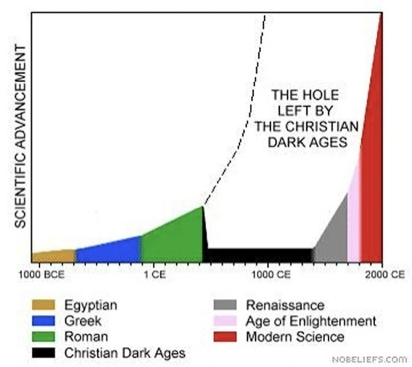
Those are our two knights – the “change and continuity” knight and the “decline and fall” knight (and our old man Gibbon, long out of his dueling days). To this we must add the nitwit: a popular vision, held by functionally no modern scholars, which represents the Middle Ages in their entirety as a retreat from a position of progress during the Roman period which was only regained during the “Renaissance” (generally represented as a distinct period from the Middle Ages) which then proceeded into the upward trajectory of the early modern period. Intellectually, this vision traces back to what Renaissance thinkers thought about themselves and their own disdain for “medieval” scholastic thinking (that is, to be clear, the thinking of their older teachers), a late Medieval version of “this ain’t your daddy’s rock and roll!”
But almost every intellectual movement represents itself as a radical break with the past (including, amusingly, many of the scholastics! Let me tell you about Peter Abelard sometime); as historians we do not generally accept such claims uncritically at face value. For a long time, well into the 19th century, the Renaissance’s cultural cachet in Europe (and the cachet of the classical period where it drew its inspiration) shielded that Renaissance claim from critique; that patina now having worn thin, most scholars now reject it, positioning the Renaissance as a continuation (with variations on the theme) of the Middle Ages, a smooth transition rather than a hard break. At the same time, knowledge of developments within the Middle Ages have made the image of one unbroken “Dark Age” untenable and made clear that the “upswing” of the early modern period was already well underway in the later Middle Ages and in turn had its roots stretching even deeper into the period. It is also worth noting here, that the term “Dark Age” has to do with the survival of evidence, not living conditions: the age was not dark because it was grim, it was dark because we cannot see it as clearly.
The popular version of this idea continues, however, to have a lot of sway in the popular conception of the Middle Ages, encouraged by popular culture that mistakes the excesses of the early modern period for “medieval” superstition and exaggerates the poverty of the medieval period (itself essentialized to its worst elements despite being approximately a millennia long), all summed up in this graph:
We are mostly going to just dunk relentlessly on this graph and yet we will not cover even half of the necessary dunking this graph demands. We may begin by noting that in its last century, the Roman Empire was Christian, a point apparently missed here.
While that sort of vision is not seriously debated by scholars, it needs to be addressed here too, in part because I suspect a lot of the energy behind the “change and continuity” position is in fact to counter some of the worst excesses of this thesis, which for simplicity, we’ll just refer to as “The Dung Ages” argument, but also because assessing how bad the fall of the Roman Empire in the West was demands that we consider how long-lasting any negative ramifications were.
Bret Devereaux, “Collections: Rome: Decline and Fall? Part I: Words”, A Collection of Unmitigated Pedantry, 2022-01-14.
December 9, 2022
QotD: Computer models of “the future”
Second, the video ignores the fact that human behavior changes in response to circumstance, sometimes in radically unpredictable ways. I might predict that we will hit peak oil (or be extremely wealthy) if I extrapolate various trends. However, as oil becomes scarce, people discover new ways to obtain it or do without it. As people become wealthier, they become less interested in the pursuit of wealth and therefore become poorer. Both of those scenarios, however, assume that humanity will adopt a moral and optimistic stance. If humans become decadent and pessimistic, they might just start wars and end up feeding off the scraps.
So, interestingly, what the future looks like might be as much a function of the music we listen to, the books we read, and the movies we watch when we are young as of the resources that are available.
Note that the solution they propose to our problems is internationalization. The problem with internationalizing everything is that people have no one to appeal to. We are governed by a number of international laws, but when was the last time you voted in an international election? How do you effect change when international policies are not working out correctly? Who do you appeal to?
The importance of nationalism is that there are well-known and generally-accepted procedures for addressing grievances with the ruling class. These international clubs are generally impervious to the appeals (and common sense) of ordinary people and tend to promote virtue-signaling among the wealthy class over actual virtue or solutions to problems.
Jonathan Bartlett, quoted in “1973 Computer Program: The World Will End In 2040”, Mind Matters News, 2019-05-31.
December 8, 2022
QotD: Politicians’ public displays of sorrow
Theodore Dalrymple, “Tears of a Tyrant”, Taki’s Magazine, 2018-04-28.
December 7, 2022
QotD: Career path from recent B.A. to being “an expert” on national TV
Just for giggles, I clicked on the bio of the cutest contributor — called, hilariously, “analysts and associates” — a
womangirlpersyn named Karolina Hird. Here’s her official bio, in full:
Karolina is a Russia Researcher on the Russia/Ukraine portfolio at ISW. She graduated from George Washington University in December of 2021 with a B.A. in International Affairs and a concentration in Security Studies. Karolina’s undergraduate research examined aspects of international law and Eastern European security with a special focus on the rise of Polish populism. She has also conducted research pertaining to Russian objectives and geopolitical strategies on NATO’s Southern periphery.
Did everyone catch that? A Bachelor’s Degree. In December 2021. This gal is all of nine months out of college.
I’ve read my share of undergraduate research. Some of it is decent. There are some undergrads I’d trust to hit the archives for limited purposes. But there are no 21 year old kids on this earth whose judgments I’d trust, because I’ve taught a LOT of college kids, and y’all …But of course she’s not doing anything policy-related. You know how this kid’s career trajectory will go: A few years at ISW, in which she’ll start appearing as a guest on the “news” as a “Ukrainian affairs expert” — and you can tell she’s an expert, because she’s an “analyst” at the “Institute for the Study of War”. Once her looks start going, she’ll move over to a staff job for some politician, then off to a think tank, then maybe a run for office in her own right, then back to the Media as a “senior analyst”. I’d wager many crisp stacks of Crispus Attucks that this lady couldn’t tell the difference between a MiG-31 and a Mazda Miata, but we’re a year or two away from putting her on national TV as an “expert” on war and peace.
How do you stop that kind of thing? How would you even start?
Severian, “Slipping the Leash”, Founding Questions, 2022-08-27.
December 6, 2022
QotD: Mao Zedong’s theory of “Protracted War”
The situation for the Chinese Communists in 1938 was a difficult one. The Chinese Red Army has set up a base of power in the early 1930s in Jiangxi province in South-Eastern China, but in 1934 had been forced by Kuomintang Nationalist forces under Chiang Kai-shek to retreat, eventually rebasing over 5,000 miles away (they’re not able to straight-line the march) in Shaanxi in China’s mountainous north in what became known as The Long March. Consequently, no one could be under any illusions of the relative power of the Chiang’s nationalist forces and the Chinese Red Army. And then, to make things worse, in 1937, Japan had invaded China (the Second Sino-Japanese War, which was a major part of WWII), beating back the Nationalist armies which had already shown themselves to be stronger than the Communists. So now Mao has to beat two armies, both of which have shown themselves to be much stronger than he is (though in the immediate term, Mao and Chiang formed a “United Front” against Japan, though tensions remained high and both sides expected to resume hostilities the moment the Japanese threat was gone). Moreover, Mao’s side lacks not only the tools of war, but the industrial capacity to build the tools of war – and the previous century of Chinese history had shown in stark terms how difficult a situation a non-industrial force faced in squaring off against industrial firepower.
That’s the context for the theory.
What Mao observed was that a “war of quick decision” would be one that the Red Army would simply lose. Because he was weaker, there was no way to win fast, so trying to fight a “fast” war would just mean losing. Consequently, a slow war – a protracted war – was necessary. But that imposes problems – in a “war of quick decision” the route to victory was fairly clear: destroy enemy armed forces and seize territory to deny them the resources to raise new forces. Classic Clausewitzian (drink!) stuff. But of course the Red Army couldn’t do that in 1938 (they’d just lose), so they needed to plan another potential route to victory to coordinate their actions. That is, they need a strategic framework – remember that strategy is the level of military analysis where we think about what our end goals should be and what methods we can employ to actually reach those goals (so that we are not just blindly lashing out but in fact making concrete progress towards a desired end-state).
Mao understands this route as consisting of three distinct phases, which he imagines will happen in order as a progression and also consisting of three types of warfare, all of which happen in different degrees and for different purposes in each phase. We can deal with the types of warfare first:
- Positional Warfare is traditional conventional warfare, attempting to take and hold territory. This is going to be done generally by the regular forces of the Red Army.
- Mobile Warfare consists of fast-moving attacks, “hit-and-run”, performed by the regular forces of the Red Army, typically on the flanks of advancing enemy forces.
- Guerrilla Warfare consists of operations of sabotage, assassination and raids on poorly defended targets, performed by irregular forces (that is, not the Red Army), organized in the area of enemy “control”.
The first phase of this strategy is the enemy strategic offensive (or the “strategic defensive” from the perspective of Mao). Because the enemy is stronger and pursuing a conventional victory through territorial control, they will attack, advancing through territory. In this first phase, trying to match the enemy in positional warfare is foolish – again, you just lose. Instead, the Red Army trades space for time, falling back to buy time for the enemy offensive to weaken rather than meeting it at its strongest, a concept you may recall from our discussions of defense in depth. The focus in this phase is on mobile warfare, striking at the enemy’s flanks but falling back before their main advances. Positional warfare is only used in defense of the mountain bases (where terrain is favorable) and only after the difficulties of long advances (and stretched logistics) have weakened the attacker. Mobile warfare is supplemented by guerrilla operations in rear areas in this phase, but falling back is also a key opportunity to leave behind organizers for guerrillas in the occupied zones that, in theory at least, support the retreating Red Army (we’ll come back to this).
Eventually, due to friction (drink!) any attack is going to run out of steam and bog down; the mobile warfare of the first phase is meant to accelerate this, of course. That creates a second phase, “strategic stalemate” where the enemy, having taken a lot of territory, is trying to secure their control of it and build new forces for new offensives, but is also stretched thin trying to hold and control all of that newly seized territory. Guerrilla attacks in this phase take much greater importance, preventing the enemy from securing their rear areas and gradually weakening them, while at the same time sustaining support by testifying to the continued existence of the Red Army. Crucially, even as the enemy gets weaker, one of the things Mao imagines for this phase is that guerrilla operations create opportunities to steal military materiel from the enemy so that the factories of the industrialized foe serve to supply the Red Army – safely secure in its mountain bases – so that it becomes stronger. At the same time (we’ll come back to this), in this phase capable recruits are also be filtered out of the occupied areas to join the Red Army, growing its strength.
Finally in the third stage, the counter-offensive, when the process of weakening the enemy through guerrilla attacks and strengthening the Red Army through stolen supplies, new recruits and international support (Mao imagines the last element to be crucial and in the event it very much was), the Red Army can shift to positional warfare again, pushing forward to recapture lost territory in conventional campaigns.
Through all of this, Mao stresses the importance of the political struggle as well. For the guerrillas to succeed, they must “live among the people as fish in the sea”. That is, the population – and in the China of this era that meant generally the rural population – becomes the covering terrain that allows the guerrillas to operate in enemy controlled areas. In order for that to work, popular support – or at least popular acquiescence (a village that doesn’t report you because it supports you works the same way as a village that doesn’t report you because it hates Chiang or a village that doesn’t report you because it knows that it will face violence reprisals if it does; the key is that you aren’t reported) – is required. As a result both retreating Red Army forces in Phase I need to prepare lost areas politically as they retreat and then once they are gone the guerrilla forces need to engage in political action. Because Mao is working with a technological base in which regular people have relatively little access to radio or television, a lot of the agitation here is imagined to be pretty face-to-face, or based on print technology (leaflets, etc), so the guerrillas need to be in the communities in order to do the political work.
Guerrilla actions in the second phase also serve a crucial political purpose: they testify to the continued existence and effectiveness of the Red Army. After all, it is very important, during the period when the main body of Communist forces are essentially avoiding direct contact with the enemy that they not give the impression that they are defeated or have given up in order to sustain will and give everyone the hope of eventual victory. Everyone there of course also includes the main body of the army holed up in its mountain bases – they too need to know that the cause is still active and that there is a route to eventual victory.
Fundamentally, the goal here is to make the war about mobilizing people rather than about mobilizing industry, thus transforming a war focused on firepower (which you lose) into a war about will – in the Clausewitzian (drink! – folks, I hope you all brought more than one drink for this …) sense – which can be won, albeit only slowly, as the slow trickle of casualties and defeats in Phase II steadily degrades enemy will, leading to their weakness and eventual collapse in Phase III.
I should note that Mao is very open that this protracted way of war would be likely to inflict a lot of damage on the country and a lot of suffering on the people. Casualties, especially among the guerrillas, are likely to be high and the guerrillas own activities would be likely to produce repressive policies from the occupiers (not that either Chiang’s Nationalists of the Imperial Japanese Army – or Mao’s Communists – needed much inducement to engage in brutal repression). Mao acknowledges those costs but is largely unconcerned by them, as indeed he would later as the ruler of a unified China be unconcerned about his man-made famine and repression killing millions. But it is important to note that this is a strategic framework which is forced to accept, by virtue of accepting a long war, that there will be a lot of collateral damage.
Now there is a historical irony here: in the event, Mao’s Red Army ended up not doing a whole lot of this. The great majority of the fighting against Japan in China was positional warfare by Chiang’s Nationalists; Mao’s Red Army achieved very little (except preparing the ground for their eventual resumption of war against Chiang) and in the event, Japan was defeated not in China but by the United States. Japanese forces in China, even at the end of the war, were still in a relatively strong position compared to Chinese forces (Nationalist or Communist) despite the substantial degradation of the Japanese war economy under the pressure of American bombing and submarine warfare. But the war with Japan left Chiang’s Nationalists fatally weakened and demoralized, so when Mao and Chiang resumed hostilities, the former with Soviet support, Mao was able to shift almost immediately to Phase III, skipping much of the theory and still win.
Nevertheless, Mao’s apparent tremendous success gave his theory of protracted war incredible cachet, leading it to be adapted with modifications (and variations in success) to all sorts of similar wars, particularly but not exclusively by communist-aligned groups.
Bret Devereaux, “Collections: How the Weak Can Win – A Primer on Protracted War”, A Collection of Unmitigated Pedantry, 2022-03-03.
December 5, 2022
QotD: Open concept house designs
A single room could serve as a study in the morning, a dining room at noon, a living room in the evening, and a bedroom at night. Beds were couches, and couches were beds. Your house was your workspace, and your minimal furniture typically had no fixed arrangement, as it was constantly moved about to accommodate different uses of the only room available. (The French and Italian words for “furniture” still hint at this history: You can see the similarity to “mobile” in meubles and mobilia.)
These open concepts of old were not only motivated by different conceptions of privacy and the expense of building additional walls. They were also required for the lower classes by premodern heating technologies. A single open hearth, or, later, fireplace or stove, could warm one large room but could not do much for other, closed-off spaces. A lord or king could build a heating element into every room, but for the average family, winter warmth required most of life to happen in a single space.
As technology advanced, ideas about privacy changed, and standards of living improved over the last 500 years, ordinary people were increasingly able to move away from an open concept home, and they eagerly did so. “Rooms began to proliferate as wealthy householders discovered the satisfactions of having space to themselves,” notes Bill Bryson in At Home: A Short History of Private Life. Though the transition was slow — toilets long had “multiple seats, for ease of conversation” — rooms were increasingly devoted to particular uses, and those uses were separated from one another as much as resources permitted.
Bonnie Kristian, “Open concept homes are for peasants”, The Week, 2019-05-12.
December 4, 2022
QotD: In praise of mediocrity
Mediocrity is not a problem in itself; it is inevitable. Indeed the world needs many mediocrities, that is to say mediocrities who know themselves, and are perfectly content, to be such (complacency is as much an underestimated quality as rebelliousness is an overestimated one). The problem with mediocrity begins when it is allied to overweening ambition, as it seems so often to be the case nowadays.
Ambition is likewise a quality that is excellent when it attaches to something worthwhile in itself, but which is dreadful when it does not. And the rapid and phenomenal spread of education has increased the spread of ambition with it, much of it inevitably of the apparatchik type, that is to say the determination to climb some bureaucratic career ladder detached from any purpose except survival and, if possible, self-aggrandizement. To climb such a ladder you have to be both ruthless and submissive at the same time. You have to be egotistically prepared to stab people in the back in the scramble for advancement, while at the same time being prepared to suppress your own personality by uttering other people’s clichés at the expense of your own thoughts. Unpreparedness to do this, either through lack of training or moral scruple, unfits you for a career in the organization, any organization. You have to learn to lie with clichés, and do so with a straight face.
Theodore Dalrymple, “In Defense of Mediocrity”, Taki’s Magazine, 2018-02-17.
December 3, 2022
QotD: Mantetsu and the Kwantung Army
Thus the South Manchuria Railway Corporation, originally contracted to develop a defunct line in a disputed territory, soon developed into a full-spectrum enterprise. Pretty much all heavy industry in the Japanese areas of Manchuria were divisions of Mantetsu. But since all the heavy industry depended on mines, and transportation, and food and housing for workers, and banks, and schools for the workers’ children, etc., pretty soon Mantetsu ran all of that, too. By the late 1920s, you could argue that Mantetsu was almost its own country.
It even had its own army, and that’s where things get really interesting.
The Kwantung Army was the security force assigned to the South Manchuria Railway Zone. The Japanese weren’t stupid; they knew the perils of independent commands far from home, and they rotated units through with some regularity. Nonetheless, the command staff remained fairly stable over the years … and so did Mantetsu’s.
The Japanese weren’t stupid, but they were people, and people being people, soon enough the lines between the Kwantung Army and Mantetsu began to blur. And since the lines between Mantetsu, the Imperial Army, and the government were already pretty blurry, pretty soon the concerns of one became the concern of all. (Nor was the Navy left out, though I’m not discussing them in order to keep it simple. They were up to their eyeballs in Mantetsu, too, because warships need lots of steel and steel comes from Manchuria).
A small but highly committed and totally ideologized faction developed inside the Kwantung Army. Several, in fact, and one of them (the Imperial Way faction) attempted an actual coup d’etat in 1936. It was put down, and the Imperial Way faction dissolved (in theory), but the problem of an intensely ideologized officer corps remained. Long story short, you had a small group of highly ideologized officers garrisoning a remote province pulling the entire Empire into big, unwinnable wars.
One could make the case that World War II in the Pacific was ultimately caused by about fifteen or twenty guys in the Kwantung Army.
That’s overly reductionist, but it highlights the huge problem with organizations slipping the leash. In theory, there was a clear chain of command, and even the head of the Kwantung Army was a down it a ways — he was subordinate to the Army Council, which was subordinate to the War Minister, who was subordinate to the Parliament, who were subordinate to the Emperor. In theory, lots of people could’ve sacked Gen. Araki, or his mini-me Ishiwara Kanji (a lieutenant colonel through most of it). Equally in theory, Mantetsu had no say in any of it — the Kwantung Army was a formation of the Imperial Japanese Army, not Mantetsu’s private security force.
But in reality, Mantetsu was so wired in to the Japanese government that in a lot of cases, it was the government. But not always, because the same could be said about the Army, and the Navy, both of which were also wired into Mantetsu up to the very top (or vice versa, your choice). And Mantetsu had their Media arm, of course, as did the Army and Navy …
What all this boiled down to, then, was a power vacuum. I know, that seems weird, but a skilled bureaucratic infighter like Ishiwara never lacked for groups to play against each other. The Army and Navy would oppose on principle any move that seemed to aggrandize the other, neither could go against Mantetsu (and neither could control it), and all had to pay at least lip service to the civilian government. Because of this, real power fell to whomever had the balls to grab it …
… which was the officer corps of the Kwantung Army. They assassinated at least two Manchurian warlords, staged a number of false flag attacks on their own positions, and generally got up to however you say “standard issue Juggalo fuckery” in Japanese, up to and including a full-scale war with China.
Severian, “Slipping the Leash”, Founding Questions, 2022-08-27.
December 2, 2022
QotD: Rome’s legions settle down to permanent fortresses
What absolutely does begin happening during the reign of Augustus and subsequently is that the Roman legions, which had spent the previous three centuries on the move outside of Italy, begin to settle down more permanently on Rome’s new frontiers, particularly along the Rhine/Danube frontier facing Central and Eastern Europe and the Syrian frontier facing the Parthian Empire. That in turn meant that Roman legions (and their supporting auxiliary cohorts) now settled into permanent forts.
The forts themselves, at least in the first two centuries, provide a fairly remarkably example of institutional inertia. While legionary forts of this early period typically replaced the earthwork-and-stakes wall (the agger and vallum) with stone walls and towers and the tents of the camp with permanent barracks, the basic form of the fort: its playing-card shape, encircling defensive ditches (now very often two or three ditches in sequence) remain. Of particular note, these early imperial legionary forts generally still feature towers which do not project outward from the wall, a stone version of the observation towers of the old Roman marching camp. Precisely because these fortifications are in stone they are often very archaeologically visible and so we have a fairly good sense of Roman forts in this period. In short then, put in permanent positions, Roman armies first constructed permanent versions of their temporary marching camps.
And that broadly seems to fit with how the Romans expected to fight their wars on these frontiers. The general superiority of Roman arms in pitched battle (the fancy term here is “escalation dominance” – that escalating to large scale warfare favored the heavier Roman armies) meant that the Romans typically planned to meet enemy armies in battle, not sit back to withstand sieges (this was less true on Rome’s eastern frontier since the Parthians were peer competitors who could rumble with the Romans on more-or-less even terms; it is striking that the major centers in the East like Jerusalem or Antioch did not get rid of their city walls, whereas by contrast the breakdown of Roman order in the third century AD and subsequently leads to a flurry of wall-building in the west where it is clear many cities had neglected their defensive walls for quite a long time). Consequently, the legionary forts are more bases than fortresses and so their fortifications are still designed to resist sudden raids, not large-scale sieges.
They were also now designed to support much larger fortification systems, which now gives us a chance to talk about a different kind of fortification network: border walls. The most famous of these Roman walls of course is Hadrian’s Wall, a mostly (but not entirely) stone wall which cuts across northern England, built starting in 122. Hadrian’s Wall is unusual in being substantially made out of stone, but it was of-a-piece with various Roman frontier fortification systems. Crucially, the purpose of this wall (and this is a trait it shares with China’s Great Wall) was never to actually prevent movement over the border or to block large-scale assaults. Taking Hadrian’s wall, it was generally manned by something around three legions (notionally; often at least one of the legions in Britain was deployed further south); even with auxiliary troops nowhere near enough to actually manage a thick defense along the entire wall. Instead, the wall’s purpose is slowing down hostile groups and channeling non-hostile groups (merchants, migrants, traders, travelers) towards controlled points of entry (valuable especially because import/export taxes were a key source of state revenue), while also allowing the soldiers on the wall good observation positions to see these moving groups. You can tell the defense here wasn’t prohibitive in part because the main legionary fortresses aren’t generally on the wall, but rather further south, often substantially further south, which makes a lot of sense if the plan is to have enemies slowed (but not stopped) by the wall, while news of their approach outraces them to those legionary forts so that the legions can form up and meet those incursions in an open battle after they have breached the wall itself. Remember: the Romans expect (and get) a very, very high success rate in open battles, so it makes sense to try to force that kind of confrontation.
This emphasis on controlling and channeling, rather than prohibiting, entry is even more visible in the Roman frontier defenses in North Africa and on the Rhine/Danube frontier. In North Africa, the frontier defense system was structured around watch-posts and the fossatum Africae, a network of ditches (fossa) separating the province of Africa (mostly modern day Tunisia) from non-Roman territory to its south. It isn’t a single ditch, but rather a system of at least four major segments (and possibly more), with watch-towers and smaller forts in a line-of-sight network (so they can communicate); the ditch itself varies in width and depth but typically not much more than 6m wide and 3m deep. Such an obstruction is obviously not an prohibitive defense but the difficulty of crossing is going to tend to channel travelers and raids to the intentional crossings or alternately slow them down as they have to navigate the trench (a real problem here where raiders are likely to be mounted and so need to get their horses and/or camels across).
On the Rhine and the Danube, the defense of the limes, the Roman frontier, included a border wall (earthwork and wood, rather than stone like Hadrian’s wall), similarly supported by legions stationed to the rear, with road networks positioned; once again, the focus is on observing threats, slowing them down and channeling them so that the legions can engage them in the field. This is a system based around observe-channel-respond, rather than an effort to block advances completely.
Bret Devereaux, “Collections: Fortification, Part II: Romans Playing Cards”, A Collection of Unmitigated Pedantry, 2021-11-12.


