
The first sin is the sin of of not having a strategy in the first place, what we might call “emotive” strategy. As Clausewitz notes, policy (again, note above how what we’re calling strategy is closest to policy in Clausewitz’ sense) is “subject to reason alone” whereas the “primordial violence, hatred and enmity” is provided for in another part of the trinity (“will” or “passion”). To replace policy with passion is to invert their proper relationship and court destruction.
The second sin is the elevation of operational concerns over strategic ones, the usurpation of strategy with operations, which we have discussed before. This is, by the by, also an error in managing the relationship of the trinity, allowing the general’s role in managing friction to usurp the state’s role in managing politics.
Perhaps the greatest example of this is the Japanese attack on Pearl Harbor; an operational consideration (the destruction of the US Pacific Fleet) and even the tactics necessary to achieve that operational objective, were elevated above the strategic consideration of “should Japan, in the midst of an endless, probably unwinnable war against a third-rate power (the Republic of China) also go to war with a first-rate power (the United States) in order to free up oil-supplies for the first war”. Hara Tadaichi’s pithy summary is always worth quoting, “We won a great tactical victory at Pearl Harbor and thereby lost the war.”
How does this error happen? It tends to come from two main sources. First, it usually occurs most dramatically in military systems where the military leadership – which has been trained for operations and tactics, not strategy, which you will recall is the province of kings, ministers and presidents – usurps the leadership of the state. Second, it tends to occur when those military leaders – influenced by their operational training – take the operational conditions of their planning as assumed constants. “What do we do if we go to war with the United States” becomes “What do we do when we go to war with the United States” which elides out the strategic question “should we go to war with the United States?” entirely – and catastrophically, as for Imperial Japan, the answer to that unasked question of should we do this was clearly Oh my, NO.
(Bibliography note: It would hardly be fitting for me to declare these errors common and not provide examples. Two of the best case-studies I have read in this kind of strategic-thinking-failure-as-organizational-culture-failure are I. Hull, Absolute Destruction: Military Culture and the Practices of War in Imperial Germany (2005) and Parshall and Tully, Shattered Sword: The Untold Story of the Battle of Midway (2005). Also worth checking out, Daddis, “Chasing the Austerlitz Ideal: The Enduring Quest for Decisive Battle” in Armed Forces Journal (2006): 38-41. The same themes naturally come up in Daddis, Withdrawal: Reassessing America’s Final Years in Vietnam (2017)).
The third and final sin is easy to understand: a failure to update the strategy as conditions change. Quite often this happens in conjunction with the second sin, as once those operational concerns take over the place of strategy, it becomes difficult for leaders to consider new strategy as opposed to simply new operations in the pursuit of strategic goals which are often already lost beyond all retrieval. But this can happen without a subordination failure, due to sunk-costs and the different incentives faced by the state and its leaders. The classic example being functionally every major power in the First World War: by 1915 or 1916, it ought to have been obvious that no gains made as a result of the war could possibly be worth its continuance. Yet it was continued, both because having lost so much it seemed wrong to give up without “victory” and also because, for the politicians who had initially supported the war, to admit it was a useless waste was political suicide.
Bret Devereaux, “Collections: The Battle of Helm’s Deep, Part VIII: The Mind of Saruman”, A Collection of Unmitigated Pedantry, 2020-06-19.
April 14, 2023
QotD: The three great strategic sins
April 13, 2023
QotD: The real purpose of modern-day official commissions
Official enquiries these days do not impress me, certainly not by comparison with those of our Victorian forefathers. No one who reads the Blue Books of Victorian Britain, for example, can fail to be impressed by the sheer intellectual honesty of them, their complete absence of any attempt to disguise an often appalling reality by means of euphemistic language, and their diligence in collecting the most disturbing information. (Marx himself paid tribute to the compilers of these reports.)
I was once asked to join an enquiry myself. It was into an unusual spate of disasters in a hospital. It was clear to me that, although they had all been caused differently, there was an underlying unity to them: they were all caused by the laziness or stupidity of the staff, or both. By the time the report was written, however (and not by me), my findings were so wrapped in opaque verbiage that they were quite invisible. You could have read the report without realising that the staff of the hospital had been lazy and stupid; in fact, the report would have left you none the wiser as to what had actually happened, and therefore what to do to ensure that it never happened again. The purpose of the report was not, as I had naively supposed, to find the truth and express it clearly, but to deflect curiosity and incisive criticism in which it might have resulted if translated into plain language.
Theodore Dalrymple, “It’s a riot”, New English Review, 2012-04.
April 12, 2023
QotD: Karen
self-propelled lifestyle accessorieskids while she gets exalted at hot yoga and the nail salon, now that school’s out. Give her a week without Starbucks, I said, locked in her house with Kayden, Brayden, Jayden, and Khaleesi, and she’ll demand we never mention the word “flu” again.In other words, I misunderstood the essence of Karen. Karen is — first, foremost, and always — a victim. I of all people should’ve known better, because I was surrounded by Karens all the time in my personal and professional life. I’ve mentioned this story before, but bear with a quick repeat: At one of my first teaching gigs, at the big directional tech that makes up a lot of “Flyover State”, the department’s women got it into their vapid little heads that they — women — were being systematically excluded from positions of power. The fact that the department chair was a woman, and in fact the whole department, emeritus through first year grad student, was something like 65% female should’ve been their first clue, but nevertheless, they persisted. They got together a blue-ribbon commission, as one does, and studied the shit out of the problem. The much-ballyhooed report revealed …
… that all the positions of authority in the department, every blessed one, was held by a female. At which point, without missing a single fucking beat, they started complaining that being forced to hold all these positions of authority was keeping them from making adequate career progress.
I shit you not.
That’s Karen, my friends.
Severian, “The Civil War That Wasn’t”, Rotten Chestnuts, 2020-09-09.
April 11, 2023
QotD: Being the target of a death threat
[…]
And about that security plan: carrying a firearm is nearly useless without very specific kinds of mental preparation. It’s not just that you have to think through large ethical issues about when to draw and when to fire (equivalently, when to threaten lethal force and when to use it). You also need good defensive habits of mind. Carrying a firearm is no good if an adversary wins the engagement before you have time to draw.
The most basic good habit of mind is maintaining awareness of your tactical environment. From what directions could you be attacked? Is there a way for an assailant to come up behind you for a hand-to-hand assault, or to line up a shooting position from beyond hand-to-hand range where you couldn’t see it? Are you exposed through nearby windows?
One advantage I had going in was reading Robert Heinlein as a child. This meant I soaked up some basic tactical doctrine through my pores. Like: when you go to a restaurant, sit with your back to a wall, preferably in a corner, in a place with good sightlines but not near a window. When you sit down, think about possible threat axes and which direction to bail out in if you have to.
Advice I’ve gotten from people with counterterrorism training includes this lesson: watch your environment and trust your instincts. Terrorists, criminals, and crazies don’t tend to blend in well even when they’re trying. If someone nearby looks or feels out of place in your surroundings, or behaves in a way not appropriate to the setting, pay attention to that; check your escape routes and make sure you can reach your weapons quickly.
How careful you have to be depends on the threat model you’re planning against. I’m not going to talk about mine in detail, because that might compromise my security by telling bad guys what expectations to game against. But I will say that it assigns a vanishingly small probability to professionals with scoped rifles; the background culture of both Iranian terrorists and their Arab proxies makes it extremely difficult for them to train or recruit snipers, and I am reliably informed that the Iranians couldn’t run professional hit teams in the U.S. anyway – too difficult to exfiltrate them, among other problems.
This, along with some other aspects of the threat model I won’t discuss, narrows the range of plausible threats to something an armed and trained individual with good backup from law enforcement has a reasonable hope to be able to counter. And the good backup from law enforcement is not a trivial detail; real life is not a Soldier of Fortune story or a running-man thriller, and a sane security plan uses all the resources available from your connections to the society around you.
Eric S. Raymond, “Fourteen months of carrying”, Armed and Dangerous, 2010-09-21.
April 10, 2023
QotD: Interaction between “big” farmers and subsistence farmers in pre-modern societies
And then just over the way, you have the large manor estate, or the Roman villa, or the lands owned by a monastery (because yes, large landholders were sometimes organizations; in medieval Europe, monasteries filled this function in some places) or even just a very rich, successful peasant household. Something of that sort. They have the capital (plow-teams, manure, storage, processing) to more intensively farm the little land our small farmers have, but also, where the small farmer has more labor than land, the large landholder has more land than labor.
The other basic reality that is going to shape our large farmers is their different goals. By and large our small farmers were subsistence farmers – they were trying to farm enough to survive. Subsistence and a little bit more. But most large landholders are looking to use the surplus from their large holdings to support some other activity – typically the lifestyle of wealthy elites, which in turn require supporting many non-farmers as domestic servants, retainers (including military retainers), merchants and craftsmen (who provide the status-signalling luxuries). They may even need the surplus to support political activities (warfare, electioneering, royal patronage, and so on). Consequently, our large landholders want a lot of surplus, which can be readily converted into other things.
The space for a transactional relationship is pretty obvious, though as we will see, the power imbalances here are extreme, so this relationship tends to be quite exploitative in most cases. Let’s start with the labor component. But the fact that our large landholders are looking mainly to produce a large surplus (they are still not, as a rule, profit maximizing, by the by, because often social status and political ends are more important than raw economic profit for maintaining their position in society) means that instead of having a farm to support a family unit, they are seeking labor to support the farm, trying to tailor their labor to the minimum requirements of their holdings.
[…]
The tricky thing for the large landholder is that labor needs throughout the year are not constant. The window for the planting season is generally very narrow and fairly labor intensive: a lot needs to get done in a fairly short time. But harvest is even narrower and more labor intensive. In between those, there is still a fair lot of work to do, but it is not so urgent nor does it require so much labor.
You can readily imagine then the ideal labor arrangement would be to have a permanent labor supply that meets only the low-ebb labor demands of the off-seasons and then supplement that labor supply during the peak seasons (harvest and to a lesser extent planting) with just temporary labor for those seasons. Roman latifundia may have actually come close to realizing this theory; enslaved workers (put into bondage as part of Rome’s many wars of conquest) composed the villa’s primary year-round work force, but the owner (or more likely the villa’s overseer, the vilicus, who might himself be an enslaved person) could contract in sharecroppers or wage labor to cover the needs of the peak labor periods. Those temporary laborers are going to come from the surrounding rural population (again, households with too much labor and too little land who need more work to survive). Some Roman estates may have actually leased out land to tenant farmers for the purpose of creating that “flexible” local labor supply on marginal parts of the estate’s own grounds. Consequently, the large estates of the very wealthy required the impoverished many subsistence farmers in order to function.
Bret Devereaux, “Collections: Bread, How Did They Make It? Part II: Big Farms”, A Collection of Unmitigated Pedantry, 2020-07-31.
April 9, 2023
QotD: Arguments from authority
The reductio ad Hitlerum is an argument from historical analogy, and analogy is, by definition, always inexact; otherwise, it would be repetition. As no less a person than Karl Marx put it, “history repeats itself, first as tragedy, second as farce” — that is, it does not, and cannot, repeat itself exactly. While analogical historical reasoning cannot be altogether eliminated, therefore, it must be used with judgment, discretion, discrimination, and care. History teaches neither nothing nor everything; and it is as dangerous to use it wrongly as to disregard it altogether.
Theodore Dalrymple, “The Cheapest Insult: The reductio ad Hitlerum: a refuge of tired minds”, City Journal, 2017-06-19.
April 8, 2023
QotD: Rome’s “excess labour” problem
The thing is — as old-school historians would tell you if any were still alive — technology is all about saving labor. Physical labor, mental labor, same deal. Consider the abacus, for instance. It’s a childishly simple device — it’s literally a child’s toy now — but think about actually doing math with it, when the only alternative is scratch paper. How much time do you save, not having to jot things down (remember where you put the jottings, etc.)?
I’m sure you see where this is going. The Romans did NOT lack for labor. They had, in fact, the exact opposite problem: Far, far too much labor. It’s almost a cliché to say that a particular group in the ancient world didn’t qualify as a “civilization” until they started putting up as ginormous a monument as they could figure out. They raised monuments for lots of reasons, of course, but not least among them was the excess-labor problem. What else are you supposed to do with the tribe you just conquered? Unless you want to wipe them out, to the last old man, woman, and child, slavery is the only humane solution.
If that’s true, then the opposite should also hold — technological innovation starts with a labor shortage. Survey says … yep. There’s a reason the Scientific Revolution dates to the Renaissance: The massive labor shortage following the Black Death. That this is also the start of the great age of exploration is also no accident. While the labor (over-)supply was fairly constant in the ancient world, once technological innovation really got going, the labor-supply pendulum started swinging wildly. The under-supply after the Black Death led to over-supply once technological work-arounds were discovered; that over-supply was exported to the colonies, which were grossly under-supplied, etc.
In short: If you want to know what kind of society you’re going to have, look at labor mobility.
Severian, “Excess Labor”, Rotten Chestnuts, 2020-07-28.
April 7, 2023
QotD: The effluvium of the university’s overproduction of progressive “elites”
What became of them? No single answer is possible. They joined the work force. Some became baristas, tech supporters, Amazon staffers and real estate agents. Others with intellectual ambitions found positions with the remaining newspapers and online periodicals, but most often they landed jobs as writers or researchers with liberal government agencies, foundations, or NGOs. In all these capacities they brought along the sensibilities and jargon they learned on campus.
It is the exodus from the universities that explains what is happening in the larger culture. The leftists who would have vanished as assistant professors in conferences on narratology and gender fluidity or disappeared as law professors with unreadable essays on misogynist hegemony and intersectionality have been pushed out into the larger culture. They staff the ballooning diversity and inclusion commissariats that assault us with vapid statements and inane programs couched in the language they learned in school. We are witnessing the invasion of the public square by the campus, an intrusion of academic terms and sensibilities that has leaped the ivy-covered walls aided by social media. The buzz words of the campus — diversity, inclusion, microaggression, power differential, white privilege, group safety — have become the buzz words in public life. Already confusing on campus, they become noxious off campus. “The slovenliness of our language”, declared Orwell in his classic 1946 essay, “Politics and the English Language“, makes it “easier for us to have foolish thoughts.”
Orwell targeted language that defended “the indefensible” such as the British rule of India, Soviet purges and the bombing of Hiroshima. He offered examples of corrupt language. “The Soviet press is the freest in the world.” The use of euphemisms or lies to defend the indefensible has hardly disappeared: Putin called the invasion of Ukraine “a special military operation”, and anyone calling it a “war” or “invasion” has been arrested.
But today, unlike in 1946, political language of Western progressives does not so much as defend the indefensible as defend the defendable. This renders the issue trickier than when Orwell broached it. Apologies for criminal deeds of the state denounce themselves. Justifications for liberal desiderata, however, almost immunize themselves to objections. If you question diversity mania, you support Western imperialism. Wonder about the significance of microaggression? You are a microaggressor. Have doubts about an eternal, all-inclusive white supremacy? You benefit from white privilege. Skeptical about new pronouns? You abet the suicide of fragile adolescents.
Russell Jacoby, “The Takeover”, Tablet, 2022-12-19.
April 6, 2023
QotD: The general’s pre-battle speech to the army
Now, there is tremendous debate as to if these speeches were ever delivered and if so, how they were delivered (see the bibliography note below; none of this is really original to me). For my part, while I think we need to be alive to the fact that what we see in our textual sources are dressed up literary compressions of the tradition of the pre-battle speech, I suspect that, particularly by the Roman period, yes, such speeches were a part of the standard practice of generalship. Onasander, writing about the duties of a general in the first century CE, tells us as much, writing, “For if a general is drawing up his men before battle, the encouragement of his words makes them despise the danger and covet the honour; and a trumpet-call resounding in the ears does not so effectively awaken the soul to the conflict of battle as a speech that urges to strenuous valour rouses the martial spirit to confront danger.” Onasander is a philosopher, not a military man, but his work became a standard handbook for military leaders in Antiquity; one assumes he is not entirely baseless.
And of course, we have the body of literature that records these speeches. They must be, in many cases, invented or polished versions; in many cases the author would have no way of knowing the real worlds actually said. And many of them are quite obviously too long and complex for the situations into which they are placed. And yet I think they probably do represent some of what was often said; in many cases there are good indications that they may reflect the general sentiments expressed at a given point. Crucially, pre-battle speeches, alone among the standard kinds of rhetoric, refuse to follow the standard formulas of Greek and Roman rhetoric. There is generally no exordium (meaning introduction; except if there is an apology for the lack of one, in the form of, “I have no need to tell you …”) or narratio (the narrated account), no clear divisio (the division of the argument, an outline in speech form) and so on. Greek and Roman oratory was, by the first century or so, quite well developed and relatively formulaic, even rigid, in structure. The temptation to adapt these speeches, when committing them to a written history, to the forms of every other kind of oratory must have been intense, and yet they remain clearly distinct. It is certainly not because the genre of the battle speech was more interesting in a literary sense than other forms of rhetoric, because oh my it wasn’t. The most logical explanation to me has always been that they continue to remain distinct because however artificial the versions of battle speeches we get in literature are, they are tethered to the “real thing” in fundamental ways.
Finally, the mere existence of the genre. As I’ve noted elsewhere, we want to keep in mind that Greek and Roman literature were produced in extremely militarized societies, especially during the Roman Republic. And unlike many modern societies, where military service is more common among poorer citizens, in these societies military service was the pride of the elite, meaning that the literate were more likely both to know what a battle actually looked like and to have their expectations shaped by war literature than the commons. And that second point is forceful; even if battle speeches were not standard before Thucydides, it is hard to see how generals in the centuries after him could resist giving them once they became a standard trope of “what good generals do.”
So did generals give speeches? Yes, probably. Among other reasons we can be sure is that our sources criticize generals who fail to give speeches. Did they give these speeches? No, probably not; Plutarch says as much (Mor. 803b) though I will caution that Plutarch is not always the best when it comes to the reality of the battlefield (unlike many other ancient authors, Plutarch was a life-long civilian in a decidedly demilitarized province – Achaea – who also often wrote at great chronological distance from his subjects; his sense of military matters is generally weak compared to Thucydides, Polybius or Caesar, for instance). Probably the actual speeches were a bit more roughly cut and more compartmentalized; a set of quick remarks that might be delivered to one unit after another as the general rode along the line before a battle (e.g. Thuc. 4.96.1). There are also all sorts of technical considerations: how do you give a speech to so many people, and so on (and before you all rush to the comments to give me an explanation of how you think it was done, please read the works cited below, I promise you someone has thought of it, noted every time it is mentioned or implied in the sources and tested its feasibility already; exhaustive does not begin to describe the scholarship on oratory and crowd size), which we’ll never have perfect answers for. But they did give them and they did seem to think they were important.
Why does that matter for us? Because those very same classical texts formed the foundation for officer training and culture in much of Europe until relatively recently. Learning to read Greek and Latin by marinating in these specific texts was a standard part of schooling and intellectual development for elite men in early modern and modern Europe (and the United States) through the Second World War. Napoleon famously advised his officers to study Caesar, Hannibal and Alexander the Great (along with Frederick II and the best general you’ve never heard of, Gustavus Adolphus of Sweden). Reading the classical accounts of these battles (or, in some cases, modern adaptations of them) was a standard part of elite schooling as well as officer training. Any student that did so was bound to run into these speeches, their formulas quite different from other forms of rhetoric but no less rigid (borrowing from a handful of exemplars in Thucydides) and imbibe the view of generalship they contained. Consequently, later European commanders tended for quite some time to replicate these tropes.
(Bibliography notes: There is a ton written on ancient battle speeches, nearly all of it in journal articles that are difficult to acquire for the general public, and much of it not in English. I think the best possible place to begin (in English) is J.E. Lendon, “Battle Description in the Ancient Historians Part II: Speeches, Results and Sea Battles” Greece & Rome 64.1 (2017). The other standard article on the topic is E. Anson “The General’s Pre-Battle Exohortation in Graeco-Roman Warfare” Greece & Rome 57.2 (2010). In terms of structure, note J.C. Iglesias Zoida, “The Battle Exhortation in Ancient Rhetoric” Rhetorica 25 (2007). For those with wider language skills, those articles can point you to the non-English scholarship. They can also serve as compendia of nearly all of the ancient battle speeches; there is little substitute for simply reading a bunch of them on your own.)
Bret Devereaux, “Collections: The Battle of Helm’s Deep, Part VII: Hanging by a Thread”, A Collection of Unmitigated Pedantry, 2020-06-12.
April 5, 2023
QotD: Harry Flashman’s adventures were not intended as “covert anticolonialism”
In their insistence on judging the value of a work of art principally in terms of its moral qualities, the publishers of today are heirs to a tradition of puritanism going back to Plato. But there has long been an anti-puritanical argument available too, the most notorious of them being the one articulated by Oscar Wilde: that to assess art in moral terms is to commit some sort of category mistake. “There is no such thing as a moral or an immoral book. Books are well-written, or badly written. That is all.” But that argument was never very persuasive by itself, and contains a large non sequitur. Why should that be “all”? Why can’t it be that part of what we’re saying in calling a book well-written is that it is morally exemplary? Surely it is those who call on us to leave our moral values at the door who have some explaining to do.
George MacDonald Fraser himself sometimes seemed to take Wilde’s view of the matter. He zealously repudiated, in his non-fiction, all attempts to defend his fiction as covertly anti-colonial, taking great pleasure in mocking critics who “hailed it as a scathing attack on British imperialism”. Was he “taking revenge on the 19th century on behalf of the 20th”? “Waging war on Victorian hypocrisy”? Were the books, as one religious journal was supposed to have claimed, “the work of a sensitive moralist” highly relevant to “the study of ethics”? No, he said, The Flashman Papers were to be taken “at face value, as an adventure story dressed up as the memoirs of an unrepentant old cad”.
Is Fraser’s avowed amoralism the whole story? In one respect, the Flashman books are certainly amoral: they embody no systematic view that colonialism was wrong, illegitimate, unjust. (Nor, come to it, do they embody the view that it was right, legitimate and just.) As Fraser appears to see it in his fiction, empire was simply the default mode of political life in much of the world. This indeed was the case for much of human history. To be colonised was generally a misfortune for the colonised, but the individual coloniser was neither hero nor villain, just a self-interested actor acting on what he believed to be the necessities of his time and place.
We live in a world where we are constantly exercised by the problem of complicity. We wonder: am I complicit in climate change because I just put on the washing machine? In a sufficiently inclusive sense of the word “complicit”, of course I am: one of countless agents whose everyday actions add a tiny bit more carbon to the atmosphere. But outside an ethics seminar, what I’d tell you is that I was just doing my laundry because the clothes were beginning to stink.
Fraser was a deft enough writer to force his characters to confront the larger, what we today might call “structural” questions, in terms that belong to their own times, not to ours. At a pivotal moment in Flash for Freedom, Flashman is enslaved himself in America. Thrown into a cart with a charismatic slave called Cassy, he gets to hear her relish the irony of his position: “Well, now one of you knows what it feels like … Now you know what a filthy race you belong to.” Is there any hope of escape, he asks her desperately. None, she replies, “there isn’t any hope. Where can you run to, in this vile country? This land of freedom! With slave-catchers everywhere, and dogs, and whipping-houses, and laws that say I’m no better than a beast in a sty!” Flashman has the grace to be silent; what can he say?
Nikhil Krishnan, “Harry Flashman’s imperial morality”, UnHerd, 2022-12-26.
April 4, 2023
QotD: We used to have this concept of “healthy socialization” for kids
30 years ago, that kind of thing wasn’t just possible, it was pretty easy, since Little League was still about silly stuff like having fun, and when high school coaches gave you the speech about teamwork and character building, he — get this — actually meant it. I know how crazy this sounds, but it was pretty much expected of us benchwarmers to take the piss out of the kid who carried on like he was some kind of Big League prospect. Nobody but parents came to the games, anyway, and wearing a letter jacket didn’t help you get girls (I tested this hypothesis extensively). Nowadays, of course, Little League squads are ruthlessly culled, and if you make the team, you’d better be ready to be put on a nutrition plan and workout schedule, to attend summer skills camps, to be no-shit scouted, by professionals, at an age where you’re still not really sure what girls are for.
You don’t get to be “a jock” for a semester, in other words. You are one, and that’s all you are, starting before puberty, and woe to the kid who only made the team because his hormonal clock was set a little ahead of the other boys’. The kid who can throw 75 at age ten, as we all know, is 99.8% certain to still be throwing 75 at age sixteen, when everyone on the JV team can catch up to it. In my day, that’s when the coach pulled you aside and explained a few things to you, gently but firmly pointing you towards the Model UN Club. He was good at it, and since he was good at giving those “teamwork and character” speeches, too, he’d tell you that this, right here, is one of those situations, so man up and accept your limitations.
Ah well. So much for being a jock. Cross it off the list, and try not to notice the relief in Mom’s eyes — and, yeah, the little bit of sadness in Dad’s — when they realize they don’t have to schlep you all over the goddamn place on summer evenings, sitting in the bleachers watching you ride the pine. Time to find something else …
Severian, “Alienation”, Rotten Chestnuts, 2020-10-29.
April 3, 2023
QotD: An odd habit of some owners of used books
When it comes to erasing from their skin names from the past, however, the tattooed are as nothing compared with some owners of secondhand books. They score through the names of previous owners inscribed on fly-leaves with something approaching vengeance, so that they are no longer legible. They are like Stalin in his desire to expunge a purged person, such as Yagoda, not only from the written record but also from the photographic record. The new owners of secondhand books not only do not want the name of the previous owners to be legible, it is as if they wanted them never to have existed. In the days before black felt-tipped pens, which can erase all trace of a person’s name at a stroke, or in effect throw him into an unmarked grave, the name was often scratched over repeatedly, with a strange assiduity, until no letter of it was legible. I have examples of this peculiar conduct dating back to the 18th century.
What does it mean, this fury against previous owners? I suspect that it indicates an attempted denial of mortality, an assertion that the book has now fallen into the hands of its rightful and final owner, that it will remain his (I think this is an almost exclusively male phenomenon) till the end of time. The evidence of previous ownership is thus a reminder of how futile such a wish is — a reminder that one does not own anything, certainly nothing of any value such as a book that one wishes to preserve, by more than temporary leasehold. We are keepers of our valuables rather than owners of them, at least if we feel it wrong to destroy them.
Theodore Dalrymple, “Tattoo Much”, Taki’s Magazine, 2017-06-10.
April 2, 2023
QotD: The (in-)effectiveness of chemical weapons against “Modern System” armies
But let’s put that in a real-world context. Five Japanese doomsday cultists used about five liters of sarin in a terror attack on a Tokyo Subway in 1995, deployed, in this case, in a contained area, packed full to the brim with people – a potential worst-case (from our point of view; “best” case from the attackers point of view) situation. But the attack killed only 12 people and injured about a thousand. Those are tragic, horrible numbers to be sure – but statistically insignificant in a battlefield situation. And no army could count on ever being given the kind of high-vulnerability environment like a subway station in an actual war.
In order to produce mass casualties in battlefield conditions, a chemical attacker has to deploy tons – and I mean that word literally – of this stuff. Chemical weapons barrages in the First World War involved thousands and tens of thousands of shells – and still didn’t produce a high fatality rate (though the deaths that did occur were terrible). But once you are talking about producing tens of thousands of tons of this stuff and distributing it to front-line combat units in the event of a war, you have introduced all sorts of other problems. One of the biggest is shelf-life: most nerve gasses (which tend to have very high lethality) are not only very expensive to produce in quantity, they have very short shelf-lives. The other option is mustard gas – cheaper, with a long shelf-life, but required in vast quantities (during WWII, when just about every power stockpiled the stuff, the stockpiles were typically in the many tens of thousands of tons range, to give a sense of how much it was thought would be required – and then think about delivering those munitions).
[…]
But that’s not the only problem – the other problem is doctrine. Remember that the modern system is all about fast movement. I don’t want to get too deep into maneuver-warfare doctrine (one of these days!) but in most of its modern forms (e.g. AirLand Battle, Deep Battle, etc) it aims to avoid the stalemate of static warfare by accelerating the tempo of the battle beyond the defender’s ability to cope with, eventually (it is hoped) leading the front to decompose as command and control breaks down.
And chemical weapons are just not great for this. Active use of chemical weapons – even by your own side – poses all sorts of issues to an army that is trying to move fast and break things. This problem actually emerged back in WWI: even if your chemical attack breaks the enemy front lines, the residue of the attack is now an obstruction for you. […] A modern system army, even if it is on the defensive operationally, is going to want to make a lot of tactical offensives (counterattacks, spoiling attacks). Turning the battle into a slow-moving mush of long-lasting chemical munitions (like mustard gas!) is counterproductive.
But that leaves the fast-dispersing nerve agents, like sarin. Which are very expensive, hard to store, hard to provision in quantity and – oh yes – still less effective than high explosives when facing another expensive, modern system army, which is likely to be very well protected against such munitions (for instance, most modern armored vehicles are designed to be functionally immune to chemical munitions assuming they are buttoned up).
This impression is borne out by the history of chemical weapons; for top-tier armies, just over a century of being a solution in search of a problem. The stalemate of WWI produced a frantic search for solutions – far from being stupidly complacent (as is often the pop-history version of WWI), many commanders were desperately searching for something, anything to break the bloody stalemate and restore mobility. We tend to remember the successful innovations – armor, infiltration tactics, airpower – because they shape subsequent warfare. But at the time, there were a host of efforts: highly planned bite-and-hold assaults, drawn out brutal et continu efforts, dirigibles, mining and sapping, ultra-massive artillery barrages (trying a wide variety of shell-types and weights). And, of course, gas. Gas sits in the second category: one more innovation which failed to break the trench stalemate. In the end, even in WWI, it wasn’t any more effective than an equivalent amount of high explosives (as the relative casualty figures attest). Tanks and infiltration tactics – that is to say, the modern system – succeeded where gas failed, in breaking the trench stalemate, with its superiority at the role demonstrated vividly in WWII.
Bret Devereaux, “Collections: Why Don’t We Use Chemical Weapons Anymore?”, A Collection of Unmitigated Pedantry, 2020-03-20.
April 1, 2023
Athenian or Visigoth? Western civilization or barbarism?
Jon Miltimore recalls Neil Postman’s 1988 essay titled “My Graduation Speech”, which seems even more relevant today than when he wrote it:
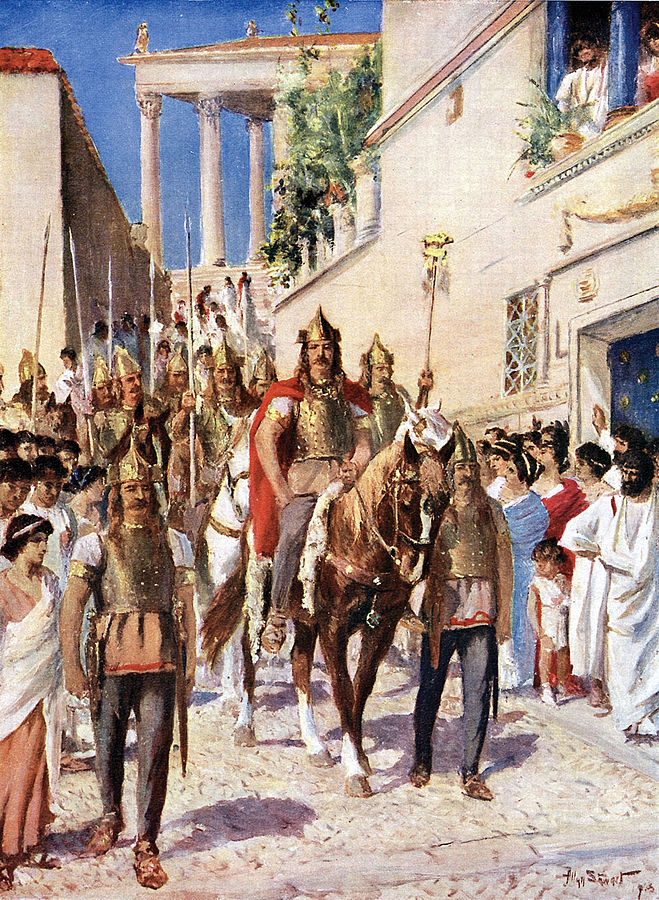
Alaric, King of the Visigoths, entering Athens in 395 AD.
Public domain illustration originally published in the Encyclopedia Britannica, 1920 via Wikimedia Commons.
What seemed to bother Postman was a nagging suspicion that modern humans were taking civilization for granted. This sentiment was more clearly expressed in one of Postman’s less-known literary works, his 1988 essay titled “My Graduation Speech“.
In his speech, Postman discusses two historic civilizations familiar to most people today — Athenians and Visigoths. One group, the Athenians, thrived about 2,300 years ago. The other, the Visigoths, made their mark about 1,700 years ago. But these civilizations were separated by much more than time, Postman explained.
The Athenians gave birth to a cultural enlightenment whose fruits are still visible today — in our art, education, language, literary works, and architecture. The Visigoths, on the other hand, are notable mostly for the destruction of civilization.
Postman mentions these peoples because, he argued, they still survive today. Here is what he wrote:
I do not mean, of course, that our modern-day Athenians roam abstractedly through the streets reciting poetry and philosophy, or that the modern-day Visigoths are killers. I mean that to be an Athenian or a Visigoth is to organize your life around a set of values. An Athenian is an idea. And a Visigoth is an idea.
But what ideas? What values? Postman explains:
To be an Athenian is to hold knowledge and, especially the quest for knowledge in high esteem. To contemplate, to reason, to experiment, to question — these are, to an Athenian, the most exalted activities a person can perform. To a Visigoth, the quest for knowledge is useless unless it can help you to earn money or to gain power over other people.
To be an Athenian is to cherish language because you believe it to be humankind’s most precious gift. In their use of language, Athenians strive for grace, precision, and variety. And they admire those who can achieve such skill. To a Visigoth, one word is as good as another, one sentence in distinguishable from another. A Visigoth’s language aspires to nothing higher than the cliché.
To be an Athenian is to understand that the thread which holds civilized society together is thin and vulnerable; therefore, Athenians place great value on tradition, social restraint, and continuity. To an Athenian, bad manners are acts of violence against the social order. The modern Visigoth cares very little about any of this. The Visigoths think of themselves as the center of the universe. Tradition exists for their own convenience, good manners are an affectation and a burden, and history is merely what is in yesterday’s newspaper.
To be an Athenian is to take an interest in public affairs and the improvement of public behavior. Indeed, the ancient Athenians had a word for people who did not. The word was idiotes, from which we get our word “idiot”. A modern Visigoth is interested only in his own affairs and has no sense of the meaning of community.
Postman said all people must choose whether to be an Athenian or a Visigoth. But how does one tell one from the other? One might be tempted to think that education is the proper path to becoming an Athenian. Alas, Postman argued that this was not the case.
I must tell you that you do not become an Athenian merely by attending school or accumulating academic degrees. My father-in-law was one of the most committed Athenians I have ever known, and he spent his entire adult life working as a dress cutter on Seventh Avenue in New York City. On the other hand, I know physicians, lawyers, and engineers who are Visigoths of unmistakable persuasion. And I must also tell you, as much in sorrow as in shame, that at some of our great universities, perhaps even this one, there are professors of whom we may fairly say they are closet Visigoths.
Postman concluded his speech by expressing his wish that the student body to which he was speaking would graduate more Athenians than Visigoths.
The production of educated barbarians was relatively low in 1988, despite Postman’s pessimism. The production of such modern-day Visigoths is unimaginably higher now than the tail end of the Cold War when he was writing. I fear we have already made our decision … and may God have mercy upon our souls.
QotD: P.G. Wodehouse and Sir Oswald Mosley
There was one exception. The object of Wodehousian scorn was the moustachioed leader of Britain’s black-shirted Fascists, Sir Oswald Mosley, 6th Baronet. A fencing champion at school, dashing war record in the Flying Corps, and a Member of Parliament, he was the recipient of an inherited title, with a family tree that stretched back to the 12th century, a country house and a Mayfair residence. In Wodehouseland, Mosley is transformed into the equally aristocratic Roderick Spode, 7th Earl of Sidcup.
Plum was intolerant of even the vaguest of threats to the established order of things. He voiced his dislike of Spode through Bertie Wooster, likening the fascist leader to one of “those pictures in the papers of dictators, with tilted chins and blazing eyes, inflaming the populace with fiery words on the occasion of the opening of a new skittle alley”. Plum focussed his gaze on the Spode/Mosley moustache, which was “like the faint discoloured smear left by a squashed black beetle on the side of a kitchen sink”, describing its owner as “one who caught the eye and arrested it”.
The proto-dictator appeared, thought Wodehouse, “as if Nature had intended to make a gorilla but had changed its mind at the last moment”. Every reader would have known it was Mosley in the crosshairs, because Spode was the leader of a fascist group called the “Saviours of Britain, also known as the Black Shorts”. The transition of attire is because, as another of Wodehouse’s masterful creations, Gussie Fink-Nottle, observed, “by the time Spode formed his Association, there were no black shirts left in the shops”.
A different Wodehouse character warned, “Never put anything on paper … and never trust a man with a small black moustache.” Indeed, anyone “whose moustache rose and fell like seaweed on an ebb-tide” was best avoided. Plum could have been referring to Mosley or Hitler. The former, as leader of Britain’s real-life black shirts, was an unashamed admirer of the latter, and he interned in Holloway prison during the war. Afterwards, as an advocate of what we today would call Holocaust denial, he moved to Paris where he died in 1980. His political journey was interesting. Mosley started as a Conservative, drifted leftwards into the Labour Party, then further left into his own independent party, which evolved into the right-wing British Union of Fascists.
Modelled on the Italian and German fascist movements, Mosley and his supporters came to believe that “Jewish interests commanded commerce, the Press, the cinema, dominated the City of London, and killed British industry with their sweatshops”. Fascism lurking in the upper classes troubled Plum Wodehouse so greatly that Spode and his Black Shorts appeared in five of his works between 1938–74.
Peter Caddick-Adams, “Coups and coronets”, The Critic, 2022-12-13.


