Quotulatiousness

June 2, 2024

A definite sign of the end-times – “South Park is going into its 27th season”

Filed under: Humour, Media, Politics, USA — Tags: , , , , — Nicholas @ 03:00

I’d pretty much given up on watching anything on television around the time that South Park went on the air, so I never “stopped watching it” because I wasn’t watching anything on TV by that time (although I did see Team America: World Police in the theatre). Andrew Sullivan says I’ve been missing something quite worthwhile for all this time:

South Park is going into its 27th season. And it has rarely been better. (I simply can’t believe so many people I meet say they haven’t watched in years. You’ve been missing out!) The new special on obesity — a deft masterclass of social commentary — has a brutal takedown of suburban white women jonesing for doses of Ozempic like meth-heads; a definitive — and musical! — digression into the insanity of the American healthcare system; pure, character-driven humor in a figure like Randy Marsh — a far subtler parody of the average American male than Homer Simpson; and, of course, Eric Cartman — the “big-boned” fat-ass kid whose capacity for pure evil was first truly captured in the epic “Scott Tenorman Must Die“.

You can read books on Ozempic, scan op-eds, absorb TikToks, and even listen to the Dishcast! — but nothing out there captures every single possible social and medical and psychological wrinkle of this new drug than this hour of crude cartoons. Yes, there are fart jokes. There are always fart jokes. But fart jokes amid a sophisticated and deeply informed parody of insurance companies? Or, in other episodes, toilet humor guiding us through the cowardice of Disney, the dopey vanity of Kanye, the wokification of Hollywood, the exploitation of black college athletes, the evil of cable companies, the hollowness of hate-crime laws, the creepiness of Christian rock, or the money-making behind legal weed? Only South Park pulls this off. Only South Park gets away with all of it.

It’s a 1990s high-low formula at root, sophisticated cultural and political knowingness married to crude cartoons, silly accents, m’kay, and a talking Christmas turd, Mr Hankey. Generationally, it really marked a moment when merging these two worlds seemed the most creative option — not an abandonment of seriousness, but the attachment of a humane levity to it. South Park can be brutal, but it is never cruel. Unless you’re Barbra Streisand or Bono. And virtually every character (even Eric) is redeemable. Except Meghan Markle.

Yes, Matt and Trey have tried other things. To wit: just one of the best and most successful musicals of the 21st century, The Book of Mormon. They’ve pioneered deep-fakes. They also just renovated and relaunched a huge Denver restaurant they loved as kids, Casa Bonita, memorialized in a classic Cartman-is-evil episode. Twenty years ago, they actually created an entirely puppet-acted movie with epic sex and vomit scenes as a commentary on the war on terror, Team America; and are now teaming up with Kendrick Lamar to shoot a live-action comedy about a biracial couple where the black boyfriend interns as a slave re-enactor only to discover that his ancestors were owned by his girlfriend’s. No landmines there.

But they always return to South Park and evince no desire to transcend it — partly because it has become an entire world that can expand and contract at will: a world where Mel Gibson tweaks his nipples and smears his feces, Mickey Mouse acts like a mafia don, Michael Jackson’s nose falls off, Meghan Markle is a literal empty vessel, Christopher Reeve eats fetuses for their stem-cells, and Tom Cruise works in a fudge factory where, yes, he does a lot of the packing.

And in two decades of an acutely polarized and politicized culture, what team is South Park on? Precisely. You can’t tell, can you? — which is a staggering achievement in its own right. And it’s not about risk-aversion: the duo was targeted by Islamist terror and didn’t blink. They also took on the censors at the MPAA — savor this memo — and obliterated one of George Carlin’s “Seven Words You Can Never Say on TV” by saying “shit” 162 times in one episode.

They’ve shown Martha Stewart putting a whole turkey up her back-hole, Paris Hilton putting a whole pineapple up her front-hole, Caitlyn Jenner running over innocent pedestrians, and Jesse Jackson demanding that his big black ass be ceremoniously kissed. They’ve tackled Scientology and Mormonism; they’ve shown intergalactic Catholic priests astonished at the idea they have to stop raping young boys; and they beat Dave Chappelle by two decades with “Mr. Garrison’s Fancy New Vagina” — their take on sex reassignment.

They have done all this, taken no prisoners, and remain uncancellable. Why? Because their mockery is genuinely universal (including themselves), their courage is real, and because they remain humane.

By humane, I mean they show how you can skewer and yet still love. As a young gay man, I often winced at the careful, all-too-sensitive depictions of gay men in most movies and television, the elaborate ways in which the subculture was homogenized and prettified for straight audiences. But in South Park, I could see the gay reality as I had already witnessed it in all its bewildering variety: the right-wing, elementary school teacher Mr Garrison … dating Mr Slave — a leather-daddy with a gerbil called Lemmiwinks living in his upper colon; I could see Big Gay Al get expelled from the Boy Scouts — and defend their right to do so; I could see Butters’ dad on the DL at the White Swallow bathhouse; in time, I could see Satan having a gay love affair with Saddam Hussein, because his other boyfriend was so lame. They even made AIDS funny. The offense worked because it always conveyed an actual truth about gay men, while also obviously mocking us with love. (Mr Slave was portrayed as a moral paragon next to Paris Hilton, for example, and Mr Garrison eventually ends up with Rick, a total normie.) South Park‘s role in helping America grow up on the topic of homosexuality, especially the young male demographic who followed them, is deeply under-rated.

June 1, 2024

Guilty!34

Filed under: Law, Media, Politics, USA — Tags: , , , — Nicholas @ 03:00

The New York City jury did what the presiding judge told them to do and returned a “guilty” verdict on all charges against former US President Donald Trump. Sentencing is apparently going to take several weeks, because … reasons, I guess. eugyppius provides the German media’s gleeful response to the verdicts:

Der Spiegel‘s characteristically dignified, restrained way to present the news.

Yesterday, a Manhattan jury found former US President Donald J. Trump guilty of 34 felony charges. It is impossible to describe this highly contrived case clearly in a single paragraph, but the upshot is that hush-money paid to the porn star Stormy Daniels violated campaign spending limits, amounted to tax fraud, or constituted an attempt to unlawfully influence the 2016 election – either all of these things at once, or some mixture of them.

The naked political motivations of the prosecution are so obvious that they preempt all possible commentary. In the United States, the establishment have felt it necessary to fortify their free and open democratic elections against unpalatable outcomes by enlisting the help of the judiciary.

Because the German press are complicit in an essentially identical strategy on this side of the pond, they are thrilled – just thrilled – at Trump’s guilty verdict. Their reporting is as voluminous as it is identical, and it’s hard to keep the different think-pieces, op-eds and articles straight. This one from the Süddeutsche Zeitung is useful mainly for hitting all the common themes:

    Guilty. Criminal. From now on, these are the official trademarks of Donald J. Trump, at least for now. He is no longer just the first former US president ever to be criminally charged, and in four different cases at that. He is now the first former US president and current presidential candidate to be convicted in criminal proceedings – unanimously, at least in the first instance. Guilty 34 times over.

    Trump is a criminal! He is guilty! It feels so good to say that! Guilty guilty guilty!

    After such a judgement, a candidate for the most powerful job in the world should be politically finished. Who can imagine a convicted criminal in the White House? What’s more, Trump is theoretically facing three further and far more important trials. Under civil law, he has already had to pay hundreds of millions of dollars in fines for sexual abuse, defamation and illegally inflated assets. But this is the USA of the Trump era, so logic hardly matters …

This is a historic case! It’s hugely important! Even though we’re far from confident it will have any meaningful impact on the election which was the whole point of this farce in the first place!

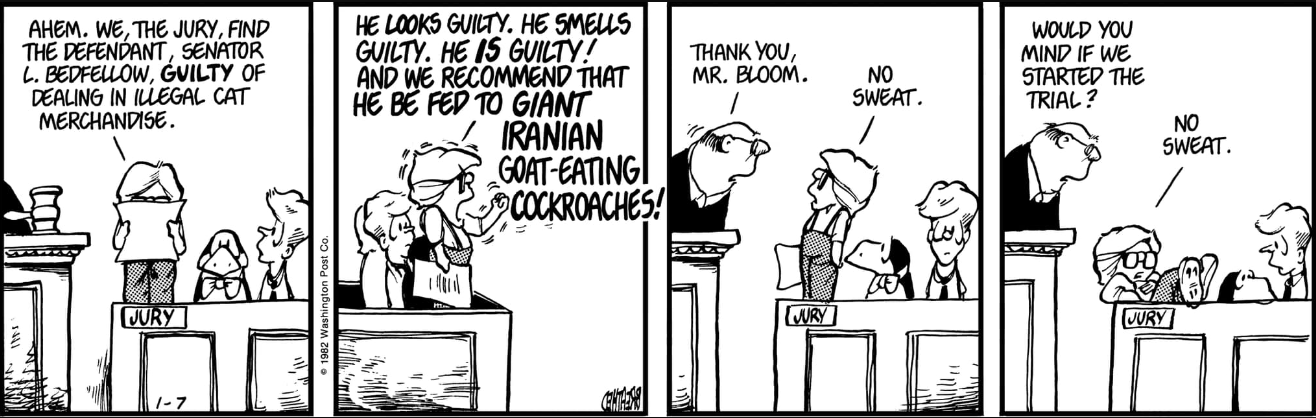
It was always going to be difficult for someone as polarizing as Donald Trump to get anything remotely like a fair trial, just like poor old Senator Bedfellow in Bloom County:

Mark Steyn, who has had his own bitter experiences with the American “justice” system, on the proceedings of the NYC kangaroo court in the Trump prosecution: “[they wouldn’t] have gone to all this trouble for a fine and a suspended sentence. They want him dead.”

As everybody but the New Guinea tribesmen who ate Joe Biden’s uncle knows by now, Donald J Trump has been found “guilty on all counts” – a quintessentially American expression because, of course, the multiple-counts racket is one of the many perversions of judicial norms that have long disgraced the US courthouse.

[…]

Be that as it may, his legal reasoning would be fine if America were a land of laws, but unfortunately it’s a land of men: whether for the forty-fifth president or a “niche Canadian”, we’re in basic “Who? Whom?” territory, as the Leninists would say. After my own experience of both the New York and Washington appellate benches, I would rate the chances of Trump getting this reversed at the state level as way lower than Mr Otis’s five per cent. It’s the same in my own case: all involved know the DC Court of Appeals is merely an interlude in order to get it wafted up to the US Supreme Court. Likewise with Trump. So we’re betting the farm on John Roberts and that rock-ribbed six-three “conservative” majority on which Republicans have expended so much energy to the exclusion of every other societal lever. And, even were they minded to intervene, as I remarked on-air to Tucker a fortnight before the last so-called election, “A judges’ republic is a contradiction in terms“.

So Mr Otis’s legal arguments have very little real-world meaning in terms of November’s exercise in republican self-government. Meanwhile, back in what passes for reality in the courts of New York, the exciting bit having concluded, we are now back to the leisurely proceduralist folderol: The corrupt Judge Méchant has scheduled sentencing for July 11th. So, for viewers of English courtroom dramas on PBS, there’s none of the traditional “Take him down!”, with the guilty party being led down the steps ten minutes after the verdict to be driven away to begin his sentence. Let me see now, July 11th is, oh, a mere six weeks away, which torpor is also very familiar to me: my own verdict came down in February, but the various post-trial motions keep getting kicked down that endless road.

July 11th is also, as it happens, four days before the GOP convention is due to start in Milwaukee. So, at a time when the presidential nominee should be practising his acceptance speech in front of his bedroom mirror, he will be a thousand miles away waiting to hear whether he is to be belatedly taken down.

Thus, Judge Méchant will have once again subordinated the election calendar to the caprices of his filthy courtroom.

In theory, Trump has been convicted of a crime and could be headed to gaol. Also in theory, his term of confinement could be put on hold pending the outcome of his appeal. But they didn’t do that with Peter Navarro, did they? And it seems highly unlikely to me that they would have gone to all this trouble for a fine and a suspended sentence. They want him dead. If you don’t get that, go over to Larry Hogan’s pad and start cooing over your “respect” for “the rule of law”.

May 31, 2024

“You only support that because it’s in your self-interest to do so”

Filed under: Economics, Education, Liberty, Media, Politics — Tags: , , , , — Nicholas @ 04:00

Helen Dale considers the painful notion that political ideas that work for the “elite” (defined in various ways) may not work at all for people unlike members of any given “elite”:

When I reviewed Rob Henderson’s Troubled for Law & Liberty at Liberty Fund, I made this observation:

    The reality that classical liberalism — the closest to my own political views, I admit — has at least a whiff of the luxury belief around it stings. It’s discomforting to acknowledge that what goes by the name of paternalism has its own intellectual pedigree, while liberalism can be a system developed by the clever, for the clever. “Highly educated and affluent people are more economically conservative and socially liberal,” Henderson says. “This doesn’t make sense. The position is roughly that people shouldn’t have to adhere to norms and if/when they inevitably hurt themselves or others, then there should be no safety net available. It’s a luxury belief.”

[…]

Joseph Heath […] uses the phrase “self-control aristocracy” to describe those who really do benefit from maximal freedom. These are people who can make better choices for themselves than any authority could make on their behalf. When the state or large corporates boss them (us) around, they (we) get really bloody annoyed. They (we) know better!

Heath’s phrase is simply a layman’s term for the personality trait various formal tests measure, and which overlaps with executive function to a considerable but as yet unknown degree.

    Because I am self-conscious about my membership in the self-control aristocracy, I am acutely aware of the fact that, when I think about questions of “individual liberty” in society, I come to it with a particular set of class interests. That is because I stand to benefit much more from an expansion of the space of individual liberty than the average person does – because I have greater self-control. So I recognize that, while a 24-hour beer store would be great for me, it would be a mixed blessing for others […]

    What does this have to do with libertarianism? It is important because every academic proponent of libertarianism – understood loosely, as any doctrine that assigns individual liberty priority over other political values – is a member of the self-control aristocracy. As a result, they are advancing a political ideal that benefits themselves to a much greater extent than it benefits other people. In most cases, however, they do so naively, because they do not recognize themselves as members of an elite, socially-dominant group, that stands to benefit disproportionately. They think of liberty as something that creates an equal benefit for all.

My response to reading Professor Heath’s piece was simplicity itself: I feel seen. I’ve even done the night school thing while working full-time. I’ve written books and chosen to play sports that require a long time and lots of skill to master. I retired at 45.

Politically, I’m not a libertarian. Libertarianism is a distinctive and largely American ideology (as the recent and bonkers fracas at its US Convention indicates) with philosophically unusual deontological roots. I am, however, within the British and French tradition of classical liberalism (which does assign individual liberty priority over other political values). And like many classical liberals I’ve been blind to problems of laws and governance for people unlike me.

I disclose this because I’ve worked in policy development in both devolved and national parliaments. I’ve probably given politicians and civil servants alike dud advice. There is almost certainly a shit policy out there (in either Scotland or Australia) with my name on it. However, this mind-blindness doesn’t only apply to people who advocate libertarian politics. I think it applies to a significant number of political ideologies just as strongly as it does to libertarianism.

That is, the ideology serves the inherited personality traits of those who promote it. “You only support that because it’s in your self-interest to do so” always struck me as a genuinely mean criticism of people who were involved in politics and policy (I may have been one of those people, natch). The problem — as I’ve been forced to accept — is that it’s true.

QotD: Progressives believe you need to be changed to their design

Filed under: Politics, Quotations, USA — Tags: , , , — Nicholas @ 01:00

The problem for the liberal is that most people do not want to be transformed. They want life to be better but not qualitatively different. It is only the liberal, or the “progressive”, as he prefers to be called today, who welcomes revolution and relishes the violent tactics necessary to bring it about. For the progressive, it is an article of faith that the masses will resist change and must be forced to swallow it.

This is a crucial difficulty, and it gives rise to all sorts of persuasion, nudging, compulsion, and outright violence. If the masses don’t know what’s good for them, they must be made to change. Every liberal in history, from Jean-Jacques Rousseau to Barack Obama, has adopted this course of action. The current liberal lions, Chuck Schumer and Nancy Pelosi, and their lion cubs – New Jersey’s Sen. Cory Booker and California’s Sen. Kamala Harris – appear to be even more radical.

Booker speaks repeatedly in favor of what he calls “the collective good”. Apparently, he knows what that good is, and others do not. And he seems willing to use uncivil means to achieve that collectivist end, such as lashing out at DHS secretary Kirstjen Nielsen. His humiliation of Nielsen was not just embarrassing. As I saw it, it revealed a cold, vicious, Leninist temperament, a willingness to sacrifice individuals in the service of the collective and of his own political ambition.

Then there is Harris. “Loose regulations and lax enforcement … That’s abandoning the middle class,” she says. What she seeks, apparently, is more government control with herself in charge.

Both of these über-liberals claim to know more than the rest of us, but what is it they know?

In a truth worthy of Wittgenstein, one could say that what they “know” is that they know, and nothing else. And what they oppose is any suggestion that they do not know.

In other words, liberalism is a temper, not a philosophy. It has no fixed content – it can be either communistic or fascistic, racially “progressive” or virulently anti-Semitic, pacifistic or militaristic – but in one respect, it never changes. It exerts control and demands obedience.

Jeffrey Folks, “Leftists versus the People”, American Thinker, 2018-02-24.

May 30, 2024

As everyone knows, it takes at least three years to find a shovel in Canada …

Filed under: Cancon, History, Media, Politics — Tags: , , , , , — Nicholas @ 05:00

In Quillette, Jonathan Kay notes the third anniversary of the “mass graves” moral panic here in the utterly dysfunctional Dominion:

Kamloops Indian Residential School, 1930.
Photo from Archives Deschâtelets-NDC, Richelieu via Wikimedia Commons.

This week marked the third anniversary of Canada’s strange “unmarked graves” scandal — a morbid social panic that took hold of my country in late May 2021, following unverified claims that the corpses of 215 (presumably murdered) Indigenous children had been located at the site of a former school in Kamloops, British Columbia.

As I’ve already described this saga in several Quillette articles, I will not belabour the specifics (which, by now, have also been covered in the international press, as well as Canada’s National Post and Dorchester Review). Instead, this update will focus on the manner by which Canadian public figures (journalists, in particular) have tried to evade accountability for their original gullibility, as it presents an interesting case study in social psychology on a national scale.

The background here, as anyone who’s followed the story closely will know, is a genuinely shameful aspect of Canadian history — the federally funded, church-run system of residential schools established in the nineteenth century as a means to assimilate the country’s Indigenous population. In many cases, children were forced to attend boarding schools located hundreds of miles from their home reserves. Mortality rates from infectious diseases (especially tuberculosis) were tragically high, and the whole issue was properly referred to an authoritative body known as the Truth and Reconciliation Commission, which concluded that at least 3,200 children died after enrolling in residential schools. The real number might well be considerably higher.

All of this had been common knowledge in Canada for years by the time Rosanne Casimir, Chief of the Tk’emlúps te Secwépemc First Nation in Kamloops claimed to have discovered the remains of 215 Indigenous children buried on the site of the former Kamloops Indian Residential School.

In fact, she’d discovered nothing of the kind. But the Canadian media ran with the claim as if it were the proven truth. A typical headline: “Tk’emlups confirms bodies of 215 children buried at former Kamloops Indian Residential School site“.

If you don’t live in Canada, it will be hard to appreciate the national hysteria that resulted. In the press, Canada was officially anointed a nation of baby killers. Prime Minister Justin Trudeau lowered the flag on public buildings for five months. Dozens of churches were burned by arsonists in apparent acts of retribution. The word “genocide” was thrown around in casual parlance as if we were Nazi Germany or Rwanda in 1994. The Canadian Press called the discovery of these ostensible unmarked graves the 2021 “Story of the Year.”

Then the days passed, the national festival of self-laceration abated somewhat, and it began dawning on some of us that — um, wait a minute — no evidence of graves had actually been presented yet. That evidence was on its way, right?

The Liberal Party of Canada, a wholly-owned subsidiary of Trudeau, Inc.

Filed under: Cancon, Politics — Tags: , , , — Nicholas @ 03:00

In The Line, Stefan Klietsch ponders the idea that a lot of the problems the Trudeau Liberals are encountering in the run-up to the next federal election are direct or indirect effects of the constitutional changes Trudeau pushed through at the first party general meeting after he became Prime Minister:

With the ongoing and persistent slump of Justin Trudeau’s party in the polls, some observers have looked back at what caused the Sunny Ways team to lose its lustre in their years of governing. Some would point to the prime minister’s harassment of Judy-Wilson Raybould in the SNC-Lavalin scandal, an episode in which the prime minister clearly lost the battle for public opinion. One personal grievance of mine is the cynical promise that the prime minister had made of the 2015 election being the last such election under the existing electoral system. Others just point to post-pandemic economic conditions, especially higher interest rates.

But looking back to the very beginning of the Trudeau era, the Liberal leader arguably planted the seeds of his inevitable downfall quite quickly after winning his majority in the 2015 election. I speak here of the constitutional package that Trudeau pushed the Liberal Party of Canada to adopt at its 2016 Biannual General Meeting.

It is a recurring theme in Canadian politics that party leaders who form government tend to become more distant and isolated from their grassroots. But whereas most prime ministers and premiers would be content to delegate management of constitutional party debates to their submissive sycophants, a sitting prime minister took it upon himself to invest his personal brand in an appeal to the party’s convention floor to pass an omnibus “modernizing” constitutional package. Since the prime minister did not again participate in the party’s constitutional debates after 2016, he evidently got everything that he wanted all in one go, and with minimal resistance.

Trudeau’s cynicism here is worthy of mockery. Imagine thinking to yourself, “Just months ago, the rejuvenated grassroots institutions of the Liberal party swept me to power and ended the decade of Liberal decline. Better fix what ain’t broke!” The changes, which included slashing of the influence of Electoral District Associations and of policy conventions, were obviously not intended as some grand exercise in democracy empowerment, but rather were intended to protect an incumbent government from any inconvenient messages and influences from a potentially unruly party grassroots.

Yet it was the same independent party grassroots that had helped bring Trudeau to power in the first place. In the 2015 campaign the Liberals had run on what columnist Andrew Coyne called a “daring” platform, a platform crafted with more input and insight than can be offered by only pollsters and political operatives. The then Liberal platform was obviously a factor in the Liberals’ poaching of supporters from the NDP, which had at times held a lead in the polls. From cannabis legalization to electoral reform to the Canada Child Benefit, where did all the big new Liberal ideas come from? The party grassroots and institutions, of course.

May 29, 2024

“The more they rant, scream and lecture, the more cool singing ‘Ausländer raus‘ and ‘Deutschland den Deutschen‘ will become”

Filed under: Germany, Media, Politics — Tags: , , , , , , , — Nicholas @ 05:00

Our deep undercover secret informant in Deutschland, eugyppius, recounts the latest scary outbreak of deadly neofascist singing in the beleaguered country:

The latest threat to German democracy including “one of the men in the video can be seen offering a slack, distinctly metrosexual Roman salute and giving himself a two-fingered Hitler moustache”

“Fascism”, as popularly understood, is both very bad and also very ill-defined, being a negative political vice characterised primarily in opposition to that equally ill-defined political virtue known as “democracy”. This “democracy”, whatever it may be, is distinguished above all by its fuzzy associations with a wide array of other virtues, like diversity, inclusiveness, equity and transsexuality. Fascism is mostly the opposite of all of these things, which sounds bad enough, but it gets much worse: Because democracy is a very fragile virtue, forever requiring vigilant defence and social fertiliser, fascism has become the most ineradicable and indestructible of weeds.

Or perhaps it is better, in our post-pandemic era, to say that fascism is like a virus. It is always spreading, despite (or because of?) our best efforts to kill it off. We vaccinate children against the fascist virus with years of indoctrination about the evils of National Socialism in school, but to judge from the present state of our political discourse, this programme has worked about as well as the mRNA jabs worked against Covid. Never have we preached so stridently against fascism, and never has it been so omnipresent.

Another curious property of fascism, is that it does not merely infect human brains. It can also taint cultural artefacts, like phrases. All of the very best people can use a specific phrase, but that does not matter at all should the fascists get ahold of it. Once they have run the benign words through their evil fascist mouths, anyone who utters them afterwards – whatever his intentions – may well be guilty of fascism. If only democracy were that effective and powerful.

As we’ve learned from the events of the past week, the Germ Theory of Fascism applies also to songs, even vacuous pop music. All of the most democratic people in Germany have worked themselves up into a collective outrage against an unremarkable 1999 Italodance tune called “L’amour toujours” (“Love always”) by Gigi D’Agostino, because some very bad fascists have been caught singing some very naughty lyrics to its indifferent melody. The fascists themselves have been cancelled of course, and the song is on its way to its own separate cancellation as well.

But I’m getting ahead of myself.

[…]

The SPD only deepened their performative self-parody by posting this graphic to Instagram:

The Sylt revellers had chanted “Germany for the Germans”, but in this image the SPD proposed an improvement: “Germany for those Germans who defend our democracy”. Checkmate fascists! Except, “Germany for the Germans” is a slogan most closely identified with Der Heimat (formerly the NPD), an “ultranationalist” and “neo-Nazi” party. Realising that they had unwittingly reproduced the forbidden Nazi incantation, and were therefore guilty of spreading this horror virus, our crack SPD social media team swiftly deleted their post and threw up a hasty apology:

    We just published a post condemning in the strongest possible terms what we all saw in a video from Sylt. We did not manage to strike a tone that would resonate with everyone. We would like to sincerely apologise for this. Our aim is to make it clear that we do not want to leave this country to the far right and hate preachers. We want to defend our democracy and our freedom. Let’s continue this fight together in solidarity!

This is one of those missteps that really leaves you scratching your head. After hours of foaming at the mouth about “neo-Nazi slogans”, our virtue-mongering social democrats posted their own version of those very same tainted words to Instagram, in apparent ignorance of their origins and deeper significance. We are left to ask what they imagined they were angry about in the first place.

It’s hard not to agree with eugyppius’ conclusion:

I have my own theory about all of this.

Once upon a time, teenagers sustained a vibrant countercultural leftism, which was all about telling the establishment to go fuck itself, ingesting inadvisable quantities of drugs and engaging in a lot of inadvisable sex. All of that was very transgressive and exciting, directed as it was against a much more conservative and straight-laced German society. They shocked people, and that was the point. In the decades since, all of those hippies have grown old, and the most ideologically committed of them have become that which they used to hate, namely a lot of insufferable shrivelled scolds. As is the way with scolds everywhere, they’ve unwittingly inspired a new countercultural movement on the opposite side of the political spectrum. The more they rant, scream and lecture, the more cool singing “Ausländer raus” and “Deutschland den Deutschen” will become. Maybe, if they don’t like these words, they should try chilling out and finally shutting the fuck up about fascism. God knows there are more important things to screech about.

In the meantime, our new fascist anthem L’amour toujours has hit the top of the German charts.

May 28, 2024

Rishi Sunak’s big-brained election-winning strategy: bring back the draft

Filed under: Britain, Media, Military, Politics — Tags: , , , , — Nicholas @ 04:00

Embattled British Conservative leader Rishi Sunak has had another of his patented brainstorms for a policy that will absolutely win his party huge numbers of “gammon” votes in the July 4th general election:

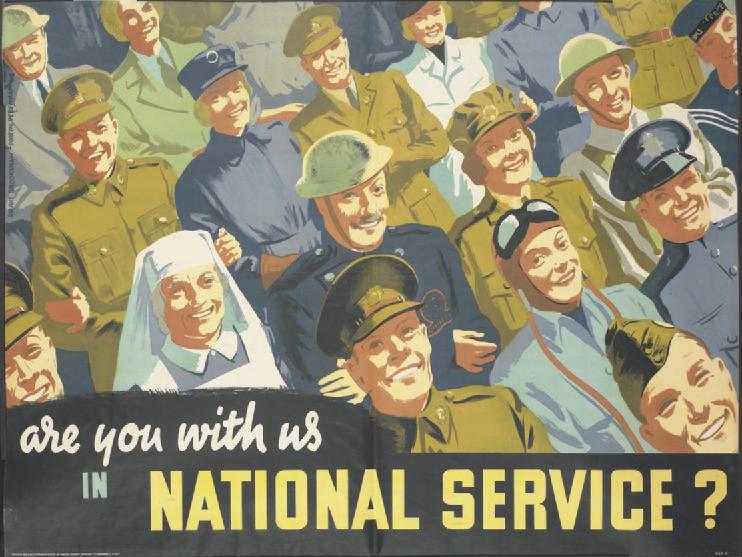
I thought the misty nostalgia for postwar “National Service” had died out long ago …

Here we go: straight off, let’s get the youth to do some indentured servitude, sorry, National Service.

The Sunday Times reports:

    Every 18-year-old will be required by law to sign up for a year of National Service under plans unveiled by the Conservatives this weekend.

    Rishi Sunak’s first manifesto commitment would see youngsters given the choice between a full-time course (for 12 months) or spending one weekend a month volunteering in their community. There will be sanctions for teenagers who do not take part. Up to 30,000 full-time positions will be created either in the armed forces or in cybersecurity training. The weekend placements could be with the fire or police service, the NHS or charities tackling loneliness and supporting older, isolated people.

    The Tories have pledged to set up a royal commission to design the £2.5billion programme and establish details such as how the cybertraining would be delivered. A pilot will start next year and by the end of the parliament legislation will be passed making it mandatory for all 18-year-olds.

[…]

The Prime Minister says: “This new, mandatory National Service will provide life-changing opportunities for our young people, offering them the chance to learn real-world skills, do new things and contribute to their community and our country.” I doubt very much it will do this. The youth could learn real world skills in a weekend job that they’d actually get paid for but under Tory Rule they must become an indentured servant of the State instead.

It was floated that “the weekend placements could be with the fire or police service, the NHS or charities tackling loneliness and supporting older, isolated people”. Really? The fire and police service having to babysit some surly 17-year-old teenager glued to a mobile phone? Is this really what a police officer wants?

No doubt the vast majority of the youth will be dumped in some NHS hospital to do goodness knows what, or indeed a nursing home. And what about all the people who are currently off work and on anti-depressants “because of mental health”. Will they be forced to volunteer, or let off the requirement?

Trudeau is at his very best in tackling imaginary problems

Tristin Hopper calls attention to just how much of the federal government’s attention is focused on problems that don’t actually exist, except in the Prime Minister’s vivid imagination, like the notorious “hidden agenda” of Pierre Poilievre’s Conservatives to turn Canada into the world of The Handmaid’s Tale by banning abortion (and undoubtedly forcing women to wear the distinctive red-dress-and-bonnet uniforms, too):

In Trudeau’s fevered imagination, this is what the Tories want Canadian women to be wearing in future.

The Trudeau government has initiated another round of warning that Canadian abortion access is at risk.

“Women’s rights, reproductive rights, and equality are non-negotiable,” Prime Minister Justin Trudeau declared at a recent speech, as Liberal Party social media accounts broadcast accusations that their opponents endanger a “woman’s right to choose”.

This would all make perfect sense in the United States, which has indeed seen a wave of new state-level laws effectively banning abortion outright.

But the Liberals are talking about Canada, a country that has no abortion laws whatsoever, and no political inclination to create any.

Polls show an incredible 80 per cent of Canadians supporting a “woman’s right to an abortion”. Conservative Prime Minister Stephen Harper didn’t once touch abortion during his nine-year tenure.

As noted, Canada literally has no legal language dealing with the whole abortion issue … and therefore any Conservative government would have to create a new law to even begin to address an issue that a super-majority of Canadians are already against “fixing”. Conservatives can be incredibly dumb at times, but that would be stupidity of a very high order indeed.

Then, there’s Trudeau’s determination to link Poilievre with Diagonal, er, Dialagon, er, Dialysis, I mean “Diagolon”, which is apparently some super-powerful secretive extreme right-wing conspiracy to … do something diagonal-ish? I dunno. I’d never heard of ’em until Trudeau started trying to tie Poilievre to them:

Earlier this month, the Liberal’s main attack against the Conservatives was that they were in thrall to Diagolon, a supposed white supremacist militia with designs on destroying Canada from within.

“What has not been answered by the leader of the Opposition is why he chooses to continue to court extreme right nationalist groups like Diagolon,” said Trudeau in the House of Commons on April 30, one of several times he would slap down a question from the Conservatives by bringing up Dialogon.

Poilievre’s alleged ties to Diagolon are pretty tenuous. At a Nova Scotia fundraiser, among the attendees who queued up to shake Poilievre’s hand was Diagolon founder Jeremy MacKenzie, who claimed he did it just to get Poilievre in trouble. More recently, Poilievre visited an anti-carbon tax encampment where one of the RVs had a small Diagolon logo scrawled on its front door in permanent marker.

What’s more, multiple police investigations have concluded that Diagolon isn’t even a group, much less an organized anti-government militia.

It’s basically three guys on a podcast and their followers — whom they’ve occasionally met for BBQs. According to an RCMP profile of Diagolon put together at the height of Freedom Convoy, it was “exceedingly difficult” to nail down Diagolon as “a distinct group, with common ideology, a political agenda, and the cohesion necessary to advance such an agenda.”

The bought-and-paid-for Canadian media, of course, haven’t done much to point out just how ludicrous these accusations are, because even if they’re not, y’know, true, they are “truthy”. It’s not likely to change, as the legacy media still hate and fear anyone who might threaten their cosy subsidy deal with the Liberals.

And then there’s the Liberals’ fixed belief that Canada is the most racist country to ever have existed and that our entire culture is based on white supremacy and oppressing the “global majority” at all times:

Derived from the U.S. academic dogma of critical race theory, anti-racism holds that Canada’s basic structures — from its police forces to its justice system to its parliaments — are all fundamentally white supremacist. As such, they can only be remedied by “deliberate systems and supports” favouring “equity-seeking groups”, according to official Government of Canada literature.

The Trudeau government has established an Anti-Racism Secretariat, they’ve poured tens of millions of dollars into race-specific grants and they’ve subjected every arm of the federal government to anti-racism mandates and training.

Agencies such as the Canada Research Chairs program now openly screen for candidates based on ethnicity and other immutable characteristics. And perhaps most infamously, it was a federal anti-racism program that paid more than $500,000 to Laith Marouf, a virulent antisemite who has repeatedly referred to his benefactor as “Apartheid KKKanada”.

All of this has proceeded on the core assumption that Canada is — and always has been — a country defined by “systemic racism”. This was stated most plainly in an internal Canadian Armed Forces report which declared “racism in Canada is not a glitch in the system; it is the system”.

There’s a lot of (imported) fretting and huffing and puffing about this “issue”, yet there is almost no evidence for any of it being true in Canada. It would be statistically more likely to be true that much of our government and business organizations are actively over-hiring and over-promoting people on the basis of them not being white or male or heterosexual than the reverse.

QotD: Women’s voting interests

Filed under: Cancon, Media, Politics, Quotations — Tags: , , , — Nicholas @ 01:00

… I was young, then. Imbecilic stupidity is common in the young, who are subject to fashionable excitations. My mother, on the other hand, was older. As a Tory, she of course doubted whether women should vote at all; but as my father was of old Ontario Methodist farmboy stock, his congenital propensity to vote Liberal had to be acknowledged.

“I have to vote Conservative, for his sake,” she reasonably explained.

She had compounded his characteristic error in 1968, however, and felt she owed an explanation to her son. This began by reminding me of her fragile, female sex.

“One thinks of the party leader on the analogy of going for a date.”

And true enough, the Tory leader, Mr Robert Stanfield, was the sort of man you could present to your father. He could be relied on, to get you home safely, and on time.

“But there are times when a woman does not want to get home on time,” mama added.

She, a registered nurse acquainted with the eccentricities of mental patients, called my attention to a phenomenon I had not previously noticed. Whenever a truly monstrous (male) psychopath is strapped away in gaol, the prison receives adoring letters for him, from women. These correspondents have never met him, and know him only from accounts in the yellow press. He may have been found guilty of heinously murdering a succession of wives and lovers. But they promise to be waiting for him on the steps of the penitentiary; and as the police will confirm, they are still there.

My mother had never comprehended how a woman could be so crazy. But when she realized that she had herself just voted for “Pierre” [that’s Trudeau the elder, to clarify], she suddenly understood.

David Warren, “The women’s vote”, Essays in Idleness, 2024-02-22.

May 27, 2024

Visual metaphors in the British general election

Filed under: Britain, Media, Politics — Tags: , , , , , — Nicholas @ 03:00

When British PM Rishi Sunak decided to drop the writ for a general election, he must have thought he was boldly seizing the initiative but his timing was characteristically bad:

If your pitch to voters is that Britain needs protection in dangerous and uncertain times, it’s probably best to first show the voters that you can protect yourself.

For example, if it’s raining, you might want to consider demonstrating the good sense to wear a raincoat. Or carry an umbrella. Or if, say, you are the prime minister of an entire country, with an events team at your disposal, you might want to consider erecting a tent of some sort, something that can keep you dry without ruining your visuals.

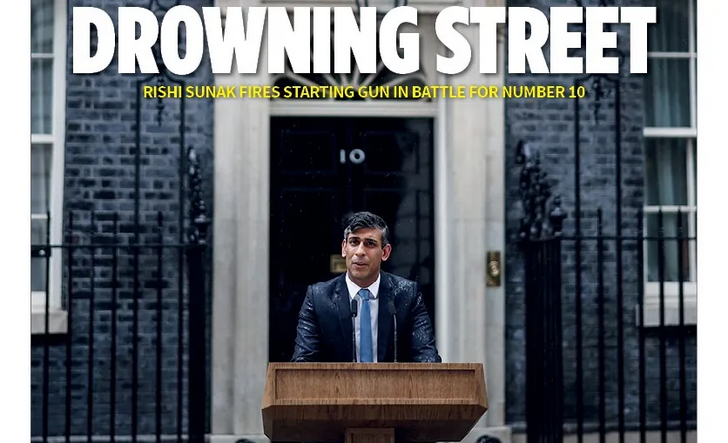
Or you can be Rishi Sunak, the beleaguered British prime minister, and stand out in the pouring rain, unprotected, and get drenched as you state your case for more time to be the country’s leader, evading the storm only when re-entering the house you will surely be vacating after voters have their say on July the 4th.

To be fair to Sunak, it’s not easy to predict the weather in London. Nor can you always control the timing of events. But when it rains all of the time where you live and you do absolutely control the timing of events, as a British prime minister does when calling an election, it’s unforgivable to be unprepared. There’s a reason most Brits keep an umbrella nailed to their hips, and it’s not style.

And if you think this is to make a mountain out of a molehill, you should check out the front pages of the U.K. papers on the morning after the election call. “Drown & out”, blared The Mirror. “Drowning Street”, chortled another broadsheet. “How long will (Sunak) rain over us,” chirped in a key regional title. Each headline was accompanied by a grim looking Sunak soaked to his whippet-like core. The presentational details matter, especially when you’re putting yourself in the shop window.

Then again, to expect anything more from a Conservative movement that is running on fumes after 14 turbulent years in power is to put hope over experience. It’s been a draining (nearly) decade and a half. There was the austerity and economic uncertainty of the coalition years. The referenda — Scottish and EU — that choked off most debate on other issues in the middle part of the last decade. And then came the double act of COVID and Ukraine, a compounding whammy that hammered supply chains and put up energy and other prices, prompting the worst cost-of-living crisis in generations. It would have been enough to test any leader’s mettle, which is probably why the Conservatives have had five prime ministers during their stretch in government, including three in 2022 alone.

May 26, 2024

Will Rishi Sunak be the British Kim Campbell?

Filed under: Britain, Media, Politics — Tags: , , , , , — Nicholas @ 05:00

The British election is now underway and if the polls are accurate, Rishi Sunak’s Conservatives are in for one heck of a thrashing. If he’s particularly unlucky, he could come close to former Canadian Prime Minister Kim Campbell’s electoral shipwreck in 1993 (losing a Parliamentary majority and being reduced to two seats in the Commons), but perhaps Labour leader Sir Keir Starmer isn’t quite the <sarc>charismatic juggernaut</sarc> that Canada’s Jean Chrétien was:

Rishi Sunak shortly after becoming Chancellor of the Exchequer in 2020.

I’m old enough to remember the sense of optimism, hope and promise felt when Tony Blair was elected back in 1997; not by me, obviously, but I could at least appreciate that other people felt that ‘things can only get better’.

Whether you think they did or not, Blair transformed the country in his own image, just as his predecessor Margaret Thatcher had done during her similarly long reign. No one could say the same of the recent fourteen years of Tory-led governments, a period that has been marked by a continual drift away from conservatism both within civil society and in many ways driven by the administration itself.

As I have said one or two times before, you could have woken up from a long coma and had no idea who had been in charge the whole time. It’s an indication of how far the Overton Window has shifted that proposals to limit student-led immigration are considered way out there despite being mainstream only a decade ago – proposals which the Prime Minister backed out of. One of the benefits of being in government should be the ability to shift the terms of debate, but whereas the rest of Europe is mostly turning Right, Britain under the Tories has gone the other way.

In retrospect, and I have definitely said this more than once or twice, the post-Brexit immigration policy was their biggest mistake. It meant the worst of both worlds for the country and for Tory coalition building, alienating both a large section of cautious voters over leaving the EU, and the many cultural conservatives they picked up in 2019 who saw the referendum as a vote on immigration.

In a parallel universe where the government reduced net migration to five figures, there may well have been immediate pain: struggles to fill vacancies, inflationary pressure caused by rising wages, and universities which now cannot survive without using the immigration system as a funding mechanism. But the Tories would have been on 30% rather than 20%; that they aren’t aware enough to understand this is strange, but then they aren’t an ideological party.

Rishi Sunak’s decision to hold the election early is very curious. Perhaps he was worried that enough letters would be handed in triggering a leadership contest; perhaps he feared that Nigel Farage would reappear and make the Reform Party even more of a problem. Perhaps he’s just impetuous and has had enough, but the announcement itself, in pouring rain and drowned out by a New Labour anthem played by a public nuisance, was fitting.

The prime minister is very unpopular, and the Tories are currently polling at catastrophic levels, but there is little enthusiasm for Labour and more people think the country will get worse than better after they are elected.

May 25, 2024

Another thing for progressives to obsess about – “horticultural appropriation”

Filed under: Britain, Media, Politics — Tags: , , , , , — Nicholas @ 04:00

In Spiked, Lauren Smith wonders if your garden — yes, your garden — is a nest of racist appropriation:

Is your garden a bed of racist colonialism?

Is your garden racist? As incredible as this may seem, it’s a question many gardeners are being forced to ask themselves. The innocent act of planting a few flowers can now get you branded with the r-word.

A piece in the June issue of the BBC’s Gardeners’ World magazine claims that the weeds of racism have sprung up in some unlikely places. Landscape designer Jackie Herald argues that choosing to plant non-native species in British gardens can constitute “horticultural appropriation”, because they were originally brought to the UK as a result of colonialism.

Herald writes: “Embedded within cross-cultural borrowing is horticultural appropriation, something that’s all too easy for our nation of gardeners to carry on regardless. In many cases, the abundant plant selections that we now take for granted did come via free-willing exchanges, but were sourced by plant hunters during years of colonialism and power-grabbing global trade.”

So, instead of picking out plants willy-nilly, Herald tries to choose plants that “connect to my client’s cultural heritage”. That means you had better check your 23&Me results before filling your flowerbeds, otherwise you could be horticulturally appropriating plants that don’t align with your racial heritage.

Uprooting racism from your garden might be more tricky than you’d think. Not least as some of the UK’s best-loved flowers are products of “colonialism”. Magnolias, for example, came from colonial Virginia and camellias from China.

Apparently, the most problematic perennial of all is wisteria, that inoffensive purple plant you often see hanging around the doors of posh houses. In 2022, Transport for London published a sightseeing guide called Art on the Underground, which claimed that wisteria has “colonial roots” (presumably no pun intended). This is because it was brought to England in the early 19th century from China. The guide also highlighted the supposedly racist nature of using words like “exotic”, “native” or “invasive” to describe plants. According to TfL, these can cultivate painful memories of “histories of conquest” and are best avoided.

QotD: “Dirt Theory”

Filed under: Media, Politics, Quotations, USA — Tags: , — Nicholas @ 01:00

Moving is racist, when white people do it. When a white person chooses to relocate, the consequences are racism. To understand this, you have to understand what Steve Sailer dubs “Dirt Theory”: Any geographical location where black or brown people live is “Tragic Dirt”, afflicted by poverty and violence, and the only solution to their problem is to move them to white-occupied “Magic Dirt”, where everybody is rich and all the kids have high test scores. At least, this is how liberals seem to believe the world works, and have made “Dirt Theory” the basis of their attitude on such issues as immigration. In their disordered minds, people like Harvard Professor Raj Chetty believe that analysis of geographic data about poverty, crime, etc., will yield insights about the causes of these phenomena — places matter more than people.

Robert Stacey McCain, “New Form of Racism Has Been Discovered”, The Other McCain, 2024-02-04.

May 24, 2024

“Great Britain is not yet a basket case. But we do a rather good impression of a failing state.”

Christopher Gage considers the plight of modern day Britain in the context of Rishi Sunak’s political suicide note election call:

Rishi Sunak shortly after becoming Chancellor of the Exchequer in 2020.

The ambition for things to get better is a bar so low it’s a carpet. A favoured genre of meme here centres on the dysfunction and general farce of a country with “Great” in its name. That lofty adjective edges perilously close to hilarity, akin to those countries prefixed by “People’s Democratic Republic”. The excitable kind with an AK-47 printed on its flag.

Call the doctor’s surgery at 8 a.m. An automated voice will reveal you are number 49 in the queue. When you eventually wade through, a soft-centred receptionist assures you in therapeutic tones that there’re no appointments left today. Sorry.

Book a same-day train ticket from London to Newcastle. Without a hint of contrition, the train company demands £786.80. That’s a week or two in warmer, healthier, saner Sevilla or three hours and eleven minutes on a train in Great Britain.

House prices and rents are akin to the board game Monopoly, in which your coked-up crypto-addled mate has lined up hotels on Mayfair.

Go to the supermarket. Olive oil, a civilising elixir which once threatened to heave the primitive British palate out of the Mesolithic era, is prohibitively expensive. If modern Britain were a film scene, it would be that of Ray Liotta in Goodfellas: Fuck you. Pay me.

This all-encompassing one-footed waltz feels like the finale of a political satire. Since the 1980s, we’ve parodied America. We’ve nailed the social pathology but not the prosperity. Essentially, Great Britain is an advertising agency with a nuclear submarine.


This election pits two tribes against each other. One tribe pines for 1997. The other yearns for 1979.

For a sizeable swathe of the population, everything is awful, and nothing will ever change. And thank God for that.

Here, a natural law dictates that anyone under 45 who dares suggest things could be better is to be consumed by a radioactive flood of sadistic nostalgia. The mere whiff of dissent conjures through the pavement a battalion of nostalgians who lament the end of Polio.

“You don’t remember the Seventies!” warn those who yearn for the Seventies. ‘Bodies uncollected! Rubbish piled up in the streets!’. In that fateful decade, striking union workers allowed garbage to pile up in the streets. To this hazy memory, the rest of us are serfs to economic juju.


Whenever I point out that a first-time buyer in London must save for 31 years just for a house deposit, a familiar chorus of denial debunks the theory of free will. “You waste your money on flat whites and trips to Rome!” goes the wearisome riposte.

During the 1970s, that prelapsarian idyll when rubbish piled in the streets, when adults caned children at random, and when Bullseye was on the telly, the average house cost four times the average wage. Today, it’s twelve to one.

To point out mathematical reality invokes spasms of uniquely British nostalgia. It’s a negative nostalgia which glories in just how bad everything was.

Churchill was right. The British people are the only people who like to be told how bad things are, who like to be told the worst. Memory-mongers paint postcards of perfect penury. Back then, children didn’t talk back. There were no phones or elbows on the table. Back then, that famed sense of community slapped any ribbon of dissent out of those who dared dream bigger than the suffocating confines of community life. The past is a foreign country in which children could count their ribs but they was happy.

Such nostalgia serves two purposes. The first indulges one’s triumph over wistfully disfigured adversity. The other bleaches the parlous state of modern Britain with a mop soaked in a very British version of nostalgie de la boue. Nostalgia, truth be told, is a polite form of dementia.

« Newer PostsOlder Posts »

Powered by WordPress