Quotulatiousness

October 15, 2009

Nobel committee had reservations, was not unanimous

Filed under: Europe, Politics, USA — Tags: , , — Nicholas @ 09:14

Apparently, it’s not just the cranky centrists, paranoid rightists and lunatic libertarians who thought the Nobel Peace Prize award to Barack Obama was incorrect: so did a majority of the committee itself:

Three of the five members of the Norwegian Nobel Committee had objections to the Nobel Peace Prize being awarded to US President Barack Obama, the Norwegian tabloid Verdens Gang (VG) reported Thursday.

“VG has spoken to a number of sources who confirmed the impression that a majority of the Nobel committee, at first, had not decided to give the peace prize to Barack Obama,” the newspaper said.

October 11, 2009

QotD: Silvio Berlusconi

Filed under: Europe, Italy, Politics, Quotations — Nicholas @ 11:29

As Silvio Berlusconi yesterday tried to shore up his position by declaring himself irreplaceable as Italy’s head of government, a court in Milan was told it had been “amply demonstrated” that he was guilty of bribery.

“I am, and not only in my own opinion, the best prime minister who could be found today,” he told a press conference. “I believe there is no one in history to whom I should feel inferior. Quite the opposite.”

The problem, he explained, was that “In absolute terms, I am the most legally persecuted man of all times, in the whole history of mankind, worldwide, because I have been subjected to more than 2,500 court hearings and I have the good luck — having worked well in the past and having accumulated an important wealth — to have been able to spend more than €200m in consultants and judges . . . I mean in consultants and lawyers.

John Hooper, “Silvio Berlusconi: I am inferior to no one in history”, The Guardian, 2009-10-10

Will Cameron be the last PM of the United Kingdom?

Filed under: Britain, Europe, Politics — Tags: , , , , — Nicholas @ 11:05

Jackie Ashley (almost alone among British commentators, according to Charles Stross) examines the likely consequences of both the next British election and the promised-by-Tory-leader referendum on the European Union:

So the question facing the Tory leadership is quite clear: if, by next May, the Lisbon treaty has come into force and Europe has a new president, quite possibly Tony Blair, will Cameron keep his promise to hold a referendum? Yes or no? It’s a straightforward question. He knows that to do so would risk a huge row with the rest of Europe, and a fully operational treaty would be harder to unpick than one not yet signed. That’s why until now he has used the weaselly words that, if the treaty is signed, he would “not let matters rest there”.

Cameron also knows that many in his party, not least his would-be successor Boris Johnson, will push for a referendum and have the support of much of the media too. If Cameron appears to want to renege on his promise, he will provoke fury and rebellion on his own side. For now, his “wait and see” gambit is beginning to look indecisive. If he were Gordon Brown, he would undoubtedly be accused of dithering.

At the same time, Cameron is worrying about another referendum, one which may prove no less momentous for the future shape of Britain. He faces a two-sided constitutional struggle, looking south towards Europe — but also north towards the Scots.

The nightmare for Cameron is that, once George Osborne has revealed details of the cuts imposed by Tory Westminster on Scottish budgets, the SNP start to gain momentum for their proposed independence referendum. Alex Salmond, Scotland’s first minister and nobody’s fool, has been watching the Conservative agendas on cuts and on Europe with fascination.

The Scots will be having their own referendum on independence in 2011, and the Tories barely poll north of the River Tweed. Up in Scotland, it’s Labour and the Scottish Nationalist Party as the top two. Scotland is in an odd situation of having its own parliament, but also sending MPs to Westminster, where they can vote on issues affecting the rest of Britain, but non-Scottish MPs do not get to vote on Scottish issues.

Charles provides the odds:

The current government is a minority one (yes, we’ve got a hung parliament): the Scottish National Party are in charge, although they rely on other parties to get legislation passed. The SNP are formally in favour of outright independence for Scotland, as an EU member nation; and they’re committed to holding a referendum on independence in 2011, before the next election. (Labour and the Lib Dems oppose this. The Tories do too, but they’re so marginal that nobody pays any attention to them.)

Here’s the rub. As things stand, the SNP would lose a vote on independence at this point. But under a conservative government in Westminster — especially one that’s wielding the axe of public service cuts, which is going to happen whoever wins the election and which will disproportionately hit the less well off, which includes a lot of Scots — well, I’d handicap things by giving the pro-independence vote an automatic bonus of 10%.

A sensitive, caring, next-generation Conservative government will therefore be at pains to tread lightly north of the border, and to attempt to defuse nationalist sentiment. Or will it?

On the one hand, to give them their full title, they’re the Conservative and Unionist Party, dedicated to preserving the union. But if they cut Scotland loose, then, in a 650 seat parliamentary system, they lose 80 seats, 78 of which belong to their rivals. Leave aside the fact that Cameron is committed to reducing the number of constituency seats in the UK: the 10% of them elected by Scotland are overwhelmingly not conservative. Ditching them will give the Conservatives an electoral lift that will last for a generation.

That’s got to be a temptation, even to a leader who “loathes the idea of being the last ever prime minister of the United Kingdom”.

October 9, 2009

What was the Nobel Peace Prize jury thinking?

Filed under: Europe, Politics, USA — Tags: , , , , — Nicholas @ 09:01

They award it to Barack Obama? For what tangible results over a period of time? He’s been in office less than a year, but has almost nothing to show for it (and, to be fair, a year isn’t a long time in American politics). But I’m not the only doubter, as Benedict Brogan is equally flabbergasted at the decision:

Nobel prize for President Obama is a shocker. He should turn it down.

They could have awarded it to Kylie Minogue and I wouldn’t have been half as surprised as I am watching the television screens around me proclaiming that Barack Obama has been awarded the 2009 Nobel peace prize. The whole business of a bunch of Scandinavian worthies doling out the profits of a long-gone dynamite maker’s fortune has always smacked of the worst sort of self-satisfied plutocratic worthiness. But this takes the biscuit. President Obama remains the barely man of world politics, barely a senator now barely a president, yet in the land of the Euro-weenies (copyright PJ O’Rourke) the great and the good remain in his thrall. To reward him for a blank results sheet, to inflate him when he has no achievements to his name, makes a mockery of what, let’s face it, is an already fairly discredited process (remember Rigoberta Menchu in 1992? Ha!). That’s not the point. What this does is accelerate the elevation of President Obama to a comedy confection, which he does not deserve, and gives his critics yet another bat to whack him with.

Update: Radley Balko sent this twitter post:

Nobel committee also gives Obama Physics prize, citing shirtless beach photo as example that he’s “quite the physical specimen.”

Update, the second: The Whited Sepulchre points out that

it was just a few weeks ago that The Teleprompter Jesus ordered a dozen Bunker-Busting Bombs for a potential attack on Iran. (Bunker-Busters are the most devastating weapons available without going nuclear.) [. . .]

I heard the folks on NPR fumbling around this morning, trying to explain the Nobel committee’s decision. Even that gang of White House Sock Puppets were bewildered. They decided that it was probably awarded for Obama’s desire for “Multilateral Approaches” to world conflicts. [. . .] I wonder if Iran is worried about France building up Bunker-Buster stockpiles…..

Everyone knew Obama would get this award, but I figured they would have the decency to wait until he was out of office, the way they did it with Jimmy Carter or The Goracle Of Music City and any other Democrats that I may have overlooked.

Update, the third: Crikey, even the Guardian thinks it was a premature award.

The citation describes his “his extraordinary efforts to strengthen international diplomacy and co-operation between peoples” in his outreach to the Muslim world and efforts to end nuclear proliferation.

Which is all very well, except that Obama is fighting wars in two Islamic states — Iraq and Afghanistan — and his efforts at international diplomacy, notwithstanding his powerful desire to achieve quick results, has thus far shown almost no progress in pushing forward peace talks in the Middle East and only very partial progress on Iran. It is true that he has made real advances in “resetting” US-Russian relations, not least over his decision to cancel an anti-missile shield that was to be based in eastern Europe, but the consequences of that engagement are too early to judge.

The reality is that the prize appears to have been awarded to Barack Obama for what he is not. For not being George W Bush.

October 8, 2009

Not quite the solution they were looking for

Filed under: Health, Politics — Tags: , , — Nicholas @ 12:40

Jacob Sullum looks at a not-very impressive result in clinical testing:

A study reported this week in the Archives of General Psychiatry found that an experimental “cocaine vaccine” was mostly ineffective at reducing consumption of the drug. Less than two-fifths of the subjects injected with the vaccine, which is supposed to stimulate production of antibodies that bind to cocaine molecules and prevent them from reaching the brain, had enough of an immune system response to significantly reduce their cocaine use (as measured by urine tests). Even among those subjects, only half cut back on cocaine by 50 percent or more.

[. . .]

Vaccine boosters think the real money lies in an effective anti-nicotine treatment, which they believe would attract “inveterate smokers” who have repeatedly tried to quit with other methods. But as The New York Times notes (in the headline, no less), such a vaccine “does not keep users from wanting the drug.” If all goes well, their cravings are not diminished in the slightest; they just can no longer satisfy them. And that’s assuming the vaccine is fully effective (as opposed to maybe 10 percent effective, like the one in the study); if not, it could actually increase consumption by neutralizing a percentage of each dose. A partially effective nicotine vaccine could be hazardous to smokers’ health if it encouraged them to smoke more so as to achieve the effect to which they’re accustomed. In any case, it’s not clear how appealing the idea of biochemically taking the fun out of smoking will be; the success of such a product hinges on consumers looking for a way to frustrate themselves.

If you take the cynical view, it’s a perfect Puritan drug: take away the benefit without reducing the desire. That way, you see, the sinners would still get all the suffering they’re entitled to without any satisfaction at all. Hell on earth, just the way Puritans like it.

You keep using that word . . .

Filed under: Politics, USA — Tags: — Nicholas @ 07:58

Jesse Walker writes:

A writer named Mike Elk has produced an entry in that venerable genre of contrarian-liberal writing, the “We Should Talk with the Right-Wing Grassroots Rather Than Demonize Them” essay. I’m always in favor of open-minded conversations that cross ideological lines, so in theory I applaud what he’s doing, but I had to chuckle at this tone-deaf sentence:

It’s time that we raise up above immature name calling and start talking to the teabaggers.

I’m sure Elk was genuinely unaware that the Tea Party marchers consider the word “teabaggers” an especially obnoxious example of “immature name calling.” Nonetheless, he sounds like an earnest Special Olympics volunteer who doesn’t understand why his “Go, retards!” chant isn’t catching on.

October 6, 2009

Parachutes also seen as harmful . . .

Filed under: Politics, USA — Tags: , , , — Nicholas @ 13:44

Following up on a report I blogged about a couple of days back, Jacob Sullum uses the same methodology to prove that skydivers would be better off without parachutes:

In Philadelphia, researchers at the University of Pennsylvania find, possessing a gun is strongly associated with getting shot. Since “guns did not protect those who possessed them,” they conclude, “people should rethink their possession of guns.” This is like noting that possessing a parachute is strongly associated with being injured while jumping from a plane, then concluding that skydivers would be better off unencumbered by safety equipment designed to slow their descent. “Can this study possibly be as stupid as it sounds?” asks Stewart Baker at Skating on Stilts. Having shelled out $30 for the privilege of reading the entire article, which appears in the November American Journal of Public Health, I can confirm that the answer is yes.

[. . .]

While the reseachers took into account a few confounding variables related to this tendency (including having an arrest record, living in a rough neighborhood, and having a high-risk occupation), they cannot possibly have considered all the factors that might make people more prone to violent attack and therefore more likely to have a gun as a defense against that hazard. To take just one example, not every criminal has an arrest record. Yet it seems fair to assume that criminals in Philadelphia are a) more likely than noncriminals to be armed and b) more likely than noncriminals to be shot. That does not mean having a gun increases their chance of being shot. Certainly they believe (as police officers do) that having a gun makes them safer than they otherwise would be. Nothing in this study contradicts that belief.

Of course, most people will only see the headline, so the underlying purpose of publishing the “study” has been achieved.

October 4, 2009

Totally unbiased study says “Guns=bad”

Filed under: Politics, USA — Tags: , , , — Nicholas @ 23:48

In no way should you try to read the data from this study as being anything other than unbiased and objective:

Medical researchers in Philadelphia have conducted out a study which indicates — according to their interpretation — that carrying a gun causes people to get shot more often. “People should rethink their possession of guns,” say the medics.

“This study helps resolve the long-standing debate about whether guns are protective or perilous,” says University of Pennsylvania epidemiology prof Charles Branas. The Penn announcement is headlined “Gun Possession [is] of questionable value in an Assault”, so it’s pretty clear which way he’s leaning.

The Penn researchers carried out their study by randomly selecting 677 people in Philadelphia who had been shot in “assaults”. Apparently five people sustain gunshot wounds every day in the City of Brotherly Love, so there were plenty to choose from.

According to the profs, six per cent of the shooting victims were packing heat when they got plugged. They compared that to a control sample of Philadelphians who had not been shot, and concluded that “people with a gun were 4.5 times more likely to be shot in an assault than those not possessing a gun”.

Of course, there’s no problem with basing your statistically valid sample on people who have already been shot: given the chance of being shot in Philadelphia, they could just have gone round to a few local bars and found the same numbers, right?

You know that the study has a certain, um, preference, when even the folks at The Register are pointing out that the data may not be randomly selected:

There didn’t seem to be any account taken of the fact that people with good reason to fear being shot — for instance drug dealers, secret agents etc — would be more likely to tool up than those with no such concerns.

The profs’ reasoning, however, would seem to be that if someone sticks you up in the street and you haven’t got a gun, you’ll just hand over your valuables and so escape with a whole skin. If you’ve got a gat, however, you might try to draw it and so get shot. Tactically, of course, it might be wiser to first hand over your wallet and then craftily backshoot the robber as he departed, but no matter.

October 2, 2009

Garrison Keillor’s modest proposal

Filed under: Politics, USA — Tags: , — Nicholas @ 12:39

This idea will sell very well in the coastal areas, not so well in the heartland:

Conservatives and liberals can agree on the basics — that the nation wallows in debt, that it is shortsighted of the states to cut back on the most essential work of government which is the education of the young, and that somehow we have got to become a more productive nation and less consumptive — but the ruffles and flourishes of Washington seem ever more irrelevant to the crises we face. When an entire major party has excused itself from meaningful debate and a thoughtful U.S. senator like Orrin Hatch no longer finds it important to make sense and an up-and-comer like Minnesota Gov. Tim Pawlenty attacks the president for giving a speech telling schoolchildren to work hard in school and get good grades, one starts to wonder if the country wouldn’t be better off without them and if Republicans should be cut out of the health-care system entirely and simply provided with aspirin and hand sanitizer. Thirty-two percent of the population identifies with the GOP, and if we cut off health care to them, we could probably pay off the deficit in short order.

Don’t tax the soft drinks: remove the subsidies instead

Filed under: Politics, USA — Tags: — Nicholas @ 12:29

Katherine Mangu-Ward thinks the US government has an easier fix to the problem than taxing soda pop:

Subsidy packages to corn growers have been sweet in recent years, with an average of about $5 billion annually since 1995, and a bumper crop of cash in 2005 clocking in at about $9.4 billion. Many of the acres of corn grown in the United States wouldn’t be profitable if it weren’t for federal subsidies (as chronicled in the excellent documentary King Corn), yet those billions keep the cheap corn piling up around our waists.

But on the other hand, debt-ridden congressmen are now terrified for their livelihoods. They’re desperate for a way to fund healthcare reform — and taking credit for solving the obesity problem would be nice, too. So the Senate Finance Committee held hearings this spring to brainstorm some ways to gin up some cash. One of the proposals they entertained was a 3 cent tax per 12 ounces of soda, which would generate $24 billion over four years, according to a December report from the Congressional Budget Office.

The application of a little basic math reveals an interesting coincidence: The expected revenue from a soda tax and the expected subsidy payments to corn farmers come to almost the same amount — somewhere between $5 billion and $6 billion a year.

September 30, 2009

More background on that broken hockey stick

Filed under: Bureaucracy, Environment, Media, Politics — Tags: , , — Nicholas @ 09:53

I don’t want to sound like a climate crank — there are more than enough of them out there, on both sides of the issue — and I’m still very much of the opinion that the question of anthropogenic global warming/climate change still needs a lot of work to answer. If human activities are causing the planet’s atmosphere to warm up in excess of what the natural feedback systems of the planet can handle, then we do need to look at ways to reduce our contribution to that warming.

Politicians and power-seeking bureaucrats jumping up and down in front of the cameras, insisting that the crisis is upon us and we need to do something now are in no way to be trusted with additional powers: without sufficient scientific evidence, we’d just be installing petty dictators over all sorts of different areas of our lives.

The specific piece of “evidence” most useful to the “do something now” faction has been the famous Hockey Stick Graph, which has been debunked. The data was carefully selected to support pre-decided conclusions. Everyone who took high school science knows the temptation . . . you know how the experiment is supposed to turn out, and who’ll know if you just write it up as if you got textbook results? The answer is . . . that’s why you do the experiment: to determine if the result matches the expectation. Skipping the whole “do the experiment” step saves time, but it’s not science.

Bishop Hill explains how the hockey stick became the best-known case of junk science in decades:

The story of Michael Mann’s Hockey Stick reconstruction, its statistical bias and the influence of the bristlecone pines is well known. McIntyre’s research into the other reconstructions has received less publicity, however. The story of the Yamal chronology may change that.

The bristlecone pines that created the shape of the Hockey Stick graph are used in nearly every millennial temperature reconstruction around today, but there are also a handful of other tree ring series that are nearly as common and just as influential on the results. Back at the start of McIntyre’s research into the area of paleoclimate, one of the most significant of these was called Polar Urals, a chronology first published by Keith Briffa of the Climate Research Unit (CRU) at the University of East Anglia. At the time, it was used in pretty much every temperature reconstruction around. In his paper, Briffa made the startling claim that the coldest year of the millennium was AD 1032, a statement that, if true, would have completely overturned the idea of the Medieval Warm Period. It is not hard to see why paleoclimatologists found the series so alluring.

Some of McIntyre’s research into Polar Urals deserves a story in its own right, but it is one that will have to wait for another day. We can pick up the narrative again in 2005, when McIntyre discovered that an update to the Polar Urals series had been collected in 1999. Through a contact he was able to obtain a copy of the revised series. Remarkably, in the update the eleventh century appeared to be much warmer than in the original – in fact it was higher even than the twentieth century. This must have been a severe blow to paleoclimatologists, a supposition that is borne out by what happened next, or rather what didn’t: the update to the Polar Urals was not published, it was not archived and it was almost never seen again.

With Polar Urals now unusable, paleclimatologists had a pressing need for a hockey stick shaped replacement and a solution appeared in the nick of time in the shape of a series from the nearby location of Yamal.

Yes, it’s long, and somewhat convoluted . . . but that is the point. Researchers were being deliberately obstructive to other researchers, concealing data necessary to reproduce the experimental results, yet publishing in numerous journals (who all should have enforced their own standards, but failed to do so) as if the data was impossible to refute.

And it was . . . because the raw data was kept out of the hands of other scientists. This is not science. It’s a deliberate fraud.

Update: JoNova adds to the story, including an image showing the relative locations of the sampled sites:
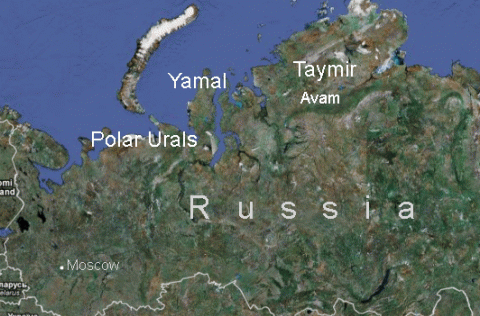
Busted_Hockey_Stick_locations

Update, the second: Tom Kelley corrects my use of the word “anthropogenic”, which I had idiotically written as “anthropomorphic”. Thanks, Tom.

A different approach to healthcare reform

Filed under: Government, Health, Politics — Tags: , — Nicholas @ 09:03

“John Galt” has a different suggestion for fixing what ails the American healthcare field:

We have some real problems: Bizarre incentives that have led to runaway costs. Rescission. An employer stranglehold over workers’ healthcare. Overuse in the form of care prescribed to protect doctors from lawyers, rather than protecting patients from illness. Arbitrary requirements to carry coverage for other people’s expensive risks.

The truth is that every one of those issues could be addressed — right now, and in a bipartisan fashion — without a single-payer system, a mandate, or any other form of “universal healthcare.” It wouldn’t even take a single massive “reform” bill — just a few simple bills, mostly repealing existing regulation.

But the left has settled on universal healthcare. The “public option.” No other reform is acceptable. No other reform will be permitted. Nothing can actually be fixed if it will lower the number of people who might benefit from a universal system, or if it will reduce national dissatisfaction with market-based care.

It’s quite true that there’s already massive government involvement in the health market, and that a lot of that consists of regulations that have dubious health benefits, but measurable detriments to patients, doctors, and hospitals.

The intersection of the War on Drugs with the government’s role in healthcare, for example, has led to a number of doctors being imprisoned for “inappropriate” prescriptions of painkillers to patients with chronic pain issues. It has also led to a huge number of doctors being afraid to prescribe what their patients actually need, for fear of being charged and convicted of “drug trafficking”. Many patients now suffer prolonged pain because they can’t get an adequate dose of painkillers and can’t find doctors to prescribe them.

All this, in pursuit of getting tough on illicit use of prescription medicine. Government at its finest.

September 28, 2009

QotD: Gambling on CO2 reduction

Filed under: Economics, Environment, Politics, Quotations — Tags: , , — Nicholas @ 12:45

There is a real and growing prospect of an all-out trade war being waged in the name of climate change.

The struggle to generate international agreement on a carbon deal has created a desire to punish “free riders” who do not sign on to stringent carbon emission reduction targets. But the greater goals seem to be to barricade imports from China and India, to tax companies that outsource, and to go for short-term political benefits, destroying free trade.

This is a massive mistake. Economic models show that the global benefits of even slightly freer trade are in the order of $50 trillion — 50 times more than we could achieve, in the best of circumstances, with carbon cuts. If trade becomes less free, we could easily lose $50 trillion — or much more if we really bungle things. Poor nations — the very countries that will experience the worst of climate damage — would suffer most.

In other words: In our eagerness to avoid about $1 trillion worth of climate damage, we are being asked to spend at least 50 times as much — and, if we hinder free trade, we are likely to heap at least an additional $50 trillion loss on the global economy.

Bjorn Lomborg, “Costly Carbon Cuts: Proposed Strategies Would Hurt the Most Vulnerable”, The Washington Post, 2009-09-28

September 26, 2009

Rick Mercer explains voter apathy

Filed under: Cancon, Politics — Tags: , , , — Nicholas @ 08:44

Rick Mercer has diagnosed the real reason nobody really wants a fall election in Canada:

It may be a myth that the Inuit have 100 different words to describe snow; it is an absolute truth that people on Parliament Hill have twice as many words to describe Stephen Harper’s various levels of angry.

[. . .]

Voting Conservative is not a problem for a majority of Canadians; we’ve done it before. Voting for an angry guy who thinks we’re stupid and will believe anything? That takes some getting used to.

[. . .]

The Liberals should have a bit of an advantage this time around. Having been beaten badly in the last election, they quickly took Stéphane Dion out behind the barn and he hasn’t been seen since. Immediately afterward, there was a puff of white smoke and the Liberal party suddenly had a brand new leader in Michael Ignatieff. He is by all accounts highly qualified, having dazzled many people at dinner parties for decades.

Mr. Ignatieff is, as we speak, surrounded by a brigade of young people in pointy shoes and designer glasses who work for him, worship him and twitter about him. Why we should vote for him? I’ve read the tweets; I’ve yet to see an answer.

[. . .]

Canadians have never come close to electing a New Democrat government federally, and yet Jack dreams. This is fine, as dreams are important.

The problem with Jack is, we all saw how excited he got when he actually thought that he was going to be a part of a coalition government. It wasn’t a normal excitement; it was the kind of excitement that scares other passengers on a plane.

Three excellent reasons to stay away from the polls. If there’s an election this year, I’m hoping there’ll be a smaller party I can cast my ballot for (without needing to hold my nose).

September 25, 2009

Consistency on the Middle East

Filed under: Politics, USA — Tags: , , — Nicholas @ 09:50

David Harsanyi looks at the consistency (actually, the lack thereof) in President Obama’s proposals for negotiation on the Palestinian-Israeli peace process:

The United States does not negotiate with terrorists — but we insist Israel do without preconditions.

We will not get entangled in the distasteful internal politics of Iran — but we define Israel’s borders.

We will remove missile defense systems in Eastern Europe so we do not needlessly provoke our good friends in Russia — but we have no compunction nudging Israel to hand over territory with nothing in return.

This week, President Barack Obama spoke to the United Nations’ General Assembly and insisted that Israel and the Palestinians negotiate “without preconditions.” (Well, excluding the effective precondition that Israeli settlements are “illegitimate,” according to the administration — so no pre-conditions means feel free to rocket Israel while you talk.)

Israelis must be wondering just what possible benefit this set of negotiations can possibly offer them: they’re the ones who stand to lose if they fall in line with Obama’s preconditions, and the Palestinians have no reason to compromise. It’s funny that the only functioning democracy in the middle east is now being portrayed as the villain by the US government, while the pocket dictatorships surrounding Israel get a free pass.

There is an ethical question that the president might want to answer, as well. Why would the United States support an arrangement that scrubs the West Bank of all its Jews? Why is it so unconscionable to imagine that Jews could live among Muslims in the same way millions of Arabs live within Israel proper? Not many international agreements feature ethnic cleansing clauses.

Isn’t this, after all, about peace?

Of course, we all know the answer to this question: Jews would be slaughtered, bombed from their homes, rocketed from their schools. This indisputable fact reveals the fundamental reality of these negotiations.

« Newer PostsOlder Posts »

Powered by WordPress


