
Alan Ruben
Published on 14 Apr 2013Part 2 of an in-depth 5 part series about George Orwell made in 1983.
April 5, 2019
The Brexit trainwreck is “revealing to the British public the extent of its political class’s incompetence”
Theodore Dalrymple in City Journal on the scale of political tomfoolery going on in the Brexit clusterfutz:

The imbroglio over Brexit has at least had the merit of revealing to the British public the extent of its political class’s incompetence. If it is accepted that people get the leadership that they deserve, however, thoughts unflattering to self-esteem ought to occur to the British population.
Theresa May did not emerge from a social vacuum. She is typical of the class that has gradually attained power in Britain, from the lowest levels of the administration to the highest: unoriginal, vacillating, humorless, prey to the latest bad ideas, intellectually mediocre, believing in nothing very much, mistaking obstinacy for strength, timid but nevertheless avid for power. Thousands of minor Mays populate our institutions, as thousands of minor Blairs did before them.
Avidity for power is not the same as leadership, and Brexit required leadership. There was none to be had, however, from the political class. From the very first, it overwhelmingly opposed Brexit — for some, the eventual prospect of a tax-free, expense-jewelled job in Brussels was deeply alluring — but found itself in a dilemma, since it could not openly deny the majority’s expressed wish. Many Members of Parliament sat for constituencies in which a solid majority had voted for Brexit. They feared that they would not win their next election.
The opposition Labour Party was as divided as the Conservatives. Irrespective of what its MPs actually believed about Brexit—its leader was, until recently, ardent for leaving the European Union, which he believed to be a capitalists’ club, changing his mind for reasons that he has so far not condescended to disclose — its main concern was to force an election that it believed it could win, a victory that would soon make Brexit seem like a minor episode on the road to ruin. The majority of the Labour MPs wanted first to bring about the downfall of a Conservative government and second to prevent Britain leaving the European Union without an agreement — what might be called the leaving-the-Union-without-leaving option. But they wanted the first more than they wanted the second, so under no circumstances could they accede to anything that Prime Minister May negotiated. Because of her tiny majority in Parliament, the hard-line Brexit members on her own side who want Britain to leave without a deal, and the refusal of her coalition partner, the Democratic Unionist Party, to back her, May needs the support of a considerable proportion of Labour MPs — which, so far, she has not received.
But the House of Commons as a whole, including the Conservatives, deprived May of leverage with which to renegotiate, because it voted that it would not accept leaving the Union without a deal. This deprived the European Union of any reason to renegotiate anything: it was a preemptive surrender to the demands of the E.U. that makes Neville Chamberlain look like a hard-bitten poker champion.
Comments Off on The Brexit trainwreck is “revealing to the British public the extent of its political class’s incompetence”
April 4, 2019
LPC Omertà in action
Omertà, according to Wikipedia, is “a Southern Italian code of honor and code of silence that places importance on silence in the face of questioning by authorities or outsiders; non-cooperation with authorities, the government, or outsiders; and willfully ignoring and generally avoiding interference with the illegal activities of others.” It’s also a remarkably appropriate way to describe the Liberal Party of Canada’s standard operating procedure:
“Ultimately the choice that is before you,” Jody Wilson-Raybould pleaded with her caucus colleagues, in a letter written hours before they were to pass sentence on her, “is about what kind of party you want to be a part of, what values it will uphold, the vision that animates it, and indeed the type of people it will attract and make it up.”
But they made that choice long ago. They knew what kind of party they wanted to be a part of from the moment they accepted their nominations; indeed, were they not the type of person that party attracts they would not have been recruited for it. It is the kind of party, and person, that unquestioningly puts loyalty to party before principle — and mercilessly punishes those who do not.
So on the question of whether to expel the former minister of justice and attorney general — along with the former Treasury Board president, Jane Philpott — for the crime of denouncing the attempt, by the prime minister and senior government officials, to interfere with a criminal prosecution, there could have been little doubt how they would vote.
Whether they chose to shoot the messengers so spontaneously, over Justin Trudeau’s objections, as some reports have claimed — they were “determined to take the matter into their own hands,” according to a Canadian Press story, as if MPs were so eager to prove their obedience to the leader as to be willing to defy him — or whether they did so under orders doesn’t much matter. The rotting of the soul is the same either way.
We can now see, if it were not already apparent, the moral compass by which the prime minister and his caucus steer. The scandal in the SNC-Lavalin affair is, by this reckoning, not the months-long campaign to subvert the independence of the attorney general and, through her, to force the independent director of public prosecutions to drop charges of fraud and corruption against a long-time Liberal party contributor, but the opposition to it.
Traditional political theory teaches that the executive branch of government is responsible to the legislative. It is now clearer than ever that the reverse more nearly applies: members of the Liberal caucus plainly see it as their role, not to hold the government to account, but rather their fellow MPs — on behalf of the government. When wrongdoing by those high in government is alleged by a pair of whistleblowers, their first thought is to root out the whistleblowers.
Comments Off on LPC Omertà in action
April 3, 2019
A review of Woke by Titania McGrath
The poetic titan of Twitter, ultra-woke voice of her generation Titania McGrath (recently revealed to be the creation of comedian Andrew Doyle), is now a published author:
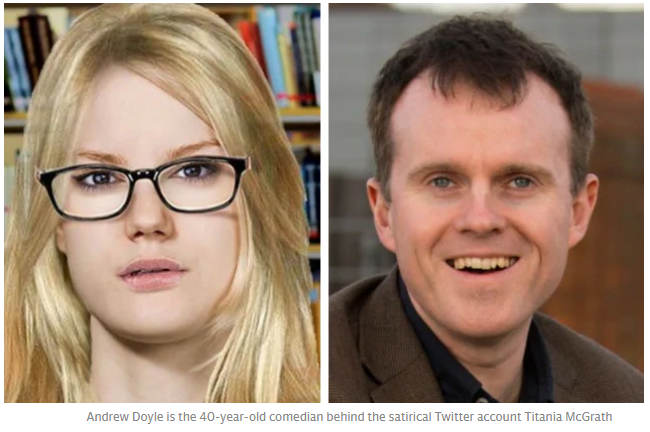
… Titania McGrath, the radical intersectional feminist poet who verbally bombards the “white supremacist patriarchy.” A malcontent who is fed up with us ignoramuses, McGrath has published her first book. Simply titled Woke: A Guide to Social Justice, it’s a manifesto written in prose possessing a revolutionary zeal so potent Che Guevara would lecherously swoon and request that she provide him with remedial education in social revolution.
McGrath addresses the vast intricacies of wokeness and responds to the counterarguments that the agents of the patriarchy often make. She also outlines how this puritanical movement can attract converts. Her insight is sought after since, after all, “our society is a slumbering beast that has been trapped in its coma for far too long.”
Proving to be Winston Churchill’s 21st-century equivalent, McGrath teabags “the foes of justice with a gender-neutral scrotum.” And challenges the “illusion of freedom” to extirpate Nazis and destroy any other obstacles to the “Intersectional Socialist Utopia.”
We all live in a “heteronormative patriarchy” that’s a “Tyranny of Facts” erected by the “Scourge of Whiteness.” Knowledge is a “patriarchal construct” that is only convenient for those who want to strengthen the white male authoritarians’ grip on power. So what must we do to rectify this?
According to McGrath, our society is almost irreparably “unwoke,” and we might have to implement drastic purgatory measures. We shall be heedful of the wisdom of brave reformists like Hannah Gadsby and eradicate anything offensive. Reforming things like comedy and any other art form perceived to be toxically masculine should be our first priority. Scientists will also tremble at the feet of these woke revolutionaries. As McGrath avers: “The idea that knowledge is more important than feelings is everything that is wrong with the field of modern science.”
With a knack for conflict analysis that would rival Churchill’s, McGrath identifies our real enemies with panache. “Every sperm is an invader” if you didn’t know, and those who commit cultural genocide by doing yoga are civilization’s true adversaries. As are compilers of the English dictionary who give credence to antediluvian definitions of racism that enable us to think a person of colour can also be racist.
Comments Off on A review of Woke by Titania McGrath
April 1, 2019
Sean Gabb on the Brexit crisis
In his latest email newsletter, Sean Gabb discusses the Brexit situation:
The consensus in the media appears to be that Parliament is out of control, and is attempting to stop our exit from the European Union – even if this means tearing up every settled constitutional norm. I disagree. No doubt, the House of Commons is filled with some very trashy people, and I have little doubt most of them would like to stay in the European Union. Even so, they are acting collectively with strict constitutional propriety. For the first time in my life, they are earning their inflated salaries and expenses and bribe allowances.
Three years ago, we vote to leave the European Union. The margin was respectable, though not substantial. The Government was therefore given one reasonably difficult job. This was to detach us from the institutions of the European Union, while respecting the wish of a large majority for continued good relations with the European Union. This was difficult, but hardly in the same class as trying to win a war against the greatest military power in the world, or dismantle an Empire, or even reform the structures and financing of local government. The most obvious compromise was to rejoin EFTA and remain in the Single Market, while negotiating a longer term set of arrangements. Most people, I think, would have accepted such a compromise. I would, and I may have written about it at the time.
Instead of doing this, however, Theresa May loaded us with endless vague promises, while negotiating in secret with the European Commission. At the end of two years and six months, she presented us with a draft Withdrawal Agreement that was universally unacceptable. I will not rehearse why it was unacceptable. Everyone has read it for himself, or read a fair summary and critique. When this was presented to the House of Commons, it was overwhelmingly rejected. Why the Labour Party and the various open Remainers voted against it is less important than that they did vote against it. This is why we have a Parliament. It is there to stop the Executive from acting against the public good. It is there to make the voice of the people heard.
Our present set of crises blew up when it emerged that Theresa May had allowed no one to think about any alternative to her Agreement. Her only solution to losing the first vote was to arrange for another, and then for another. Each time, her Agreement was rejected – and rejected, I repeat, for good reasons. But, thanks to her wickedness or stupidity, there were only three options available to Parliament. One was to swallow her Agreement. Another was to leave without any deal. The other was to give up on leaving – to cancel the Referendum result.
[…]
It may be that the plan was to unveil a fraudulent leaving agreement, and to whip this through Parliament, leaving the rest of us to grumble about it for the next generation, though unable to do anything about it. If so, the plan has failed. The problem is not that our ruling class does not want to be bound by the will of the people – this is hardly a novel discovery. The problem is the crude inflexibility of our rulers. The EFTA compromise I and most other people would have accepted three years ago would have allowed any number of quiet understandings in London that let things as they matter to our rulers go on much as before. Instead, they wanted complete victory on their terms, and they planned for no other outcome. No competent strategist or negotiation behaves like this. The Tory ultras did not behave like this in 1832 or 1911. Labour did not behave like this after 1983. On the whole, we are lucky that we have asked these people only to arrange a departure in good order from a customs
union. They might instead have messed up something really important.These crises have been a useful learning experience. Theresa May and the interests she has been chosen to front are both wicked and stupid. Speaking for myself, I think our Members of Parliament – wretched creatures if these may be in themselves – for doing their job and lifting the stone to show the pale and stinking bugs in full light of day. Sooner or later, we shall leave the European Union. This will be a messier and more acrimonious departure than it needed to be. But I suspect that the debate between Leavers and Remainers is turning to a shared demand for our will to be obeyed by the Executive. This is a much wider matter than our membership of the European Union. Leaving is now a symbol of who has the final say in this country. The longer our decadent rulers try to hold firm, the more radical the demands will grow for a reconstruction of the system.
I have no idea what will happen in the next few weeks. But I am glad we have the Parliament that we have.
Alex Noble feels the situation is going pretty much exactly how the EU wanted it to go from the start:
For a few months now I have written about how the EU’s plan is increasingly transparent, and it is becoming possible to anticipate their every move.
I believe we are now so close to the outcome they wargamed a year ago, that the final week is now almost completely predictable.
For what it’s worth, here we go.
[…]
So this coming week, the EU will water down or remove the backstop they never cared about, and the British people will be betrayed into vassalage by their Vichy Parliament.
That’s right – another “breakthrough” is imminent, although I suspect the EU will once again trot out the gap-toothed Belgian bumpkin Verhofstadt to pretend to find the whole affair insulting, so we remember to be properly grateful to his paymasters.
All other options now are just scare tactics – No Brexit, No Deal, long extensions, a general election, a loss of drinking water, or pet food, or medicine – these are all just the Bad Cop act designed to get us to gratefully turn to the Good Cop.
Namely the EU’s Withdrawal Agreement, which as I’ve pointed out is like the Withdrawal Technique in that despite the promises made, it usually involves no actual withdrawal.
We have been herded for nearly a year like scared children towards the EU’s treaty, which imprisons us forever in the EU – it is what they wanted all along, and they have used our government, our MPs (with a few dozen honourable souls still resisting as I write), our media, and the craven statists embedded in our institutions to convince us that the EU’s Withdrawal Agreement represents freedom.
In this coming week, all but a few dozen stalwarts will crumble, and then the only question is whether enough Labour europhiles will cross the House to pass this grotesque betrayal and inflict it on the British people.
At that stage, I wonder whether our cries of fury and anguish will fade into silence, or swell into carnage?
Comments Off on Sean Gabb on the Brexit crisis
QotD: George H.W. Bush
Way back in the olden thymes, conservatives during the Reagan years had a real fear that the Rockefeller Republicans would not only undermine the conservative agenda, but find a way to corrupt the Reagan administration. It was an unwarranted fear. Those Progressive Republicans were a dying force in politics. Reagan was a man of his age so his conservatism does not always make sense to the modern ear, but he stuck to his guns for the most part. He was a politician, so he compromised when he had to.
Then George H. W. Bush was ready to take the reigns of the movement and the party, despite being a Rockefeller Republican. Bush was a Progressive by any measure, but he supposedly got religion in the 1980’s, and to be fair, a lot of people went through that transformation. There were even old Jewish guys, who used to support communists, that were suddenly changing teams to join the new emerging majority. Bush spent a lot of time convincing the voters he was just like Reagan and they had nothing to fear.
The ’88 election was a landslide for Bush and a lot of sensible people thought that he would be the finishing touches to the new conservative majority. He would smooth out the rough patches and put a shine on other aspects to it. His famous pledge to never raise taxes was the cornerstone of his pitch. Wiser heads, the paleocons, saw what was coming, but most did not. That’s why when Bush broke his promise, a year into his presidency, his voters were crushed. Bush was a liar.
History is written by the victors and that means the Left, so we’re always told that Bush lost in ’92 because Clinton was sent by the void where God once existed, to bring joy and bliss to the blessed and smite the wicked. The truth is, Bush lost because the core of his voters rightly saw him as a liar and a fink. Many people I know, including myself, voted third party as a protest. Yeah, it meant a degenerate would win the election, but at least we knew what we were getting. Liars like Bush always find new ways to screw you.
[…]
This brings us back to Bush. He spent the remainder of his presidency trying to rebuild his standing with conservatives. He even scored what was pitched as a stunning victory in the First Gulf War. But, you only get one shot to piss away your integrity and Bush did not miss that opportunity. He entered the general election as a weak incumbent and Clinton used his broken pledge in commercials to remind everyone that Bush was an untrustworthy liar. Imagine that. Clinton beat Bush on the integrity issue.
“The Z Man”, “Donald Herbert Walker Trump”, The Z Blog, 2017-04-07.
Comments Off on QotD: George H.W. Bush
March 31, 2019
CSI: Robert Mueller won’t be renewed for a third season
In the latest Andrew Heaton newsletter, a brief ode to CSI: Robert Mueller, which didn’t get enough of a ratings boost from this season to get renewed for next year:
The biggest news of the week is, of course, that the Supreme Court ruled a guy in Alaska can continue moose hunting on his hovercraft. (Thank God — if we can’t blast away at megafauna from a floating disk, why did we even bother fighting the British to begin with?!) After that spectacular work of jurisprudence from the highest court in the land, the second biggest news item is probably the Mueller report.
[…]
Back to the Mueller report. I didn’t really follow CSI: Robert Mueller over these last two seasons. For one thing, it seemed very complicated. One character got indicted over rugs. Another character got indicted over porn hush money. These always struck me as convoluted plot devices.
Secondly, I suspected that the Mueller report would wind up being more smoke than fire, so I decided not to do daily play-by-play’s, and instead focused my prodigious analysis on things like hover board moose hunting. (For example, if you shoot a moose while levitating, does the activity fall under FAA jurisdiction, or is it still under the purview of the Federal Moose Department, like everywhere else?)
My friends who breathlessly and repeatedly stated that Trump was hours away from a Watergate-level scandal seemed very confident the walls were closing in, and very eager to accumulate any and all ammunition to fire at the White House. For them, the Mueller investigation did not exist to determine whether or not the president colluded with Russia. Its purpose was to broadly accumulate sufficient material to impeach Trump with, on any charge capable of pulling it off. But that was never the remit of Mr. Mueller — nobody ever said, “Hey throw some spaghetti at impeachment charges until something sticks.”
To be clear, I am not a fan of Mr. Trump, nor would I hesitate to support his impeachment if presented with good evidence that he broke the law or unlawfully shot a moose from an unregistered hovercraft outside of designated moose-killing zones (MKZ). But if we’re going to go down the impeachment route, there needs to be a smoking gun and a clearly outlined felony charge. Removing the head of state from office through political guile and vague technicalities wouldn’t alleviate the staggering divisiveness Mr. Trump has bequeathed us, it would bake it in for two generations.
Despicable man-child though he may be, overall it’s a win for our country that its leader turned out to not collaborate with our arch-rivals to undermine democracy. That’s a net positive. I’ve become more Burkean during the Trump years, and worry about the institutional damage his relentless tantrums are inflicting on constitutional restraints, the veracity of courts, and the role of the media. I don’t want to add the validity of American elections to his collateral damage.
You can subscribe to the Heaton newsletter here or you can visit his website here.
Comments Off on CSI: Robert Mueller won’t be renewed for a third season
March 27, 2019
“This was the week it became necessary to destroy the village of good government in order to save it”
It may be hard to believe, but in his latest at Maclean’s, Paul Wells appears to be getting a little bit cynical about recent shenanigans in Ottawa:
We have learned so much. Within minutes Monday afternoon, two good reporters had stories (here and here) about the Chief Justice of Manitoba, who was a candidate to be Chief Justice of the Supreme Court of Canada and who, later, wasn’t. Both reporters unfurled similar yarns about a lone Prime Minister standing athwart the tide of conservatism by blocking — shudder — a Harper appointee from sitting on the top court. Jody Wilson-Raybould plays the role of villain in the piece.
Both reporters decorously neglect to mention that Trudeau’s choice for Chief Justice, Richard Wagner, was a Harper appointee.There are many things we can say about this story, working outward in concentric rings from the thing itself. First, Glenn Joyal’s views, as expressed in speeches that were said to alarm the prime minister, are almost comically orthodox. I first became aware of the notion that Charter litigation systematically airlifts important matters from the parliamentary arena and into the realm of jurisprudence in a Chantal Hébert column in the late 1990s. If I had paid more attention to literally any of my Canadian public administration profs a decade earlier I would have caught the argument then, because it is canvassed in every Canadian political science class. This is not wild-eyed Hayekism.
Second, perhaps the many thousands of Canadians who have applied for federal government appointments under what they thought was a confidential process, introduced by this prime minister, will want to contemplate a class-action suit against him. Because it is now radiantly clear to each of them that their CV is being held hostage by a claque of embattled sorcerers’ apprentices who will cheerfully wheel it over the transom to any waiting scribe if anything about them — their opinions, a fallen political star’s unfortunate decision to argue for their advancement — becomes politically inconvenient. This is the very stuff of the police state.
It was immediately fashionable to wonder on social media how everyone would react if Stephen Harper had done such a thing. It’s germane to note that Stephen Harper never did. Because he had more class. Welcome to the Tet offensive of Charter rights: This was the week it became necessary to destroy the village of good government in order to save it.
Third, Justice Joyal’s wife was in poor health. Apparently we are to believe that 9,000 jobs depended on your knowing that.
If the Trudeau government is not the source of the leak, I assume we will see spectacular efforts deployed in the next 36 hours to find the leaker. Mark Norman-scale efforts. But I’m pretty sure that we needn’t hold our breath, because the government is the source of the leak; that the amiable chap who currently sits in the office once occupied by the Attorney General of Canada will not bestir himself to question Monday’s sickening attack on due process; and that the leak will actually be roundly applauded by the ambient cloud of Liberal and Liberal-adjacent opinion, which became self-aware this weekend and decided Jody Wilson-Raybould and Jane Philpott are a virus endangering the party’s re-election chances and must therefore be stopped.

Comments Off on “This was the week it became necessary to destroy the village of good government in order to save it”
March 26, 2019
Matt Taibbi on “a death-blow for the reputation of the American news media”
A revised and updated chapter from his Hate, Inc.:
Note to readers: in light of news that Special Prosecutor Robert Mueller’s investigation is complete, I’m releasing this chapter of Hate Inc. early, with a few new details added up top.
[…]
Over the weekend, the Times tried to soften the emotional blow for the millions of Americans trained in these years to place hopes for the overturn of the Trump presidency in Mueller. As with most press coverage, there was little pretense that the Mueller probe was supposed to be a neutral fact-finding mission, as apposed to religious allegory, with Mueller cast as the hero sent to slay the monster.
The Special Prosecutor literally became a religious figure during the last few years, with votive candles sold in his image and Saturday Night Live cast members singing “All I Want for Christmas is You” to him featuring the rhymey line: “Mueller please come through, because the only option is a coup.”
The Times story today tried to preserve Santa Mueller’s reputation, noting Trump’s Attorney General William Barr’s reaction was an “endorsement” of the fineness of Mueller’s work:
In an apparent endorsement of an investigation that Mr. Trump has relentlessly attacked as a “witch hunt,” Mr. Barr said Justice Department officials never had to intervene to keep Mr. Mueller from taking an inappropriate or unwarranted step.
Mueller, in other words, never stepped out of the bounds of his job description. But could the same be said for the news media?
For those anxious to keep the dream alive, the Times published its usual graphic of Trump-Russia “contacts,” inviting readers to keep making connections. But in a separate piece by Peter Baker, the paper noted the Mueller news had dire consequences for the press:
It will be a reckoning for President Trump, to be sure, but also for Robert S. Mueller III, the special counsel, for Congress, for Democrats, for Republicans, for the news media and, yes, for the system as a whole…
This is a damning page one admission by the Times. Despite the connect-the-dots graphic in its other story, and despite the astonishing, emotion-laden editorial the paper also ran suggesting “We don’t need to read the Mueller report” because we know Trump is guilty, Baker at least began the work of preparing Times readers for a hard question: “Have journalists connected too many dots that do not really add up?”
The paper was signaling it understood there would now be questions about whether or not news outlets like itself made galactic errors by betting heavily on a new, politicized approach, trying to be true to “history’s judgment” on top of the hard-enough job of just being true. Worse, in a brutal irony everyone should have seen coming, the press has now handed Trump the mother of campaign issues heading into 2020.
Nothing Trump is accused of from now on by the press will be believed by huge chunks of the population, a group that (perhaps thanks to this story) is now larger than his original base. As Baker notes, a full 50.3% of respondents in a poll conducted this month said they agree with Trump the Mueller probe is a “witch hunt.”
Comments Off on Matt Taibbi on “a death-blow for the reputation of the American news media”
March 25, 2019
QotD: Village life
I hate rumor. Perhaps I hate it more because I grew up in a village.
The people who imagine villages are idyllic and every person in it loves the other like a brother or sister, have no knowledge of people — or reality. Sure, in many villages in isolated places, most of the people there are related to some degree. This was not true where I grew up, because the village was already in the process of exploding into a large-city suburb. It wasn’t visible to me as a child, because it was so slow, and newcomers still took years to integrate, but it it had been going on for so long that the appellation of “aunt” given to any grown woman by any child was just courtesy, not truth. Still, had we been all related, people who imagine that makes for harmonious living must have been only children and the children of only children.
No, never mind, I’m being silly. Those people are actually enormous racists and oikophobes. Hating their own home, they imbue places far away, particularly those inhabited by people who tan more than they do, with the qualities of heaven. They also in the process make those people-who-tan (or as I always think when I’m the object of this type of thought, and yes, I am, it’s what enables them to think themselves my intellectual superiors a-priori “Little brown peoples”) less than human. They (we) are not people with our own agency, and all the virtues and vices of mankind, but sort of little pets, perfect, well behaved and needing both the protection of our masters, the pale enlightened, and their pat on the head for how good we are. (Most of the left’s ideas on “defeating colonialism” envision themselves as benevolent colonial masters. In fact, the colonialism of Marxist ideas in Africa is what has made it hell on Earth, far worse than any colonial overseers could do. By turning their best and brightest into Marxist apostles at our “finest universities” they get to send these ideas back to Africa. There was some idea they would flourish there among people unsullied by greed and the wish to succeed individually (yes, it’s that racism again. It is inherent in the left’s contrived “celebration” of black people, Kwanza, which is really a celebration of socialist principles. And no, is in no way African. It was invented in the US. For one there isn’t such a thing as an “African” holiday. The continent is as or more varied than Europe (because transport was near impossible for most of its existence, tribes and villages were very isolated indeed.)) It didn’t. Instead it has made Africa worse than ever before. And this was done by turning its favorite sons, its brightest sparks into poison pills. Colonialist Marxism is appalling and responsible for the deaths of millions. As is Marxism everywhere.)
Sarah Hoyt, “Painted All In Tongues”, According to Hoyt, 2017-03-20.
Comments Off on QotD: Village life
March 23, 2019
17 Million F*ck Offs – A Song About Brexit
Dominic Frisby
Published on Mar 5, 2019Please help take this song to number one by buying a copy of the single at iTunes/Amazon etc
Amazon – https://www.amazon.co.uk/17-Million-F… ITunes (ignore Apple Music and go to the iTunes store) – https://itunes.apple.com/gb/album/17-…I’ll put in other links as and when they come in.
Written and performed by Dominic Frisby
Music composed and played by Martin Wheatley (based on a traditional Devon folk song)
Video directed by anon
Audio mixed and recorded by Wayne McIntyre
Assistant director Mark “Yeti” CribbsLyrics
On the 23rd of June, 2016
The people of the United Kingdom – and Gibraltar – went to vote
On an issue that for some had been burning for years
The question in full – and unaltered – was – I quoteShould the United Kingdom remain a member of the European Union
or leave the European Union?It was the greatest democratic turnout in British history, I do not scoff
And when the time came to speak the British said f*ck off.
F*ck off.Campaigning had gone on for many a month
With debate and discussion on many a front
They’d argued they’d fought they’d smeared and pulled stunts
There was David Cameron. Theresa May. George Osborne.
Tony Blair. John Major. The BBC.
The British told them to f*ck off. The British told them to f*ck off.If you vote to leave, you’ll lose your job
Vote to leave, you’ll lose your home.
The ensuing recession will last for years
Said David Cameron. Theresa May. George Osborne.
And the Treasury. Tony Blair. John Major. The BBC.
The Bank of England. Mark Carney. The EU. The IMF. The US president. Saint Obama. Back of the queue. Loads of celebrities. Gary Lineker. JK Rowling. Benedict Cumbertwat. Lord Adonis. Who the fuck’s he anyway?
The British told them to f*ck off. Seventeen million f*ck offs.They wheeled in the experts to tell us what’s right
They gave us the benefit of their foresight
To leave is calamitous, that’s definite.
Food shortages. No medicine. Planes grounded. House price crash. ½ a million jobs lost. Cost of £4,300 to every home. Stock market collapse. Riots. No sandwiches.
There’d be an outbreak of super gonorrhea. They seriously said that. Donald Tusk at the EU said it would be the end of Western civilization as we know it. I’m not joking. And one more thing. If you vote to leave, that makes you racist.
The British told them to f*ck off. Seventeen million f*ck offs.The vote is final, there’s no going back
Although now they want to go back and re-vote
I think we know what the answer will be
To Gary Lineker. Alastair Campbell. Dominic Grieve. Chuka Umana. Keir Starma. Vince Cable. Anna Soubry (not a Nazi). Rory Bremner. Armando Ianucci. Delia Smith. Steve Coogan. David Lammy. Lord Adonis. Who the fuck’s he anyway?
The British will tell them f*ck off. 17 million f*cks offs.ISRC#: TCAED1904492
Comments Off on 17 Million F*ck Offs – A Song About Brexit
QotD: Pity the poor politicians
The first reason to pity them, however, is that someone, or rather some group of people, has to do politics, just as people have to do other unpleasant jobs, such as cleaning lavatories. If it were not for the politicians whom we actually have, there would only be others, not necessarily better. Politicians are like the poor: You have them with you always — except in Switzerland, that happy land where people do not even know who their president is, he being so profoundly unimportant.
But the second and more compelling reason to pity the poor politicians is that theirs is a dreadful life judged by normal standards. If it has its compensations, such as power, money, and bodyguards, they are bought at a dreadful cost. The other day I caught a glimpse of what that life must be like.
A television crew came to make a documentary about me. It will last about 45 minutes, will be watched (thank goodness) by only a small audience, and took two and a half days’ filming to make. The television crew was very nice, which is not my universal experience of television people, to put it mildly; but even so, two and a half days being followed by a camera is more than enough to last me the rest of my life.
I found the strain of it considerable, even though, really, nothing was at stake. It did not matter in the slightest, not even to me, if I made a fool of myself by what I said. There would be no consequences for my career, such as it is (it is almost over); there would be no humiliating exposures of my fatuity in the press, no nasty political cartoons as a consequence, and no insulting messages over the antisocial media. The television team was clearly not out to trip me up or perform a hatchet job on me. It was friendly and I could trust it not to distort what I said by crafty editing. But all the same, the attempt to act naturally while in the constant presence of a camera and a microphone with a furry cover was tiring. The order to be natural is a contradiction in terms. You might as well order someone to be happy.
Of course, one grows accustomed to anything in time. Just as a bad smell disappears from one’s awareness if one remains for long enough in its presence, so eventually one forgets about the presence of a camera and a microphone. No doubt politicians who live half their waking time within the field of these instruments learn to ignore their physical intrusiveness; but, of course, much more is at stake for them than it ever was for me. They are under constant surveillance; and just as the pedant reading a book pounces upon an error, even if it be only typographical, and marks it with his pen, so journalists and political enemies pounce upon a gaffe uttered by a politician and try to ruin him with it. And the more subjects come under the purview of political correctness, the easier it becomes to make a gaffe that will offend some considerable part of the eggshell population. In fact, much of that population actually wants to be offended; being offended is the new cogito that guarantees the sum. I am offended, therefore I am.
Theodore Dalrymple, “Pity the Poor Politicians”, Taki’s Magazine, 2017-04-01.
Comments Off on QotD: Pity the poor politicians
March 22, 2019
The rise of the neo-barbarians and modern tribalism
Sarah Hoyt isn’t a fan of civilization being replaced by the prehistoric landscape of tribe versus tribe, forever:
Tribalism seems to be the default setting of the human race.
Maybe it’s because we’re built on the frame of Great (or at least pretty good) Apes. Band seems to be the default unit of a Great Ape.
The people who do those cute and vapid studies on how your toddler is racist — by which they mean he prefers people who look like mommy and daddy, or their surrogates in his life — don’t seem to understand that. They don’t seem to understand that for most of human existence, (prehistory is much longer than history) for a toddler to stray outside his tribe meant at best he was raised as a slave, and at worst he became lunch.
I wonder if it’s this uncritical, sort of history-and-genetics free view of the world that causes the left to think that tribes are awesome.
Might just be their usual — and honestly, isn’t it tiresome by now? — view of the world which thinks everything “natural” by which they mean pre-civilized is better. This leads to nostalgie de la boue and therefore elevates primitive/non civilized cultures over western culture.
Or perhaps it is simply the fact that Marxism was “rescued” by Gramsci. Marxism was bad enough in its inability to see individuals, and ascribing everyone to economic tribes.
[…]
Anyway, back to our point: one of the great advances of humanity, possibly as momentous as the discovery of fire, was the overcoming of tribalism.
Forging tribe-like bonds based on “we share this land” and in fact, being able to tell ourselves stories about how “everyone in this land is one people” gave rise to the city state, the country, and eventually the “community of civilized men.”
Of course, yes, Christianity had a lot to do with this, but there was some of that going on already in the Roman Empire, where Persian and Greek could both declare (after the appropriate formalities and acculturation) “Civis Romanum sum.”
As bad as the super-states of the twentieth century got — because there’s nothing as a large nation with a good dose of crazy-making philosophical theory — it allowed commerce and industry, which are miles and miles better at creating and keeping wealth than hunting-gathering.
The problem is that the left, led by Gramsci, has re-invented tribalism. And no, I don’t just mean tribalism of place of origin or color — though they include that — I mean tribalism of EVERYTHING.
Being unable to see individuals (has anyone done studies of their brain? Maybe there’s something missing) they instead keep sorting people into increasingly smaller groups based on things that have bloody nothing to do with what the person IS capable of, or thinks or believes: Color, who people sleep with, what people have between their legs, who people like to sleep with, what people call their deity, etc. etc. ad very definitely nauseum.
[…]
The other side effect of this is that everyone who isn’t a member of the tribe is potentially the enemy. This is what leads to the internecine fights within the left, and why if they should win (forbid) we’ll be stuck in civil war after civil war forever. Adapting the Arab proverb: Me and my Marxist classmates against the world; Me and my black Marxist classmates against our white Marxist classmates; Me and my black Marxist female classmates against our black Marxist male classmates; Me and my black lesbian Marxist female classmates against our black straight Marxist female classmates… and so on ad infinitum, until the tribe of one is at war with everyone else, and worse stuck in a pit of anger and resentment because he/she isn’t given all the recognition and compensation he/she should have from the rest of the world at large.
At the same time anyone outside it is viewed as less than human. This is why they think they can tell everyone to shut up because “white privilege” or “male privilege” or whatever, and they honestly think there will be no resistance and no backlash.
Comments Off on The rise of the neo-barbarians and modern tribalism
March 21, 2019
Remy: “Affluenflammation”
ReasonTV
Published on 20 Mar 2019When quality of life improved, doctors discover a new affliction.
Reason is the planet’s leading source of news, politics, and culture from a libertarian perspective. Go to reason.com for a point of view you won’t get from legacy media and old left-right opinion magazines.
A parody of the Red Hot Chili Peppers’ “Californication” written by Remy.
Music tracks, mastering, and background vocals by Ben Karlstrom
Video produced by Austin Bragg.LYRICS
There’s a non-foregone phenomenon in any prosperous nation
When primal fears all disappear the brain then gets a sensation
The medical name we gave this pain is affluenflammationOl’ Bill Tub is chugging a jug of cold bovine lactation
When his eyes then realize that carton side’s got information
And since his life contains no strife it’s affluenflammationFor the better part of history diseases all were raging
Measles, mumps up on your junk like they were Kevin Spacey
Then came Jonas Salk
Makes you wonder what all for…Cuz we’ve got affluenflammation
We’ve got affluenflammationOl’ Chip Black is cracking the back of twelve live-steamed crustaceans
For the perks and glee of living free he starts to lose appreciation
And if you probe his frontal lobe — yep — affluenflammationThrough the course of human history each day we faced starvation
Rats and pox and chamber pots, streets filled with defecation
Free markets changed the norm
Makes you wonder what all for…Cuz we’ve got affluenflammation
We’ve got affluenflammation
We’ve got affluenflammation
We’ve got affluenflammation
Comments Off on Remy: “Affluenflammation”


