CaNANDian
Published 25 Sep 2012Christopher Hitchens talked with EconTalk host Russ Roberts about George Orwell. Drawing on his book Why Orwell Matters, Hitchens talked about Orwell’s opposition to imperialism, fascism, and Stalinism, his moral courage, and his devotion to language. Along the way, Hitchens made the case for why Orwell matters.
Download audio: http://www.econtalk.org/archives/2009…
May 17, 2021
Christopher Hitchens – On EconTalk discussing George Orwell [2009]
May 12, 2021
Looking at a highly influential document among progressive groups
Matthew Yglesias on Tema Okun’s “The Characteristics of White Supremacy Culture” and its role in furthering progressive emotions over what they consider to be the most racist society in human history (that is, the modern west but especially the United States):
Debating abstractions is difficult and frustrating, and the discourse about “wokeness” and “cancel culture” has become a snakepit of semantic debates, bad-faith actors, and people of goodwill talking past each other.
So I want to talk instead about one specific document, not because I think it’s the most important document in the world, but because I don’t really see anyone who I read and respect talking about it even though I’ve seen it arise multiple times in real life.
I’m talking about “The Characteristics of White Supremacy Culture” by Tema Okun, which I first heard of this year from the leader of a progressive nonprofit group whose mission I strongly support. He told me that some people on the staff had started wielding this document in internal disputes and it was causing big headaches. Once I had that on my radar, I heard about it from a couple of other nonprofit workers. And I saw it come up at the Parent Teacher Association for my kid’s school.
It’s an excerpt from a longer book called Dismantling Racism: A Workbook for Social Change Groups that was developed as a tool for Okun’s consulting and training gigs.
But today, even though it’s not what I would call a particularly intellectually influential work in highbrow circles — even ones that are very “woke” or left-wing — it does seem to be incredibly widely circulated. You see it everywhere from the National Resource Center on Domestic Violence to the Sierra Club of Wisconsin to an organization of West Coast Quakers.
Which is to say it’s sloshing around quite broadly in progressive circles even though I’ve never heard a major writer, scholar, or political leader praise or recommend it. And to put it bluntly, it’s really dumb. In my more conspiratorial moments, I wonder if it’s not a psyop devised by some modern-day version of COINTELPRO to try to destroy progressive politics in the United States by making it impossible to run effective organizations. Even if not, I think the document is worth discussing on its own terms because it is broadly influential enough that if everyone actually agrees with me that it’s bad, we should stop citing it and object when other people do. And alternatively, if there are people who think it’s good, it would be nice to hear them say so, and then we could have a specific argument about that. But while I don’t think this document is exactly typical, I do think it’s emblematic of some broader, unfortunate cultural trends.
H/T to Colby Cosh for the link.
May 10, 2021
QotD: Against the notion of the “Social Contract”
As a modern conservative, [Roger] Scruton defends a form of democracy unknown to Aristotle. Following David Hume and Edmund Burke, however, he opposes the idea that the “political order is founded on a contract.” For Scruton, the state of nature is a chimera — an invention of modern political philosophers who had forgotten the debt and gratitude owed to our predecessors. The fictitious state of nature — so central to philosophical liberalism — obscures the fact that membership in a community, with its requisite duties and obligations, is a precondition for meaningful freedom. “Absolute freedom” — doing whatever one wants — is always an invitation to anarchy or tyranny. In the modern world, the nation is the political form that guarantees membership and self-government.
In all of his political writings, Scruton takes on the Left for scorning existing norms and customs, and for promoting a “culture of repudiation.” The Left is “negative.” It dismisses “every aspect of our cultural capital” with the language of brutal invective: accusing every defender of human nature and sound tradition of “racism,” “xenophobia,” “homophobia,” and “sexism.” Like 1984‘s “two minutes of hate,” this language tears down, intimidates, and can never build anything humane or constructive — it is nihilistic to the core. At the same time, Scruton wants to reach out to reasonable liberals who eschew ideology and who still believe in civility and the promise of national belonging. His conservatism can discern the truth in liberalism (another Aristotelian trait) while the partisans of repudiation see half the human race as enemies.
Daniel J. Mahoney, “Beyond the Culture of Repudiation”, Claremont Review of Books, 2018-06.
May 4, 2021
Our modern verbal taboos
John McWhorter tackles the dreaded “N-word” — perhaps the most powerful taboo word in our current quasi-religious culture:
The question is why we have become so extremely sensitive about that word since the 1990s, despite that our times are so much further from the ones where whites casually levelled the term with abandon. Why are we making a finger-cross and hanging garlic in the doorway against even any semblance or suggestion of a sequence of sounds?
Supposedly because the word recalls slavery, Jim Crow and horrific abuses. But then, even black people just a few decades ago didn’t typically think this meant that one cannot utter the word even to refer to it. That’s new, and it is, quite simply, a taboo — as in what we associate with societies vastly different from our own.
There are languages in Australia where you use a separate vocabulary with your mother-in-law, and it is taboo to use the regular word equivalents for it with her. In one of the languages, there is a general word for moving that you use when talking to your mother-in-law about going, walking, sailing and crawling. To use the regular words for these things with her would be like hauling off with a curse word in English.
This sounds quaint to us, but should not, because our treatment of the N-word is hardly different. The idea that the word is simply never to be uttered is so deeply entrenched now that it may seem odd to many people under about 40 that in times that seemed quite modern not so long ago, one could produce the sounds of the word nigger in public if you were talking about it rather than using it. With taste, of course — one didn’t go about saying it over and over. But there was an understanding that to refer to it — especially since this was usually in condemnation — was harmless. Because it was.
If you think about it, this made perfect sense. It’s today’s situation that is odd, in that suddenly we have a taboo of a kind we associate with pre-scientific indigenous societies. The word must be chased away whenever it seeps in through the cracks in the floor, just as if you pick up the phone and the Devil is on the line, you hang up. To wit, this is more evidence that Electness is a religion. The evolution in sensibility about the N-word has been an early manifestation of Elect ideology, penetrating so quickly because of the especially loaded nature of the word. It’s pretty easy to classify it as heresy for saying a word that is used as a slur; getting people fired for saying reverse racism — as happened to former San Francisco Museum of Modern Art Gary Garrels — takes a while.
Some will despise that I am calling the new take on the word pious. But 25 years ago we all knew exactly those things about the word’s heritage, and felt modern and enlightened to, with sensible moderation, utter the word in reference rather than gesture. Under normal conditions, the etiquette would have stayed at that point. The only thing that makes that take on the word now seem backwards is a sense of outright “cover-your-mouth” taboo: i.e. religion. This performative refusal to distinguish, this embrace of the mythic, shows a take on the N-word analogous to taking the Lord’s name in vain.
I call this refusal performative — i.e. a put-on — because I simply cannot believe that so many people do not see the difference between using a word as a weapon and referring to the word in the abstract. I would be disrespecting them to suppose that they don’t get this difference between, say, Fuck! as something yelled and fuck as in a word referring to sexual intercourse. They understand the difference, but see some larger value in pretending that it doesn’t exist.
In my experience, a common idea is that if we allow the word to be used in reference, there is a slippery slope from there to whites feeling comfortable hurling the slur as well. There are two problems with this point. One: for decades civilized people could use the word in reference, and yet there was no sign of the epithet coming back into style. Today’s crusaders can’t claim to be holding off some rising tide. Second: what is the sociohistorical parallel? At what point in human history has a slur been proscribed, but then returned to general usage because it was considered okay to refer to the word as opposed to use it? That many people can just imagine this happening with the N-word is not an argument, especially since it’s hard not to notice that this hypothetical scenario fits so cozily into their professionally Manichaean take on race.
Preparing for the worst (and hoping it won’t happen)
I’m generally optimistic about the big picture in any given situation no matter how pessimistic I’m inclined to be on smaller matters and individual details. For this reason, I try not to think too much on just how bad things might get if too many current cultural trends continue as they are. Sarah Hoyt, on the other hand, has some suggestions for getting past any potential social upheavals we may face in the very near future:
If you’re in a major city and I like you, I beg you, with tears in my eyes to get out as soon as you can (and yes, we’re working on it.) Some neighborhoods and places will be safe-ish, but in the US the brunt of the horrific will be in big cities, because that’s what the left thinks MATTERS and where they’ll concentrate their effort.
Forgive me for corporate speak from the nineties, but in this case it applies: their paradigm is broken and they can’t see it because they’ve done everything possible to insulate themselves from input coming from outside the paradigm.
When this happens and the people of the dead paradigm still have some power, the result is kind of like when you fill a container with gasoline, then drop a match in. It’s best to be in the places they think don’t matter.
Other than that: well, you don’t know how interconnected the world supply chains are, until they break. These last two years have been a lesson and no mistake. When I say we’ll unfuck ourselves relatively fast, it doesn’t mean we’ll reverse disastrous globalization in an eye blink. We won’t.
Try to have the things you think you’ll need for five-ten years. That includes newish computers (the silicon crisis is real) perhaps more expensive than you’re used to buying, and raw materials for what you’ll need, from fabric to … I don’t know. Probably not clay. But now might be a bad time to downsize and get rid of that “for company” dish set, depending on your rate of breakage of the everyday one. Lay by paper, too. If we start getting electricity brownouts and blackouts, having stuff you want to keep printed might help.
Food. I don’t need to say it. I think I have maybe enough for a year and a half, though at the end our diet would be mighty strange. But we’re already hearing screams of food supply failure. (I want to get us moved, and start laying in more food. The delays and set backs are driving me nuts.)
And what about the stupid laws proscribing wrong thinkers? For now? Nothing. If you’re hidden and submerged stay that way. Look at it this way: if the people who hid Jews in their attics had come out early to defend them, they too would be in the camps and unable to help. We’re already past the point where “a brave stand” will help. The left knows they’re losing. They can’t understand why, but they know they’re losing, and they’re angry and murderous because of it. And they won’t let go, until it all explodes in their faces. So if you are hidden, stay thus, and get ready to hide people in your metaphorical attic. Because those like me who are exposed, if they have a good bit of luck, just might manage to make it there.
Just prepare, prepare as hard as you can.
You’ll be blindsided. We all will be. Seriously. Books that go through this lie. It’s always more complex and more difficult than you can imagine, and you will be caught off guard.
If you’re lucky, the things you’re caught in won’t kill you.
If we’re all lucky we’ll come out the other side alive and well, most of us. Which is good, because we’ll be needed if we want future generations to grow up under a constitutional republic.
The rest of the world? Foggedaboutit. Not a chance. They’re going to try to crawl back to pre-English enlightenment. Some areas will manage it, too.
For us? I don’t know. There is a chance. Honestly. A chance is all we can ask for.
So, let’s survive and be ready to push the odds. Because the destruction will be everywhere. But the re-building must begin in America.
QotD: DOUBLETHINK
This demands a continuous alteration of the past, made possible by the system of thought which really embraces all the rest, and which is known in Newspeak as DOUBLETHINK.
The alteration of the past is necessary for two reasons, one of which is subsidiary and, so to speak, precautionary. The subsidiary reason is that the Party member, like the proletarian, tolerates present-day conditions partly because he has no standards of comparison … This day-to-day falsification of the past, carried out by the Ministry of Truth, is as necessary to the stability of the regime as the work of repression and espionage carried out by the Ministry of Love.
The mutability of the past is the central tenet of Ingsoc. Past events, it is argued, have no objective existence, but survive only in written records and in human memories. The past is whatever the records and the memories agree upon. And since the Party is in full control of all records and in equally full control of the minds of its members, it follows that the past is whatever the Party chooses to make it. It also follows that though the past is alterable, it never has been altered in any specific instance. For when it has been recreated in whatever shape is needed at the moment, then this new version IS the past, and no different past can ever have existed … It is also necessary to REMEMBER that events happened in the desired manner. And if it is necessary to rearrange one’s memories or to tamper with written records, then it is necessary to FORGET that one has done so. The trick of doing this can be learned like any other mental technique. It is learned by the majority of Party members, and certainly by all who are intelligent as well as orthodox. In Oldspeak it is called, quite frankly, “reality control”. In Newspeak it is called DOUBLETHINK.
George Orwell, Nineteen Eighty-Four, 1949.
May 1, 2021
The more we ask governments to do, the less well they do … everything
Matt Gurney’s latest Code 47 post reflects on the good and bad of Canadian governance right now (and yes, I agree with his basic take that despite buffoonery and incompetence at all levels of government, Canadians still generally have it good):

In some ways, absolutely. Canada’s relative awesomeness is not an accident. We rest on the accomplishments of prior generations and some of what we do today contributes directly to the common prosperity. A ton of stuff happens behind the scenes, every day, that contribute enormously to our way of life — really, make it possible. But in other ways, the pandemic has revealed just how incompetent and inept our governments have become meeting new challenges. It’s like every last bit of bandwidth our governments have is used up just keeping the status quo running along, and if we ask it to do anything new, it’s like hitting a computer with one process too many for its CPU. It just locks up.
Real-life example: I was watching today as the Ontario and federal governments continued bickering about the proper border controls we should have during what will probably be the last phase of this crisis. And what struck me was the sheer insanity of not having settled this a long time ago. I’m not even saying what I think the answer should have been. There’s a lot of genuinely competing interests there. I have my opinion, you can have yours. But can we at least agree that what to do about the goddamn borders ought not to still be under active decision 14 frickin’ months after this all began?
The federal government, in particular, seems to have fallen into a trap of its own making in that it corporately seems to believe that saying they’ll do something is exactly the same as actually doing something. Often enough, I’m pleased and relieved to find that Trudeau Jr.’s latest brain fart never got further than the press release and obligatory photo op, but it has become a constant in federal affairs. Optics matter far more than achievements, as long as the tame Canadian media play along — and they always played along with their boyfriend PM even before he bought them off with real money — nothing really changes. And everyone seems generally okay with this … except that real problems are not being addressed (ask any First Nations representative about how well the feds are helping with long-standing, known issues, for instance).
Certain provinces have done better than others. It’s tempting to point at them and go, ah ha, there’s what we should have done. And I think this is in large part fair and true. But it’s hard to make direct comparisons. Nova Scotia is not Ontario, and what worked in Nova Scotia wouldn’t necessarily have worked here. Believe me, if I could have swapped in their leaders for ours, I would have. It would have been an upgrade for sure. But the right solution, and personalities, for one crisis, in one time and place, aren’t necessarily the right solution for even that same crisis, at the same time, in a different place. I suspect we’ll spend a long time arguing about this once it’s all over, but I think that’s more or less where I’ve landed. Most of us would have been better off trying to be more like the Atlantic, but that doesn’t mean it would have recreated Atlantic-like successes everywhere.
But all that being said, there have been enormous basic failures, both in leadership and execution. You’ve all heard the joke about how someone new to government is shocked and dispirited to finally seize the levers of power, only to discover they’re not connected to anything. You can push and pull the levers all day long. But they don’t do anything. In Canada, both federally and in some of the provinces, we’ve been shockingly slow, again and again, to pull those levers. And sometimes, even after they’re pulled, nothing happens.
I don’t know if I have this thought through yet in a meaningful, useful way. This is a big, big idea that I’m starting at from different angles, trying to even conceive of its dimensions and scope. But if there is one problem we have — we have more, but if there is a meta-problem — I think it is that Canadian governments have lost the ability to execute new policy agendas. What we already have will generally work, more or less. But new things, or updates to old things? We routinely accept that failure is an option, or that even our successes will be late and overbudget — beyond acceptable real-world margins. (Life is always more complicated than theory.) There are things in my life that I just take for granted will work. If I get into my car and it doesn’t start, that surprises me, even though I am intellectually aware that that’s a possibility every time I try. But too often, with government, there is an entirely justified skepticism that it’ll succeed at all, let alone as intended, and yet, we shrug, because, hey. It’s Canada. Things are still good. How upset can I get about another program failure when I can just go fire up the barbecue and watch some hockey or something.
Governments are generally not very good at solving problems, especially novel problems that don’t already have a template to follow for success in similar circumstances. Set up a bureaucracy, establish processes and procedures, and set it in motion and it’ll carry on until the final Trump, but don’t ask it to cope with a crisis or even just an unexpected event or six. That’s not what they’re good at and they generally lack the organizational flexibility to adapt on the fly. Or at all.

QotD: “WOLF! Film at 11”
Yes, false conspiracy theories are dangerous. One of the best defences a polity has against them is a reasonable level of trust in the authorities and the media. In the long run the only way to gain this trust is to be worthy of it, i.e. not to lie and not to hide the truth. By their promiscuous propagation of any story, however baseless, that might harm the Republicans and their enthusiastic censorship of any story, however credible, that might make the Democrats look bad, the American Woke Media, old and new, have lost this trust. As a result reality ensues, to quote TV Tropes. Or if you prefer the same truth in an older format, take your quote from William Caxton’s summary at the end of his retelling of the fable of the boy who cried wolf, “men bileve not lyghtly hym whiche is knowen for a lyer“.
Natalie Solent, “Why do Americans think the media might be hiding things from them? Let’s try asking Tony Bobulinski on Twitter”, Samizdata, 2021-01-13.
April 25, 2021
QotD: “The Great Satan”
As soon as you see the recommendation from Noam Chomsky on the cover of the book, you can pretty much guess where McQuaig is coming from. I refer to the Chomskyan school of thought as American Monist: in short, the only actor on the world stage is America. It is the sole source of evil and depredation. Everyone else is motivated solely by love and concern for humanity, whilst America is, singularly, motivated only by greed, lust for power and a general animus for all things good, sunny and nice. Only America acts; everyone else is acted upon by the Hegemon, and can’t be blamed for the consequences of their actions. America is the Primus Mobilis. And America is bad. So, for example, the notion that an economy-based increased lust for oil is driving foreign policy is solely a characteristic of America; no other nation on earth appears to give a shit about oil. Certainly not France, Russia or China; McQuaig hardly mentions them. While McQuaig is forced to acknowledge that French, Russian and Chinese support for Saddam (and attendant undermining of UN sanctions) was related in some fashion to the oil deals they had each struck with Iraq, she airily dismisses the role that oil plays in their respective foreign policies. So the “oil as the root of all evil” trope is batted away in the space of two sentences when talking about other countries, but more than 300 pages are required to explain how oil and America are mutually catalyzing demon twins. When the rapaciousness of oil companies is discussed, it is almost exclusively American oil companies which are named; hardly ever any of the European, Russian or other oil companies. Because those other oil companies don’t possess the true indicia of evil, you see: they don’t stamp their barrels “Made in the USA”.
Bob Tarantino, “LIB Review: It’s the Crude, Dude”, Let It Bleed, 2005-03-05.
April 24, 2021
[“white” evil is] “not only objectivity, individualism, and writing, but linear thinking, quantitative reasoning, the Protestant work ethic, planning for the future, and being on time”
The latest post by John McWhorter at It Bears Mentioning discusses the “white” behaviours and thought patterns that many activists believe are as harmful to American blacks as outright white supremacism:
The organization 1776Unites, founded by my mentor and model Bob Woodson, has tweeted out a video where various black people decry a now fashionable idea that “whiteness” includes being smart. As in, precise, objective, fond of the written word, oriented towards dispassion, on time.
Those things are all manifestations of intelligence, vigilance, discipline. But according to our Elect folk, we black people are best off channeling our Crazy Badass Mothafucka. Because that’s more “authentic.” And, I get the feeling, fun to watch.
Because so many think that the battle that I and others are waging against Critical Race Theory’s transmogrification into education for children is an obsession with something that isn’t a real problem, I want to explore a bit. Someone I deeply respect not long ago surmised to me that the idea that black kids should be exempt from real standards is something being promulgated via mere paper “handouts,” and that the real problem is censorship from the right. I just don’t think so.
First, watch this, the 1776Unites video. Just a few minutes.
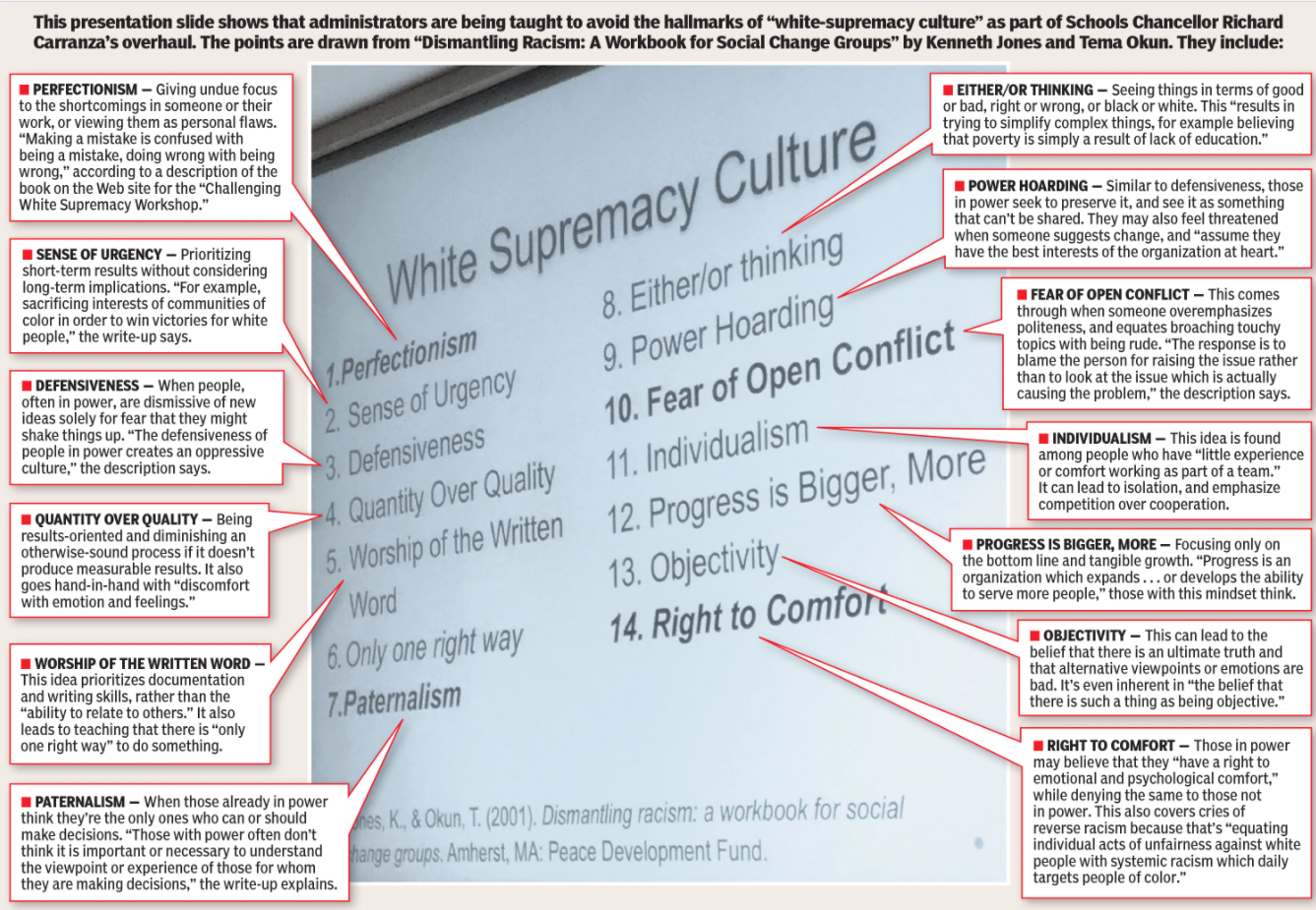
And now, as to what we are referring to, it starts actually before last summer. I knew something was really wrong when in 2019 at a conference in New York City for the city’s principals and superintendents, participants were presented with an idea that to teach with sensitivity to race issues meant keeping certain issues in mind.
These included ways of looking at things that are “white” rather than correct: namely, objectivity, individualism, and valuing the written word. Schools Chancellor Richard Carranza was fine with this, happily telling the media that it’s white people’s job to do the “work” of identifying the racist assumptions in how they go about their business.
So: to stand outside of matters and analyze them with one’s own private mind, and perhaps couch one’s conclusions with the considered artifice of writing rather than the spontaneity of speaking, is inauthentic for black and Latino people. It is racist to impose such things on black and Latino (and Native American?) kids. Or at best, brown kids should be taught this uptight “white” business only as a gloomy alternative to the realness of just hanging out sharing passing personal impressions via chatting.
[…]
This view of precision and detachment as white is a view about, more economically, reason. The idea is that to master close reasoning is suspect. It is exactly the roots of the “Math is Racist” notion, and if you want a whiff of how religiously people can glom on to such ideas, take a look at my Twitter feed in the week after I posted about that here.
Yet, seeing this educational philosophy laid out in the sunlight, The Elect cannot dismiss it as fringe “kookiness” — unless they want to insult the curators of a national museum devoted to celebrating the very black people The Elect live to liberate. At the African-American History Museum in Washington, D.C., for a hot minute or two in 2020 you could see a variation on the Jones-Okun business, an expanded presentation of what we must reject as “white” evil. An educational poster was displayed that slammed not only objectivity, individualism, and writing, but linear thinking, quantitative reasoning, the Protestant work ethic, planning for the future, and being on time.
QotD: Marxism and the teenage mind
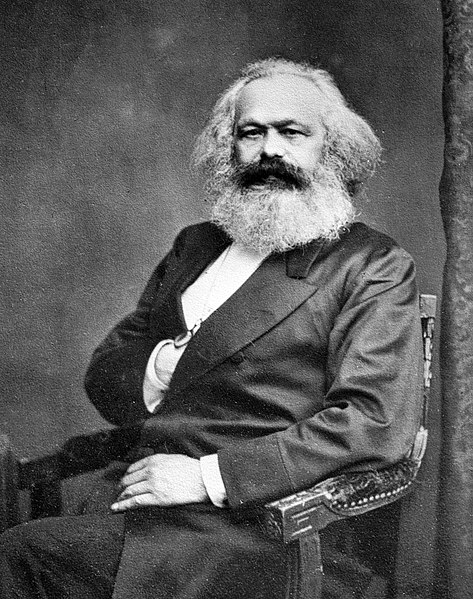
Marxism just seems right to teenagers of all ages. Teenagers’ only frame of reference is their parents, and to the inexperienced — as all teenagers by definition are — even the best parents seem willful and capricious, if not outright tyrannical. (The gray, wrinkled teenagers who refuse to learn merely substitute “society” for “their parents” in their emotional incontinence). Teenagers live in a weirdly binary world, where the switches can only be “on” or “off,” yet all terms are undefined.
That’s why the worst thing a teenager can think of is “unfair.” It’s wrong because it feels wrong, and anything that’s wrong must be somebody’s fault — again, how could it be otherwise? Parents can’t afford to let their kids learn big lessons the hard way. Literally can’t afford it, in that teenagers can’t see why, for example, you can’t take that turn at 85 mph on an icy road. You can explain it to them until you’re blue in the face, but as anyone who has spent any time around teenagers knows, there’s a large subset of them that will simply refuse to get it. Alas, those tend to be the brighter ones, and so a large part of the subtle art of teenager management is setting up smaller, less catastrophic situations for them to fuck up, such that they hopefully learn by analogy. Which is still, of course, the grownups’ fault …
A big part of growing up, then, is: realizing that not everything is someone’s fault. Every effect has a cause, that’s a simple truth of logic, but not every event has a cause. The real world, grownups know, is what Buddha said it is, a nexus of causes and conditions. Even the simplest event has innumerable proximate causes, necessary-but-not-sufficient conditions, and so on. If you want to argue, in terms of pure logic, that every event is an intersection of a long series of causal chains that are all, in theory, perfectly discoverable, go nuts, but for all practical purposes, shit just happens. Accepting that is one of the foundation stones of adulthood.
From that perspective, one’s youthful Marxism seems silly, and nothing seems sillier than Marx’s endless ranting against the perfidy of “the capitalists.” Just as your parents aren’t really the capricious tyrants you thought they were when they wouldn’t let you use the car on Friday night, so even the biggest of businessmen are just people. Marx paints them as cartoonishly evil, but though a guy like Andrew Carnegie was a real bastard in his youth, no doubt about that, he too grew up, becoming a staunch philanthropist and anti-imperialist. So, too, with the labor theory of value, which is the closest thing to the quintessence of the teenage mind ever put to paper — those Air Jordans are “overpriced,” no one denies that, but it’s simply not true that selling $5 shoes for $200 is “exploitation.” There’s this thing called “demand,” and … well, you get it.
Severian, “Marx Was Right After All (on ongoing series”, Rotten Chestnuts, 2021-01-12.
April 23, 2021
QotD: Why the British despise the middle class
… any observer of that British class system will know that it is indeed a little different from that in other places.
The aristocracy have always looked down upon the middle class. That gross and inelegant disdain for trade for example. The insistence that actually doing something for a living – even professionally – just isn’t as good as doing nothing off a rent roll.
From the other end we’ve that very bolshie – in the colloquial sense – insistence that the middle class are just parasites upon the toil of the workers. This being what also informs – misinforms – that idea that we’d be better off if we had much more manufacturing. Men in flat caps doing something physical etc.
That is, much of the society dislikes the very existence of the middle class. Actually, more than dislikes, from above they’re – we’re – despised and from below hated to the point that we bourgeoisie should be eliminated as a class.
The surprise that fewer claim to be of that section of the hierarchy than are is thus, well, it’s a surprise, right?
Tim Worstall, “Sociologist Can’t Do Sociology”, Continental Telegraph, 2021-01-19.