Quotulatiousness

October 7, 2021

Alberta’s pantomime election to nominate a Senate candidate that Trudeau can ignore with great relish

Filed under: Cancon, Media, Politics — Tags: , , , , — Nicholas @ 05:00

In the latest NP Platformed newsletter, Colby Cosh discusses the apparently ongoing non-binding election for Alberta’s next Senate seat:
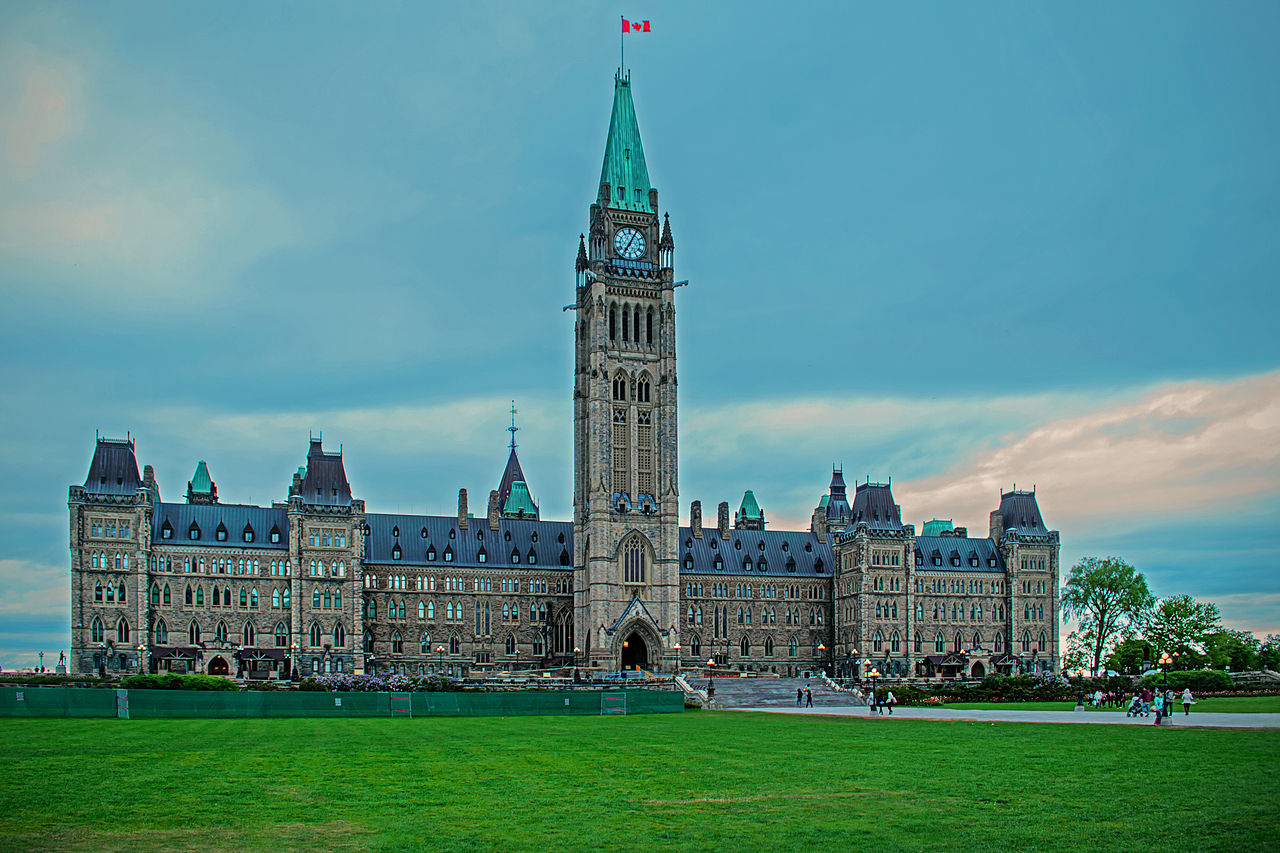
Parliament Hill in Ottawa.
Photo by S. Nameirakpam via Wikimedia Commons.

The prestige of Trudeau’s Independent Advisory Board for Senate Appointments must be maintained at all hazards, which is why the Prime Minister’s Office undertook, a little surprisingly, to provide our Ryan Tumilty with an official response to Alberta’s Senate election. The board, says the voice of the PMO, “evaluates candidates based on public, merit-based criteria”; it was not deemed necessary to finish the sentence with “… unlike the demented, bloodthirsty populace of Alberta, who will presumably just vote for the candidate who can devour the most tar sand at a COVID party.”

For our part, NP Platformed has always been a tad frustrated that smaller political groupings don’t welcome Alberta Senate elections as a chance for a low-stakes, low-cost electoral push toward the limelight. Now that federal and provincial Conservative parties are united, for the moment, 2021’s Senate election has not been accompanied even by the quiet campaigning or the minuscule media attention that the first four elections involved. It is probably to be expected that the three Conservative Party of Canada candidates on the Senate ballot will accumulate enough semi-automatic votes to be nominated.

The Liberals and New Democrats, on an official level, stayed further away from the Senate election process than ever. Duncan Kinney, a totally-independent-from-the-NDP left-wing journalist and fellow of the Broadbent Institute, is appearing on the ballot as part of a sort of none-of-the-above campaign. His entire platform is “this Senate election is illegitimate and stupid, but wouldn’t it be amusing if I won anyhow?” (We’ll take the bait: yes, it would!)

And the People’s party has taken the opportunity to pick three official nominees. If you ask us, the Mad Max party absolutely ought to have hung onto some of what it spent on the federal election and devoted the funds to making a big splash in this one. The TV networks and newspapers would ululate with helpful rage if some PPC creature topped the Senate ballot. Heck, Maxime Bernier has always been able to personally attract big crowds in Alberta. If he had planned ahead and squatted here for six months to meet the residency requirement, he could have run in the Senate election himself.

His proxies probably won’t get anywhere, but we’ll see. There really is an opportunity for a bit of chaos here, since anyone who can break into the top three on this ballot would become an Alberta “senator-in-waiting”. Some of the independent candidates, including former Slave Lake mayor Karina Pillay and former Alberta finance minister Doug Horner, have name recognition that could count for a lot in a low-turnout vote.

October 6, 2021

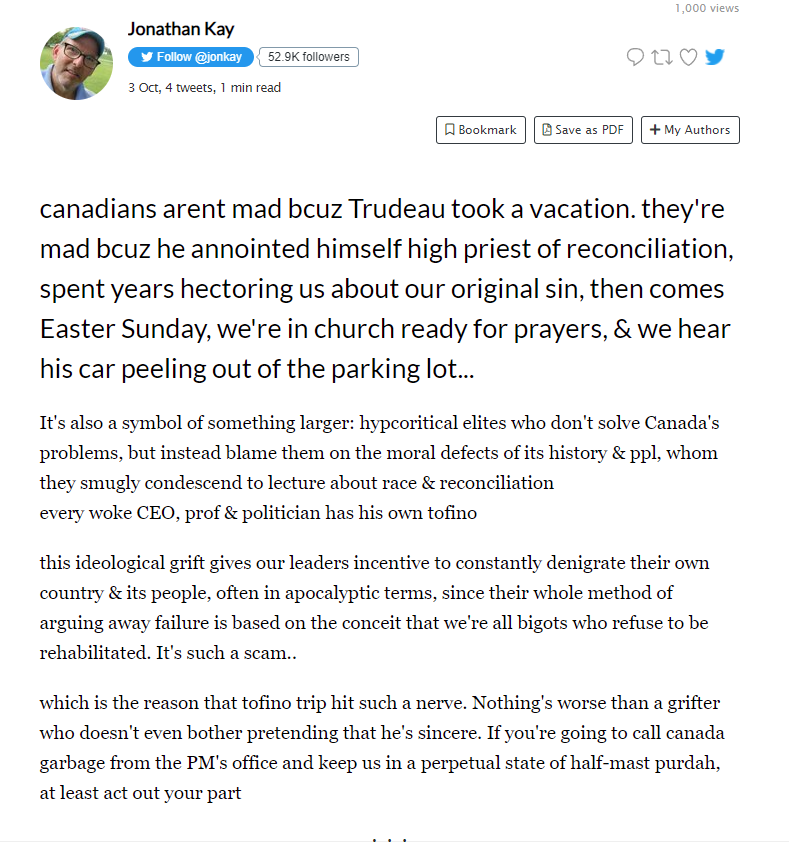
Jonathan Kay explains why Justin Trudeau’s no-show got a lot of Canadians mad

Filed under: Cancon, Media, Politics — Tags: , , , — Nicholas @ 03:00

Linked from Small Dead Animals, Jonathan Kay took to the twits to summarize why this particular Justin Trudeau flake-out seems to have impacted his reputation so much more than all the other flake-outs he’s pulled over the years (screencapped for those who find Threadreader links objectionable):

October 4, 2021

QotD: Theresa May is to Boris as Neville Chamberlain was to Winston

Whisper it gently, but there’s a mysterious woman in Boris Johnson’s life. Someone very special to him. Though she gets none of the credit, she’s the secret of his success, so it’s time she emerged from the shadows and received the recognition she deserves. Step forward … Theresa May.

Exactly two years ago, our second female Prime Minister was bowing out. After a torrid time in office it was finally over, and it ended with characteristic grace. In her resignation statement, she blamed no one for her fall, expressing only gratitude for the chance she’d had to serve the country she loved.

Her critics were not so generous. Ranked against other Prime Ministers […] she fares poorly. In particular, she suffers by comparison to her successor. He delivered Brexit; she didn’t. He won a majority; she lost one. But that’s not the whole story. Two years on from the end of her premiership, we need to tell the truth: which is that Boris owes it all to Theresa.

It wouldn’t be the first time that a successful PM is found to be in debt to a predecessor. Winston Churchill, for instance, owed a great deal to the much-maligned Neville Chamberlain. The reason why Britain was able to hold out against Hitler was that, before the war, Chamberlain had rearmed the country. In particular, he built up the fighter capacity of the RAF, which proved so crucial in the Battle of Britain.

As for Chamberlain’s infamous failures, these too were foundational to Churchill’s success. It’s unlikely that the great man would have become Prime Minister had Chamberlain not exhausted the credibility of appeasement. Indeed she did more than Chamberlain to ensure ultimate triumph of her successor, and looking beyond the obvious low points of her premiership a very different picture emerges. Indeed, she provided the key ingredients for the victories that followed.

Peter Franklin, “Boris owes it all to Theresa May”, UnHerd, 2021-05-23.

October 3, 2021

Trudeau’s no-show on the very first “National Day for Truth and Reconciliation” wasn’t accidental

Filed under: Cancon, Media, Politics — Tags: , , , — Nicholas @ 03:00

In The Line, an explanation of sorts for the Prime Minister effectively boycotting his own National Day for Truth and Reconciliation to go on a family vacation in British Columbia:

Thursday was Canada’s first National Day for Truth and Reconciliation. According to Heritage Canada, it is a day that “honours the lost children and Survivors of residential schools, their families and communities. Public commemoration of the tragic and painful history and ongoing impacts of residential schools is a vital component of the reconciliation process.”

To mark the occasion, ceremonies were held in Indigenous communities across the country. Politicians from every level of government took part. In those provinces where it was not a holiday, schoolchildren wore orange shirts and learned about a shameful part of their country’s past, and came home telling their parents that “every child matters”.

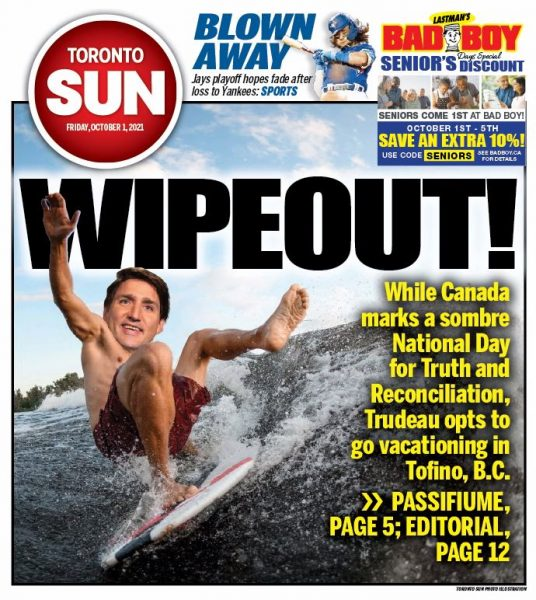
And Justin Trudeau, the prime minister of Canada, who lowered the flag on federal buildings and has kept it down ever since, who has made reconciliation the centrepiece of his leadership, went surfing in Tofino. But not before lying about it — his official itinerary had him in private meetings in Ottawa, and it was only after Toronto Sun reporter Bryan Passifiume noticed that a federal jet had taken off from Ottawa and made its way to one of the most gorgeously isolated parts of the country that the PMO admitted that Trudeau wasn’t in Ottawa working the phones, he was in Tofino playing in the waves. When he was tracked down by a team from Global news, he turned his back to the camera and walked sullenly away along the beach.

What are we to make of this behaviour? Social media was full of people calling it an “own goal” or an “unforced error” or a “self-inflicted wound”, and that Trudeau’s officials should have known that this trip was a bad idea, and urged him to put it off by a day or two.

We think these people are getting it wrong. To call this an error in judgment fundamentally misunderstands Justin Trudeau’s psychology and what motivates him. As far as we at The Line can tell, the timing of this trip, the location, and the predictable negative reaction, was very deliberate, and is entirely in keeping with the prime minister’s previous behaviour. To put it bluntly, the prime minister is taking a suck attack.

When the Liberals came to power in 2015, winning a very surprising majority government, it was almost completely due to the perceived magnetism of Justin Trudeau. He charmed Canadians, he charmed the press, and he charmed foreigners; his “because it’s 2015” line made international headlines and made him the figurehead of youthful, global progressive politics. He was the handsome noble young prince here to save us all.

The problem is, when you’re at the top there is only one way to go in politics and that’s down. And so inevitably came the 2019 federal election, in which Liberal fortunes were undermined by two main things: the fallout from the SNC-Lavalin scandal that saw two ministers and his senior adviser resign, and the emergence of a number of photos showing a very grownup, but very immature, Justin Trudeau cavorting around in blackface. After the Liberals were reduced to a minority, with his own reputation heavily, er, stained, Trudeau disappeared in what was clearly an epic sulk. When he re-emerged in the public eye, he’d grown a beard that was clearly designed to Add Gravitas to his public image.

He did it because he could do it, and he’d do it again just to show Canadians just how disappointed he is in them and how much harder they will need to work to regain the privilege of his leadership. We could use a man like Bertolt Brecht again…

October 2, 2021

Signs of “white privilege” apparently include swearing and wearing second-hand clothing

Filed under: Britain, Politics — Tags: , , , , , — Nicholas @ 05:00

It’s gotten to the point that I half expect to be told that even breathing is a clear indicator of “white privilege”. Brendan O’Neill reports on a mandatory University of Kent diversity and inclusion course that declares white people swearing or wearing second-hand clothes are clearly evidence of their “privilege”:

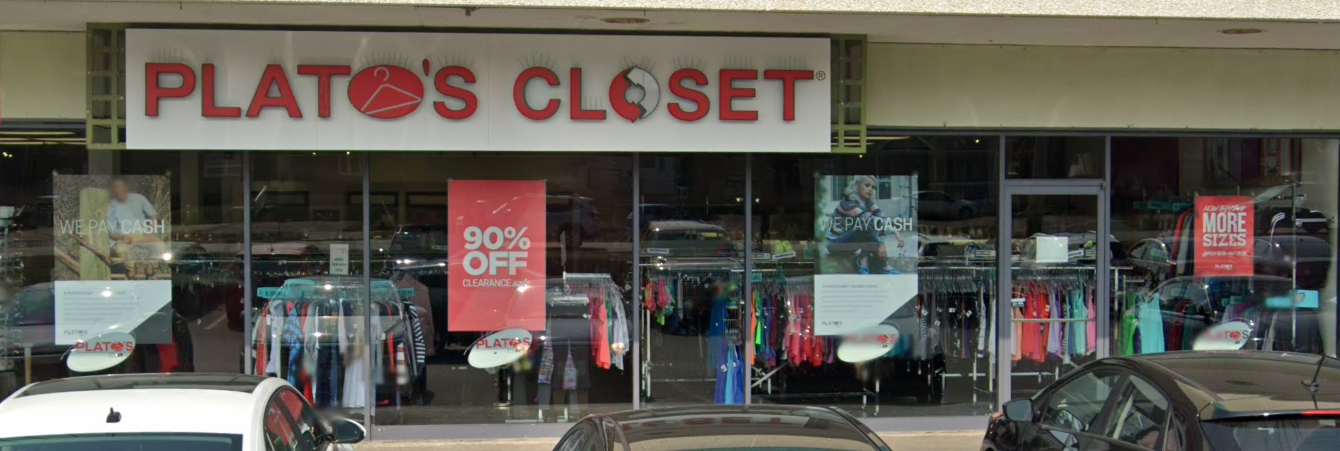
Plato’s Closet used clothing store in Oshawa, Ontario. Obviously a nest of racial privilege.
Detail from Google Street View.

So now wearing second-hand clothes is a sign of “white privilege”. Just when you thought you’d heard it all from the loopy identity lobby, they come out with the idea that putting on a vintage dress or a musty old man’s shirt you bought from Oxfam is proof that you enjoy racial favouritism. This crackpot claim is made in a course being foisted on students at the University of Kent. If you can wear second-hand clobber without this being held up as yet another example of the “bad morals of [your] race”, then you are apparently white and you’re definitely privileged.

I have so many questions. First, who exactly is going around saying to ethnic-minority people who dare to don vintage fashion, “Oh God, how typical of your race to wear second-hand clothes?”. I am going to say “nobody”. When racist toerags do accost people who look different to them, it is usually not to critique their Seventies florals or dad’s old blazer. Secondly, it will surely be news to all the less well-off white kids who have little choice but to wear second-hand clothes – “hand-me-downs” – that their repurposed trainers and patched-up jumpers are proof of their privilege. Some of us who crazily cling to the belief that class and income remain the key shapers of privilege in our society might even say that the wearing of second-hand clothes in such circumstances is proof of the absence of privilege. Mad, I know.

The Kent course, titled “Expect Respect”, is only the latest example of students being inculcated into the ways of moral conformism. It’s a mandatory module, which takes four hours to complete, and is designed to raise students’ awareness about white privilege, microaggressions, pronouns and other riveting topics. The module includes a “white privilege quiz” – such fun! – in which the freshers are grilled over the societal benefits enjoyed by whitey. Apparently if you can swear without being called a disgrace to your race or go shopping without being followed or harassed, then you enjoy white privilege. Students who correctly identify all the indicators of racial privilege get a gold star. Presumably those who don’t get branded with the letter “R” for racist.

The list of things that are apparently signs of white privilege grows longer and more demented by the day. Saying “I don’t see colour” is white privilege. Eating French food is white privilege. Drinking milk is white privilege. Saying “I don’t have white privilege” is white privilege. Of course it is. “For white people to dismiss the benefits they’ve reaped because of their whiteness only goes to show how oblivious – and privileged – they really are”, says one writer. This is the Kafkaesque trap of identity politics. There’s no winning in this slippery game. Refuse to acknowledge another person’s race and you’re racist. But obsess over another person’s race and presumably you’re also racist. Saying “I don’t see difference” is racist. But saying “Oh you seem different, where are you from?” is racist too. Confess your white privilege, and clearly you’re privileged. Deny it and you’re really privileged. It’s like being an old lady on a ducking stool in medieval times. Float, you’re a witch. Die, you’re a witch.

Federal NDP going through the six phases of political campaigns – enthusiasm, disillusionment, panic, the search for the guilty, the punishment of the innocent, and the promotion of the uninvolved

Filed under: Cancon, Politics — Tags: , , , , — Nicholas @ 03:00

The NDP had high, high hopes for the September election, largely pinned on the undoubted popularity of their leader among young voters. As Joshua Hind shows, it didn’t work out at all the way they had hoped:

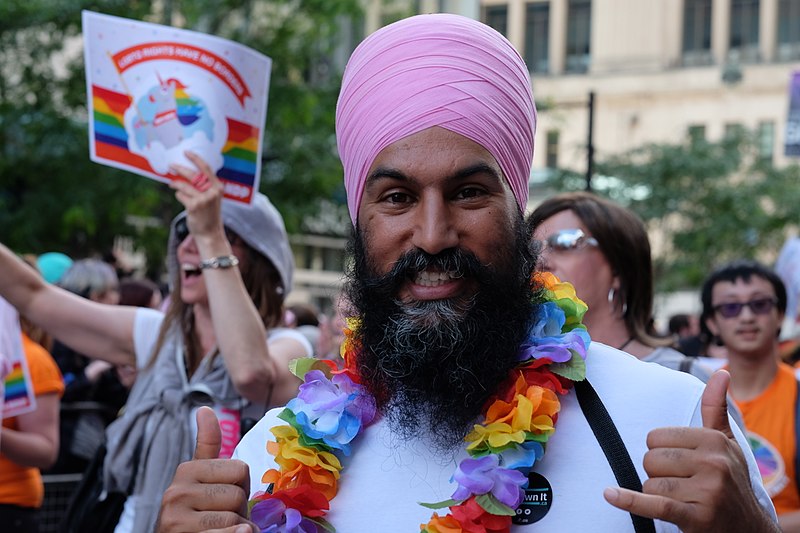
Federal NDP leader Jagmeet Singh taking part in a Pride Parade in June 2017 (during the NDP leadership campaign).
Photo via Wikimedia Commons.

Only the most die-hard supporters of the New Democratic Party thought the recently-concluded 2021 federal election was winnable in the way 2015 felt very winnable in the early days. Still, the NDP’s showing at the polls — a single-digit increase in popular vote and a single new seat — is undeniably disappointing for a party that spent big to win back seats.

With that disappointment gnawing at them, the NDP and its faithful are bound to want to assign some blame, a process which always starts with the leader. But that’s a uniquely tough proposition for the NDP, who not only has Canada’s Best-Liked Leader™ in Jagmeet Singh, but has also positioned Singh to be the entire personality and profile of the party. In trying to create another singular figure like Jack Layton, the NDP has painted itself into a tight corner.

In project management there’s an old joke about the “Six Phases”. Like the stages of grief, the six phases of project management are the various emotional states into which all large projects — construction, software development, political campaigns — can be divided. They are: enthusiasm, disillusionment, panic, the search for the guilty, the punishment of the innocent, and the promotion of the uninvolved.

It’s easy to see the first three in an election, where enthusiasm, disillusionment and panic often happen all at once. Now in the post-election period, parties must wade into the more fraught final phases.

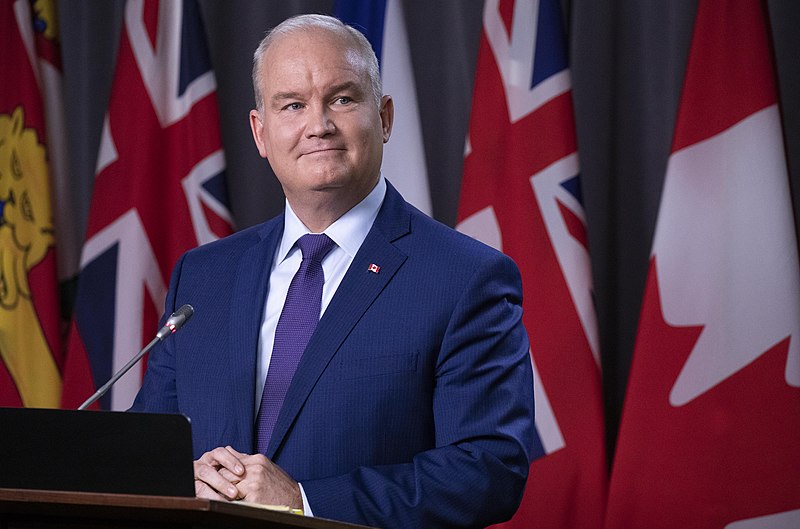
The search for the guilty started the moment the networks called the election for Justin Trudeau’s Liberal Party, and Conservative leader Erin O’Toole is already under scrutiny. The Greens, for their part, got a head start on punishing the innocent by pinning their party’s staggering immolation exclusively on their (now former) leader, Annamie Paul.

For the NDP, things are more delicate.

Jagmeet Singh, who’s personable, well-spoken and very photogenic, was front and centre in every aspect of the NDP’s campaign. Their bus exclusively featured his name and picture, the first page on their website is simply labelled, “Jagmeet”, and every campaign stop was focused on the leader and his appeal. But the “leader first” tactic that arguably got the most attention was the social media campaign, specifically Singh’s appeal to young voters through TikTok.

Singh is the undisputed Canadian political TikTok champion, with nearly 850,000 followers and videos that regularly rack up millions of likes. His content is charming and apparently quite credible with TikTok users, at times fun, mischievous and pleasantly silly. It’s also clearly the platform Singh likes best. His Instagram account is mostly reposts from Twitter, and his Twitter account, while popular, doesn’t get nearly the response he earns on TikTok. Because it’s so important to Singh, and presumably the NDP, it can also form the basis for appraisals of both, and that creates new challenges.

September 30, 2021

QotD: Hate speech

Filed under: Liberty, Politics, Quotations — Tags: , , , — Nicholas @ 01:00

Cultivating hatred for another human group ought to be no more acceptable when it issues from the mouths of women than when it comes from men, no more tolerable from feminists than from the Ku Klux Klan.

Daphne Patai, Heterophobia: Sexual Harassment and the Future of Feminism, 1998.

September 29, 2021

The federal Conservatives, post-election

Filed under: Cancon, Economics, Media, Politics — Tags: , — Nicholas @ 03:00

As Erin O’Toole ably demonstrated in the September 20th federal election, when you deliberately exclude the SoCons, the libertarians, the gun-owners, the free speech advocates, and the fiscal conservatives, what you have left is a party that doesn’t have a lot to differentiate itself from the Liberals. Ben Woodfinden offers some thoughts on the Conservative Party’s immediate post-election phases:

I don’t want to spend long on this point because I find this kind of Conservative infighting (the tory syndrome), which is often about a combination of both ideology mixed in with personal feuds and rivalries, extremely frustrating. I think O’Toole deserves a second shot for a few reasons. I thought there was a lot to like in the platform, because O’Toole himself performed fairly well during the campaign for the most part, and the Conservatives are on the path to form government. I also think another leadership election is a bad idea and this habit of dumping leaders after single election results is extremely shortsighted. Changes are needed, but I don’t think replacing O’Toole is one of them.

Before some of you send furious responses about how I’ve “sold out” or how O’Toole sold out and therefore needs to go, I absolutely do think that portions of the base have every right to be angry. As I wrote in the Post column, what has angered many is not simply the campaign O’Toole ran, it was that he won the leadership running as a “true blue” and then pivoted to something else.

The Conservative Party is not a party of one. O’Toole needs to show some humility and work to rebuild some trust with these parts of the base (and caucus) who are upset and angry over this. The Conservative Party is very much a coalition of different groups who disagree on all sorts of things. Keeping these groups together is a delicate and at times challenging task. […]

Anyways, to summarize where I stand on this, and I have no plans of getting dragged into this too much – there needs to be some efforts on behalf of O’Toole to restore some trust with the various factions within the party that are unhappy, but I think overall some of the shifts that are being made are worthwhile ones. It would improve the discourse on conservatism in Canada if we moved beyond the red versus blue tory, liberal lite versus true blue framing that serves us poorly. While we need to wait for a full post-mortem and analysis of the results, there also seem to me to have been some positive signs that this realignment/blue collar shift can work. Matt Gurney interviewed an anonymous senior campaign official after the election for TVO, and something the official said intrigued me:

    Gurney: Whoa, hang on. That sounds like something we just shouldn’t blow past! What was the old Conservative coalition, and what happened to it?

    Conservative: [Laughs] Okay, obviously it varies by place, but think of it this way: our three legs were big business and corporate, rural and farmers, and a swing component. That third one was tricky. Mulroney brought the Quebec nationalists. Harper, we got them with ethno-community suburban outreach. But I think the Liberals are beating us on big business, and we need to accept that and pivot to small business, working-class, things like that. We just started doing that, and it’s already working. We did shockingly well in Hamilton. And look at northern Ontario. These places are in play for us now. Northern Ontario is going to get very interesting. But if I’m being honest, the question of who the new Canadian Conservative voter isn’t one we’ve fully answered yet. We’re winning the popular vote, but we still need to grow, and I think that needs more time.

I went and did some digging myself and what this anonymous official is saying here appears to check out, and if you combine this with the gains made in Atlantic Canada I think there are real reasons for optimism on this front. This election could be comparable to what happened with the Conservatives in 2017 in the UK, but in a positive way. Hear me out here. In that election Theresa May came close, but just fell short, on breakthroughs across the board that would have fully inaugurated her as the champion of this realignment conservatism. While it didn’t materialize in 2017, it did in 2019. The progress is there, and I really think Conservatives should give this another shot next chance they get, it really could pay off. The party needs to break through in suburban seats, and I think this “thoughtful populism” as John Ibbitson described it can absolutely do that in the next election.

September 26, 2021

QotD: Euphemism

Filed under: Media, Politics, Quotations — Tags: , , — Nicholas @ 01:00

Throughout the Globe piece, neither Robinson nor his interviewer is able to say the words “mentally ill,” let alone crazy. Rather, it is said that he “suffers from a mental illness,” or in Svendspeak, that he is “living with mental illness,” rather like a room-mate. This is a euphemism, a kind of linguistic prophylactic intended to shield the speaker, no less than the listener, from the harsh reality to which it refers. Like all euphemisms and some prophylactics, it will eventually wear out, requiring the substitution of some new euphemism in its place. In time, “living with mental illness” will be seen as a grievous insult, much as “coloured people” is to people of colour. (Except, of course, for those working at the National Association for the Advancement of Colored People.)

Andrew Coyne, “False Sensitivity”, andrewcoyne.com, 2005-05-07.

September 24, 2021

From Handmaid’s Tale cosplay to eco-terrorism

Filed under: Britain, Environment, Media, Politics — Tags: , , , , — Nicholas @ 05:00

Connor Tomlinson outlines the many performative and disruptive projects of Roger Hallam:

Insulate Britain gluing themselves to the M25 for a week has already produced a four-car collision, with victims airlifted to hospital, and delayed a mother’s treatment, leaving her paralysed by a stroke. Despite these events, activists claim they “don’t accept that we put lives at risk”. It’s vital that legal and cultural action is taken to insulate Britons from this dangerous brand of eco-extremism.

As Dan Wootton’s interview with activist Liam Norton explained, the endangerment of lives to exercise political pressure would classify Insulate Britain as ecological terrorists. The action Insulate Britain wishes to force government to take is “to produce within four months a legally binding national plan to fully fund” the insulation of all Britain’s 29 million homes with taxpayer cash. Essentially, they’re sitting in the motorway, blocking your work commute, so the state can take and spend more of your pay-check.

Insulate Britain is another in a long line of activist vanity projects engineered to make headlines by founder Roger Hallam. Starting with “Stop Killing Londoners” in 2017, Hallam went on to co-create Extinction Rebellion; before being ousted over his comments concerning the Holocaust. But Hallam’s alarmist and extremist rhetoric preceded this insensitive remark. In, 2019, Hallam said “forcing the governments to act” or “bring[ing] them down and create[ing] a democracy fit for purpose” will require “some [to] die in the process”. This “democracy” would, paradoxically, be a “socialist project”, with Hallam in the ideological driving seat.

Hallam’s prior protests demonstrated a similar indifference to human suffering. Hallam was arrested at Heathrow Airport for aiming to fly drones into active airspace and ground commercial flights. His “Heathrow Pause” protests constituted a terror threat, in that drones could cause flights to be grounded or collide and crash. Again, Hallam was willing to risk lives to make headlines.

All of these movements claim the sole solutions to apocalyptic emergencies are the appointment of Hallam himself to a position of public power which lets him implement whichever solutions he deems necessary. His PhD at Kings College on “civil disobedience” exposes Hallam’s own egoism in comparing himself to MLK and Gandhi. This was also an indictment of modern university radicalism; echoed by Dr. Charlie Gardner of the University of Kent making the same comparison in a lecture, calling himself “a hero of our times”, and refusing to disavow Hallam when I challenged him on it.

When I first heard of the M25 protests, I thought they’d be allowed to carry on for a token amount of time to get their actions into the media and then they’d be cleared off by the police. I was quite astonished to find that they were permitted to stay in place for several hours and that the police were being quite solicitous of their health and protecting them from any attempt at counter-protest by the stranded motorists. I’m now worried that the next time they try this, the motorists will have learned that the police aren’t there to enforce the law and be tempted to take it into their own hands.

Jen Gerson has some helpful advice for the Conservative party

Filed under: Cancon, Politics — Tags: , , , , , — Nicholas @ 03:00

Writing in Maclean’s, Jen Gerson suggests to the “conservatives” that they shouldn’t dump their new-ish leader on the basis of the party’s results in the September 20 election:

It’s come to my understanding that there is some considerable consternation about the future of Erin O’Toole, leader of the Conservative Party of Canada, on the grounds that he underperformed in this week’s election.

I cannot help but wonder whether those now implacably resolved to booting the man for being inadequately conservative might, perhaps, consider getting a goddamn grip.

Yes, I understand that O’Toole ran his leadership campaign further to the right than his personality would otherwise suggest, in order to win over the Conservative base. And, yes, I understand that the unstated agreement behind this bait-and-switch was that O’Toole needed to show progress in key regions, particularly the 905. Also, yes, I understand that these gains failed to materialize, and that many conservatives feel both betrayed, and more importantly, no closer to government.

This state of affairs may ensure O’Toole’s leadership is unsalvageable.

Certainly, O’Toole and his brain trust seem to have rationally concluded that they could leave western conservatives hanging out to dry so they could chase votes in the GTA — because up until now, those westerners had nowhere else to go. However, the rise of the PPC suggests that they may now have somewhere to go …

Conservatives have a bad habit. They go into an election with reasonable expectations, enjoy some early momentum, and then let the excitement get to their heads. They reset those early expectations to something far less probable, and when the campaign produces exactly the results they predicted at the outset they declare the whole affair a disappointing failure.

I will note here that this complements the Liberal temperament, which interprets entirely lacklustre results as nothing short of a sign from the trumpet-wielding messengers of God blessing their mandate. Only the Liberals would see two successive minority governments with declining popular vote totals as clear-cut evidence that they, the worthy elect, have been chosen without reservation to lead the nation to paradise.

The Conservatives could use a little more of that energy.

These observations are provably true of both parties. The only amendment I could suggest is that the Liberals really do believe they have been granted the right to run Canada by divine providence (which few of them actually dare refer to in conversation) and view any interruption in their God-given right to rule as unnatural and a perversion of the arc of history.

Conservatives ought to have seen this election as the first in a two-election strategy. Fundamentally, the urbanites who hold the key to government don’t trust you, Conservatives. They’re worried about the conspiratorial lunatics in your caucus and your base, and they’re worried about who actually holds the reins of power in your party. Their distrust is fair, and will take time to repair.

If you dump your affable, moderate, centrist leader at the first opportunity because he didn’t crack the 905 on his first try, and you replace him with someone who will chase Maxime Bernier’s vanishing social movement like a labradoodle running after the wheels of a mail truck, you will wind up confirming every extant fear and stereotype this crowd already holds about you and your party.

It’s a trap. Be smarter than that.

The PPC nearly tripling the size of their vote over two years doesn’t quite match the characterization of a “vanishing social movement”, but I’m not who she’s trying to persuade here. It’s often said that modern “conservatives” don’t actually have a plan except to do what Liberals/Democrats want to do — just a little bit slower. O’Toole (and Ontario Tories generally) fits that description quite well.

QotD: The LGBT advocacy group Stonewall proves Hoffer right — “every great cause begins as a movement, becomes a business and eventually degenerates into a racket”

Filed under: Britain, Bureaucracy, Health, Politics, Quotations — Tags: , , , — Nicholas @ 01:00

There is a law of nature that governs campaigning groups and charities, which is that an organisation set up to deal with a particular problem will always find a way to exist even after that problem has been addressed.

The reason is simple: by the time an issue has been solved, or almost solved, the business is at its peak. Employees’ salaries and pensions are at stake, reputations have been built and influence has been secured. And so it is that Eric Hoffer’s great insight is fulfilled: every great cause begins as a movement, becomes a business and eventually degenerates into a racket.

Very few causes have degenerated into a racket so completely as the former gay-rights group known as Stonewall. When it was founded in 1989, gay rights in Britain, as across Europe, had some way to go to reach equality. Back then, there was a different age of consent for homosexuals and heterosexuals, homosexuals did not have the right to marry or to have their partnerships legally recognised and, most pertinently, a Conservative government had made it impossible for young gay people to be in any way informed about their sexuality during their time at school.

There was certainly a long way to go, and Ian McKellen, Matthew Parris, Simon Fanshawe and the rest of the group’s founders faced an uphill battle for many years. But it was a battle which they helped to win.

Once most of their objectives had been achieved, though, what were Stonewall to do? There were several options in front of them. The most obvious, one might think, would have been to scale down and remain in place to deal with residual issues, such as the existence of homophobia in schools and other remaining pockets of society.

Douglas Murray, “How Stonewall sacrificed gay rights”, UnHerd, 2021-05-25.

September 22, 2021

The “She-lection” or the “what was that?” election or the “what was the point?” election

Filed under: Cancon, Government, Media, Politics — Tags: — Nicholas @ 05:00

In Tuesday’s NP Platformed newsletter, Colby Cosh looks at the sham election we just experienced … differently … here:

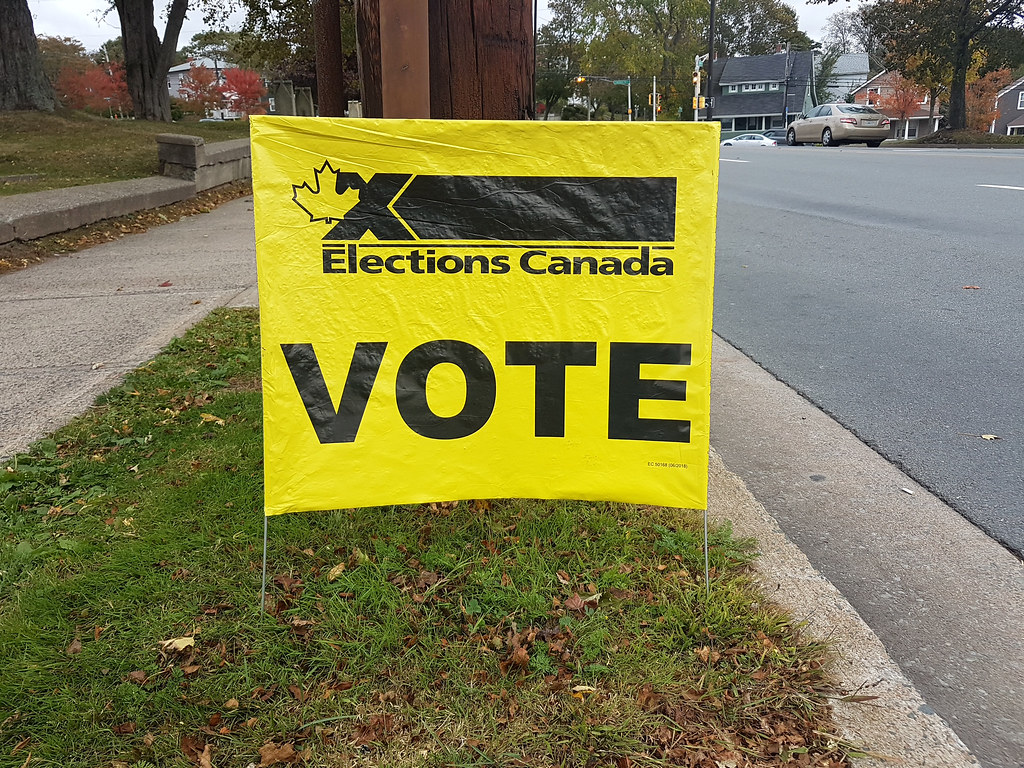
“2019 Canadian federal election – VOTE” by Indrid__Cold is licensed under CC BY-SA 2.0

What to say about a federal election in which nothing happened? Surely last night’s refusal by the Canadian public to budge an inch is more astonishing than almost any other imaginable result could be. Our last two elections were separated by exactly 700 days. During that brief time, Canada experienced a science-fiction disease pandemic with mass death and violent protests, a fairly urgent diplomatic crisis with China, a dramatic change in the U.S. presidency, a foreign-policy disaster in Afghanistan, epic Liberal scandals and constitutional strife. Canadians seem to have lived through all of this and decided that it made no difference, or no net difference, in how they wanted to vote.

Maybe this could be considered a psychological defence reaction to the surprising prospect of an election. Given the incredible result — no consecutive Canadian elections have ever been remotely this close in seat outcome — we can hardly even say “surprising and unwelcome”. Everyone knew who was responsible for calling an election. In Liberal ridings, the response seems to have been gratitude for the opportunity to vote Liberal again so soon.

In conversation with a non-representative sample of Canadian voters outside the Toronto border, it’s rare to find people who admit to voting Liberal, yet clearly enough people did yet again — nearly 20,000 of them in my riding alone. I live in Erin O’Toole’s riding, so the winner wasn’t in a lot of doubt despite him not having any spare time to campaign here. I was pleased to find over 3,600 other Durham voters willing to vote PPC this time around, giving Patricia Conlin about 5.6% of the vote. I’ve generally been a Libertarian voter all these years … at least when there’s been a Libertarian candidate to vote for … but this time around as in 2019 the Libertarians didn’t have anyone running here, so voting PPC was my best option.

The more we watch NDP Leader Jagmeet Singh campaign, the more we think, “Toronto does have an awful lot of people who ought not to be especially eager to run headlong into stuff like wealth taxes and confiscatory rates on capital gains.” The New Democrats seem increasingly determined to cement their all-urban base among youths and convinced leftists with bolshie rhetoric. Are the resentful, hopeless millions they hope to add to these stagnant forces really out there? Was this an election result that reveals a populace disaffected with neoliberal capitalism — of a kind genuinely beset by rent-seeking, cronyism and corruption — and keen on revolutionary change?

Unfortunately, the very failure of the election to yield a different result probably means that every party can treat last night as a rehearsal rather than a test. NP Platformed‘s initial instinct, which we reserve the right to throw out, is that we’ll be back at it with the same cast of characters in another 700 days or so. Everyone failed: what else is there but to follow Beckett’s dictum? “Try again. Fail again. Fail better.”

Other than Maxime Bernier, is there a federal party leader who can point to the results of this election and claim much more than a bare moral victory?

Speaking of highly sus votes … here’s an example from California’s recall election

Filed under: Government, Politics, USA — Tags: , — Nicholas @ 03:00

At Samizdata, Niall Kilmartin recounts what he heard from a Californian friend after their recent election on recalling the sitting governor:

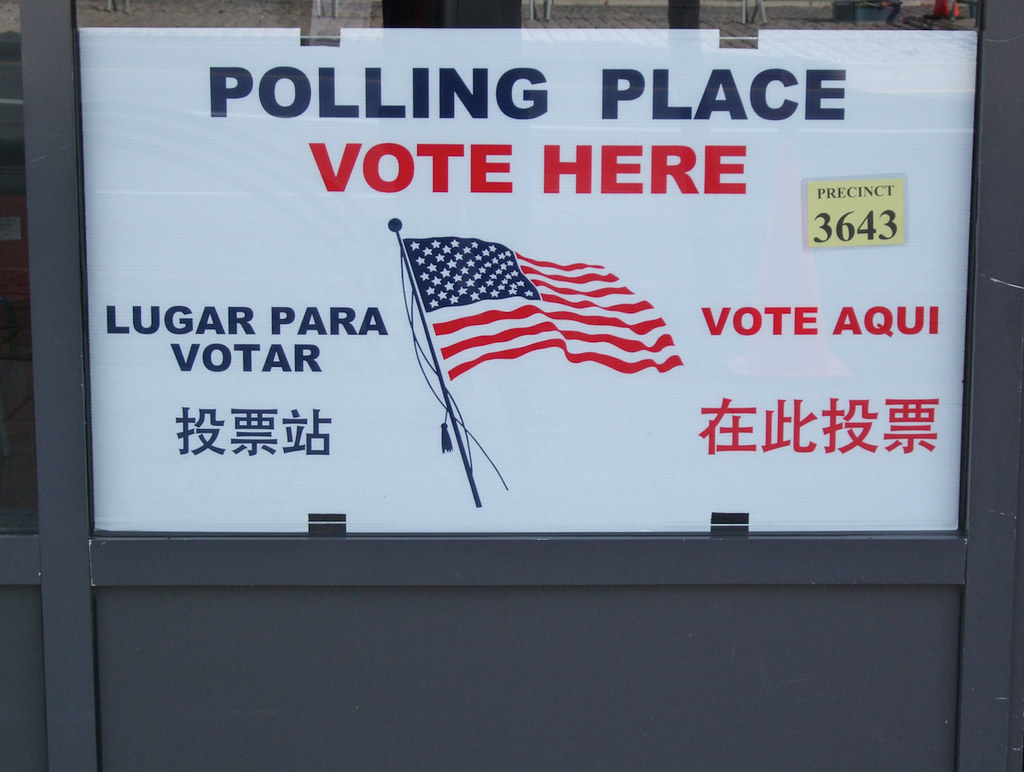
“Polling Place Vote Here” by Scott Beale is licensed under CC BY-NC-ND 2.0

He was sent a postal ballot – a ballot and an envelope to return it in. He had not asked for it and did not want it but got it anyway. His wife was also sent one and what I say below applies to her as well.

Both envelope and ballot had serial numbers printed on them – and they were sequential: the return envelope’s serial number differed by one from its ballot’s serial number. (His wife’s likewise, so it seemed to be a pattern.) This gave him some concerns.

  • As the state had posted the serial-numbered ballot specifically to him, it sure looked like, after the election, the authorities would be able to tell how he’d voted. In a state where expressing a heterodox thought can be career-ending, this was a little worrying. Of course, he could have chosen to trust the Governor’s assurance that the state would never dream of recording the serial-to-address data, let alone exploiting it afterwards (if the Governor had given that specific assurance, but he did not recall whether Newsom had clearly promised that as such).
  • As the envelope and ballot serials had this simple sequential relationship, it sure looked like anyone who saw the returned envelope (which had to have his name and address on it), would be able to deduce the serial of his ballot. In a state where the operation of the law can make defying antifa more dangerous to you than to them, this was a little worrying. Of course, he could have chosen to trust the Governor’s assurance that no such person would later be able to get access to the ballots or their scanned data to relate his name and address to his vote (if the Governor had given that specific assurance, but he did not recall whether Newsom had clearly promised that as such).
  • As there was no secrecy sleeve, it sure looked like whoever ripped the envelope open to get the ballot during the count would have a hard time not seeing his name, address and vote all at once anyway. In a state where supporting the wrong party can lead to unequal application of the law, this was a little worrying. Of course, he could have chosen to trust the Governor’s assurance that the electoral staff would be unable to record or memorise such information (if the Governor had given that specific assurance, but he did not recall whether Newsom had clearly promised that as such).

After thinking about this, he went to the local polling station on election day to try and get a ballot from them and put it in the ballot box the old-fashioned way. Wisely, he took the postal ballot with him, knowing they should – and in this case probably would – want to see it destroyed. Unwisely, he filled it in beforehand in case they refused to let him vote the old fashioned way (so that, in that case, he could at least put the postal ballot straight into the box, thus cutting some intermediaries out of the insecure loop, without making a second visit). He gave me a vivid word-picture of the crossed-arms, blocking-the-way lady in change of the polling place when he made his request. They did not absolutely refuse, but it was made clear to him that the first thing to happen would be his postal vote being torn open and carefully examined before its destruction. Cursing himself for the “forethought” of filling it in “in case”, he decided that that would destroy the point of the exercise, which was to cast a secret ballot – though he did wonder by then whether, despite his studiously-meek demeanour, the lady felt any more doubt of whom he was voting for than he felt of whom she was voting for. So in the end he used it as the state intended he should.

September 21, 2021

A little New York City tale

Filed under: Media, Politics, USA — Tags: , , , , , — Nicholas @ 03:00

Jim Treacher found the twists and turns in this NYC local story to be disturbing his sleep:

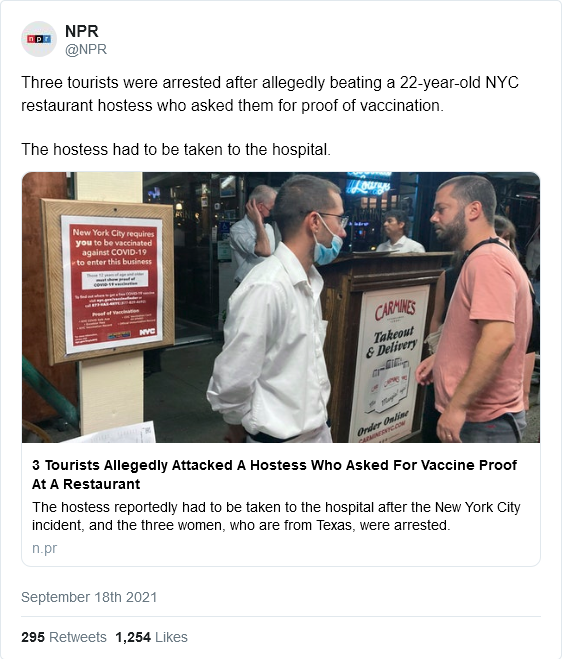
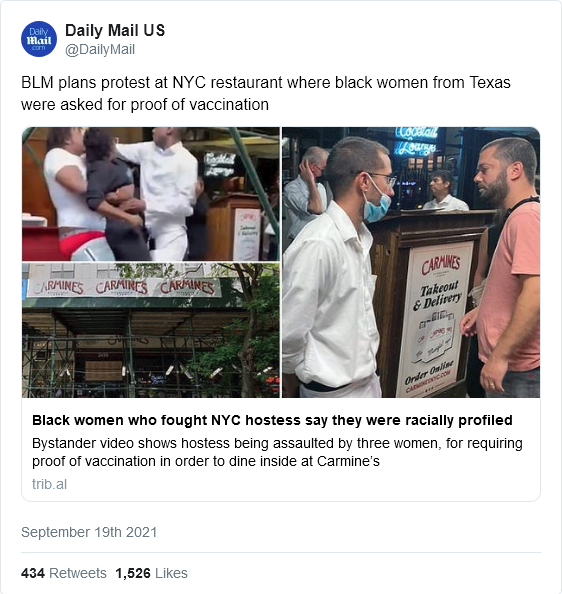
An odd little news story got stuck in my brain over the weekend, so I tried to figure out why. Last week, three Texas women attacked a hostess at a restaurant in New York City because the hostess asked them for proof that they’re vaccinated:

Seems like an overreaction, no? It’s not like a restaurant hostess is responsible for state and local laws. She was just doing her job.

In the initial NPR story I read, the women were described only as being “from Texas”. Which immediately tells a certain audience, NPR’s audience, everything they need to hear. Everyone knows what those Texans are like, right? Yeeeeeee-haw! Them inbred redneck anti-vax science-denyin’ hayseeds prob’ly voted for Trump, didn’t they? Yer darn tootin’!

It just goes to show how evil those dirty Republicans really are. They’d rather beat up a woman in public than surrender a little bit of their freedom for the greater good. I’ll bet they weren’t even wearing masks. Tsk, tsk, tsk. And another tsk for good measure!

But when you read past the headline, you learn a bit more about these three lovely ladies:

    Police arrested three women — 21-year-old Tyonnie Keshay Rankin, 44-year-old Kaeita Nkeenge Rankin and 49-year-old Sally Rechelle Lewis — and they have since been charged with misdemeanor assault and criminal mischief …

Now, at the risk of being branded a racist — the most damning yet ubiquitous accusation in the modern world — I saw those names and I assumed those women are African-American.

I know. I know! I’m not proud of it, but that’s just how deeply my white privilege has taken root in my soul.

The headline doesn’t mention their race (“3 Tourists Allegedly Attacked A Hostess Who Asked For Vaccine Proof At A Restaurant”). There’s no mention of race in the story at all, so according to National Public Radio, race had nothing to do with it.

Well, race is about to have something to do with it:

Presto! In the blink of an eye, this story just magically transformed from “Stupid Anti-Vax Texans Literally Punch Science in the Face” to “Black Women in NYC Restaurant Latest Victims of Racial Profiling.” (Remember that Starbucks incident? Remember how the whole company shut down for an entire afternoon to do “anti-racial bias” training?)

And if those dueling narratives aren’t confusing enough for the average liberal mind, it gets even better: The hostess is Asian. So, here’s yet another victim of the anti-Asian violence we’ve been hearing about for the past 18 months. #StopAsianHate, anyone?

Anyone? Hello?

No, that’s not the narrative this time. Which is what this is all about: narratives, not facts.

« Newer PostsOlder Posts »

Powered by WordPress