
… back in 1968 the Media convinced themselves they held the whip. Between the “Chicago Police Riot” (in reality a bunch of SDS goons finally goading the cops into cracking down) and the Tet Offensive (in reality, a communist catastrophe that all but destroyed the Viet Cong as a fighting force), the Media convinced themselves they truly were the shapers of the nation’s hearts and minds. From then on out, the Media assumed their primary job was not to report the news, but to instruct us how to feel about the news. They anointed themselves as a secular priesthood, and from that moment forward, people went into “journalism” specifically to change the world.
That suited the Democrats’ short-term interests just fine. Then as now, the Democrats were a bunch of fellow-traveling wannabe-totalitarians. The difference, though, is that in 1968 grownups were still in charge of the party. Being intimately familiar with the concept of “useful idiots”, the grownup Dems were happy to encourage the journo-kids’ delusions of grandeur. The kids might not have been able to stir up enough shit to get Hubert Humphrey elected — that would’ve been a tough sell for Josef Goebbels — but they could make life hot for Richard Nixon. In other words, the Democrats thought they held the whip.
1972 should’ve been a wakeup call, but to be fair, all the campaign wonks were still reeling from The Great Magic Party Switch of 1964. Both halves of the failed Democratic ticket from 1968 ran in the 1972 primaries, and so did George Wallace (who actually won more primaries than either Humphrey or Muskie — 6 to 5 and 4, respectively). Which left George McGovern, a goofy hippie from a nothing state who was so bad at politics that he got outflanked as a peacenik by Richard Nixon, the man who was right at that moment actually running the goddamn war. […]
[McGovern’s platform was], in short, “amnesty, abortion, and acid,” a Donald Trump-level linguistic killshot if ever there was one.
The point isn’t that McGovern was a goofy hippie. The point is that McGovern was The Media’s fair-haired boy. Hubert Humphrey was no one’s idea of a steely-eyed realist, but he was a grown-up. When he attacked McGovern as too radical during their primary debates, he was expressing America’s frustration with bratty, coddled, know-nothing college kids and their bong-addled, patchouli-soaked nonsense. But since it was the aforesaid spoiled, stoned college kids who wrote the election coverage …
Viewed from this perspective, Democratic Party politics up to now can be seen as the increasingly desperate attempts of the few remaining grownups to fend off The Media’s increasingly frantic grabs for the whip. Take a gander at these goofballs from 1976. Remember the “Scoop Jackson Democrats” all the National Review types kept gushing about when they needed some Democratic cover for W’s imperial misadventures? “Scoop” Jackson was a real guy, and probably the only adult in the room in 1976. Jimmy Carter, the eventual nominee, could at least fake being a serious, mature human being when he wasn’t being chased by enraged, swimming bunnies. The Jerry Brown of 1976 is the very same Jerry Brown who is putting the finishing touches on the shitholization of California here in 2019, and guess who The Media just loooooooved back in the ’76 primaries?
See also: Every other election through 2016. Sometimes The Media and the Party moved in tandem — e.g. Bill Clinton — but more often it played out like 1988, when the Party had to drag a bland nonentity (Mike Dukakis) over the finish line in the face of a Media darling (Jesse Jackson). This dynamic also explains the weird “enthusiasm gap” of Democratic voters starting in 2000 — nobody actually liked Al Gore or John Kerry, but since W. made The Media lose their tiny little minds, they went all-in on painting those two human toothaches as The Saviors of Mankind.
Severian, “Which Hand Holds the Whip?”, Rotten Chestnuts, 2019-07-17.
October 18, 2022
QotD: The US media and the Democratic Party since 1968
October 17, 2022
QotD: Julius Nyerere
One day, the not very difficult thought occurred to me that Nyerere’s stated aim was not the real aim, that the aim of his policies was not the economic development of the country or anything like it, but rather the maintenance of himself and his cronies in power. Once I made this simple assumption, I could see what should have been obvious to me from the first: that far from being a miserable failure, Nyerere was a brilliant and outstanding success. Not only had he maintained himself in power for more than twenty years with very little challenge, apart from an early attempt at a coup by the army, but he had successfully managed to present himself to the world as a man of outstanding principle: indeed, there are even now moves afoot by the Catholic Church, to which he was more attached even than he was to Kim Il Sung, to canonise him, notwithstanding his imprisonment of political opponents and his forced removal of the peasantry from where it was living into collectivised villages. One of his miracles was to have extracted huge sums of aid money from the willing dupes of Scandinavia and elsewhere, which disappeared in Tanzania as water through sand but was so essential to him in the maintenance of his power.
If the aim of politicians is the attainment of power, Nyerere was one of the most successful politicians of the twentieth century, and very far from the fool or incompetent that I had thought him.
Theodore Dalrymple, “Brexit Doesn’t Mean Brexit”, Law & Liberty, 2019-04-15.
October 16, 2022
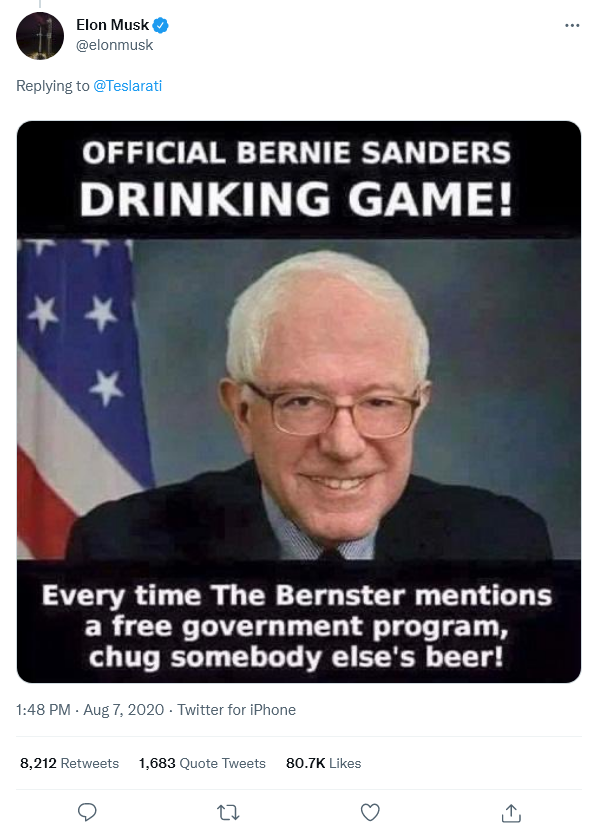
“Musk’s plebeian sense of humor is probably a big part of why the establishment can’t stand him”
Patrick Carroll speculates on why Elon Musk is so disliked by the other rich and powerful folks in his 0.01% demographic:
This isn’t the first time Musk has brought his playful, irreverent, meme-culture spirit to the market. A few years ago he launched his car into space because he thought it would be amusing, and some of his companies now accept Dogecoin as payment.
Musk in general seems rather fun, relatable, and laid back. He doesn’t take himself too seriously, and that’s probably a big part of why people like him.
Another reason he’s so likable is that he doesn’t mind poking fun at politicians, executives, and other “blue-check” elites. To the contrary, he seems to enjoy it.
Examples of Musk mocking the elites abound.
[…]
The question then becomes, how do we combat the insistence on political correctness? How do we push back when moral busybodies insert themselves in matters that are none of their business?
At first, it’s tempting to meet them on their own terms, to politely and logically state our case and request that they leave us alone. And sometimes that can be the right move. But often, a much more effective approach is to do what Elon Musk is doing: become the fool.
Rather than taking the elites seriously, the fool uses wit, humor, and satire to highlight how ridiculous the elites have become. He employs clever mockery and a tactful mischievousness to call the authority of the elites into question. When done well, this approach can be brilliantly effective. There’s a reason joking about politicians was banned in the Soviet Union.
The story of the Weasley twins and Professor Umbridge in Harry Potter and the Order of the Phoenix is one of my favorite examples of how mischievousness and mockery can be used to expose and embarrass those who take things too seriously. As you probably know, Umbridge was committed to formality and order, and she imposed stringent limits on fun and games. Now, the Weasley twins — the jesters of Hogwarts, as it were — could have responded with vitriol. They could have written angry letters, signed a petition, and gone through all the proper channels to get her removed. But instead, they threw a party in the middle of exams, making a complete mockery of her seriousness. They gave her the one thing she couldn’t stand: fun. And wasn’t that way more powerful?
If I had to guess, Musk’s plebeian sense of humor is probably a big part of why the establishment can’t stand him. They don’t mind someone who challenges them through the proper channels and in a respectful manner — that’s actually playing into their hand, because it concedes they are deserving of respect in the first place. What they can’t stand is being taken lightly, being teased and ridiculed and ultimately ignored.
Why can’t they stand that? Because our reverence for the elites is actually the source of their power. They win as long as we take them seriously. They lose the moment we don’t.
October 13, 2022
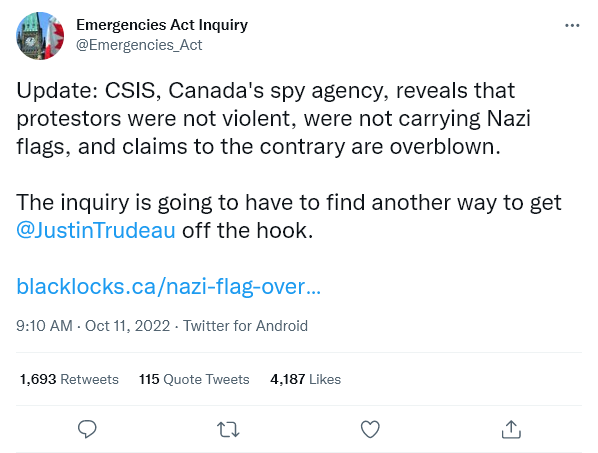
Are we to believe that Prime Minister Trudeau lied about the Freedom Convoy? To the fainting couches!
Some recent revelations show that Prime Minister Justin Trudeau was … less than perfectly honest … about the intelligence reports he was receiving about the Freedom Convoy:
It has now been revealed that statements by Prime Minister Justin Trudeau associating the “Freedom Convoy” with Nazism were unfounded, according to Canadian Security Intelligence Service (CSIS) documents published by Blacklock’s Reporter.
On January 31, 2022, Trudeau conflated support for the “Freedom Convoy” with “Nazi symbolism” in his first press conference addressing the massive anti-mandate demonstration that captured the world’s attention in the first two months of the year.
Trudeau also stated at the time that he would not meet with the truckers because of their supposed “hateful rhetoric” and “violence towards citizens”, behavior he consistently implied was a core aspect of the movement’s strategy to put an end to COVID jab mandates nationwide.
Contradicting Trudeau’s characterization, the now-revealed documentation from CSIS, dated February 2 – just two days after the prime minister’s initial comments – explain that the protest was predominantly comprised of “patriotic Canadians standing up for their democratic rights” and not of those holding extremists beliefs.
Detailing how the presence of bigoted imagery is “not unique” when it comes to large-scale protests, CSIS also noted that the presence of swastikas on some flags was “not necessarily to self-identify as Nazis but to imply the Prime Minister and federal government are acting like Nazis by imposing public health mandates”.
It was therefore the conclusion of CSIS that while some attendees had manually added swastikas to flags, it was to associate Trudeau with Nazism as a statement of their opposition to the ideology.
Two weeks after the CSIS report was produced, Trudeau doubled-down on his conflation of the Freedom Convoy with Nazism, accusing the Conservative Party of Canada, and in particular Jewish MP Melissa Lantsmann, of standing “with people who wave swastikas”.
October 12, 2022
The two traditions of the American political left
Chris Bray responds to a post by Leighton Woodhouse that declares that “left libertarianism” has won the battle for the soul of the American left:
I see two traditions on the American political left.
One is a tradition skeptical of authority, or aggressively hostile to it: Striking miners battling Coal and Iron Police, or Pinkertons, or Colorado sheriffs, or the National Guard; Wobblies fighting cops in the street; Great War-era socialists attacking the military draft, and going to prison for it; the Weatherman planting bombs in police and military offices. This tradition on the left views government as authority, a repressive servant of the status quo — “the executive committee of the bourgeoisie”. Leftists in this tradition say that of course government serves capitalism and corporate power, and of course the government isn’t on our side. Go back to the Coal and Iron Police to see how radical labor activists saw them: state-sanctioned police, with badges, on the private payroll of the industrialists. The young radical George Orwell, writing about his time fighting in Spain: “When I see an actual flesh-and-blood worker in conflict with his natural enemy, the policeman, I do not have to ask myself which side I am on.”
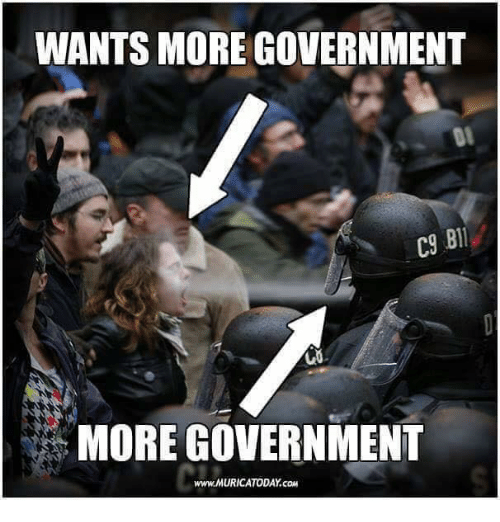
The other is a tradition centered on the supposedly inherent decency, wisdom, and fairness of government, a tradition that runs through the capital-p Progressive Era and Woodrow Wilson, to the New Deal, and onward into the Great Society. In this tradition, state power is benevolence itself, and points its kindness downward. Government interposes itself between the downtrodden worker and the power of the wealthy, ensuring the dignity of the poor. Tax the rich! In this tradition, government represents our best selves, our highest yearning for a better world. Why, just look at how much more equitable the progressive income tax made our social order, back when marginal tax rates were so much more fair at the top. Government serves, protects, nurtures: It’s the tool of the ordinary man, offering the noble guarantees of Social Security and Medicaid. Of course government is on our side, fellow downtrodden, and we need more of it.
Those two traditions don’t fit together, though the obvious way to square the circle is to say that a Bill Ayers opposes the power of the state when it opposes him, and embraces it if he thinks his side has come to control it. This would mean that there aren’t two ideological traditions — just two different instrumental postures. But no one who survived the Ludlow Massacre thought the government was a benevolent servant of the working man.
As Leighton Woodhouse notes, we have a good deal of what looks like anti-authority leftism in our cities, in the form of movements that call for the end of mass incarceration, the defunding of the police, and the transition to a social services model in response to homelessness and drug addiction. In this view, rising crime and growing homelessness are signs of urban leftists rejecting authority as a tool. Homelessness is not a crime, you fascists!
But I’ve written before about the incredible strangeness of progressive political columnists denouncing Donald Trump’s vicious authoritarianism, and then proudly pivoting to an expression of their approval of the warm and caring Justin Trudeau — who cracked down on incipient Trumpism in his country by boldly freezing the bank accounts of dangerous participants in the evil right-wing truck convoy. When government freezes the bank accounts of protesters, government is fighting against authoritarianism, obviously. More government power means less authoritarianism!
QotD: Luxury beliefs
An easy way to show that you’re not a member of the riff-raff, the masses, is to hold the opposite opinion, or a strange opinion that maybe doesn’t make sense, because it shows you’re not one of them. It’s not just the opinion itself, but the way that you express it. If you express it using vocabulary that no-one has ever heard of, for example … You often are not paying the price for your luxury beliefs, but even if you do, it’s still not nearly the same as the cost inflicted on the lower classes if they were to adopt those luxury beliefs too. […]
I talked to a friend of mine who was telling me, “When I set my Tinder radius to one mile, just around the university, and I see the bios of the women, a lot of their profiles say things like ‘poly’ or ‘keeping it casual’ – basically, they’re not interested in anything too serious.” He says something like half of them have something like that in their bio. And then he said, “But when I expand the radius on my Tinder to five miles, to include the rest of the city and the more run-down areas beyond the university bubble, half the women are single moms.” And basically, the luxury beliefs of the former group, the educated group, trickled down and ended up having this outsize effect on the people who are less fortunate, who don’t have the [social and] economic capital of the people who can afford that belief.
David Thompson, quoting from the transcript of a TRIGGERnometry interview with Rob Henderson, David Thompson, 2022-07-11.
October 11, 2022
Quebec politics explained (in Quebec!)
J.J. McCullough
Published 9 Oct 2022Politics in Canada’s French province. Thanks to Bespoke Post for sponsoring this video! New subscribers get 20% off their first box — go to https://www.bespokepost.com/jj20 and enter code
JJ20at checkout.My election watching buddy Sisyphus55: https://www.youtube.com/c/Sisyphus55
(more…)
Looking for a full definition of “Two-Spirit” is a fruitless task
In Quillette, Jonathan Kay tries to find a satisfactory definition of the term “Two-Spirit” but despite his best efforts comes up empty:
On August 28th, Justin Trudeau’s government announced “Canada’s first federal 2SLGBTQI+ action plan: Building Our Future With Pride“, which was described as “a whole-of-government approach to achieve a future where everyone in Canada is truly free to be who they are and love who they love”. One aim of the $100-million plan, the government explained, is to convince Canadians to adopt the term “2SLGBTQI+” in place of “LGBT” — on the basis that 2SLGBTQI+ “is more inclusive and places the experiences of Indigenous 2SLGBTQI+ communities at the foreground as the first 2SLGBTQI+ peoples in North America”.
The two characters given pride of place, “2S”, signify “Two-Spirit”, a term that’s been a form of self-identification among Indigenous North Americans since the 1990s. But the descriptor doesn’t appear to be in wide everyday use outside Canada. And so non-Canadian readers will sometimes ask me to explain its meaning — at which point, I have to admit that I can’t. And I’m hardly alone: While most Canadians know that the “Two-Spirit” category is connected to Indigenous identity in some way, there’s an unspoken rule against requesting more specific information.
Last week, the Elementary Teachers’ Federation of Ontario (ETFO), the province’s elementary-school teachers union, published what the authors present as a primer on Two-Spirit identity, a document written in close consultation with 2S-identified Indigenous people. Since the report’s target audience consists of workaday teachers who educate young students, I imagined that Niizh Manidoowag: Two-Spirit might finally provide me with a straightforward explanation of what the 2S identifier actually means.
Unfortunately, it doesn’t. In fact, one of the main themes of the 32-page document is that the task of defining the Two-Spirit concept is (quite literally) beyond the powers of Western language and epistemology. And in any case, the category is almost completely open-ended: The act of proclaiming oneself Two-Spirited could be a statement about one’s gender, or sexual orientation, or both, or neither. Or 2S can be a statement about one’s politics, spirituality, or simply one’s desire to present as “anti-colonial”.
According to the ETFO report, there are only two non-negotiable elements of a Two-Spirited individual—both of which are spelled out multiple times in the document, and in bold letters. Neither rule is concerned with sex or gender, but rather with race and political orientation: To be Two-Spirited requires (1) that you are Indigenous; and (2) that you are engaged in a “decolonizing act of resistance”:
There is no one way to prescribe usage of the term [Two-Spirit] … There is no one way to define the term Two-Spirit. Two-Spirit people and their roles predate colonial impositions, expectations, and assumptions of sex, gender, and sexual orientation. Where colonial worldviews often frame concepts as linear, compartmentalized, categorical, and hierarchical, Indigenous worldviews tend to be understood as non-linear, reciprocal, (w)holistic, relational, and independent of Eurocentric perspectives and framings. As such, identifying as two-spirit is a decolonizing act of resistance in and of itself.
The term Two-Spirit was first popularized in 1990, at an inter-tribal Native American/First Nations gay and lesbian summit in Winnipeg, and is derived from the Ojibwa words Niizh Manidoowag. By one account, delegates were looking for a term that would “distance Native/First Nations people from non-Natives, as well as from the words ‘berdache‘ [a European term suggesting deviancy] and ‘gay'”. But lore has it that the true originator is a Fisher River First Nation woman named Myra Laramee, who experienced a vision of the world as seen “through the lens of having both feminine and masculine spirit”.
On the surface, that sounds like what today might be called “non-binary”. But that analogy fails on a fundamental level. The idea of gender identity relates to the (perceived) nature of oneself. Two-Spirit people, on the other hand, are described in the ETFO report as possessing a savant-like power (or “lens”) that channels truths about the nature of the external world.
The Two Spirit concept is also entirely distinct from run-of-the-mill gender dysphoria. In everyday progressive gender parlance, it is typically insisted that trans women are just like other women. Two-Spirited people, by contrast, are presented as an entirely unique specimen whose arrival within traditional Indigenous societies was “celebrated” — “highly valued” “gifts” who “possess the best of both gendered identities”.

October 10, 2022
Janice Fiamengo on the #MGTOW affair – “In short, men who ‘go their own way’ have decided that they need women even less than the mythical fish needed its wheeled transport”
Recently, much impassioned wailing and howling has been directed at new Conservative Party leader Pierre Poilievre for his media team’s use of the notorious, misogynistic, coded-hate-speech metatag #MGTOW on postings to social media. Janice Fiamengo calls out the bold hypocrisy of most of the critics:
Remember “A woman needs a man like a fish needs a bicycle?”
Popularly credited to feminist icon Gloria Steinem, the slogan embodied the insouciance and independence claimed by Second Wave feminists. Women could get along just fine without men (though not without their tax money, as it turned out — more on this later) and lesbian feminists like Adrienne Rich (in “Compulsory Heterosexuality and Lesbian Existence”) explicitly called on all women to withdraw their caring from men as an act of female solidarity.
Nice, eh?
Anyone who objected to the anti-male rhetoric was dismissed as an apologist for patriarchal oppression (“Do you have a problem with equality?”), and generations of young women were given the message that wanting to love and be loved by a man was a betrayal of the sisterhood. What else was one to make of Professor of Law Catharine MacKinnon’s claim, in her 1989 essay for the journal Ethics, that “The major distinction between intercourse (normal) and rape (abnormal) is that the normal happens so often that one cannot get anyone to see anything wrong with it” (p. 336-337).
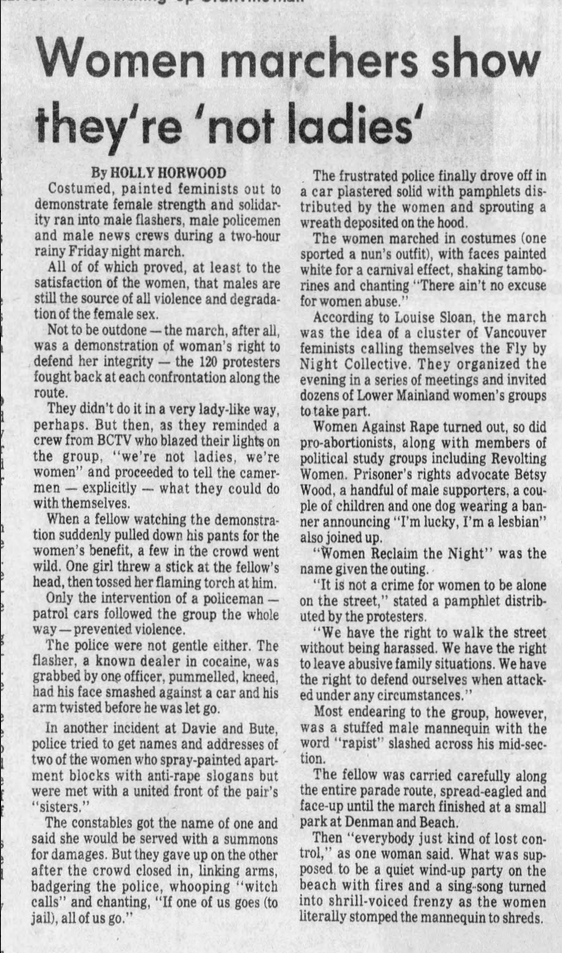
For decades, feminists in Canada have been given a free pass to vilify men as a group. In 1978, women’s groups held the first “Women Reclaim the Night” march in downtown Vancouver. It was a raucous, aggressive, property-destroying affair culminating in the symbolic murder of a stuffed male “Rapist” mannequin who was “literally stomped to shreds” by woman warriors.
[…]
So it is rather rich, now, five decades into the feminist revolt, to see pundits and political commentators huffing and puffing in outrage about MGTOW, dubbed a “misogynist men’s rights movement” or a “far-right misogynistic online movement”, and calling on newly-minted Conservative leader Pierre Poilievre (who, alas, seems eager to oblige) to disavow them. MGTOW stands for Men Going Their Own Way, and it was a happy day for the mainstream feminist-left when Global News allegedly discovered that Poilievre’s team had tagged many of his videos with the acronym.
The hypocrisy is off the charts.
It’s doubtful that any of the commentators getting on their high horses knows anything about MGTOW except the hysterical nonsense feminists have cooked up. MGTOW is not an official movement, far less an “organization”, as Poilievre mistakenly called it. It has no recognized leadership, no designated spokespersons, no political program, no lobbying power, and no public presence. It is not actually interested in “men’s rights” except to point out that men don’t have any. It has no philosophical connection with incels. It is basically a loose (mainly online) affiliation of men who have decided to check out of women’s lives.
Aren’t feminists always saying that they want men to stop dominating them, subjugating them, pestering them, harassing them, controlling them, and making them uncomfortable? That’s what MGTOW are all about.
October 9, 2022
What do you call it when a military-funded organization intervenes in US domestic politics? It’s “anti-fascism“, obviously
Chris Bray continues digging into the activities of a Department of Defence-funded operation at the University of Maryland:
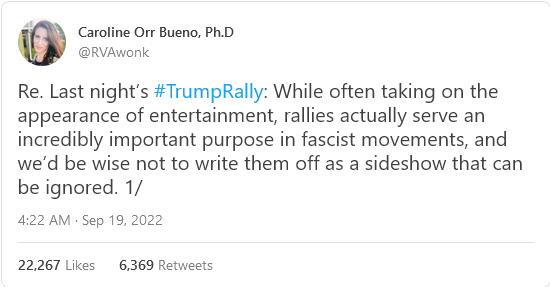
I wrote this morning about the disinformation expert Caroline Orr Bueno, a postdoctoral fellow at ARLIS — the Applied Research Laboratory for Intelligence and Security at the University of Maryland (who is identified as Caroline Orr on her ARLIS profile, so that’s the name I’ve used for her). Orr aggressively and repeatedly argues against the American political right, framing conservative politics as fascist and describing Donald Trump as an authoritarian figure. She makes a political argument, and she does it often.
This is true not only of her social media posts, but also of her published work. She’s a pro-Antifa political partisan (more about this in a moment), specifically arguing against the right and against Donald Trump rather than only studying disinformation across the political spectrum.
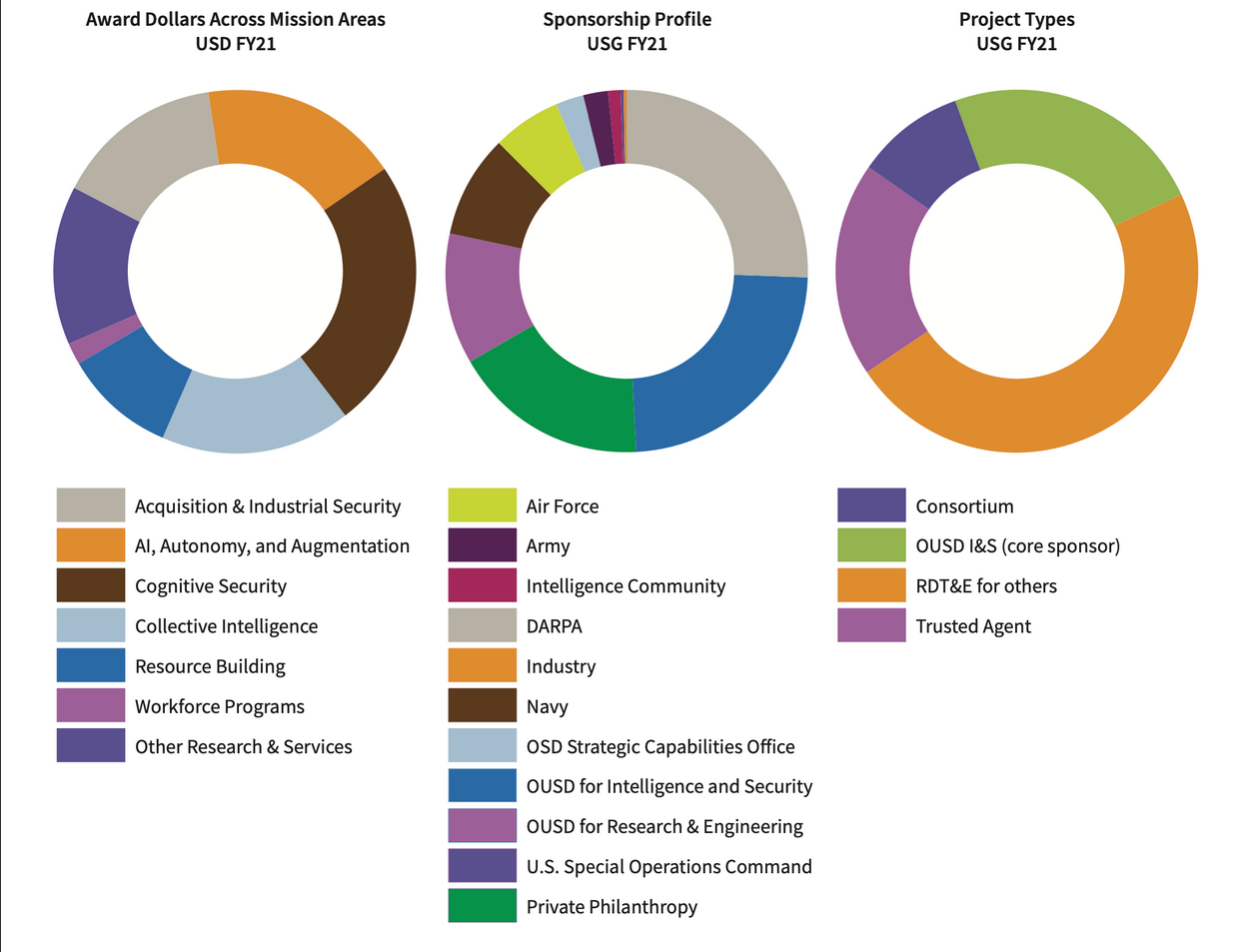
Now: ARLIS, where Orr works, is primarily funded by the Department of Defense, and its “core sponsor” is the Undersecretary of Defense for Intelligence and Security. You can download the 2021 annual report from ARLIS here […] You can find a description of the laboratory’s $46 million in funding on page 26 of that report:
So a research center largely funded by the military, and specifically sponsored by and aligned with the Undersecretary of Defense for Intelligence and Security, is arguing against a likely candidate for President of the United States and his supporters, participating in the work of shaping a political narrative while drawing DOD funds. Orr’s national security work as a military intelligence-funded researcher is to make sure people know that Donald Trump is bad.
This scholar has military funding:
Military intelligence is paying for politics. Military-funded academic researchers have the same academic freedom every other academic researcher has, and Orr has a right to express political opinions. But she’s doing government-funded research into the academic topic of Trump is bad so don’t support him, and that’s a misuse of federal funding and military authority. I assign the failure to the institution, not to the person. (The irony of military-funded academic leftist politics is not hard to spot, but that sort of thing doesn’t seem to matter anymore.)

October 8, 2022
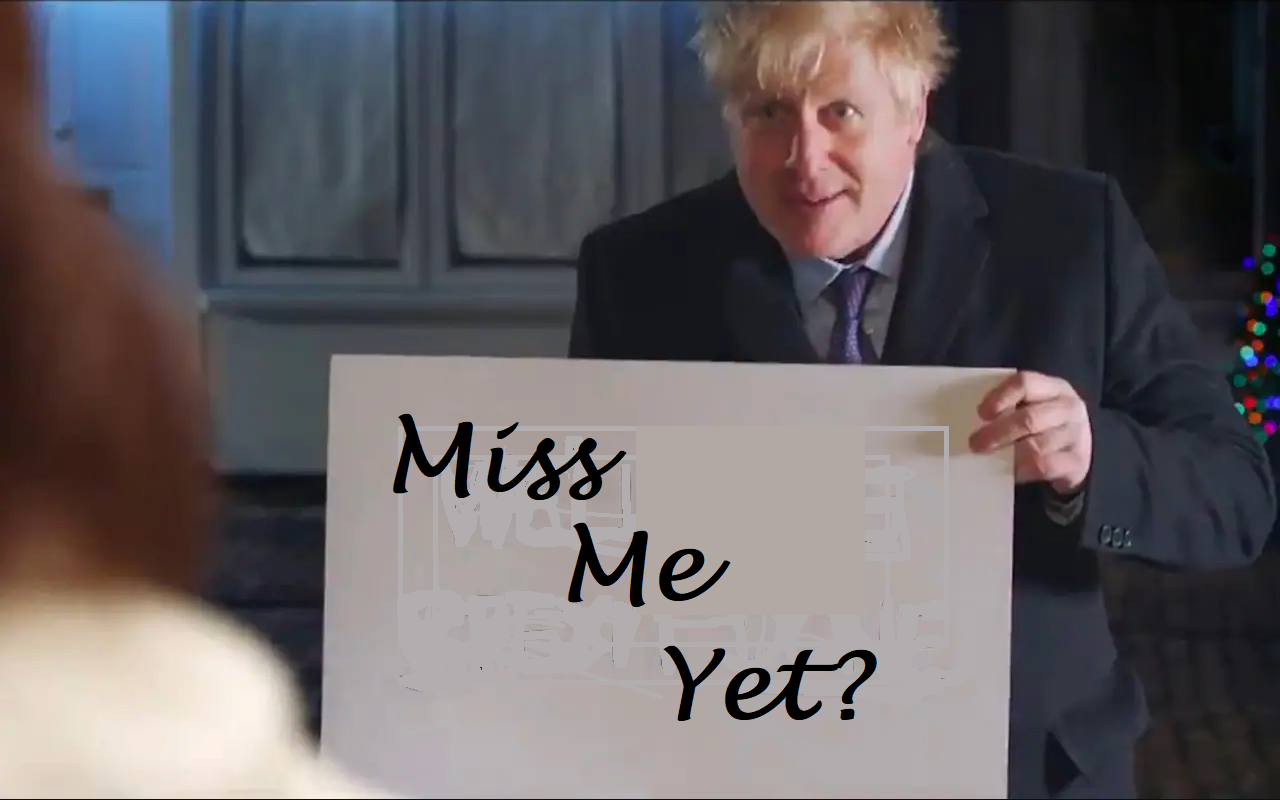
First BoJo “Miss me yet?” meme time?
Dominic Sandbrook on the terrible, awful, very bad start to Liz Truss’s Premiership:
If you believe the mainstream media, it has been yet another cosmically dire week for the Conservatives. But let’s stop going on about all the little things that went wrong, and concentrate instead on what went right. Nobody died. Liz Truss got through her speech without losing her voice, losing her mind or falling off the stage. The pound is back up to its level before Kwasi Kwarteng’s Fiscal Event. And maybe, just maybe, things are going to come right after all.
The winter energy crisis won’t be as bad as everybody fears. Inflation will start to come down. By the spring, that enormous Labour poll lead will be a fading memory. And as the next election approaches, ordinary people across the land will throw their caps in the air and cheer the name of Good Queen Liz …
No. No, I can’t do it. Tempting as it is to tilt against the conventional wisdom, sometimes you just have to face facts. The conference was awful. The speech was awful. This has been the worst start to any premiership, I think, in recent history — perhaps even in all British history.
Perhaps some readers will think this very harsh. But one close Truss ally, speaking off-the-record to the Financial Times, didn’t seem to think so. “I just went back to my hotel room and cried,” he said. “It’s a total disaster.” That’s pretty much what the general public think, too. In focus groups this week, the words that came up again and again were “incompetent”, “useless”, “untrustworthy”, “dangerous” and “clueless”. The punters aren’t always right, of course. But this time they are right, aren’t they?
“Our policy is great,” Penny Mordaunt told a fringe conference audience a couple of days ago, “but our comms is shit.” But if your comms really is shit, then who cares about the policy? Who even knows about it? Communicating your policy is the very essence of politics. If you can’t do it, you’ll never win another election.
I watched Truss’s speech through my fingers, embarrassed not just by the sheer lack of content, but the comically wooden and childlike delivery. It speaks volumes that in their desperation to find something, anything, nice to say about it, sympathetic papers applauded her for staying calm after she was interrupted by hecklers. Only somebody who had never heard of Harold Wilson, Margaret Thatcher or Tony Blair — all of whom were brilliant at dealing with interruptions — could have possibly thought this worth applauding.
For although academics and activists often prefer to talk about the abstractions of ideology or the nuts and bolts of policy, performance really, really matters in politics. To some extent, in fact, performance is politics. Even in a parliamentary system, you need a messenger who embodies the message, a leader who can charm and explain. Watch Thatcher talking to Robin Day in 1984, or Jim Callaghan being interviewed by Thames TV’s This Week in 1978, and it’s like entering a different world. Whatever their ideological differences, Thatcher and Callaghan are seasoned, accomplished performers, at the top of their respective games. They think about the questions. They talk in complete sentences, even complete paragraphs. They give long, considered, serious answers. They seem like impressive, well-informed, formidable people. Then watch Truss again, and try not to weep.
October 7, 2022
The “two movies on the same screen” effect: most Canadians see impending collapse but our “elites” think everything’s peachy
Tara Henley contrasts the reality many Canadians are facing day-to-day with the out-of-touch “laptop elites” who, as a class, did great through the last two and a half years and who have no clue at all why anyone would see the state of the country as anything like a collapse:

Pierre and Ana Poilievre at a Conservative leadership rally, 21 April, 2022.
Photo by Wikipageedittor099 via Wikimedia Commons.
There has been much discussion lately about the state of our nation — and whether or not we, as a society, are in decline.
Former journalist and Justin Trudeau speechwriter (and current Substacker) Colin Horgan published a provocative essay at The Line last month, arguing that our country is vulnerable to extremists who believe that “the current system of liberal democracy is inherently corrupt and corrupted, verging on collapse, and that, in the extreme, its downfall can and should be hastened by acts of violence”.
Horgan worries that Conservative leader Pierre Poilievre — who’s been actively speaking to this ambient vibe of distress and dissatisfaction — could accelerate such destabilization.
Poilievre does not say extreme things, Horgan concedes, but Poilievre’s message is “still poison” because “what he telegraphs is the vision of a social order at a tipping point, with the suggestion that it can be easily pushed over”.
In short, Poilievre has tapped into “an Internet language of decline”.
There’s a thriving cottage industry in the Canadian legacy media doing everything they can to tar Poilievre as a Canadian Hitler and to continue the re-typing and re-phrasing of government talking points for the mass market. The government subsidies to “approved” media outlets will help keep the lights on a bit longer as they continue to lose audience share — and trust.
Our quality of life has been eroded for some time now. Wages have been stagnant for decades. Precarious work is the order of the day, both for the working class and professionals. Rents and property prices are through the roof; according to the Globe and Mail, since 2000, domestic home prices have increased by 420 percent. Inflation is high. Gas is expensive. Food costs are up. We are coping with a crisis of social isolation. Our opioid epidemic rages on.
Meanwhile, pandemic policy has benefited the laptop class and harmed the most vulnerable among us. (See lockdowns and school closures, for starters.)
Indeed, there has been extreme winners and losers during the COVID era, which saw a massive transfer of wealth upwards. Billionaires in this country, in fact, saw their wealth increase 68 percent during the pandemic.
Should we be surprised that those on the losing end are expressing their frustration?
[…]
Things have only gotten worse as the pandemic has dragged on and citizens have been hit with high inflation and rising interest rates (while also staring down other looming financial catastrophes).
According to an Angus Reid poll out this week, nine out of ten Canadians have cut their household budgets due to inflation and high prices. And 46 percent of Canadians say their personal finances are worse off now than they were at this time last year.
But if the material conditions in this country are dire, so too is the national mood.
In fact, there is a gaping wound at the centre of our national psyche.
Essential workers have laboured throughout the COVID crisis, endangering their health and that of their families, in order to keep society running. In return for their heroic efforts, the unvaccinated among them — many of whom previously contracted COVID and have natural immunity — have seen themselves ostracized and smeared as racists and misogynists. Their fundamental values have been mocked in the public square, and their basic rights and freedoms, including freedom of expression, have been compromised. Some have lost jobs, social lives and more for declining vaccination.
To comprehend the human toll this has taken, one need only look to the grassroots #TrudeauMustGo campaign on Twitter.
The consequences of vaccine mandates should have been covered in great depth by our national press. But instead, the Canadian media largely fell down on this story, often generating coverage that uncritically reproduced the Liberal party line.
Trust in the Canadian news media is now at its lowest point in seven years.
And judging from the reader mail I get, the Liberals’ decision to turn vaccine mandates into a wedge issue has had significant social consequences — tearing apart families, communities, and workplaces in ways that may take years to recover from.
All told, what we are witnessing is not merely a state of decline. It is a form of collapse. A collapse of the social contract. A collapse of the expectations we grew up with — that if you worked hard and respected the law, you could have a home, a family if you chose, and, crucially, a say in our democracy.
What we are living through is a collapse of life as we knew it in Canada.
What was once a stable, prosperous, diverse democracy is now a nation divided, rife with fear and anger, and financial and social instability.
Not only has our Prime Minister failed to grasp this, but he’s actively stoked tensions.
October 6, 2022
QotD: Life in grad school
After a few years of this, you forget what normal life is even like. You come to understand the deep and longstanding grievances the Poststructuralist Feminist Marxists have with the Marxist Feminist Poststructuralists. Oh, there’s scads of “diversity” on campus — all those recruiting brochures they mail to dumb parents in the ‘burbs aren’t lying — but there’s one thing you’ll never, ever find: The thought that maybe politics doesn’t matter all that much.
That’s the answer, right there. Academic “humanities” work is mostly bullshit because most people just don’t care about politics. To normals, if they think about “politics” at all, it’s in Schoolhouse Rock terms — some guys in Washington vote on some stuff, and that’s how a bill becomes a law. They certainly don’t mean ideology, which is pretty much the only thing academics mean. That a normal person could walk into the voting booth without really knowing if he’s going to pull the lever for Trump or Hillary fries an egghead’s circuits…
… and yet, as we all know, the majority of American voters do this, every single time. There’s something profound about normal person behavior that academics just can’t — or won’t — grasp.
Severian, “Ignoring the Human Factor”, Rotten Chestnuts, 2019-08-14.
October 5, 2022
Are the protests in Iran about to tip over into actual revolution?
In The Line, Kaveh Shahrooz reports on the still-ongoing public protests after the death of a young woman at the hands of the morality police:

Aftermath of anti-government protests in Bojnord, North Khorasan Province, Iran, 22 September, 2022.
Photo from Tasnim News Agency Bojnord Desk via Wikimedia Commons.
Revolutions are funny things. They sometimes appear impossible until, in one single moment, they become inevitable. In Iran, that moment came on September 13th with the murder of a young woman.
Mahsa Amini, a 22-year-old who was also known by her Kurdish name “Gina”, had come from Iran’s Kurdistan region to visit her brother in Tehran. It was during that trip that she faced a particular humiliation that has become a fact of life for tens of millions of women in that country: a run-in with the country’s gasht-e ershad (“Guidance Patrol”). The role of this roving gang, seemingly imported from Atwood’s Gilead and called Iran’s “morality police”, is to monitor the streets to find and punish violations of the regime’s seventh-century moral and dress codes.
Having determined that Mahsa’s hijab exposed a little too much hair — a few strands of a woman’s hair and men will simply be incapable of controlling their sexual urges, the logic goes — they detained and beat her severely. The story for most women who deal with the morality police typically ends there, after which they are released to seethe at having endured another round of state-imposed gender apartheid. For Mahsa, the story ended differently: with a skull fracture that caused her to be brought, brain dead, to a local clinic. She died there on September 16th.
The murder of Mahsa Amini was the spark that set off a revolution. The killing reminded women of their daily misery at the hands of a regime that, both de facto and de jure, treats them as second-class citizens. And it reminded everyone of the million other senseless cruelties, large and small, that they must endure daily at the hands of a barbaric theocracy. Outraged by the death of an innocent young woman, the people took to the streets in protests that continue to this day.
There have been mass protests in Iran before. In 2009, in response to a widespread belief that Mahmoud Ahmadinejad had illegally stolen the presidential election — to the extent the word “election” means anything in a country where candidates must first be approved by a clerical body loyal to the regime — citizens protested by the millions. Their slogan, “Where’s my vote?” rested on the premise that a fair, albeit controlled, election was something that could change the system for the better. The protesters typically avoided confrontation with security forces. Even when they happened to corner a regime thug periodically, they ensured that no harm was done to him.
“The centre ground on domestic policy and public services is Corbynism with a union flag on it and the word ‘British'”
Ed West on the decidedly conservative cast of many British voters’ core beliefs:

Jeremy Corbyn, then-Leader of the Labour Party speaking at a Rally in Hayfield, Peak District, UK on 25th July 2018 in support of Ruth George MP.
Photo by Sophie Brown via Wikimedia Commons.
It wasn’t until I was a fairly grown up that I learned just how conservative many Labour voters were. My parents’ Labour-supporting friends had mostly belonged to what Ken Livingstone called ‘the party of the metropolitan pervert’, London types who worked in creative industries or the public sector and held ultra-liberal views (at least for the 90s). But out there in the real world there were all these Labour supporters who were even more Right-wing than my dad, whether on crime, immigration, Europe, sexual relations or pretty much any social issue. They just wanted, in Blackadder’s words, a few less fat bastards eating all the pie.
That is pretty much where the public are now. As Aaron Bastani put it: “The centre ground on domestic policy and public services is Corbynism with a union flag on it and the word ‘British'”.
Although Jeremy Corbyn lost decisively in 2019, many have forgotten the political lesson of the Corbyn era — that it wasn’t his economic policies that put people off, but his lack of patriotism. He came from that long line of Quaker-Unitarian radicals who have always been seen as too sympathetic to Britain’s enemies, whether it was Robespierre, Napoleon, the USSR, Irish republicans or Islamic radicals.
Corbynomics is certainly more popular than what the current Tory Party is offering, especially that served up in the recent mini-budget, after which it could be said that things are developing not necessarily to the Government’s advantage.
I don’t have strong opinions on the aborted 45% tax cut; it didn’t seem very wise, or fair, but I’m not sure how drastic it was; Robert Colvile in The Sunday Times suggests that the proposal was not as bold as people make out. Yet it seems to be hugely unpopular, except with the Institute for Economic Affairs.
But I’m not convinced that makes it bad.
The IEA’s Kristian Niemietz has repeatedly pointed out that free-market economics is generally quite unpopular, and during the depths of the Brexit dispute he wrote a piece opposing what he called “Bregalitarianism”:
The Bregalitarian loves to wallow in faux-indignation every time an opponent – which can be a Remainer, but it can also just be a more cautious, less enthusiastic Brexiteer – mentions the possibility that not everyone who cast a vote on 23 June 2016 was fully aware of all the possible ramifications. “How DARE you suggest that 17.4 million voters are stupid!”, cries the Bregalitarian. “How DARE you be so patronising and insulting!”
I find this Bregalitarian rhetoric deeply disingenuous – and never more so than when free-marketeers engage in it … Here’s a little home truth: if you are a free-marketeer in Britain in 2018, you are part of a small and unpopular minority. The vast majority of the British public disagree with you on virtually everything. There is majority support for a (re-) nationalisation of energy companies, the railways, water and bus companies. There is majority support for rent controls and various price controls.
As a free-marketeer, you probably want, if not fully privatised, then at least mixed systems of healthcare and education, with much greater private sector involvement. If so, you are almost alone in Britain with that view. There is also majority support for a lot more government regulation, a lot more government interference with private business decisions, higher taxes and a larger state.
Indeed, public opinion on economic issues is quite eye-watering: a full 28 per cent of British adults want banks to be run by the state, and 30 per cent even want internet providers nationalised. A quarter want travel agents nationalised.


