Extra Credits
Published on 13 Sep 2018This series is brought to you by World of Tanks PC. Check out the game at the link below and use the invite code FORAGER for extra goodies. https://redir.wargaming.net/r06pve1j/…
As the ruthless clash of the Saipan invasion drags on into the second week, a unique and unlikely hero emerges. Marine scout Guy Gabaldon can speak Japanese. He deserts his post, not once but twice, to reach out to the enemy soldiers and civilians.
September 15, 2018
Battle of Saipan – Suicide Island – Extra History – #2
September 8, 2018
Battle of Saipan – Steel and Coral – Extra History – #1
Extra Credits
Published on 6 Sep 2018The battle of Saipan would decide the fate of the Pacific War. On a tiny island, just five miles wide, thousands died under advanced artillery and amphibious tanks. This series is brought to you by World of Tanks PC. Check out the game at the link below and use the invite code FORAGER for extra goodies. https://redir.wargaming.net/r06pve1j/…
Support us on Patreon! http://bit.ly/EHPatreon
August 27, 2018
Kingdom of Majapahit – An Empire of Water – Extra History – #1
Extra Credits
Published on 25 Aug 2018In this series we will explore the history of a short-lived kingdom that united the diverse, 13,000+ islands of Indonesia: Majapahit. Before Majapahit came along, however, the Kingdom of Srivijaya and the Kingdom of Mataram laid the stepping stones.
Please note: The next episode of Majapahit will be published on September 15 and will continue every Saturday thereafter. The EC team is taking a well-deserved short upload break for a few weeks!
July 12, 2018
Great Blunders of WWII: Japan’s Mistakes at Midway
Anthony Coleman
Published on 3 Nov 2016From the History Channel DVD series “Great Blunders of WWII”
April 13, 2018
India and the “Quad”
At Strategy Page, Austin Bay discusses India’s position, both geographically and militarily with respect to China:
As the Cold War faded, a cool aloofness continued to guide India’s defense and foreign policies. Indian military forces would occasionally exercise with Singaporean and Australian units — they’d been British colonies, too. Indian ultra-nationalists still rail about British colonialism, but the Aussies had fought shoulder to shoulder with Indians in North Africa, Italy, the Pacific and Southeast Asia, and suffered mistreatment by London toffs. Business deals with America and Japan? Sign the contracts. However, in defense agreements, New Delhi distanced itself from Washington and Tokyo.
The Nixon Administration’s decision to support Pakistan in the 1971 Indo-Pakistani War [Wikipedia link] embittered India. Other issues hampered the U.S.-India relationship. Indian left-wing parties insisted their country was a “Third World leader” and America was hegemonic, et cetera.
However, in the last 12 to 15 years, India’s assessments of its security threats have changed demonstrably, and China’s expanding power and demonstrated willingness to use that power to acquire influence and territory are by far the biggest factors affecting India’s shift.
In 2007, The Quad (Quadrilateral Security Dialogue), at the behest of Japan, held its first informal meeting. The Quad’s membership roll sends a diplomatic message: Japan, Australia, America and India. Japan pointed out all four nations regarded China as disruptive actor in the Indo-Pacific; they had common interests. Delhi downplayed the meeting, attempting to avoid the appearance of actively “countering China.”
No more. The Quad nations now conduct naval exercises and sometimes include a quint, Singapore.
The 2016 Hague Arbitration Court decision provided the clearest indication of Chinese strategic belligerence. In 2012, Beijing claimed 85 percent of the South China Sea’s 3.5 million square kilometers. The Philippines went to court. The Hague tribunal, relying on the UN Convention on the Law of the Sea treaty, supported the Filipino position that China had seized sea features and islets and stolen resources. Beijing ignored the verdict and still refuses to explain how its claims meet UNCLOS [Wikipedia link] requirements.
That is the maritime action. India and China also have mountain issues. In 1962, as the Cuban Missile Crisis diverted world attention, the two Asian giants fought the Indo-Chinese War [Wikipedia link] in the Himalayas. China won. The defeat still riles India.
“…it is possible to complete an entire degree in anthropology without hearing any criticism of Margaret Mead’s Coming of Age in Samoa“
Margaret Mead’s reputation has run the gamut over the last nearly 100 years after her career-making visit to Samoa in the mid-1920s:
… my journey did leave me with a newfound and abiding respect for the anthropologist Margaret Mead. At the same young age of 23, Mead travelled to the Samoan Islands to the east of the Vanuatu in the South Pacific Ocean to study the islands’ Polynesian people. On a cloudy Samoan day in August of 1925, she stepped off the S.S. Sonoma in Pago Pago Bay, Tuttuila, and began her research. By the end of her career, she was celebrated as the mother of anthropology, both revered and despised for the image of humanity she presented to the world, and for her conclusions about the Samoan people, in particular.
At first, her conversations with the Samoans did not go especially well:
Mead: When a chief’s son is tattooed they build a special house, don’t they?
Asuegi: No, no special house.
Mead: Are you sure they never build a house?
Asuegi: Yes. Well, sometimes they build a small house of sticks and leaves.
Mead: Was that house sacred?
Asuegi: No, not sacred.
Mead: Could you take food into it?
Asuegi: Oh no. That was forbidden.
Mead: Smoke in there?
Asuegi: Oh no, very sacred.
Mead: Could anybody go into the house who wished?
Asuegi: Yes, anybody.
Mead: No one was forbidden to go in?
Asuegi: No.
Mead: Could the boy’s sister go in?
Asuegi: Oh no. That was forbidden.Mead later recalled that she could have “screamed with impatience.” To make matters worse, the native Samoans would often take her belongings and redistribute them according to ceremonial obligations. But, eventually, she began to make progress. Mead developed close friendships with a small and dedicated group of young girls who became her chief informants. She was made a taupou, a ceremonial virgin, despite having a husband back in the United States. Before long, Mead was considered a respected honorary member of the society, and her research project blossomed. A few months and a tropical hurricane later, Mead returned to the United States, and in 1928, she published the results of her research, Coming of Age in Samoa: A Psychological Study of Primitive Youth for Western Civilization.
Her work was widely accepted and praised but by the 1960s, there were some signs challenging her research and conclusions, especially the research of New Zealand anthropologist Derek Freeman. Although he held back the publication of his work until after her death, she was aware of his criticisms and received one of the chapters of his book in advance:
Countless readers had formed a romantic image of the Samoan people from Coming Of Age in Samoa, but now Freeman had broken the spell. The people most blindsided by Freeman’s book were those anthropologists who had stood in front of lecture audiences and fed students Mead’s image of Samoa. Some of them immediately attacked the book. Anthropologist Laura Nader, sister of independent US politician Ralph Nader, called Freeman’s book a “Right-wing political backlash” for questioning the influence of culture on human behavior, and a vote by American Anthropological Association condemned the book as unscientific.
Over the next few decades, Mead’s reputation hung precariously in the balance as anthropologists and evolutionary psychologists battled it out in the nature-nurture controversy. However, the cruelest blow to Mead would come from anthropologists themselves.
It turned out that the young girls Mead apparently depended upon for many of her concepts about Samoan life were far from truthful about their lives:
Unlike the American anthropologists who preached Mead’s findings, Samoans themselves tended to look upon Mead’s work negatively. Some of the Samoan elders burned copies of Coming of Age in Samoa when they realized what Mead had written, and for some time libraries in Samoa didn’t stock the book. Samoan anthropologist Unasa L. F. Va’a called it “one of the worst books of the twentieth century.”3 One of the questions that preoccupied Freeman was how Mead arrived at the erroneous conclusions she drew in her book. He decided that Mead’s own research came mostly from interviews with women, particularly young women, who are hardly the best informants when it comes to matters of historical warfare and violence. On the subject of promiscuity, Freeman conjectured that Mead was the victim of a hoax by her young female informants: “All the indications are that the young Margaret Mead was, as a kind of joke, deliberately misled by her adolescent informants.” In 1987, a few years after Margaret Mead and Samoa was published, it was discovered that one of Mead’s close informers in 1926, Fa’apua’a Fa’amu, was still alive, and wished to swear on the Bible to clear the record on what she had told Mead all those years ago about sexual relations among the Samoans:
We said that we were out all night with the boys; she failed to realize that we were just joking and must have been taken in by our pretenses… She must have taken it seriously but I was only joking. As you know, Samoan girls are terrific liars when it comes to joking. But Margaret accepted our trumped up stories as though they were true.…Yes, we just lied and lied to her.
But was she totally wrong? Doubts exist here, too:
Although Mead’s analysis is obviously highly questionable, the degree to which her work misrepresented Samoan society remains an open question. In 2009, the anthropologist Paul Shankman published his book The Trashing of Margaret Mead in which he reconsiders the evidence. Shankman describes Freeman as an unruly character marked by mental instability, a vindictive desire to ruin the careers of other anthropologists, and plain rudeness (Shankman recalled a nightmare experience when he gave a lecture at ANU and Freeman sat behind him opening and reading his mail so loudly that Shankman had to ask him to stop). This ad hominem attack on Freeman might seem like a desperate effort to evade his refutation of Mead, or to seek revenge on Freeman, but Shankman does succeed in raising some important questions. For example, although virginity is prized in Samoa, it is much more prized among the taupou, the ceremonial virgins of higher status who go on to marry the chiefs. Among the lower status girls, sexual mores were more relaxed and some of these girls did sleep with men before marriage as even Freeman’s data found. Other aspects of Shankman’s belated defense of Mead are more contentious. For example he dismisses Fa’apua’a Fa’amu’s testimony about lying to Mead as irrelevant due to her advanced age and sometimes contradictory statements. He also speculates that Fa’apua’a Fa’amu’s testimony was probably not influential on Mead’s wider conclusions because she was only one of 25 informants. These are important qualifications to what is often presented as Freeman’s decisive refutation of Mead’s work.

March 27, 2018
History Buffs: Tora! Tora! Tora!
History Buffs
Published on 21 Jun 2017Tora! Tora! Tora! is a 1970 Japanese-American historical war film that dramatizes the Japanese attack on Pearl Harbor in 1941. The film was directed by Richard Fleischer, Toshio Masuda and Kinji Fukasaku and stars an ensemble cast, including Martin Balsam, Joseph Cotten, Sō Yamamura, E. G. Marshall, James Whitmore and Jason Robards. The title is the Japanese codeword used to indicate that complete surprise had been achieved. “Tora” means “tiger” in Japanese.
Cynical Historian: Pearl Harbor review – https://www.youtube.com/watch?v=oUlwDDeAQNE
March 7, 2018
USS Lexington‘s final resting place discovered by Paul Allen’s RV Petrel
As reported by News Corp Australia:

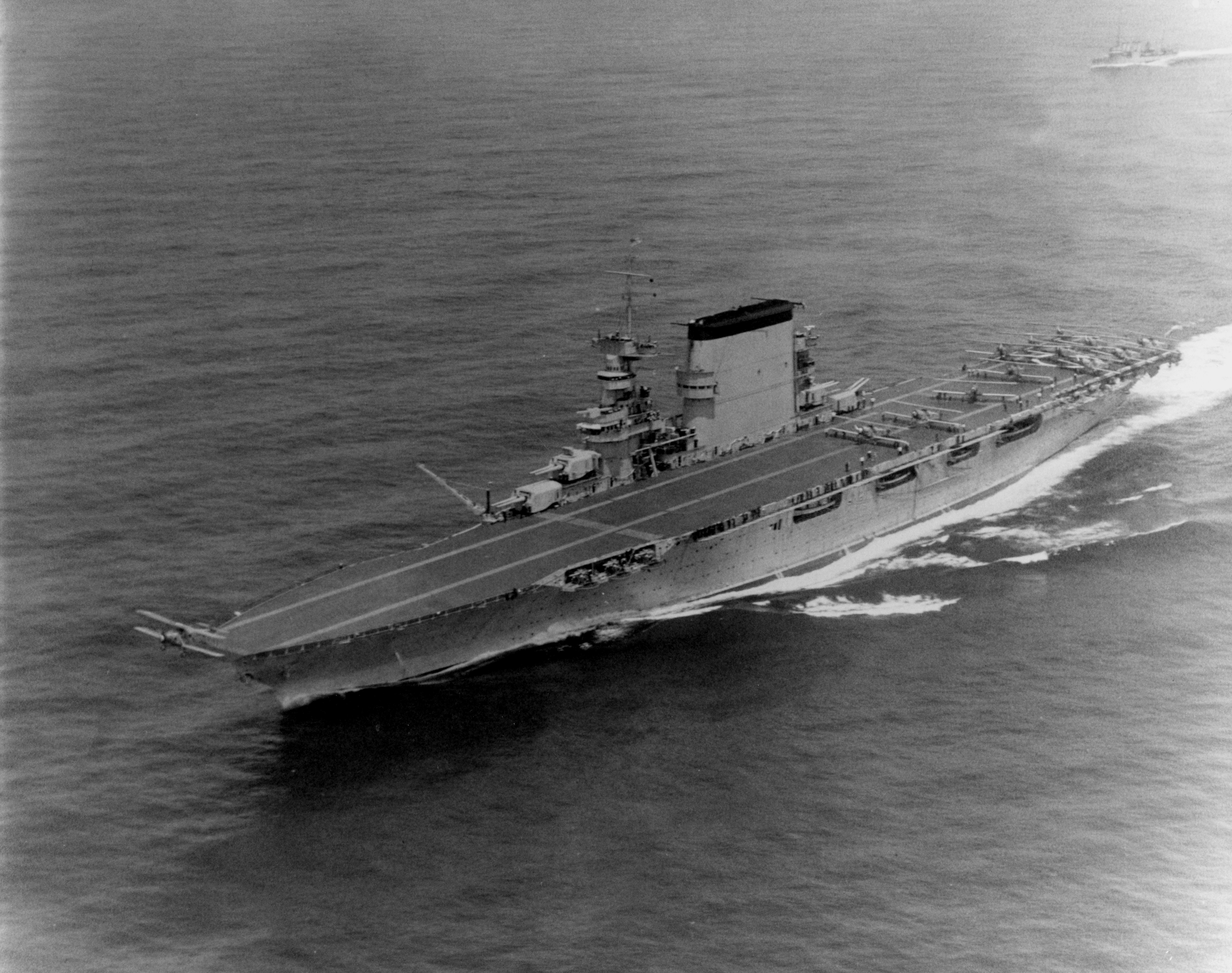
U.S. Navy Martin T4M-1 aircraft of Torpedo Squadron 1B (VT-1B) are launching from the deck of the aircraft carrier USS Lexington (CV-2) in 1931. Note the “four-stacker” (Clemson/Wickes-class destroyer) in the upper right corner.
US Navy photo via Wikimedia.
Now, 76 years after it settled to the bottom, it’s been found.
It’s the latest find by billionaire Paul Allen.
And it’s in a remarkably well preserved condition.
Soon-to-be US ambassador to Australia, US Pacific Commander Admiral Harry Harris says he is elated at the find.
“As the son of a survivor of the USS Lexington, I offer my congratulations to Paul Allen and the expedition crew of Research Vessel Petrel for locating the ‘Lady Lex’,” he said in a tweet.
[…]
Paul Allen’s research vessel Petrel located the wreck of the USS Lexington yesterday.
According to a post on the philanthropist’s website, it rests some 800km off the coast of Queensland at a depth of about 3km.
The find was the result of a six month project.
Photos so far returned by RV Petrel’s submersible show several aircraft that have tumbled out of the carrier and on to the ocean’s floor. Their original markings and paintwork remain remarkably clear.
The ship itself, while showing heavy scarring from the battle and the stresses of diving 3km to the sea floor, is also well preserved. Gun mounts and other fittings show only little sign of corrosion and deterioration.
Vulcan Inc.
Published on 5 Mar 2018Wreckage from the USS Lexington was discovered on March 4, 2018 by the expedition crew of Paul G. Allen’s Research Vessel (R/V) Petrel. The aircraft carrier, “Lady Lex” was found more than 3,000 meters below the surface, resting on the floor of the Coral Sea more than 500 miles off the eastern coast of Australia.
January 17, 2018
Thirty-eight minutes in Hawaii
Colby Cosh on the false alarm in Hawaii:
Of course, an incident like this really takes several idiots lined up in a long row. Missile tests by North Korea have been making Hawaiian officials nervous lately about the archipelago’s exposed position in the mid-Pacific. The rhetoric being traded between dictator Kim Jong-un and U.S. President Donald Trump is certainly not so easy to brush off in Hawaii, where plenty of living people have personal memories of Pearl Harbor.
U.S.-North Korean tension has, in recent months, been leading to a de-mothballing of old civil-defence measures in Hawaii, such as sirens and bomb shelters. It has also led, as we now know, to the updating of the traditional emergency broadcasting system. It can now reach out to your phone and fling you right out of your four-poster bed at the Hyatt Regency Waikiki Beach.
For something that was “not a drill”, the mistaken smartphone message will have had a lot of the same effects. The most important thing that HEMA learned was that if you have the ability to electronically auto-terrorize everyone within a certain radius, you had better have some fast, equally automatic way of correcting an error. It took HEMA 38 minutes to send a second notice to smartphone users reading “There is no missile threat or danger to the State of Hawaii. Repeat. False Alarm.” And, no, I’m not sure what the “Repeat” is doing there, either.
During those 38 minutes, thousands of Hawaiians and tourists had sent desperate farewells to loved ones — although some noticed that the outdoor sirens, which had just been tested last month, were not going off, and drew the correct conclusion. There is very little evidence of anything technically describable as “panic” happening in the state, despite the ubiquitous use of that word in Sunday headlines.
Jokes about poor interface design are being circulated in the aftermath of the Hawaiian incident, but the governor did specify that the person who made the “mistake” actually clicked through a second “are you sure you want to create traumatizing chaos for no reason?” confirmation message. HEMA also says it will require two separate people to confirm smartphone alerts in the future, which, if I can be forgiven a toe-dip into conspiratorial thinking, almost seems to hint at the possibility of some kind of awareness-raising prank.
November 28, 2017
Invasions, Naval Battles and German Raiders – WW1 in the Pacific I THE GREAT WAR Special
The Great War
Published on 27 Nov 2017New Zealand: A Society At War: http://amzn.to/2A7Ojz0
One of the theatres of war that’s often overlooked, the Pacific saw some of the earliest military actions of the Great War. On top of this, there were many naval engagements in this particular ocean, including some famous German merchant raiders. We cover all this and more in today’s special episode.
October 22, 2017
July 2, 2017
The US Navy’s WW2 floating drydocks
I’d never heard of these massive mobile drydock facilities before:

USS Iowa (BB-61) in a floating drydock at Manus Island, Admirality Islands, 28 December 1944. (via Wikimedia)
The United States Navy, during World War 2, decided to create a temporary forward base utilizing service stations; these stations meant the United States Navy could operate throughout the huge Pacific Ocean for more sustained amounts of time.
Creating these pretty much meant they could have a major naval base within a short distance of any operation carried out in the area. The base was able to repair; resupply and refit, meaning fewer ships had to make the journey to a facility at a major port, which allowed them to remain in the Pacific for up to a year and beyond.
These stations were officially named Advance Base Sectional Docks (ABSDs) and were put together section by section. Each part was welded to the next once in their correct position.
There were two different sizes of floating docks created, the largest ones were created using ten sections and could lift 10,000 tons each – being 80 feet wide and 256 feet long. Once these sections were welded together, it became a fully assembled dock that was a whopping 133 feet wide, 827 feet long and could lift up to 90,000 tons.
This was more than enough lifting power for any ship within the Fleet.
The post also included this film, showing the USS Idaho being moved into an ABSD at Esperitu Santo in August, 1944:
Published on 7 May 2015
On August 15, 1944 the mighty battleship Idaho arrived at Espiritu Santo in the Pacific and slipped into a floating dry dock so that emergency repairs could be made to the ship’s blisters. This special film — likely made by the crew of the battleship’s observation aircraft — documents the activities as the ship is maneuvered into position. The dry dock shown is likely one of the Large Auxiliary Floating Dry Docks (AFDB), probably AFDB/ABSD-1. This was constructed in sections during 1942 and 1943 at Everett Shipbuilding Co., Everett, WA., by the Chicago Bridge & Iron Co., Eureka, CA., the Pollack-Stockton Shipbuilding Co., Stockton, CA., and Chicago Bridge & Iron Co., Morgan City, LA. During World War II ABSD-1 was assigned to the Asiatic-Pacific Theater and towed to Espiritu Santo in the New Hebrides and assembled for service. Later it was disassembled and towed to Manicani Bay, P.I. and reassembled for service by September 1945.
USS Idaho had been damaged during long days of combat that began with the bombardment of Saipan in June. With the landing assault underway on 15 June, the battleship moved to Guam for bombardment assignments. As the American fleet destroyed Japanese carrier air power in the Battle of the Philippine Sea from 19–21 June, Idaho protected the precious transport area and reserve convoys. After returning to Eniwetok from 28 June to 9 July, the ship began preinvasion bombardment of Guam on 12 July, and continued the devastating shelling until the main assault eight days later. As ground troops battled for the island, Idaho stood offshore providing vital support until anchoring at Eniwetok on 2 August.
After repair, Idaho‘s mighty guns were needed for the next giant amphibious assault on the way to Japan. She sailed from San Diego on 20 January 1945 to join a battleship group at Pearl Harbor. After rehearsals, she steamed from the Marianas on 14 February for the invasion of Iwo Jima. As Marines stormed ashore on 19 February, Idaho was again blasting enemy positions with her big guns, and fired star shells at night to illuminate the battlefield. She remained off Iwo Jima until 7 March, when she underway for Ulithi and the last of the great Pacific assaults – Okinawa.
At the end of the conflict Idaho made her triumphal entry into Tokyo Bay with occupation troops on 27 August, and was anchored there during the signing of the surrender on board the Missouri on 2 September. Four days later she began the long voyage to the East Coast of the United States, steaming via the Panama Canal to arrive at Norfolk on 16 October. She decommissioned on 3 July 1946 and was placed in reserve until sold for scrap on 24 November 1947 to Lipsett, Incorporated, of New York City.
June 25, 2017
Fort Drum – America’s concrete battleship
Published on 15 Sep 2016
After the United States acquired the Philippines from Spain, the U.S. Board of Fortifications recommended that important harbors be fortified. This led to the development of defenses on several islands at the mouth of Manila and Subic Bays. One of these was El Fraile Island which would later become Fort Drum, America’s concrete battleship.
Read more about America’s concrete battleship, Fort Drum, here: http://www.wearethemighty.com/articles/americas-concrete-battleship-defended-manila-bay-until-the-very-end
June 4, 2017
The Battle of Midway, 4-7 June 1942
Last month, Victor Davis Hanson recounted the American side of the Battle of Midway, which many historians see as the turning point of the Pacific War:

Battle of Midway deployment map, according to Seeschlachten der Weltgeschichte by William Koenig (German version of Epic Sea Battles) via Wikimedia
Seventy-five years ago (June 4-7, 1942), the astonishing American victory at the Battle of Midway changed the course of the Pacific War.
Just six months after the catastrophic Japanese surprise attack on Pearl Harbor, the U.S. crushed the Imperial Japanese Navy off Midway Island (about 1,300 miles northwest of Honolulu), sinking four of its aircraft carriers.
“Midway” referred to the small atoll roughly halfway between North America and Asia. But to Americans, “Midway” became a barometer of military progress. Just half a year after being surprised at Pearl Harbor, the U.S. Navy had already destroyed almost half of Japan’s existing carrier strength (after achieving a standoff at the Battle of the Coral Sea a month earlier).
The odds at the June 1942 battle favored the Japanese. The imperial fleet had four carriers to the Americans’ three, backed up by scores of battleships, cruisers and light carriers as part of the largest armada that had ever steamed from Japan.
No military had ever won more territory in six months than had Japan. Its Pacific Empire ranged from the Indian Ocean to the coast of the Aleutian Islands, and from the Russian-Manchurian border to Wake Island in the Pacific.
Yet the Japanese Navy was roundly defeated by an outnumbered and inexperienced American fleet at Midway. Why and how?
May 23, 2017
The Ally From The Far East – Japan in World War 1 I THE GREAT WAR Special
Published on 22 May 2017
Japan’s participation in World War 1 is an often overlooked part of their history – even in Japan itself. Their service as one of the members of the Entente marked the climax of a development that started with the Meiji Restoration, a way out of isolation and into the global alliance system. This brought Japan more power and was also very lucrative. And after fighting in the Pacific Theatre of World War 1, the Siege of Tsingtao and contributing the Japanese Navy to the war effort, Japan had a seat at the table of the Versailles peace negotiations.