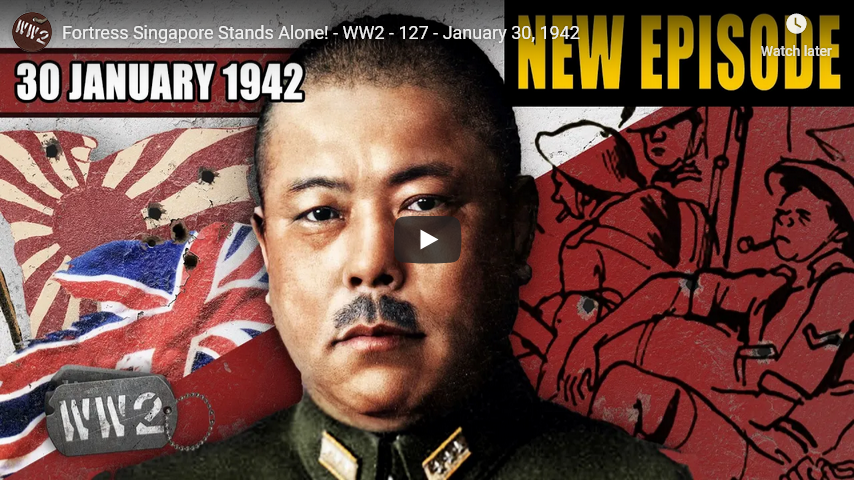
The Japanese advance on Singapore has gotten close enough that the British have destroyed the causeway to Singapore Island. The Japanese are also making attacks in the Solomon Islands, Burma, the Philippines, and the Dutch East Indies — their threat to Australia is real. Erwin Rommel’s surprise spoiler offensive in North Africa takes Benghazi, and on the eastern front the Soviets break a hole in the German lines in the north even as the temperature drops to the -50s.
Written and Hosted by: Indy Neidell
Director: Astrid Deinhard
Producers: Astrid Deinhard and Spartacus Olsson
Executive Producers: Astrid Deinhard, Indy Neidell, Spartacus Olsson, Bodo Rittenauer
Creative Producer: Maria Kyhle
Post-Production Director: Wieke Kapteijns
Research by: Indy Neidell
Edited by: Iryna Dulka
Sound design: Marek Kamiński
Map animations: Eastory (https://www.youtube.com/c/eastory)
Sources:
– JoJan, Berserker276 – from Wikimedia Commons
– National Portrait Gallery
– Termometer by Andi Nur Abdillah from the Noun Project
– Bundesarchiv – Bild 101I-811-1881-33
– Mil.ru
Soundtracks from the Epidemic Sound:
– Rannar Sillard – “Easy Target”
– Jo Wandrini – “Dragon King”
– Rannar Sillard – “Split Decision”
– Craft Case – “Secret Cargo”
– Reynard Seidel – “Rush of Blood”
– Flouw – “A Far Cry”
– Fabien Tell – “Weapon of Choice”
– Johan Hynynen – “Dark Beginning”
– Gunnar Johnsen – “Not Safe Yet”
– Fabien Tell – “Last Point of Safe Return”
The History Guy: History Deserves to Be Remembered
Published 6 Jan 2021
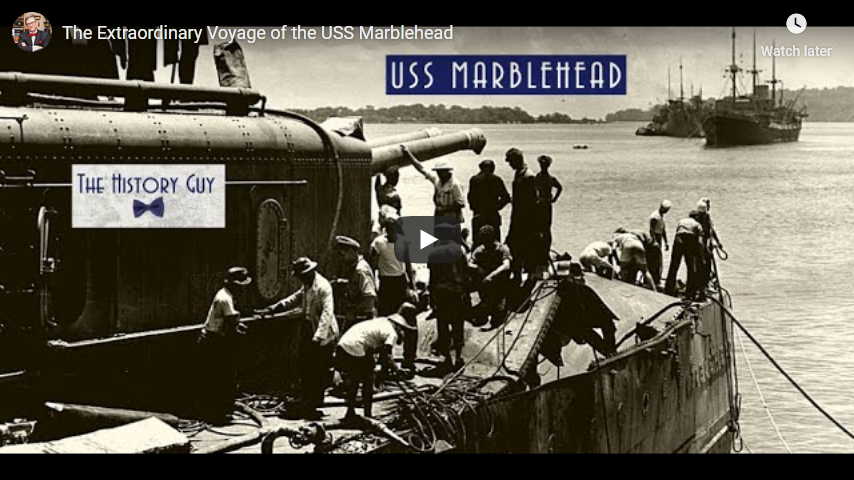
By May 1942, nearly half of the forty surface ships of the U.S. Asiatic fleet would be sunk, including the fleet’s largest vessel, the heavy cruiser USS Houston. But the improbable survival of one of the fleet’s vessels, the light cruiser USS Marblehead, is the stuff of legend. The extraordinary voyage of the Marblehead is history that deserves to be remembered.
This is original content based on research by The History Guy. Images in the Public Domain are carefully selected and provide illustration. As very few images of the actual event are available in the Public Domain, images of similar objects and events are used for illustration.
All events are portrayed in historical context and for educational purposes. No images or content are primarily intended to shock and disgust. Those who do not learn from history are doomed to repeat it. Non censuram.
The History Guy: History Deserves to Be Remembered is the place to find short snippets of forgotten history from five to fifteen minutes long. If you like history too, this is the channel for you.
Awesome The History Guy merchandise is available at:
teespring.com/stores/the-history-guy
Script by THG
#usnavy #thehistoryguy #WWII
Comments Off on The Extraordinary Voyage of USS Marblehead
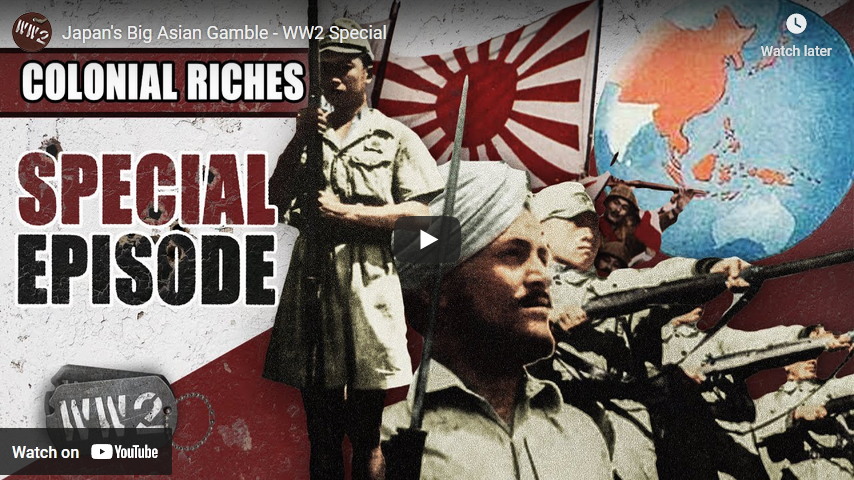
Access to scarce natural resources and labor was a big reason for the Japanese to invade numerous South-East asian countries. But was that necessary? And did the benefits outweigh the risk? Let’s find out!
Hosted by: Indy Neidell
Written by: Joram Appel
Director: Astrid Deinhard
Producers: Astrid Deinhard and Spartacus Olsson
Executive Producers: Astrid Deinhard, Indy Neidell, Spartacus Olsson, Bodo Rittenauer
Creative Producer: Maria Kyhle
Post-Production Director: Wieke Kapteijns
Research by: Joram Appel
Image Research by: Michał Zbojna
Edited by: Michał Zbojna
Sound design: Marek Kamiński
Colorizations:
Julius Jääskeläinen – https://www.facebook.com/JJcolorization/
Icons from The Noun Project:
asia by Ted Grajeda
clothing by Adnen Kadri
Coal by Eucalyp
Wire by Arthur Shlain
noun_Wool_2842881
noun_rock_12609
noun_rock_481051
noun_hemp_2183488
Iron Ingot by Jetro Cabau Quirós
rock by Bakunetsu Kaito
Medicine by Ladalle CS
noun_rock_481016
noun_silk_3492403
noun_Oil_3319962
Paper by Sergey Demushkin
rock by Aline Escobar
tire by Juan León
soap by Roman
noun_Wood_2177037
noun_Metal_3369307
rock by Bakunetsu Kaito
noun_Mineral_3517065
Soundtracks from Epidemic Sound:
“Sights of the Tokyo Tower” – Sight of Wonders
“Paths of a Samurai” – Mandala Dreams
“Pacific Shores” – Mandala Dreams
“Sights of the Tokyo Tower” – Sight of Wonders
“Save Her” – Jon Bjork
A TimeGhost chronological documentary produced by OnLion Entertainment GmbH.
From the comments:
World War Two
4 hours ago
Japan wasn’t the only nation that went to war over Asia’s natural resources. Indonesia was a big source of wealth for the Dutch ever since it became a colony, so The Netherlands went to war after World War Two, when the Indonesians declared their independence. We have made a whole series about the Indonesian War of Independence, including a prologue covering the colonial context (including WW2 occupation) of Indonesia. You can watch that prologue right here: https://youtu.be/IkKJSRaeOik
Comments Off on Japan’s Big Asian Gamble – WW2 Special
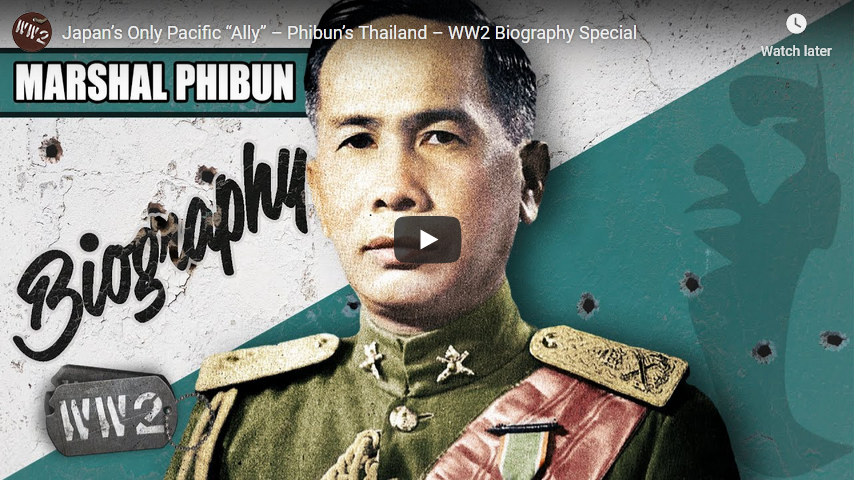
Thailand’s prime minister and de-facto dictator Plaek Phibunsongkhram imported European fascism, nationalism and militarism to his country. But when Japan’s threat to South-East Asia became imminent, Phibun didn’t know what to do. His story is one of utter indecisiveness and opportunism.
Hosted by: Indy Neidell
Written by: Joram Appel
Director: Astrid Deinhard
Producers: Astrid Deinhard and Spartacus Olsson
Executive Producers: Astrid Deinhard, Indy Neidell, Spartacus Olsson, Bodo Rittenauer
Creative Producer: Maria Kyhle
Post-Production Director: Wieke Kapteijns
Research by: Joram Appel
Edited by: Miki Cackowski
Sound design: Marek Kamiński
Map animations: Eastory (https://www.youtube.com/c/eastory)
Sources:
IWM HU 675
Portrait of Plaek Phibunsongkhram, courtesy of 冯銮披汶 https://commons.wikimedia.org/wiki/Fi…
From the Noun Project: people by ProSymbols, tick by akash k
Soundtracks from the Epidemic Sound:
Johannes Bornlof – “Deviation In Time”
Philip Ayers – “Trapped in a Maze”
Rannar Sillard – “March Of The Brave 4”
Fabien Tell – “Last Point of Safe Return”
Johannes Bornlof – “The Inspector 4”
Farrell Wooten – “Blunt Object”
The US government realizes that it cannot send help to relieve the US and Filipino forces in the Philippines, but it does not tell those forces. Meanwhile in the USSR, a huge Red Army offensive against entrenched German forces begins along the entire frontline. The Germans have pulled back in North Africa, though, to consolidate. The Japanese enter Manila and advance in Malaya, but are forced to withdraw in China.
Written and Hosted by: Indy Neidell
Director: Astrid Deinhard
Producers: Astrid Deinhard and Spartacus Olsson
Executive Producers: Astrid Deinhard, Indy Neidell, Spartacus Olsson, Bodo Rittenauer
Creative Producer: Maria Kyhle
Post-Production Director: Wieke Kapteijns
Research by: Indy Neidell
Edited by: Iryna Dulka
Sound design: Marek Kamiński
Map animations: Eastory (https://www.youtube.com/c/eastory)
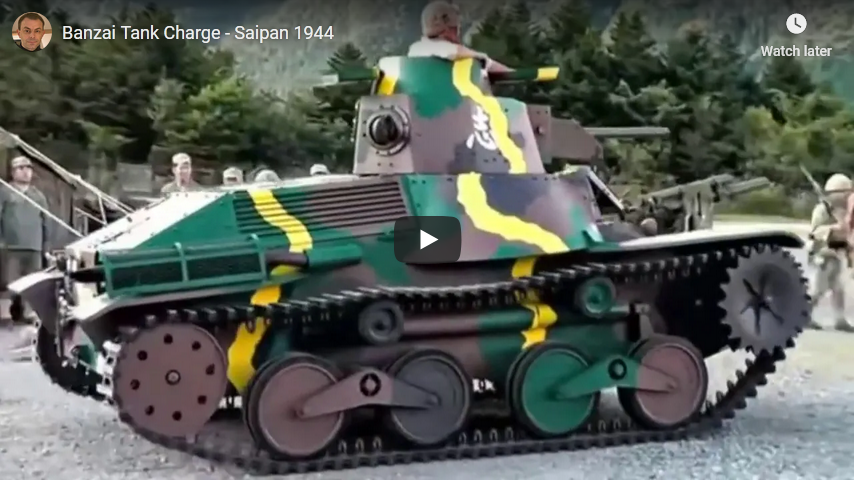
The story of the largest tank battle of the Pacific Campaign on the island of Saipan.
Dr. Mark Felton is a well-known British historian, the author of 22 non-fiction books, including bestsellers Zero Night and Castle of the Eagles, both currently being developed into movies in Hollywood. In addition to writing, Mark also appears regularly in television documentaries around the world, including on The History Channel, Netflix, National Geographic, Quest, American Heroes Channel and RMC Decouverte. His books have formed the background to several TV and radio documentaries. More information about Mark can be found at: https://en.wikipedia.org/wiki/Mark_Fe…
Disclaimer: All opinions and comments expressed in the ‘Comments’ section do not reflect the opinions of Mark Felton Productions. All opinions and comments should contribute to the dialogue. Mark Felton Productions does not condone written attacks, insults, racism, sexism, extremism, violence or otherwise questionable comments or material in the ‘Comments’ section, and reserves the right to delete any comment violating this rule or to block any poster from the channel.
The Japanese make gains in Malaya, Burma, Hong Kong, Borneo, and the Philippines. The Allies also have trouble in the Atlantic and the Mediterranean, where they are beginning to seriously suffer from a lack of capital ships. The Soviet Red Army is advancing, though, and Stalin takes personal control of planning for the upcoming counteroffensive, while Adolf Hitler takes personal control of the German Army.
Written and Hosted by: Indy Neidell
Director: Astrid Deinhard
Producers: Astrid Deinhard and Spartacus Olsson
Executive Producers: Astrid Deinhard, Indy Neidell, Spartacus Olsson, Bodo Rittenauer
Creative Producer: Maria Kyhle
Post-Production Director: Wieke Kapteijns
Research by: Indy Neidell
Edited by: Miki Cackowski
Sound design: Marek Kamiński
Map animations: Eastory (https://www.youtube.com/c/eastory)
Sources:
Bundesarchiv
IWM MH 26392, WPN 298, K 2204, FL 20432, A 12126, A 9257, FL 1203, E 3469E
Mil.ru
Narodowe Archiwum Cyfrowe
Picture of Mark Young, courtesy of National Portrait Gallery
Soundtracks from the Epidemic Sound:
Phoenix Tail – “At the Front”
Reynard Seidel – “Deflection”
Skrya – “First Responders”
Hakan Eriksson – “Epic Adventure Theme 4”
Philip Ayers – “The Unexplored”
Max Anson – “Ancient Saga”
Rannar Sillard – “March Of The Brave 9”
Johannes Bornlof – “Death And Glory 2”
Johan Hynynen – “Dark Beginning”
Fabien Tell – “Last Point of Safe Return”
The Japanese launch attacks all over Southeast Asia and the Pacific, and launch a preemptive surprise attack on the American Pacific Fleet at Pearl Harbor. The war is suddenly much larger. In the USSR, the Germans find themselves now heavily on the defensive after the failure to take Moscow, while in North Africa, Erwin Rommel decides he must withdraw out of Cyrenaica to await reinforcements.
Written and Hosted by: Indy Neidell
Director: Astrid Deinhard
Producers: Astrid Deinhard and Spartacus Olsson
Executive Producers: Astrid Deinhard, Indy Neidell, Spartacus Olsson, Bodo Rittenauer
Creative Producer: Maria Kyhle
Post-Production Director: Wieke Kapteijns
Research by: Indy Neidell
Edited by: Miki Cackowski
Sound design: Marek Kamiński
Map animations: Eastory (https://www.youtube.com/c/eastory)
Sources:
IWM HU 56120, K 1385, HU 675, TR153, HU 81216, WPN 298
NARA
Bundesarchiv
Narodowe Archiwum Cyfrowe
Picture of a victim of starvation during the siege of Leningrad, courtesy of George Shuklin
Picture of Alfred Godwin-Austen, courtesy of Berserker276 https://commons.wikimedia.org/wiki/Fi…
Picture of Harold Cole, courtesy of Cumbria County Archives
Soundtracks from the Epidemic Sound:
Phoenix Tail – “At the Front”
Johannes Bornlof – “Deviation In Time”
Johan Hynynen – “Dark Beginning”
Rannar Sillard – “March Of The Brave 4”
Jo Wandrini – “To War!”
Reynard Seidel – “Deflection”
Wendel Scherer – “Defeated”
Johannes Bornlof – “Death And Glory 3”
Johannes Bornlof – “The Inspector 4”
Hakan Eriksson – “Epic Adventure Theme 3”
Skrya – “First Responders”
Bonnie Grace – “Imperious”
A TimeGhost chronological documentary produced by OnLion Entertainment GmbH.
From the comments:
World War Two
2 days ago (edited)
Five days ago, we covered the Japanese attacks on Pearl Harbor minute by minute in real time over five hours. If you missed that, then check out episode one right here, you’ll love it: https://www.youtube.com/watch?v=Joh2BXPsrXs&t=4s
NOTE: An error snuck through our controls regarding the Japanese casualties at Wake, we are working with YouTube to have it fixed before the video goes public. We apologize for this inconvenience.
Japan attacked a whole variety of places that day, launching massive offensives all over SE Asia and the Pacific. I’ll be covering them here weekly, of course, but for even more coverage, check out our day by day Instagram coverage of the war: https://www.instagram.com/ww2_day_by_day
Comments Off on Hitler Declares War on the USA and the Jews – WW2 – 120 – December 12, 1941
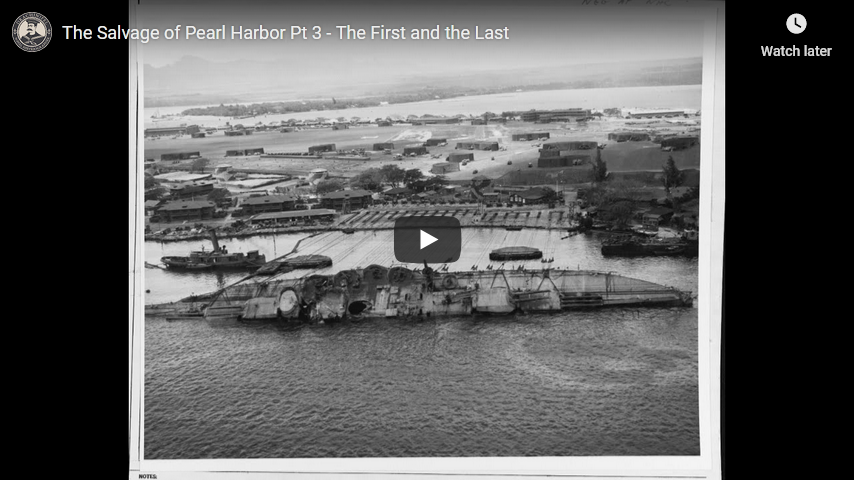
Today we look at the salvage efforts on the USS Shaw, first vessel salvaged from the remains of the attack on Pearl Harbor and the work on the last two vessels under the team’s care, the Utah and Oklahoma
Sources:
www.amazon.co.uk/gp/product/B00C0JIXJO https://www.history.navy.mil/our-coll…
www.amazon.co.uk/Pearl-Harbor-Fleet-Salvage-Appraisal/dp/0898755654
www.amazon.co.uk/Descent-into-Darkness-Harbour-Divers/dp/0891417451
Videos – US National Archives / US Department of Defense
Free naval photos and more – www.drachinifel.co.uk
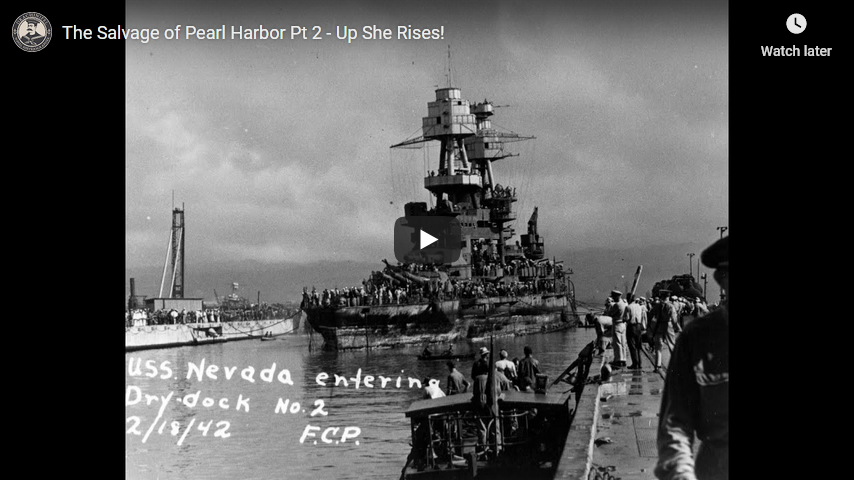
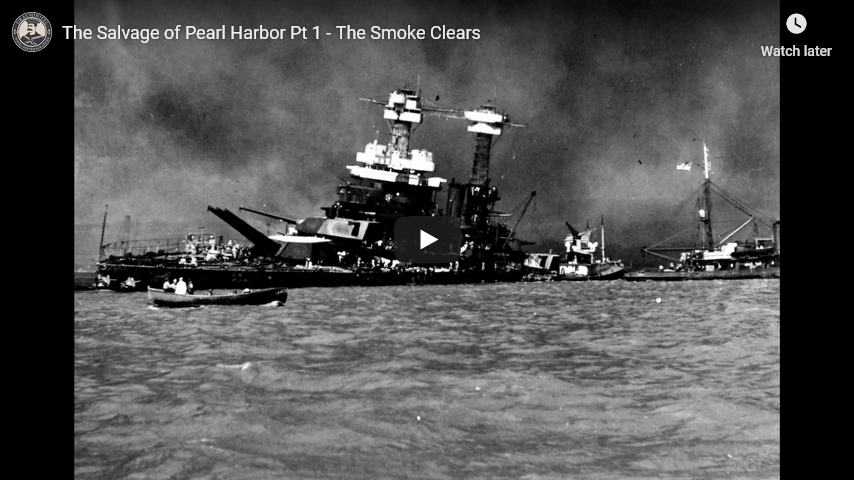
Today we look at the salvage efforts on the three battleships outright sunk in the attack on Pearl Harbor that would be returned to service.
Sources:
www.amazon.co.uk/gp/product/B00C0JIXJO https://www.history.navy.mil/our-coll…
www.amazon.co.uk/Pearl-Harbor-Fleet-Salvage-Appraisal/dp/0898755654
www.amazon.co.uk/Descent-into-Darkness-Harbour-Divers/dp/0891417451
Videos – US National Archives / US Department of Defense
Free naval photos and more – www.drachinifel.co.uk
Powered by World of Warships – https://wo.ws/PearlHarbor – Register now to receive an exclusive bonus!
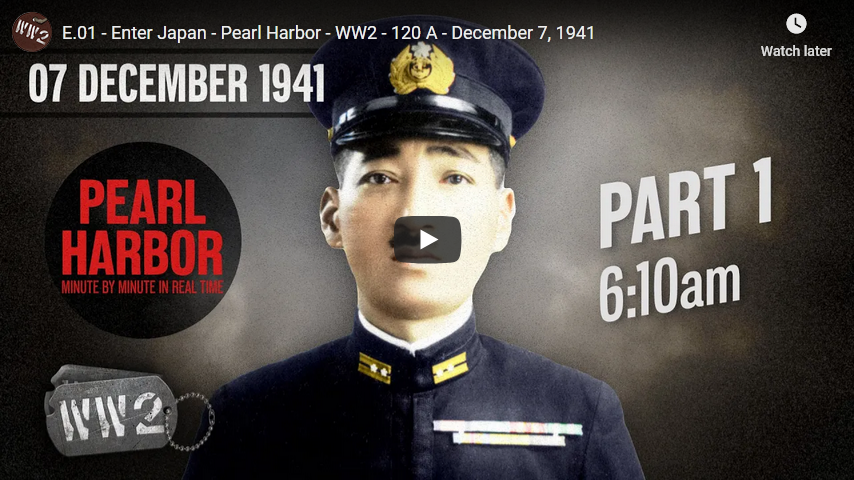
In this episode: Japan’s meticulous planning and preparation made it possible to surprise the Americans at Pearl Harbor. Alert on Oahu is largely nonexistent. It is the deep breath before the plunge.
Hosted by: Indy Neidell
Written by: Spartacus Olsson and Indy Neidell
Directed by: Wieke Kapteijns
Executive Producers: Astrid Deinhard, Indy Neidell, Spartacus Olsson, Bodo Rittenauer
Produced by: Astrid Deinhard and Spartacus Olsson
Co-Producers: Maria Kyhle and Francis van Berkel
Edited by: Iryna Dulka
Set Design by: Astrid Deinhard
Graphic Design by: Mikolaj Uchman
Map Animations by: Daniel Haczyk and Eastory
Assistant Editors: Miki Cackowski, Daniel Weiss, Karolina Dołega
Still Colorizers: Adrien Fillon, Norman Stewart, Jaris Almazani, Daniel Weiss, Mikolaj Uchman, Carlos Ortega Pereira
Research by: Indy Neidell, Spartacus Olsson, Markus Linke, Wieke Kapteijns, Bastian Gaete, Lewis Braithwaite, Tim Smith, Ian Irungu
Sound Design by: Marek Kamiński
Dogfights by: Daniel Weiss, Bastian Gaete, Ian Sowden, Dennis Stepanov
Voices:
Mitsuo Fuchida – Daniel Grieb
Ada Peggy Olsson – Shani Neidell Beard
Iyōzō Fujita – Emi Celis
James Anderson – Emi Celis
Dorinda Stagner – Zora Johnson
Jack Kelley – Ryan Socash
James McClelland – Spartacus Olsson
Phil Rasmussen – Spartacus Olsson
Dan Wentrcek – Dennis Stepanov
Thompson Izawa – Samir Mechel
Robert Isacksen – Ian Sowden
Joseph K. Taussig Jr. – Tim Smith
James Cory – Ryan Tebo
Film colorization by: Ricks Film Restoration
Naval Gameplay by: World of Warships
Archive material provided by: Reuters/Screenocean
A TimeGhost chronological documentary produced by OnLion Entertainment GmbH.
From the comments:
World War Two
1 hour ago (edited)
When we set out to do this crazy project we thought we wanted to try some really new things. As anyone knows that follows us regularly, our first and foremost goal is remembrance — to shine a light on our past and learn form our ancestors’ mistakes and achievements. We try our best to do that with a dedication to facts and details liberated from partisan, or ideological historiography. For this purpose, the attack on Pearl Harbor serves very well. It is a compact event over only a few hours that is spectacular in its nature, tragic in its effect, gripping in its drama, and has tremendous impact on WW2 on all fronts. It is also an event that is often simplified to the point of misunderstanding, has been woven into national mythology, and given rise to some pretty nutty conspiracy myths. Simply put: the Attack on Pearl Harbor is short enough, exciting enough, and misunderstood enough for us to do a limited series like this.
But more than that we also wanted to try some new technical and narrative things. Since we started doing historical documentaries with the Great War in 2014 we have tried to be on the forefront of pioneering new ways of creating historiography for the modern media world. Narratively, we have dedicated ourselves to chronologies, which in historiography is nothing new, but it is new in the world of film documentaries (at least to the level we do it) — so we thought; “heck what if we go down to minute by minute for this” — well we did and it taught us an enormous amount about Pearl Harbor, but also about how we can write. We will get back to that in further comment on the series. As for technology, it truly is technology that enables our work, well any media — for us it is social media, affordable ways to capture film, global virtual remote working spaces, digital research opportunities, digital film archives, and so on.
Two areas we had not been able to venture into was recreation of scenes using computer graphics and colorization of moving images. Using a gaming engine to create animation is also nothing new, but usually very, very expensive because you have to first create the world, the assets and the characters for your recreation. But for Pearl Harbor, World of Warships https://worldofwarships.com and World of Warplaneshttps://worldofwarplanes.com opened an opportunity to do this on a new scale at a cost that is only a fraction of what it usually costs. Along the way we also got to know Ricks Film Restorations (https://bit.ly/ricksfilmresorations and https://www.youtube.com/user/Rick88888888) who use AI technology to enhance and colorize film footage. While both of these technologies are only at the beginning of their potential, we think the results are spectacular. More than anything it has enabled us to enhance the emotional and visual experience for this series to a level we never reached before. Last but not least it enabled us to use the financial contributions of the TimeGhost Army, and World of Warships to create five hours of content for less than 1/50th — only 2% — of what it would cost to do with traditional means.
creatingstuff
In the Name of the entire TimeGhost Team,
Astrid, Indy, Spartacus, and Wieke
Episode Guide:
This is a 10 episode limited series within our weekly coverage of WW2 — to see the immediate events leading up to this day watch episode 119 from December 5, https://youtu.be/DYUzmBuX-6Y. Some of the events covered briefly as they start on this day, such as the invasions in the West Pacific will be covered in more detail in the coming weeks, especially in episode 120K (the 11th episode this week).coming out on December 12.
The History Guy: History Deserves to Be Remembered
Published 22 Apr 2019
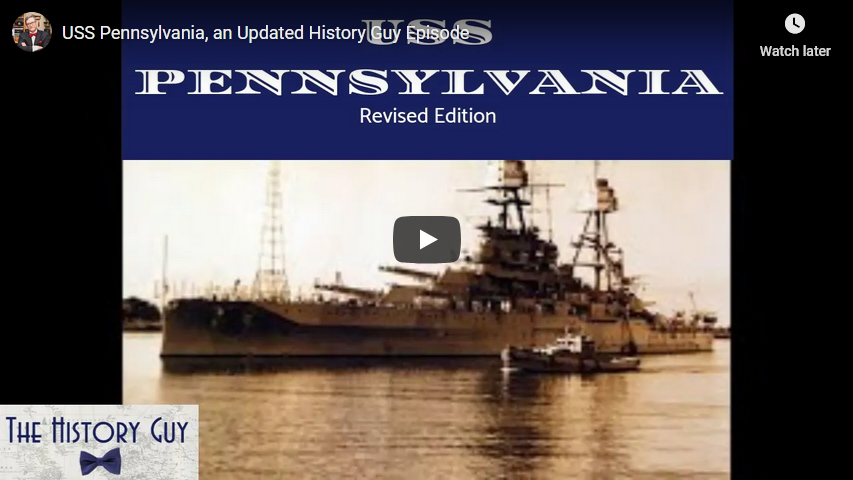
USS Pennsylvania was in dry dock when the attack came at Pearl Harbor. The History Guy remembers part of her history that may have been forgotten.
This episode was originally posted December 7, 2017. It has been updated to correct some errors in the original, and new footage of USS Pennsylvania has been added.
This is original content based on research by The History Guy. Images in the Public Domain are carefully selected and provide illustration. As images of actual events are sometimes not available, images of similar objects and events are used for illustration.
All events are portrayed in historical context and for educational purposes. No images or content are primarily intended to shock and disgust. Those who do not learn from history are doomed to repeat it. Non censuram.
The History Guy: History Deserves to Be Remembered is the place to find short snippets of forgotten history from five to fifteen minutes long. If you like history too, this is the channel for you.
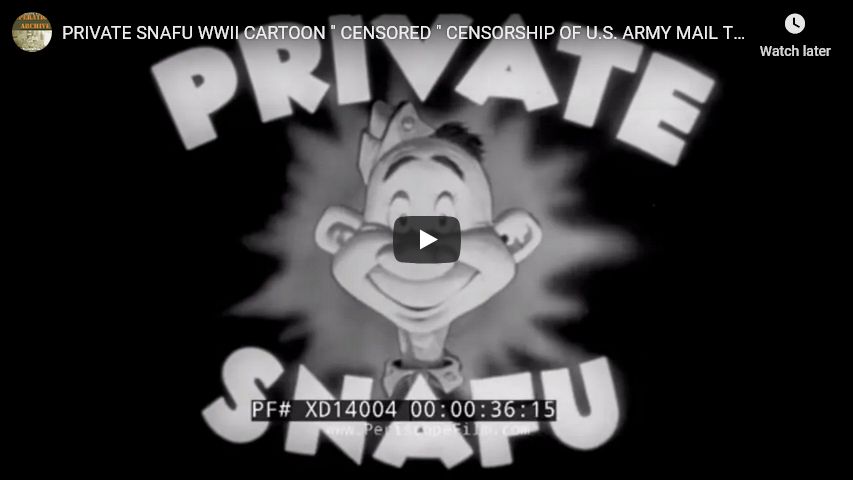
Censored is one of 26 Private SNAFU (Situation Normal, All F*cked Up) cartoons made by the U.S. Army Signal Corps to educate and boost the morale of the troops. The SNAFU character was created by Theodore Geisel (Dr. Seuss) and Phil Eastman, and most were animated by Warner Brothers Animation Studios. They were voiced by actors including Mel Blanc and scored by Carl Stalling. This cartoon Censored, depicts the lengths to which Private SNAFU will go to sneak an uncensored letter in the mail — with terrifying results. Fortunately it all turns out to be a dream, but SNAFU is so shaken that he censors his own mail. The film was obviously inspired by the mass censorship of personal letters by the Army during the war, to reduce the chance that enemy spies would be able to gain intelligence by intercepting them.
Much of the military correspondence during the war took place via V-mail, short for Victory Mail. This was a hybrid mail process used as the primary and secure method to correspond with soldiers stationed abroad. To reduce the cost of transferring an original letter through the military postal system, a V-mail letter would be censored, copied to film, and printed back to paper upon arrival at its destination. The V-mail process is based on the earlier British Airgraph process
During World War II, both the Allies and Axis instituted postal censorship of civil and military mail. The largest organizations were those of the United States, though the United Kingdom employed about 10,000 censor staff while Ireland, a small neutral country, only employed about 160 censors. Both blacklists and whitelists were employed to observe suspicious mail or listed those whose mail was exempt from censorship. In the United States censorship was under the control of the Office of Censorship whose staff count rose to 14,462 by February 1943.
We encourage viewers to add comments and, especially, to provide additional information about our videos by adding a comment! See something interesting? Tell people what it is and what they can see by writing something for example: “01:00:12:00 — President Roosevelt is seen meeting with Winston Churchill at the Quebec Conference.”
This film is part of the Periscope Film LLC archive, one of the largest historic military, transportation, and aviation stock footage collections in the USA. Entirely film backed, this material is available for licensing in 24p HD, 2k and 4k. For more information visit http://www.PeriscopeFilm.com
Comments Off on Private SNAFU “Censored” WW2 US Army cartoon
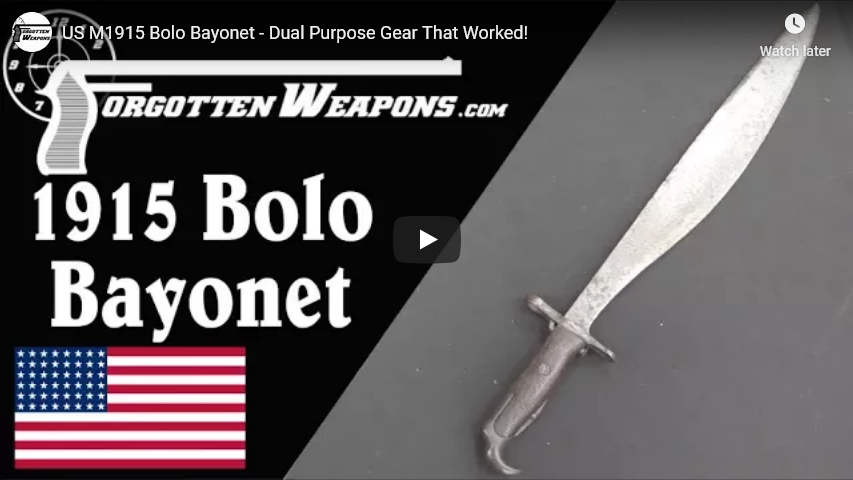
The M1915 bolo bayonet was originally the brainchild of US Army Captain Hugh D. Wise, Quartermaster with the 9th Infantry in the Philippines. In 1902, he recommended the implement in a letter to his superior officers, noting that a bolo style of bayonet (ie, one with a widened machete-like blade) would have several advantages over the standard knife bayonet then being issued with the Krag-Jorgenson rifles the US Army was using. Specifically, the wider bayonet would be easier to recover after a thrust (he noted several instances of troopers being killed while trying to extricate their bayonets from enemies) and also (and more significantly) make an excellent and necessary bushwhacking tool in the jungle environment of the Philippines.
Wise’s idea was taken with interest and Springfield produced a series of experimental bolo bayonets, but the project ended there as the 1903 Springfield was adopted with a rod bayonet instead of a blade. Of course, the rod bayonet would be shortlived, and the blade bayonet would come back. The bolo bayonet ideas resurfaced in 1911 when a commission was formed to look into special equipment for the Philippine Scouts. After another series of experimental designs, the M1915 Bolo bayonet was formally adopted on May 22, 1915 and an order was placed for 6,000 of them to be made at Springfield Armory.
Delivery of these bayonets took place in 1915 and 1916, and they proved to be extremely popular tools with the soldiers in the Philippines. They would remain in service on the islands until World War Two, serving at last as a replacement for the M1913 cavalry saber for the 26th Cavalry.