
Published on 13 Aug 2016
Indy sits in the chair of wisdom again to answer your questions about World War 1.
August 14, 2016
Captured Tanks – Bagpipers I OUT OF THE TRENCHES
Comments Off on Captured Tanks – Bagpipers I OUT OF THE TRENCHES
August 13, 2016
Harjit Sajjan: “Even using the terminology of peacekeeping is not valid at this time”
Our minister of national defence is on a tour of several African countries, looking at potential deployments for Canadian troops in troubled areas. A positive sign that the government is moving away from their long-standing infatuation with 70s-style “blue beret” peacekeeping missions is the message the minister communicated at the first stop of his tour, as reported in the Globe and Mail by Steven Chase:
Defence Minister Harjit Sajjan says what Canada will ask its soldiers to do in Africa can no longer be called peacekeeping because the term doesn’t reflect modern demands of stabilizing a conflict zone – something experts say could run the gamut from training other countries’ troops to counterterrorism.
Mr. Sajjan spoke from Ethiopia, the first stop in an eight-day fact-finding mission to Africa, as Ottawa tries to narrow where to deploy soldiers in what it promises will be a return to a major peacekeeping role for Canada.
The Defence Minister acknowledges the job in conflict-ravaged countries is potentially more dangerous these days and said he prefers the phrase “peace support operations” to describe the task Canada is preparing to embrace in one or more places in Africa.
“I think we can definitely say what we used to have as peacekeeping, before, is no longer. We don’t have two parties that have agreed on peace and there’s a peacekeeping force in between,” he told The Globe and Mail in an interview.
“Even using the terminology of peacekeeping is not valid at this time,” he said. “Those peacekeeping days, those realities, do not exist now and we need to understand the reality of today.”
Mr. Sajjan has been directed by Prime Minister Justin Trudeau to “renew Canada’s commitment to United Nations peace operations” – a campaign pledge made by the Liberals, who had accused the Harper government of turning its back on peacekeeping.
I strongly suspect that the Canadian Forces do not currently have the ability to engage in a significant role in Africa, given existing commitments to our NATO allies and the long list of equipment that needs to be replaced to maintain the Forces’ current capabilities. Aside from the big-ticket items for the RCN (replacing the current frigates, destroyers, and logistical support ships), the RCAF (the CF-18 is coming to the end of its service life so a new fighter aircraft is needed soon and we are still flying 1960s-era Sea King helicopters on our ships), there is a long list of boring, everyday equipment that also needs to be budgeted and ordered. The federal government is looking for economies in the defence budget, rather than looking to spend more. Foreign expeditions are very expensive, and Canadians are particularly sensitive to the risk of casualties in distant lands. Minister Sajjan may find a role that Canada can fill that would satisfy the PM’s desire to be seen to be doing more, yet does not run the risk of higher military spending and disproportional danger to our troops, but I don’t expect it to happen.
Comments Off on Harjit Sajjan: “Even using the terminology of peacekeeping is not valid at this time”
August 12, 2016
Italy Breaks Through – Cadorna’s Triumph I THE GREAT WAR Week 107
Published on 11 Aug 2016
Italy’s war in the alps wasn’t very successful so far but this week they took Gorizia, a major triumph for the Duke of Aosta and Italian Chief of Staff Luigi Cadorna.
Comments Off on Italy Breaks Through – Cadorna’s Triumph I THE GREAT WAR Week 107
August 10, 2016
The Year Of Battles I THE GREAT WAR Summary Part 6
Published on 9 Aug 2016
1916 is known as the year of battles and in the summer of that year this name was truly earned. The Battle of Verdun, the Brusilov Offensive and the Battle of the Somme were all fought simultaneously. On top of that, the Austrians launched a “punishment expedition” against the Italians, the Arab Revolt was declared and the slowly but steadily the Balkan front was built up once more.
Comments Off on The Year Of Battles I THE GREAT WAR Summary Part 6
August 9, 2016
The British Naval Blockade of Germany I THE GREAT WAR Special
Published on 8 Aug 2016
The big and decisive naval battle that the Royal Navy had hoped for did not happen during World War 1. But another naval strategy slowly but surely ground the German economy down.
Comments Off on The British Naval Blockade of Germany I THE GREAT WAR Special
August 8, 2016
QotD: Peace
Almost everyone wants peace, the problem is that we’ve had peace in this country for so long that most people don’t recognize it for the aberration that it is. Because of this, a curiously contradictory mindset holds sway over a large segment of the population, most of them on the left side of the political spectrum. It goes something like this: “Well, we want peace, so we’ll just refuse to fight. If we refuse to fight, the other guy will have no reason to fight us.” If you point out to them that the other guy just might not want peace, you’ll get a predictable response: “Well, since peace is the default state of the world, if we can figure out what we did to make the other guy mad at us and desirous of war, and make it up to him, then he’ll feel comfortable with allowing the default state to resume.”
The problem is, of course, that peace isn’t the default state of the world, war is. Human beings are predators, and we are genetically designed to be in competition with other human beings, either individually or in groups. If group A has something group B wants, the natural instinct of group B is to attack group A and take it. The only way that group A can prevent this from happening is to be stronger than group B. For centuries, the Mongol tribes roamed the countryside of Mongolia, squabbling with and fighting each other. The great neighboring dynasties, the Xia and Jin, had little to fear from the Mongols beyond nuisance raids, because they were stronger. Then Temujin united the tribes, assumed the title Genghis Khan, and swept both empires off the face of the earth. The empires had enjoyed peace for generations — because they were strong. When they ceased to be stronger than their foes, they soon ceased to be entirely.
So what? Primitives. Barbarians. Savages. We’re different now. Civilized. Cultured. Superior.
I hate to break it to you, but we’re not. 13th century man is behaviorally identical to modern man. 8 centuries is nowhere near long enough for that kind of evolutionary change in the human animal. People are … people. Always have been, always will be. The reason that we’ve enjoyed centuries of peace in America (even our wars haven’t been fought here since the 1860s) is because we’ve been strong enough that nobody has had the ability to fight us over here, and we’ve had the ability to go fight them over there when we needed to. There is nothing about this situation that is written in stone. Our homeland is peaceful because we’ve had the military might necessary to make it impossible for foes to make it not peaceful.
But now, with so many believing that peace is the natural order of things, we are in grave danger of finding out that peace is not the natural order of things, it’s a luxury, one that is paid for in blood and the willingness and ability to shed it. Our military is a shell of its former self, hollowed out to buy bread and circuses for the masses. Our diplomacy a joke, conducted insecurely and thus transparent to our foes. Our foreign policy is a hot mess of appeasement and apology. All of this makes us look weaker and weaker to the world, and so now they believe that they can take what they want from us because we can no longer defend it. Bill Clinton gave Ukraine a rock solid guarantee of protection in return for them giving up their nukes to ensure “peace”. That’s gone, along with half that country. Our strongest allies are realizing that they are on their own against genocidal aggressions and prepare to act alone or in concert with new allies. We issue ultimatums and draw red lines and the world laughs at us. This isn’t peace, it’s the prelude to destruction. Our destruction.
Weirddave, “Fundamental Concepts – Weakness Invites Aggression”, Ace of Spades H.Q., 2015-03-07.
Comments Off on QotD: Peace
August 7, 2016
Flamethrowers – Anti Aircraft Guns I OUT OF THE TRENCHES
Published on 6 Aug 2016
In this week’s episode we answer your questions about flamethrowers, anti aircraft guns and the role of reserves.
Comments Off on Flamethrowers – Anti Aircraft Guns I OUT OF THE TRENCHES
August 5, 2016
Germany’s Grandeur – Analyzing the War Effort I THE GREAT WAR Week 106
Published on 4 Aug 2016
It has been two years since the global escalation that lead to World War 1. Three of the biggest battles in history are fought simultaneously now and there is no end in sight. When asked about the state of the war, the nations are still determined but the German position is still full of grandiose exaggerations.
Comments Off on Germany’s Grandeur – Analyzing the War Effort I THE GREAT WAR Week 106
August 2, 2016
The Great Explorer – Ernest Shackleton I WHO DID WHAT IN WW1?
Published on 1 Aug 2016
Ernest Shackelton set sail for the Antarctic when most young men in Europe were setting sail to fight a war. While millions of them died, he was completely isolated trying to survive the harsh conditions. Shackelton’s expediton was probably one of the last grand ventures from the age of wonder and when he reached civilisation again, the world had truly gone mad.
Comments Off on The Great Explorer – Ernest Shackleton I WHO DID WHAT IN WW1?
August 1, 2016
Top 10 Misconceptions About World War 1 I THE GREAT WAR Special
Published on 31 Jul 2016
We thought about a list of misconceptions about World War 1 that don’t want to die even 100 years later.
Comments Off on Top 10 Misconceptions About World War 1 I THE GREAT WAR Special
A new flag for the Canadian Army
Chris Banks posted a link to this article in the Lorne Scots Facebook group:
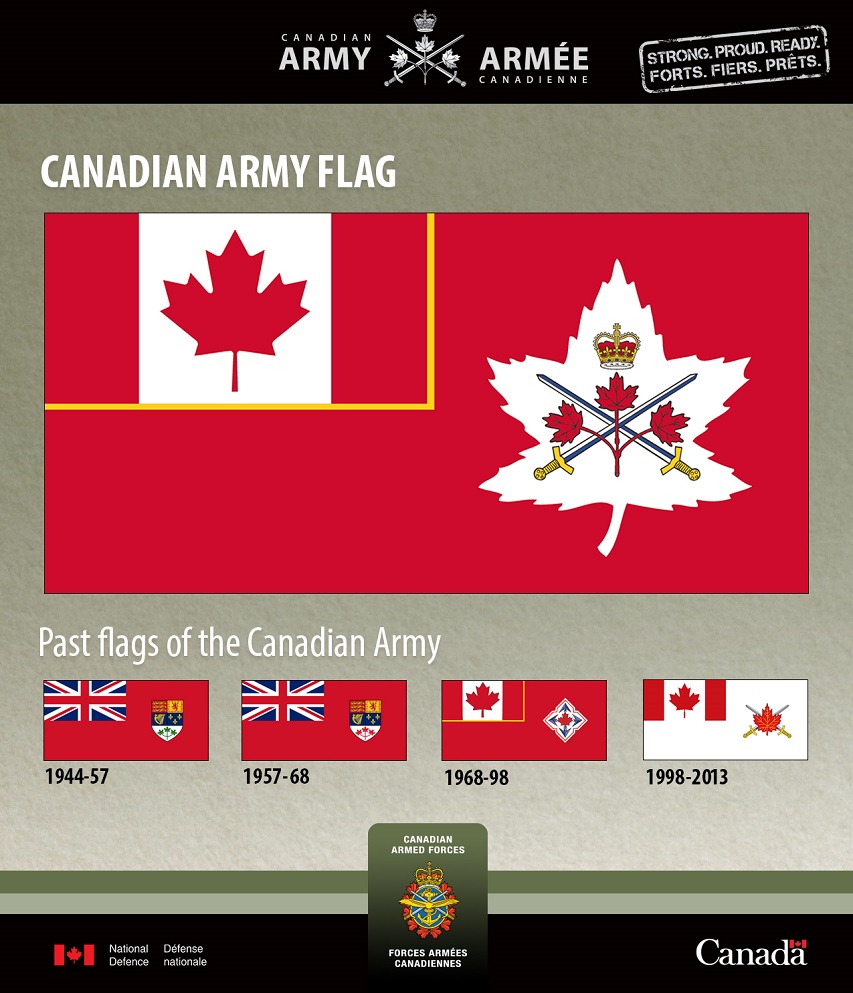
The Canadian Army (CA) will advance into the future under a new flag that nods to its proud past.
The flag was unveiled July 14, 2016, during a ceremony on Parliament Hill in which CA members welcomed their new Commander, Lieutenant-General Paul Wynnyk.
The new design features the Canadian flag and a white, stylized maple leaf against a red background. Superimposed on the white maple leaf is the badge that members used during the Second World War and the Korean conflict, consisting of three maple leaves over a pair of crossed swords. Sitting atop the centre leaf is an image of St. Edward’s Crown, a symbol that has been used in coronation ceremonies for over 300 years.
The maple leaf was worn on the collars of Canadian soldiers who fought in the Battle of Vimy Ridge during the First World War, and was included on the new flag to honour the 100th anniversary of the battle, which will be marked in 2017. The same maple leaf flew on the Headquarters flags of the fighting Divisions during the Second World War and still flies across Canada at the CA’s various Division Headquarters.
Comments Off on A new flag for the Canadian Army
QotD: Heinlein versus Pournelle
I took some heat recently for describing some of Jerry Pournelle’s SF as “conservative/militarist power fantasies”. Pournelle uttered a rather sniffy comment about this on his blog; the only substance I could extract from it was that Pournelle thought his lifelong friend Robert Heinlein was caught between a developing libertarian philosophy and his patriotic instincts. I can hardly argue that point, since I completely agree with it; that tension is a central issue in almost everything Heinlein ever wrote.
The differences between Heinlein’s and Pournelle’s military SF are not trivial — they are both esthetically and morally important. More generally, the soldiers in military SF express a wide range of different theories about the relationship between soldier, society, and citizen. These theories reward some examination.
First, let’s consider representative examples: Jerry Pournelle’s novels of Falkenberg’s Legion, on the one hand, and Heinlein’s Starship Troopers on the other.
The difference between Heinlein and Pournelle starts with the fact that Pournelle could write about a cold-blooded mass murder of human beings by human beings, performed in the name of political order, approvingly — and did.
But the massacre was only possible because Falkenberg’s Legion and Heinlein’s Mobile Infantry have very different relationships with the society around them. Heinlein’s troops are integrated with the society in which they live. They study history and moral philosophy; they are citizen-soldiers. Johnnie Rico has doubts, hesitations, humanity. One can’t imagine giving him orders to open fire on a stadium-full of civilians as does Falkenberg.
Pournelle’s soldiers, on the other hand, have no society but their unit and no moral direction other than that of the men on horseback who lead them. Falkenberg is a perfect embodiment of military Führerprinzip, remote even from his own men, a creepy and opaque character who is not successfully humanized by an implausible romance near the end of the sequence. The Falkenberg books end with his men elevating an emperor, Prince Lysander who we are all supposed to trust because he is such a beau ideal. Two thousand years of hard-won lessons about the maintenance of liberty are thrown away like so much trash.
In fact, the underlying message here is pretty close to that of classical fascism. It, too, responds to social decay with a cult of the redeeming absolute leader. To be fair, the Falkenberg novels probably do not depict Pournelle’s idea of an ideal society, but they are hardly less damning if we consider them as a cautionary tale. “Straighten up, kids, or the hero-soldiers in Nemourlon are going to have to get medieval on your buttocks and install a Glorious Leader.” Pournelle’s values are revealed by the way that he repeatedly posits situations in which the truncheon of authority is the only solution. All tyrants plead necessity.
Eric S. Raymond, “The Charms and Terrors of Military SF”, Armed and Dangerous, 2002-11-13.
Comments Off on QotD: Heinlein versus Pournelle
July 31, 2016
The Trench Coat – Entente or Allies? I OUT OF THE TRENCHES
Published on 30 Jul 2016
It’s Chair of Wisdom time again where we answer all your questions about World War 1.
Comments Off on The Trench Coat – Entente or Allies? I OUT OF THE TRENCHES
July 29, 2016
Happy Birthday World War 1 I THE GREAT WAR – Week 105
Published on 28 Jul 2016
2 years. It has been 2 years since Austria-Hungary declared war on Serbia which led to a downwards spiral that we now remember as World War 1. And this week 100 years ago, the three biggest battles in human history are being fought simultaneously: The Battle of Verdun, the Battle of the Somme, the Brusilov Offensive. Happy Birthday.
Comments Off on Happy Birthday World War 1 I THE GREAT WAR – Week 105
July 26, 2016
The British Uniforms of World War 1 I THE GREAT WAR Special
Published on 25 Jul 2016
Matthew Moss helped us with this episode, check out his website: http://www.historicalfirearms.info
The British Army was probably the best equipped at the beginning of the war. They already transitioned to the more practical khaki colour, faded out the differences between infantry and other branches and developed uniforms for different climates. But of course World War 1 brought its own number of problems for the British Army.
Comments Off on The British Uniforms of World War 1 I THE GREAT WAR Special


