Sabaton History
Published on 28 Mar 2019You don’t generally think about Brazil when talking about World War Two. Still, they joined the Allied powers in 1942, after which the Brazilian Expeditionary Force played a role in the battle for Italy. The Sabaton song “Smoking Snakes” (from the Heroes album) is about the Brazilian effort during World War Two and especially about three Brazilian soldiers who wouldn’t surrender.
Support Sabaton History on Patreon: https://www.patreon.com/sabatonhistory
Watch more videos on the Sabaton YouTube channel: https://www.youtube.com/user/Sabaton?…
Listen to Sabaton on Spotify: http://smarturl.it/SabatonSpotify
Official Sabaton Merchandise Shop: http://bit.ly/SabatonOfficialShopHosted by: Indy Neidell
Written by: Markus Linke and Indy Neidell
Directed by: Astrid Deinhard and Wieke Kapteijns
Produced by: Pär Sundström, Astrid Deinhard and Spartacus Olsson
Creative Producer: Joram Appel
Executive Producers: Pär Sundström, Joakim Broden, Tomas Sunmo, Indy Neidell, Astrid Deinhard, and Spartacus Olsson
Maps by: Eastory
Edited by: Iryna Dulka
Sound Editing by: Marek KaminskiEastory YouTube Channel: https://www.youtube.com/channel/UCEly…
Archive by: Reuters/Screenocean https://www.screenocean.com
Music by Sabaton.
Research contribution: Leitura ObrigaHISTÓRIA – Check out their channel: https://www.youtube.com/obrigahistoria
The Mariners’ Museum and Park
Brazilian casualty chugs milk
https://catalogs.marinersmuseum.org/o…
P0003/01-#W-14256An OnLion Entertainment GmbH and Raging Beaver Publishing AB co-Production.
© Raging Beaver Publishing AB, 2019 – all rights reserved.
March 29, 2019
Smoking Snakes – Brazilian Expeditionary Force – Sabaton History 008
Canada and the Battle of the Atlantic, part 3 by Alex Funk
Editor’s Note: This series was originally published by Alex Funk on the TimeGhostArmy forums (original URL – https://community.timeghost.tv/t/canada-and-the-battle-of-the-atlantic-part-1-edited/1433).
Sources:
- The Far Distant Ships, Joseph Schull, ISBN 10 0773721606 (An official operational account published in 1950, somewhat sensationalist)
[Schull’s book was published in part because the funding for the official history team had been cut and they did not feel that the RCN’s contribution to the Battle of the Atlantic should have no official recognition. It is very much an artifact of its era, and needs to be read that way. A more balanced (and weighty) history didn’t appear until the publication of No Higher Purpose and A Blue Water Navy in 2002, parts 1 and 2 of the Official Operational History of the RCN in WW2, covering 1939-1943 and 1943-1945, respectively.]- North Atlantic Run: the Royal Canadian Navy and the battle for the convoys, Marc Milner, ISBN 10 0802025447 (Written in an attempt to give a more strategic view of Canada’s contribution than Schull’s work, published 1985)
- Reader’s Digest: The Canadians At War: Volumes 1 & 2 ISBN 10 0888501617 (A compilation of articles ranging from personal stories to overviews of Canadian involvement in a particular campaign. Contains excerpts from a number of more obscure Canadian books written after the war, published 1969)
- All photos used exist in the Public Domain and are from the National Archives of Canada, unless otherwise noted in the caption.
I have inserted occasional comments in [square brackets] and links to other sources that do not appear in the original posts. A few minor edits have also been made for clarity.
Part 3 — The professionals and the amateurs
Marc Milner picks up the story in North Atlantic Run:
While the operational side of the navy chafed at the bit, the shore side got on with the daunting work of expansion. The first task was to provide both personnel and ships for the system of defended ports. Acquisition of the ships was a manageable problem, though the results were far from satisfactory. By the end of 1939 the RCN had managed to beg, borrow, or buy over sixty auxiliary vessels of all shapes and sizes, enough to fill out the minesweeping, anti-submarine, and harbour duties of the defended ports. Many of the ships were unreliable or unsuitable for their assigned roles and therefore badly needed replacement. In fact, few were worthy of long-term service in any but the most menial tasks.
The bulk of the auxiliary vessels taken into the RCN came from other government departments. Manning them posed no problem because most of the ships’ crewmen transferred to naval service, enlisting in the RCN Reserves, Special Service, which respected their peculiar skills (for example, ice clearance). Retired officers of the Royal Navy resident in Canada, of whom about forty were designated for duty with the RCN, also helped fill the gap in manpower.
[Editor’s Note: In general, the regular RCN consisted of professional officers and ratings who planned to continue in the navy after the war. The RCNR were professional seamen in civilian life who would return to their profession at the end of hostilities. RCNR men were highly prized in the navy for their sea-going skills. The RCNR Special Service was (I believe) just a designation for RCNR officers and ratings who had specialized skills, like icebreaking experience, over and above ordinary merchant navy experience. The RCNVR were “hostilities-only” volunteers, with a core of longer-term reservists who had some limited experience before the war. RCNR and RCNVR officers had slightly different rank insignia than RCN officers, as summarized by the Canadian Military Police Virtual Museum:]
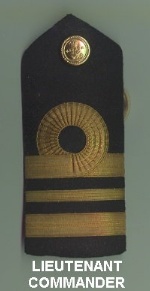
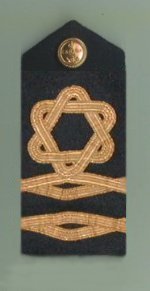
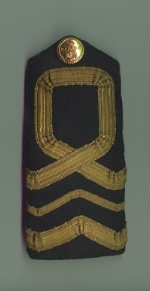
Regular Officers in the RCN wore gold stripes on their epaulettes or on the cuffs. The uppermost stripe incorporated the “Executive Curl”. This was a holdover from the early days of the Royal Navy when officers responsible for ship handling and command were separate from other officers such as Surgeons and Engineers. Engineers were granted the curl in 1915 and by 1919 the rest of the branches had been granted it.
Officers of the Royal Canadian Navy Volunteer Reserve (RCNVR) wore similar rank insignia to those of the Regular Navy, however the stripes were of a different pattern, being a zig zag design. This of course lead to the RCNVR being nicknamed the “Wavy Navy”. [The epaulette on the left is of an RCN Lieutenant Commander. The one on the right] is that of an RCNVR Lieutenant Commander. Officers of the Royal Canadian Navy Reserve (RCNR) [in the middle] wore another special pattern of rank stripes. In this case, the curl resembled a Star of David. An RCNR Lieutenant’s rank is illustrated. These patterns of special insignia were discontinued in the mid 1950’s, after which Regular and Reserve Officers wore identical rank insignia.
Marc Milner continues:
With the dispatch of the second — and final — draft of volunteer reservists (RCNVR) to the coast on 10 September, the RCN exhausted its cadre of readily available and “trained” personnel. The first plan for further mobilization was tabled on 17 September and called for an active strength of 5,472 all ranks by the end of March 1940, rising to seven thousand by the same date in 1941. As with other personnel projections in the early months of the war, this first one was based on the needs of home defence and the availability of ships. The RCN proved rather successful at cobbling together its auxiliary fleet, and the projections for March 1940 were surpassed much earlier. Yet, despite this early trend towards rapid growth, expansion in 1939 and 1940 was choked by shortages of every conceivable type. Sailors went without proper naval uniforms because no one foresaw, at the end of 1939, that the navy’s strength would rise to ten thousand by September 1940. Further, until 1943 the “key to expansion” as the Naval Staff liked to call it, was the shortage of training staff, a shortfall which the RN unwilling to help alleviate.
What the navy badly wanted were skilled men: men whom they were losing in large numbers to the other two services, particularly the air force. For the RCN did not even have the necessary housing to take in the throngs of eager and qualified volunteers waiting to join up. The problem occasioned debate at the first Naval Staff meeting in January of 1940. The urgent need for temporary accommodation was stressed, “in order that recruiting programme could be proceeded with before the new rapidly expanding RCAF seized all the best — and particularly most skilled, men”. The RCN also found that it had to lower the minimum age of entry from twenty-one to nineteen in order to counter the ravages of the air force on available manpower.
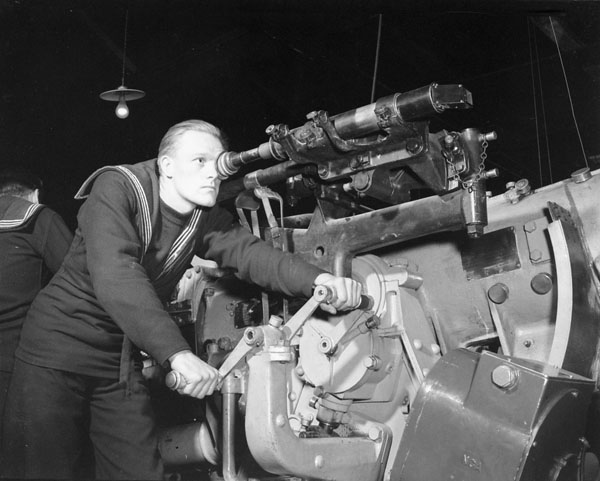
RCN rating operating the training mechanism of a 4.7-inch gun, Royal Canadian Navy Gunnery School, Halifax, Nova Scotia, 1940.
Canada. Dept. of National Defence / Library and Archives Canada / PA-104416
Despite the struggle over manpower and the navy’s reluctance to expand too quickly, the growth of the navy soon acquired a snowball effect which it seemed incapable — or perhaps undesirous — of firmly controlling. At the end of 1939 the Naval Staff anticipated a completed wartime strength (after three years) of 1,500 officers and 15,000 ratings. This figure was reached and passed in half the time. But the really hectic pace of expansion did not begin until after the fall of France and Norway. Up to that point the RCN had planned a very deliberate and selective growth, as Vice-Admiral Nelles, Chief of the Naval Staff (CNS), explained to the naval minister in January 1940.
Macdonald had broached the subject of giving preferences in RCNVR commissions to members of prominent yacht clubs. In an illuminating statement Nelles made it clear to the minister what role “Sunday Sailors” would play in Canada’s war at sea. “The RCN is in need of many men before this war is over,” Nelles wrote, “but the [types] of ships suitable to Canadian service conditions [Tribal-class destroyers or small inshore-patrol ships] are more suited to the employment of professional seamen than of amateur small boat yachtsmen.” The CNS’s comment was no idle remark on an easily dismissed subject. Earlier in the same day Nelles had received a memorandum from his director of Naval Personnel, who, no doubt responding to the minister’s inquiry, refused to countenance the mythical value of “Sunday Sailors”. Yachting, the DNP reported to his chief, had about as much to do with modern naval skills as flying a kite had to do with modern air operations. None the less, in order to find employment for these eager warriors, Nelles informed Macdonald that he was prepared to release fifty young yachtsmen to the Royal Navy “to serve in the more interesting appointments overseas and represent Canada at the scene of active operations”. His words suggest clearly what Nelles and the navy felt of keeping the fleet in home waters. In terms of manpower this option offered an alternative to simply turning recruits away, and they would not be lost to either Canada or the war effort. The loan scheme was approved, and it was initially decided to send all RCNVR recruits in excess of 4,500 to serve in the RN. Though this plan was later drastically altered, the incident illustrates the selective nature of the navy’s expansion before the fall of Western Europe, the desire to participate in the “active” theatre, and the problems inherent in trying to expand from too small a base.
Back at sea, the phony war was one of drudgery for the RCN, aside from its participation in the capture of the SS Hannover in the Caribbean. Shuttling convoys back and forth between the defended ports of Canada to meeting points offshore, the odd troop transport across the ocean, coastal convoys between ports. All essential, but not the work the navy had been hoping for.
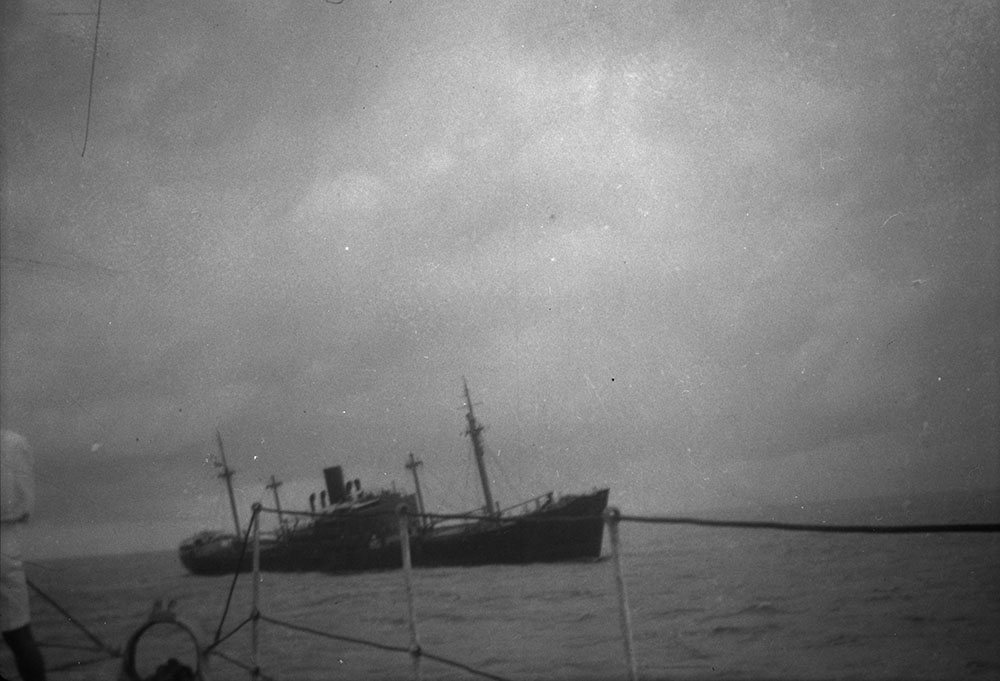
HMS Dunedin and HMCS Assiniboine intercepted the blockade runner SS Hannover in early March, 1940. Later, this vessel was converted into an escort aircraft carrier, HMS Audacity.
Canada. Dept. of National Defence / Library and Archives Canada / PA-104055
They got their wish soon enough. The phony war ended quite spectacularly in the spring of 1940, and a request was sent from London to Ottawa for “all available destroyers”, even as the BEF fought to disengage itself and form a secure position from which to evacuate. The cabinet eventually more or less agreed, even thought it meant virtually stripping Canada herself of naval defenses.
The fall of France left some senior Canadian politicians, Mackenzie King among them, more concerned than ever for the vulnerability of Canada’s vast coastline. However, both the Canadian Chiefs of Staff and the British, including Prime Minister Churchill (by whose opinion Mackenzie King set great store), were able to convince the Canadian prime minister that Canada’s first line of defence was the English Channel.
The navy mustered four destroyers for travel to Europe. Joseph Schull writes of their departure and first subsequent action in Far Distant Ships:
In Halifax, on the afternoon of the 24th [of May], the Canadian destroyers Restigouche, Skeena and St. Laurent were preparing to go to sea on an unscheduled voyage. Leaves had been cancelled, libertymen summoned back to their ships and all prospect of an Empire Day celebration ruined with truly naval efficiency. The mood on board St. Laurent was particularly black, as she had been recalled from one convoy and was under orders for sea again before a man could step ashore. The mess deck “buzz”, discredited and discouraged by nine months of unvarying monotony, gave promise only of another local convoy run. If there was any bright feature of the day it must have been the mild spring weather which had enabled the men to relieve their crowded mess decks by sending heavy clothes and miscellaneous cold weather gear ashore.
With early evening came the familiar “cable party fall in” and the equally familiar call for sea dutymen to muster. The destroyers nosed their way out of the harbour while men on watch speculated without much curiosity over the fact that there appeared to be no convoy in evidence.
The explanation came several hours later. There was to be no convoy this time and no turning back to Halifax after twenty-four hours. The lambie coats left in Halifax would not be seen by their owners for a considerable time. An urgent cable from the United Kingdom had arrived at Ottawa the day before. Invasion was an imminent possibility and every ship which Canada could send was required in British waters.
Restigouche, Skeena and St. Laurent were on their way. Assiniboine and Ottawa were in refit in Halifax and would not be operational until about the middle of June. Saguenay could not make the crossing as she was also badly in need of refit. Fraser, en route to Bermuda, had been assigned to the Jamaica Force of the Royal Navy in March to conduct Caribbean patrols. En route to Bermuda, had been ordered to continue her voyage, refuel at Bermuda and proceed directly to the United Kingdom.
The first wartime passage of the three destroyers was uneventful but scarcely monotonous. By day and by night the men went through intensive air raid and anti-submarine exercises. The commanding officer of Restigouche saw the efficiency of his ship increase rapidly during the voyage and suggested that the improvement “was no doubt accelerated by the realization of the ship’s company that we were rapidly approaching an extremely active war zone.”
It may well have been so. While still a day’s steaming from the United Kingdom the ships were ordered to a position of Ushant on an abortive submarine hunt; and when they finally secured at Plymouth on June 1 the evacuation of Dunkirk was at its height. The First Lord of the Admiralty found time for cordial words to the newcomers:
The presence of units of the Royal Canadian Navy in our midst inspires us all to a still harder effort. Confident both of your skill and of your valour we wish you good luck in the fierce and exacting toil which lies before you.
How Does it Work: Long Stroke Gas Piston
Forgotten Weapons
Published on 28 Mar 2019http://www.patreon.com/ForgottenWeapons
Cool Forgotten Weapons merch! http://shop.bbtv.com/collections/forg…
The long stroke gas piston system was in its heyday about 50 years ago, and was popular in both rifles and machine guns. The principle is that the gas piston is fixed to the bolt carrier, and both cycle rearward for the full length of the cartridge upon firing. The system was used in such distinguished designs as the M1 Garand, Kalashnikov, Browning Automatic Rifle, and ZB/Bren light machine guns among others. By including the mass of the gas piston in the reciprocating parts, the long stroke system potentially carries more momentum when cycling, this improving extraction and feeding. This generally comes at the cost of increased perceived recoil, as the extra mass impacting the rear of the receiver at the end of travel is felt by the firer.
Contact:
Forgotten Weapons
PO Box 87647
Tucson, AZ 85754
March 28, 2019
Canada and the Battle of the Atlantic, part 2 by Alex Funk
Editor’s Note: This series was originally published by Alex Funk on the TimeGhostArmy forums (original URL – https://community.timeghost.tv/t/canada-and-the-battle-of-the-atlantic-part-1-edited/1433).
Sources:
- The Far Distant Ships, Joseph Schull, ISBN 10 0773721606 (An official operational account published in 1950, somewhat sensationalist)
[Schull’s book was published in part because the funding for the official history team had been cut and they did not feel that the RCN’s contribution to the Battle of the Atlantic should have no official recognition. It is very much an artifact of its era, and needs to be read that way. A more balanced (and weighty) history didn’t appear until the publication of No Higher Purpose and A Blue Water Navy in 2002, parts 1 and 2 of the Official Operational History of the RCN in WW2, covering 1939-1943 and 1943-1945, respectively.]- North Atlantic Run: the Royal Canadian Navy and the battle for the convoys, Marc Milner, ISBN 10 0802025447 (Written in an attempt to give a more strategic view of Canada’s contribution than Schull’s work, published 1985)
- Reader’s Digest: The Canadians At War: Volumes 1 & 2 ISBN 10 0888501617 (A compilation of articles ranging from personal stories to overviews of Canadian involvement in a particular campaign. Contains excerpts from a number of more obscure Canadian books written after the war, published 1969)
- All photos used exist in the Public Domain and are from the National Archives of Canada, unless otherwise noted in the caption.
I have inserted occasional comments in [square brackets] and links to other sources that do not appear in the original posts. A few minor edits have also been made for clarity.
Part 2 — The Admiralty takes control
On August 26, just a few days before the official outbreak of war, a single word Admiralty telegram was received in Ottawa from London: FUNNEL. With that message all British merchant vessels passed under Admiralty control. The same transfer took place in Canada on the same day. No Canadian-registered ship, no merchant ship in any Canadian port could sail without the authority of the Royal Canadian Navy. Naval control officers faced an enormous task. All British merchant vessels in North American waters would have to be gathered in from the wide face of the sea, assembled, bunkered, stored, provided with codes and orders. Vessels of every type would have to be formed into orderly fleets, sailed at precise times and by specified routes with the precision of a crack railway, all in absolute secrecy. Halifax stirred once again with the grim vitality of a key port in a world at war. Ships put in, their schedules interrupted, their captains angry, demanding explanations they didn’t get. Painting parties descended to defile clean white ships with the drab gray of military vessels. Old naval guns were mounted on merchantmen and a few ships were issued machine guns.
[Editor’s Note: Unlike the Royal Navy’s comparatively vast administrative resources for organizing convoys, the RCN had to draw heavily upon a small number of retired RN and RCN officers living in Canada and the United States to gather enough officials to establish convoy control in Canadian ports (the same pool would also be used to recruit convoy commodores). It’s difficult for modern readers, used to networked computers with online databases, to realize just how much literal paperwork had to be created and maintained from scratch to even begin organizing the convoy system from North America to the UK: that it was done at all is amazing. That it was done about as well as could be hoped is incredible.]
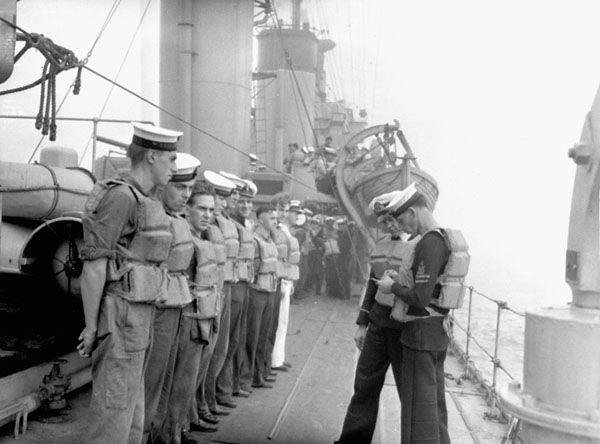
Ratings mustered along the starboard side of HMCS Assiniboine at sea, ca. September 1940.
Canada. Dept. of National Defence / Library and Archives Canada / PA-104105
On August 31st HMCS Fraser and St. Laurent were re-deployed to the east coast from the west coast.
On September 16th, six days after Canada declared war, the destroyers St. Laurent and Saguenay moved out through the Halifax approaches. Following behind were the 18 merchant ships of convoy HX-1, Halifax to the UK. Awaiting them offshore were the Royal Navy cruisers HMS Berwick and HMS York. The crossing was uneventful, but these 18 were the first of a grand total of 25,343 merchant vessels that would sail from North America under Canadian escort.
To briefly discuss the convoy system itself, it’s fairly simple: merchant vessels sail in organized groups rather than on their own and are provided some form of naval escort to protect them from hostile vessels. Even lightly guarded convoys are immensely preferable to ships sailing on their own, reducing the width of the target area and forcing any potential attacker to weigh the risk of counter-attack by the escorts. [Editor’s Note: It may seem odd to landlubbers like most of us, but even a large convoy is not much easier to find than a single ship in the wide ocean. Fewer discrete targets requires more search time by enemy submarines and surface raiders.] The speedier the convoy, the better, but the limited speed of many of the merchant ships necessitated a system of fast and slow convoys with different starting points in the Americas, and different codes for identification. The merchant vessels are described by Alan Easton, captain of the corvette HMCS Baddeck in 50 North: Canada’s Atlantic Battleground [Easton’s book is factual in most ways except for the dialogue and some of the names being changed]:
We sailed to Sydney, Nova Scotia. There we spent the night, topped up with fuel and stood out of the harbour early the next morning, where we were to await the convoy we had been instructed to escort. Many ships were lying at anchor that morning in the fine, land-locked harbour, ships of numerous different Allied and neutral nations, for this was the assembly port for the eastbound slow Atlantic convoys in those days. As we moved back and forth off the harbour mouth, I fell to examining the ships as they came out, one behind the other at intervals of three or four minutes, led by the Commodore’s ship. It was always intensely interesting to me to gaze at the ships. The more weatherbeaten and decrepit the ship, the more attractive she was to me; she had a story to tell and I could sometimes discern a part of it by just looking. The newest might have been ten years old, the oldest perhaps forty or fifty. Some were built of iron — the inch-thick plating of the 1880s, before the days of steel. They were large and small, from about nine hundred tons to nine thousand. You could tell almost at a glance their nationality, or the country in which they were built, by the shape of their hulls and the construction of their upperworks. But as they came out they flew their ensigns, soon to be hauled down, so that you could not mistake their identity. They were all heavily laden, few that were not down to their Plimsoll marks and some with little freeboard, perhaps four feet between the water and the well deck.
The first ship moved slowly, marking time as it were, to allow the others to take their stations, so that the whole could form into three columns. Soon after noon, the Commodore seemed to be satisfied that all were in their correct places for he ran up a flag hoist indicating that the speed of the convoy was to be seven knots. When every ship had signified that she understood his signal, the Commodore hauled his flags down and the engines of this heterogeneous collection of vessels simultaneously moved faster, although to the onlooker there was no perceptible change in speed.
The fast/slow system was implemented fairly early on, and by August 1940 slow convoys were more often being formed in Sydney, Nova Scotia, the faster convoys in Halifax. By 1941, fast convoys left every six days and made the crossing in around 13 to 14 days. Slow convoys left every six days as well, but took 16 to 17 days to cross. The size of the convoys varied. The largest convoy to ever make the crossing was HXS-300 consisting of 167 ships, but a good benchmark was 40 or so merchant vessels. These ships are positioned in a grid with nine columns, 920 metres apart, and in each column five ships, 550 metres apart. Ships carrying dangerous cargoes, such as gas, fuel, or explosives are placed in the centre, the position that affords the most protection against enemy torpedoes. The convoy commodore, in most cases a retired naval officer, is on board one of the merchant ships to take defensive measures as required and ensure coordination with the escort.
[Editor’s Note: An image from Swansea Docks showing the schematic arrangement of slow convoy ONS-154 returning to Halifax later in the war:]
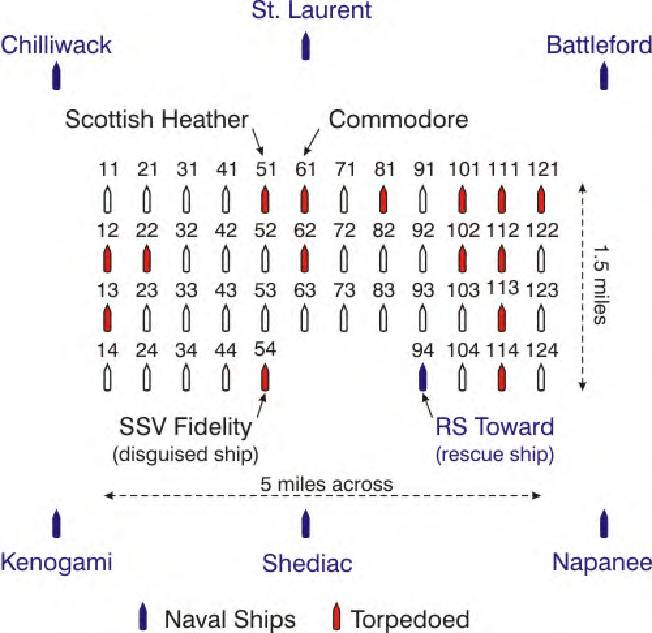
Convoy ONS-154 in December, 1942. The numbers indicate the column and row designations for each merchant ship in the convoy.
Image by Ron Tovey, Swansea Docks – click the image to visit his site.
The following system of codes was used for identification of trans-Atlantic convoys:
HX: Fast convoys (9 knots or over) sailing from Halifax (or later New York)
SC: Slow convoys (under 9 knots) sailing from Sydney, Halifax, or New York
ON: westbound convoys sailing from Great Britain to North America
ONS: slow westbound convoys sailing from Great Britain to North America
The following system of call letters was used for identification of coastal convoys:
BX: Boston to Halifax
XB: Halifax to Boston
SQ: Sydney to Quebec City (via the St. Lawrence River)
QS: Quebec to Sydney
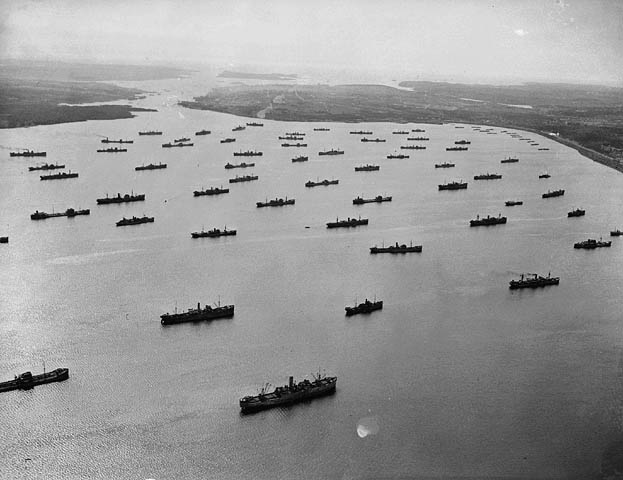
Convoy forming in Bedford Basin, 1 April, 1942
Canada. Dept. of National Defence / Library and Archives Canada / PA-112993
There was much debate among Canadian politicians as to the role Canada would play in the war in general. In the first few weeks, much debate was had as to which services would receive what money, and how they would be integrated into the allied war effort. Prime Minister Mackenzie King had somewhat sold the war to the nation as being different from the last war [Editor’s Note: where Canada provided an over-strength army corps for the Western Front, suffering nearly 60,000 combat deaths, slightly more than the US combat losses in that war]. Finance Minister J. L. Ralston publicly envisaged a program that would be “practical rather than spectacular”. The Prime Minister spoke of protecting Canada by sending food and raw materials to Britain and building a navy and air force and munitions industry, even the first musings of what would become the BCATP [British Commonwealth Air Training Plan] (though these early plans paled in comparison to what it would eventually become.) Canada would contribute vast amounts of resources to the allied cause, but there was not going to be a need for a large land army to fight and die in Europe. The army was just as short of equipment as the navy was and the air force consisted of 3100 men and 270 mostly obsolete aircraft, with just 19 modern Hurricanes. The old issue of conscription that had led to riots in Montreal in 1917 immediately reappeared, and an important provincial election in Quebec had been called within two weeks of the declaration of war in almost direct response to it. [Editor’s Note: The risk of another conscription crisis haunted the Canadian government from the very start of the war: English Canada was heavily in favour, but Quebec was just as opposed, and the ruling Liberal Party couldn’t risk losing their support in Quebec.] What soldiers Canada did have departed Halifax as part of convoy TC-1 in early December, and by the end of the month Canada had 15,000 men in England (the 1st Canadian Infantry Division).
It is the opinion of my sources that the idea of a limited war were extremely favorable to the navy and air force in the early months. Canadian naval vessels and aircraft fighting alongside the United Kingdom was seen as an appropriate contribution, whilst at the same time, seen as far less costly in terms of lives than a large expeditionary army, which Mackenzie King was steadfastly opposed to (fear of conscription crisis was ever present). Canada’s merchant fleet was at Britain’s disposal without question, combined with the vast natural resources she could provide, quite nicely rounded out the “limited war” concept. Industrial military capacity was small, almost non-existent, and building ships, aircraft and munitions would help it grow.
Focusing specifically on the navy itself, what few ships it had were immediately deployed on patrols and put to work escorting coastal convoys within coastal waters, and trans-Atlantic convoys to a handover point mid-voyage. The reserves were activated and sent to the coasts. In November all the Canadian destroyers were placed under the command of the Royal Navy’s North America and West Indies station (somewhat to the Government’s dismay, although not the navy’s: most RCN officers had close peacetime ties to the British squadron and felt it was the natural choice. They had actually requested this at the start of the war and had been refused by the government, who wanted the RCN’s ships kept close to home.) This placement also had the benefit of assuring the RCN that they would participate in the types of operations they had trained for; fleet work, or sweeps for surface raiders. October 1939 saw the purchase of a another destroyer, re-named HMCS Assiniboine in Canadian service. These seven River-class destroyers would form the backbone of the navy well into 1943. A modest attempt had been made in 1938 to give Canadian yards some experience building warships with a minesweeper program. Despite the dispersal of the contracts to both Atlantic and Pacific yards for four Fundy-class minesweepers, the Canadian shipbuilding industry was unprepared for the demands wartime was to make of it.
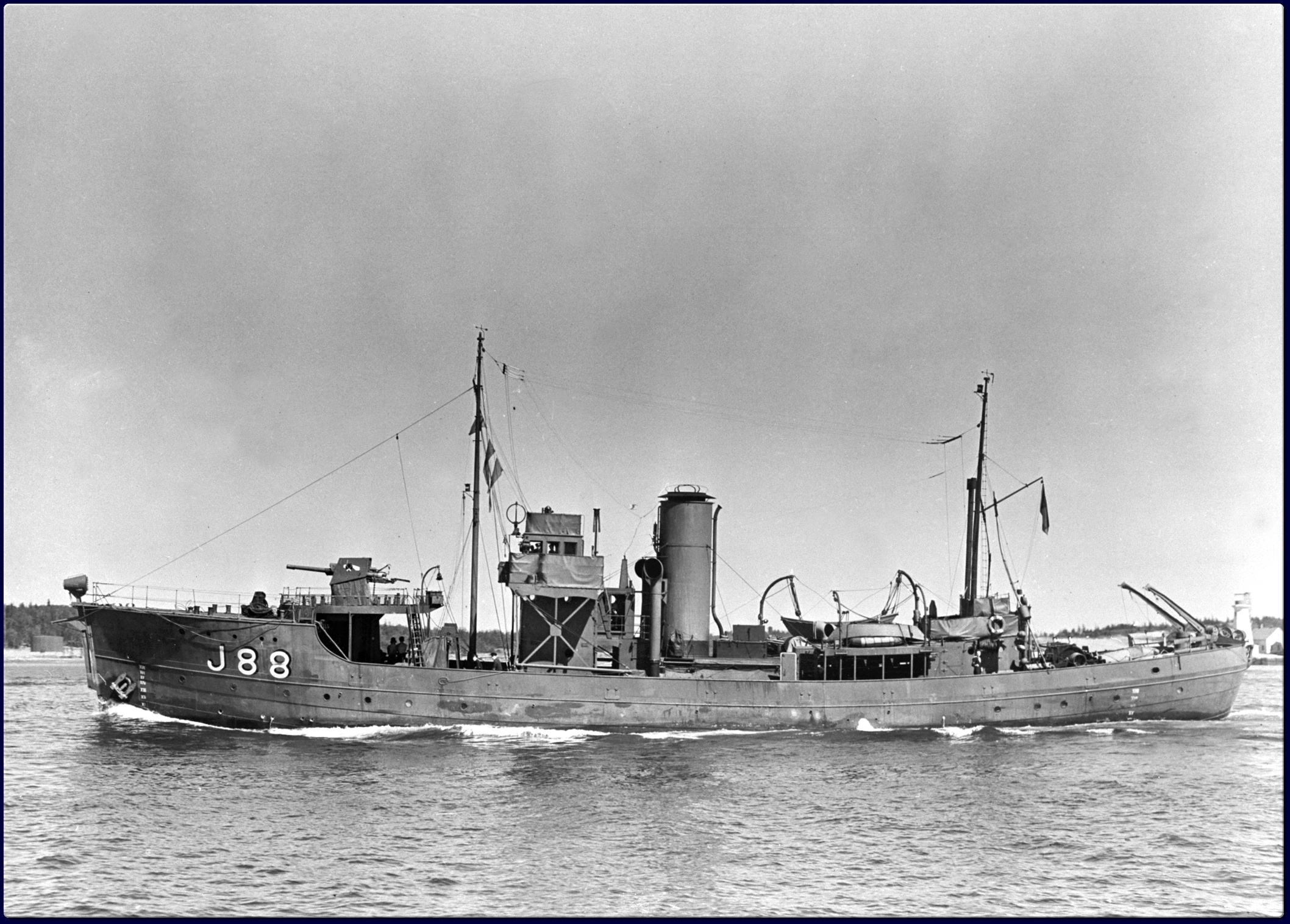
Undated photograph of RCN minesweeper HMCS Fundy (J88).
Canadian Navy Heritage website. Image Negative Number NP-1404 via Wikimedia Commons.
In North Atlantic Run, Marc Milner discusses the Ottawa front of the RCN’s early wartime struggles:
In the government the navy actually had a friend, as it discovered when planners began to submit estimates for expansion. As the late Admiral L.W. Murray, RCN (in September 1939, the Director of Operations and Training) recalled, the navy was given a carte blanche to plan its growth over the succeeding four or five years. When in February 1940 Murray and the deputy minister presented the first wartime naval estimates before the Finance Committee of the cabinet, they passed despite a “fine-tooth comb” inspection. The fact was that the navy’s expansion and its attendant shipbuilding programs suited the government’s intention to profit from what was seen as a limited European war. The prime minister, W.L. Mackenzie King, was steadfastly opposed to fielding yet another large army in Europe, which might lead to high casualties and a call for conscription. Rather, his government sought to channel Canada’s war effort into the sinews of war and into much less personnel-intensive services such as the air force and the navy. Both of these services also offered excellent opportunities for the development of Canadian industry.
The link between industrial and naval expansion also went deeper than simply the building of ships. In July 1940, the expansion of the navy was given impetus by the appointment of a separate minister of Defence for the Naval Service. King chose Angus L. Macdonald, former premier of Nova Scotia. Although once rather uncharitably described as “lightweight”, Macdonald was extremely popular in his home province and a strong voice for Nova Scotia in Ottawa. Macdonald and two other prominent Nova Scotians, Colonel J.L. Ralston, the Minister of Defence, and J.L. Ilsley, the Minister of National Revenue, formed the right wing of King’s cabinet — what J.W. Dafoe called the “Tory Imperialists”. All supported a full war effort, a position that led in 1944 to a bitter break between King and the two defence ministers over the issue of conscription. But apart from Macdonald’s desire to see Canada fully represented at the front, he shared many of King’s beliefs, including the notion that the preservation of the free world depended upon the retention of power in Canada by the Liberal Party.
Macdonald also believed that Canada could and should progress industrially from the war. Long a crusader for the re-industrialization of Nova Scotia, he saw an opportunity to funnel some of government investment into his own province. There was, moreover, a direct link between industrial growth and a large navy. “What use could it be to increase our agricultural production … or to put forth the magnificent industrial effort that we have,” Macdonald asked in 1945, “unless this food and these munitions could be got safely across the sea?” Although in the end he failed to restore to Nova Scotia its past lustre, this was precisely the rationale used to justify building destroyers in Halifax during the war. In the most fundamental sense, then, the aspirations of the [full-time, professional] navy and the government coincided.
Parker Hale M85: Traditional Sniper in a Modern World
Forgotten Weapons
Published on 27 Feb 2019http://www.patreon.com/ForgottenWeapons
Cool Forgotten Weapons merch! http://shop.bbtv.com/collections/forg…
The 1985 competition to pick a new sniper rifle for the British military came down to a closely fought contest between the Accuracy International PM and the Parker Hale M85. The M85 was a fantastically accurate rifle, every bit the equal of the AI submission and to this day there are still people who were involved in the trials who insist that the M85 should have been selected. Ultimately, the decision came down to the logistical issues surrounding the rifle, where AI’s chassis system was superior to Parker-Hale’s traditional construction. Despite being defeated, Parker Hale sold some 800 M85 rifles – nearly as many as the military contract would have procured (and in fact, a few M85s were purchased by several military units).
If you are interested in learning more, I highly recommend checking out Steve Houghton’s newly released book, The British Sniper: A Century of Evolution. It can be found at:
https://www.swiftandboldpublishing.co…
Contact:
Forgotten Weapons
PO Box 87647
Tucson, AZ 85754
March 27, 2019
Canada and the Battle of the Atlantic, part 1 by Alex Funk
Editor’s Note: This series was originally published by Alex Funk on the TimeGhostArmy forums (original URL – https://community.timeghost.tv/t/canada-and-the-battle-of-the-atlantic-part-1-edited/1433).
Sources:
- The Far Distant Ships, Joseph Schull, ISBN 10 0773721606 (An official operational account published in 1950, somewhat sensationalist) [Schull’s book was published in part because the funding for the official history team had been cut and they did not feel that the RCN’s contribution to the Battle of the Atlantic should have no official recognition. It is very much an artifact of its era, and needs to be read that way. A more balanced (and weighty) history didn’t appear until the publication of No Higher Purpose and A Blue Water Navy in 2002, parts 1 and 2 of the Official Operational History of the RCN in WW2, covering 1939-1943 and 1943-1945 respectively.]
- North Atlantic Run: the Royal Canadian Navy and the battle for the convoys, Marc Milner, ISBN 10 0802025447 (Written in an attempt to give a more strategic view of Canada’s contribution than Schull’s work, published 1985)
- Reader’s Digest: The Canadians At War: Volumes 1 & 2 ISBN 10 0888501617 (A compilation of articles ranging from personal stories to overviews of Canadian involvement in a particular campaign. Contains excerpts from a number of more obscure Canadian books written after the war, published 1969)
- All photos used exist in the Public Domain and are from the National Archives of Canada, unless otherwise noted in the caption.
I have inserted occasional comments in [square brackets] and links to other sources that do not appear in the original posts. A few minor edits have also been made for clarity.
Canada and the Battle of the Atlantic, part 1
Canada’s navy before WW2
This is my modest attempt to illustrate Canada’s contribution to the Battle of the Atlantic and the war at sea in general. In my honest opinion it was the most important thing we did as a nation aside from the BCATP (British Commonwealth Air Training Plan).
The Naval Service of Canada/Royal Canadian Navy before World War 2
The Royal Canadian Navy (RCN) was founded in 1910 under the Naval Service Bill re-introduced by Prime Minister Wilfrid Laurier (its first attempt at approval under George Foster in 1909 had failed), creating the Naval Service of Canada [Wikipedia – https://en.wikipedia.org/wiki/Origins_of_the_Royal_Canadian_Navy]. A distinct naval force for the Dominion of Canada to be maintained and manned by Canadians, which could be placed under British control if needs be. Two ex-Royal Navy vessels were obtained for the purposes of training [cruisers HMCS Niobe and HMCS Rainbow].
[There actually was an even earlier attempt to create a Canadian navy, as related by Joseph Schull:]
There had been one hint, in 1880, of an awareness of naval needs. A dispatch from the Governor General to the Colonial Secretary had suggested that Canada “would not be averse to instituting a ship for training purposes if the Imperial Government would provide the ship.” To the restrained enthusiasm of this proposal the Admiralty had responded with appropriate generosity. Charybdis, an ancient steam corvette, was at the time limping homeward from the China Station. The Canadian Government could have her.
When Charybdis arrived in the United Kingdom it was discovered that her boilers were worn out. Canada paid for their replacement. The ship was then coaxed and coddled across the Atlantic by a redoubtable Captain Scott, R.N., retired. Upon arrival in Saint John, Charybdis broke loose from her moorings in a gale and damaged much of the shipping in harbour. She had hardly been secured, and the clamour of aggrieved shipowners had not died down, when two Saint John citizens, attempting to come on board, fell through the rotting wood of her gangplank and were drowned. It was sufficient naval experience for the Canadian Government of that time. The wreck was towed from Saint John and turned over to the unwelcoming authorities of the Royal Navy. Charybdis became a gruesome memory, a political Flying Dutchman which heaved over the horizon when any naval proposal was advanced during the next thirty years.
The election of a new government (which had opposed the original bill) in 1911 left the new service in limbo. [Also in 1911, the Naval Service was given permission by King George V to rename itself the Royal Canadian Navy.] Nevertheless, between the two ex-Royal Navy vessels, two submarines purchased from the US [by the provincial government of British Columbia(!)], and two government patrol vessels pressed into military service the RCN spent the early years of World War 1 patrolling the east and west coasts of North America and sometimes as far south as Panama to deter the German naval threat. As that real or perceived threat slowly evaporated, the Canadian Navy’s patrols became less frequent.
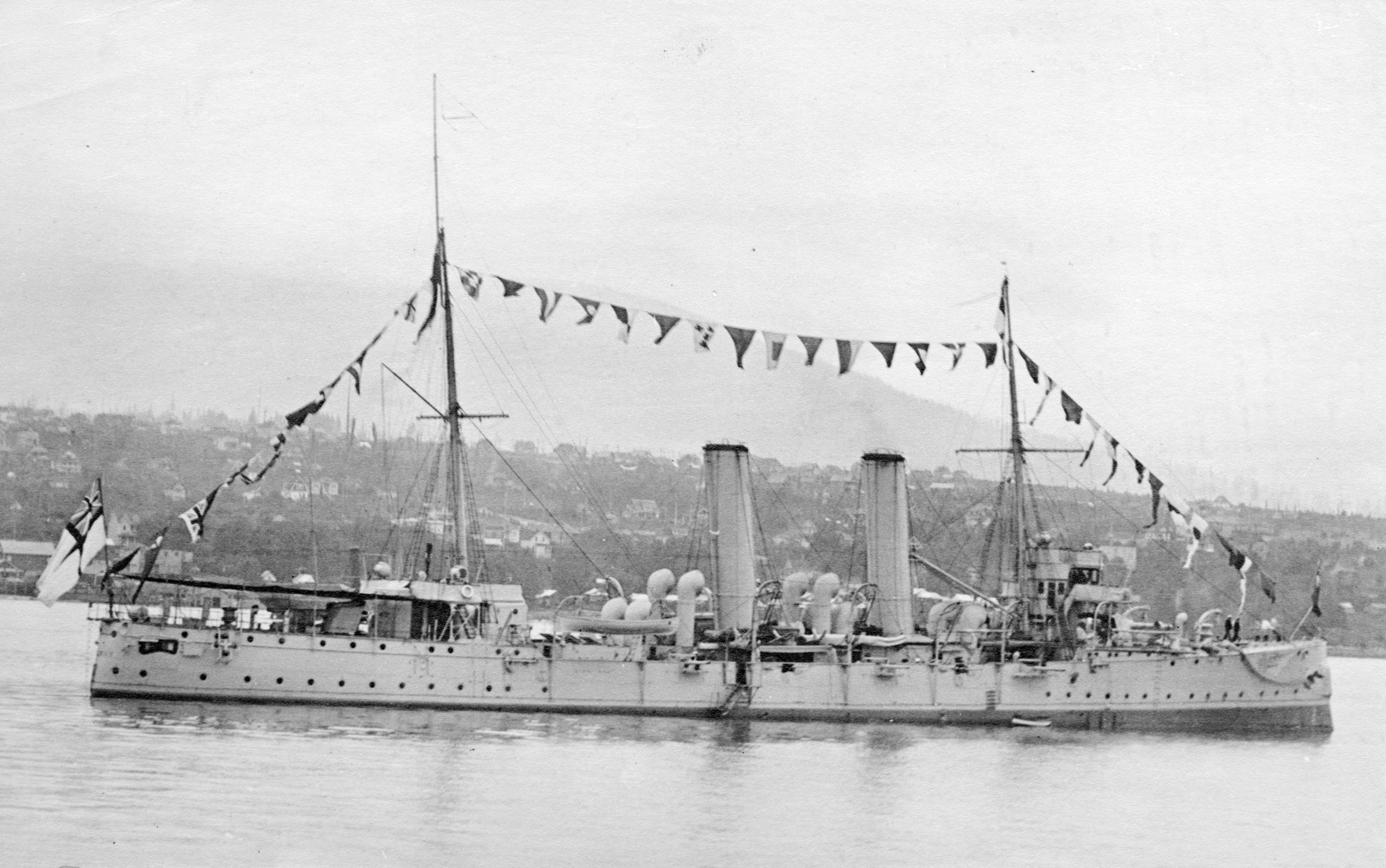
HMCS Rainbow at North Vancouver, 1910.
Photo from the City of Vancouver Library, the collection of Matthews, James Skitt, Major (1878-1970) via Wikimedia Commons.
The First World War saw the modest beginnings of the Canadian Navy, although it should be pointed out that many more Canadians chose to serve in the Royal Navy than the Canadian one, some as officers.
The inter-war years saw very little growth for the RCN. The post-war drawdown naturally occurred, and by 1922 the service had only 366 men and had paid off their only remaining cruiser. The Naval Volunteer Reserve was firmly established in Canadian cities across the country (and numbered around 1,000 men) but the Navy itself only kept two destroyers donated by the Royal Navy in service [HMCS Patriot and HMCS Patrician], until these were replaced by two more destroyers in the late 1920s (once again, ex-RN [ships renamed as HMCS Champlain and HMCS Vancouver]). 1931 saw a major facelift with the first ships built specifically for the RCN: HMCS Skeena and HMCS Saguenay.
The early 1930s saw the Navy along with the other Canadian service branches almost completely starved of funding, although by the late 30s, escalating world tension convinced the Canadian government to slowly begin rebuilding. Two more destroyers were purchased from the Royal Navy in 1937 (HMCS Fraser and HMCS St Laurent) and then two more in 1938 (HMCS Ottawa and HMCS Restigouche).
Marc Milner outlines the RCN’s original expansion plans in North Atlantic Run:
In January 1939 the government, reacting to the Munich crisis, announced its intentions to proceed with building a fleet capable defending Canada’s two coasts. The expansion plan, when completed, would give the RCN a strength of eighteen modern destroyers, sixteen minesweepers, and eight anti-submarine vessels, the numbers split evenly between Pacific and Atlantic commands, and a flotilla of eight motor torpedo boats for the east coast. Not surprisingly, little came of this plan before war broke out. In fact, by May the government had sharply cut the navy’s estimates. The 1939 building program (four anti-submarine vessels and two motor torpedo boats) was scrapped, and there was just enough money left to acquire the necessary plans. It is, however, significant that the RCN’s expansion plans were laid down in the last days of peace. Later developments would thrust a new form of expansion on the RCN, one more easily attainable in wartime than a fleet of destroyers, yet one which did not conform to the long-term goals of the professional navy.
Thus, by the outbreak of the Second World War in September 1939, the RCN consisted of six River-class destroyers, five minesweepers, and two small training vessels.
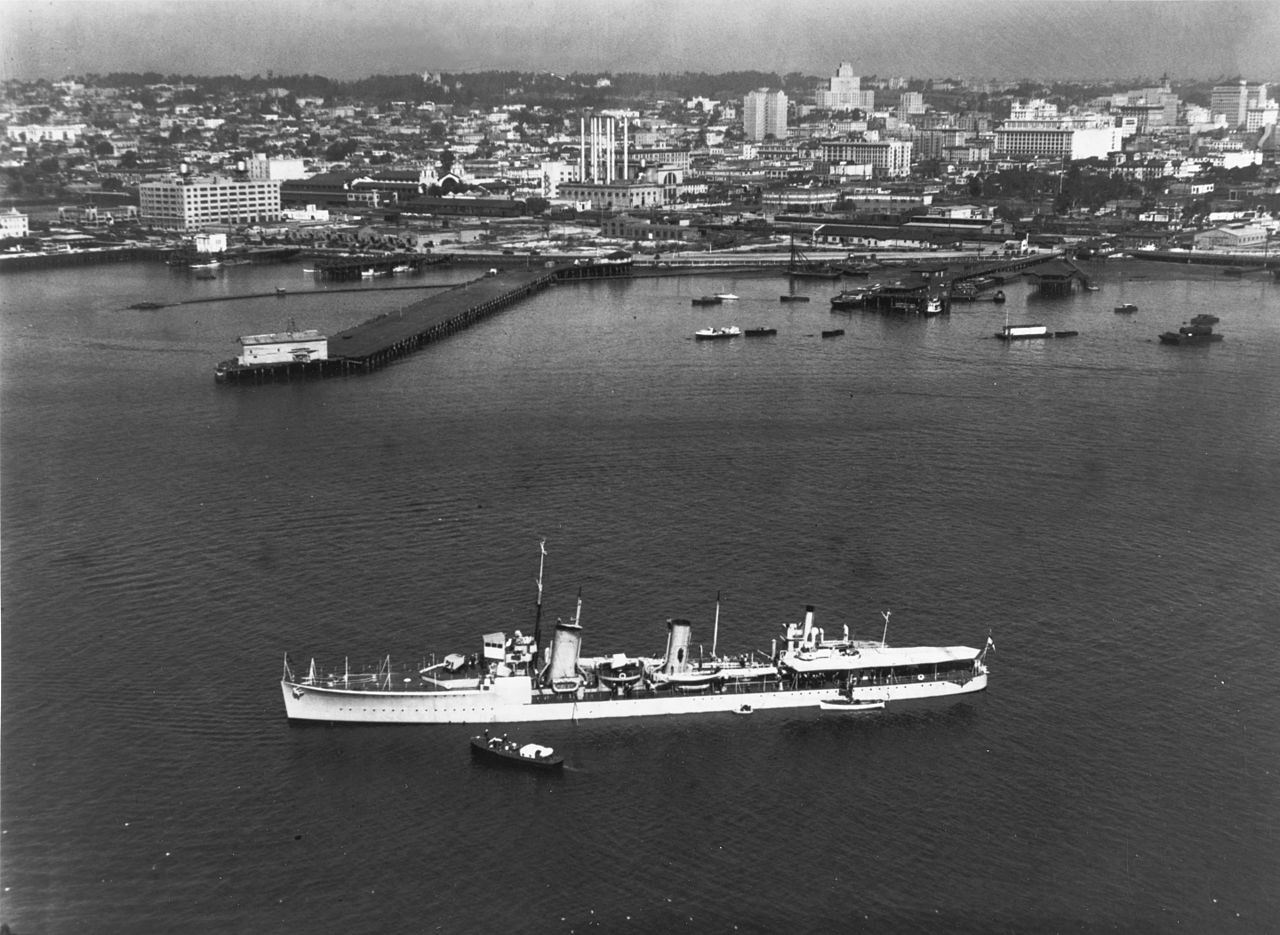
HMCS Vancouver (F6A) anchored off San Diego, California (USA), on 5 March 1929.
Official U.S. Navy photo 80-G-416377 from the U.S. Navy Naval History and Heritage Command, via Wikimedia Commons.
The January 1939 expansion plan belied the fact that the RCN was a traditional, gun-oriented navy. The experiences of the First World War and technological developments since had confirmed the sanctity of the gun as the pre-eminent naval weapon. Admittedly, the threat from Germany’s U-boats in 1917 had been grave. But her indiscriminate use of the submarine had brought the United States into the conflict on the Allied side and (or so it seemed) therefore cost Germany the war. It was felt that in future no nation would risk the sanction of a world coalition by resorting to “piracy” on the high seas. But even if Germany, or any other nation, turned once again to unrestricted submarine warfare on merchant shipping, the means of defeating the threat was already in service with Commonwealth navies — convoy and ASDIC.
During the First World War, before the adoption of the convoy system, German U-Boats preferred to use their deck guns to destroy lone merchant vessels, using their precious torpedoes sparingly. With the introduction of the convoy system, the days of easy targets vanished and the proximity of naval escort forced the U-Boat to either risk fighting an unequal surface battle against more heavily gunned escorts or to operate submerged. Convoys made the oceanic routes much safer, but this success was not unmixed. Cargo ships continued to sail independently and unescorted to and from convoy assembly ports in British coastal waters, and the U-boats resorted to submerged attack tactics inshore. Although Britain was never again threatened with defeat by starvation, losses to merchant shipping remained high for the rest of the war because of the virtual immunity of a submerged submarine to any threat of effective counter-attack by escort ships.
With the U-Boats relegated to nuisance status through the use of convoys, their final telling defeat simply awaited the perfection of a reliable underwater-detection device. The Allied Submarine Detection Investigation Committee was established in 1918 to resolve this problem, but it was not until the early twenties that an effective underwater sound locating and ranging set (now called sonar) was in use. ASDIC, as the British called the device, was to spell the doom of the submarine. As late as 1936 the First Sea Lord [the professional head of the Royal Navy], Admiral A.E.M. Chatfield, claimed that the RN’s anti-submarine measures were 80% effective. With location no longer a problem, it was believed that destruction of a submarine by a few well-placed depth charges would follow with equal certainty.
…
If anything, Canadian planners, like those elsewhere, were absorbed by the unknown dangers of air attack on trade (particularly on convoys) and by the very real threat of powerful enemy surface raiders. Both of these also presented Canada with the only real threat of direct enemy action. The RCN was therefore charged with defence against surface and air attacks on Canada and on trade in adjacent waters — the two were really inseparable. The “forms and scales of attack to which Canada would be subject,” as anticipated in 1939, reflected the preoccupation with surface and air threats. Bombardment by a single battleship and/or one or two large cruisers, by armed merchant cruisers (AMCs), or even by heavily gunned submarines was felt likely. Attacks could also be expected in the form of MTBs launched from larger ships, mines, small assault parties, or aircraft carrying torpedoes, bombs, or gas. Indeed, it was thought that aircraft launched from remote points along the Canadian coast might penetrate as far inland as Toronto. Certainly, the major coastal centres were in danger of quick and unexpected raids.
The expansion plan of January 1939 was naturally intended to counter these threats. To make good its intentions, the navy hoped to acquire the most powerful destroyers then in service, the Tribal-class. The Tribal’s high speed and heavy armament (eight 4.7-inch guns and four torpedo tubes) made it a veritable “pocket” cruiser, and several acting in concert posed a credible threat to a lone battleship. Not surprisingly, the RCN would pursue its intention to acquire Tribals throughout the entirety of the war, eventually absorbing dockyard space, resources, and trained manpower which could have been better used to maintain the escort fleet.
[Editor’s Note: On the other hand, had they not pursued a Tribal-class building program, the RCN might well have suffered a similar or even worse drawdown after the war as it did in 1919-22.]
On the eve of the Second World War the submarine was therefore considered by the RN to be a manageable problem. The same held true in the RCN. In a pre-war analysis of the threats to trade and possible countermeasures, Commodore Nelles summarized Canadian reaction to the submarine:
If international law is complied with, Submarine attack should not prove serious. If unrestricted warfare is again resorted to, the means of combating Submarines are considered to have so advanced that by employing a system of of convoy and utilizing Air Forces, losses of Submarines would be very heavy and might compel the enemy to give up this form of attack.
Nelles went on to point out that the RCN would provide anti-submarine equipment and mines “for prosecution of offensive measures against submarine attack.” His choice of words illustrates clearly the thinking of naval contemporaries on how best to deal with submarines — offensive action. The countermeasures outlined by the CNS indicated that some lessons had been drawn from the previous war, and in the long term the combination of convoy, air power, and aggressive anti-submarine warfare proved more than a match for the U-boats. Unfortunately, Britain and her allies lacked the necessary means for a very long time, and the resilience of modern submarines proved a surprise to virtually everyone.
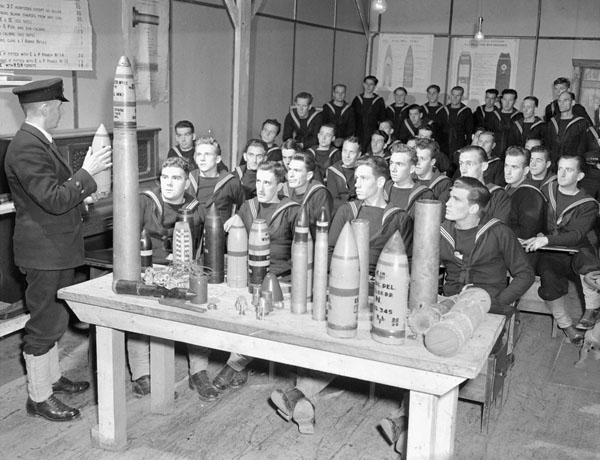
Chief Petty Officer Lowther delivering a lecture about various types of ammunition, Royal Canadian Navy Gunnery School, Halifax, Nova Scotia, Canada, 1940.
Credit: Canada. Dept. of National Defence / Library and Archives Canada / PA-104417
March 26, 2019
Donning hoplite armour
Lindybeige
Published on 28 Sep 2016How long does it take a hoplite to get ready for action? Watch one incompetent one time himself as he dons his panoply.
Support me on Patreon: https://www.patreon.com/Lindybeige
More weapons and armour videos here: https://www.youtube.com/playlist?list…
Some game systems have rules on how long it takes to put on armour. Here I give you some practical hints as to how long it actually takes. Yes, the sword and shield are just mock-ups, but the time it takes to take them up is probably about the same as the real thing.
Was this really shot in ancient Greece? No, it was a park in Gosforth, near a primary school and with aircraft flying overhead and a breeze just strong enough to create constant rustling of leaves and occasional wind noise on the microphones.
Buy the music – the music played at the end of my videos is now available here: https://lindybeige.bandcamp.com/track…
Lindybeige: a channel of archaeology, ancient and medieval warfare, rants, swing dance, travelogues, evolution, and whatever else occurs to me to make.▼ Follow me…
Twitter: https://twitter.com/Lindybeige I may have some drivel to contribute to the Twittersphere, plus you get notice of uploads.
website: http://www.LloydianAspects.co.uk
March 25, 2019
The Boston Massacre – Snow and Gunpowder – Extra History
Extra Credits
Published on 23 Mar 2019Boston, 1770. A frigid winter night. A British sentry strikes a local citizen. Civilians begins to gather. Reinforcements arrive to back up the young sentry. Insults and snowballs escalate. Then out of the darkness comes a shout: “FIRE!”
The Boston Massacre didn’t come out of nowhere — resentment between the early US colonies and the British army had been brewing for some time over the Stamp Act. A propaganda war ensued between the loyalists and the radicals. John Adams would get his revolutionary start as he worked to resolve this injustice…
Join us on Patreon! http://bit.ly/EHPatreon
Battle of Ecnomus (256 BC) – Largest Naval Battle in History
Invicta
Published on 12 Sep 2016The Battle of Ecnomus in 256 BC is arguably the largest naval battle in history with 680 warships and an estimated 290,000 rowers and marines participating! This monumental clash was fought during the First Punic War between Rome and Carthage along the coast of Sicily.
Fleet Anatomy: https://www.youtube.com/watch?v=7PhRp…
Fleet Operation: https://www.youtube.com/watch?v=397-i…
Fleet Tactics: https://www.youtube.com/watch?v=VOc8m…More Classical Antiquity Documentaries: https://www.youtube.com/playlist?list…
Literary Sources:
Uniforms of the Roman World by Kevin Kiley
Republican Roman Warships by Osprey Publishing
The Fall of Carthage by Adrian Goldsworthy
Augustus by Anthony EverittGame Engine:
Total War: Rome IIGame Mods:
Devide et Impera
Realistic Ship Colors
Ave_Gigas.pak
From the comments:
Invicta
2 years ago
It has been a real pleasure to research and produce the documentary series on the Roman Navy. This video is a culmination of that exploration into the little-covered world of ancient naval combat which I hope has been equally enlightening and entertaining. It is also worth mentioning that the battle maps I created for this video individually show the 680 vessels from both sides. Though this was painstaking to do, it was worth it to convey the insane scale of this encounter at sea.I’d also like to point out that I tried using new effects in this video. I will continue to try new styles and adapt my presentations in the future and greatly appreciate any and all feedback. Thank you all for your support and help thus far. Its a true joy to have an audience for this passion of mine : )
March 24, 2019
Il Duce and der Führer Have a Date – WW2 – 030 – March 23 1940
World War Two
Published on 23 Mar 2019French Prime Minister Daladier overplays his hand and is replaced after his vision regarding Scandinavia wasn’t widely shared in the French parliament. Meanwhile, the French and British in France are preparing for a German attack. If Hitler gets it his way, they will also have to prepare for an attack in the south as Hitler tries to persuade Mussolini to join his invasion.
Join us on Patreon: https://www.patreon.com/TimeGhostHistory
Or join The TimeGhost Army directly at: https://timeghost.tvFollow WW2 day by day on Instagram @World_war_two_realtime https://www.instagram.com/world_war_t…
Between 2 Wars: https://www.youtube.com/playlist?list…
Source list: http://bit.ly/WW2sourcesWritten and Hosted by: Indy Neidell
Produced and Directed by: Spartacus Olsson and Astrid Deinhard
Executive Producers: Bodo Rittenauer, Astrid Deinhard, Indy Neidell, Spartacus Olsson
Creative Producer: Joram Appel
Research by: Indy Neidell
Edited by: Iryna Dulka
Map animations: EastoryPhotos of the Winter War are mostly from the Finnish Wartime Photograph Archive (SA-Kuva).
Colorisations by Norman StewartEastory’s channel: https://www.youtube.com/channel/UCEly…
Archive by Screenocean/Reuters https://www.screenocean.comA TimeGhost chronological documentary produced by OnLion Entertainment GmbH.
From the comments:
World War Two
25 minutes ago (edited)
The Wehrmacht is amassing at the German western borders. The Allies are ducked behind the Maginot Line and standing ready to advance into Belgium, are they in the right places? We want to go to France before the Germans do to give you guys some solid specials about the coming events there – you can help us by supporting the TimeGhost 1940 Road Trip to France here: https://timeghost.tv/support-the-1940-france-roadtrip/ more info here: https://www.youtube.com/watch?v=z3Mvd1VEFyw Thank you for your Support!!!!
Major Fosbery’s Automatic Revolver: History and Mechanics
Forgotten Weapons
Published on 9 Aug 2017http://www.patreon.com/ForgottenWeapons
George Fosbery, V.C., was a decorated British officer with substantial combat experience in India when he decided to design a better sidearm in 1895. True semiautomatic handguns were in their very early stages of development at that time, and Fosbery thought that one could have a more durable, more powerful, and simpler weapon by using a revolver as a foundation. He began experimenting with a Colt SAA, but soon moved to using Webley revolvers when he found the Colt internals insufficiently durable for his conversion.
What Fosbery did was to relocate the barrel and cylinder into an upper assembly which could move independently of the grip and trigger of the gun. Upon firing, the energy of recoil would push the upper assembly rearwards, re-cocking the hammer and indexing the cylinder to the next chamber. This gave the shooter the rapid fire of a double action revolver with the excellent trigger pull of a single action revolver.
The gun was introduced at the Bisley shooting matches, where it proved quite popular as a target gun. By the time production began in the early years of the 20th century, however, semi-auto handguns had improved significantly, and the opportunity for the Webley-Fosbery to be a big seller had already passed. Still, British officers were required to provide sidearms chambered for the .455 service cartridge, and more than a few opted to purchase Webley-Fosberys.
Thanks to Mike Carrick of Arms Heritage magazine for providing this Webley-Fosbery for this video! See his regular column here: https://armsheritagemagazine.com
If you enjoy Forgotten Weapons, check out its sister channel, InRangeTV! http://www.youtube.com/InRangeTVShow
March 22, 2019
“Shiroyama” – The Satsuma Rebellion – Sabaton History 007
Sabaton History
Published on 21 Mar 2019What will you do when your traditional way of life is threatened by a powerful force in your native lands? The samurai didn’t hesitate to answer this question with: our swords. During the Satsuma Rebellion, the samurai and its leader Saigō Takamori fought the Japanese Imperial Government. Their rebellion ended with the Battle of Shiroyama, where in 1877 the samurai prepared for a last stand.
Support Sabaton History on Patreon: https://www.patreon.com/sabatonhistory
Watch the official music video for Shiroyama here: https://www.youtube.com/watch?v=oKW6g…
Listen to Sabaton on Spotify: http://smarturl.it/SabatonSpotify
Official Sabaton Merchandise Shop: http://bit.ly/SabatonOfficialShopHosted by: Indy Neidell
Written by: Markus Linke and Indy Neidell
Directed by: Astrid Deinhard and Wieke Kapteijns
Produced by: Pär Sundström, Astrid Deinhard and Spartacus Olsson
Creative Producer: Joram Appel
Executive Producers: Pär Sundström, Joakim Broden, Tomas Sunmo, Indy Neidell, Astrid Deinhard, and Spartacus Olsson
Maps by: Eastory
Edited by: Iryna Dulka
Sound Editing by: Marek KaminskiEastory YouTube Channel: https://www.youtube.com/channel/UCEly…
Archive by: Reuters/Screenocean https://www.screenocean.com
Music by Sabaton.An OnLion Entertainment GmbH and Raging Beaver Publishing AB co-Production.
© Raging Beaver Publishing AB, 2019 – all rights reserved.
From the comments:
Sabaton History
2 days ago (edited)
In the 19th century, Japan transitioned from a feudal society to a modern constitutional monarchy shaped after its western counterparts. A constitution was introduced which made every Japanese man equal under the law. This effectively ended the privileged status of the samurai in Japan. However, many samurai didn’t take this kindly. A group of them rebelled against the Imperial government, which is what the Sabaton song “Shiroyama” is all about.The fact that we can research, film and produce this with Indy and his team is only thanks to the people who support us on Patreon. If you don’t already, please do consider supporting us – which also gives you some cool rewards as well as early access to all our episodes!
March 21, 2019
Tank Chats #44 T14 and A33 (Excelsior) Assault Tanks | The Tank Museum
The Tank Museum
Published on 13 Jan 2018The Second World War American T14 and British A33 (Excelsior) Assault tanks were made to the same specification as one another, neither ever went in to service and only one of each were made. They both survive at The Tank Museum.
Support the work of The Tank Museum on Patreon: ► https://www.patreon.com/tankmuseum
Or donate http://tankmuseum.org/support-us/donateVisit The Tank Museum SHOP: ►https://tankmuseumshop.org/
Twitter: ► https://twitter.com/TankMuseum
Tiger Tank Blog: ► http://blog.tiger-tank.com/
Tank 100 First World War Centenary Blog: ► http://tank100.com/ #tankmuseum #tanks
March 19, 2019
The Russian Civil War in Early 1919 I THE GREAT WAR
The Great War
Published on 18 Mar 2019Check out The Great War Miniatures Game: http://bit.ly/BattlefrontMiniatures
Use “greatwarchannel1” for 25% off of the Great War Game Book
Use “greatwarchannel2” for 10% off of any Army Deal plus free shipping worldwide.The biggest conflict, or rather series of conflicts, that had their roots in the First World War are today known as the Russian Civil War. After the October Revolution the Bolsheviks under Vladimir Lenin and Leon Trotsky fought all across the former Russian Empire to consolidate their power.
» SUPPORT THE CHANNEL
Patreon: https://www.patreon.com/thegreatwar
Merchandise: https://shop.spreadshirt.de/thegreatwar/» SOURCES
Figes, Orlando. A People’s Tragedy. The Russian Revolution (London: The Bodley Head, 2017 [1996]).Mawdsley, Evan. The Russian Civil War (New York: Pegasus Books, 2005).
Robert Gerwarth, The Vanquished. Why the First World War Failed to End, 1917-1923 (Penguin, 2017)
Gattrell, Peter. Russia’s First World War (Pearson, 2005).
Leonhard, Jörn. Der überforderte Frieden. Versailles und die Welt 1918-1923 (CH Beck, 2018).
Lloyd George, David. The Truth About the Peace Treaties, vol 1, (London: Victor Glocancz, 1938).
Mawdsley, Evan. “International Responses to the Russian Civil War,” in 1914-1918 online.
International Encyclopedia of the First World War. https://encyclopedia.1914-1918-online…Peeling, Siobhan. “War Communism,” in 1914-1918 online.
International Encyclopedia of the First World War. https://encyclopedia.1914-1918-online…Smele, Jonathan. The ‘Russian’ Civil Wars 1916-1926 (London: Hurst, 2015).
Sumpf, Alexandre. “Russian Civil War,” in 1914-1918 online.
International Encyclopedia of the First World War. https://encyclopedia.1914-1918-online…Volkov, Evgenii. “Czech Legions,” in 1914-1918 online.
International Encyclopedia of the First World War. https://encyclopedia.1914-1918-online…» SOCIAL MEDIA
Twitter: https://twitter.com/WW1_Series
Reddit: https://reddit.com/r/TheGreatWarChannel»CREDITS Presented by: Jesse Alexander
Written by: Jesse Alexander
Director: Toni Steller & Florian Wittig
Director of Photography: Toni Steller
Sound: Toni Steller
Editing: Toni Steller
Mixing, Mastering & Sound Design: http://above-zero.com
Motion Design: Christian Graef – GRAEFX
Maps: Daniel Kogosov (http://patreon.com/Zalesky)
Research by: Jesse Alexander
Fact checking: Florian Wittig
Channel Design: Alexander Clark Original Logo: David van StepholdA Mediakraft Networks Original Channel
Contains licenced material by getty images
All rights reserved – Real Time History GmbH i.Gr. 2019
The dangers of over-relying on new technology
Ted Campbell discusses one of the potential problems when military organizations depend too much on new tech working as advertised by the developer:
I have been a constant critic, in these pages, and in other fora, of the Canadian military’s command and control (C²) superstructure. I believe it is overly complex and bureaucratic, too top heavy and it is ‘fat,’ even, I have said, morbidly obese. I think Canada has far, far too many admirals and generals, almost all (except for, perhaps, a half dozen, at most) being one or two ranks higher than is needed for the job they do, in too many headquarters that do little of value except talk
toat each other. I believe our C² has more do do with trying to emulate our (equally grossly obese) neighbour to the south than with meeting the needs of Canada.
The solution to the C² obesity problem is about 99% political … it needs a minister who will direct the Chief of the Defence Staff to chop something between ⅓ and ½ of the admirals and generals and commodores and Navy captains and Army and Air Force colonels and many of the HQs in which they sit. Of course that will require a massive (and overdue) revision to the entire military remuneration system so that admirals and colonels and corporals and privates, too, all get paid, appropriately well, for what they do for Canada. That needs to be agreed, by the prime minister, before the Minister of National Defence orders give the order to “chop.”But that’s the top level problem and I have, I think, ranted on enough about it … my readers will either agree or not.
I believe, as I said the other day, that there is also a serious problem at the operational and tactical levels of the military, and it involves more than just command and control (C²), it involves the command, control and communications (C³) systems and, especially, the degree to which they are reliant on modern electronics and, especially, yet again, the electro-magnetic spectrum to establish a global information network upon which the military is nearly totally reliant. When, not if, “nearly totally reliant” becomes over-reliant, as I believe is now the case, and is most pronounced, the military sometimes uses the acronym C4I, meaning command, control, communications, computers and intelligence or worse, C4I2 which means command, control, communications, computers, intelligence and interoperability according to the US Department of Defense Dictionary of Military and Associated Terms. The mere fact that we seem to want to assign fancy acronyms to a few aluminium and plastic boxes full of solid sate circuits seems to me to indicate that we don’t actually understand that, beneath the blinking lights and flashy displays is a process than, in many respects, is little changed from what we did 75 years ago. The need to manage and handle information is unchanged, the technology we can use to do those things has changed.*
The problem, as I see it, is that the modern military is fascinated with what technology can do ~ and it can do a lot of really useful things ~ but are less willing to understand its limitations.
Don’t get me wrong: I think computers are wonderful; they make many mundane but time consuming tasks easy to accomplish in the blink of an eye. Ditto for radios and radars which seem to erase distance as show us things that used to be invisible. But all technology comes at a price … sometimes, as in the world of electronic warfare (EW), the price is fairly easy to understand: if you say anything on your radio then a modestly sophisticated enemy can, quickly and accurately, locate your exact position and send artillery or sir strikes your way; or the enemy can ‘spoof’ your communications networks, feeding false information into it and spreading confusion. The enemy can, also, use the radio spectrum to gain access to (hack) your computer network and make you deceive yourself. Or the threats may be physical, like the anti-satellite networks, such as the Chinese are developing, which according to Lieutenant General Jay Raymond of the United Stares Air Force, mean that “soon every satellite in every orbit will be able to be held at risk.” Our, Canadian and allied, national surveillance and air defence systems use satellite networks as do our strategic command and control (C²) networks which manage Canada’s armed forces at home and overseas. Even the most modern “networked” systems might be rendered deaf and blind.