Forgotten Weapons
Published 24 Sep 2017Get your copy on Amazon: http://amzn.to/2xwfDZ8
I ordered a copy of Damien Lewis’ book on the exploits of British SOE in WWII expecting to find an overview of, well, what SOE had done during the war. That’s not quite what this book is. Instead, Lewis has given us essentially a first-person view of SOE’s work through the eyes of Danish commando Anders Lassen (VC, MC with two bars). Don’t be fooled by the cover image; the North African LRDG is never mentioned. However, what Lassen was involved in was equally impressive and probably less well known.
Lassen was part of the crew for the first real SOE operation, the theft of a pair of German and Italian supply ships from the neutral Spanish port at Fernando Po. In an exploit that could be straight out of Hollywood, a band of commandoes sailed a pair of tugboats into the harbor at night while the ships’ officers were ashore at a raucous party. They blew the anchor chains with explosive charges, locked the crews below deck, and sailed the ships out to sea where they could be legally captured by a British destroyer. And they did it without a single death on either side.
The exploits only became bigger and bolder after that, with Lassen and his comrades making regular raids across the English Channel and running a freewheeling campaign of both hit-and-run raids and occupation of Greek islands in the Aegean. These were the quintessential independent Special Forces fighters, operating outside regular military command structures and supply chains, fighting as they saw fit. Lassen eventually became the commanding officer of a large group, and by the end of the war had been awarded the Military Cross three times. His last operation in Italy — where his men were hit with a shattering defeat when pushed into the role of spearheading a conventional offensive — would result in him posthumously receiving the Victoria Cross for his heroism.
I ended up reading the book almost entirely in a single sitting, and found it riveting and fascinating — far more so than the typical academic history. It offers a humbling and motivating example of what men can do when they are skilled and motivated. At the same time, it also left me a bit melancholy, as by the end we can see Lassen consumed by his combat experiences and slowly becoming removed from society. Nobody can say how Lassen would have coped had he survived the war, but one suspects he would have led a troubled life. Perhaps that is the price one must pay to become, as Churchill described, “a hand of steel which plucks the German sentries from their posts with growing efficiency.”
http://www.patreon.com/ForgottenWeapons
Cool Forgotten Weapons merchandise! http://shop.bbtv.com/collections/forg…
If you enjoy Forgotten Weapons, check out its sister channel, InRangeTV! http://www.youtube.com/InRangeTVShow
January 16, 2020
Book Review: The Ministry of Ungentlemanly Warfare by Damien Lewis
January 15, 2020
Hundred Years’ War: Battle of Crecy 1346
Kings and Generals
Published 7 December 2017The Hundred Years’ War of 1337-1453 between France and England is one of the most crucial conflicts in the history of Europe. It changed the social, political and cultural outlook of the countries involved, influenced the change in warfare, brought the end of feudalism closer. The first phase of this war is called the Edwardian War, and one of the most decisive engagements of this conflict was the battle of Crecy (1346). This series will have 5 videos, so don’t hesitate to like, subscribe and share. And if you want to support us, you can do it on Patreon: http://www.patreon.com/KingsandGenerals or Paypal: http://paypal.me/kingsandgenerals
We are grateful to our patrons, who made this video possible: Ibrahim Rahman, Koopinator, Daisho, Łukasz Maliszewski, Nicolas Quinones, William Fluit, Juan Camilo Rodriguez, Murray Dubs, Dimitris Valurdos, Félix Gagné-Dion, Fahri Dashwali, Kyle Hooton, Dan Mullen, Mohamed Thair, Pablo Aparicio Martínez, Iulian Margeloiu, Chet, Nick Nasad, Jeyares, Amir Eppel, Thomas Bloch, Uri Sternfeld, Juha Mäkelä, Georgi Kirilov, Mohammad Mian, Daniel Yifrach, Brian Crane, Muramasa, Gerald Tnay, Hassan Ali, Richie Thierry, David O’Hare, Christopher Commins, Chris Glantzis, Mike, William Pugh, Stefan Dt, indy, Bashir Hammour, Mario Nickel, R.G. Ferrick, Moritz Pohlmann, Russell Breckenridge, Jared R. Parker, Kassem Omar Kassem, AmericanPatriot, Robert Arnaud, Christopher Issariotis, John Wang, Joakim Airas, Nathanial Eriksen and Joakim Airas.
This video was narrated by our good friend Officially Devin. Check out his channel for some kick-ass Let’s Plays. https://www.youtube.com/user/Official…
The Machinimas for this video is created by one more friend – Malay Archer. Check out his channel, he has some of the best Total War machinimas ever created: https://www.youtube.com/user/Mathemed…
Inspired by: BazBattles, Invicta (THFE), Epic History TV, Historia Civilis and Time Commanders
Machinimas made on the Total War: Attila engine using the great Medieval Kingdoms mod.
Production Music courtesy of Epidemic Sound: http://www.epidemicsound.com
January 14, 2020
The Desert Fox | Rommel’s FIRST Battle in the North African Campaign | BATTLESTORM
TIK
Published 17 May 2016Erwin Rommel faces the might of the British Empire. In 3D animation, we’ll see the units, the battlefield and the tactics The Desert Fox uses to overcome the British and Australian forces at Mersa Brega and throw them out of Italian Libya. Except for Tobruk of course! The video covers Erwin Rommel’s arrival in Italian Libya up to the beginning part of the Battle of Tobruk 1941.
This video is Part 2 of the Western Desert Campaign – Part 1 (Operation Compass) is in the link below
https://www.youtube.com/watch?v=b71kd…Bibliography
Battistelli, Pier Paolo. Erwin Rommel (Command). Osprey Publishing, 2010.
Beckett, Ian F. Rommel: A Reappraisal. Great Britain, 2013.
Beevor, Antony. The Second World War. Phoenix, 2014.
Bickers, Richard Townshend. The Desert Air War: 1939-1945. Endeavour Press Ltd, 2015.
Butler, Daniel Allen. Field Mashal: the Life and Death of Erwin Rommel. Casemate Publishers, 2015.
Dimbleby, Jonathan. Destiny in the Desert: The Road to El Alamein – the Battle that Turned the Tide. Great Britain, 2012.
Liddell Hart, B.H. A History of the Second World War. Pan Books, 2015.
Hastings, Max. All Hell Let Loose: The World at War 1939-1945. HarperPress, 2011.
Jorgensen, Christer. Afrika Korps: Rommel’s 1941 Offensive (Rapid Reads). Brown Bear Books, 2014.
LaFace, Major Jeffrey L. Tactical Victory Leading to Operational Failure: Rommel in North Africa. Pickle Partners Publishing, 2014.
Lyman R. The Longest Siege: Tobruk – The Battle That Saved North Africa. Pan Books, 2011.
Moorehead, Alan. The Desert War: the Classic Trilogy on the North Africa Campaign 1940-43. CPI Group, 2012.
Nash, N. Strafer Desert General: The Life and Killing of Lieutenant General WHE Gott. Pen and Sword Books Ltd, 2013.
Neillands, Robert. The Desert Rats: 7th Armoured Division 1940-45. UK, 2005.
Neillands, Robert. Eighth Army: From the Western Desert to the Alps, 1939-1945. John Murray Publishers, 2004.
Pitt, Barrie. The Crucible of War: Volume 1: Wavell’s Command. Cassell & Co, 2001.
Playfair, Major-General I.S.O. The Mediterranean and Middle East, Volume II, “The Germans come to the help of their Ally” (1941). The Naval & Military Press Ltd, 2004.
Raugh, H. Wavell in the Middle East 1939-1941: A Study in Generalship. USA, 2013.
Reuth, Ralf Georg. Rommel: The End of a Legend. Haus Publishing, 2005.
Thompson, Dennis H. Discarded Victory – North Africa, 1940-1941. Pickle Partners, 2014.
Williamson, Gordon. Afrikakorps 1941-43 (Elite). Osprey Publishing, 2009.
January 13, 2020
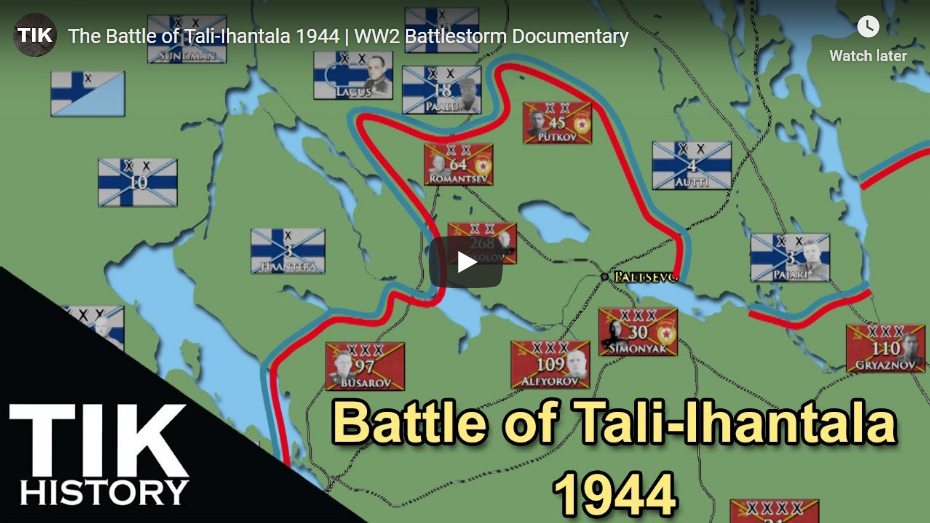
MANNERHEIM | History and his Line
TIK
Published 22 Jun 2017Carl Gustav Emil Mannerheim towers over all other characters of the Winter War, and of Finnish history in general. This video is a brief introduction to one of the great leaders of the 20th Century (and according to a TV poll in 2004, the greatest Finn of all time). Full script is available as captions/subtitles, and the source I used for this video is –
Trotter, W. The Winter War: The Russo-Finnish War of 1939-40. Aurum Press Ltd, 2003.
If you’d like to help me make these videos, consider supporting me on Patreon https://www.patreon.com/TIKhistory
The Nika riots in Constantinople (with bonus NASCAR analogies)
Not only does Tamara Keel provide interesting and informative gun information, she also has at least a vague interest in late Classical/early Medieval history:

Court of Emperor Justinian with (right) archbishop Maximian and (left) court officials and Praetorian Guards; Basilica of San Vitale in Ravenna, Italy. The bearded man to Justinian’s right is believed to be Belisarius. (via Wikimedia)
The center of social life in Constantinople was the Hippodrome, a massive stadium where chariot races were held. Chariot racing was wildly popular with all strata of society, and everybody was a fan of one team or another; the Blues, the Greens, the Whites, and the Reds. Although as time went on, hardly anybody paid attention to anybody other than the Blues and the Greens. Kinda like Dale Jr. fans and Jeff Gordon fans and who cares about Kurt Busch anymore ’cause he’s a tool.
So, everybody who was anybody was a fan of the Blues or the Greens. You only hung out with fellow Dale fans, all the Jeff Gordon fans voted the same way, you beat the crap out of rival fans in bar fights when you could. Trouble really erupted, however, when some popular ringleaders from each faction were imprisoned on murder raps after a bit of friendly head-busting got out of hand after a contested race.
Dale fans and Jeff Gordon fans united and went wild in the streets, burning and looting and actually laying siege to the palace in a mob scene. The emperor Justinian (via someone expendable, no doubt) announced his willingness to accede to their demands, even to the point of agreeing to abdicate in favor of their choice for a new ruler. Fortunately for Justinian, his wife Theodora and a senior eunuch in the palace bureaucracy named Narses had the stones the emperor lacked. They put their heads together with Belisarius and Mundus, two great Byzantine generals, and hatched a plan.
As the tens of thousands of rioters thronged in the vast Hippodrome, waiting for the new emperor’s coronation, Belisarius and his bodyguard of no more than a couple hundred steppe archers took the passageway under the street from the palace to the imperial box in the stadium. With the crowd focused on the impending ceremony, nobody noticed the archers fanning out in the skybox until they started volleying into the crowd. Panic ensued and, leaving a litter of 24 flags and 88 mesh-back ball caps and shot-up, trampled bodies, the crowd stampeded for the big main gates off the racetrack.
Unfortunately, Mundus and his bodyguard were drawn up in ranks blocking the exit, and they opened fire into the front rows of the fleeing mob. Needless to say, when all was said and done, the backbone of the rioters was broken. Thousands had been shot, and many thousands more were crushed in the press. Justinian held onto his crown, no thanks to his own dithering.
Deadly Moments in History – The Nika Riots
Invicta
Published 27 Feb 2018We relive the deadly Nika Riots which brought the Emperor Justinian to his knees and resulted in the death of 30,000 civilians. In our journey we will explore the history of chariot racing, the undercurrents of dissent, and the blow by blow unfolding of the riot.
Support future documentaries: https://www.patreon.com/InvictaHistory
Twitter: https://twitter.com/InvictaHistoryDocumentary Credits:
Research: Invicta and Luas McCahill
Script: Invicta
Artwork: Robbie McSweeney
Editing: Invicta
Music: Total War Soundtrack, Dreamnote, RecognitionLiterary Sources
–History of the Wars, I by Procopius
–Empress Theodora by J. A. S. Evans
–Justinian: The Last Roman Emperor by G. P. Baker
January 12, 2020
The shoot-down of Flight 752
Colby Cosh discusses the destruction of Ukraine International 752 in the historical context of the Vincennes incident (later on Friday, the Iranian official position appears to have shifted to accepting responsibility for an accidental missile launch):

Some of the wreckage of Ukraine International flight 752 near Tehran, Iran.
Photo from MOJ Newsagency via Wikimedia Commons.
It has become fairly obvious, whatever the Iranian authorities may say now or later, that Ukraine International Airlines Flight 752 was shot down after departing Tehran. This was, in truth, overwhelmingly probable the moment the news broke, but there was still widespread shock and disbelief on Thursday when several Western heads of government announced signal-intelligence evidence of a missile strike. There are still “How could such a thing happen?” reactions pouring forth — mostly from people who are old enough, in theory, to recall the USS Vincennes accidentally shooting down an Iran Air Airbus A300 in 1988.
I say “in theory,” but the truth is that popular memory of the Vincennes incident has been much diminished — outside Iran — by later events in the region. This must qualify as one of the good Lord’s most sadistic jests. The United States wasn’t officially at war with anyone in the region at the moment when its best-trained sailors, equipped with scorchingly new and uncannily powerful missile and battlespace-mapping technology, blew up a commercial airliner full of religious pilgrims.
The Navy was in the Gulf not to fight or oppose anybody in particular, but to protect neutral shipping from the Iran-Iraq War. Up to the time of the accident, it was Iraq that demonstrably presented the greater danger to American warships. Ronald Reagan was still president. The First Gulf War wouldn’t kick off until 1990.
In other words: we forgot. The memory of Vincennes was overwritten by a generation of Middle East conflict, like an old computer file.
Which leaves a paradox. Liberals who regard recent U.S. history as one enormous, indistinguishable mass of bloodthirsty actions don’t seem especially aware of one of the most horrifying tactical blunders in American military history. What’s one jet plane more or less in the black ledger of imperialism? Conservatives, meanwhile, are racing to accuse Iran of “murder” in the case of Flight 752.
Blunders can be worse than crimes, according to one of the most famous of all military maxims. But if one points out that Iran’s “murder” of innocents is starting to look like a nightmarish replay of Vincennes, one risks being accused of postulating “moral equivalence” between the United States and Iran.
Fighting Far Away From Home – Allied Advance in Africa – WW2 – 072 – January 11 1941
World War Two
Published 11 Jan 2020Action in Albania. Action in North-Africa. Action in East-Africa. Action in China and action on the Mediterranean. It looks like every belligerent party is amping up its efforts to get a foothold wherever they are. And if your enemy is gaining ground? You just throw more material and men at them.
Join us on Patreon: https://www.patreon.com/TimeGhostHistory
Or join The TimeGhost Army directly at: https://timeghost.tvFollow WW2 day by day on Instagram @World_war_two_realtime https://www.instagram.com/world_war_t…
Join our Discord Server: https://discord.gg/D6D2aYN.
Between 2 Wars: https://www.youtube.com/playlist?list…
Source list: http://bit.ly/WW2sourcesWritten and Hosted by: Indy Neidell
Produced and Directed by: Spartacus Olsson and Astrid Deinhard
Executive Producers: Bodo Rittenauer, Astrid Deinhard, Indy Neidell, Spartacus Olsson
Creative Producer: Joram Appel
Post-Production Director: Wieke Kapteijns
Research by: Indy Neidell
Edited by: Daniel Weiss
Map animations: Eastory (https://www.youtube.com/c/eastory)Colorizations by:
– Dememorabilia – https://www.instagram.com/dememorabilia/
– Julius Jääskeläinen – https://www.facebook.com/JJcolorization/Sources:
IWM (A 4161), (E 872), (A 4162), (A 9793), (A 13509).
Division Coat of Arms by Noclador
oil barrel by BomSymbols from the Noun Project
can by Anniken & Andreas from the Noun ProjectSoundtracks from Epidemic Sound:
– “Arriving in Ancient Rome” – Kikoru
– “Easy Target” – Rannar Sillard
– “Split Decision” – Rannar Sillard
– “Road To Tibet 5” – Rannar Sillard
– “Death And Glory 1” – Johannes Bornlöf
– “The Inspector 4” – Johannes Bornlöf
– “Not Safe Yet” – Gunnar JohnsenArchive by Screenocean/Reuters https://www.screenocean.com.
A TimeGhost chronological documentary produced by OnLion Entertainment GmbH.
From the comments:
World War Two
3 days ago (edited)
It looks like all fronts are heating up this week. And that the German reaction to the British offensive in North-Africa and the Greek progress in Albania is to move more German troops southward. This week already shows how that potentially threatens Britains position in the Mediterranean. Well, just like the British and Germans, we hope to increase our manpower in 1941. Do your part and expand our community of loyal supporters and history buffs by joining the TimeGhost Army on https://www.patreon.com/timeghosthistory and https://timeghost.tv. The war effort needs you!
Cheers, Joram
January 11, 2020
Logistics of Alexander the Great in His Campaign
Military History Visualized
Published 11 Jan 2016Patreon: https://www.patreon.com/join/mhv
Alexander the Great is well known for his tactics on the battlefield. Some aspect that is often forgotten is that victory on the battlefield requires well supplied troops. This is especially true, because Alexander’s conquest covered a vast area.
See the YouTube description for a lengthy sources list.
Feature History – Emu War
Feature History
Published 25 Jan 2017Hello and welcome to a Feature History special; featuring the Emu Wars, the incompetence of my own country, and my miserable attempt at doing the accent I should have.
Patreon
https://www.patreon.com/FeatureHistory
https://twitter.com/Feature_History
———————————————————————————————————–
The credit for this video goes to Feature History’s employee of the month, me, for the art, animation, script, voice-over.
Music
Kevin MacLeod – “Drankin’ Song”
Kevin MacLeod – “Bama Country”
QotD: “Don’t ask, don’t tell”
As all right-thinking people know, Don’t Ask, Don’t Tell was a right-wing atrocity against gays, hatched in the pernicious seventy-two degree corners of the doubleplusungood and evilwickedbadnaughty Pentagon, fought against nearly to the death by progressives …
That’s not remotely what happened. Rather, the Uniform Code of Military Justice, as enacted by Congress, has long deemed Sodomy, which covered more than just homosexual conduct, as a criminal offense potentially carrying severe penalties. Moreover, the procedure for entering into service demanded that prospective recruits deny or admit to homosexual leanings, in writing, which admissions would usually bar the man or woman from service. Of course, back when the shame of being publicly homosexual was very great, people who wanted to join the armed forces simply lied about it and then, as a general rule, hid it while in service.
Liberal Democratic President Bill Clinton, acting in his capacity as Commander in Chief of the armed forces, simply ordered that prospective recruits were not to be asked if they were gay or had homosexual leanings, and were not to volunteer the information. That, young Millennial, is where DADT came from; it came from a liberal, liberally motivated, and pandering to his liberal base.
Did you know that? No? Well, then; ask yourself, WHY didn’t you know?
What the loss of history does to you, dear Millennial, is that it robs you of the ability to reason your way to cause and effect. Never mind the crappy to the point of idiotic decisions and programs this might lead you to support, consider what it does to you as a person. What, after all, is the effect of shielding people from contrary opinions by designating and maintaining, under color of law or regulation, “safe spaces” for this or that minority? Does it make them stronger? Better able to deal with a harsh world? Does it change that objective world to something less harsh? No and no and no; it does none of that. Do you gain grit in a safe space? Ha. Do you learn endurance in a safe space? Oh, please.
Tom Kratman, “It’s Up to You, Millennials. Deflect or Be Doomed”, Milo, 2017-12-06.
January 10, 2020
One more Scramble in Africa – The Second Italo-Abyssinian War | BETWEEN 2 WARS I 1935 Part 4 of 4
TimeGhost History
Published 9 Jan 2020After European Empires were done scrambling for Africa, not much of the African continent was left to be ruled by its native people, or to be colonised for other colony-hungry European powers. However, the Kingdom of Abyssinia is one of the countries that made it through the scramble alive. That is, until Benito Mussolini shifts the Italian focus to East-Africa once more.
Join us on Patreon: https://www.patreon.com/TimeGhostHistory
Hosted by: Indy Neidell
Written by: Joram Appel, Spartacus Olsson and Naman Habtom
Directed by: Spartacus Olsson and Astrid Deinhard
Executive Producers: Bodo Rittenauer, Astrid Deinhard, Indy Neidell, Spartacus Olsson
Creative Producer: Joram Appel
Post-Production Director: Wieke Kapteijns
Research by: Naman Habtom
Edited by: Daniel Weiss
Sound design: Marek KaminskiSources:
Diploma by Alena from the Noun Project
Teacher by b farias from the Noun Project
guns by Cards Against Humanity from the Noun Project
Curved path by Allie Tate from the Noun Project
Labor Day by H Alberto Gongora from the Noun Project
train tracks by Prasad from the Noun ProjectColorizations by:
– Dememorabilia – https://www.instagram.com/dememorabilia/
– Julius Jääskeläinen – https://www.facebook.com/JJcolorization/A TimeGhost chronological documentary produced by OnLion Entertainment GmbH.
“Light in the Black” – United Nations Peacekeeping – Sabaton History 049 [Official]
Sabaton History
Published 9 Jan 2020The United Nations were created to avoid any future human suffering and all-out conflict. Numerous peacekeeping missions had the goal to deescalate and protect the innocent. However, the success and usefulness of the UN is still quite ambiguous. The Sabaton song “Light in the Black” is about the UN peacekeeping missions and we tell you about the history.
Support Sabaton History on Patreon: https://www.patreon.com/sabatonhistory
Listen to Attero Dominatus (where “Light in the Black” is featured):
CD: http://bit.ly/AtteroDominatusStore
Spotify: http://bit.ly/AtteroDominatusSpotify
Apple Music: http://bit.ly/AtteroDominatusAppleMusic
iTunes: http://bit.ly/AtteroDominatusiTunes
Amazon: http://bit.ly/AtteroDominatusAmzn
Google Play: http://bit.ly/AtteroDominatusGooglePlayListen to Sabaton on Spotify: http://smarturl.it/SabatonSpotify
Official Sabaton Merchandise Shop: http://bit.ly/SabatonOfficialShopHosted by: Indy Neidell
Written by: Markus Linke and Indy Neidell
Directed by: Astrid Deinhard and Wieke Kapteijns
Produced by: Pär Sundström, Astrid Deinhard and Spartacus Olsson
Creative Producer: Joram Appel
Executive Producers: Pär Sundström, Joakim Broden, Tomas Sunmo, Indy Neidell, Astrid Deinhard, and Spartacus Olsson
Production Intern: Rune Væver Hartvig
Post-Production Director: Wieke Kapteijns
Edited by: Iryna Dulka
Sound Editing by: Marek Kaminski and Karolina Dolega
Maps by: Eastory – https://www.youtube.com/c/eastoryArchive by: Reuters/Screenocean https://www.screenocean.com
Music by Sabaton.Sources:
RijksmuseumAn OnLion Entertainment GmbH and Raging Beaver Publishing AB co-Production.
© Raging Beaver Publishing AB, 2019 – all rights reserved.
Tank Chats #58 Buffalo & Weasel | The Funnies | The Tank Museum
The Tank Museum
Published 28 Oct 2018Another episode in the Tank Chats Funnies Specials, with David Fletcher looking at the weird and wonderful vehicles of 79th Armoured Division led by Major General Percy Hobart, known as “Hobart’s Funnies”.
The Buffalo, or Landing Vehicle Tracked IV (LVT), is a lightly armoured tracked amphibious carrier. British “Buffaloes” were used in Northern Italy during WW2 and were issued to the 79th Armoured Division in Northwest Europe where they played an important role in the crossing of the Rhine, in 1945. This particular Weasel is amphibious and was used in muddy and wet conditions, rather than directly in water.
Support the work of The Tank Museum on Patreon: ► https://www.patreon.com/tankmuseum
Visit The Tank Museum SHOP: ► https://tankmuseumshop.org/
Twitter: ► https://twitter.com/TankMuseum
Tiger Tank Blog: ► http://blog.tiger-tank.com/
Tank 100 First World War Centenary Blog: ► http://tank100.com/ #tankmuseum #tanks #tankchats
January 9, 2020
Operation Compass 1940-41 | BATTLESTORM North African Campaign Documentary
TIK
Published 21 Dec 2015The most in-depth look at Operation Compass out there! Using animations and detailed maps, let’s find out what happened in one of the greatest British (and Commonwealth) victories of the war and who was responsible for the destruction of the Italian 10th Army. This video covers the start of the North African Campaign up to the Battle of Beda Fomm.
Sources:
Barnett, C. The Desert Generals. Weidenfeld & Nicolson, 2011.
Bierwirth, J. Beda Fomm: An Operational Analysis. Pickle Partners, 1994.
Christie H. Fallen Eagles: The Italian 10th Army in the Opening Campaign in the Western Desert, June 1940. Pickle Partners 1999.
Dimbleby, J. Destiny in the Desert. Britain 2013.
Moorehead, A. The Desert War: The Classic Trilogy on the North Africa Campaign 1940-43. Aurum Press, 2014.
Playfair, I.S.O. The Mediterranean and Middle East Volume 1: Early Successes against Italy [to May 1941]. 1954.
Wahlert, G. The Western Desert Campaign. Australia, 2011.Music is my own!