Quotulatiousness

January 24, 2020

“The Attack of the Dead Men” – Gas Warfare on the Eastern Front – Sabaton History 051 [Official]

Filed under: Germany, History, Media, Military, Russia, WW1 — Tags: , , , — Nicholas @ 04:00

Sabaton History
Published 23 Jan 2020

This episode is about the “Attack of the Dead Men”. During the third battle for Osowiec Fortress in July 1915 during the Great War, German artillery was bombarding the defending Russian soldiers with a new deadly weapon: Poison Gas. The fatal mixture of chlorine and bromine descended like a green fog over the Russian trenches. Without adequate gas-masks to protect themselves, the defenders were believed to all have died in agony. However, as the German infantry advanced, they did not only march right into a Russian counterattack but also encountered the dead, seemingly rising from their graves.

Support Sabaton History on Patreon: https://www.patreon.com/sabatonhistory

Listen to The Great War (where “The Attack of the Dead Men” is featured):
CD: http://nblast.de/SabatonTheGreatWar
Spotify: https://sabat.one/TheGreatWarSpotify
Apple Music: https://sabat.one/TheGreatWarAppleMusic
iTunes: https://sabat.one/TheGreatWarItunes
Amazon: https://sabat.one/TheGreatWarAmazon
Google Play: https://sabat.one/TheGreatWarGooglePlay

Check out the trailer for Sabaton’s new album The Great War right here: https://www.youtube.com/watch?v=HCZP1…

Listen to Sabaton on Spotify: http://smarturl.it/SabatonSpotify
Official Sabaton Merchandise Shop: http://bit.ly/SabatonOfficialShop

Hosted by: Indy Neidell
Written by: Markus Linke and Indy Neidell
Directed by: Astrid Deinhard and Wieke Kapteijns
Produced by: Pär Sundström, Astrid Deinhard and Spartacus Olsson
Creative Producer: Joram Appel
Executive Producers: Pär Sundström, Joakim Broden, Tomas Sunmo, Indy Neidell, Astrid Deinhard, and Spartacus Olsson
Post-Production Director: Wieke Kapteijns
Edited by: Iryna Dulka
Sound Editing by: Marek Kaminski
Maps by: Eastory – https://www.youtube.com/c/eastory

Archive by: Reuters/Screenocean https://www.screenocean.com
Music by Sabaton.

Sources:
– IWM: Q 78100, Q 86635
– The New York Public Library
– Narodowe Archiwum Cyfrowe

An OnLion Entertainment GmbH and Raging Beaver Publishing AB co-Production.

© Raging Beaver Publishing AB, 2019 – all rights reserved.

The Arms and Armour of The English Civil War

Filed under: Britain, History, Military, Weapons — Tags: , , , , , — Nicholas @ 02:00

Royal Armouries
Published 21 Dec 2017

The Royal Armouries’ English Civil War collection boasts an array of infantry and cavalry arms and armour from the 1640s. Delve into this turbulent historical period with a look at some cavalry arms and armour.

Where to find us:

⚔Website: https://royalarmouries.org/home
⚔Blog: https://blog.royalarmouries.org/
⚔Twitter: https://twitter.com/Royal_Armouries

The Royal Armouries is the United Kingdom’s national collection of arms and armour. On this channel, discover what goes on behind the scenes at the museum and to see our collection come to life. From combat demonstrations to jousting coverage to behind the scenes tours with our curators, we’ve got it covered.

Have a question about arms and armour? Feel free to leave us a comment and we’ll do our best to answer it.

January 23, 2020

Vespasian: The Path To Power | Timeline

Filed under: Britain, Europe, History, Military — Tags: , , , , , — Nicholas @ 06:00

Timeline – World History Documentaries
Published 9 Jun 2017

Check out our new website for more incredible history documentaries: HD and ad-free. http://bit.ly/2O6zUsK

Looks at the life of the Roman emperor Vespasian, from childhood to his death in 79 AD. Provides insight into the sophisticated workings of the Roman Empire.

Content licensed from Digital Rights Group (DRG).

Book Review – The Lee Enfield, by Ian Skennerton

Filed under: Britain, History, Military, Weapons, WW1, WW2 — Tags: , , — Nicholas @ 02:00

Forgotten Weapons
Published 21 May 2017

Available from Amazon: http://amzn.to/2qBntgB

Ian Skennerton is a leading authority on British rifles, having written extensively on Sniders, Martinis, Enfields, and more. This specific book, The Lee Enfield is the most recent iteration of his compendium of Lee-Enfield information, printed in 2007 (previous versions were The Lee Enfield Story of the 1980s and The British Service Lee of the 90s). It is an absolute wealth of information, including a large amount of original British military documents. Skennerton covers a huge array of developmental and experimental versions of the Enfield as well as the standard production models (including American, Canadian, Australian, and Indian production).

Strange WW1 modifications and accessories, grenade launchers, snipers, lightweight guns, carbines, long rifles, semiautomatic conversions, you name it — it’s all here. Unfortunately, the organization and editing leaves a lot to be desired, in my opinion. It is a book that looks magnificent when idly flipped through, but can be frustrating to use to understand the history of a gun or guns. The text often jumps from one subject to another, forcing the reader to piece together elements from different sections to figure out a coherent story.

That said, it remains an indispensable book for the Enfield enthusiast, as it has a ton of information not found elsewhere. I hope that if a new revision or edition is ever produced, Mr. Skennerton will employ the services of a ruthless editor to help him form the raw information into a more navigable history.

Cool Forgotten Weapons merchandise! http://shop.bbtv.com/collections/forg…

http://www.patreon.com/ForgottenWeapons

If you enjoy Forgotten Weapons, check out its sister channel, InRangeTV! http://www.youtube.com/InRangeTVShow

January 22, 2020

Introduction to Military Flamethrowers with Charlie Hobson

Filed under: History, Military, Weapons, WW1, WW2 — Tags: , , — Nicholas @ 04:00

Forgotten Weapons
Published 5 May 2016

http://www.flamethrowerexpert.com

You can find Charlie Hobson’s book, US Portable Flamethrowers here:
http://amzn.to/1SP9yc5

Flamethrowers are a significant piece of military weapons history which are very widely misunderstood, as flamethrowers have never been the subject of nearly as much collector interest as other types of small arms. The US military removed its flamethrowers from inventory in 1985, and all other major national militaries have done the same. In the US, the lack of general interest led to most of the surplussed weapons being destroyed as scrap, and few survive in private collections. At the same time (and for the same reason) a great deal of the information on these weapons was also discarded and lost.

One of the people who has done a tremendous amount of work to recover practical information on historical military flamethrowers as well as restore, service, and operate them is Charlie Hobson. He has worked extensively with the US military museum system as well as the entertainment industry (if you have seen a movie of TV show using a real flamethrower, it was almost certainly done under his supervision).

Today I am discussing the basic of flamethrowers with Charlie. The goal is to provide a good baseline foundation so we can go on to look at a couple specific historical flamethrowers and understand them in context. So sit back, relax, and enjoy a chat with a man who is truly passionate about this underappreciated aspect of military history!

January 21, 2020

The Korean War – THE COLD WAR Turns Hot!

Filed under: Asia, China, History, Military, Russia, USA — Tags: , , , — Nicholas @ 06:00

IT’S HISTORY
Published 23 May 2015

Not so long after World War 2, the Cold War had its first very hot conflict. After the separation of Korea into a communist north and a pro-western south, the stage was set for war. A war that escalated quickly and brought new innovations to the front that were only in a testing phase a few years earlier. The conflict cooled down into an armistice and created the DMZ that we still know today.

» SOURCES
Videos: British Pathé (https://www.youtube.com/user/britishp…)
Pictures: mainly Picture Alliance
Content:
Mulholland, Andrew: The Korean War: History in an Hour, William Collins, 2013
Malkasian, Carter: The Korean War, Osprey Publishing, 2014
Hastings, Max: The Korean War, Pan, 1987

» ABOUT US
IT’S HISTORY is a ride through history – Join us discovering the world’s most important eras in IN TIME, BIOGRAPHIES of the GREATEST MINDS and the most important INVENTIONS.

» HOW CAN I SUPPORT YOUR CHANNEL?
You can support us by sharing our videos with your friends and spreading the word about our work.

» CAN I EMBED YOUR VIDEOS ON MY WEBSITE?
Of course, you can embed our videos on your website. We are happy if you show our channel to your friends, fellow students, classmates, professors, teachers or neighbors. Or just share our videos on Twitter, Reddit etc. Subscribe to our channel and like our videos with a thumbs up.

» CAN I SHOW YOUR VIDEOS IN CLASS?
Of course! Tell your teachers or professors about our channel and our videos. We’re happy if we can contribute with our videos.

» CREDITS
Presented by: Indy Neidell
Based on the script by: Daniel Hungerford
Directed By: Daniel Czepelczauer
Director of Photography: Markus Kretzschmar
Music: Markus Kretzschmar and Daniel Czepelczauer
Sound Design: Bojan Novic
Editing: Franz Jänich

A Mediakraft Networks original channel
Based on a concept by Florian Wittig and Daniel Czepelczauer
Executive Producers: Astrid Deinhard-Olsson, Spartacus Olsson
Producer: Daniel Czepelczauer
Social Media Manager: Florian Wittig and Laura Pagan

Contains material licensed from British Pathé
All rights reserved – © Mediakraft Networks GmbH, 2015

Punic Wars | 3 Minute History

Filed under: Africa, Europe, History, Military — Tags: , , , , — Nicholas @ 02:00

Jabzy
Published 25 Jan 2015

Finally broke into the Ancient Period

January 20, 2020

Pyrrhus of Epirus: Enemy of Rome

History Time
Published 2 Dec 2017

A brief look at one of the first and greatest adversaries of the Romans.

Some of the maps used in this and other History Time videos were produced by the incredible Battles of the Ancients. Check out the awesome website below for your ancient history fix.
http://turningpointsoftheancientworld.com/

Music:-
Two Steps From Hell – “Hearts of Courage”
https://www.youtube.com/watch?v=eYj8c…
BrunuhVille – “Song of the North” (Alt. Version)
https://www.youtube.com/watch?v=RHAFr…
Adrian Von Ziegler – “Moonsong”
https://www.youtube.com/watch?v=ifQ3J…

If you liked this video and have a spare dollar you can help to support the channel here:-
http://www.patreon.com/historytimeUK

Are you a budding artist, illustrator, cartographer, or music producer? Send me a message! No matter how professional you are or even if you’re just starting out, I can always use new music and images in my videos. Get in touch! I’d love to hear from you.

I’ve also compiled a reading list of my favourite history books via the Amazon influencer program. If you do choose to purchase any of these incredible sources of information, many of which form the basis of my videos, then Amazon will send me a tiny fraction of the earnings (as long as you do it through the link) (this means more and better content in the future) I’ll keep adding to and updating the list as time goes on:-
https://www.amazon.com/shop/historytime

I try to use copyright free images at all times. However if I have used any of your artwork or maps then please don’t hesitate to contact me and I’ll be more than happy to give the appropriate credit.

—Join the History Time community on social media:-
Patreon:-
https://www.patreon.com/historytimeUK
Instagram:-
https://www.instagram.com/historytime…
Twitter:-
https://twitter.com/HistoryTimeUK

The reasons HMS Queen Elizabeth has two islands – Russia copied the twin island design

Filed under: Britain, Military, Technology, Weapons — Tags: , , , — Nicholas @ 04:00

Military TV
Published 5 Jan 2020

Many have wondered why HMS Queen Elizabeth has two “islands”. Here we consider why she is the first aircraft carrier in the world to adopt this unique arrangement and the benefits it brings.

REDUNDANCY AND SEPARATION CAN BE GOOD
In a moment of inspiration back in 2001, an Royal Navy officer serving with the Thales CVF design team developing initial concepts for what became the Queen Elizabeth class, hit upon the idea of separate islands. There are several advantages to this design but the most compelling reason for the twin islands is to space out the funnels, allowing greater separation between the engines below. Queen Elizabeth class has duplicated main and secondary machinery in two complexes with independent uptakes and downtakes in each of the two islands. The separation provides a measure of redundancy, it increases the chances one propulsion system will remain operational in the event of action damage to the other. Gas turbine engines (situated in the sponsons directly below each island of the Queen Elizabeth class) by their nature require larger funnels and downtakes than the diesel engines (in the bottom of the ship). The twin island design helps minimise their impact on the internal layout.

In a conventional single-island carrier design, either you have to have a very long island (like the Invincible class) which reduces flight deck space or, the exhaust trunkings have to be channelled up into a smaller space. There are limits to the angles this pipework may take which can affect the space available for the hangar. The uptakes can also create vulnerabilities, the third HMS Ark Royal was lost to a single torpedo hit in 1941, partly due to progressive engine room flooding through funnel uptakes.

The twin island design has several other benefits. Wind tunnel testing has proved that the air turbulence over the flight deck caused by the wind and the ship’s movement, is reduced by having two islands instead of one large one. Turbulent air is a hindrance to flight operations and aircraft carrier designers always have to contend with this problem. Twin islands allow greater flight deck area because the combined footprint of the two small islands is less than that of a single larger one. By having two smaller islands it allowed each to be constructed as a single block and then shipped to Rosyth to be lifted onto the hull. The forward island was built in Portsmouth and the aft island built in Glasgow.

This arrangement solves another problem by providing good separation for the main radars. The Type 1046 long range air surveillance radar is mounted forward while the Type 997 Artisan 3D medium range radar is aft. Powerful radars, even operating on different frequencies, can cause mutual interference or blind spots if the aerials are mounted too close together. Apart from a slim communications mast, both the Artisan and 1046 have clear, unobstructed arcs.

Lanchester MkI: Britain’s First Emergency SMG

Filed under: Britain, History, Military, Weapons, WW2 — Tags: , , , — Nicholas @ 02:00

Forgotten Weapons
Published 5 Sep 2017

Sold for $16,100 (transferrable).

The Lanchester MkI was the first British effort to produce a domestic submachine gun during World War II. The British military had rejected these types of arms as “gangster guns” prior to the war, and did not see them as useful in a military context. Well, that opinion changed rather quickly as they watched the German blitzkrieg sail through continental Europe.

The very first solution was to purchase Thompson SMGs from the United States, but these were extremely expensive weapons, and not a suitable long term plan. The next solution was to reverse engineer a pair of German MP28 SMGs captured in Ethiopia. This was done by a Sterling company engineer named George Lanchester, and it was a successful project. Both the Royal Navy and Royal Air Force purchased the guns (although the RAF would cancel its order later, and the guns would pretty much all go to the Royal Navy).

Mechanically, the Lanchester is a very close copy of the MP28, with a few stylistic changes. These include the use of an SMLE pattern stock, the addition of a bayonet lug for a 1907 pattern bayonet, and the use of brass or bronze for the magazine housing instead of steel. The original MkI Lanchesters were select-fire, with a lever to allow semi or full-auto fire. This was removed with the simplified MkI* pattern, however.

The Lanchester would be quickly followed by the Sten gun, which offered much cheaper and faster manufacture, and the British Army would use huge numbers of Stens. The Lanchester would stay in service for decades after the war, though, serving on many naval vessels in British service and with other nations when British ships were sold as surplus.

http://www.patreon.com/ForgottenWeapons

Cool Forgotten Weapons merch! http://shop.bbtv.com/collections/forg…

If you enjoy Forgotten Weapons, check out its sister channel, InRangeTV! http://www.youtube.com/InRangeTVShow

January 19, 2020

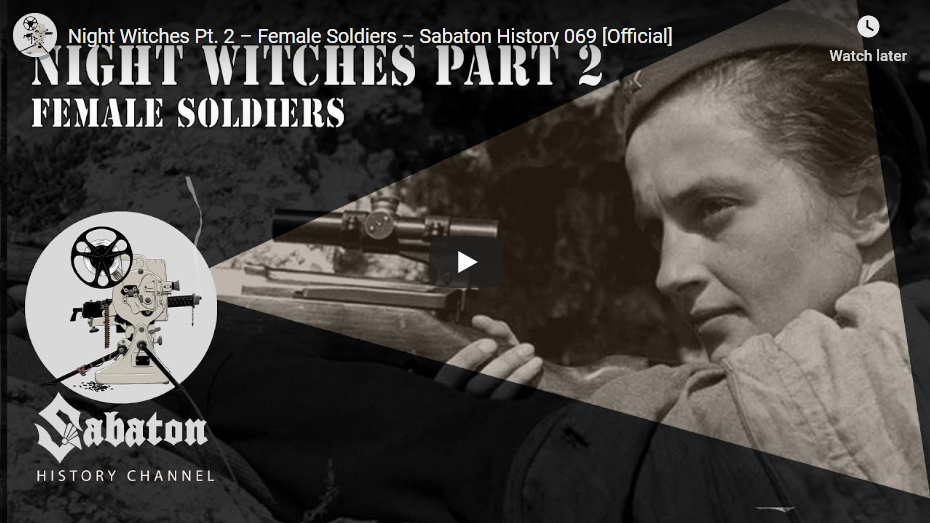
“Night Witches” – Female Soviet Pilots – Sabaton History 050 [Official]

Filed under: History, Media, Military, Russia, WW2 — Tags: , , , , , , — Nicholas @ 06:00

Sabaton History
Published 18 Jan 2020

This episode is about the Soviet 588th bomber regiment. They were all-female and got the nickname “Night Witches” from the sound their planes made after they killed their engines for maximum effect. This sound made German think of the broomsticks of witches, and they called them “Nachthexen“.

Support Sabaton History on Patreon: https://www.patreon.com/sabatonhistory

Listen to Heroes (where “Night Witches” is featured):
CD: http://bit.ly/HeroesStore
Spotify: http://bit.ly/HeroesSpotify
Apple Music: http://bit.ly/HeroesAppleMusic
iTunes: http://bit.ly/HeroesiTunes
Amazon: http://bit.ly/HeroesAmz
Google Play: http://bit.ly/HeroesGoogleP

Watch the official lyric video of “Night Witches” here: https://www.youtube.com/watch?v=C7NSU…

Listen to Sabaton on Spotify: http://smarturl.it/SabatonSpotify
Official Sabaton Merchandise Shop: http://bit.ly/SabatonOfficialShop

Hosted by: Indy Neidell
Written by: Markus Linke and Indy Neidell
Directed by: Astrid Deinhard and Wieke Kapteijns
Produced by: Pär Sundström, Astrid Deinhard and Spartacus Olsson
Creative Producer: Joram Appel
Executive Producers: Pär Sundström, Joakim Broden, Tomas Sunmo, Indy Neidell, Astrid Deinhard, and Spartacus Olsson
Post-Production Director: Wieke Kapteijns
Edited by: Iryna Dulka
Sound Editing by: Marek Kaminski
Maps by: Eastory – https://www.youtube.com/c/eastory

Eastory YouTube Channel: https://www.youtube.com/channel/UCEly…
Archive by: Reuters/Screenocean https://www.screenocean.com
Music by Sabaton.

Colorizations:
– Olga Shirnina a.k.a. Klimbim – https://klimbim2014.wordpress.com/

Sources:
– Tver United State Museum
– Photo of the instructor Semeon Lykin and a group of pilots posing in front of a Polikarpov Po-2 courtesy of Franco Folini on Flickr
– Po-2 “Sudstroitel”; 588th night light bomber aviation regiment – all courtesy of Segey G on Flickr
– SA-kuva 39220
– Sniper scope icon by DTDesign from the Noun Project

An OnLion Entertainment GmbH and Raging Beaver Publishing AB co-Production.

© Raging Beaver Publishing AB, 2019 – all rights reserved.

Mao Against Everyone – China at War and Civil War – WW2 – 073 – January 18, 1941

Filed under: Britain, China, France, History, Italy, Military, WW2 — Tags: , , , , , , , — Nicholas @ 04:00

World War Two
Published 18 Jan 2020

The Chinese Communists and Nationalists clash while they’re also both facing Japanese armies in the North. And although the Communists are not the obvious victor this week, the battle has bigger ramifications. Other action takes place in Cambodia and the Mediterranean.

Join us on Patreon: https://www.patreon.com/TimeGhostHistory
Or join The TimeGhost Army directly at: https://timeghost.tv

Follow WW2 day by day on Instagram @World_war_two_realtime https://www.instagram.com/world_war_t…
Join our Discord Server: https://discord.gg/D6D2aYN.
Between 2 Wars: https://www.youtube.com/playlist?list…
Source list: http://bit.ly/WW2sources

Written and Hosted by: Indy Neidell
Produced and Directed by: Spartacus Olsson and Astrid Deinhard
Executive Producers: Bodo Rittenauer, Astrid Deinhard, Indy Neidell, Spartacus Olsson
Creative Producer: Joram Appel
Post-Production Director: Wieke Kapteijns
Research by: Indy Neidell
Edited by: Mikołaj Cackowski
Map animations: Eastory (https://www.youtube.com/c/eastory)

Colorizations by:
– Dememorabilia – https://www.instagram.com/dememorabilia/
– Julius Jääskeläinen – https://www.facebook.com/JJcolorization/

Sources:
Imperial War Museum (E872; E 6600)
Narodowe Archiwum Cyfrowe

Soundtracks from Epidemic Sound:
Phoenix Tail – “At the Front”
Johannes Bornlof – “Death And Glory 2”
Johannes Bornlof – “Last Man Standing 3”
Yi Nantiro – “Watchman”
Johan Hynynen – “Dark Beginning”
Reynard Seidel – “Deflection”
Bonnie Grace – “Imperious”

Archive by Screenocean/Reuters https://www.screenocean.com.

A TimeGhost chronological documentary produced by OnLion Entertainment GmbH.

January 18, 2020

Tank Chats #59 Sherman Grizzly | The Tank Museum

Filed under: Cancon, History, Military, USA, WW2 — Tags: , , , — Nicholas @ 02:00

The Tank Museum
Published 16 Nov 2018

David Willey, Tank Museum Curator, presents a Tank Chat on the Sherman Grizzly.

This version of the Sherman was built in Canada from October 1943. After the fall of France, the Canadians began making their own vehicles, beginning with the Ram tank based on the M3 Lee chassis before moving on to a modified M4 Sherman. Only about 180 were produced.

This vehicle is currently on loan to the Heeresgeschichtliches Museum Wien.

Support the work of The Tank Museum on Patreon: ► https://www.patreon.com/tankmuseum

Visit The Tank Museum SHOP: ► https://tankmuseumshop.org/
Twitter: ► https://twitter.com/TankMuseum
Tiger Tank Blog: ► http://blog.tiger-tank.com/
Tank 100 First World War Centenary Blog: ► http://tank100.com/ #tankmuseum #tanks #tankchats

January 17, 2020

Zionism, Arabism & Colonialism in the Middle East | BETWEEN 2 WARS I 1936 Part 1 of 3

Filed under: Britain, France, History, Middle East, Military — Tags: , , , , , , — Nicholas @ 06:00

TimeGhost History
Published 16 Jan 2020

After more than twenty years of colonial management, promises made but few promises kept and ethnic & cultural clashes in the area, unrest in the Middle East erupts in violence. A series of movements originate in this time, with long lasting consequences.

Watch our episode about the Middle east in the 1920s here: https://youtu.be/y6tSvRbvh2s

Join us on Patreon: https://www.patreon.com/TimeGhostHistory

Hosted by: Indy Neidell
Written by: Joram Appel
Directed by: Spartacus Olsson and Astrid Deinhard
Executive Producers: Bodo Rittenauer, Astrid Deinhard, Indy Neidell, Spartacus Olsson
Creative Producer: Joram Appel
Post-Production Director: Wieke Kapteijns
Research by: Joram Appel
Fact-Checking by: Jonas Srouji
Edited by: Daniel Weiss
Sound design: Marek Kaminski

Sources:
Arab by LINECTOR from the Noun Project
Bomb by P Thanga Vignesh from the Noun Project

Colorizations by:
– Dememorabilia – https://www.instagram.com/dememorabilia/
– Adrien.Colorisation – https://instagram.com/adrien.colorisa…
– Norman Stewart

Soundtracks from Epidemic Sound:
– “Dawn Of Civilization” – Jo Wandrini
– “The Inspector 4” – Johannes Bornlöf
– “Easy Target” – Rannar Sillard
– “First Responders” – Skrya
– “Not Safe Yet” – Gunnar Johnsen
– “Deflection” – Reynard Seidel
– “The Charleston 3” – Håkan Eriksson

A TimeGhost chronological documentary produced by OnLion Entertainment GmbH.

From the comments:

TimeGhost History
42 minutes ago (edited)
We have already covered “Carving up the Middle East” in one of our first Between Two Wars episodes (watch here: https://youtu.be/y6tSvRbvh2s), but we felt like we had to return to the area one more time as all that carving had quite some consequences. This means that a large part of this episode is about colonialism, Zionism, Arabism, race and ethnicity. I’m also aware of the complicated modern-day conflict in the area, many of which originate in [the events covered in] this episode. However, we would like the comment section to be reserved for debating the history. We’re not going to engage with people discussing modern-day issues and politics, and we’re going to be quite strict in monitoring any racist or otherwise hateful comments.

Cheers,
Joram

SdKfz 2 Kettenkrad: Germany’s Halftrack Motorcycle

Filed under: Germany, History, Military, Technology, WW2 — Tags: , , , — Nicholas @ 04:00

Forgotten Weapons
Published 16 Jan 2020

http://www.patreon.com/ForgottenWeapons

https://www.floatplane.com/channel/Fo…

Cool Forgotten Weapons merch! http://shop.bbtv.com/collections/forg…

The Sd.Kfz. 2 Kettenkraftrad (aka Kettenrad) is a deliciously German sort of vehicle, a small utility tractor made with a pair of treads and motorcycle front wheel. It was powered by a 4 cylinder Opel automotive engine generating 36 horsepower, and had a 3-speed gearbox with high and low range transfer case. Top speed was 44 mph, and it could tow about 1,000 pounds of ammunition or other supplies in a small 2-wheeled trailer, or directly tow light artillery pieces.

The vehicle was developed in 1939, and in mass production in time to see substantial use in Operation Barbarossa; the German invasion of Russia. Although complex to maintain and expensive to produce, the Kettenkrad was quite well suited to the terrain and distances of the Eastern Front. As the war progressed and supplies became scarcer and artillery became heavier it was less universally useful, but remained in service until the very end of the war, tasked with jobs as mundane as towing aircraft at airfields. After the war, they were put into civilian agricultural service (much like the Jeep in the US).

This example is in the rental fleet at DriveTanks.com, available for instruction and driving to anyone. It is one of my very favorite vehicles from World War Two, and I really appreciate DriveTanks giving me the opportunity to do some driving on it and show it to you! See all their available rentals here:

https://www.drivetanks.com

Contact:
Forgotten Weapons
6281 N. Oracle #36270
Tucson, AZ 85740

« Newer PostsOlder Posts »

Powered by WordPress