Jabzy
Published 9 Mar 2015I cut quite a bit out to save time. I’ll try and do a video on the Protectorate or the Restoration soon.

Jabzy
Published 9 Mar 2015I cut quite a bit out to save time. I’ll try and do a video on the Protectorate or the Restoration soon.
TimeGhost History
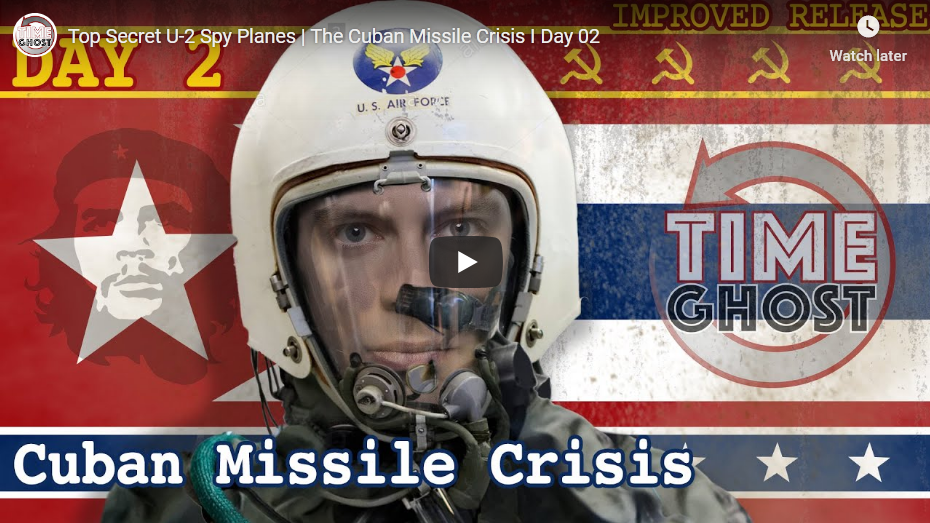
Published 8 Jul 2020On October 17th, 1962, the U2 Dragon Lady spy plane yield more alarming pictures of Cuban missile sites and President Kennedy is urged to restrain his dogs of war.
Join us on Patreon: https://www.patreon.com/TimeGhostHistory
Hosted by: Indy Neidell
Written by: Spartacus Olsson
Director: Astrid Deinhard
Producers: Astrid Deinhard and Spartacus Olsson
Executive Producers: Astrid Deinhard, Indy Neidell, Spartacus Olsson, Bodo Rittenauer
Creative Producer: Joram Appel
Post-Production Director: Wieke Kapteijns
Research by: Spartacus Olsson
Edited by: Daniel Weiss
Sound design: Marek KaminskiColorizations:
– Carlos Ortega Pereira (BlauColorizations) – https://www.instagram.com/blaucoloriz…Soundtracks from Epidemic Sound:
– “Cold Eyes” – Elliot Holmes
– “Car Chase in Virginia” – White Bones
– “Moving to Disturbia” – Experia
– “Zoot Suit” – Elliot Holmes
– “From the Depths” – Walt Adams
– “When They Fell” – Wendel SchererArchive by Screenocean/Reuters https://www.screenocean.com.
A TimeGhost chronological documentary produced by OnLion Entertainment GmbH.
World War Two
Published 7 Jul 2020Unlike the German Army, which for the most part had many idle months over the past year, the German Air Force — the Luftwaffe — has seen constant action in the Battle of Britain and the Mediterranean Theater. How did this affect its preparations and plans for the invasion of the Soviet Union?
Join us on Patreon: https://www.patreon.com/TimeGhostHistory
Or join The TimeGhost Army directly at: https://timeghost.tvFollow WW2 day by day on Instagram @World_war_two_realtime https://www.instagram.com/world_war_two_realtime
Between 2 Wars: https://www.youtube.com/playlist?list…
Source list: http://bit.ly/WW2sourcesWritten and Hosted by: Indy Neidell
Director: Astrid Deinhard
Producers: Astrid Deinhard and Spartacus Olsson
Executive Producers: Astrid Deinhard, Indy Neidell, Spartacus Olsson, Bodo Rittenauer
Creative Producer: Joram Appel
Post-Production Director: Wieke Kapteijns
Research by: Indy Neidell
Edited by: Mikołaj Cackowski
Sound design: Marek Kamiński
Map animations: Eastory (https://www.youtube.com/c/eastory)Colorizations by:
Jaris Almazani (Artistic Man), https://instagram.com/artistic.man?ig…
Dememorabilia – https://www.instagram.com/dememorabilia/
Cassowary Colorizations https://www.flickr.com/photos/cassowa…Sources:
Messerschmitt Bf 110, courtesy ElwoodB https://commons.wikimedia.org/wiki/Fi…
Junkers_Ju_87B-2_Stuka by Kaboldy https://commons.wikimedia.org/wiki/Fi…
Bundesarchiv
IWM E 3064E, E 3066E, A 4153Soundtracks from the Epidemic Sound:
Phoenix Tail – “At the Front”
Johannes Bornlof – “The Inspector 4”
Reynard Seidel – “Deflection”
Philip Ayers – “Trapped In A Maze”
Rannar Sillard – “March Of The Brave 4”
Fabien Tell – “Last Point Of Safe Return”
Johan Hynynen – “Dark Beginning”Archive by Screenocean/Reuters https://www.screenocean.com.
A TimeGhost chronological documentary produced by OnLion Entertainment GmbH.
TimeGhost History
Published 7 Jul 2020On 16 October 1962, the Cuban Missile Crisis begins. President Kennedy assembles his advisors in EXCOMM to find an adequate response to the threat posed by Soviet nuclear missiles on Cuba.
Join us on Patreon: https://www.patreon.com/TimeGhostHistory
Hosted by: Indy Neidell
Written by: Spartacus Olsson
Director: Astrid Deinhard
Producers: Astrid Deinhard and Spartacus Olsson
Executive Producers: Astrid Deinhard, Indy Neidell, Spartacus Olsson, Bodo Rittenauer
Creative Producer: Joram Appel
Post-Production Director: Wieke Kapteijns
Research by: Spartacus Olsson
Edited by: Daniel Weiss
Sound design: Marek KaminskiColorizations:
– Carlos Ortega Pereira (BlauColorizations) – https://www.instagram.com/blaucoloriz…Soundtracks from Epidemic Sound:
– “Cold Eyes” – Elliot Holmes
– “Zoot Suit” – Elliot Holmes
– “Juvenile Delinquent” – Elliot Holmes
– “Scope” – Got Happy
– “Nightclub Standoff” – Elliot Holmes
– “When They Fell” – Wendel SchererArchive by Screenocean/Reuters https://www.screenocean.com.
A TimeGhost chronological documentary produced by OnLion Entertainment GmbH.
Forgotten Weapons
Published 12 May 2016http://www.patreon.com/ForgottenWeapons
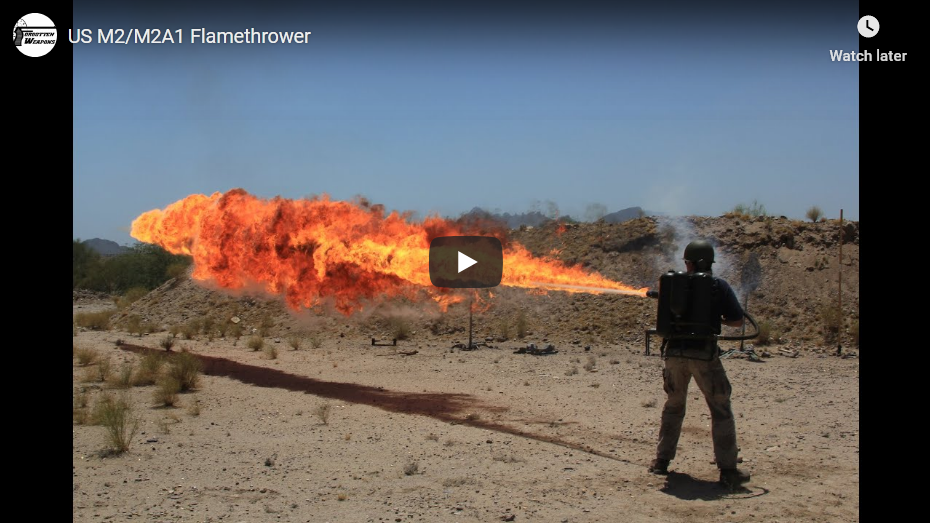
After a dismal first attempt at designing a flamethrower (the M1) in 1941, the US Chemical Corps along with several universities and industrial partners put in a lot of research to develop a more usable and effective flamethrower. The result was the M2, which went into production in early 1944. It would prove to be an exceptionally effective weapon in the island-hopping campaign towards the end of the war.
The M2 was arguably the best flamethrower fielded by any military during the war, with a number of excellent design features. These included:
* A constant-pressure regulator to ensure that the range stayed the same from the first to the last shot of a tank of fuel
* An on/off main valve easily accessible to the operator
* A supremely waterproof and reliable pyrotechnic cartridge ignition system
* An auto-shutoff valve which sealed at the nozzle, preventing dribble (and cutting off fuel flow should the operator lose control of the weapon)The M2 would see service into the Vietnam War even as its successor the M9 was being issued. It was a truly outstanding design, and remains viable to this day.
Thanks to Charlie Hobson for showing us the unit and teaching me to fire it, and also thanks to Adaptive Firearms for letting us use their range facilities!
You can find Charlie Hobson’s book, US Portable Flamethrowers here:
http://amzn.to/1SP9yc5
TimeGhost History
Published 6 Jul 2020The year before Soviet Premier Nikita Khrushchev places nuclear missiles on Cuba, the Soviets blow up the biggest atomic bomb ever detonated. If it blew up over Paris, millions would die.
Join us on Patreon: https://www.patreon.com/TimeGhostHistory
Try Nukemap here: https://nuclearsecrecy.com/nukemap/
Hosted by: Indy Neidell
Written by: Spartacus Olsson
Director: Astrid Deinhard
Producers: Astrid Deinhard and Spartacus Olsson
Executive Producers: Astrid Deinhard, Indy Neidell, Spartacus Olsson, Bodo Rittenauer
Creative Producer: Joram Appel
Post-Production Director: Wieke Kapteijns
Research by: Spartacus Olsson
Edited by: Daniel Weiss
Sound design: Marek KaminskiColorizations:
– Carlos Ortega Pereira (BlauColorizations) – https://www.instagram.com/blaucoloriz…Sources:
RIA Novosti archive, image #35173, image #793499.
https://flickr.com/photos/102221463@N…From the Noun Project:
Mountain – By Harold Weaver
Mushroom Cloud – By yanti, ID
destroyed house – by Gan Khoon Lay
Hospital – By Hare Krishna, IN
Fire Station – By Florian Maier
School – David
Church – by Karla Design
Paris – By Vonn WeisenbergerSoundtracks from Epidemic Sound:
– “Cold Eyes” – Elliot Holmes
– “Scope” – Got Happy
– “Juvenile Delinquent” – Elliot Holmes
– “Moving to Disturbia” – Experia
– “Zoot Suit” – Elliot Holmes
– “From the Depths” – Walt Adams
– “Car Chase in Virginia” – White BonesArchive by Screenocean/Reuters https://www.screenocean.com.
A TimeGhost chronological documentary produced by OnLion Entertainment GmbH.
Niall Ferguson on the rapid drop in temperature in US/Chinese relations in the last eight years:
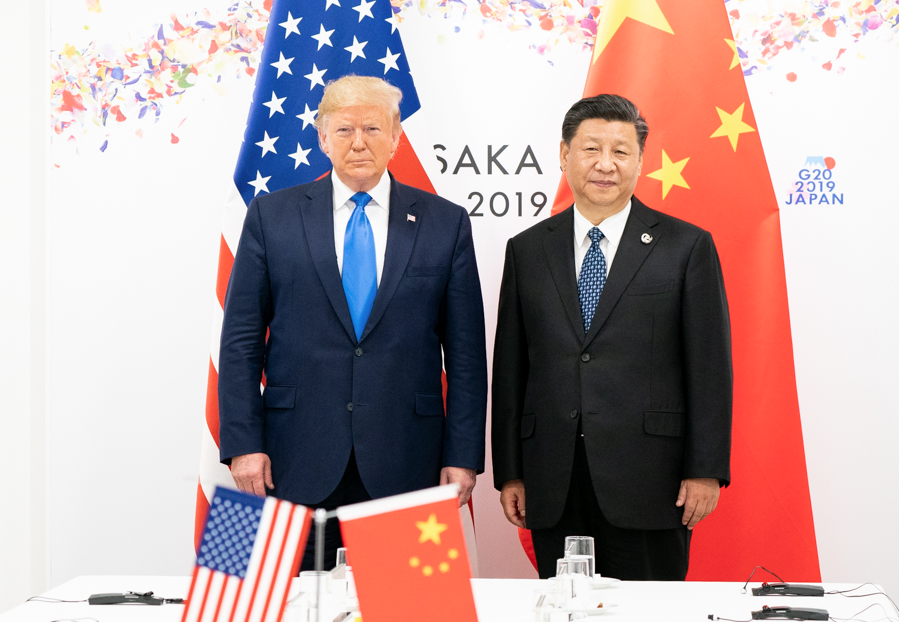
President Donald Trump and PRC President Xi Jinping at the G20 Japan Summit in Osaka, 29 June, 2019.
Cropped from an official White House photo by Shealah Craighead via Wikimedia Commons.
“We are in the foothills of a Cold War.” Those were the words of Henry Kissinger when I interviewed him at the Bloomberg New Economy Forum in Beijing last November.
The observation in itself was not wholly startling. It had seemed obvious to me since early last year that a new Cold War — between the U.S. and China — had begun. This insight wasn’t just based on interviews with elder statesmen. Counterintuitive as it may seem, I had picked up the idea from binge-reading Chinese science fiction.
First, the history. What had started out in early 2018 as a trade war over tariffs and intellectual property theft had by the end of the year metamorphosed into a technology war over the global dominance of the Chinese company Huawei Technologies Co. in 5G network telecommunications; an ideological confrontation in response to Beijing’s treatment of the Uighur minority in China’s Xinjiang region and the pro-democracy protesters in Hong Kong; and an escalation of old frictions over Taiwan and the South China Sea.
Nevertheless, for Kissinger, of all people, to acknowledge that we were in the opening phase of Cold War II was remarkable.
Since his first secret visit to Beijing in 1971, Kissinger has been the master-builder of that policy of U.S.-Chinese engagement which, for 45 years, was a leitmotif of U.S. foreign policy. It fundamentally altered the balance of power at the mid-point of the Cold War, to the disadvantage of the Soviet Union. It created the geopolitical conditions for China’s industrial revolution, the biggest and fastest in history. And it led, after China’s accession to the World Trade Organization, to that extraordinary financial symbiosis which Moritz Schularick and I christened “Chimerica” in 2007.
How did relations between Beijing and Washington sour so quickly that even Kissinger now speaks of Cold War?
The conventional answer to that question is that President Donald Trump has swung like a wrecking ball into the “liberal international order” and that Cold War II is only one of the adverse consequences of his “America First” strategy.
Yet that view attaches too much importance to the change in U.S. foreign policy since 2016, and not enough to the change in Chinese foreign policy that came four years earlier, when Xi Jinping became general secretary of the Chinese Communist Party. Future historians will discern that the decline and fall of Chimerica began in the wake of the global financial crisis, as a new Chinese leader drew the conclusion that there was no longer any need to hide the light of China’s ambition under the bushel that Deng Xiaoping had famously recommended.
Brad Polumbo reports on the split between Republican voters and Republican Senators on ending the US military involvement in Afghanistan:
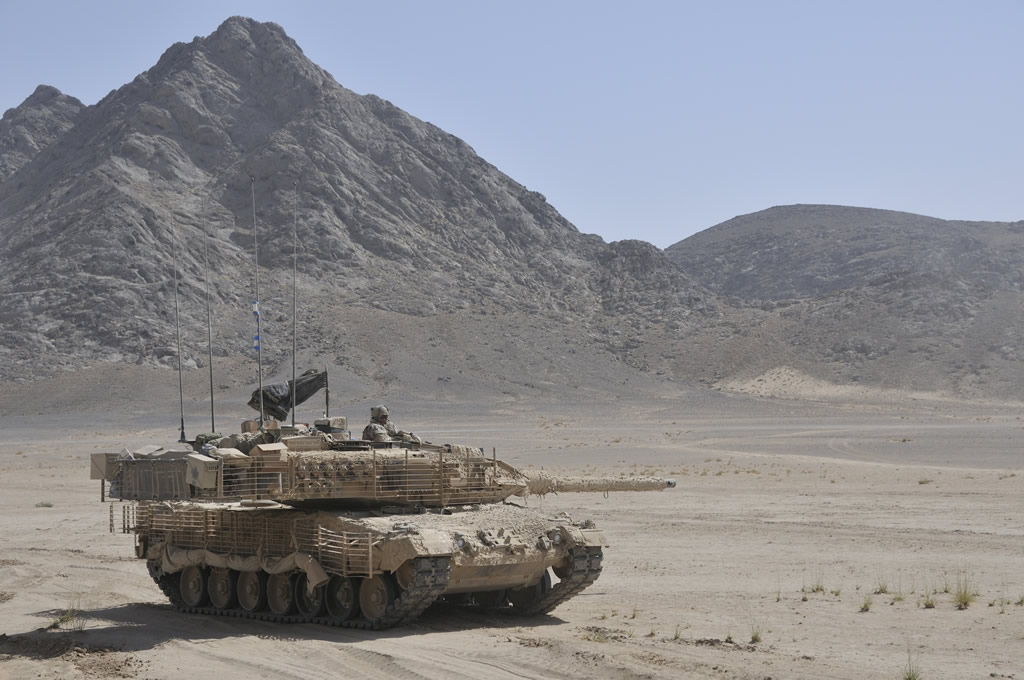
Leopard 2A6M in Afghanistan
Applied to the Middle East, the America First framework is intuitive — our military misadventures in countries like Iraq, Libya, and Afghanistan have cost the U.S. tremendously yet failed to further our interests. Once the party of hawks and idealists, Republican voters are now firmly in the America First camp. According to The Intercept, 81% of 2016 Trump voters support removing troops from Afghanistan.
Unfortunately, this shift in views has not been represented in Congress. Most Senate Republicans just explicitly voted against ending the war in Afghanistan.
On Wednesday evening, Sen. Rand Paul, a libertarian-leaning Kentucky Republican, introduced an amendment to the National Defense Authorization Act that would have brought our troops home from Afghanistan, given those soldiers who served a bonus, and repealed the authorization of force Congress passed in 2001. But in a 60 to 33 vote, the Senate shot it down, with only three Republicans in addition to Paul — Sens. Mike Lee, Mike Braun, and Steve Daines — backing the amendment.
“Our amendment [would] finally and completely end the War in Afghanistan,” Paul said on the Senate floor. “Over 4,000 Americans have died in Afghanistan and over 20,000 have been wounded. It’s time to bring our soldiers home.”
“It is not sustainable to keep fighting in Afghanistan generation after generation,” he continued. “In fact, we now have soldiers who were born after 9/11 serving in Afghanistan.”
“We’ve been there for 20 years,” the senator said. “How can we characterize withdrawal after 20 years, after we defeated the enemy, as ‘precipitous’? It’s crazy. The American people say, ‘Come home,’ and this is your chance.”
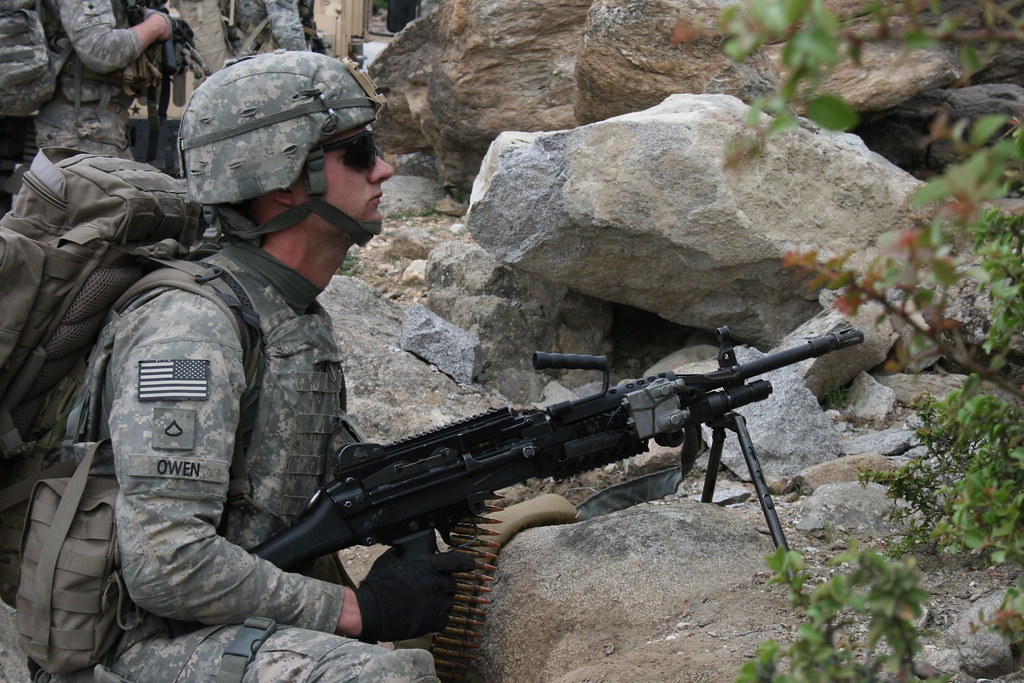
“Afghanistan 2010 43” by david_axe is licensed under CC BY-NC 2.0


Townsends
Published 24 Feb 2020Visit Our Website! ➧ http://www.townsends.us/ ➧➧
Help support the channel with Patreon ➧ https://www.patreon.com/townsend ➧➧
Instagram ➧ townsends_official

World War Two
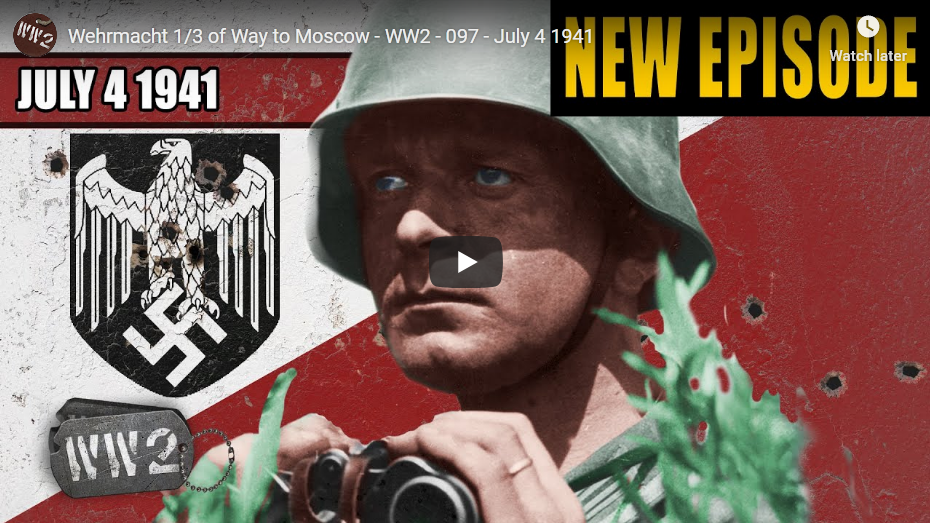
Published 4 Jul 2020Operation Barbarossa continues this week but is already running into problems that are gonna be hard to fix. The Japanese are thinking future war strategy, while the British set up a focused research program on nuclear power and atom bombs…
Join us on Patreon: https://www.patreon.com/TimeGhostHistory
Or join The TimeGhost Army directly at: https://timeghost.tvFollow WW2 day by day on Instagram @World_war_two_realtime https://www.instagram.com/world_war_two_realtime
Between 2 Wars: https://www.youtube.com/playlist?list…
Source list: http://bit.ly/WW2sourcesWritten and Hosted by: Indy Neidell
Director: Astrid Deinhard
Producers: Astrid Deinhard and Spartacus Olsson
Executive Producers: Astrid Deinhard, Indy Neidell, Spartacus Olsson, Bodo Rittenauer
Creative Producer: Joram Appel
Post-Production Director: Wieke Kapteijns
Research by: Indy Neidell
Edited by: Iryna Dulka
Sound design: Marek Kamiński
Map animations: Eastory (https://www.youtube.com/c/eastory)
Map consultants: Rabih Rached and Patrick AdaimyColorizations by:
– Daniel Weiss
– Julius Jääskeläinen – https://www.facebook.com/JJcolorization/
– Cassowary Colorizations
– Jaris Almazani (Artistic Man) – https://instagram.com/artistic.man?ig…Sources:
– SA-Kuva
– museum.ru
– National Portrait Gallery
– Weight by Vadim Solomakhin from the Noun Project
– Imperial War Museum: FL1204
– Narodowe Archiwum Cyfrowe
– Bundesarchiv, CC-BY-SA 3.0: Bild_101I-186-0199-12A, Bild_101I-208-0027-04A, Bild_183-B10901
– Yad Vashem Photo Archives, 46405, https://photos.yadvashem.org/photo-de…Archive by Screenocean/Reuters https://www.screenocean.com.
A TimeGhost chronological documentary produced by OnLion Entertainment GmbH.
Forgotten Weapons
Published 20 Mar 2020http://www.patreon.com/ForgottenWeapons
https://www.floatplane.com/channel/Fo…
Cool Forgotten Weapons merch! http://shop.bbtv.com/collections/forg…
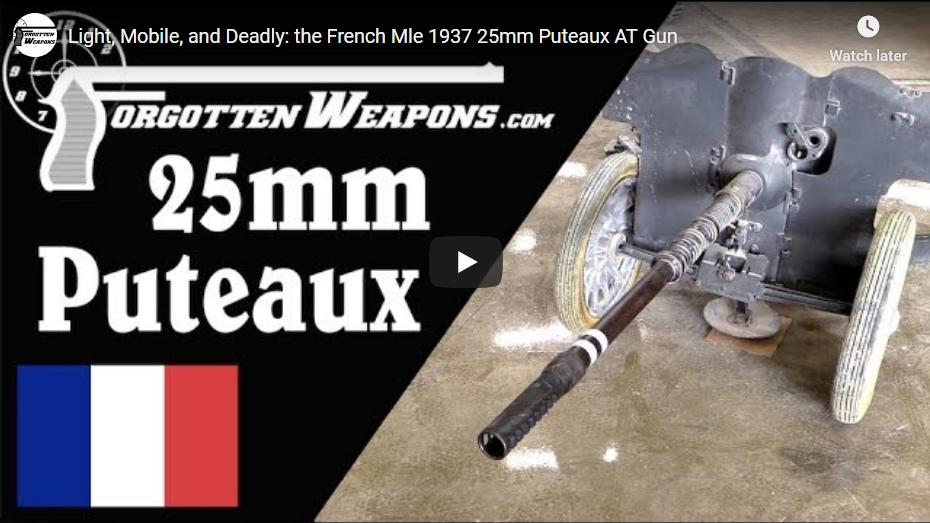
After World War One, the French military set up a program to modernize all of its weaponry, and that included a replacement for the Mle 1916 light infantry cannon. An anti-tank gun had not been necessary during the Great War, as Germany never fielded tanks in substantial numbers — but as a pioneer of the modern tank, the French recognized the need for a good AT gun. Taking a lesson from World War One, they wanted a light gun that was flexible and mobile, easily moved around the battlefield and easily concealed from enemy fire. A 25mm cartridge was specified, and both the Hotchkiss company and the Puteaux arsenal created guns to use it. Both were adopted into service, with the Hotchkiss Mle 1934 being a bit heavier and the Puteaux Mle 1937 being a bit lighter, at only about 600 pounds. The Puteaux gun was quite small, easily moved by a horse or virtually any motorized vehicle. It had a long barrel and the 25mm AP projectile had a muzzle velocity of about 3150 fps, making it quite effective on the light and medium tanks of the 1930s. It was also remarkably accurate, and the long barrel and flash hider gave it a very small firing signature. Aiming was done with either a 4x magnified optic or a set of backup iron sights.
A total of 1285 of these guns were made before the armistice of June 1940, and they served ably in the Battle of France. A few were also used by the British before Dunkirk, and after the armistice they were used by German forces in limited numbers, and also supplied to Spain and Finland as military aid (this particular one has a Finnish property tag on it).
Thanks to DriveTanks.com in Uvalde Texas for giving me access to film this Puteaux cannon for you!
Contact:
Forgotten Weapons
6281 N. Oracle #36270
Tucson, AZ 85740
Atun-Shei Films
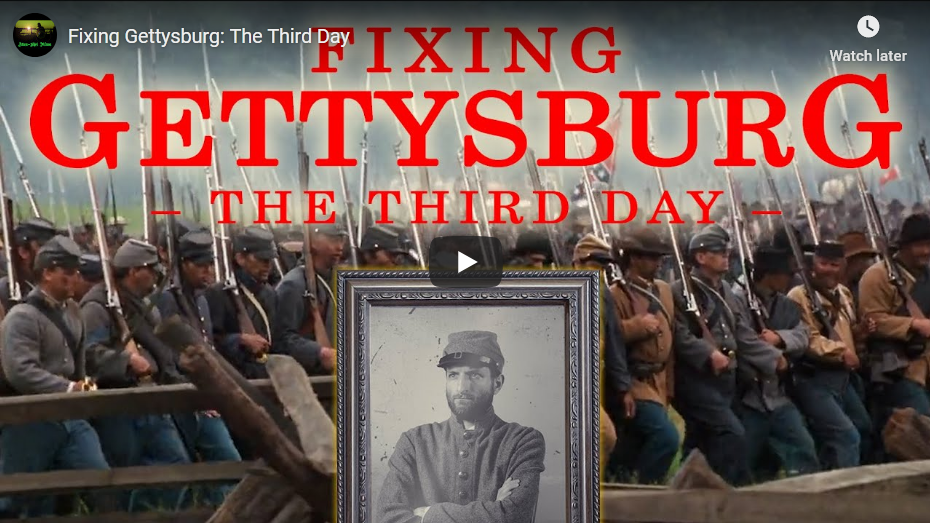
Published 3 Jul 2020In this three-part series, I review a classic Ron Maxwell film about a little known historical event that no one talks about called the Battle of Gettysburg. I also present an abbreviated and oversimplified history of the battle, while simultaneously criticizing the movie for presenting an abbreviated and oversimplified history of the battle.
In the third episode, I discuss the third day of fighting on July 3, 1863 – including the morning scrap on Culp’s Hill, East Cavalry Field, and Pickett’s Charge.
Support Atun-Shei Films on Patreon ► https://www.patreon.com/atunsheifilms
Leave a Tip via Paypal ► https://www.paypal.me/atunsheifilms (Between now and October, all donations made here will go toward the production of The Sudbury Devil, our historical feature film)
#Gettysburg #CivilWar #VideoEssay
Watch our film ALIEN, BABY! free with Prime ► http://a.co/d/3QjqOWv
Reddit ► https://www.reddit.com/r/atunsheifilms
Twitter ► https://twitter.com/atun_shei
Instagram ► https://www.instagram.com/atunsheifilms
Merch ► https://atun-sheifilms.bandcamp.com~REFERENCES~
[1] Frederick Tilberg, Scott Hartwig, John Heiser: Gettysburg National Military Park Handbook (2013). Historic Map and Print Company, Page 49
[2] James Longstreet: From Manassas to Appomattox, Da Capo Edition (1992). Da Capo Press, Page 392
[3] “Haskell’s Account of the Battle of Gettysburg”. Bartleby: Great Books Online https://www.bartleby.com/43/3504.html
[4] “East Cavalry Battlefield – Ranger John Nicholas” (2014). GettysburgNPS https://youtu.be/AfwBOOFFlXQ
The Australian government has embarked on a ten-year military expansion program that is clearly directed against recent Chinese bullying in the region:
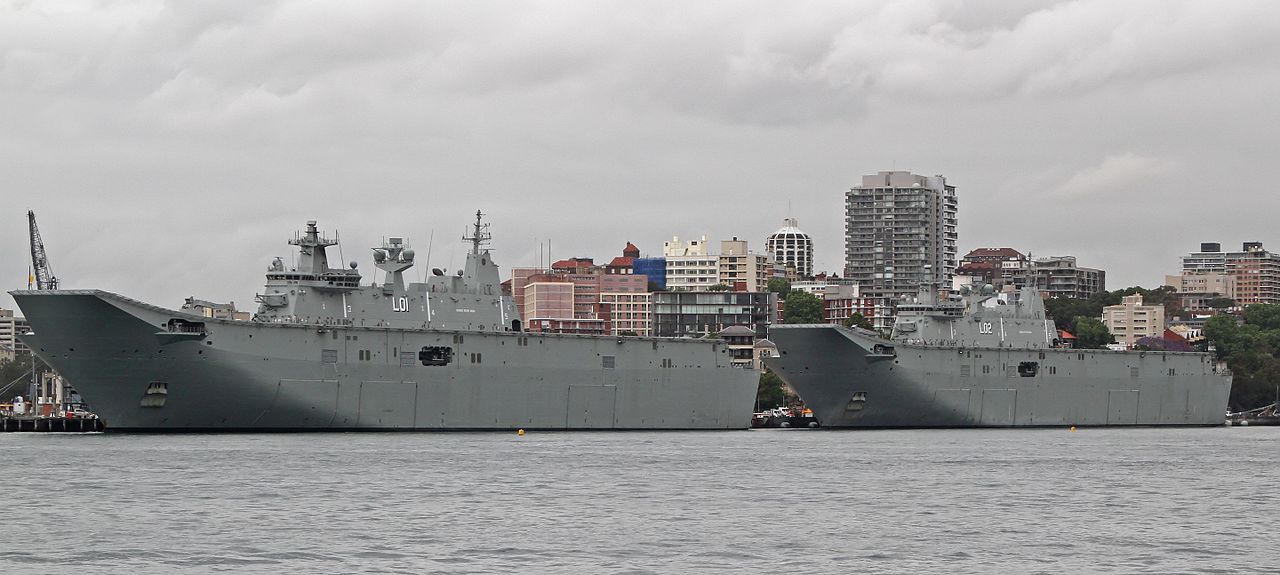
HMAS Adelaide (LHD 01) and HMAS Canberra (LHD 02), based on the Spanish navy’s Juan Carlos I landing helicopter dock built by Navantia, and commissioned in November 2014 (Canberra) and December 2015 (Adelaide).
Photo by Tony Hisgett via Wikimedia Commons.
[Australian PM] Scott Morrison has unveiled a more aggressive defence strategy aimed at countering the rise of China, while warning that Australia faces regional challenges on a scale not seen since World War II.
The strategy increases the focus on the Indo-Pacific region, with the Prime Minister warning that Australia needs to prepare for a post-COVID-19 world that is “poorer, more dangerous and more disorderly”.
Australia will build a larger military that is focused on its immediate backyard, including new long-range anti-ship missiles, signalling a major shift in the nation’s defence strategy.
“We have not seen the conflation of global economic and strategic uncertainty now being experienced here in Australia in our region since the existential threat we faced when the global and regional order collapsed in the 1930s and 1940s,” the Prime Minister warned.
Mr Morrison also announced a commitment to spend $270 billion over the next decade on defence capabilities, including more potent strike weapons, cyber capabilities and a high-tech underwater surveillance system.
Over the four years, the Australian Defence Force (ADF) is expected to grow by 800 people, comprising 650 extra personnel for the Navy, 100 for the Air Force, and 50 for the Army.
According to Defence’s 2019-20 Budget Statement, the ADF was estimated to grow to 60,090 by this year, with 16,272 full-time public service staff.
Its budget was expected to grow to 2 per cent of Australia’s gross domestic product by 2020-21, “equating to approximately $200 billion in Australia’s defence capability over 10 years”, making the new announcement an increase of $70 billion to the department.
In a speech at the Australian Defence Force Academy Mr Morrison argued the Indo-Pacific is the “epicentre” of rising strategic competition and “the risk of miscalculation — and even conflict — is heightening”.
Lindybeige
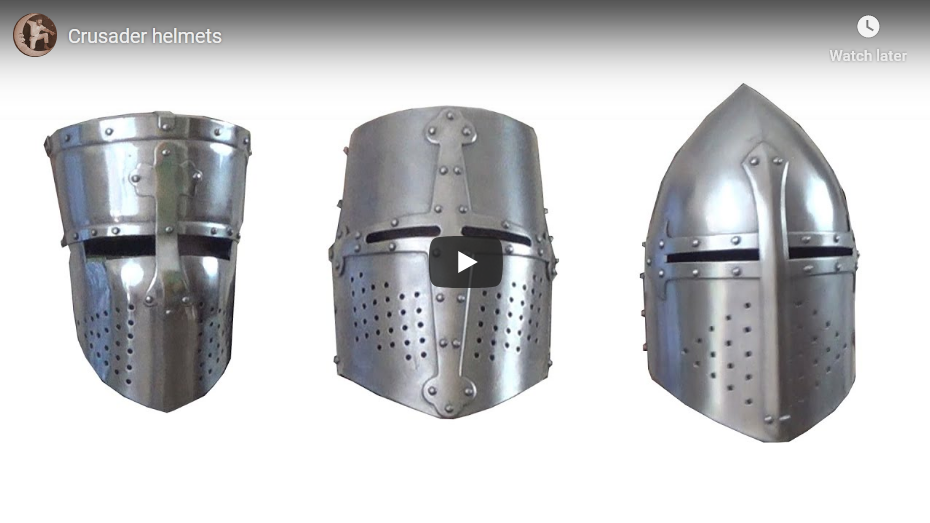
Published 4 Sep 2014Here I show you three common styles of crusader helmet, and I comment upon them.
Thanks to Dr David Tetard for the loan of his helmets. These particular ones were bought here:
www.getdressedforbattle.co.uk
http://www.kovexars.cz/index.php (HL 007 and 103)Lindybeige: a channel of archaeology, ancient and medieval warfare, rants, swing dance, travelogues, evolution, and whatever else occurs to me to make.
▼ Follow me…
Twitter: https://twitter.com/Lindybeige I may have some drivel to contribute to the Twittersphere, plus you get notice of uploads.
website: www.LloydianAspects.co.uk
Atun-Shei Films
Published 2 Jul 2020In this three-part series, I review a classic Ron Maxwell film about a little known historical event that no one talks about called the Battle of Gettysburg. I also present an abbreviated and oversimplified history of the battle, while simultaneously criticizing the movie for presenting an abbreviated and oversimplified history of the battle.
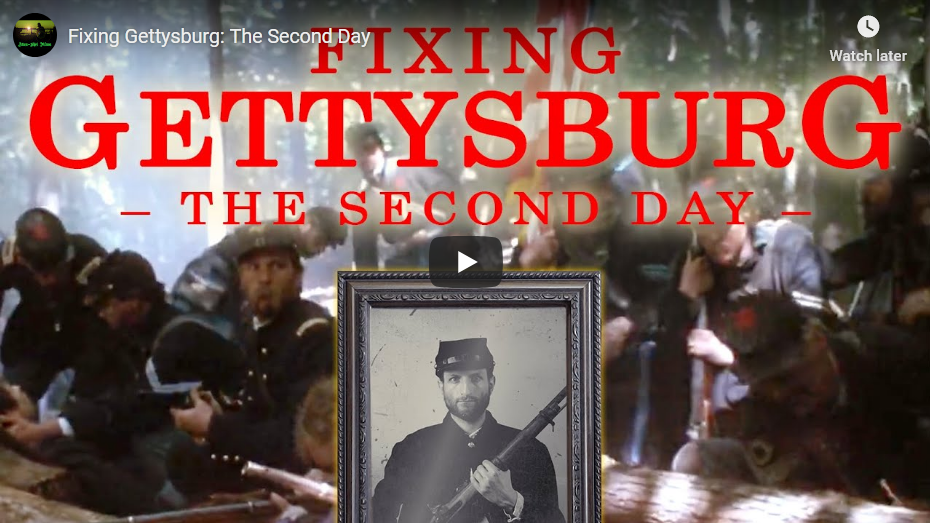
In the second episode, I discuss the first day of fighting on July 2, 1863 – including Dan Sickles’ shenanigans on the left, the 20th Maine on Little Round Top, the 1st Minnesota, and the night battle on Culp’s Hill.
Support Atun-Shei Films on Patreon ► https://www.patreon.com/atunsheifilms
Leave a Tip via Paypal ► https://www.paypal.me/atunsheifilms (Between now and October, all donations made here will go toward the production of The Sudbury Devil, our historical feature film)
#Gettysburg #CivilWar #VideoEssay
Watch our film ALIEN, BABY! free with Prime ► http://a.co/d/3QjqOWv
Reddit ► https://www.reddit.com/r/atunsheifilms
Twitter ► https://twitter.com/atun_shei
Instagram ► https://www.instagram.com/atunsheifilms
Merch ► https://atun-sheifilms.bandcamp.com~REFERENCES~
[1] Stephen W. Sears: “General Longstreet and the Lost Cause” (2005). American Heritage Magazine https://www.americanheritage.com/gene…
[2] W.C. Storrick: The Battle of Gettysburg (1931). J Horace McFarland Company, Page 26
[3] Frederick Tilberg, Scott Hartwig, John Heiser: Gettysburg National Military Park Handbook (2013). Historic Map and Print Company, Page 31-32
[4] Storrick, Page 27
[5] William B. Styple: Generals in Bronze (2005). Belle Grove Publishing Company, Page 222
[6] “The 1st Minnesota Infantry at Gettysburg” (2014). Iron Brigader https://ironbrigader.com/2014/01/03/1…
[7] Storrick, Page 29-30
[8] Tilberg, Hartwig, Heiser, Page 45



Powered by WordPress