Quotulatiousness

August 16, 2021

French and German Armies in 1870 – Dreyse and Chassepot Rifle Overview I GLORY & DEFEAT Week 3

Filed under: France, Germany, History, Military, Weapons — Tags: , , , , — Nicholas @ 04:00

realtimehistory
Published 29 Jul 2021

Sign up for Curiosity Stream and get Nebula bundled in and SAVE 26%: https://curiositystream.com/realtimeh…

While the French and different German Armies are gathering we are taking the time this week to take a look at military organization and warfare in 1870. As a special guest we also have Cap And Ball on the show who introduces the famous Chassepot and Dreyse rifles which will be important in this conflict.

» THANK YOU TO OUR CO-PRODUCERS
John Ozment
James Darcangelo
Jacob Carter Landt
Thomas Brendan

» OUR PODCAST
https://realtimehistory.net/podcast – interviews with historians and background info for the show.

» LITERATURE
Arand, Tobias: 1870/71. Die Geschichte des Deutsch-Französischen Krieges erzählt in Einzelschicksalen. Hamburg 2018
Delpérier, Louis; Mirouze, Laurent: Der Deutsch-Französische Krieg 1870/71. Bd. 2. Uniformierung und Ausrüstung der französischen Armeen. Wien 2020
Herre, Franz: Kaiser Wilhelm I. Der letzte Preuße. Köln 1980
Milza, Pierre: L’année terrible. La guerre franco-prussienne. Septembre 1870 – mars 1871. Paris 2009
Stein, Markus; Bauer, Gerhard: Der Deutsch-Französische Krieg 1870/71. Bd. 1. Uniformierung und Ausrüstung der deutschen Armeen. Wien 2020

» SOURCES
Fontane, Theodor: Der Krieg gegen Frankreich. Bd. 1. Berlin 1873
Kriegsgeschichtliche Abtheilung des Großen Generalstabs (Hg.): Der deutsch-französische Krieg 1870/71. Erster Theil. Erster Band. Berlin 1874
Pflugk-Harttung, Julius: Krieg und Sieg 1870-1871. Bd. 2 Berlin 1896

» OUR STORE
Website: https://realtimehistory.net

»CREDITS
Presented by: Jesse Alexander
Written by: Cathérine Pfauth, Prof. Dr. Tobias Arand, Jesse Alexander
Director: Toni Steller & Florian Wittig
Director of Photography: Toni Steller
Sound: Above Zero
Editing: Toni Steller
Motion Design: Philipp Appelt
Mixing, Mastering & Sound Design: http://above-zero.com
Maps: Battlefield Design
Research by: Cathérine Pfauth, Prof. Dr. Tobias Arand
Fact checking: Cathérine Pfauth, Prof. Dr. Tobias Arand

Channel Design: Battlefield Design

Contains licensed material by getty images
All rights reserved – Real Time History GmbH 2021

HMS Glamorgan – Computer Ship Of The Future (1967)

Filed under: Britain, History, Military, Technology, Weapons — Tags: , , , , — Nicholas @ 02:00

British Pathé
Published 13 Apr 2014

English Channel.

Top shots of the guided missile destroyer battleship HMS Glamorgan at sea. In the control/computer room a man pulls out old-fashioned computer records [circuit packs, I believe] from a large control cupboard; officers on the bridge look at dials and through binoculars. Various shots in steering, control and engine rooms as the ship moves along. On the flight deck sailors play hockey while others watch and cheer them on. A navigator on deck looks through a sextant while another officer makes notes. A helicopter is moved from a hanger out onto the deck and prepared for takeoff; firemen in asbestos suits and helmets stand by with a hose; the chopper takes off.

Three young men play guitars and banjos before a television camera in a tiny studio; we hear that the ship has its own closed circuit TV station; good shots of the filming; tape recording machines going round; picture being adjusted. Men in a mess room watch the performance on the television while they have a pint. Several shots of the sailors getting their rum rations. Various shots in the kitchens show food being prepared and served into the sailors mess tins; good canteen and catering shots (most of the food looks pretty unappetising) [the person writing the description clearly has no idea just how unappetizing British food could be in the 1960s … this looks well above average for the time]. In the sick bay a sailor gets a shot in the arm from the Medical Officer.

Several shots of the radar antennae on the ship and the men looking at the radar scanner screens in the control room. Men in protective gloves and hoods load shells in the gun turret; M/Ss of the main guns on the ship being fired. Several shots show the countdown for Seaslug missiles to be fired; men at control panels look at dials and radar screens; an officer counts down into a microphone (mute). Complicated boards of buttons show the location of the missiles, intercut with shots of the missiles moving into position by electronic instruction. The missiles move into the launchers on deck and are fired; men watch their progress on a radar screen. Another launcher moves into position; L/S of the ship as the missiles are fired.

Note: on file is correspondence and information about HMS Glamorgan. Cuts exist – see separate record. FILM ID:419.04

A VIDEO FROM BRITISH PATHÉ. EXPLORE OUR ONLINE CHANNEL, BRITISH PATHÉ TV. IT’S FULL OF GREAT DOCUMENTARIES, FASCINATING INTERVIEWS, AND CLASSIC MOVIES. http://www.britishpathe.tv/​

FOR LICENSING ENQUIRIES VISIT http://www.britishpathe.com/​

British Pathé also represents the Reuters historical collection, which includes more than 136,000 items from the news agencies Gaumont Graphic (1910-1932), Empire News Bulletin (1926-1930), British Paramount (1931-1957), and Gaumont British (1934-1959), as well as Visnews content from 1957 to the end of 1984. All footage can be viewed on the British Pathé website. https://www.britishpathe.com/

August 15, 2021

No Soviet Oil for Hitler – WW2 – 155 – August 14, 1942

World War Two
Published 14 Aug 2021

The Axis advance into the Caucasus is going great … except the oil towns they take have no oil, and wasn’t that the whole purpose? Meanwhile in the Pacific, the US Navy is suffering perhaps its greatest defeat ever off Savo Island, even as the Marines take Tulagi, Gavutu, and Tanambogo.
(more…)

Denel NTW 20: A Multi-Caliber Anti-Materiel Rifle

Filed under: Africa, Military, Weapons — Tags: , , , , — Nicholas @ 02:00

Forgotten Weapons
Published 7 Sep 2018

http://www.patreon.com/ForgottenWeapons​

Cool Forgotten Weapons merch! http://shop.bbtv.com/collections/forg…​

Created by noted South African gun designer Tony Neophytou, the NTW-20 is a bolt action anti-materiel rifle made in 20x82mm, 20x110mm, and 14.5x115mm. The weapon began as idea to use the large quantities of surplus 14.5mm ammunition available at the time, and a recognition that the 14.5mm Soviet cartridge was an excellent anti-armor round, with a really remarkably high muzzle velocity. To widen the rifle’s capabilities, it was decided to incorporate an easily interchangeable barrel, and also chamber it for the 20x82mm round used in the Inkunzi PAW individual weapon and Inkunzi Strike machine gun. The 20x82mm is low velocity compared to traditional 20mm cartridges, carrying the same explosive or incendiary payload but without the punishing recoil of what was originally an aircraft cannon cartridge.

Both of these cartridges are fed from a 3-round box magazine on the left side of the action. A single-shot version in the longer 20x110mm cartridge was also developed by request of a military client, but this cartridge is too long to fit the magazine. A version in .50 BMG was considered, but decided against on the basis of the 14.5mm being just as available and substantially more effective.

The gun is liberally sprinkled with clever engineering and design features — things like using the recoil-absorbing travel of the action to recock the hammer, and the use of both 20mm and 14.5mm cartridge cases as levers for unlocking the barrel. The optic was custom made for the rifle, an 8x56mm long eye relief scope to prevent any chance of the scope bell injuring the shooter during recoil. The trigger mechanism uses only a single spring, and is easily removed from the action. The bolt handle itself is on a pivot pin, and provides the primary extraction leverage to ensure easy cycling with the high-pressure 14.5mm cartridge.

From a military perspective, the NTW-20 is easily broken apart into barrel and action loads, and can be transported more easily than any comparable weapon by a two-man team. The use of a recoil buffer in the action and an effective muzzle brake makes it a remarkably pleasant 20mm rifle to fire. Of all the anti-material rifles I have fired (Lahti L39, Solothurn S18-1000, Mauser T-Gewehr), the NTW-20 was by far the most comfortable to shoot. It was also the only one in which I jumped at the chance to fire more rounds once the filming needs were met. It certainly has a kick, but not at all a painful one.

Many thanks to Denel Land Systems for allowing me to try out this very cool rifle!

If you enjoy Forgotten Weapons, check out its sister channel, InRangeTV! http://www.youtube.com/InRangeTVShow

August 14, 2021

Infantry Weapons at Guadalcanal – WW2 Special

Filed under: History, Japan, Military, Pacific, USA, Weapons, WW2 — Tags: , , , , , , , — Nicholas @ 04:00

Update: The folks at the World War Two channel have taken down this video due to technical errors in the script. Here’s their explanation.

World War Two
21 hours ago
Video on Infantry Arms at Guadalcanal retracted. Indy explains why:

Hi everyone. Indy here. As most of you know, I do the research and writing for all of the regular weekly episodes here. I host many of the specials as well, though I do not do the research for most of them- occasionally so, if it’s something that’s really in my field of expertise, like geopolitics, strategy, personal stories, communications, and international relations. The research for the other specials is done by a variety of specialists in their fields or historians, so we can maintain the quality you’ve come to expect from us. I understand, though, that many of you have serious issues with the research for the Guadalcanal infantry special. Our apologies for that- the research was done by an historian, a PhD [student], actually, and we also ensured it was double fact-checked, but obviously some serious mistakes slipped through. Live and learn. I will say that I think it is important that you continue to tell us when you take issue with something we present, since we strive to make the most complete and accurate documentary series possible, so although some of them are hard to read we appreciate such feedback from our community.

And this is from the researcher who worked on the script:

Marlon Londoño
18 hours ago
Hey guys! This is Marlon, the PhD student in question who helped with the researching and writing of the episode. Just to give a little background, I’m a volunteer researcher who helps with the channel over the summer while I’m not teaching/researching/taking coursework. I’m a military historian and my main academic focus is on social and cultural military history (i.e. what people’s wartime experiences were like and why. I’m especially interested in how people justify wartime violence and oftentimes the types of weapons they use play a role in that mental process, so that’s the context in which I usually think about weapons on the battlefield).

I’m sorry that I let a lot of you down with the mistakes about the Garand and Arisaka, among others. To be honest, I was surprised to learn they were myths. But I certainly know now, and I don’t think I’ll be forgetting any time soon 😅 One thing that I firmly believe as a researcher and educator is that nobody has a monopoly on the truth, least of all me. I tell that to my students on the first day of class each semester. I certainly don’t presume that the degree I’m pursuing makes me infallible or instantly qualified for anything. And this was a classic example of just how wrong I can be sometimes!

For what it’s worth, I love war history just as much as anyone else in the community, and I’m sorry that my research wasn’t as rigorous as it might otherwise have been. I hope you all might be willing to give any future episodes of mine a second chance, and of course I’m all ears for any mistakes that you want to point out!

August 13, 2021

Spycraft and the Special Operations Executive – WW2 – Spies & Ties 07

World War Two
Published 12 Aug 2021

Astrid talks about spying all the time, but what was it actually like for people on the ground? We look through the lens of the British Special Operations Executive (SOE) to find out!
(more…)

[Military 101] NATO Unit Counters – Niehorster Dialect

Filed under: History, Military — Tags: — Nicholas @ 02:00

Military History Visualized
Published 26 Jul 2016

» HOW YOU CAN SUPPORT MILITARY HISTORY VISUALIZED «
(A) You can support my channel on Patreon: https://www.patreon.com/join/mhv

(B) You can also buy “Spoils of War” (merchandise) in the online shop: https://www.redbubble.com/people/mhvi…​

» SOCIAL MEDIA LINKS «
twitter: https://twitter.com/MilHiVisualized​
tumblr: http://militaryhistoryvisualized.tumb…​

Script & Further Information: http://militaryhistoryvisualized.com/…​

—Sources—
–Websites & Links–

Niehorster – Military Organization Symbols Key
http://niehorster.org/000_admin/009_s…

https://en.wikipedia.org/wiki/NATO_Jo…

—Credits & Special Thanks—
The Counter-Design is heavily inspired by Black ICE Mod for the game Hearts of Iron 3 by Paradox Interactive
https://forum.paradoxplaza.com/forum/…​

—Song—-
Ethan Meixsell – “Demilitarized Zone” (the Irony :D)

August 12, 2021

FN CAL: Short-Lived Predecessor to the FNC

Filed under: Europe, History, Military, Weapons — Tags: , , , , — Nicholas @ 02:00

Forgotten Weapons
Published 4 Jan 2019

http://www.patreon.com/ForgottenWeapons​

Cool Forgotten Weapons merch! http://shop.bbtv.com/collections/forg…​

The CAL (Carabine Automatique Leger; Light Automatic Carbine) was FN’s first attempt to produce a 5.56mm rifle as a counterpart to the 7.62mm FAL. While light and handy, the CAL was a relatively complex and expensive design, and failed to garner many sales. About 12,000 were made in total before FN pulled the gun in favor of the FN FNC, which would prove to be much more successful.

Contact:
Forgotten Weapons
PO Box 87647
Tucson, AZ 85754

QotD: Ignoring the warnings

… on Dec. 7, 1941, a U.S. Army Air Force lieutenant was spending his first-ever shift with a radar unit atop some Hawaiian high ground. Radar was brand new technology, and the U.S. was still figuring out how to best use it. The poor lieutenant watched on a scope as a big blob of something approached the naval base. He assumed it was a bunch of friendly planes coming in from the U.S. — what else would it be, right? Besides, even if he had been worried, there was no established protocol to sound an alarm. Forty-some-odd years before the release of Ghostbusters, the poor lieutenant was living the iconic tagline — when there’s a big mass of planes flying toward your base, who ya gonna call? And so the lieutenant and his men could only watch Japan’s massively successful attack on the U.S. fleet, an attack that caught the American defenders totally unprepared, with sailors asleep in their racks and senior officers golfing or breakfasting. There had been some intelligence warnings that Japan was up to something, but no one guessed that an attack on Hawaii was imminent. Not even the guys who quite literally saw it coming.

Let’s jump forward a few decades: in 1973, Israeli military intelligence was fully aware of a huge build-up of men and weapons on its borders with Syria and Egypt. The mobilizations were impossible to hide — tens of thousands of troops, tanks, artillery, the whole apparatus of modern warfare was lining up across Israel’s borders. But Israel’s top military intelligence officer concluded that the build-up was intended to apply political pressure ahead of negotiations, not actually to prepare for an assault. Israel was militarily superior, after all, and had handily defeated the combined Arab armies before, including just six years prior. The Arabs simply wouldn’t dare try again. Right?

Wrong. They dared, Israel was caught totally by surprise, and the Jewish state came shockingly close to defeat and likely destruction.

Ideally, these kinds of mistakes — mistakes of preparedness, mistakes of erroneous conclusion — are studied, learned from and then never repeated. In the real world, of course, we tend to make the same mistakes over and over.

Matt Gurney, “How the COVID crisis broke our leaders’ minds”, The Line, 2021-04-23.

August 11, 2021

The Symphony That Defeated the Wehrmacht – WAH 040 – August 1942, Pt .1

Filed under: China, Europe, Germany, History, Japan, Military, Russia, USA, WW2 — Tags: , , , , , , — Nicholas @ 04:00

World War Two
Pubished 10 Aug 2021

The Big Action at the Warsaw Ghetto continues, while The Japanese carry out retaliations against the Chinese for aiding American airmen. Dmitri Shostakovich’s “Symphony no. 7” premieres in the besieged city of Leningrad.
(more…)

Tank Chats #119​ | Churchill Mark VI and VIII | The Tank Museum

Filed under: Britain, History, Military, Weapons, WW2 — Tags: , — Nicholas @ 02:00

The Tank Museum
Published 19 Mar 2021

The Tank Museum’s Historian David Fletcher discusses a tank in the Museum’s collection which entails a certain level of controversy. Is it a Churchill Mark IV, or Mark VI? David believes it to be a Mark IV 75mm, with a number of updates, hence the disparity. David also covers the Mark VIII variant with the 95mm close support howitzer. Join him to find out more.
(more…)

QotD: Wellington and Napoleon

Filed under: Britain, Europe, France, History, Humour, Military, Quotations — Tags: , , , , , — Nicholas @ 01:00

But the most important of the great men who at this time kept Britain top nation was an Irishman called John Wesley, who afterwards became the Duke of Wellington (and thus English). When he was still Wolseley, Wellington made a great name for himself at Plassaye, in India, where he

    “Fought with his fiery few and one,”

remarking afterwards, “It was the bloodiest battle for numbers I ever knew.” It was, however, against Napoleon and his famous Marshals (such as Marshals Ney, Soult, Davos, Mürren, Soult, Blériot, Snelgrove, Ney, etc.) that Wellington became most memorable. Napoleon’s armies always used to march on their stomachs, shouting: “Vive l’Intérieur!” and so moved about very slowly (ventre-à-terre, as the French say), thus enabling Wellington to catch them up and defeat them. When Napoleon made his troops march all the way to Moscow on their stomachs they got frozen to death one by one, and even Napoleon himself admitted afterwards that it was rather a Bad Thing.

Gorilla War in Spain

The second part of the Napoleonic War was fought in Spain and Portugal and was called the Gorilla War on account of the primitive Spanish method of fighting.

Wellington became so impatient with the slow movements of the French troops that he occupied himself drawing imaginary lines all over Portugal and thus marking off the fighting zone; he made a rule that defeats beyond these lines did not count, while any French army that came his side of them was out of bounds. Having thus insured himself against disaster, Wellington won startling victories at Devalera, Albumina, Salamanda, etc.

Waterloo

After losing this war Napoleon was sent away by the French, since he had not succeeded in making them top nation; but he soon escaped and returned just in time to fight on the French side at the battle of Waterloo. This utterly memorable battle was fought at the end of a dance, on the Playing Fields of Eton, and resulted in the English definitely becoming top nation. It was thus a very Good Thing. During the engagement the French came on in their usual creeping and crawling method and were defeated by Wellington’s memorable order, “Up Jenkins and Smashems”.

This time Napoleon was sent right away for ever by everybody, and stood on the deck of a ship in white breeches with his arms like that.

W.C. Sellar & R.J. Yeatman, 1066 And All That, 1930.

August 10, 2021

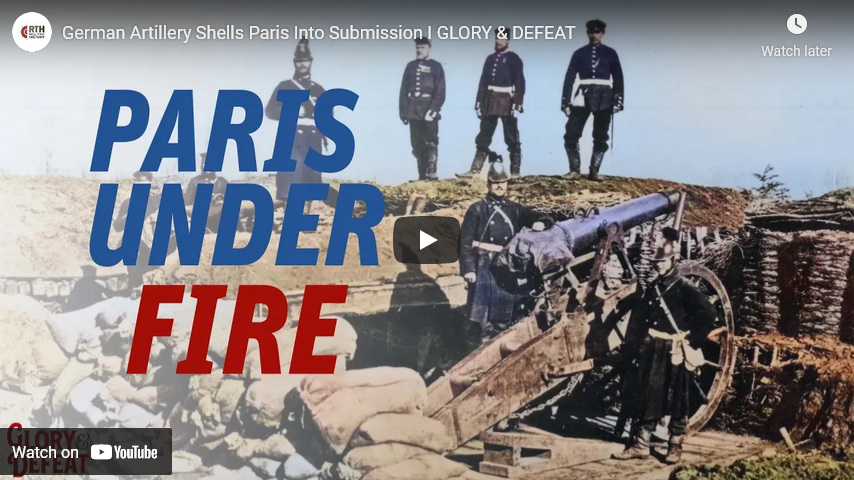
Franco-Prussian War – First Fighting and Casualties I GLORY & DEFEAT Week 2

Filed under: France, Germany, History, Military — Tags: , , , , , — Nicholas @ 04:00

realtimehistory
Published 22 Jul 2021

Support Glory & Defeat: https://realtimehistory.net/gloryandd…

With the official declaration of war from France, Prussia mobilizes and calls in the defensive alliances with the other German states within the North German Confederation but also with Bavaria, Württemberg and Baden. And while the bigger armies still assemble, the first skirmishes happen near the French border.

» OUR PODCAST
https://realtimehistory.net/podcast – interviews with historians and background info for the show.

» LITERATURE
Arand, Tobias: 1870/71. Der Deutsch-Französische Krieg erzählt in Einzelschicksalen. Hamburg 2018

Arand, Tobias / Bunnenberg, Christian (Hrsg.): Karl Klein. Fröschweiler Chronik. Kriegs- und Friedensbilder aus dem Krieg 1870. Kommentierte Edition. Hamburg 2021

Bourguinat, Nicolas / Vogt, Gilles: La guerre franco-allemande de 1870. Une histoire globale. Paris 2020

Howard, Michael: The Franco-Prussian War. London 1961

Milza, Pierre: L’année terrible. La guerre franco-prussienne septembre 1870 – mars 1871. Paris 2009

» SOURCES

Becker, Josef (Hrsg.): Bismarcks spanische «Diversion« 1870 und der preußisch-deutsche Reichsgründungskrieg. Bd. III. Paderborn, München, Wien, Zürich 2003

Bebel, August / Bernstein, Eduard (Hrsg.): Der Briefwechsel zwischen Friedrich Engels und Karl Marx. Bd. IV. Stuttgart 1921

Fontane, Theodor: Krieg gegen Frankreich, Bd. 1. Berlin 1873

Napoléon III: Proclamation de l’Empereur. Paris, 23. Juillet 1870

» OUR STORE
Website: https://realtimehistory.net

»CREDITS
Presented by: Jesse Alexander
Written by: Cathérine Pfauth, Prof. Dr. Tobias Arand, Jesse Alexander
Director: Toni Steller & Florian Wittig
Director of Photography: Toni Steller
Sound: Above Zero
Editing: Toni Steller
Motion Design: Philipp Appelt
Mixing, Mastering & Sound Design: http://above-zero.com
Maps: Battlefield Design
Research by: Cathérine Pfauth, Prof. Dr. Tobias Arand
Fact checking: Cathérine Pfauth, Prof. Dr. Tobias Arand

Channel Design: Battlefield Design

Contains licensed material by getty images
All rights reserved – Real Time History GmbH 2021
August 9, 2021

The German Wars of Unification – Bismarck’s Rise I GLORY & DEFEAT

Filed under: Europe, Germany, History, Military — Tags: , , , , , — Nicholas @ 04:00

realtimehistory
Published 19 Jul 2021

Support Glory & Defeat: https://realtimehistory.net/gloryandd…

After the failed revolution of 1848, the German states within the German confederation were still moving towards unification. This movement would come from the citizens this time though but from the top. Prussia’s chancellor Otto von Bismarck was using clever and aggressive diplomacy to outmaneuver his biggest German rival: Austria.

» OUR PODCAST
https://realtimehistory.net/podcast – interviews with historians and background info for the show.

» LITERATURE
Arand, Tobias: 1870/71. Der Deutsch-Französische Krieg erzählt in Einzelschicksalen. Hamburg 2018
Bremm, Klaus-Jürgen: 1866. Bismarcks Krieg gegen die Habsburger. Darmstadt 2016
Buk-Swienty: Schlachtbank Düppel. Geschichte einer Schlacht. Hamburg 2015
Fesser, Gerd: Königgrätz – Sadowa. Bismarck Sieg über Österreich. Berlin 1994

» SOURCES
Böhme, Helmuth (Hrsg.): Die Reichsgründung. dtv-Dokumente. München 1967

Dollinger, Hans: Das Kaiserreich. Seine Geschichte in Texten, Bildern und Dokumenten. München, 1966

Hardtwig, Wolfgang /Hinze, Helmuth (Hrsg.): Deutsche Geschichte in Quellen und Darstellungen. Bd. 7: Vom Deutschen Bund zum Kaiserreich 1815 – 1871. Stuttgart 1997

Huber, Ernst Rudolf (Hrsg.): Dokumente der Verfassungsgeschichte, Bd. 2. 1851 – 1900. Stuttgart u.a. 1961

N.N.: Helmuth von Moltkes Briefe an seine Braut und Frau. Stuttgart u.a. 1911

Low, Sidney / Sanders Lloyd C.: The History of England During the Reign of Victoria (1837-1901) Volume 12 of 12, [Part of Series: The Political History of England in Twelve Volumes, Edited by William Hunt and Reginald L. Poole], Longmans, Green, and Co., London. 1907

» OUR STORE
Website: https://realtimehistory.net

»CREDITS
Presented by: Jesse Alexander
Written by: Cathérine Pfauth, Prof. Dr. Tobias Arand, Jesse Alexander
Director: Toni Steller & Florian Wittig
Director of Photography: Toni Steller
Sound: Above Zero
Editing: Toni Steller
Motion Design: Philipp Appelt
Mixing, Mastering & Sound Design: http://above-zero.com
Maps: Battlefield Design
Research by: Cathérine Pfauth, Prof. Dr. Tobias Arand
Fact checking: Cathérine Pfauth, Prof. Dr. Tobias Arand

Channel Design: Battlefield Design

Contains licensed material by getty images
All rights reserved – Real Time History GmbH 2021

1815 Eruption of Mount Tambora

The History Guy: History Deserves to Be Remembered
Published 6 May 2020

In 1815, the volcano Mount Tambora on the island of Sumbawa in the Dutch East Indies erupted in the most explosive volcanic eruption in human history. The explosion affected the world’s climate, changing history in surprising ways. The History Guy recalls the forgotten history of the year without a summer.

This is original content based on research by The History Guy. Images in the Public Domain are carefully selected and provide illustration. As very few images of the actual event are available in the Public Domain, images of similar objects and events are used for illustration.

You can purchase the “offshore” bow tie worn in this episode at The Tie Bar:
https://www.thetiebar.com/?utm_campai…​

All events are portrayed in historical context and for educational purposes. No images or content are primarily intended to shock and disgust. Those who do not learn from history are doomed to repeat it. Non censuram.

Find The History Guy at:

Patreon: https://www.patreon.com/TheHistoryGuy​

The History Guy: History Deserves to Be Remembered is the place to find short snippets of forgotten history from five to fifteen minutes long. If you like history too, this is the channel for you.

Awesome The History Guy merchandise is available at:
teespring.com/stores/the-history-guy​

Script by THG

#volcano​ #thehistoryguy​ #history

From the comments:

The History Guy: History Deserves to Be Remembered
11 months ago
A viewer complained that much of the footage of volcanoes were volcanoes dissimilar to Tambora. Notably, Tambora is a stratovolcano. Lava from stratovolcano eruptions tends to be very viscous and cools quickly, whereas much of the footage in the episode is from shield volcanos in Hawaii, which produce free-flowing lava. Please understand that I can only use media in the Public Domain. I did not mean to misinform the audience by using the available footage and photographs.

« Newer PostsOlder Posts »

Powered by WordPress