realtimehistory
Published 19 Aug 2021Support Glory & Defeat by sponsoring an illustration: https://realtimehistory.net/adoptanar…
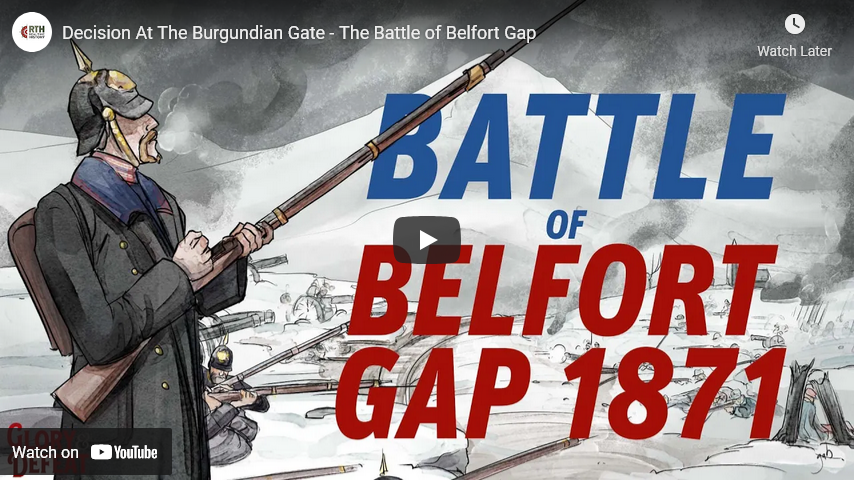
The French Army of Marshal Bazaine was hoping to reach Verdun or even Paris after the first engagements around Metz. But the French troops were exhausted which allowed the Germans to catch up. With the Battle of Gravelotte and the Battle of Mars-la-Tour, the fate of the French Rhine Army is sealed; they are trapped in Metz.
» THANK YOU TO OUR CO-PRODUCERS
John Ozment
James Darcangelo
Jacob Carter Landt
Thomas Brendan» OUR PODCAST
https://realtimehistory.net/podcast – interviews with historians and background info for the show.» LITERATURE
Arand, Tobias: 1870/71. Die Geschichte des Deutsch-Französischen Krieges erzählt in Einzelschicksalen. Hamburg 2018
Bourguinat, Nicolas/Vogt, Gilles: La Guerre franco-allemande de 1870. Une histoire globale. Paris 2020
Buk-Swienty, Tom: Feuer und Blut. Hauptmann Dinesen. Hamburg 2014
Roux, Georges: La Guerre de 1870. Paris 1966» SOURCES
Braun, Lily (Hrsg.): Kriegsbriefe aus den Jahren 1870/1 von Hans von Kretschman. Berlin 1911
Engels, Friedrich: Der Deutsch-Französische Krieg. Sechzig Artikel aus der “Pall Mall Gazette”. Berlin (Ost) 1957
Fontane, Theodor: Der Krieg gegen Frankreich. Bd. 1. Berlin 1873
Geschichte des Krieges 1870–1871, Union Deutsche Verlagsanstalt, Stuttgart 1895
N. N. (Hrsg.): Bismarcks Briefe an seine Gattin aus dem Kriege 1870/71. Stuttgart, Berlin 1903
Seigneur, Daniel: Carnets d’un infirmier d’une guerre oublié. Bière 2014» OUR STORE
Website: https://realtimehistory.net»CREDITS
Presented by: Jesse Alexander
Written by: Cathérine Pfauth, Prof. Dr. Tobias Arand, Jesse Alexander
Director: Toni Steller & Florian Wittig
Director of Photography: Toni Steller
Sound: Above Zero
Editing: Toni Steller
Motion Design: Philipp Appelt
Mixing, Mastering & Sound Design: http://above-zero.com
Maps: Battlefield Design
Research by: Cathérine Pfauth, Prof. Dr. Tobias Arand
Fact checking: Cathérine Pfauth, Prof. Dr. Tobias ArandChannel Design: Battlefield Design
Contains licensed material by getty images
All rights reserved – Real Time History GmbH 2021
August 24, 2021
Bloody Victories – The Battles For Metz | GLORY & DEFEAT Week 6
August 23, 2021
Canada is extremely good at posturing on the international stage … not so good at performing
Kevin Newman on the continuing failure of the Canadian government and Canadian Armed Forces to protect and retrieve the people in Afghanistan we’ve promised to help:

On the second day of the Taliban’s rule in Kabul, the front of Hamid Karzai International Airport was crowded with people trying to travel abroad, but were stopped by Taliban militants, 17 August, 2021.
Public domain image from VOA via Wikimedia Commons.
It is impossible to piece together, or understand, why no one from Canada would come out of the military protection of the airport to speak to them over the past two days. Because there must have been a whole lot of talking happening on the safe side of the razor wire barrier separating the Afghans from the terminal. Late Friday, a Canadian C-17 carrying more soldiers and a few diplomatic and immigration staff arrived at Kabul’s military air terminal. They had a plan to work with American forces to get some of the gas station people out of the country. There seemed to be renewed confidence expressed in media interviews by Immigration Minister Marco Mendicino that, finally, things would happen.
Instead the Americans started executing rapid-retrieval missions into Kabul to get their own people out, sealed the entrance where Canada’s gas station people were waiting, and co-operation with Canadian forces seemed to disintegrate.
In the meantime, there was a game of numbers to play. With so few Canadian cases on that C-17 ready to return to a third country, the big grey plane was loaded with Afghans that other countries had successfully brought to the airport. A picture and story was fed to political reporters on the campaign trails in Canada declaring broadly that “106 Afghans have been flown out on a Canadian C17” – but National Defence would not reveal if any of those passengers had been Canadian cases.
According to the Globe and Mail‘s Stephen Chase there had been none on the only other Canadian flight of 175 to leave the airport twenty-four hours earlier, even as the government boated of another “success”. For weeks, the Prime Minister and his besieged cabinet had also been talking about 20,000 refugees coming to Canada. That too was misleading in is vagueness, according to Global News’ Mercedes Stephenson, as all but a handful are coming from outside Afghanistan and even then, it’s over many years.
There is zero evidence from multiple Afghan sources around the airport that any of those the Prime Minister boasts they’re “rescuing”, (LGTBQ2, human rights advocates, women and journalists) have come from Kabul or any part of Afghanistan in the past month.
With all that, the government continues to claim a C-17 will come and go each day. But do the math. If even a hundred daily Canadian cases make those flights, (no where near that many have so far), there is no way the vast majority of applicants will make it here before the window closes for evacuations. Canada’s commitment of men and materials in no way matches the need. So, will Immigration officials those with no hope now of rescue and admit that they won’t get out in time? That number is likely in the thousands. They need to develop a more realistic way to survive the Taliban.
The mystery in this deadly absurdity is the government’s obsession with paperwork. Even today Canadian officials on the safe side of the airport controlling who might get through were reported by eyewitnesses to be taking an “extremely strict” approach to paperwork verification. Only those granted full Canadian citizenship under the government’s Special Immigration Measure are being told they qualify to leave. That requires a lot more work to process and is perhaps less than a tenth of all the Afghans who are known to have applied and are in various stages of completing multiple forms.
Other countries have also been willing to grant refugee status to their interpreters and families, which doesn’t guarantee citizenship, but is it is a much faster way to process many more people, and it gives Afghans more choices should air rescue be impossible. In a news conference, Mendicino claimed his department’s agent in Kabul has authority to overlook the passport and biometric fingerprint requirements. But the evidence on the ground suggests he is being ignored.
Swastika Raised on Highest Point in Europe – WW2 – 156 – August 21, 1942
World War Two
Published 21 Aug 2021The Axis advance in the Caucasus takes Mt. Elbrus, and the one on Stalingrad continues, and there are several raids of note this week- a Japanese one on Guadalcanal is destroyed, an Allied one on Dieppe is badly savaged, and an American one at Makin Atoll is successful in the short term, but with bad long term ramifications.
(more…)
Canadian Army Ranks 1939-1945
HandGrenadeDivision
Published 6 Sep 2019A brief video describing the ranks used by the Canadian Army in the Second World War, with an equally brief introduction to the General Staff system.
Further reading and resources regarding the Canadian Army of the Second World War:
Service Publications
canadiansoldiers.com
http://www.canadiansoldiers.com
Department of National Defence Directorate of History and Heritage
August 21, 2021
In this matter Canada apes the US rather than following the great example provided by France
In The Line, Kevin Newman highlights the stark difference between what France has been doing to rescue their own citizens and Afghani civilians with ties to France with the utterly feckless Canadian government’s “effort”:

On the second day of the Taliban’s rule in Kabul, the front of Hamid Karzai International Airport was crowded with people trying to travel abroad, but were stopped by Taliban militants, 17 August, 2021.
Public domain image from VOA via Wikimedia Commons.
Ten buses screamed out of France’s embassy in Kabul early this week, past every Taliban checkpoint along the way, and according to eyewitnesses, zipped confidently through a back-entrance gate and straight onto the chaotic tarmac at Hamid Karzai International Airport. Five hundred exhausted and terrified passengers were then loaded onto a French military aircraft which quickly took off.
And then it happened again on Thursday, four buses this time, under the guard of French special forces. As with the first convoy, Paris newspapers reported the buses carried French nationals stranded in Kabul, and hundreds of Afghans and their families the French embassy had given shelter to since before the Taliban roared into and re-occupied the city. Two ballsy airlifts took them to safety at a French military base in the United Arab Emirates, where hundreds of desperate people were given a hot meal, questioned about their identities and had their documents confirmed. Most were then sent on to Paris, where they received physical and mental-health support as well as cash, clothing, and places to stay as they begin their new lives.
On those same days in Kabul, another country tried to rescue its citizens and hundreds of Afghan interpreters and their families hiding throughout the city. I’ve pieced together what happened to them from texts and video Canadian veterans have been receiving every hour from people they know in Kabul, and I am sharing them with permission. I have verified each of these facts (from the peace of Canada) with multiple sources on the ground.
There were no buses, soldiers or escorts for these terrified people. Thursday they received a short text from Immigration, Refugees and Citizenship Canada (IRCC). They were instructed (in English only) to urgently head to the airport on their own, try to find a way through multiple Taliban checkpoints searching for them, and then if they survived that kilometres-long trip, figure out a way through thousands of desperate Afghans trying to flee. They were told by IRCC to carry documents to identify themselves to a gate agent, but because those same documents would be used to identify them by the Taliban, it was up to them to decide whether to carry them. With that, IRCC wiped its hands of responsibility. No direction on where to avoid Taliban checkpoints, no specific gates to head to (there are eight), and no Canadians on site to help. In fact there hadn’t been any Canadian officials in Kabul for a week, and when a few arrived hours after that text blast, reporters said they had travelled on an American military flight because their Canadian C-17 needed servicing somewhere else.
Needless to say, no one got through the airport, so they returned to their safe houses — wondering if their last flight to freedom had left without them.
It hadn’t. It never existed. Later that night another set of blasts went out again telling Afghans to move on their own to the airport. This time they were told to shout “Canada” and hope a soldier would hear them and help them through the airport gates. Taliban guards could hear them as well there, which would ensure that the target on their backs they had been trying to hide came completely into focus.
“Free” Navies of World War 2 – Small but Deadly (and a little crazy)
Drachinifel
Published 13 Aug 2019Today we take a brief look at the various “Free” navies that operated with the Royal Navy and how that interaction played out across the years of conflict.
Want to support the channel? – https://www.patreon.com/Drachinifel
Want a shirt/mug/hoodie – https://shop.spreadshirt.com/drachini…
Want a medal? – https://www.etsy.com/uk/shop/Drachinifel
Want to talk about ships? https://discord.gg/TYu88mt
Want to get some books? www.amazon.co.uk/shop/drachinifel
Drydock Episodes in podcast format – https://soundcloud.com/user-21912004
August 20, 2021
Battle of Colombey-Nouilly – Strasbourg Under Siege I GLORY & DEFEAT Week 5
realtimehistory
Published 12 Aug 2021Sign up for Curiosity Stream and get Nebula bundled in and SAVE 26%: https://curiositystream.com/realtimeh…
After the opening battles of the Franco-Prussian War, the German armies have suffered heavy casualties but were also able to stop French plans in their tracks. Now the French are withdrawing towards Metz and the symbolic city of Strasbourg is under siege.
» THANK YOU TO OUR CO-PRODUCERS
John Ozment
James Darcangelo
Jacob Carter Landt
Thomas Brendan» OUR PODCAST
https://realtimehistory.net/podcast – interviews with historians and background info for the show.» LITERATURE
Arand, Tobias: 1870/71. Die Geschichte des Deutsch-Französischen Krieges erzählt in Einzelschicksalen. Hamburg 2018Mährle, Wolfgang (Hrsg.): Nation im Siegesrausch. Württemberg und die Gründung des Deutsches Reichs 1870/71. Stuttgart 2020
Milza, Pierre: L’année terrible. La guerre franco-prussienne septembre 1870 – mars 1871. Paris 2009
Roux, Georges: La Guerre de 1870. Paris 1966
» SOURCES
Bodenhorst, Georges: Le siége de Strasbourg en 1870. Paris. u.a. 1876Engels, Friedrich: “Notes on the war, No. 5”, in: The Pall Mall Gazette Nr. 1712 vom 9. August 1870
Engels, Friedrich: “Der Deutsch-Französische Krieg 1870/71“. Sechzig Artikel aus der Pall Mall Gazette. Berlin (Ost) 1957
Fontane, Theodor: Der Krieg gegen Frankreich. Bd.1 und 2. Berlin 1873
» OUR STORE
Website: https://realtimehistory.net»CREDITS
Presented by: Jesse Alexander
Written by: Cathérine Pfauth, Prof. Dr. Tobias Arand, Jesse Alexander
Director: Toni Steller & Florian Wittig
Director of Photography: Toni Steller
Sound: Above Zero
Editing: Toni Steller
Motion Design: Philipp Appelt
Mixing, Mastering & Sound Design: http://above-zero.com
Maps: Battlefield Design
Research by: Cathérine Pfauth, Prof. Dr. Tobias Arand
Fact checking: Cathérine Pfauth, Prof. Dr. Tobias ArandChannel Design: Battlefield Design
Contains licensed material by getty images
All rights reserved – Real Time History GmbH 2021
“They were there to debate Afghanistan, a far-away country of which it turns out that we know even less than we thought”
The British government recalls Parliament to debate the situation in Afghanistan (not that there’s much to be done at this late stage, but formalities are at least being observed in a perfunctory manner):
The House of Commons was full, for the first time since last March. Members of Parliament had been brought back from their holidays, from West Country campsites and from Greek resorts, in a repatriation operation that puts the Foreign Office to shame.
They were there to debate Afghanistan, a far-away country of which it turns out that we know even less than we thought. It was only last month that Boris Johnson was assuring MPs that “there is no military path to victory for the Taliban”, although we now know that path was straight along the road to Kabul, as fast as their trucks could carry them.
Now Johnson was back to explain that things had turned out to be a bit more complicated than he thought. Or perhaps a bit simpler: we’ve gone, they’re back. Parliament was getting eight hours to discuss this, although it was too late to do very much about it. It wasn’t so much shutting the stable door after the horse had bolted as holding a long discussion about the history of equine care as the stallion in question disappeared over the horizon.
Still, the atmosphere was jolly. Many of these MPs haven’t seen each other in over a year. There was a first-day-of-term feel to things. With Parliament’s Covid restrictions lapsed, the Conservatives were wedged in together in the small, windowless chamber, barely a facemask in sight. The government’s instructions are still to wear masks in crowded places, but the Conservatives view Covid as some sort of socialist conspiracy that will go away if they ignore it. Or maybe they just feel that rules are for the little people.
Labour MPs had at least nodded to social distancing, sitting about 18 inches apart from each other. This is, admittedly, easier when there aren’t very many of you. The opposition benches were a sea of masks. Only the Democratic Unionists, who like the Tories see illness as a sign of moral failure, were a lone island of uncovered faces.
Johnson’s statement was, as ever, a masterpiece of bare adequacy. It eloquently just about dealt with the matter in question, magisterially pretty much covering the bases. The speechwriters, one sensed, must have been working on the words late into the previous afternoon. They had gone through as many as one draft as they tried to come up with something that, if it didn’t deal with every complex nuance of the Afghan tragedy, at least asked the question that Johnson lives by: “Will this do?”
The situation in Afghanistan was a “concern”, the prime minister explained, with what might, in another context, have been a brilliantly comic understatement. Over the past 20 years, the British had worked for a better future for the people of Afghanistan. “Some of this progress,” the prime minister said, “is fragile”, which is certainly one way of putting it.
What had gone wrong with our intelligence services, several people asked, that they had so comprehensively failed to see this coming? Be fair, replied Johnson, even the Taliban had been surprised by the speed of their own advance.
On the US Naval Institute Blog, CDRSalamander notes the only speech in the House of Commons during that debate that grabbed and held the attention of the entire body:
Let’s back away from the problem at hand a bit … and then back up further. I mentioned it earlier, but let’s bring it up again; national humiliation. There are different aspects of this growing humiliation that are already manifesting itself, the first of which is how others look at us.
Let’s start with our closest friend and take a moment to listen to a speech earlier today in the British House of Commons by Tom Tugendhat, MP.
The mission in Afghanistan wasn’t a British mission, it was a Nato mission. … And so it is with great sadness that I now criticise one of them. … To see their commander-in-chief call into question the courage of men I fought with — to claim that they ran. It is shameful. … this is a harsh lesson for all of us and if we are not careful it could be a very, very difficult lesson for our allies. … to make sure we are not dependent on a single ally, on the decision of a single leader, but that we can work together with Japan and Australia, with France and Germany, with partners large and small, and make sure we hold the line together.
That is our closest friend outlining a loss of confidence. That is just one datapoint from a friend, but it is safe to say that it is probably somewhere in the center of opinion.
What are those nations who are not our friends thinking? I don’t think I need to spend all that much time on discussing how emboldened they are. It is self-evident to anyone who reads USNIBlog.
On the ground, troops of 2nd Battalion, The Parachute Regiment are actively involved in escorting British and Afghani civilians from safe houses to Kabul airport for evacuation:
At least one NATO country hasn’t forgotten the civilians who have been left behind during the precipitate withdrawal by US troops.
HMS Indefatigable – Guide 116 (Extended)
Drachinifel
Published 6 Apr 2019HMS Indefatigable, a razee frigate of the British Royal Navy, is today’s subject.
Want to support the channel? – https://www.patreon.com/Drachinifel
Want to talk about ships? https://discord.gg/TYu88mt
Want to get some books? www.amazon.co.uk/shop/drachinifel
August 18, 2021
The Conscripts and Conscientious Objectors of World War Two – WW2 Special
World War Two
Published 17 Aug 2021In keeping with their ideals of personal liberty, Britain and the United States have historically maintained relatively small armies made up of volunteer soldiers. When Germany and Japan mobilize huge numbers of well-trained conscripts and sweep across Europe and Asia, the democratic allies devote huge resources to closing the gap, while respecting the rights of those who object to fighting on moral grounds.
(more…)
Tank Chats #120 | Sd.Kfz. 234 Panzerspähwagen | The Tank Museum
The Tank Museum
Published 26 Mar 2021The Tank Museum’s Curator David Willey presents a Tank Chat on the Sd.Kfz. 234 Panzerspähwagen, a heavy German reconnaissance vehicle from the Second World War, and the only wheeled German armour in The Tank Museum collection. Join David as he tells you more.
(more…)
QotD: Napoleon Bonaparte
Wednesday [May 5th] marks the 200th anniversary of the death of the French Emperor Napoleon Bonaparte, who was, depending on who you’re listening to, either a wily Corsican bandit who rose to dominate Europe through force and terror, or a messiah of liberalism who de-medievalized the continent. Whichever view you buy, Napoleon’s unique vis viva is still felt strongly in the world today. Any strong history undergrad ought to be able to chart a path from Napoleon through his nephew and successor Napoleon III, to what A.J.P. Taylor called “the period of the German wars” (ending in 1945), to the present moment.
The French Republic still uses Napoleonic touches in its mythmaking, as do its politicians. Sweden’s crown is still worn by descendants of Bernadotte, a general who was of humble birth but proved the ultimate champion of the emperor’s bizarre game of thrones. Napoleon said of his army that every man in it carried a marshal’s baton in his knapsack. By the same token, every ambitious colonel who ever plotted to pull together a squadron of tanks and overthrow a president carries a little portrait of Napoleon I next to his bosom. It may not be fair to say that Napoleon bears part of the responsibility for Hitler, but if there had been no Napoleon there could not possibly have been a Hitler. It is probably one of those “necessary cause” vs. “sufficient cause” things that give people so much trouble.
The bicentenary of Napoleon’s lonely death in custody on a windblown South Atlantic island has given the English an excuse to refresh some of their most precious and whimsical tokens of victory. At Apsley House, the home of the 1st Duke of Wellington, art restorers have been giving special attention to a bronze copy of Napoleon’s death mask, which was taken in plaster after the emperor expired. It’s a mesmerizing totem: to our eyes, the face emphasizes the Italian character that the ci-devant Buonaparte struggled to elude and conceal on the way to becoming master of France. Death masks seem creepy to us today, but they speak in ways a portrait cannot.
Colby Cosh, “Will There Be Cake?”, NP Platformed, 2021-05-05.
August 17, 2021
Opening Battles of the Franco-Prussian War: Saarbrücken, Wissembourg, Wörth I GLORY & DEFEAT Week 4
realtimehistory
Published 5 Aug 2021Support Glory & Defeat: https://realtimehistory.net/gloryandd…
Early August 1870 saw the first series of opening battles of the Franco-Prussian War. The Battle of Saarbrücken was the only battle of the entire war fought on German soil, the following Battle of Wissembourg, the Battle of Wörth and the Battle of Spicheren happened right after and gave a glimpse of the carnage to come.
» THANK YOU TO OUR CO-PRODUCERS
John Ozment
James Darcangelo
Jacob Carter Landt
Thomas Brendan» OUR PODCAST
https://realtimehistory.net/podcast – interviews with historians and background info for the show.» LITERATURE
Arand, Tobias: 1870/71. Die Geschichte des Deutsch-Französischen Krieges erzählt in Einzelschicksalen. Hamburg 2018Bourguinat, Nicolas/Vogt, Gilles: La guerre franco-allemande de 1870. Une histoire globale. Paris 2020
Gall, Lothar (Hrsg.): Deutschland Archiv. Deutsche Geschichte in Dokumenten. O.O., o. J. (2007)
Mährle, Wolfgang: “Das württembergische Heer im Deutsch-Französischen Krieg 1870/71“, in: Nation im Siegesrausch. Württemberg und die Gründung des Deutschen Reichs 1870/71, hrsg.v. Wolfang Mährle. Stuttgart 2020. S. 45-64.
Milza, Pierre: L’année terrible. La guerre franco-prussienne septembre 1870 – mars 1871. Paris 2009
Roux, Georges: La Guerre de 1870. Paris 1966
» SOURCES
Bazaine, François-Achille: Episoden aus dem Krieg von 1870 und der Belagerung von Paris. Berlin 1884Chuquet, Arthur: La guerre 1870/71. Paris 1895
Engel, o.V.: Die Verluste der deutschen Armeen an Offizieren und Mannschaften im Kriege gegen Frankreich 1870 und 71. Berlin 1872
Engels, Friedrich: Der Deutsch-Französische Krieg. Sechzig Artikel aus der ‘Pall Mall Gazette’. Berlin (Ost) 1957
Goncourt, Edmond de: Journal. Bd. 5. 1869-1872. Leipzig 2013
Henderson, George: The battle of Spicheren, August 6th 1870, and the events that preceded it – a study in practical tactics. London 1891
Klein, Karl: Fröschweiler Chronik. Kriegs- und Friedensbilder aus dem Jahre 1870/71. Illustrierte Jubelausgabe. München 1897
Kriegsgeschichtliche Abtheilung des Großen Generalstabs (Hg.): Der deutsch-französische Krieg 1870/71. Erster Theil. Erster Band. Berlin 1874
Kühnhauser, Florian: Erinnerungen eines Soldaten des königlich bayerischen-Infanterie-Leib-Regiments. Partenkirchen 1898
Le Faure, Amédée: Atlas de la guerre 1870/71. Paris 1875
Meisner, Heinrich Otto (Hrsg.): Kaiser Friedrich III. Das Kriegstagebuch von 1870/71. Berlin, Leipzig 1926
Pietsch, Ludwig: Von Berlin bis Paris. Kriegsbilder 1870-1871. Berlin 1871
» OUR STORE
Website: https://realtimehistory.net»CREDITS
Presented by: Jesse Alexander
Written by: Cathérine Pfauth, Prof. Dr. Tobias Arand, Jesse Alexander
Director: Toni Steller & Florian Wittig
Director of Photography: Toni Steller
Sound: Above Zero
Editing: Toni Steller
Motion Design: Philipp Appelt
Mixing, Mastering & Sound Design: http://above-zero.com
Maps: Battlefield Design
Research by: Cathérine Pfauth, Prof. Dr. Tobias Arand
Fact checking: Cathérine Pfauth, Prof. Dr. Tobias ArandChannel Design: Battlefield Design
Contains licensed material by getty images
All rights reserved – Real Time History GmbH 2021
Mark Steyn – “The scale of America’s global humiliation is so total that I see my friends at Fox News cannot even bear to cover it”
The collapse of western — specifically American — control in Afghanistan got put on fast forward and the US dying media can’t be bothered to give it much attention. Mark Steyn didn’t explicitly predict this particular high-speed collapse, but he’s been warning about the Afghan situation for over a decade:

A Boeing CH-47 Chinook transport helicopter appears over the U.S. embassy compound in Kabul, 15 Aug 2021. Image from Twitter via libertyunyielding.com
To reprise a line from a decade-old column of mine:
Afghanistan is about Afghanistan – if you’re Afghan or Pakistani. But, if you’re Russian or Chinese or Iranian or European, Afghanistan is about America.
That’s the point to remember: if you’re an Afghan schoolgirl, today is the fall of Kabul; elsewhere, in the chancelleries of allies and enemies alike, it’s the fall of America. Even by their usual wretched standards, the world’s most somnolent media are struggling to stay up to speed on the story. Here’s the scoop from USA Today:
Taliban’s Afghanistan Advance Tests Biden’s ‘America Is Back’ Foreign Policy Promise
You don’t say! Did he misread the prompter, or mishear the guy in his ear? “America is on its back”, surely?
But don’t worry, the world’s most lavishly over-funded “intelligence community” is on the case:
Kabul Could Fall To The Taliban Within 90 Days, U.S. Intelligence Warns
Thank you, geniuses. That was Thursday. So it turned out to be well within ninety hours — which is close enough for US intelligence work.
Was this the same “seventeen intelligence agencies” who all agreed Russia had meddled in the 2016 election — and with whose collective intelligence only a fool would disagree?
Or perhaps it was only one intelligence agency — most likely the crack agents of the highly specialized Federal Unitary Central Kabul Western Intelligence Tracking Service.
To modify Hillary Clinton, what difference at this point would it make if the US government simply laid off its entire “intelligence community”?
Indeed, what difference would it make if it closed down its military? Obviously, it would present a few mid-life challenges for its corrupt Pentagon bureaucracy, since that many generals on the market for defense lobbyist gigs and board directorships all at once would likely depress the going rate. But, other than that, a military that accounts for 40 per cent of the planet’s military spending can’t perform either of the functions for which one has an army: it can’t defeat overseas enemies, and it’s not permitted to defend the country, as we see on the Rio Grande.
So what’s the point?
Oh, oh, but, if a nation doesn’t have an army to defend it, a quarter-of-a-million foreign invaders could just walk into the country with impunity every month!
The scale of America’s global humiliation is so total that I see my friends at Fox News cannot even bear to cover it. As I write, every other world network — the BBC, Deutsche Welle, France 24, not to mention the Chinese — is broadcasting the collapse of the American regime in real time; on Fox, meanwhile, they’re talking about the spending bill and the third Covid shot and the dead Haitians … as if the totality of the defeat is such that for once it cannot be fixed into the American right’s usual consolations (“well, this positions us pretty nicely for 2022”).
On the leftie side, of course, the court eunuchs have risen as one to protect the Dementia Kid, and are working as hurriedly as the Kabul document-shredders in an effort to figure out a way to blame it all on Trump.
Of course, retreating from Kabul is kind of a western military tradition:

Remnants of an Army (1879) by Elizabeth Butler portraying William Brydon arriving at the gates of Jalalabad as the only survivor of a 16,500 strong evacuation from Kabul in January 1842.
Public domain image via Wikimedia Commons.
The remnants of an army, Jellalabad (sic), January 13, 1842, better known as Remnants of an Army, is an 1879 oil-on-canvas painting by Elizabeth Thompson, Lady Butler. It depicts William Brydon, assistant surgeon in the Bengal Army, arriving at the gates of Jalalabad in January 1842. The walls of Jalalabad loom over a desolate plain and riders from the garrison gallop from the gate to reach the solitary figure bringing the first word of the fate of the “Army of Afghanistan”.
Supposedly Brydon was the last survivor of the approximately 16,000 soldiers and camp followers from the 1842 retreat from Kabul in the First Anglo-Afghan War, and is shown toiling the last few miles to safety on an exhausted and dying horse. In fact a few other stragglers from the Army eventually arrived, and larger numbers were eventually released or rescued after spending time as captives of Afghan forces.
QotD: The “Crisis of the Third Century”
You can find huge shelves of books analyzing this, attributing it to every conceivable thing, from the ol’ “lead in the water pipes” to massive structural defects stretching into remote antiquity. There’s probably something to all of them, but the biggest proximate cause is probably one the Romans themselves had identified, as early as Sallust, way back in the last century BC: lack of purpose. Having defeated Carthage and salted the earth where once she stood, the Roman “security state” — the largest and most comprehensive ever assembled to that point — simply ran out of reasons to exist.
If you’ve read much about (or especially by) them, you know that the Romans were, for lack of a better term, paranoid. It was simply incompatible with the Roman psyche to have any large, organized group of non-Romans anywhere near the Empire’s borders … so the Empire kept expanding, first reducing, then Romanizing, every conceivable threat. They kept doing this long past the point of negative returns, such that the Empire collapsed under the strain of trying to hold itself together.
Stop me if this sounds familiar: A “government” whose only claim to legitimacy is naked force. A large, increasingly rapacious, increasingly class-conscious military with no obvious enemies to fight, and no ability to subdue the ones it settles for. A large, increasingly rapacious, increasingly caste-conscious bureaucracy that views the whole “Imperial” project as one big tax farming operation. Massive, ever-increasing wealth disparities that can only be very temporarily alleviated by debasing the currency, because structural reform is culturally impossible from above, and physically impossible from below. And to top it all off, a weird, apocalyptic religious cult totally destroying the few pan-imperial cultural institutions, including the military.
The history of the Third Century is insanely complex, not well understood in many respects even by field specialists, but the gist of it is clear enough: Some general somewhere decides he’d like to have a crack at emperorizing, so he gets his troops to throw a purple toga on him and proceeds to take on the incumbent. Some other general thinks that’s a pretty nifty idea, so he does the same thing, taking on both the incumbent and the pretender. Not wanting to be left out of the fun, the incumbent’s main general murders the incumbent and takes the crown for himself, fighting whoever’s left, plus whichever of his subordinate commanders decide they want a shot at the big chair. The Senate rubber-stamps one of these clowns, or some other general who decides he’d like to throw his toga into the ring, and civil war follows civil war until one of them temporarily triumphs … only for the same thing to happen again once the shine is off the new guy (usually in less than a year or two).
They called ’em the “Barracks Emperors” for a reason, y’all. And it’s actually worse than that, since lots of times the rebel generals didn’t bother going for the big prize back in Italy. Lots of them decided they’d do just fine ruling, say, Britain, or parts of Gaul, or Asia Minor or Egypt or what have you, while the other guys slugged it out for the increasingly marginalized, if not totally meaningless, “official” title. Declare yourself the Emperor of ___, issue some slapped-together coins with your picture on them, and go nuts. The “Gallic Emperors” had a run of nearly half a century like that — not bad at all for Late Antiquity.
Severian, “The Crisis of the Third Decade”, Rotten Chestnuts, 2021-03-18.