
The Tank Museum
Published 18 Mar 2022Join Stuart Wheeler for an Anti-Tank Chat and discover the US military’s development of the Bazooka anti-tank weapon.
(more…)
July 16, 2022
Anti-Tank Chats #4 Bazooka | The Tank Museum
Comments Off on Anti-Tank Chats #4 Bazooka | The Tank Museum
July 15, 2022
HMCS Sackville Walkaround
iChaseGaming
Published 25 Jul 2019Moved to Halifax, must visit HMCS Sackville 😀 and here she is!
(more…)
Comments Off on HMCS Sackville Walkaround
July 14, 2022
Prokhorovka: An Avalanche of Armor – WW2 – 202 B – July 13, 1943
World War Two
Published 13 Jul 2022As dawn broke on 12th July 1943, the spearheads of the German II SS Panzer Corps and the Soviet 5th Guards Tank Army were shuffling into their positions. The battle of Zitadelle was entering a pivotal moment. Would the elite of the German Panzers finally achieve a breakthrough into open country? Or would the might of the Soviet Tank Army break them in a pre-emptive attack? The battle and fate of Operation Zitadelle was to be decided in front of a small village called Prokhorovka.
Special thanks to Jason Shafer, pattygman46 and QuinnTheSpin for their support during this episode’s premiere
(more…)
Comments Off on Prokhorovka: An Avalanche of Armor – WW2 – 202 B – July 13, 1943
The plight of 1st Canadian Infantry Division during the opening stages of Operation Husky, July 1943
First Canadian Infantry Division had an exciting start to Operation Husky — for certain values of “exciting” — as told in Mark Zuehlke’s Operation Husky: The Canadian Invasion of Sicily, July 10-August 7, 1943:
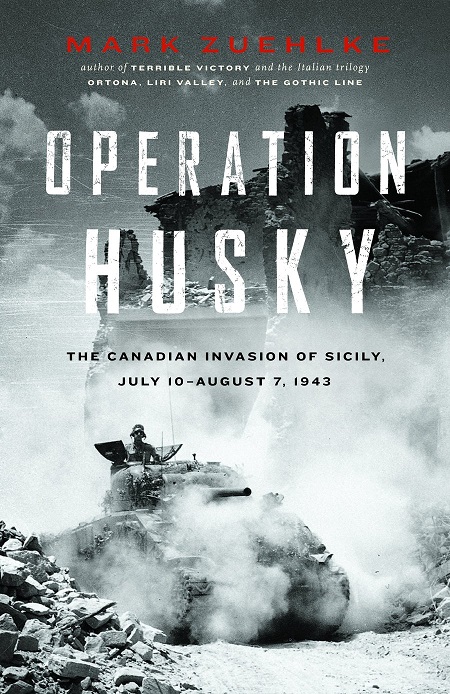
Every day [during the convoy to Sicily], Major General Guy Simonds and Lieutenant Colonel George Kitching performed the same macabre ritual. Kitching would take a hat filled with equal-sized chits of paper on which the names of every ship bearing Canadian personnel and equipment was written and hold it out to the divional commander. Simonds drew three chits and those three ships were declared lost, victims of torpedoes from a German U-boat — the scenario at times being that about one thousand men aboard the fast convoy had drowned and burned in oil-drenched seas, or hundreds of trucks, tanks, guns, radios, and other equipment in the slow convoy had plummeted to the bottom of the Mediterranean. All lost, gone. Kitching and his staff would then sit down and coldly “examine the effect the loss of these three ships would have on our projected plans.”
On July 3, Simonds pulled from the hat chits for three ships travelling in the Slow Assault Convoy — City of Venice, St. Essylt, and Devis. The coincidence was chilling, for it was aboard these vessels that equal portions of the divisional headquarters equipment — including all the trucks, Jeeps, radio sets, and a panoply of other gear that kept a division functioning — had been distributed. Were one or even, God forbid, two of these ships sunk, the headquarters could function almost as normal. But lose the three and the division was crippled.
Kitching considered the “chance of all three ships being sunk as a million to one”. Deciding there was no point in studying the implications of such a wildly remote possibility, he asked Simonds to draw another three names from the hat, which the general did.
As you’ve probably already figured out, the one-in-a-million situation turned up on schedule. City of Venice took a torpedo during a submarine alert, with Royal Navy escort ships dropping depth charges on a suspected U-boat position. The convoy instructions were for damaged ships to be left behind and for the undamaged ships to carry on, as the danger was greater if the whole convoy slowed or stopped to aid the stricken ship(s). City of Venice could not be saved, and ten crew members and ten Canadian soldiers were killed, but the other 462 men on board were transferred to a rescue ship. A few hours later, two more ships from the convoy were lost: St. Essylt, and Devis.
While the loss of lives aboard the three torpedoed slow convoy ships was relatively small, the amount and nature of equipment and stores sent to the bottom of the Mediterranean was serious. A total of 562 vehicles were lost, leaving 1st Canadian Infantry Division facing a major transportation shortage. Also lost were fourteen 25-pounders [gun-howitzers], eight 17-pounders [heavy anti-tank guns, equivalent to German 88mm guns], and ten 6-pounder anti-tank guns that would significantly reduce the division’s artillery support. “In addition to the above,” the divisional historical officer, Captain Gus Sesia, noted in his diary, “we lost great quantities of engineers’ stores and much valuable signals equipment.” The biggest immediate blow was the loss of all divisional headquaters vehicles and equipment, including many precious wireless sets — precisely the nightmare scenario forecast and rejected by Kitching as infeasible when Simonds had drawn these ships by lot a few days earlier.
Equally serious was the loss in equipment and lives suffered by the Royal Canadian Army Medical Coprs personnel attached to the division. Due to a loading error, instead of No. 9 Field Ambulance’s vehicles being distributed among several ships, fifteen out of eighteen were on Devis. Accompanying the vehicles was a medical officer and nineteen other ranks and medical orderlies. Four of the other ranks were among the fifty-two Canadian troops killed and another four suffered injuries. The other field ambulance, field dressing station, and field surgery units assigned to the division were largely unaffected. No. 5 Field Ambulance’s vehicles had been distributed correctly so only two of them and a ton of medical supplies went down with St. Essylt. City of Venice had just one medical officer, Captain K.E. Perfect, aboard and he escaped uninjured. But Perfect was overseeing safe passage of nine tons of stretchers and blankets, which all went to the bottom.
[…]
A fully accounting of the losses would not be completed for days. Even on July 7, reports were still coming in that City of Venice remained under tow and bound for Algiers. Finally, at 1900 hours on that day, its sinking was confirmed. The report also stated that most of the surviving Canadian troops had been loaded on a Landing Craft, Infantry in Algiers and were en route for Malta. From there, they would eventually rejoin the division.
Compounding the loss of so many vehicles was the fact that the division had left Britain with a smaller than mandated number due to lack of shipping capacity. Once the seriousness of the situation was appreciated, Lieutenant Colonel D.G.J. Farquharson, the division’s assistant director of ordnance services, and his staff “tried to make [the losses] good … by emergency measures, improvising and obtaining what could be obtained buckshee from the Middle East.” They soon had commitments for some vehicles, but these would not be available until after the initial landings. The fact that every vehicle to be found locally was a Dodge posed “a considerable ordnance problem, because what spare parts we had were based on Ford and Chevrolet makes.” Improvisation would be the order of the day.
Comments Off on The plight of 1st Canadian Infantry Division during the opening stages of Operation Husky, July 1943
July 13, 2022
The Irish Fighting for Britain, Mexico’s Role in the War, and Chuikov in Uranus – WW2 – OOTF 27
World War Two
Published 12 Jul 2022How many Irishmen are fighting for Britain and why? And what did Chuikov do during Operation Uranus? And what role has Mexico played in the fighting so far? Find out the answers to these fascinating questions in our latest edition of Out of the Foxholes!
(more…)
m/26 Suomi: Aimo Lahti’s First Production Design
Forgotten Weapons
Published 23 Mar 2022
(more…)
Comments Off on m/26 Suomi: Aimo Lahti’s First Production Design
QotD: Military information
Many years ago a very wise, very senior officer explained to me that information, in the military and, he thought, in almost any enterprise, has three aspects: information management, information technology and information handling. Information management, he said, was (is) everyone’s business: the infantry section commander in combat, the pilot in his fighter and the staff officers in various HQs, in ships, in buildings and even in aircraft, need to understand what information they need to do their jobs, where to find it and how to sift the wheat from the chaff. Information technology, he explained, is, generally, the business of a relatively few technical specialists who adapt it to the needs of combat and support forces. Information handing, he said, is a fairly narrow business that involves picking up information wherever it is, in a small, remote sensor, on a radar screen, in a thick, written intelligence report, transforming it into the best means for “transport”, moving it to the places it is needed, quickly and accurately, and then transforming it, again, into the form which is best suited to the recipients who will manage it and, ultimately, use it. There are three aspects he said and they should not be mixed together: everyone needs to be an information manager, a few need to be information technology implementers or providers and fewer still need to be information handlers. The definition of a command and control system he told us, is the people, and procedures (information management), the facilities and resources (which includes information technology) and communications (information handling) which a commander uses to direct his (or her) forces and fight and win, his or her battle.
Ted Campbell, “Military command, control and communications”, Ted Campbell’s Point of View, 2019-03-17.
Comments Off on QotD: Military information
July 12, 2022
Kursk, When Titans Clash – 202 – July 9, 1943
World War Two
Published 10 Jul 2022Adolf Hitler launches his huge summer offensive in the USSR, Operation Citadel, known as the Battle of Kursk. Men in the millions clash. The Allies’ New Georgia campaign continues in the Solomons, both on land and with fighting at sea this week, and the preliminary actions begin for the Allied invasion of Sicily, scheduled to go off tomorrow.
(more…)
Comments Off on Kursk, When Titans Clash – 202 – July 9, 1943
Killing the Resistance, and Rockets of Death – War Against Humanity 068 – July 10, 1943
World War Two
Published 10 Jul 2022The Polish and French resistance find themselves weakened by the lots of their leaders. Hitler decided to give Werner von Braun hundreds of thousands of slaves to launch the German rocket program.
(more…)
Comments Off on Killing the Resistance, and Rockets of Death – War Against Humanity 068 – July 10, 1943
QotD: Greek city-state logistics in the time of the Peloponnesian War
Greek logistics in this period in general were very limited compared to either Macedonian or Roman logistical capabilities in subsequent centuries, or contemporary Persian logistics capabilities. Ironically, the most sustained study of classical Greek logistics concerns the campaigns of Xenophon (J.W. Lee, A Greek army on the March (2008)), meaning that it concerns not polis amateurs but an army of mercenary professionals, and yet compared to what the Macedonians would be able to do (see D.W. Engels, Alexander the Great and the Logistics of the Macedonian Army (1978)) half a century later in the same terrain, even these Greek logistics – probably the gold standard of their time – are astoundingly underdeveloped.
Put very briefly: Greek armies seem to have had relatively little carrying or logistics capacity. They did not seem to have generally moved with sufficient engineering tools or materials for effective field fortification or siege warfare. This is compounded by their inability to mill grain on the move (something Macedonian and Roman armies could do), which compounds problems of using local supply. You can eat unmilled grain (it can be roasted or boiled into porridge, but this is less than ideal. What they do tend to have is a high number of non-combat personal servants (precisely the sort of fellows good Roman or Macedonian generals drive out of the camp as soon as possible), who impose additional logistics burdens without much increasing the operational range or endurance of the army. Consequently, Greek armies struggled to stay out in the field throughout the year, whereas Roman and Macedonian armies were routinely capable of year-round campaigning.
Bret Devereaux, “Collections: This. Isn’t. Sparta. Part VII: Spartan Ends”, A Collection of Unmitigated Pedantry, 2019-09-27.
Comments Off on QotD: Greek city-state logistics in the time of the Peloponnesian War
July 11, 2022
Troop Deployments for the Battle of Kursk – WW2 Special
World War Two
Published 9 Jul 2022Over the last few weeks entire cities-worth of troops along with all the logistical support needed to support them have gathered in and around the Kursk salient. Here’s how they’ve been deployed, and where they could go from here.
(more…)
Comments Off on Troop Deployments for the Battle of Kursk – WW2 Special
The Master Race of Asia? – WAH 067 – July 3 1943
World War Two
Published 8 Jul 2022
(more…)
Comments Off on The Master Race of Asia? – WAH 067 – July 3 1943
July 10, 2022
Seven easy steps to fix military procurement
CDR Salamander wrote these for the US military, so some of them are far out-of-scale for tiddlers like the Canadian Armed Forces, but the spirit is still valid and relevant:
1. No weapon system presently under production will be allowed to stop production until its replacement is under production itself.
2. Acknowledge we have lied to ourselves for decades actual magazine requirements in war (use “new” lessons from the Russo-Ukraine War for the tender to save face — whatever works) — and accelerate/restart production of everything from ASW weapons to strike weapons of all types.
3. Acknowledge that we do not have enough weapons — specifically anti-air and land attack — on our warships. Every war proves this and recent experience tells us this.
4. If I take away your access to satellite VOX & DATA and you cannot navigate and fight, you are not a wartime asset and your funding sent somewhere useful.
5. Accelerate capacity for repair away from fleet concentration areas, preferably afloat. Maximize production of sealift and begin the process to replace the C-5M.
6. If your combat unit does not have organic, robust unmanned ISR under the command of your unit’s commander, you are worthless in the war to come and you will have such a capability by FY25 or you will be disestablished.
7. Pass the Salamander Bill: no General of Flag Officer shall, for a period no less than 5-yrs from retirement date, receive compensation of any kind or anything of value from any publicly or privately held company that does business with the federal government, nor shall they serve in any non-paid positions with same.
Yes, #7 is important. If you have not realized why in 2022, you are part of the problem.
Comments Off on Seven easy steps to fix military procurement
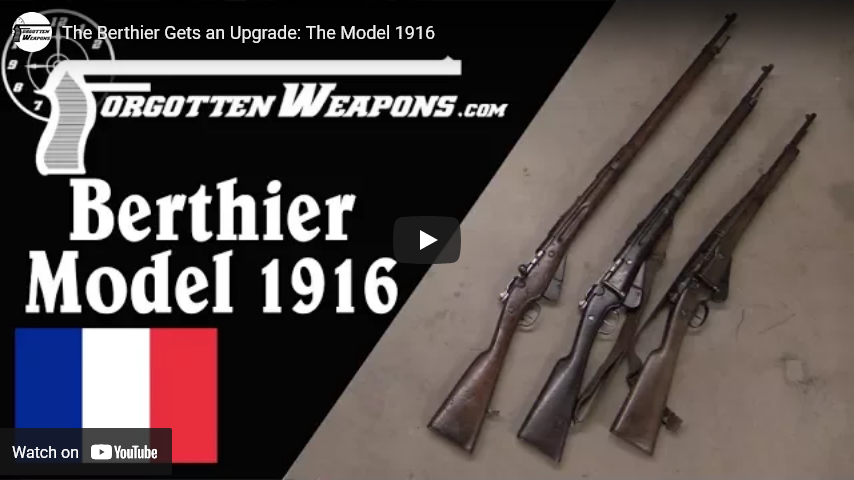
The Berthier Gets an Upgrade: The Model 1916
Forgotten Weapons
Published 26 Jul 2017http://www.patreon.com/ForgottenWeapons
The “Modifié 1916″ update to the Berthier system of rifles and carbines marked a major improvement in the gun’s combat effectiveness — really the first substantial overhaul to the design since it was developed in 1890. The two main elements of the upgrade were the addition of an upper handguard and an extension of the magazine from 3 rounds to 5, to match the capacity of the Mauser rifles used by Germany. In addition, several other improvements were made at the same time, including a redesign of the sights to favor quick target acquisition over long range precision and the addition of luminous radium elements to the sights. The upgrade package originally also included a dust cover over the bolt, but this was dropped for reasons I have not been able to determine.
This upgrade package was formally adopted in late 1916, and would go into production in 1917. However, it took a substantial time for the weapons to filter down to the front lines, and only a small number of M16 carbines and a very small number of M16 long rifles actually saw combat service before the Armistice. The M16 pattern (particularly the carbines) would form the standard armament for the French military right up to World War II, however, with Berthier carbine production continuing until 1939.
If you enjoy Forgotten Weapons, check out its sister channel, InRangeTV! http://www.youtube.com/InRangeTVShow
Comments Off on The Berthier Gets an Upgrade: The Model 1916
July 9, 2022
Tank Chat #151 Plastic Tank | The Tank Museum
The Tank Museum
Published 11 Mar 2022► TIMESTAMP:
00:00 – INTRO
00:43 – FEATURES
(more…)
Comments Off on Tank Chat #151 Plastic Tank | The Tank Museum


