
Valour Canada
Published 28 Dec 2015This video describes the Royal Canadian Navy’s (RCN) invaluable contributions to the invasion on D-Day, June 6, 1944. Operation Neptune was the name of the English Channel-crossing portion of the larger Normandy invasion (named Operation Overlord).
1. Overview (0:00)
Dawn. June 6, 1944. D-Day. Operation Overlord, the largest amphibious invasion in history, is about to begin. This is a description of the battlefield prior to the attack and also tells how the RCN played an important role both in the English Channel and along the French coast.2. Stop the U-boats (2:55)
Churchill said that the only thing that scared him during the war were the U-boats. This describes the problematic German U-boats and how the British and Canadian Navies (Operation Neptune) worked together to find, track, and destroy the underwater menace prior to D-Day.3. Clear the Mines (6:27)
“There is no doubt that the mine is our greatest obstacle to success” – British Admiral Bertram Ramsay. The size and effectiveness of the German minefield that guarded the D-Day beaches and how the Allied Navies worked together to prepare a route through which the invasion could occur.4. Cover the Beaches (9:49)
The Canadian Tribal-class destroyers played a significant role in eliminating the German Navy’s major surface warships’ threat to the invasion fleet. The RCN destroyer squadron and their mission of clearing the English Channel of German ships before, during, and after the invasion. A battle between the Canadian destroyers Haida and Huron and four German ships near the port of Brest on June 9 is discussed. Also covered are the two Canadian destroyers, Algonquin and Sioux, that were tasked with shore bombardment at Juno Beach.5. Land the Troops (13:01)
Shortly after dawn and following a forty-minute naval barrage at Juno Beach, the first Canadian soldiers came ashore. By noon, the beach was held by the Canadians and millions of tons of supplies were being brought ashore. This section describes the first waves of the invasion and the tanks, artillery, vehicles, and supplies that were soon to follow.
(more…)
June 4, 2023
D-Day Series: RCN and Operation Neptune
June 3, 2023
Why Was Normandy Selected For D-Day?
Real Engineering
Published 28 Mar 2020In the debut episode of the Logistics of D-Day we explore the logic and planning that resulted in Normandy being chosen as the location for the largest amphibious invasion in the history of human kind.
(more…)
June 2, 2023
“Montgomery was a military talent; Slim was a military genius”
Dr. Robert Lyman is a known fan of Field Marshal Slim (as am I, for the record), not only for his brilliant military achievements, but also as a writer:
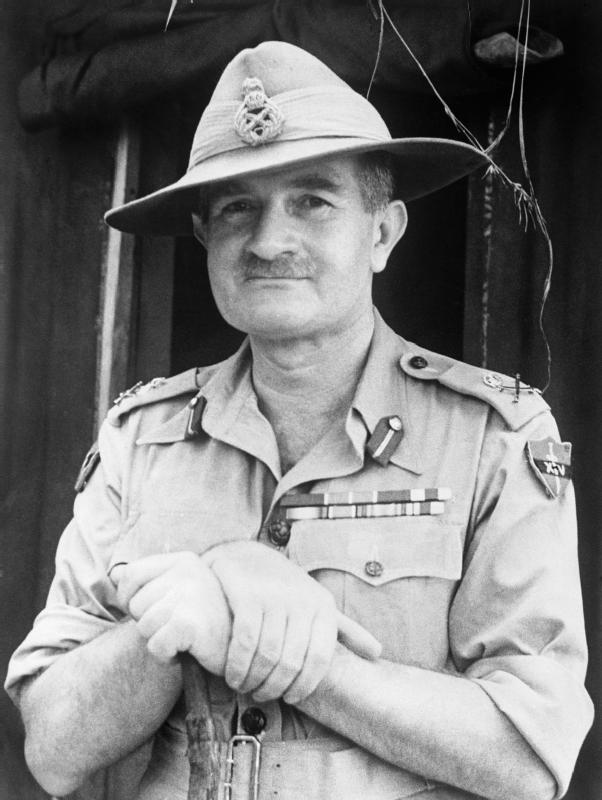
Field Marshal Sir William Slim (1891-1970), during his time as GOC XIVth Army.
Portrait by No. 9 Army Film & Photographic Unit via Wikimedia Commons.
How many British generals have been able to write as well as they could fight? Strangely perhaps, quite a few. Field Marshal Sir Michael Carver (Dilemmas of the Desert War, The Seven Ages of the British Army), General Sir David Fraser (And We Shall Shock Them), General Sir John Hackett (The Third World War) and Major General John Strawson (Beggars in Red) are four outstanding soldier-writers that spring immediately to mind. Even Monty wrote his memoirs. And in our own day I’ve read plenty of competent books from a slew of men who’ve reached the top of the profession of arms. The work of some, like that of General Sir Richard Sherriff (2017: War with Russia), Major General Mungo Melvin (Manstein) and Brigadier Allan Mallinson (Too Important for the Generals et al), could be described as outstanding. Julian Thompson and Richard Dannatt also fit this bill. But by far and away the best of Britain’s soldier-writers in the last century was also probably the greatest soldier – and field commander – of them all: Bill Slim. He was, more properly, Field Marshal William J. Slim KG, GCB, GCMG, GCVO, GBE, DSO, MC, KStJ, the onetime General Officer Commanding the famous 14th Army – the so-called Forgotten Army – of Burma fame. He was, in this author’s view, the greatest British general of the last war (to avoid further debate, let’s just agree that Monty failed as a coalition commander, whereas Slim excelled). Slim’s ability as a general is perfectly summed up by the historian Frank McLynn:
Slim’s encirclement of the Japanese on the Irrawaddy deserves to rank with the great military achievements of all time – Alexander at Gaugamela in 331 BC, Hannibal at Cannae (216 BC), Julius Caesar at Alesia (58 BC), the Mongol general Subudei at Mohi (1241) or Napoleon at Austerlitz (1805). The often made – but actually ludicrous – comparison between Montgomery and Slim is relevant here … there is no Montgomery equivalent of the Irrawaddy campaign … Montgomery was a military talent; Slim was a military genius.1
Some hint of Bill Slim’s fluency with the written word to complement his ability as a soldier came with the publication of Defeat into Victory in 1956, his superb retelling of the Burma story. Apart from its remarkable tale – the humiliation of British Arms in 1942 eventually overturned by a triumphant (and largely Indian) army in 1945 (87% of Slim’s army was Indian) – the quality of the writing was astonishing. Its author, a man who would be appointed Chief of the Imperial General Staff in 1949 (following Monty), the first Sepoy General ever to do so, and by Attlee no less, could clearly wield a pen every bit as he could destroy Japanese armies in battle (a feat he achieved twice, first in 1944 and again in 1945). When the book was first published it was an instant publishing sensation with the first edition of 20,000 selling out immediately. The Field recorded: “Of all the world’s greatest records of war and military adventure, this story must surely take its place among the greatest. It is told with a wealth of human understanding, a gift of vivid description, and a revelation of the indomitable spirit of the fighting man that can seldom have been equalled – let alone surpassed – in military history.” The London Evening Standard was as effusive in its praise: “He has written the best general’s book of World War II. Nobody who reads his account of the war, meticulously honest yet deeply moving, will doubt that here is a soldier of stature and a man among men.” The author John Masters, who served in the 14th Army, wrote in the New York Times on 19 November 1961 that it was “a dramatic story with one principal character and several hundred subordinate characters”, arguing that Slim was “an expert soldier and an expert writer”. The book remains a best seller today.
The following year Slim also published an anthology of speeches and lectures, loosely based on the theme of leadership, called Courage and Other Broadcasts. Then in 1959 he published his second book, Unofficial History, which bears out in full Masters’ description of Slim as a superb writer. It was a deeply personal, honest though light hearted account of events during his service. It received widespread acclaim. The author John Connell described it as “for the most part uproarious fun. If Bill Slim hadn’t been a first-rate soldier, what a short story writer he might have made.” For its part, The National Review wrote: “One of the most significant aspects of Field Marshal Slim’s book is the affectionate respect he shows when he writes about British and Indian soldiers. He finds plenty to amuse him too. I doubt whether a kindlier or truer description of the contemporary soldier has been given anywhere than in Unofficial History … It is one of the most delightful and amusing books about modern campaigning I have ever read.”
1. The General Wondered Why https://amzn.eu/d/45gHfOH
Germany Adopts the PPSh in 9mm: the MP-41(r)
Forgotten Weapons
Published 20 Feb 2023During World War Two, both German and Russian soldiers often thought that the other side’s weapons were better than their own. In particular, both sides often preferred their opponents’ SMGs. In late 1941, a group of German officers formally requested that Germany simply copy and produce the PPSh-41. This led to the HWA formally studying the question of PPSh-41 vs MP-40 … and they found that the German gun was better, but the Russian magazine was better.
Naturally, as a result of this finding, the German military chose to convert captured Russian PPSh-41s to use MP-40 magazines. The conversion used standard MP40 magazines, and required magazine well adapters and new 9mm barrels. Some 10,000 such conversions were made in total. Some used cast magwell adapters and some were stamped, and the barrels were made from standard MP40 barrels turned down to fit PPSh trunnions.
The standard 7.62mm PPSh-41 in German service was designated MP-717(r), while the ones changed to 9x19mm like this were designated MP-41(r). Many thanks to Limex for giving me access to film this one for you!
(more…)
May 31, 2023
Improvised Weapons of WW2 | Anti-Tank Chats #8 | The Tank Museum
The Tank Museum
Published 10 Feb 2023Historian Stuart Wheeler is back with another Anti-Tank Chat. In this episode, he looks at the development and use of improvised, thrown and placed infantry anti-tank weapons, available to British and Commonwealth forces in World War II.
(more…)
QotD: The second system of war
Agriculture created a stationary population that both wouldn’t move but which could also be dominated, subjugated and have their production extracted from them. Their wealth was clustered in towns which could be fortified with walls that would resist any quick raid, but control of that fortified town center (and its administrative apparatus of taxation) meant control of the countryside and its resources. Taking such a town meant a siege – delivering a large body of troops and keeping them there long enough to either breach the walls or starve the town into surrender. This created a war where territorial control was defined by the taking of fixed points.
In such war, the goal was to deliver the siege. But delivery of the siege meant a large army which might now be confronted in the field (for it was unlikely to move by stealth, being that it has to be large enough to take the town). And so to prohibit the siege from being delivered, defenders might march out and meet the attackers in the field for that pitched battle. In certain periods, siegecraft or army size had so outpaced fortress design that everyone rather understood that after the outcome of the pitched battle, the siege would be a forgone conclusion – it is that unusual state of affairs which gives us the “decisive battle” where a war might potentially be ended in a stoke (though they rarely were).
We may term this the second system of war. It is the system that most modern industrial and post-industrial cultures are focused on. Our cultural products are filled with such pitched battles, placed in every sort of era of our past or speculative future. It is how we imagine war. Except that it isn’t the sort of war we wage, is it?
Because in the early 1900s, the industrial revolution resulted in armies possessing both amounts of resources and levels of industrial firepower which precluded open pitched battles. All of those staples of our cultural fiction of battles, developed from the second system – surveying the enemy army drawn up in battle array, the tense wait, then the furious charge, coming to grips with the enemy in masses close up – none of that could survive modern machine guns and artillery.
Bret Devereaux, “Collections: The Universal Warrior, Part IIa: The Many Faces of Battle”, A Collection of Unmitigated Pedantry, 2021-02-05.
May 30, 2023
M1886 Lebel Rifle at the Range
Forgotten Weapons
Published 17 Mar 2013The French M1886 Lebel was the first smallbore smokeless powder rifle adopted by a major military, and was a game changer in the European arms race in the 1880s. It wasn’t an outstanding design in many ways (like the slow-loading tube magazine and requirement to use a screwdriver to remove the bolt), but its 8mm smokeless cartridge jumped France to the front of the technological race regardless. Today, we’re taking one out to the range to see how it shoots.
May 29, 2023
The Moment D-Day Was Announced
World War Two
Published 28 May 2023D-Day is just around the corner, we’re in the end game now. You can learn more about the project and how to get involved at http://DDay.TimeGhost.tv
May 28, 2023
Thanks to geography, Canada has “been able to neglect national security for decades”
In the weekly Dispatch post from The Line‘s editors, an almost unremarkable comment comes into close focus:
Continuing with the Johnston report fallout, The Line has been pondering a tweet by Thomas Juneau, one of the country’s relatively few genuine experts in Canadian intelligence and national security. Let’s state this up front: The Line likes Thomas Juneau. He’s written for us before, we hope he’ll write for us again. Nothing that follows should be seen as disagreeing with or nitpicking the professor, because The Line broadly agrees with the point he was making, and found his entire thread on Twitter worth the read. But let’s zoom on this particular comment:
What specifically caught us was this part: “We have been able to neglect national security for decades”.
Again, no disagreement here. Both your Line editors would have made that literal exact argument countless times before in their careers, because it’s true, and likely with essentially identical language. But we read Juneau’s tweet when the Johnston report, and the POEC report before it, were much on our minds. And we’ve been unable to shake the feeling ever since that perhaps “neglect” isn’t the right word for how Canadians approach security. Maybe, we’re wondering, it’s something closer to “disdain”.
Canada has “neglected” a lot of things, after all. And we don’t even mean that in the sense of a lament or criticism. There’s a ton of policy areas or even simply fields of knowledge and expertise that Canada hasn’t paid any particular attention to or made a priority. As Line editor Gurney cracked on the podcast this week, we’ve also neglected botany as a national endeavour. But if some strange international development or social change required Canada to up its botany game, we suspect we’d just … do that. We’d recruit botanists from abroad, schools would open botany colleges, we’d create a Progressive Feminist Botanical Middle-Class Tax Credit (though you’d probably need to attest that you are pro-choice to apply for it). Pivoting to botany wouldn’t be a problem. We’d just emphasize botany, and let a thousand flowers bloom. As it were.
Whenever the issue is anything even remotely proximate to national defence and security, though, the mere suggestion that we should maybe do better, spend more money, allot greater resources, pay more attention, and build up current and future capabilities, is met with something that goes beyond neglect. Neglect implies a degree of apathy. The default Canadian response to any push for a greater emphasis on national defence and security is something closer to hostility.
“Like, why would we care about that weird stuff,” the default Canadian response goes. “That’s dumb. What, do you think Russia is going to invade us or something? What does Canada even need an army or spies for? Why would we even want to have experts on this stuff? This is Canada. We don’t need that stuff. Are you just some kind of weirdo or just some wannabe American?”
Your Line editors agree it’s a problem, but we aren’t sure exactly the root of it. Gerson thinks it might be more just an aversion to thinking about unpleasant things; we quipped on our podcast that talking about defence and security in Canada results in the kind of aghast stares a first-class passenger during the last dinner on the Titanic would have received from his dining companions if he’d casually mentioned he’d been counting the number of lifeboats and had noticed something interesting.
Whoa, dude, we’re having a lovely dinner here. Why you gotta be bringing that up? You think the ship is gonna sink or something?
Gurney thinks there’s truth to that, and would add that if that’s the problem, it goes beyond what we would think of as defence and security, and go all the way into emergency preparedness. Canada and Canadians are chronic under-investors on emergency preparedness and underpreparers because Bad Things Don’t Happen Here, They Happen Somewhere Else, Thank You Very Much. Our typical emergency response plan is “Don’t worry, that won’t happen.” Gurney also thinks this all might be related to how Canadians continually define themselves in opposition to Americans: since the Americans do invest heavily in national defence and security, there’s probably some Canadians out there who have concluded, even subconsciously, that that is an American thing to do, and we don’t do American things.
The above is all a bit theoretical, we grant, but we can’t stop thinking about it all the same. What if the problem isn’t that we neglect security so much as actively dislike thinking and talking about it? If so, that’s a bad habit that may prove difficult, and ultimately expensive, to break free from.
Breakout from Anzio! – WW2 – Week 248 – May 27, 1944
World War Two
Published 27 May 2023After four months, the Allies breakout from their bridgehead at Anzio and meet with the advancing troops heading north after the fall of Monte Cassino last week. The Japanese begin phase two of their big operation in China, and both the Soviets and the Western Allies continue making plans for their massive June offensives to squeeze the Axis from both sides of Europe.
(more…)
May 27, 2023
Lee 1875 Vertical Action Carbine
Forgotten Weapons
Published 21 Aug 2014The 1875 Lee Vertical Action was an experimental rifle designed by James Paris Lee (of Lee Enfield and Lee Navy fame) as an idea to increase the rate of fire from single-shot Army rifles. He touted an impressive 30 rounds in 45 seconds with the rifle, thanks to several design elements that combined to make a very fast manual of arms. In total only 143 of these guns were made at Springfield Armory, and this example is the only known carbine variant.
(more…)
QotD: The war elephant’s primary weapon was psychological, not physical
So it is possible – even without special anti-elephant weapons or tactics – for very high quality infantry (and we should be clear about this: Alexander’s phalanx was as battle hardened as troops come) to resist the charge of elephants. Nevertheless, the terror element of the onrush of elephants must be stressed: if being charged by a horse is scary, being charged by a 9ft tall, 4-ton war beast must be truly terrifying.
Yet – in the Mediterranean at least – stories of elephants smashing infantry lines through the pure terror of their onset are actually rare. This point is often obscured by modern treatments of some of the key Romans vs. Elephants battles (Heraclea, Bagradas, etc), which often describe elephants crashing through Roman lines when, in fact, the ancient sources offer a somewhat more careful picture. It also tends to get lost on video-games where the key use of elephants is to rout enemy units through some “terror” ability (as in Rome II: Total War) or to actually massacre the entire force (as in Age of Empires).
At Bagradas (255 B.C. – a rare Carthaginian victory on land in the First Punic War), for instance, Polybius (Plb. 1.34) is clear that the onset of the elephants does not break the Roman lines – if for no other reason than the Romans were ordered quite deep (read: the usual triple Roman infantry line). Instead, the elephants disorder the Roman line. In the spaces between the elephants, the Romans slipped through, but encountered a Carthaginian phalanx still in good order advancing a safe distance behind the elephants and were cut down by the infantry, while those caught in front of the elephants were encircled and routed by the Carthaginian cavalry. What the elephants accomplished was throwing out the Roman fighting formation, leaving the Roman infantry confused and vulnerable to the other arms of the Carthaginian army.
So the value of elephants is less in the shock of their charge as in the disorder that they promote among infantry. As we’ve discussed elsewhere, heavy infantry rely on dense formations to be effective. Elephants, as a weapon-system, break up that formation, forcing infantry to scatter out of the way or separating supporting units, thus rendering the infantry vulnerable. The charge of elephants doesn’t wipe out the infantry, but it renders them vulnerable to other forces – supporting infantry, cavalry – which do.
Elephants could also be used as area denial weapons. One reading of the (admittedly somewhat poor) evidence suggests that this is how Pyrrhus of Epirus used his elephants – to great effect – against the Romans. It is sometimes argued that Pyrrhus essentially created an “articulated phalanx” using lighter infantry and elephants to cover gaps – effectively joints – in his main heavy pike phalanx line. This allowed his phalanx – normally a relatively inflexible formation – to pivot.
This area denial effect was far stronger with cavalry because of how elephants interact with horses. Horses in general – especially horses unfamiliar with elephants – are terrified of the creatures and will generally refuse to go near them. Thus at Ipsus (301 B.C.; Plut. Demetrius 29.3), Demetrius’ Macedonian cavalry is cut off from the battle by Seleucus’ elephants, essentially walled off by the refusal of the horses to advance. This effect can resolved for horses familiarized with elephants prior to battle (something Caesar did prior to the Battle of Thapsus, 46 B.C.), but the concern seems never to totally go away. I don’t think I fully endorse Peter Connolly’s judgment in Greece and Rome At War (1981) that Hellenistic armies (read: post-Alexander armies) used elephants “almost exclusively” for this purpose (elephants often seem positioned against infantry in Hellenistic battle orders), but spoiling enemy cavalry attacks this way was a core use of elephants, if not the primary one.
Bret Devereaux, “Collections: War Elephants, Part I: Battle Pachyderms”, A Collection of Unmitigated Pedantry, 2019-07-26.
May 26, 2023
CH-124 Sea King; Legendary ASW helicopter and example of a deeply flawed defense procurement process
Polyus
Published 21 May 2023The Sea King was a legendary aircraft in the history of the Royal Canadian Navy. It filled the role of hunter and killer in the Cold War against Soviet submarines. By the mid-90s the situation had changed and their retirement seemed eminent. How naive. The process of finding a replacement for this workhorse would be an election promise by government after government for over 30 years. Its replacement, the CH-148 Cyclone, became operational in 2018. This allowed the 55 year old workhorses to finally retire.
(more…)
May 25, 2023
The Hoplite Heresy: Why We Don’t Know How the Ancient Greeks Waged War
The Historian’s Craft
Published 9 Feb 2023Hoplites are probably one of the first things that come to mind when one thinks of “Ancient Greece”. Equipped with a bronze spear and wearing bronze armor or a linothorax, and hefting the aspis — the hoplite‘s bronze shield — they fought in phalanxes. The classic mode of fighting in this formation was the “othismos“, the push, with the aim being to disrupt the enemy phalanx and break their formation. But, over the past few decades, views on hoplite warfare have been called into question and seriously revised, because there are problems in the source material. So, what are these problems, and how do historians of Ancient Greece understand hoplite warfare?
May 24, 2023
The American flagship of Standing NATO Maritime Group 2 (SNMG2)
CDR Salamander has thoughts on the state of the current flagship of Standing NATO Maritime Group 2 (SNMG2), USS James E. Williams … unhappy thoughts:
One of the most high profile alliance units is Standing NATO Maritime Group 2 (SNMG2).
Consisting of a half dozen or so destroyers and frigates from assorted alliance members, it cruises about refining how we work together, conducting exercises, and showing the flag around the Mediterranean and Atlantic as time and livers allow. It is also an opportunity for nations to show their allies their professionalism.
Really, for a Sailor of any nation, it is some of the best duty you can find this side of BALTOPS … but I digress. We’ll return to BALTOPS at the bottom of the post.
Because of its high profile and extended operations with alliance nations, the ships we assign to SNMG2 don’t just represent the USA as any warship that “shows the flag” does, but it imprints on the mind of military and civilian leaders in Europe the quality of the US Navy and by extension, the nation it serves.
Our opponents in the world will also see it as an indication of our general health, morale, and the respect we show our friends.
I had an interesting seat as a junior officer. A little more than a month after reporting to my first sea duty command, I found myself with a front row seat to not just Desert Shield/Storm, but to the last year or so of the Soviet Union. I then watched from the Mediterranean and Atlantic the slow decay of the now Russian naval forces through the 1990s. A common refrain was as we got a close look at them was, “Did you see the condition they’re in?”
Looks matter. With ships, even more than people, the external manifestations of poor condition are a warning of significant problems inside the skin of the ship
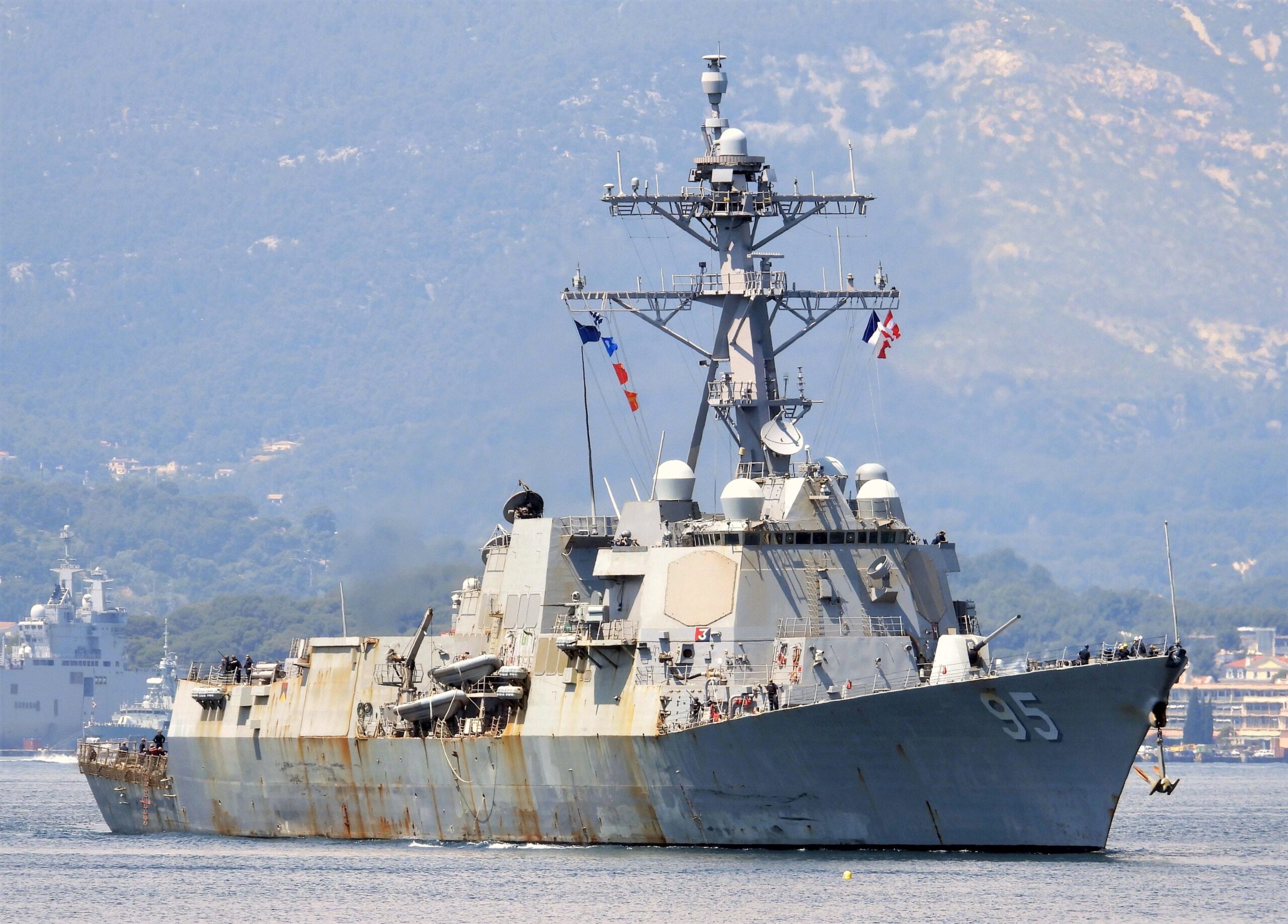
The Arleigh Burke-class Flight IIA guided missile destroyer USS James E. Williams (DDG 95) as it was leaving Toulon, France, May 22, 2023. Yes, the ship named after a Boatswain’s Mate First Class looks like that. I am sorry BM1, we tried.
Photo from https://twitter.com/WarshipCam/status/1660740976942501893.
SNMG2 decided to honor the United States Navy by having one of its destroyers be its flagship. That’s right kiddies; that rusting eyesore is the flagship of SNMG2.
The US Navy decided that this was the warship they wanted to represent the US Navy and the nation it serves. This was an act of commission – of intent – as conscious of an act as that which ensured that in the last few years that warship was not manned, trained, equipped, or maintained at a level which would allow for basic maintenance. Even as she got ready to get underway, no one stopped her. No one tried a last minute fix. The whole evolution has an ambiance of, “Who cares. Send her.”
Don’t think the insult isn’t properly understood, if not to Congress and the American people, but to our friends and competitors. Don’t think this isn’t the talk of allied wardrooms.


