Quotulatiousness

May 30, 2017

The Belisarius fixation in SF&F

Filed under: Books, History, Middle East — Tags: , , , , , — Nicholas @ 03:00

Jo Walton wonders why an otherwise obscure general of an otherwise obscure empire appears so often in fantasy and science fiction:

I once wrote jokingly here that there are only three plots, and they are Hamlet, Pride and Prejudice, and Belisarius, because those are the ones everyone keeps on reusing.

There is a conference in Uppsala in Sweden the weekend before the Helsinki Worldcon called “Reception Histories of the Future” which is about the use of Byzantium in science fiction. The moment I heard of it, I immediately started thinking about our obsessive reuse of the story of Belisarius. (I’m going. Lots of other writers are going. If you’re heading to Helsinki, it’s on your way, and you should come too!)

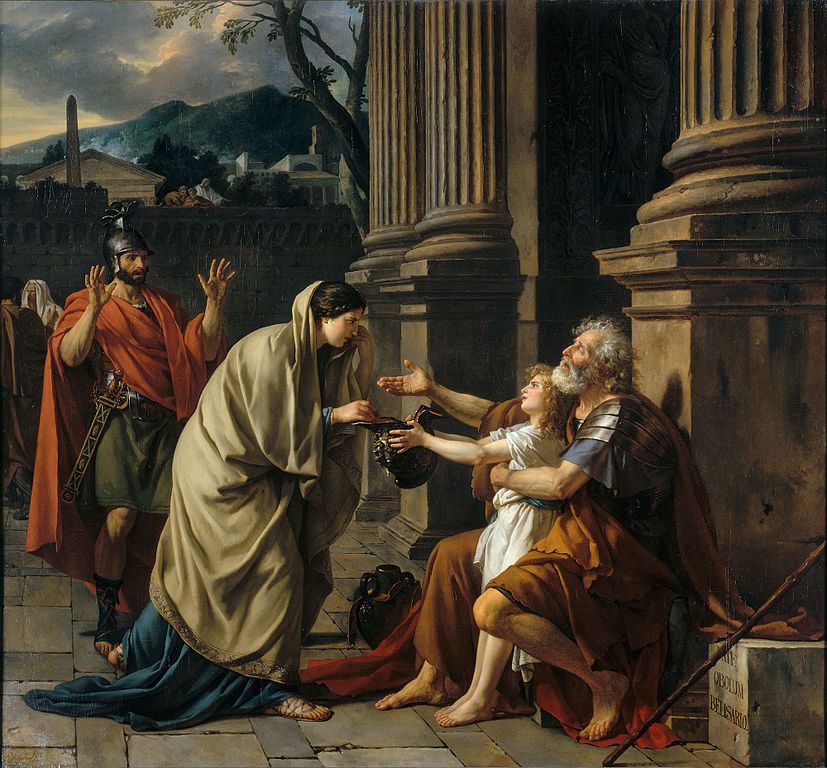
It’s strange that science fiction and fantasy are obsessed with retelling the story of Belisarius, when the mainstream world isn’t particularly interested. Robert Graves wrote a historical novel about him in 1938, Count Belisarius, and there’s Gillian Bradshaw’s The Bearkeeper’s Daughter (1987), but not much else. Whereas in genre, we’ve had the story of Belisarius retold by Guy Gavriel Kay, David Drake (twice) and Chelsea Quinn Yarbro, and used by L. Sprague de Camp, John M. Ford, Jerry Pournelle, Robert Silverberg, and Isaac Asimov. So what is it about this bit of history that makes everyone from Asimov to Yarbro use it? And how is it that the only place you’re likely to have come across it is SF?

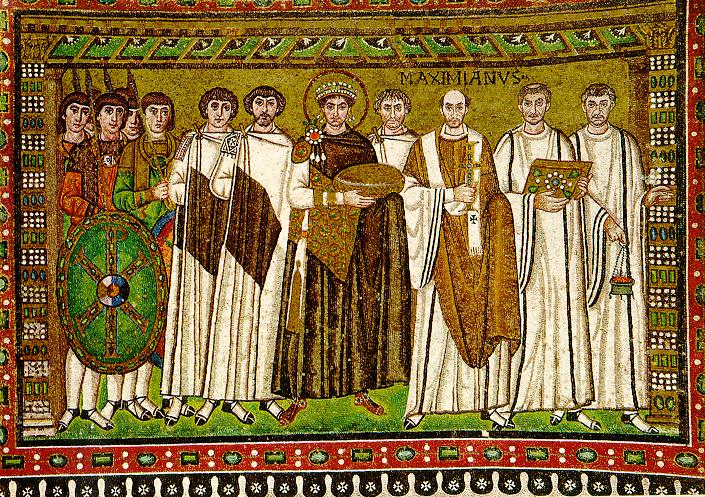
First, let’s briefly review the story. First Rome was a huge unstoppable powerful indivisible empire. Then Rome divided into East and West, with the Eastern capital at Constantinople. Then the Western half fell to barbarians, while the Eastern half limped on for another millennium before falling to the Ottoman conqueror Mehmed II in 1453. We call the eastern half Byzantium, but they went right on calling themselves the Roman Empire, right up to the last minute. But long before that, in the sixth century, at the exact same time as the historical Arthur (if there was an Arthur) was trying to save something from the shreds of Roman civilization in Britain, Justinian (482-565) became emperor in Constantinople and tried to reunite the Roman Empire. He put his uncle on the throne, then followed him. He married an actress, the daughter of an animal trainer, some say a prostitute, called Theodora. He has a loyal general called Belisarius. He built the great church of Hagia Sophia. He withstood a giant city riot in the hippodrome, the great chariot-racing stadium, by having Belisarius’s soldiers massacre a huge number of people. He wrote a law code that remained the standard law code everywhere in Europe until Napoleon. And Belisarius reconquered really quite large chunks of the Roman Empire for him, including Rome itself. At the height of his success he was recalled to Rome and fired because Justinian was jealous. Belisarius had a huge army and could have taken the throne for himself, which was typical of both the Roman and the Byzantine empires, but he was loyal and let Justinian fire him. This is all happening at a time of Christian schism and squabbling about heresy between different sects.

While I’d quibble about her thumbnail sketch a bit, there’s more than enough there to fuel dozens of alt-history, fantasy, or science fiction novels … the fiction couldn’t be much more difficult to swallow than the reality. My first contact with the story of Belisarius was indeed the Robert Graves novel (which I still heartily recommend). I imagine that was true for most of the authors listed above.

May 29, 2017

On this day in 1453

Filed under: History, Middle East, Religion — Tags: , , , , , — Nicholas @ 17:29

In the Smithsonian Magazine in 2008, Fergus M. Bordewich described the events of 29 May, 1453:

In the 11th century, the Byzantines suffered the first in a series of devastating defeats at the hands of Turkish armies, who surged westward across Anatolia, steadily whittling away at the empire. The realm was further weakened in 1204 when western European crusaders en route to the Holy Land, overtaken by greed, captured and looted Constantinople. The city never fully recovered.

By the mid-15th century, Constantinople was hemmed in by Ottoman-controlled territories. On May 29, 1453, after a seven-week siege, the Turks launched a final assault. Bursting through the city’s defenses and overwhelming its outnumbered defenders, the invaders poured into the streets, sacking churches and palaces, and cutting down anyone who stood in their way. Terrified citizens flocked to Hagia Sophia, hoping that its sacred precincts would protect them, praying desperately that, as an ancient prophesied, an avenging angel would hurtle down to smite the invaders before they reached the great church.

Instead, the sultan’s janissaries battered through the great wood-and-bronze doors, bloody swords in hand, bringing an end to an empire that had endured for 1,123 years. “The scene must have been horrific, like the Devil entering heaven,” says Crowley. “The church was meant to embody heaven on earth, and here were these aliens in turbans and robes, smashing tombs, scattering bones, hacking up icons for their golden frames. Imagine appalling mayhem, screaming wives being ripped from the arms of their husbands, children torn from parents, and then chained and sold into slavery. For the Byzantines, it was the end of the world.” Memory of the catastrophe haunted the Greeks for centuries. Many clung to the legend that the priests who were performing services that day had disappeared into Hagia Sophia’s walls and would someday reappear, restored to life in a reborn Greek empire.

That same afternoon, Constantinople’s new overlord, Sultan Mehmet II, rode triumphantly to the shattered doors of Hagia Sophia. Mehmet was one of the great figures of his age. As ruthless as he was cultivated, the 21-year-old conqueror spoke at least four languages, including Greek, Turkish, Persian and Arabic, as well as some Latin. He was an admirer of European culture and patronized Italian artists, such as the Venetian master Gentile Bellini, who painted him as a bearded, introspective figure swathed in an enormous robe, his small eyes gazing reflectively over an aristocratically arched nose. “He was ambitious, superstitious, very cruel, very intelligent, paranoid and obsessed with world domination,” says Crowley. “His role models were Alexander the Great and Julius Caesar. He saw himself as coming not to destroy the empire, but to become the new Roman emperor.” Later, he would cast medallions that proclaimed him, in Latin, “Imperator Mundi” — “Emperor of the World.”

Before entering the church, Mehmet bent down to scoop up a fistful of earth, pouring it over his head to symbolize his abasement before God. Hagia Sophia was the physical embodiment of imperial power: now it was his. He declared that it was to be protected and was immediately to become a mosque. Calling for an imam to recite the call to prayer, he strode through the handful of terrified Greeks who had not already been carted off to slavery, offering mercy to some. Mehmet then climbed onto the altar and bowed down to pray.

Among Christians elsewhere, reports that Byzantium had fallen sparked widespread anxiety that Europe would be overrun by a wave of militant Islam. “It was a 9/11 moment,” says Crowley. “People wept in the streets of Rome. There was mass panic. People long afterward remembered exactly where they were when they heard the news.” The “terrible Turk,” a slur popularized in diatribes disseminated across Europe by the newly invented printing press, soon became a synonym for savagery.

May 26, 2017

German Bombers Over Britain – Arab Revolt On The Advance I THE GREAT WAR Week 148

Filed under: Europe, France, History, Italy, Middle East, Military, WW1 — Tags: , — Nicholas @ 05:00

Published on 25 May 2017

This week 100 years ago, Germany is flying concentrated bomber attacks with multiple Gotha bombers on British cities – causing more damage than any Zeppelin raid before. In the Middle East, T.E. Lawrence and his allies from the Arab Revolt are on the march while on the Western Front, the last battles of the Nivelle Offensive come to an end.

A noteworthy historical “Oh, shit!” moment

Filed under: Books, Greece, History, Middle East, Military — Tags: , , — Nicholas @ 03:00

At Catallaxy Files, a guest post on a most butt-puckering “Oh, shit!” from long ago:

My favourite Oh Shit moment of all time occurred a while ago. On the 4th of September 401 BC to be exact. At dawn.

Cyrus the brother of the Persian Emperor wanted to knock him off and take the throne. He had plenty of local soldiers, but to add some oomph he hired about 13,000 Greek mercenaries. Many of these were Athenians down on their luck after their city lost the Peloponnesian Wars. The Greek hoplites were the Abrams tanks of the day. Unstoppable.

The Battle of Cunaxa saw Cyrus and his brother face off. It was going reasonably well for Cyrus’s guys – the Greeks routed their Persian opponents. But then Cyrus spotted the Emperor and his guard. According to Xenophon he then took his bodyguard of 600 heavy cavalry off and attacked the Emperor’s 6,000. Cyrus went all in – he personally attacked his brother and wounded him. But in doing so he received a javelin just under one eye and expired.

Which brings us to dawn next morning. The Greeks had no idea that their paymaster had suffered a quite unsuccessful death or glory moment, until the news arrived just then.

The Persians, having sorted out their differences, were now united into a huge army under Artaxerxes the Emperor. Which left the small matter of the Greek mercenary force deep inside the Persian Empire and surrounded by a vast horde of very unhappy Persians.

Oh shit.

The story of their escape back to Greece is awe inspiring and amazing. Well worth reading. Xenophon’s Anabasis is available free from Project Gutenberg at the link.

May 23, 2017

Remembering the Six-Day War

Filed under: History, Middle East, Military, Religion — Tags: , , , , , , — Nicholas @ 03:00

With the 50th anniversary coming up in a few weeks, Jerrold L. Sobel provides a retrospective on the Arab-Israeli war of 1967:

For those of us alive during those daunting days in May 1967 leading up to the war, it was a period in time we will never forget, nor should we. Its ramifications were and are germane to this very day.

No discussion of the Six-Day War can be made without the background of its major protagonist, Gamal Abdel Nasser. Whereas today ISIS is attempting to dominate the Islamic world under an Islamic Caliphate, Nasser, then president of Egypt, attempted to do the same but with a secular approach. On July 23, 1952, he and a group of officers staged a coup and ousted the Egyptian King Farouk. Although the real leader, Nasser initially remained in the background but in fact was instrumental in abolishing the monarchy in 1953. The following year he came out of the shadows to assume absolute power and began instituting far-reaching economic reforms which instantly made him the darling of the Arab world. By 1956 his relations with the West had deteriorated to the point that he brazenly nationalized the Suez Canal, prompting an invasion by England, France, and Israel. Under pressure from the U.S., these forces withdrew, and a United Nations Emergency force was subsequently placed as a buffer between Egypt and Israel; the withdrawal of which would play a pivotal role in the conflict 11 years later.

At the pinnacle of his popularity, Nasser joined with Syria forming what became the United Arab Republic (U.A.R.), a move which encouraged the Syrians to ramp up incessant attacks against Israel from their vantage point on the Golan Heights, towering 3,000 feet above the Galilee. No Israeli farm or Kibbutz was spared the wrath of Syrian artillery. Much like the residents of Sderot and other Israeli towns adjacent to Gaza today, Jews were forced to sleep and conduct their lives in bomb shelters.

[…]

In the early hours of June 5, 1967 Israel launched a preemptive air strike on the air forces of Egypt, Jordan, and Syria with devastating effect. Five days later the armies of these nations along with Iraq, which also joined the fray were crushed and forced to sue for a ceasefire. The war may have taken only six days but its ramifications and similarities to today’s Middle East conflict is unquestionable. What were the accomplishments?

  • For the first time since prior to the Ottoman Empire, Jews have unfettered access to their Holy sites and a united Jerusalem their ancient capital.
  • The indefensible 1948 armistice line which bisected Israel from the Jordan River to within 9 miles of the Mediterranean Sea had been abrogated.
  • Israel took control of Judea and Samaria, which was illegally annexed by Jordan following the ’48 armistice.
  • Israel commands the highly defensible Jordan Valley where terrorist attacks had emanated from both Jordan and Syria.
  • Israel was able to trade the Sinai Peninsula for a peace treaty with her main antagonist, Egypt.
  • The Golan Heights, the onetime haven for terrorists and Syrian artillery, was annexed and have remained relatively quiet for the past 50 years.
  • Most importantly, by winning the war decisively, Israel staved off what was intended to be another mass genocide of the Jewish people….

What was not accomplished?

  • An end to terrorism.
  • An end to Anti-Semitic cartoons and rhetoric throughout much of the Islamic world, particularly Iran.
  • An end of vilification of Israel by the Palestinian leadership, media, and educational system.
  • A Palestinian leader willing to recognize Israel as the homeland of the Jewish people.
  • A United Nations only united in castigating the only true democracy in the Middle East.
  • A total negation of slander on campus against Jews masked under the pretense of Anti-Zionism; particularly the BDS movement.

Despite these and other seemingly irreconcilable problems, winning the Six-Day War has allowed the Jewish state to survive and rise from its fledgling third-world status into a technological, economic, and military behemoth; an island of democratic renaissance surrounded by a sea of despair.

Top 10 Reasons the Byzantine Empire Was Among the Most Successful in History

Filed under: Europe, History, Middle East, Religion — Tags: , , , , — Nicholas @ 02:00

Published on 2 May 2017

You’d see a lot of changes when looking at a map of present day Europe and comparing it to a 30 year old one. Belarus, Moldova, Ukraine and the Baltic States were all part of the USSR. Yugoslavia and Czechoslovakia were still states. Go back even further and the map looks even stranger. Putting all those different people under the same banner and keeping them that way was and still is next to impossible. Many have tried and most have failed, but the first to even come close were the Romans. Their inheritors, the Byzantines, managed to keep it together for over 1100 years, thus creating the longest-living Empire on the continent. Here’s how they did it.

April 22, 2017

Movie on the Armenian Genocide attracts massive number of Turkish trolls

Filed under: History, Media, Middle East, WW1 — Tags: , , , , , , , — Nicholas @ 04:00

One of the worst aspects of the First World War was the attempt by Ottoman forces to eliminate the Armenian “threat” by launching an organized campaign of murder and deportation that killed an estimated 1.5 million Armenians. A new movie which is set in this time has been drawing trollish attention from Turkish detractors:

The Promise, the grandest big-screen portrayal ever made about the mass killings of Armenians during World War I, has been rated by more than 111,300 people on IMDb — a remarkable total considering it doesn’t open in theaters until Friday and has thus far been screened only a handful of times publicly.

The passionate reaction is because The Promise, a $100-million movie starring Oscar Isaac and Christian Bale, has provoked those who deny that 1.5 million Armenians were massacred between 1915 and 1923 by the Ottoman Empire or that the deaths of Armenians were the result of a policy of genocide. Thousands, many of them in Turkey, have flocked to IMDb to rate the film poorly, sight unseen. Though many countries and most historians call the mass killings genocide, Turkey has aggressively refused that label.

Yet that wasn’t the most audacious sabotage of The Promise, a passion project of the late billionaire investor and former MGM owner Kirk Kerkorian.

In March, just a few weeks before The Promise was to open, a curiously similar-looking film called The Ottoman Lieutenant appeared. Another sweeping romance set during the same era and with a few stars of its own, including Ben Kingsley and Josh Hartnett, The Ottoman Lieutenant seemed designed to be confused with The Promise. But it was made by Turkish producers and instead broadcast Turkey’s version of the events — that the Armenians were merely collateral damage in World War I. It was the Turkish knockoff version of The Promise, minus the genocide.

“It was like a reverse mirror image of us,” said Terry George, director and co-writer of The Promise. George, the Irish filmmaker, has some experience in navigating the sensitivities around genocide having previously written and directed 2004’s Hotel Rwanda, about the early ’90s Rwandan genocide.

George bought a ticket to see it. “Basically the argument is the Turkish government’s argument, that there was an uprising and it was bad and we had to move these people out of the war zone — which, if applied to the Nazis in Poland would be: ‘Oh, there was an uprising in the Warsaw Ghetto and we need to move these Jews out of the war zone,’” says George. “The film is remarkably similar in terms of structure and look, even.”

The movie itself, however, didn’t win over A.V. Club critic Ignatiy Vishnevetsky:

Among the many virtues of James Gray’s The Lost City Of Z is its sense of proportion, which turns a decades-spanning historical epic into a pas de deux between vision and madness. Unfortunately, most recent historical epics have been more on the order of Terry George’s The Promise: messes of soap and cheese. Here at last is a film that tackles the Armenian genocide by way of a flimsy love triangle and an international cast (it really captures the diversity of the Armenian people), straining so hard to show its good intentions that it doesn’t bother to be directed. What does a movie that can’t even mount a competent horse chase — despite repeated attempts — have to say about the murder of 1.5 million people? At least George can rest easy knowing that his film is less bungled than Bitter Harvest, the February release that turned the Holodomor into the stuff of schmaltz. Up next, presumably, is Nicholas Sparks’ Auschwitz.

Doing his best impression of Omar Sharif, Oscar Isaac stars as Mikael Boghosian, a village apothecary who agrees to marry doe-eyed local girl Maral (Angela Sarafyan) in order to use her dowry to finance his dream of becoming a doctor. (Pity poor Maral, as no two members of the cast seem to agree on how to pronounce her name.) Arriving in Constantinople, the capital of the Ottoman Empire, Mikael moves in with his wealthy uncle and enrolls in medical school, but soon develops a crush on Ana (Charlotte Le Bon), the modern young woman who tutors his uncle’s children. But it’s 1914, and the Ottoman Empire is about to enter World War I as an ally of Germany and Austria-Hungary and within months will begin a strategic elimination of its large Armenian minority. As if to make matters worse, Ana has an American boyfriend, Chris Myers (Christian Bale), the Associated Press’ bureau chief of Armenian genocide exposition.

Still from The Promise, by Open Road Films.

April 21, 2017

The Nivelle Offensive – Carnage At The Chemin Des Dames I THE GREAT WAR Week 143

Filed under: Europe, France, Germany, History, Middle East, Military, WW1 — Tags: , , — Nicholas @ 05:00

Published on 20 Apr 2017

French Commander Robert Nivelle was sure that his offensive would bring the final victory against Germany. He scaled up his successful plan from Verdun which had worked so well and even when other generals questioned the very idea of the offensive, he would refuse to alter it or call it off. The Germans knew that the French were coming and were well prepared. And so the disaster at the Chemin Des Dames unfolded.

April 8, 2017

Trump’s Syria Strike Won’t Solve Any Problems But Could Make Everything Worse

Filed under: Middle East, Military, USA — Tags: , , , — Nicholas @ 04:00

Published on 7 Apr 2017

“It is in the vital national security interest of the United States to prevent and deter the use of deadly chemical weapons,” said President Donald Trump in explaining a U.S.-missile strike on a Syrian airbase. That might sound good and even noble in theory, explains Emma Ashford of the Cato Institute, but the plain truth is that he’s wrong. What’s worse, it’s far from clear what either the United States or other countries in the region will do next.

The essential lesson that George W. Bush, Barack Obama, and now Donald Trump keep forgetting is that military interventions, especially in other countries’ civil wars, often makes things worse, Ashford tells Nick Gillespie.

Produced by Austin Bragg. Cameras by Todd Krainin and Mark McDaniel.

March 31, 2017

Lenin Takes The Train – First Battle of Gaza I THE GREAT WAR Week 140

Filed under: Europe, History, Middle East, Military, Russia, WW1 — Tags: , , , , — Nicholas @ 05:00

Published on 30 Mar 2017

When the Russian government promises to continue the war and support the Entente with another offensive, the Germans are allowing Vladimir Ilyich Ulyanov aka Lenin to board a train from his exile in Switzerland to Russia. The British Army once again underestimates the Ottoman Empire at the 1st Battle of Gaza and the Toplica Uprising ends.

March 22, 2017

QotD: Sharia and women’s rights

Filed under: Liberty, Middle East, Quotations, Religion — Tags: , , , , — Nicholas @ 01:00

As a moral and legal code, Sharia law is demeaning and degrading to women. It requires women to be placed under the care of male guardians; it views a woman’s testimony in court as worth half that of a man’s; and it permits a husband to beat his wife. It’s not only women’s legal and sexual freedoms that are curtailed under Sharia but their economic freedoms as well. Women generally inherit half of the amount that men inherit, and their male guardian must consent to their choosing education, work, or travel.

In Saudi Arabia, Iran, Sudan, and parts of Nigeria, where Sharia law underpins the judicial system, women’s rights suffer greatly.

There is a growing trend among some feminists to make excuses for Sharia law and claim it is nothing more than a personal moral guide, and therefore consistent with American constitutional liberties. Yet the rules that such “Sharia-lite feminists” voluntarily choose to follow are also invoked to oppress women — to marry them off, to constrain their economic and human rights, and to limit their freedom of expression — who have not consented to them. The moral conflict between Sharia and universal human rights should not be dismissed as a misunderstanding, but openly discussed.

Many Western feminists struggle to embrace universal women’s rights. Decades ago, Germaine Greer argued that attempts to outlaw female genital mutilation amounted to “an attack on cultural identity.” That type of deference to traditional practices, in the name of cultural sensitivity, hurts vulnerable women. These days, relativism remains strong. Too many feminists in the West are reluctant to condemn cultural practices that clearly harm women — female genital mutilation, polygamy, child marriage, marital rape, and honor violence, particularly in non-Western societies. Women’s rights are universal, and such practices cannot be accepted.

Ayaan Hirsi Ali, “On This ‘Day Without a Woman,’ Don’t Leave Women Oppressed by Sharia Law Behind”, The Daily Beast, 2017-03-08.

March 19, 2017

Byzantium, Persia and the rise of Islam

Filed under: History, Middle East, Religion — Tags: , , , , — Nicholas @ 03:00

At The Declination, Dystopic explains why he’s fascinated by the untold stories of the sudden influx of Muslim armies from the Arabian peninsula that shattered the Persian Empire and nearly toppled the Byzantines in the 7th century:

In the course of perusing my backlinks, I discovered a little-known blog call the House of David. This one is fascinating because the author delves deeply into a topic which has bothered me for most my life: just how was it that Islam conquered Sassanian Persia and most of Byzantium more or less simultaneously? Normally this question is answered in the West, at least, by primarily Greek sources. Those are useful, yes, but only paint part of the picture. The proprietor of House of David seeks to answer the question from Persian and Arabic sources, also.

The strangeness of this event cannot be overstated. As successors to the Romans (or as Romans themselves, depending on how you account them), the Byzantines were masters of siege craft. Certainly the Theodosian walls impress well enough. Being consummate engineers of fortifications, Roman forts and walled cities dotted the empire, and for the most part, the Romans were excellent at defending them. The Byzantines continued the tradition of effective defense throughout most of their history, as they were under near-constant assault from all sides.

[…]

In some cases, of course, there was treachery from some of the Byzantines themselves, most notably in Egypt. But in other cases, such as the Exarchate of Africa, local Byzantine resistance was absolutely fierce. The wars in North Africa absolutely devastated the place. It never recovered after this. So complete was this devastation and desolation that Carthage, which bounced back even after the Romans razed it, never recovered from it. Even conquest by the Vandals had not been so terrible.

And still, after the Byzantines themselves lost much of North Africa, the native Christian Berbers continued to resist for some time under a supposed witch-queen named Kahina. And Byzantine resistance remained for a time around Cueta even after Carthage was destroyed, where the possibly-apocryphal Count Julian was said to have finally thrown in with the Muslims in order to avenge himself upon the Visigoths.

Yet the Arab steamroller moved on.

The final triumph of Byzantine siege craft could be seen in the twin Arab sieges of Constantinople, both beaten back effectively by the Byzantines. So why did they lose so completely everywhere else?

March 17, 2017

The Tsar Abdicates – Baghdad Falls I THE GREAT WAR Week 138

Filed under: Europe, History, Middle East, Military, Russia, WW1 — Tags: , , , — Nicholas @ 04:00

Published on 16 Mar 2017

The protests that emerged in Russia this week are growing stronger and the Tsar is increasingly isolated until even his generals are pushing for his abdication. And after 300 years of Romanov rule, Tsar Nicholai II abdicates and when his brother refuses to take up the throne, the dynasty is no more. Meanwhile in the Middle East, the British are taking Baghdad effectively seizing control over a large area.

March 16, 2017

Origins of the Silk Road

Filed under: Asia, China, Europe, History, Middle East — Tags: , , — Nicholas @ 03:00

I’ve been quietly fascinated by the ancient Silk Road trading route spanning from the Middle East to China since I first heard about it as a kid. (The most recent book I read on the topic, Foreign Devils on the Silk Road, blended bits of the history of the route with the activities of European spies in the area preceding the start of the First World War.) At Ars Technica, Annalee Newitz summarizes some recent work in Nature that pushes back the origins of the Silk Road more than two millennia:

The Silk Road was a series of ancient trading routes that spanned Asia, reaching as far as the Middle East and Europe. Self-organizing and vast, it fell under the control of various empires — but never for long. The polyglot civilizations of traders who lived along its routes are the subject of legends, and more recently the Silk Road lent its name to an infamous darknet market. Historians usually date the Silk Road from roughly the 200s to the 1400s. But a new study in Nature suggests the trade routes may be 2,500 years older than previously believed and its origins much humbler than the rich cities it spawned.

Historical accounts of the Silk Road begin in China in the 100s, when the Han Dynasty used its many routes to trade with the peoples of Central and South Asia. Han soldiers protected the roads and maintained regular outposts on them, allowing wealth and knowledge to flow across the continent. Monks wandering the Silk Road brought Buddhism from India to China, while merchants brought spices, gems, textiles, books, horses, and other valuables from one part of the continent to the other. Great Silk Road cities such as Chang’an (today called Xi’an) and Samarkand grew fat on wealth from the routes that passed outside their walls.

But Washington University in St. Louis anthropologist Michael Frachetti and his colleagues wondered how people traversed the many difficult stretches of the Silk Road that switchbacked through the mountains of Central Asia. Even though these routes weren’t urban or under the protection of soldiers, people used them all the time to pass between Asia and the Middle East. We can see where these travelers camped at over 600 archaeological sites in the mountains. Writing in Nature, Frachetti and his colleagues describe how they had to devise a new approach to track the routes people took between these camps.

The problem was that previous scholars assumed people took routes that resembled what a “least cost” algorithm would draw — essentially the easiest path. This is “largely effective in lowland zones where economic networks and mobility between urban centers are consistent with ease of travel,” the researchers write in their paper. But those algorithms won’t work in the mountains, on uneven terrain that was often barren.

NHK and CCTV did a 12-part documentary on the Silk Road, with beautiful theme music by Kitaro:

Published on 18 Sep 2013

Camels plodding across the desert, and a sense of timelessness evoked by Kitaro’s theme music… NHK devoted 17 years to the planning, shooting and production of The Silk Road, which unearthed trade routes linking long-lost civilizations of East and West. A landmark in broadcasting history, this series told the story of the rise and fall of ancient civilizations.
The NHK Tokushu and China’s CCTV documentary series The Silk Road began on April 7, 1980. The program started with the memorable scene of a camel caravan crossing the desert against the setting sun, with Kitaro’s music and a sense of timelessness. It was the start of an epic televisual poem.

The first journey described in the series began in Chang’an (now Xi’an), at the eastern end of the ancient route. On 450,000 feet of film, the NHK crew recorded the path westward to the Pamir Heights at the Pakistan border and this material was edited to make 12 monthly broadcasts. In response to viewers’ requests that the series be extended to cover the Silk Road all the way to Rome, sequels were made over the next 10 years. Seventeen years after the program was conceived, the project was completed.

1) The Glories of Ancient Chang-An
Chang-An – China’s old center. The journey begins from Chang-An, current Xi-an that was more than 1,000 years a capital in China, and the melting pot of international influences.

February 26, 2017

Disc Grenade – Camel Corps – Austro-Hungarian Heroes I OUT OF THE TRENCHES

Filed under: Europe, History, Middle East, Military, Weapons, WW1 — Tags: , , — Nicholas @ 04:00

Published on 25 Feb 2017

Indy sits in a French Chair this time and answers your questions about World War 1. This week we talk about the German disc grenades and the heroes that were celebrated in Austria-Hungary.

« Newer PostsOlder Posts »

Powered by WordPress