
Should some sort of post-mortem ever be conducted on the catastrophic failure of all computer models, it will be done with the help of a computer model, that will cost billions in whatever currency to assemble. It will show the need for more computer studies. And therefore, it will be catastrophically wrong.
But note: for 100 dollars or negotiable, I will produce a minority report that will explain everything, infallibly. I will not preview the report in this Idlepost, however, because it might be worth money to me.
Aw, heck. Since I am rich beyond the dreams of avarice, let me just go ahead and blow all the beans. Let me recklessly tell gentle reader why computer models are always mistaken.
It is because their makers decide the result, before they design the model.
This does not mean they are self-interested phanatics, consciously preying on the gullibility of a drooling, ignorant public; although usually it does. For even if, by disposition, they are lofty, objective types, they will need, objectively, a lofty budget to perform a “credible” study. This means they must beg huge sums of money, and this will only be available from a source with an unhealthy interest in the result.
You see, the problem has nothing to do with computers. Even among humans, the phenomenon of “garbage in, garbage out” is well attested. The intention of following the evidence where it leads, is transient. I should think only a saint could sustain it, for longer than he could hold his breath under water.
David Warren, “A note on sternutation”, Essays in Idleness, 2020-06-19.
August 21, 2025
QotD: Computer models
August 20, 2025
“All politics is local” … except when it isn’t
Lorenzo Warby on a recent study of the vast chasm between what European voters want in areas like crime and immigration and what their elected representatives want:
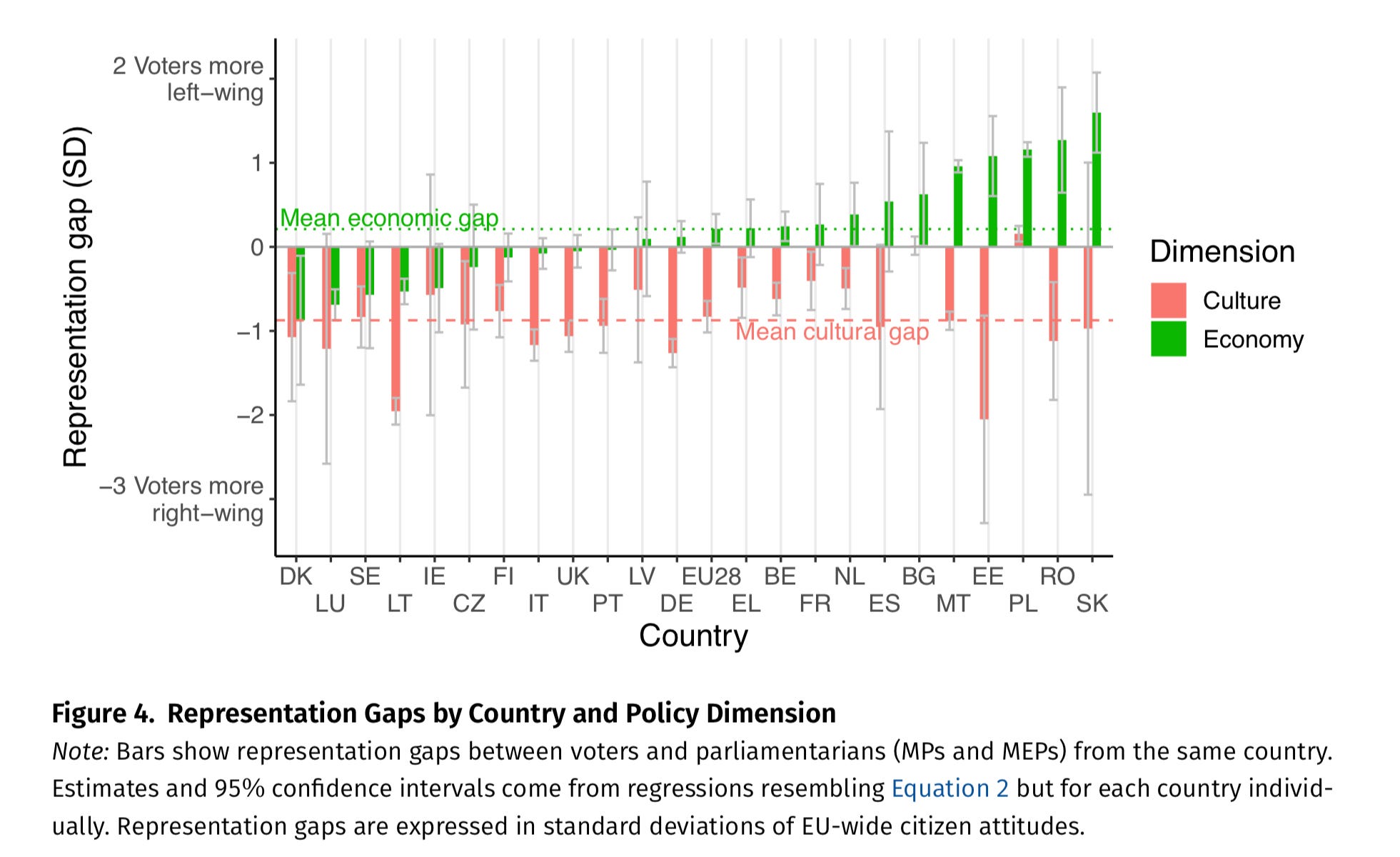
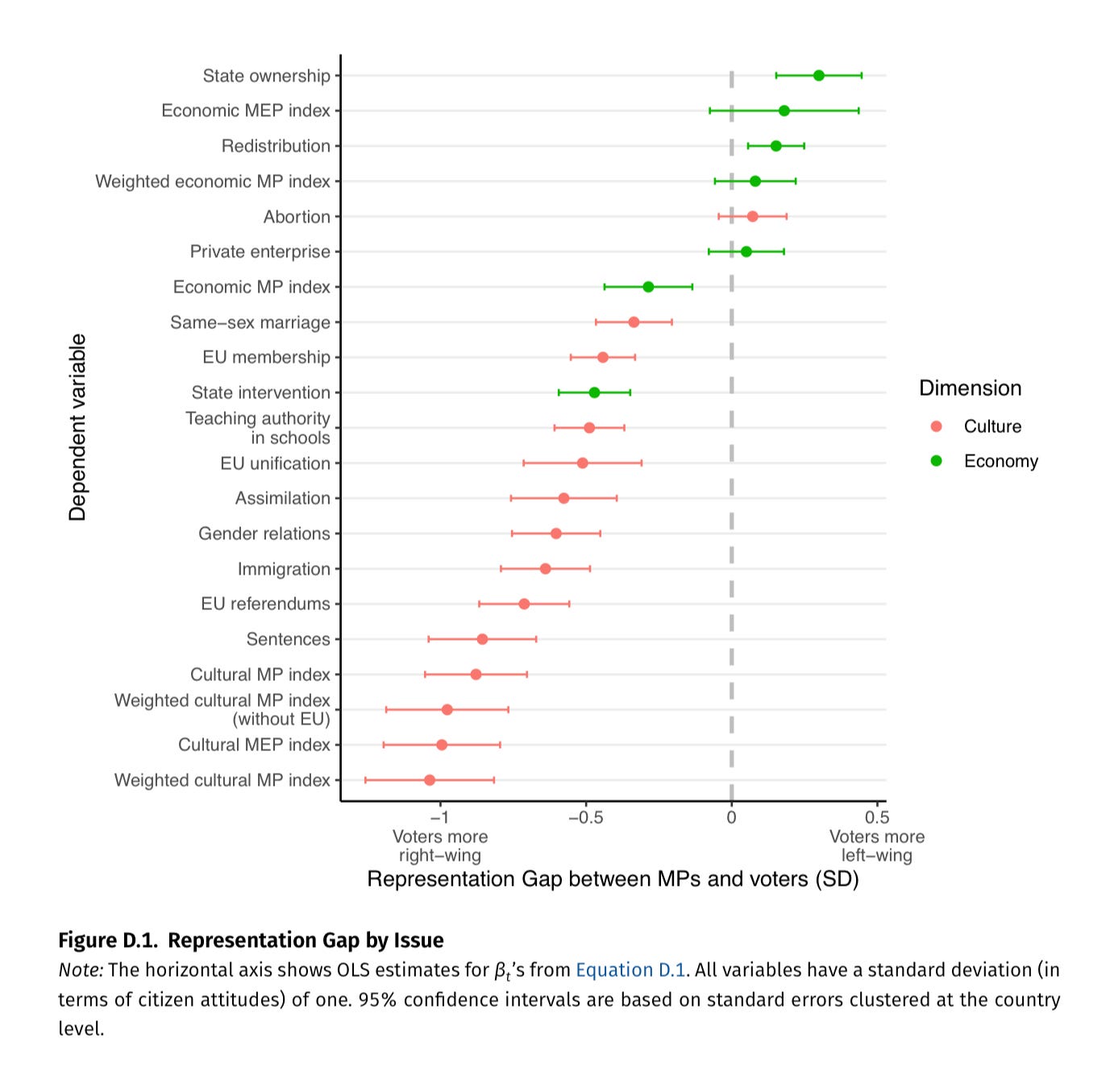
Economist Laurenz Guenther has performed the very useful exercise of quantifying how unrepresentative the views of European politicians are of their voters on cultural issues, such as crime and immigration. This is not true of economic issues, where the views of politicians tend to be quite representative of their voters.
In the case of economic issues, in some countries the politicians are more pro-market (“right”) then their voters, in others they are more dirigiste (“left”) than their voters, in others still they are very similar to their voters. There is simply no consistent pattern, and the average gap between voters and politicians across European countries on economic issues is fairly small.
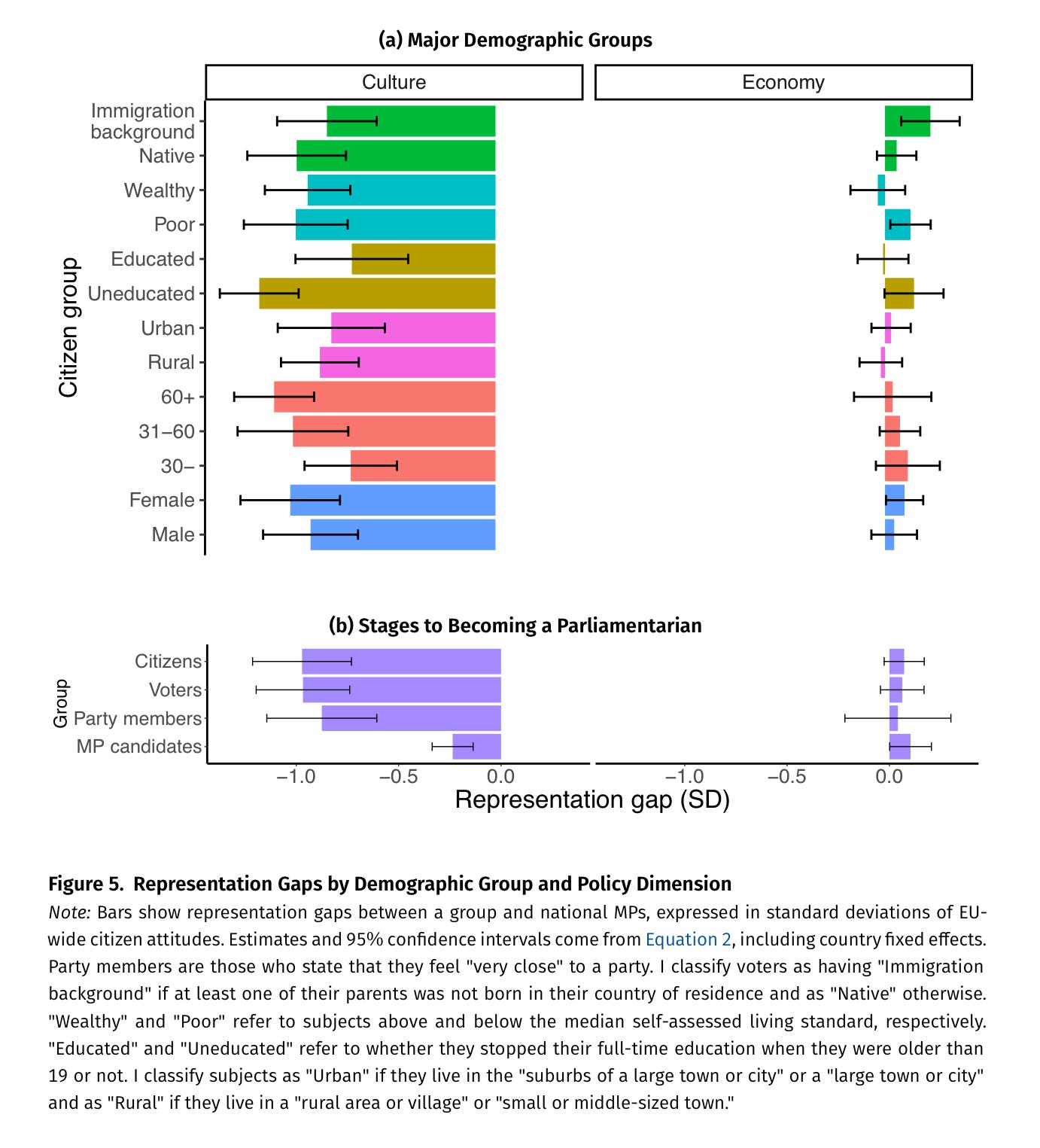
With cultural issues, such as crime and immigration, we get a very different pattern. There, politicians are consistently more socially liberal (“left”) than their voters and by a considerable margin. While education levels explain some of this difference, they do not explain very much, as politicians are significantly more socially liberal than even university-educated voters.
Moreover, politicians are unrepresentative even of their own Party members/base on cultural issues and, again, in being much more liberal than their core supporters. There is some factor or factors specific to being a contemporary politician that systematically separates them out from voters on cultural issues yet does not operate with economic issues.
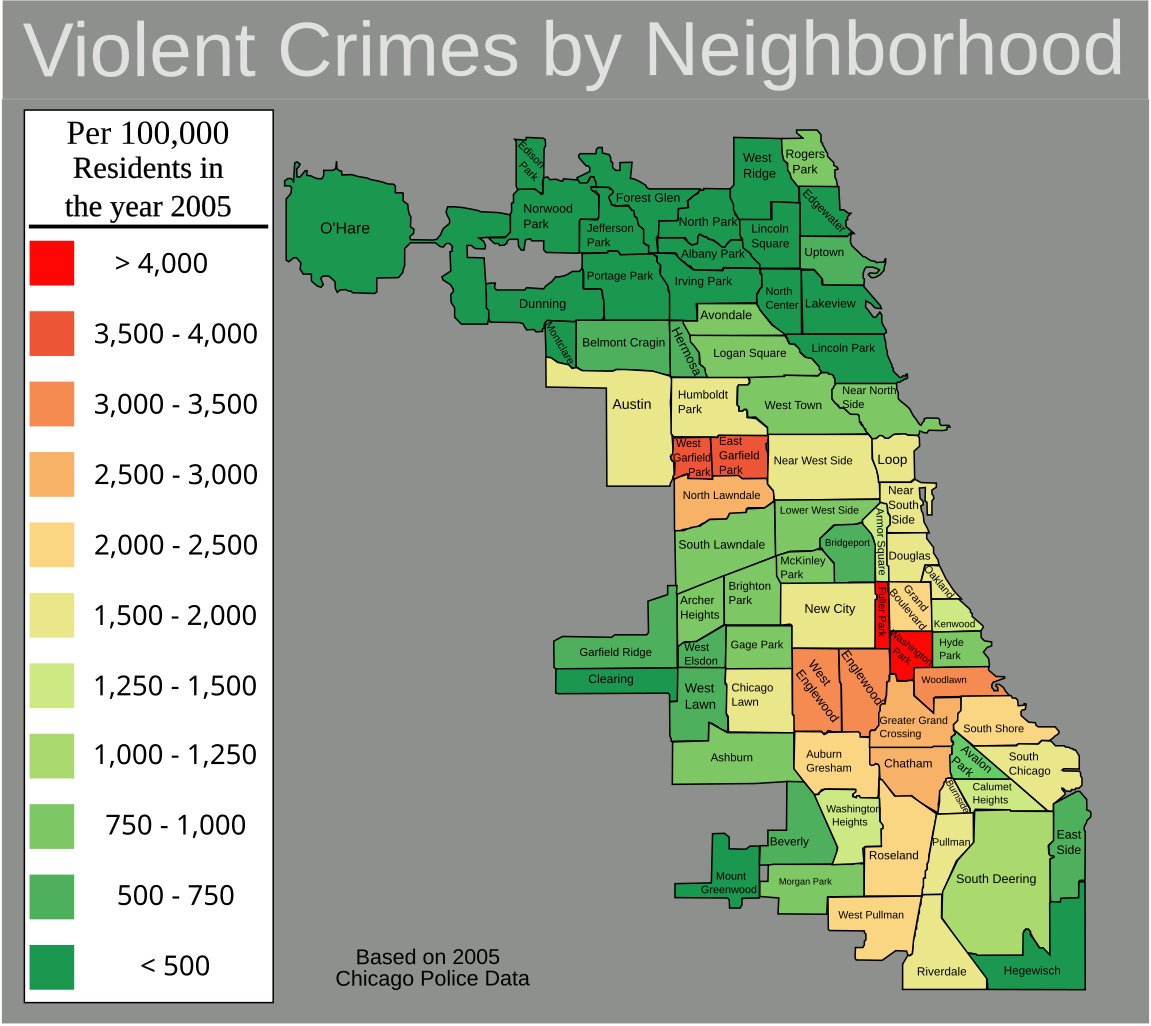
Veteran politician Tip O’Neill famously said that all politics is local. This is particularly true of cultural issues such as crime and immigration, where the effects vary wildly by location. This is much less true of economic issues, which are much more economy-wide in their operation.
There are various features we can identify here. First, executive function(s) — including such features as patience (aka time horizon) — varies between people and is highly heritable. Localities that have lots of people with poor executive function operate very differently from those where it is very much normal for people to have strong executive function.
As the combination of physical robustness and weak executive function predicts criminal behaviour, this has a great deal to do with why crime varies so dramatically by locality. This is especially as crime is very much a power law phenomenon, where a small minority of (overwhelmingly) men commit the vast majority of violent crimes.
Source – Wikimedia Commons.
It also means that people who have spent their lives in social milieus full of people with high executive function can have little or no sense of what happens when one has to deal with weak executive function folk. This is the people unlike me problem that so bedevils contemporary politics and commentary.
August 19, 2025
Bad laws in Canada must be challenged in court
At Rigid Thinking, Damian Penny says — and I wholeheartedly agree — that it’s a good thing for laws to be challenged in the courts, but especially when it’s called an “emergency”:

[Retired Canadian veteran Jeff] Evely, with the help of some conservative/libertarian-ish legal organizations, plans to challenge the woods ban in court as a violation of the Canadian Charter of Rights and Freedoms. This is not a popular position here in Nova Scotia (in online discussions, the phrases “Maple MAGA” and the venerable “American-style” come up a lot) and I am not sure he’ll be successful.
But, honestly, I give him credit for trying. In fact, I’d argue his Charter challenge is win-win for everyone in Nova Scotia, whether one supports, opposes or remains indifferent to the policy.
That’s not despite the pressing emergency posed by the forest fire threat, but because of it.
When we’re faced with a crisis, that’s precisely when governments are tempted to seize as much power and authority as possible – and, more importantly, when the public is more inclined to go along with it.
Hence, Trudeau I imposing War Measures Act provisions during the 1970 October crisis, the PATRIOT Act debate after 9/11, COVID-19 restrictions during the pandemic, Trudeau II using the Emergencies Act when the “Freedom Convoy” set up shop in downtown Ottawa, and now Premier Houston (whom I support, despite some misgivings about this issue) using sweeping measures to tramp down the forest fire risk.
And sometimes such powers are justified under the circumstances. Even self-professed libertarians will admit as such when the emergency is something they’re personally worried about, and when a leader from the “good” team is in power.1
But they aren’t always justified. And governments definitely can’t be trusted to handle such power responsibly the longer the “emergency” goes on.
- The rise of Trump has allowed many “libertarians” to reveal themselves as authoritarians, but that’s for another post.
August 18, 2025
Canada’s state-subsidized media now seem to see their job as pro-government PR
At The Rewrite, Peter Menzies considers the state of Canadian media in how they reported on the Maritime provinces’ draconian policies during the ongoing wildfire season:

Screencaptured image of one of the August 2025 wildfires in the Maritimes from Global News via The Rewrite
There will always be conflicts between collective rights and individual liberties. One is valuable in ensuring there is order in society, which is important. The other is necessary to maintain freedom, which lots of people live without but is nevertheless desirable. When there’s too much freedom, people look for politicians who will restore order. When there is too much order, people rebel and demand freedom (see everything from the French Revolution to the Freedom Convoy).
Traditionally, those inclined to the order side if the ledger have been viewed as conservatives while “liberals” have led the fight for individual freedom manifest in the civil rights movement, the emancipation and advancement of women, freedom of speech, etc. that are now viewed as fundamental to the maintenance of a modern, liberal democracy.
But as Pete Townsend wrote a little more than half a century ago, the parting on the left is now the parting on the right (and the beards have all grown longer overnight). Journalists tend to lean left, which means their traditional opposition to the imposition of order has been replaced by a collectivist tendency to sympathize with those imposing it. It is left to the newsroom minorities on the right to carry the torch for individual liberties.
To wit, this CBC story on Nova Scotia’s wild fire-induced ban — enforced with a $25,000 fine until Oct. 15 — on walking anywhere in the woods was oblivious to the impact on personal freedom. Never crossed their minds. When the issue was raised on social media, Twitter journos took up the cause. Stephen Maher dismissed individual liberty concerns as fringe views and maintained that the restrictions could be justified as “reasonable” limitations of Charter rights. While the Globe and Mail‘s editorial board called the Nova Scotia move “draconian”, Globe columnist Andrew Coyne nevertheless wondered “How the hell did the right to walk in the woods of Nova Scotia during a forest fire emergency get elevated into the right’s latest cultural obsession?”
It was left to commentators such as Marco Navarro-Genie to point out the intellectual flaccidity fueling parts of the collectivist argument when New Brunswick followed Nova Scotia’s lead and NB Premier Susan Holt said this:
Me going for a walk in the woods is gonna cause a fire. I can understand why people, uh, think that that’s, that’s. That’s ridiculous. But the reality is, it’s not that you might cause a fire, it’s that if you’re out there walking in the woods and you break your leg, we’re not gonna come and get you because we have emergency responders that are out focused on a fire that is, uh, threatening the lives of New Brunswickers.
That, believe it or not, was a good enough explanation for the collectivist thinking in most mainstream newsrooms.
If journalism is to be useful in defending democracy, those involved in it need to be intellectually equipped to understand the stakes. And their first instinct must be to treat the suppression of liberty as a serious issue whenever the powerful indulge in it at the expense of the powerless. That doesn’t mean liberty should always trump order (traffic lights are eminently reasonable). But it does mean that journos should demand that politicians justify their actions rather than simply helping them explain them to the Great Unwashed. To do otherwise is to fail.
August 17, 2025
To replace a people, first you need to induce guilt and self-hate
On his Substack, Frank Furedi discusses just how negatively the British establishment views the national flag and those uncultured boors who display it:
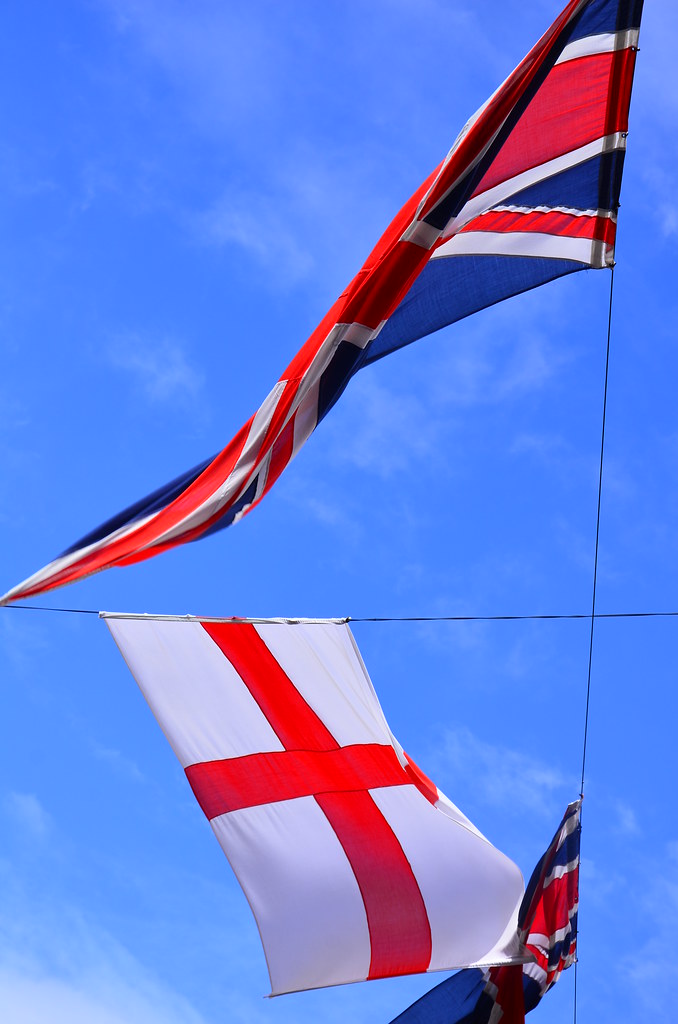
“Union Jacks and crosses of St George” by Ben Sutherland is licensed under CC BY 2.0 
 .
.
First a confession. I am not a serial flag-waver. In fact, one of the features of British history that I always appreciate is that its people possessed so much confidence about itself that it did not see the need for ostentatious displays of patriotism and flag waving. However, today matters are different. The nation’s cultural and political elites regard the Union Jack and the St George’s Cross — the flag of England — with embarrassment and studied contempt. Today many British institutions would rather fly the Palestinian flag or the LGBTQ+ or of Ukraine than flags that bear the nation’s symbols. Outwardly pride in Britain is in danger of being displaced by the sentiment of self-loathing.
Foreign observers are often surprised by the relative absence of Britain’s flag in public spaces. As one such observer noted recently, in Oxford Pride flags are outnumbered the Union Jack “by at least fifty to one”. He noted that the “next day in London, I saw Pride flags all about, with the Union Jack reserved for tourist sites like the Tower of London, which also sported Pride flags”.
In fact, the British Establishment’s reaction towards England’s flag is often communicated through the sentiment of ridicule and hatred. This sentiment has been embraced by local councils, particularly ones that are under the influence of Labour and the Lib Dems. Many of them feel entitled to prevent these flags from being displayed. Most recently the Birmingham’s Labour dominated council has ordered the removal of Union and St George’s flags from lamp posts in this city. The Council announced its decision to remove the flag on the ground that they put the lives of pedestrians and motorists “at risk” despite being up to 25ft off the ground! Needless to say, the Council applies a different standard of judgment when it comes flying the Palestinian flag, which are flown all over the City. Presumably this flag does not constitute a danger to motorists and pedestrians.
In Birmingham, Britain’s second largest city flying the flag of the nation is regarded by local officialdom as a risk to safety.
The British Establishment feels contempt towards not only Britain’s flags but also towards the people who enthusiastically identify with them with patriotic pride. An incident involving Emily Thornberry, Labour MP for Islington South, in November 2014 captures well the contempt that significant sections of the British political class have towards the symbolic displays of patriotism. During a by-election campaign in Rochester, she posted a photo of a house displaying three St George’s flags, with a white van parked outside, and accompanied it with the arch caption, “Image from #Rochester”. The implication of her post was that those who decorated their house with the flags of England were a legitimate target of disdain. Since they were obviously morally inferior to her superior kind there was no need for a caption explaining this on her post.
Millennial Woes discusses how the contempt of the elites for the British people is leading to increasing possibility of civil unrest … or worse:
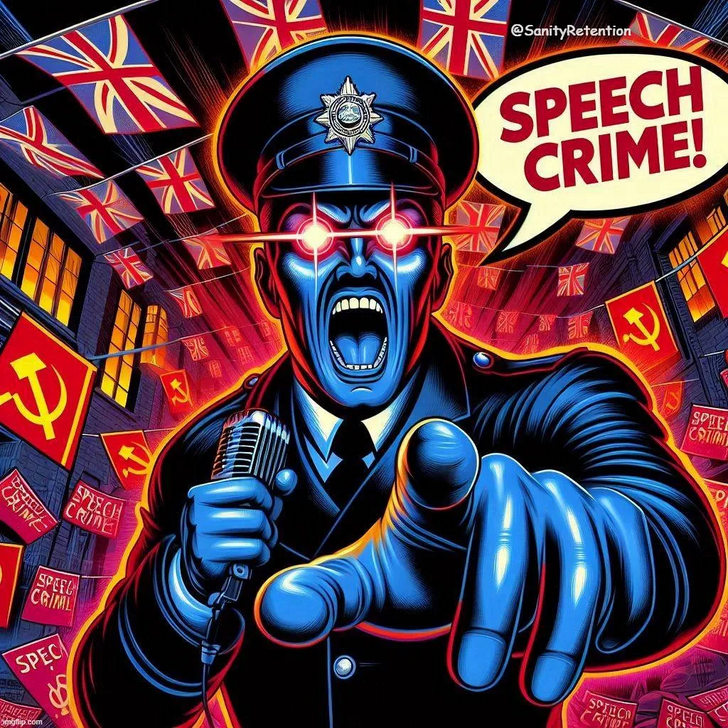
The short answer as to “why?” is that, even in mid 2025 when many people are sensing a mood developing, the government is still doing all the things that are bringing that mood about. They have no reverse gear. Despite their rhetoric, they are not reducing immigration and are certainly not doing mass deportation. In addition we have learned that, for years, they have been covertly propagandising us. Meantime the hate speech laws which muzzle us are still in force and being strengthened. Recently, the Online Safety Act came into force and the very next day numerous internet platforms had to start censoring content. We can literally see our oppression increasing in real-time. And even now, they want more. Always, we feel the government trying to stop us talking about its abuse of us. (Even as I type these words, I am aware that they could get the police raiding my home and seizing my devices.)
Image from Millennial Woes
The same is true in the media. This morning I heard that the BBC are making a high-profile drama about 11th Century Britain in which a key historical figure will be played by a Black actor. Our news media is still biased in favour of mass immigration at any cost. Adverts are still full of black-man-white-woman couples. It is relentless.
In business, White people are handicapped by preferential treatment for non-whites in employment, business loans and career opportunities. A few days ago I got an advert on YouTube featuring a business consultant woman who defiantly said “at the end of the day, diversity is the key to success”. Middle-class White people habitually work against each other and their group interests, causing personal failure and burning resentment for many of their ethnic kin.
It doesn’t actually matter whether the people who perpetuate all of this truly “believe” in it. What matters is that they are prepared to behave as if they do. The incentives have taken on a life of their own, become self-perpetuating, making alternatives almost illegal and certainly a guarantor of “social death” and “professional death”. Even with all the evidence that diversity is bad, nobody in the professional class will dare to speak against it because, even now, that would be the end of their career. And so the poisoning continues.
In short, I feel that my country’s mainstream is working constantly against my ethnic group surviving. Furthermore I see no end in sight for this ethnic sabotage.
And many other people think the same – more and more all the time, in fact. This is why they are getting ever more angry.
Among young people there are more reasons still, economic pressures which mean they can’t get on the property ladder and build the security to start a family. That is immensely frustrating for a lot of energetic young adults, and they haven’t got (haven’t been able to get) much to lose. When a society doesn’t facilitate this most basic desire in people, it should expect upheaval.
However, against this backdrop of oppression, dysfunction and madness, the main catalyst for civil unrest will be something much more concrete: refugees sexually assaulting White women and children. Such crimes are now occurring every day. Unfortunately, there is no reason why they will lessen in frequency. (I will not endanger myself further by explaining why. Everyone knows.)
And it is the fact that, indeed, “everyone knows” which makes civil unrest inevitable. It isn’t just spergs, theorycels, doomers, basement-dwellers and politics or race science obsessives any more; it’s the apolitical working-class who just want a decent chance at life. When they believe their own government is denying them that, it is inevitable that they will “rise up”. It is only a question of when, where, how and how many.
It has been pointed out that, during covid, the public didn’t “rise up”. But I say this was because, despite the restrictions and the perversity of that situation, throughout it people were still comfortable. Most importantly, they didn’t feel their children were in danger. That is the key thing. Dangers that never attended raising a child in Britain thirty years ago are now ubiquitous, even if you live in a nice middle-class town.
Update, 18 August: Welcome, visitors from Instapundit. Please do have a look around at other posts you may find of interest. I send out a daily summary of posts here through my Substack – https://substack.com/@nicholasrusson that you can subscribe to if you’d like to be informed of new posts in the future.
August 15, 2025
Ted Gioia on Hunter S. Thompson
I must admit that I got hooked on Hunter S. Thompson’s writing very early. I read Fear and Loathing in Las Vegas in my mid-teens and it blew my mind. I couldn’t actually believe everything he wrote, but I couldn’t completely discount it either. I certainly haven’t read everything he wrote … especially his later sports commentary, but I have read most of the best-known books. On his Substack, Ted Gioia is running a three-part series on the writer and his work:

That’s Hunter Thompson. There’s always someone in control behind the wheel — even when he seems most out of control.
This hidden discipline showed up in other ways. Years later, when he ran for sheriff in Aspen or showed up in Washington, D.C. to cover an election for Rolling Stone, savvy observers soon grasped that Thompson had better instincts and organizational skills than some of the most high-powered political operatives. People rallied around him — he was always the ringleader, even going back to his rowdy childhood. And hidden behind the stoned Gonzo exterior was an ambitious strategist who could play a long term game even as he wagered extravagantly on each spin of the roulette wheel that was his life.
“I don’t think you have any idea who Hunter S. Thompson is when he drops the role of court jester,” he wrote to Kraig Juenger, a 34-year-old married woman with whom he had an affair at age 18. “First, I do not live from orgy to orgy, as I might have made you believe. I drink much less than most people think, and I think much more than most people believe.”
That wasn’t just posturing. It had to be true, merely judging by how well-read and au courant Thompson became long before his rise to fame. “His bedroom was lined with books,” later recalled his friend Ralston Steenrod, who went on to major in English at Princeton. “Where I would go home and go to sleep, Hunter would go home and read.” Another friend who went to Yale admitted that Thompson “was probably better read than any of us”.
Did he really come home from drinking binges, and open up a book? It’s hard to believe, but somehow he gave himself a world class education even while living on the bleeding edge. And in later years, Thompson proved it. When it came to literary matters, he simply knew more than most of his editors, who could boast of illustrious degrees Thompson lacked. And when covering some new subject he didn’t know, he learned fast and without slowing down a beat.
But Thompson had another unusual source of inspiration he used in creating his unique prose style. It came from writing letters, which he did constantly and crazily — sending them to friends, lovers, famous people, and total strangers. Almost from the start, he knew this was the engine room for his career; that’s why he always kept copies, even in the early days when that required messy carbon paper in the typewriter. Here in the epistolary medium he found his true authorial voice, as well as his favorite and only subject: himself.
But putting so much sound and fury into his letters came at a cost. For years, Thompson submitted articles that got rejected by newspapers and magazines — and the unhinged, brutally honest cover letters that accompanied them didn’t help. He would insult the editor, and even himself, pointing out the flaws in his own writing and character as part of his pitch.
What was he thinking? You can’t get writing gigs, or any gigs, with that kind of attitude. Except if those cover letters are so brilliant that the editor can’t put them down. And over time, his articles started resembling those feverish cover letters — a process unique in the history of literature, as far as I can tell.
When Thompson finally got his breakout job as Latin American correspondent for the National Observer (a sister publication to the Wall Street Journal in those days), he would always submit articles to editor Clifford Ridley along with a profane and unexpurgated cover letter that was often more entertaining than the story. In an extraordinary move, the newspaper actually published extracts from these cover letters as a newspaper feature.
If you’re looking for a turning point, this is it. Thompson now had the recipe, and it involved three conceptual breakthroughs:
- The story behind the story is the real story.
- The writer is now the hero of each episode.
- All this gets written in the style of a personal communication to the reader of the real, dirty inside stuff — straight, with no holds barred.
Why can’t you write journalism like this? In fact, a whole generation learned to do just that, mostly by imitating Hunter S. Thompson …
August 14, 2025
August 13, 2025
QotD: The New York Times and their 1619 project
It’s a good point, isn’t it? If you don’t believe in a liberal view of the world, if you hold the doctrines of critical race theory, and believe that “all of the systems in the country” whatever they may be, are defined by a belief in the sub-humanity of black Americans, why isn’t every issue covered that way? Baquet had no answer to this contradiction, except to say that the 1619 Project was a good start: “One reason we all signed off on the 1619 Project and made it so ambitious and expansive was to teach our readers to think a little bit more like that”. In other words, the objective was to get liberal readers to think a little bit more like neo-Marxists.
The New York Times, by its executive editor’s own admission, is increasingly engaged in a project of reporting everything through the prism of white supremacy and critical race theory, in order to “teach” its readers to think in these crudely reductionist and racial terms. That’s why this issue wasn’t called, say, “special issue”, but a “project”. It’s as much activism as journalism. And that’s the reason I’m dwelling on this a few weeks later. I’m constantly told that critical race theory is secluded on college campuses, and has no impact outside of them … and yet the newspaper of record, in a dizzyingly short space of time, is now captive to it. Its magazine covers the legacy of slavery not with a variety of scholars, or a diversity of views, but with critical race theory, espoused almost exclusively by black writers, as its sole interpretative mechanism.
Don’t get me wrong. I think that view deserves to be heard. The idea that the core truth of human society is that it is composed of invisible systems of oppression based on race (sex, gender, etc.), and that liberal democracy is merely a mask to conceal this core truth, and that a liberal society must therefore be dismantled in order to secure racial/social justice is a legitimate worldview. (That view that “systems” determine human history and that the individual is a mere cog in those systems is what makes it neo-Marxist and anti-liberal.) But I sure don’t think it deserves to be incarnated as the only way to understand our collective history, let alone be presented as the authoritative truth, in a newspaper people rely on for some gesture toward objectivity.
Andrew Sullivan, “The New York Times Has Abandoned Liberalism for Activism”, New York, 2019-09-13.
August 12, 2025
Britain warns online platforms about “overzealous” interpretation of online safety law
“Ben the Layabout” posted a note over at Founding Questions linking to a Telegraph article [archive.ph link] that seems to indicate the British government is demanding that online services both enforce the letter of the law and the spirit … whatever that might mean at any given moment in time:
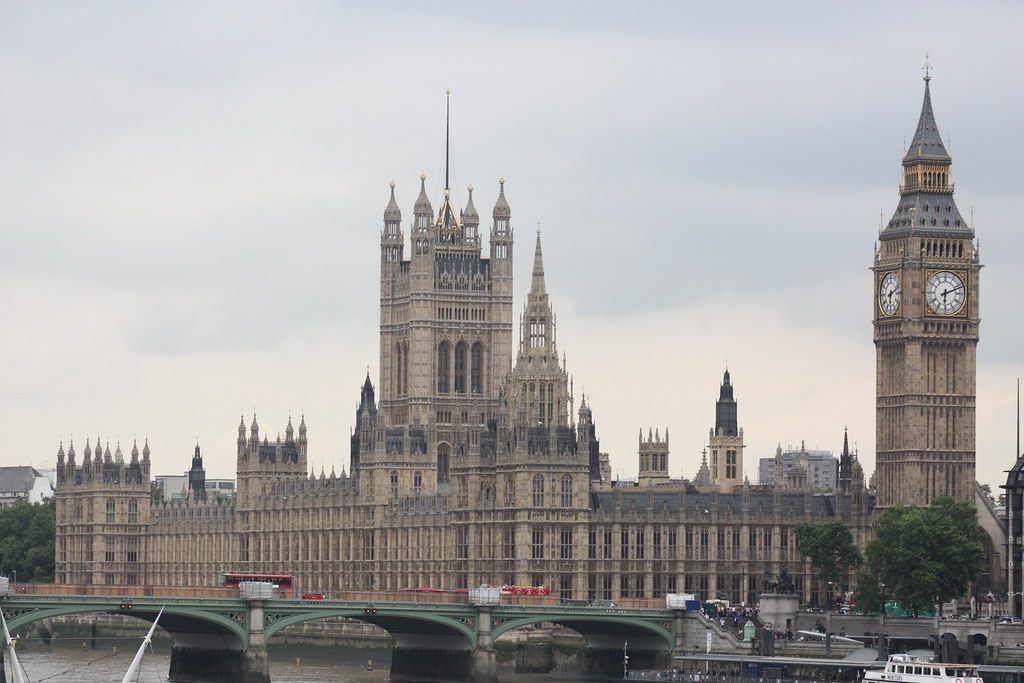
“Palace of Westminster”by michaelhenley is licensed under CC BY-NC-SA 2.0


Social media giants face huge fines for curbing free speech by “overzealous” enforcement of online safety laws.
Ministers have told platforms including Facebook, X, Instagram and TikTok they must not restrict access to posts that express lawfully held views.
The warning, in an apparent change of tone from ministers, comes amid a backlash over websites blocking users from viewing material, including parliamentary debates about grooming gangs.
Campaigners have said that free speech is threatened by the Government’s application of the Online Safety Act, which is meant to protect children from harmful content.
JD Vance, the US vice-president, used a visit to the UK this week to warn ministers against going down the “dark path” of censorship.
Whitehall sources have expressed concern that social media firms, some of which have criticised the law, “have been overzealous” in enforcing it and must be “mindful” of the right to freedom of expression.
The Science Department, which oversees the legislation, told companies they could face fines if they failed to uphold free speech rules.
A spokesman said:
As well as legal duties to keep children safe, the very same law places clear and unequivocal duties on platforms to protect freedom of expression.
Failure to meet either obligation can lead to severe penalties, including fines of up to 10 per cent of global revenue or £18m, whichever is greater.
The Act is not designed to censor political debate and does not require platforms to age gate any content other than those which present the most serious risks to children such as pornography or suicide and self-harm content.
Platforms have had several months to prepare for this law. It is a disservice to their users to hide behind deadlines as an excuse for failing to properly implement it.
So online sites big and small are required to obey the British law, but only as and how the British government wants it enforced or they’ll levy massive punishment. Too lax? Punishment. Too strict? Also punishment. It’s almost as if Britain wants to be cut off from the rest of the internet …
AOL to shut down its last dial-up access: dozens to be inconvenienced
James Lileks on the end-of-era announcement from AOL — and I can’t recall the last time I thought of that company — that they’ll be eliminating the last of their dial-up internet access accounts:
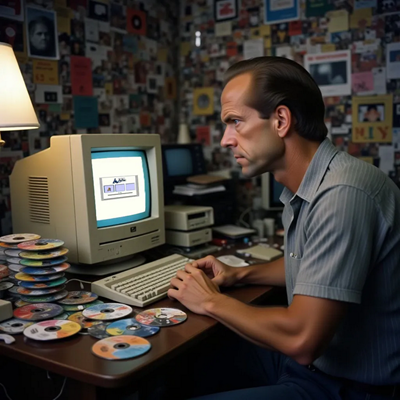
New tech: shiny today, tarnished tomorrow. Everything that was once bright and brilliant now stamps its walker towards the exit door. The headlines wave goodbye: Last telegram office in the US shut down.
Last phone booth in New York is decommissioned. The latest: AOL to shut off its landline customers.
You’d think this would be news on the level of “homing pigeon trainer employment hits record lows”.
Who uses dialup? Yahoo, which now owns the AOL brand, says that the user base is in the “low thousands”, which suggests that some people forgot to turn off autopay in 2005. What does AOL do today? The usual basket of dross and chum. A website that offers “trending videos” — gosh, don’t know where else you’d find those — and a lot of news stories, supplied by Yahoo, and its … numberless army of journalists, I guess.
It’s a legacy brand for people who want to slide into the internet like comfy slippers they left under the desk. And that’s fine. Facebook serves the same function. It’s a place to start, a home base. A familiar window out which we gaze daily We all have them. But let us not get nostalgic for AOL and the early days of the internet. Some people, of course, love to talk about the pioneer days, and how it required some technical know-how:
Well, we didn’t have those fancy little pre-made modems like you got in the 90s, so we had to get a little matchbox and fill it up with a certain kind of specially-bred insect that sang a note at a particular pitch when exposed to electrical current. So you’d crank up the generator and put the little alligator clips on the box and hold the box up to the phone while you entered your user name in Morse code by pushing on the hang-up buttons, and then you had to shake the box so the insect singing would modulate. Took about an hour, but then you’d be “On the Line”, as we said, and you could go to a Usenet group and call people Nazis. Kids today, they can call someone a Nazi without lifting a finger.
QotD: Rick Wakeman – “I was Spinal Tap for real”
“How’d you do that?” an engineer asked.
“Don’t tell him,” Visconti told Wakeman. “It’ll make you a fortune!”
Visconti asked Wakeman if he could come back to play mellotron for one of his artist’s recording sessions. After getting dropped off at the studio by his mother, Wakeman was greeted at the studio by a precocious young rocker whose eyes appeared to be two different colors. His name was David Bowie, and he wanted Wakeman to play mellotron on “Space Oddity”, the title track of his second album. “This will be a piece of cake for you,” he reassured Wakeman.
“Oh, okay,” Wakeman stammered.
“I take it you have played a piece of cake before?” Bowie replied. Wakeman, confused and nervous, offered no reply.
“Well,” Bowie went on, “maybe not then.”
The song launched a lifelong friendship with Bowie, and Wakeman’s career. He became rock’s go-to keyboardist, playing in countless sessions. In 1970, Melody Maker, at the time England’s most influential music publication, featured Wakeman on a cover story that anointed him “Tomorrow’s Superstar”. Bowie offered him a few key pieces of advice: get your own band, play with musicians who understand you, and, when it comes time to perform, “do what you want onstage, especially if you’re using your own money. Don’t let a promoter, agent, or manager tell you otherwise — they don’t have the imagination.”
Wakeman put the advice to use in the brashest of ways: He turned down Bowie’s offer to play in his sideband, the Spiders From Mars, and instead became the keyboardist for Yes. With its mystical lyrics, orchestral productions, Tolkienseque album art, and long, multipart songs, Yes exemplified progressive rock in all its technical breadth and portentous glory. Wakeman, who surrounded himself with keyboards and wore a cape to hide his arms after a critic said he moved like “a demented spider”, became prog rock’s most iconic star. “Here comes Rick, the caped crusader!” the band’s lead singer, Jon Anderson, recalls with a laugh. “He had a great sort of stance onstage, and very powerful energy. It really put him apart from any other keyboard player.” Or, as Wakeman deadpans, “I was Spinal Tap for real”.
David Kushner, “The Stranger-Than-Fiction Secret History of Prog-Rock Icon Rick Wakeman”, Vanity Fair, 2020-06-25.
August 11, 2025
Smug Canadian boomer autohagiography rightly antagonizes the under-35s
Fortissax had an argument with one of his readers over a smug, self-congratulating meme about how wonderful Canada was in the 1990s and early 2000s:

What we lived through long before Trudeau was the Shattering, the breakdown of Canada’s social cohesion, driven by left-liberalism with communist characteristics applied to race, ethnicity, sex, and gender, and punitive almost exclusively toward visibly White men. My generation, those millennials born on the cusp of Gen Z, saw post-national Canada take shape not in the comfortable suburban rings of the GTA or the posh boroughs of Outremont and Westmount, but in self-segregated, ghettoised enclaves of immigrants whose parents never integrated and were never required to.
Memes like that are dishonest because they feed a false memory. The 2000s were not normal. Wages were stagnant, housing was already an asset bubble, and immigration was still flooding in under a policy that explicitly forbade assimilation. Brian Mulroney had enshrined multiculturalism into law in 1988. Quebec alone resisted, carving out the right to limit immigration under the 1992 Quebec–Canada Accord. After Chrétien, Stephen Harper brought in three million immigrants, primarily from China, India, and the Philippines in that order.
The Don Cherry conservatives of that era were Bush lite. They were rootless, cut off from their history, their identities manufactured from the top down since the days of Lester B. Pearson. They conserved nothing. For Canadian youth, it was the dawn of a civic religion of wokeness, totalitarian self-policing by striver peers, and the quiet coercion of every institution. My memories of that decade are of constant assault — mental, physical, spiritual — from leftists in power, from encroaching foreigners, and from the cowardice of conservatives.
Your 2000s might have been great. For us, they were communist struggle sessions. In 2009 we were pulled from class to watch the inauguration of Barack Obama, a foreign president, as a historic moment for civil rights. Our schools excluded us while granting space to every group under the sun: LGBT safe spaces and cultural clubs for Italians, Jamaicans, Jews, Indians, Indigenous, Balkaners, Greeks, Slavs, Portuguese, Quebecois, Iroquois, Pakistanis — every culture celebrated except our own. Anglo-Quebecers and Anglo-Canadians got nothing but an Irish club, closely monitored for “white supremacy” and “racism” by the HR grandmas of the gyno-gerontocracy of English Montreal. Students self-segregated, sitting at different cafeteria tables and smoking at different bus shelters. At Vanier, Dawson, and John Abbott College, these divisions were institutionalised. I remember walking into the atrium of Dawson, my first post-secondary experience, greeted by a wigger rolling a joint while a Jamaican beatboxed to Soulja Boy.
We became amateur anthropologists out of necessity, forced to navigate a nationwide cosmopolitan experiment from birth. We learned the distinctions between squabbling southeastern Europeans of the former Yugoslavia, and we did not care if Kosovo was Serbia or whether Romanians and Albanians were Slavic, they all acted the same way. We learned the divides within South Asia, the rivalries between Hindutva and Khalistani, the differences between a Punjabi, a Gujarati, a Telugu, a Pakistani, a Hong Konger, a mainlander, and a Taiwanese. We know the shades of Caribbean identity, the factions of the Middle East, and the intricacies of North African identity. We should never have needed to know these things, but we do.
For us, childhood in this cesspit was the seedbed of radicalism. We never knew an era when contact with foreigners was limited to sampling food at Loblaws. All we know is being surrounded by those who hate us, governed by a state that wants to erase us, with no healthcare, no homes, no jobs that are not contested by foreigners, and no money to start families.
August 10, 2025
“Believe all women” especially when they imagine (or hallucinate) offense
An excerpt from a work-in-progress by James Pew, from an incident during the heydey of #MeToo hysteria in the Toronto media community:
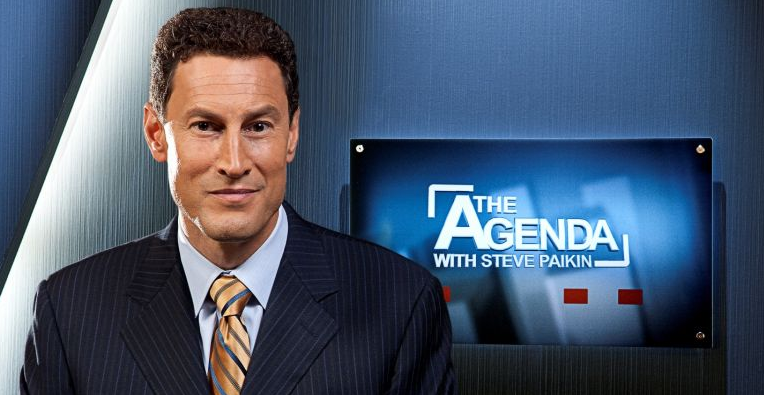
Steve Paikin is a Canadian journalist and author, and the host of TVOntario’s acclaimed flagship program, The Agenda With Steve Paikin. In his brush with #MeToo infamy, Paikin was accused of asking for, or possibly suggesting sex with a woman (who had previously appeared on his show), while at a business lunch with her at Grano restaurant in Toronto. The woman, a former Toronto Mayoral candidate who has a record of previous unsubstantiated claims against former Toronto Mayor Rob Ford, claims to have “politely” declined Paikin’s request, but said she was not invited back on his show because of her refusal to have sex with him.
The Paikin scandal was different from others which had unfolded in the hazardous year of 2018. This was a #MeToo story where the public appeared interested in both sides. Were chinks in the #MeToo armour beginning to appear? As Joe O’Conner wrote in the pages of the National Post, there was “an accusation and a vociferous denial”.1 But similar to other #MeToo narratives, the accuser was reaching deep into the past. According to Sarah Thomson, Paikin’s unwanted proposition for sex occurred in 2010.
Defending himself on Facebook, Paikin called the allegations a “complete fiction”. He wrote: “To be clear, I did not have sex, suggest, request, imply, or joke about having sex with you (Sarah Thomson)”.
Paikin had been a supporter of #MeToo. He wrote that “The #MeToo movement is too important to be undermined by spurious allegations”. Did he not realize that #MeToo means “believe all women”? Aren’t spurious allegations the type we are not supposed to believe? Wouldn’t that mean that women don’t (or can’t) make spurious allegations, but only the type of allegations that must be believed unquestioningly? Didn’t Paikin realize the contradiction in thinking that #MeToo was important, but in his case it was acceptable to cast off its intrinsic blanket credulity concerning the abuse claims of women? Paikin wrote:
Sadly, in this day and age, too many people are going to believe the lie, especially when it comes to this subject. I am mortified that in many peoples’ eyes, I have lost the presumption of innocence that I’ve previously enjoyed. But I did not do these things. There is simply no truth to these allegations.2
Surprisingly, TVO did not remove Paikin, but launched an investigation instead. In a piece published in the Globe and Mail called “The Humiliation of Steve Paikin”, Margaret Wente wrote, “Mr. Paikin was lucky not to be suspended, people say. Some luck. His name is in the headlines, generally on the same page as all the other #MeToo stories that now dominate the news. I imagine that most people who know him don’t believe a word of it. Others will think, ‘These days you never know’.”3 A fair assessment. Wente later points out “Women (just like men) lie for all kinds of reasons, including the fact that they are unbalanced or unhinged.” However, it should be pointed out that in the #MeToo era and since, women do not get cancelled and humiliated because a man (or men) made unsubstantiated allegations against them.
The most suspicious part of the story is that Thomson’s assistant was present at the lunch meeting when Paikin supposedly propositioned her. Who would do such a thing as Paikin was accused in the presence of other people? Thomson did not provide the name of her assistant, and no investigative journalists were able to find out who she was. A critical detail appeared to go uncorroborated. However, the independent investigator tracked her down and conducted an interview. Her testimony was essential to clearing Paikin, although she chose to remain anonymous.
By April of 2018, the independent investigation into the allegations against Paikin was complete. It was found that while Thomson genuinely believed that Paikin had propositioned her “the evidence brought forward by Thomson and others (did) not support her account of what happened”.4 Rachel Turnpenney, the lawyer who conducted the investigation, referred to Thomson’s former assistant as “Witness J” – whose testimony contradicted Thomson’s account. Witness J told investigators that Paikin did not proposition Thomson or make any inappropriate sexual comments during the lunch.
But even if the allegations were true, was what Paikin alleged to have done really so bad? Aren’t men taught to ask for consent? Isn’t that what “propositioning” Thomson would have been? It could be argued, had the allegations turned out to be true, that Paikin demonstrated inappropriate, perhaps insensitive conduct. Clearly it would have been poor judgement, but should a man like Paikin be fired for a slip in judgement where no crime occurred? In hypothetical defense of a mis-step that never occurred, is it not possible to argue that a man might misread body language or other signs from a woman, and interpret them as mutual sexual interest? Getting this wrong can be embarrassing for both parties involved, but does it meet the severity of a cancellable offense? As Margret Wente wrote, “The truth is that not all men are guilty of what they’ve been accused of, and others aren’t that guilty of very much”.
But the social justice contingent is obsessed with power dynamics. According to them, any man who holds a professional position elevated over a woman he is attracted to, will automatically use his power to coerce the woman for sexual favours. In spite of the high-profile example in figures such as former American movie mogul Harvey Weinstein, it is insane to assume this is the default position of successful men, or men in places of authority or influence, just as it is insane to believe all women unconditionally.
Turnpenney felt that while Paikin’s testimony was consistent and credible, Thomson made “leaps without sufficient evidence to do so and she linked evidence together without factual foundation. Thomson’s evidence also veered toward being exaggerated and untrue.” Even though Paikin was ultimately exonerated, he was humiliated by the experience. In the initial statement he made defending himself, he characterized Thomson’s actions as defamatory. However, lucky for Thomson, Paikin chose not to sue. Thomson paid no penalty for all the trouble she caused, and most people felt Paikin was fortunate to have dodged a #MeToo bullet. As of this writing, Steve Paikin is still the host of The Agenda.
1. A #MeToo story with two sides: Steve Paikin fires back at sexual harassment allegations
2. ‘My turn’: Steve Paikin responds to sexual misconduct allegations – Sudbury News
3. The humiliation of Steve Paikin – The Globe and Mail
4. TVO host Steve Paikin cleared by investigator after sexual harassment accusations | CBC News
Al Stewart – “Helen and Cassandra”
jonnoms
Published 19 Jun 2011Slight re-working of ‘Where Are They Now?’ video to another, Al Stewart song.
August 9, 2025
Carney hints at backing away from Trudeau’s digital policy catastrophes
Michael Geist on the possibility that Prime Minister Mark Carney is starting to recognize just how damaging to Canadian interests the previous government’s various online bills have been:

Digital policies did not play a prominent role in the last election given the intense focus on the Canada-U.S. relationship. Prime Minister Mark Carney started as a bit of a blank slate on the issue, but over the past few months a trend has emerged as he distances himself from the Justin Trudeau approach with important shifts on telecom, taxation, and the regulation of artificial intelligence. Further, recent hints of an openness to re-considering the Online News Act and heightened pressure from the U.S. on the Online Streaming Act suggests that a full overhaul may be a possibility.
This week’s decision to let the CRTC’s decision on wholesale access to fibre broadband networks stand is a case in point. Last November, the Justin Trudeau-led government sent the CRTC’s initial ruling back to the Commission for reconsideration, noting that it “has concerns about future and ongoing investments in broadband infrastructure and services in Ontario and Quebec, including in rural, remote and Indigenous communities, and concerns that those investments could, if they are unprofitable, lead to a decline in quality and consumer choice in the retail Internet services market”. Nine months later, the CRTC came back with the roughly same ruling. That led to yet another request for a cabinet review but this time the government stood by the CRTC despite significant industry opposition. New leader, dramatically new approach.
The CRTC is example was preceded by the decision to eliminate the digital services tax. While the strategic approach seemed misguided – dropping the DST should have garnered more than just an agreement from the U.S. to return to the bargaining table – some noted at the time that perhaps Carney wasn’t a supporter of the DST and had few qualms with rescinding it. The tax had been a foundational part of the government’s campaign to “make web giants pay” but in a matter of 72 hours in late June it was gone.
The government has also shifted its approach on AI regulation. After months of supporting Bill C-27 and the EU-style AI regulatory approach, a new government brought a new minister and a new approach. Evan Solomon, the newly installed AI and Digital Innovation Minister, used his first public speech as minister to pledge that Canada would move away from “over-indexing on warnings and regulation” on AI. That too represents a significant shift in approach, particularly since Trudeau had embraced the EU style regulatory model.
Then there is the Online News Act and Online Streaming Act. When asked about the Online News Act this week, Carney seemed to suggest he was open to change, stating “this government is a big believer in the value of … local news and the importance of ensuring that that is disseminated as widely and as quickly as possible. So, we will look for all avenues to do that.” While that isn’t a clear commitment to change, it is far from an ironclad commitment to legislation is viewed by many to have done more harm than good. Further, reports indicate that the U.S. Congress is escalating pressure to rescind the Online Streaming Act, which may put that law on the chopping block, particularly if a court appeal strikes down elements of the bill or the CRTC’s implementation of the law puts the bill on the Trump radar screen.


