
Quotulatiousness

December 11, 2013

The media and the Mandela funeral

Filed under: Africa, Britain, Media — Tags: , , , — Nicholas @ 10:29

In the Guardian Simon Jenkins discusses the way the media covered Nelson Mandela’s funeral:

Enough is enough. The publicity for the death and funeral of Nelson Mandela has become absurd. Mandela was an African political leader with qualities that were apt at a crucial juncture in his nation’s affairs. That was all and that was enough. Yet his reputation has fallen among thieves and cynics. Hijacked by politicians and celebrities from Barack Obama to Naomi Campbell and Sepp Blatter, he has had to be deified so as to dust others with his glory. In the process he has become dehumanised. We hear much of the banality of evil. Sometimes we should note the banality of goodness.

Part of this is due to the media’s crude mechanics. Millions of dollars have been lavished on preparing for Mandela’s death. Staff have been deployed, hotels booked, huts rented in Transkei villages. Hospitals could have been built for what must have been spent. All media have gone mad. Last week I caught a BBC presenter, groaning with tedium, asking a guest to compare Mandela with Jesus. The corporation has reportedly received more than a thousand complaints about excessive coverage. Is it now preparing for a resurrection?

More serious is the obligation that the cult of the media-event should owe to history. There is no argument that in the 1980s Mandela was “a necessary icon” not just for South Africans but for the world in general. In what was wrongly presented as the last great act of imperial retreat, white men were caricatured as bad and black men good. The arrival of a gentlemanly black leader, even a former terrorist, well cast for beatification was a godsend.

[…]

Mandela was crucial to De Klerk’s task. He was an African aristocrat, articulate of his people’s aspirations, a reconciler and forgiver of past evils. Mandela seemed to embody the crossing of the racial divide, thus enabling De Klerk’s near impossible task. White South Africans would swear he was the only black leader who made them feel safe — with nervous glances at Desmond Tutu and others.

South Africa in the early 90s was no postcolonial retreat. It was a bargain between one set of tribes and another. For all the cruelties of the armed struggle, it was astonishingly sparing of blood. This was no Pakistan, no Sri Lanka, no Congo. The rise of majority rule in South Africa was one of the noblest moments in African history. The resulting Nobel peace prize was rightly shared between Mandela and De Klerk, a sharing that has been ignored by almost all the past week’s obituaries. There were two good men in Cape Town in 1990.
The overpraising of popular culture

Filed under: Books, Media — Tags: , , , — Nicholas @ 09:37

In the Wall Street Journal, Terry Teachout comes not to praise Leonard Elmore:

… It used to be that we didn’t take popular culture seriously, but now we don’t take anything else seriously.

Do I exaggerate? Consider the endless encomia that greeted the airing in September of the final episode of “Breaking Bad,” which the Daily Beast described as “a perfect, A-1 piece of televisual filmmaking…an unparalleled valedictory achievement.” Or Tuesday’s announcement by LA Weekly that it’s cutting back its theater reviews from seven per issue to two. Or the fact that no classical musician has appeared on the cover of Time magazine since 1986. Or…but why go on? You know as well as I do that in postmodern America, pop culture gets most of the ink. It always has, but nowadays it also receives the kind of dead-serious critical attention in the academy and elsewhere that used to be reserved for high art — and increasingly it does so to the exclusion of high art.

[…]

Once again, it’s not my purpose to demean pop culture. I think that most of the best movies made in America in the 20th century were crime dramas, screwball comedies and westerns. But there’s more to life than getting your head blown off in a drug deal, and more to be said about love than can be crammed into a 32-bar ballad. Novels like Flannery O’Connor’s Wise Blood, plays like Tennessee Williams’s “The Glass Menagerie,” ballets like Jerome Robbins’s “Dances at a Gathering,” paintings like Jacob Lawrence’s “Migration Series,” musical compositions like Aaron Copland’s Piano Sonata: These are large-scale works of art that aim higher than their popular counterparts. (In fact, that’s not a bad rough-and-ready definition of high art.) Mere ambition, mind you, is not in and of itself a good thing, any more than bigger is by definition better, but we’re cheating ourselves when we direct our attention solely to less ambitious art.

H/T to Kathy Shaidle for the link.

December 10, 2013

Origins of the “infographic” plague

Filed under: Books, Media — Tags: , , , — Nicholas @ 09:28

As Tim Harford says, “So it’s HIS fault”:

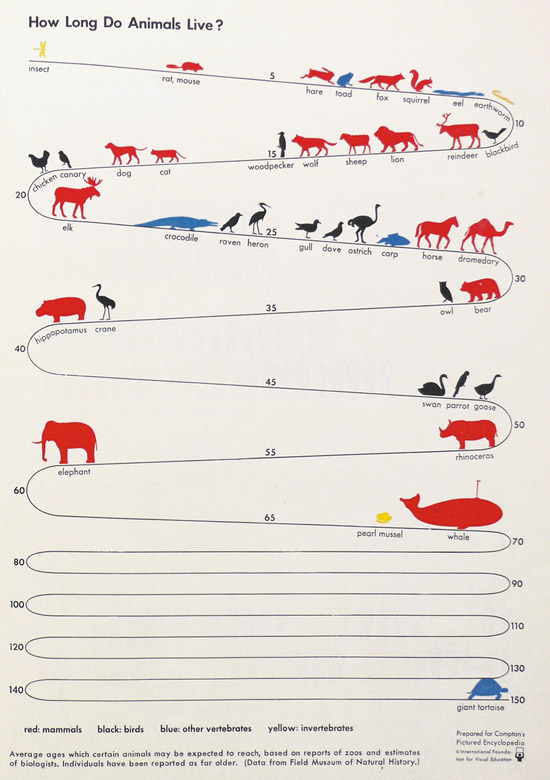
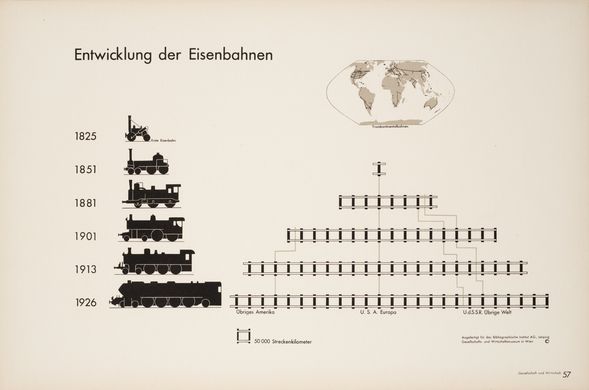
In the 1930s, Austrian sociologist, philosopher and curator Otto Neurath and his wife Marie pioneered ISOTYPE — the International System Of TYpographic Picture Education, a new visual language for capturing quantitative information in pictograms, sparking the golden age of infographics in print.

The Transformer: Principles of Making Isotype Charts is the first English-language volume to capture the story of Isotype, an essential foundation for our modern visual language dominated by pictograms in everything from bathroom signage to computer interfaces to GOOD’s acclaimed Transparencies.

Isotype1

The real cherry on top is a previously unpublished essay by Marie Neurath, who was very much on par with Otto as Isotype’s co-inventor, written a year before her death in 1986 and telling the story of how she carried on the Isotype legacy after Otto’s death in 1946.

Isotype2

The pundits are “mad as hell” and hope we’re ready to man the barricades for them

Filed under: Media, Politics, USA — Tags: , , , — Nicholas @ 09:03

Jim Geraghty notes the common theme among anguished pundits both left and right:

One problem with the “this is intolerable, and we need an uprising!” cry is that we’ve already had at least two “uprisings” at the ballot box in recent years: The Obama wave of 2008 and the Tea Party wave of 2010. But their remedies for the “intolerable” condition are contradictory — one envisions a much greater role for government in Americans’ daily lives, while the other concludes government’s growing role exacerbates the problems instead of solving it.

Ironically, the two sides agree in their denunciation of crony capitalism, but what they usually mean is that they’re opposed to the other guy’s crony capitalism. Obama voted for TARP and then exploited its discontent, shrugged at the taxpayers getting stuck for the bill of Solyndra and other green energy boondoggles, then did his part to help walking conflict of interest Terry McAuliffe become governor of Virginia. The flip side of the coin too many Republicans are all too comfortable with their own versions of crony capitalism — loans and loan guarantees subsidize U.S. exporters, state economic development boards, and Bob McDonnell’s cozy financial arrangements with donors, among other examples. While crony capitalism isn’t really a driving force behind our national sense of diminishing economic opportunities, it certainly doesn’t help anyone except the cronies, and enhances the sense that wealth is built through cheating and secret deals, not hard work or innovation.

(Notice that this expression of economic discontent is so generic that everybody’s got a grievance, and nobody thinks they’re the beneficiaries. This is how you get multimillionaire rapper/mogul Jay-Z selling Occupy Wall Street-themed t-shirts, or the CEO of bailed-out insurance giant AIG explicitly comparing the treatment of his company to lynchings in the South, or the number of members of Congress who have complained about their $174,000 per year salary.)

December 9, 2013

The “epidemic of slavery” in Britain is an urban legend

Filed under: Britain, Media — Tags: , , , — Nicholas @ 11:53

In sp!ked, Frank Furedi talks about the much-talked-about but almost certainly mythical “epidemic of slavery” in Britain:

A London detective inspector, Kevin Hyland, informed the world that ‘we have never seen anything of this magnitude before’. The UK home secretary, Theresa May, echoed his sentiments and said she would make tackling modern-day slavery her top priority. She said there was ‘one positive’ to the case of the south London slave house: the public had finally become aware of the issue of slavery, which, according to May, continues to have a ‘shocking presence in modern Britain’. By this time, claims that thousands of people in Britain were being held in conditions of ‘slavery’ were circulating in the media.

Detective inspector Hyland may not have seen ‘anything of this magnitude’ before — but the fact is that what he saw, or imagined he saw, was a fantasy of slavery rather than the grim reality of forced servitude. Indeed, the story of the south London slaves rapidly unravelled. Early reports hinted at a heroic rescue mission involving detailed planning and up to 40 police operatives. But within a few days it became evident that the three ‘slaves’ were not slaves as we have traditionally understood that term. Certainly they were not physically held against their will. Contrary to early media reports, which suggested the three women had been imprisoned in a house for 30 years, later accounts revealed that they went outdoors to run errands and had access to telephones and a television.

As the initial story of forced imprisonment became difficult to sustain, the narrative of scaremongering shifted — now focusing on the psychological and emotional horrors the women allegedly suffered. Suddenly, the image of the iron collar and chains used by slave-owners gave way to talk of ‘invisible handcuffs’. From this point on, the promoters of this urban legend about modern-day slavery argued that what is really significant about this hitherto unrecognised crime is not what can be seen by the naked eye but rather the often ‘invisible’ problem of mental enslavement. These are slaves who are not physically chained into a life of servitude, but rather are wrapped up in ‘emotional chains’ by their psychologically manipulative captors. ‘Brainwashed’ became the term most commonly used by campaigners spreading myths about an epidemic of ‘slavery’.

December 7, 2013

Hitchcock’s MacGuffin in US politics

Filed under: Media, Politics, USA — Tags: , , , — Nicholas @ 13:16

At Ace of Spades HQ, Ace explains what the MacGuffin is and why American media outlets don’t care about it and think you shouldn’t care about it either:

In a movie or book, The MacGuffin” is the thing the hero wants.

Usually the villain wants it too, and their conflict over who will end up with The MacGuffin forms the basic spine of the story.

In Raiders of the Lost Ark, the MacGuffin is, of course, the Lost Ark. Indy wants it; the Nazis have it. This basic conflict over simple possession animates a two hour long movie.

Alfred Hitchcock noted — counterintuitively, when you first hear this — that the specifics of the MacGuffin don’t really matter at all to a movie. He pointed out that the audience doesn’t care at all about the MacGuffin. The hero in the movie itself cares, but the audience doesn’t.

In one Hitchcock film, the MacGuffin was some smuggled uranium hidden in vintage wine bottles. But Hitchcock noted it didn’t matter if it was uranium in wine bottles, or a fragment of a diplomatic dispatch from the Nazi high command, or a hidden murder weapon, or photographs proving a Senator’s affair.

Okay, we’ve got the movie notion down … what’s the US political MacGuffin?

For Obama’s fanbois, this is not politics. This isn’t even America, not really, not anymore.

This is a movie. And Barack Obama is the Hero. And the Republicans are the Villains. And policy questions — and Obama’s myriad failures as an executive — are simply incidental. They are MacGuffins only, of no importance whatsoever, except to the extent they provide opportunities for Drama as the Hero fights in favor of them.

Watching Chris Matthews interview Obama, I was struck by just how uninterested in policy questions Matthews (and his panel) were, and how almost every question seemed to be, at heart, about Obama’s emotional response to difficulties — not about policy itself, but about Obama’s Hero’s Journey in navigating the plot of President Barack Obama: The Movie.

As with a MacGuffin in the movie, only the Hero’s emotional response to the MacGuffin matters.

Again and again, Matthews and his panel focused not on weighty questions of state, but on what toll these important-sounding MacGuffins took upon the Star of the Picture, Barack Obama.

Matthews was not terribly interested in hearing about the problems with Obamacare, or how Obama planned to address them.

But he was very interested in learning how Obama was coping with the challenges.

Matthews didn’t care all that much about disputes over the budget. But he was keenly interested in Obama’s thoughts on his opponents in such struggles.

Chris Matthews’ called Obama’s last answer the most important in the interview, and his entire panel agreed it was simply amazing.

[…]

Note what they’re not talking about: America. Policy. The economy. Obamacare. Actual live political controversies and possible programmatic responses to the difficulties we face (many of which Obama has caused himself, or made worse).

No, American politics is now merely a MacGuffin, an important-sounding but ultimately inconsequential and disposable plot device for holding interest in the Hero’s Journey.

Ultimately the only thing that matters is the Hero itself. It doesn’t matter why the Hero Barack Obama wants the Lost Ark of Sensible Gun Control, or the Shankara Stones of Comprehensive Immigration Reform, or the Democratic Holy Grail of Affordable Health Care. These are very minor details and only matter to the extent the Hero exerts himself to achieve them.

The viewers of this film don’t really care about these things, but only Obama’s frustration at being denied them, or his joy in attaining them.

Bohemian Rhapsody: Star Wars Edition

Filed under: Humour, Media — Tags: , , — Nicholas @ 11:36

Published on 4 Dec 2013

Press “CC” in the player for the lyrics! Based on “Bohemian Rhapsody” by Queen and STAR WARS created by George Lucas. Performed by the Star Wars cosplayers of the Arizona geek community!

Produced by the Students and Faculty of the Digital Video Program at University of Advancing Technology in Tempe, Arizona (http://www.uat.edu)

“Star Wars Edition” Lyrics by Stephen Panagiotis, Jamall Richards and Paul DeNigris

“Star Wars Edition” Vocals Produced by Joey Sawhill & Adam Newton
All vocals by Adam Newton
Engineered & Mixed by Joey Sawhill

December 4, 2013

The rising tide of “isolationism”

Filed under: Liberty, Media, Politics, USA — Tags: , , — Nicholas @ 08:23

Justin Raimondo on the irritating-to-pundits-and-politicians increase in what they mis-characterize as isolationism:

For years the Pew folks have been yelping about “isolationism.” They’ve been telling us it’s on the march — except among the elites — with the strong implication being that this is not a Good Thing. But do they know what the heck they’re talking about?

One has to wonder what extending peaceful commercial links with other nations has in common with invading them, meddling in their internal politics, or otherwise bullying them around. Indeed, establishing voluntary non-coercive relations with other nations — otherwise known as international trade — is the polar opposite of military and/or political intervention in their affairs. The American people know this. The Pew folks — not so much.

The bias of the Pew Center is evident in every line of the report, and also in its structure: the Pew Poll is really two polls, one a survey of the hoi polloi (you and I), the other a poll of members of the “internationalist” Council on Foreign Relations (CFR), the elite foreign policy group founded by Elihu Root and dominated by the Morgan banking interests from the get-go. The gulf between us plebeians and the Very Serious People in Washington (and New York) has been growing for years, but today it is a vast chasm: The CFR types are aghast at the “isolationism” of the rest of us, and ascribe to this various causes: “war fatigue,” the costs — and of course our narrow plebeian “isolationist” anti-cosmopolitan country-bumpkin outlook.

While 51 percent of normal Americans say we’re pushing our weight around far too much, the exact opposite opinion is held by the Washington-New York know-it-alls: “By contrast, about twice as many CFR members say the US does too little internationally as say it does too much (41% vs. 21%); 35% say the US does the right amount.” While us Normals were overwhelmingly opposed to US intervention in Syria, the CFR’ers were for it 2-to-1. Yes, they’re wrong about practically everything, including what it means to be an “isolationist” — a creature that has never existed and could not exist outside of North Korea.

[…]

The political class in this country has a far different view of commercial relations between nations than the Average American. To the latter, it is simply Good Old American Free Enterprise, albeit engaged in overseas. The former are not so naïve: they realize it is all about buying political influence, and, failing that, using the US military to guarantee the safety, security, and profitability of American investments abroad.

Viewed through this lens, American foreign policy since 1890 takes on a whole new dimension, which Rothbard’s Wall Street, Banks, and American Foreign Policy reveals in scintillating detail. The One Percent have been utilizing the US military as their private security force ever since that time: indeed, every war we have fought — yes, including the Good War — was fulsomely supported by the economic elite and their journalistic camarilla against the overwhelming desire of the American people to stay out. The political class has deliberately conflated commercial contacts with military and political intervention into the affairs of other nations — because, for them, the two are synonymous.

According to the mindset of the Pew Center and their good buddies at the CFR, “isolationism” has to mean commercial isolation. While this may puzzle the average person, look at it from the perspective of a professional thief: without the threat of US sanctions and the ultimate bludgeon of US military intervention, how else will the big banksters and their sycophants enforce a “world order” that exists so they can make a fast buck off the sweat of Chinese coolies, Eurasian oil workers, and Mexican maquiladores?

December 3, 2013

Blackadder Rides Again

Filed under: Britain, History, Humour, Media — Tags: , — Nicholas @ 00:01

Published on 30 May 2013

Documentary looking at the much-loved sitcom from its first transmission in 1983. The programme features an exclusive in-depth interview with Edmund Blackadder himself, Rowan Atkinson, the first time he has agreed to talk about his experiences making the show. Also reflecting on their time on the show are other key members of the team, including Stephen Fry, Hugh Laurie, Tony Robinson, Rik Mayall, Ben Elton and Richard Curtis.

December 2, 2013

Reason.tv: Gregg Easterbrook on how football fleeces taxpayers

Filed under: Books, Business, Football, Media — Tags: , , , — Nicholas @ 16:46

Published on 2 Dec 2013

Whether you like football or not — whether you’ve ever bought a ticket to a high school, college, or NFL game — you’re paying for it.

That’s one of the takeaways from The King of Sports: Football’s Impact on America, Gregg Easterbrook’s fascinating new book on the cultural, economic, and political impact of America’s most popular and lucrative sport.

“The [state-supported] University of Maryland charges each…undergraduate $400 a year to subsidize the football program,” says Easterbrook, who notes that only a half-dozen or so college teams are truly self-supporting. Even powerhouse programs such as the University of Florida’s pull money from students and taxpayers. “They do it,” he says, “because they can get away with it.”

At the pro level, billionaire team owners such as Paul Allen of the Seattle Seahawks and Shahid Khan of the Jacksonville Jaguars benefit from publicly financed stadiums for which they pay little or nothing while reaping all revenue. Easterbrook also talks about how the lobbyists managed to get the NFL chartered as a nonprofit by amending tax codes designed for chambers of commerce and trade organizations.

As ESPN.com‘s Tuesday Morning Quarterback columnist, Easterbrook absolutely loves football but also isn’t slow to throw penalty flags at the game he thinks is uniquely America. In fact, he sees the hypocrisy at the center of the business of football as “one of the ways that football synchs [with] American culture….Everyone in football talks rock-ribbed conservatism, self-reliance. Then their economic structure is subsidies and guaranteed benefits. Isn’t that America?”

Easterbrook sat down with Reason‘s Nick Gillespie to discuss The King of Sports, how the business of football burns taxpayers, and whether increased worries about brain injuries and other problems spell eventual doom for the NFL and other levels of play.

Produced by Todd Krainin. Cameras by Meredith Bragg and Krainin.

November 30, 2013

“I have nothing to hide from the government, so why should I worry?”

Filed under: Government, Liberty, Media — Tags: , , , — Nicholas @ 11:39

The Electronic Frontier Foundation explains why you should worry about omnipresent government surveillance:

There are a few ways to respond to this, depending on what you think will work best for the person raising the question.

  • Point out how mass surveillance leaves you at the mercy of not only the NSA, but also to the DEA, the FBI and even the IRS. We know that the government claims that any evidence of a “crime” can be sent to the appropriate law enforcement agencies.
  • Tell them that, even if you don’t think you have something to hide, it’s possible the government thinks you do, or can create some concern about you (or your friends or loved ones). There are so many laws and regulations on the books, Rep. Jim Sensenbrenner said the Congressional Research Service did not have the resources to count them all. One legal expert has argued that the average person likely commits three felonies a day without ever realizing. So, you may be technically breaking a law you have no idea about.
  • We all benefit from a system that allows privacy. For example, when journalists can speak to sources without the specter of surveillance, helping fuel investigative journalism and the free flow of information. And this is not just a hypothetical — the Department of Justice subpoenaed the phone records of Associated Press journalists in an effort to track down government whistleblowers. And it’s not just journalists. Activists, political organizers, lawyers, individuals conducting sensitive research, businesses that want to keep their strategies confidential, and many others rely on secure, private, surveillance-free communication.

Need a new conspiracy theory?

Filed under: Humour, Media — Tags: , , — Nicholas @ 09:34

A couple of my friends posted links to this rather useful flowchart to help you find the conspiracy theory that’s right for you:

[Click to see full-size flowchart]

[Click to see full-size flowchart]

H/T to Jessica Brisbane and John McCluskey for the link.

November 27, 2013

Some awkward questions about the Brixton “slaves”

Filed under: Britain, Law, Media — Tags: , , , , — Nicholas @ 10:29

Brendan O’Neill goes through the “half-truths and wild claims” of the recent modern slavery story in Britain:

It was presented to us as another Fritzl-like horror, involving three ‘enslaved women’, at least one of whom had ‘spent her whole life in captivity’ and had ‘never seen the outside world’. Or it was Britain’s own version of the recent Cleveland, Ohio case, in which Ariel Castro kidnapped three women from the streets and shackled them to immoveable objects in his house where he abused them for 10 years. In fact, it was worse than Cleveland, suggested the Mirror, because where those American women only suffered for a decade, these British-based women went through a ‘30-year nightmare of captivity, servitude and unimaginable brutality’. It was, in a nutshell, the worst-ever case of hidden human enslavement, the papers told us. ‘No known victims have spent so long in captivity being brainwashed, beaten, manipulated and terrorised’, one said.

We now know that these claims about the so-called ‘Brixton slaves’ are, to use the only term that will suffice, bullshit. Everything that has subsequently come to light, everything that has unfolded in the six days since these ‘slaves’ were ‘rescued’ from some kind of one-time Maoist commune, has called into question the initial claims made by the police, the highly dramatised narrative imposed on these events by the media, and the hyperbolic descriptions of the case by politicians desperate to appear as modern-day William Wilberforces combatting the evils of ‘slavery’. Indeed, the key question that must now be asked is not ‘How did three women end up in a grim commune?’ (let’s leave that to the police), but rather: ‘Why did the entire British media and the political class, along with campaigners and the Twitterati, so willingly and gullibly buy a horror story that was not true?’

[…]

So almost everything we were told about the Brixton case has turned out either to be untrue or to have been wildly exaggerated or dramatised. These were not slaves. They were not held captive. They were not denied contact with the outside world. Rather, what we seem to be dealing with is, quite simply, a very, very eccentric household, in which various people came together, did and believed very strange things, developed an obsession with Mao and conspiracy theories about the British ‘fascist state’, and then ended up regretting it all — well, three of women seem to have regretted it. And so they left. Voluntarily. Without a struggle. It sounds like it was all very unpleasant; it seems clear emotional manipulation was involved and possibly physical force too (but let’s allow the courts to decide that). But slavery? Fritzl-style abuse? Hell, horror, unimaginable brutality? There is nothing remotely resembling evidence to show that anything like that occurred.

So why did the media, politicians, feminists and campaigners lap up this half-cooked, shrill, mostly baseless fantasy about slaves stuck in suburban jails in London? Because it spoke to their already existing prejudices; because it seemed to confirm the darker thoughts that lurk in their heads, about wicked men, vulnerable women, and the unspeakable things that happen in ‘ordinary houses on ordinary streets’; because it allowed them to feel, temporarily, like history-making moral crusaders against evil, and to hell with anything so pesky as a fact. Aneeta Prem, head of the Freedom Charity that assisted the women and drove much of the dramatic talk about ‘domestic servitude’ and ‘rescue’, yesterday said there was too much media frenzy around the case and ‘the more information there is that comes into the public domain, the more it will hamper [the women’s] recovery’. So there’s a problem with having too much information about this case? Why? Might it be because the information so dramatically contradicts the fantasy put about by Prem and others about a group of slaves having been held captive in London for three decades?

OMG! There are scary-sounding chemicals in your Thanksgiving Dinner!

Filed under: Environment, Food, Health, Media — Tags: , , — Nicholas @ 09:23

Our American friends are about to celebrate their (weirdly late) Thanksgiving this week, so junk science food scares are also making another annual appearance. Angela Logomasini explains why you can safely ignore most of the advice you may receive about food safety this Thanksgiving:

Toxic chemicals lurk in the “typical” Thanksgiving meal, warns a green activist website. Eat organic, avoid canned food, and you might be okay, according to their advice. Fortunately, there’s no need to buy this line. In fact, the trace levels of man-made chemicals found in these foods warrant no concern and are no different from trace chemicals that appear in food naturally.

The American Council on Science and Health (ACSH) illustrates this reality best with their Holiday Dinner Menu, which outlines all the “toxic” chemicals found naturally in food. The point is, at such low levels, both the man-made and naturally occurring chemicals pose little risk. This year the ACSH puts the issue in perspective explaining:

    Toxicologists have confirmed that food naturally contains a myriad of chemicals traditionally thought of as “poisons.” Potatoes contain solanine, arsenic, and chaconine. Lima beans contain hydrogen cyanide, a classic suicide substance. Carrots contain carototoxin, a nerve poison. And nutmeg, black pepper, and carrots all contain the hallucinogenic compound myristicin. Moreover, all chemicals, whether natural or synthetic, are potential toxicants at high doses but are perfectly safe when consumed in low doses.”

Typically, these kinds of food safety scares depend on using unfamiliar scientific names of various chemicals, knowing that most peoples’ memories of high school science have long since faded away. Anything “safe” has an ordinary name, while anything “toxic” goes by a tongue-twisting science-y name that conceals far more than it reveals to non-scientists. Remember how many times the dangers of dihydrogen monoxide (DHMO) have been used to whip up support for petitions to ban the stuff (see the Material Safety Data Sheet (pdf) for it). Dihydrogen monoxide is a science-y way of describing a molecule with two hydrogen atoms and one oxygen atom … it’s another name for water, but it sounds so much more ominous that way, doesn’t it?

November 26, 2013

Never-let-a-crisis-go-to-waste department – the modern slavery bill

Filed under: Britain, Law, Media — Tags: , , , , — Nicholas @ 09:11

Tim Worstall explains why the rush to legislate based on the public outrage over the most recent case of slavery is a bad idea that will have worse results:

I know that I shouldn’t giggle over such things but the revelation that the three “slaves” recently found were in fact the remnants of a Maoist commune well known to social services (indeed, housed by the local council) does provide a certain amusement as we see various leftish types suddenly running away from the story. However, now onto something a great deal more important. Theresa May and various campaigners are going to use this to try and pass an extremely bad law about modern slavery. And it’s worth our all complaining very loudly about this now, as the bill is being drawn up, not later when it is too late.

The problem is that there are two distinct meanings being conflated together for the convenience of the legislators, police, and media: I) sex slavery (which most people recognize as a terrible crime that should be prosecuted to the fullest extent of the law) and II) illegal immigration (which is not the same thing at all). By lumping the much larger number of type II cases in with the tiny number of type I, you get a big headline-friendly number to shock and energize the population who think you’re really talking only about type I cases.

As Operation Pentameter found out, after every police force in the country tried to search out and find sex slaves they found not one single case in the entire country that they were able to prosecute for the crime.

That is, the police went looking for slavery, type I definition of trafficking, while this foundation is using the type II definition of illegal immigration (or, to get to that 50% number, simply of immigration, legal or not).

Oh, and Eaves is involved. They were the people behind the Poppy Project. Which, laughably, claimed that evidence of foreign born women working in brothels in London was evidence of trafficking. Guess all those foreigners working in The City are slaves then, eh?

Just to make this entirely clear here. These campaigners (and that includes May here) are going to use our revulsion of the type I trafficking to pass extraordinarly severe laws against the type II stuff. Up to and including life imprisonment and confiscation of all financial assets. Yet it is only type I that is in fact slavery. Type II is more normally defined as the employment of an illegal immigrant.

Anyone really want life imprisonment for employment of an illegal immigrant? Someone who, entirely of their own volition, tried to make their lives better by breaking the law to come to this country is now going to be defined as a slave?

« Newer PostsOlder Posts »

Powered by WordPress


