Jon, my former virtual landlord sent along an interesting link:
An introduction by David and Ben Crystal to the ‘Original Pronunciation’ production of Shakespeare and what they reveal about the history of the English language.

Jon, my former virtual landlord sent along an interesting link:
An introduction by David and Ben Crystal to the ‘Original Pronunciation’ production of Shakespeare and what they reveal about the history of the English language.
I am not an economist. I am an economic historian. The economist seeks to simplify the world into mathematical models — in Krugman’s case models erected upon the intellectual foundations laid by John Maynard Keynes. But to the historian, who is trained to study the world “as it actually is”, the economist’s model, with its smooth curves on two axes, looks like an oversimplification. The historian’s world is a complex system, full of non-linear relationships, feedback loops and tipping points. There is more chaos than simple causation. There is more uncertainty than calculable risk. For that reason, there is simply no way that anyone — even Paul Krugman — can consistently make accurate predictions about the future. There is, indeed, no such thing as the future, just plausible futures, to which we can only attach rough probabilities. This is a caveat I would like ideally to attach to all forward-looking conjectural statements that I make. It is the reason I do not expect always to be right. Indeed, I expect often to be wrong. Success is about having the judgment and luck to be right more often than you are wrong.
Niall Ferguson, “Why Paul Krugman should never be taken seriously again”, The Spectator, 2013-10-13
I’m not sure how you could characterize the great George Orwell as anything other than a socialist, unless you’ve never actually read any of his works:
One wonders whether the confusion stems from what [Krystal Ball] thinks she knows about Orwell’s politics? Contrary to the devout wishes of many conservatives, it remains an indisputable fact that George Orwell was a socialist. He was not “confused” about his politics. He was not a “capitalist in waiting.” He was not merely “living in another time.” He was a socialist, and he believed that, “wholeheartedly applied as a world system,” socialism could solve humanity’s problem. By contrast, he was wholly appalled by capitalism, which he described as a “racket” and which he believed led inexorably to “dole queues, the scramble for markets and war.” Abandoning a comfortable upbringing that had included an education at Eton and a stint as an imperial policeman in Burma, Orwell not only went out into the streets to discover how the other half lived but went so far as to risk his life for the cause, fighting for the Workers’ Party of Marxist Unification against Franco in the Spanish Civil War. (He was shot by a sniper, but survived.)Orwell’s press card portrait, 1943
When the Right seized upon 1984 (which his publisher quipped to his irritation might be worth “a cool million votes to the Conservative party”), Orwell reacted with controlled anger, explaining in a letter that was published in Life magazine that,
my novel Nineteen Eighty-Four is not intended as an attack on socialism, or on the British Labor party, but as a show-up of the perversions to which a centralized economy is liable, and which have already been partly realized in Communism and fascism.
So far, so clear.
And yet, admirably, he never lost his independence of mind, writing in the very next line of his explanation that,
I do not believe that the kind of society I describe necessarily will arrive, but I believe (allowing of course for the fact that the book is a satire) that something resembling it could arrive. I believe also that totalitarian ideas have taken root in the minds of intellectuals everywhere, and I have tried to draw these ideas out to their logical consequences.
This fear came to preoccupy him — and to the exclusion of almost everything else. “Every line of serious work that I have written since 1936,” he explained in Why I Write, “has been written, directly or indirectly, against totalitarianism and for democratic Socialism, as I understand it.”
How he understood it was changing by the day. “Collectivism,” he warned in a 1944 book review, “leads to concentration camps, leader worship and war.” More important, perhaps, he admitted that this might always be so, suggesting that “there is no way out of this unless a planned economy can somehow be combined with the freedom of the intellect, which can only happen if the concept of right and wrong is restored to politics.” Like Wilde before him, he held that freedom of the intellect to be indispensable. The question: Could socialism accommodate it?
It is de rigeur these days to cast Orwell as being merely an anti-totalitarian socialist — a “democratic socialist,” if you will — and, in doing so to parrot the graduate student’s favorite assurance that, because Marxism has never been tried in any sufficiently developed country, its critics are condemning merely its “excesses.” Certainly, Orwell did not believe that the Soviet Union was in any meaningful way a “socialist” state: “Nothing,” he charged, “has contributed so much to the corruption of the original idea of socialism as the belief that Russia is a socialist country and that every act of its rulers must be excused, if not imitated.” But, dearly as he hoped it could be realized, he also never quite managed to convince himself that his form of socialism was possible either — let alone that it could coexist with the English liberties he so sharply championed. For Orwell, it was not simply a matter of distinguishing between the “good” and “bad” Left, but worrying whether the former would lead always to the latter — a concern that the British literary classes, which indulged Stalin’s horrors to an unimaginable degree, did little to assuage.
At The Federalist, David Harsanyi says the debate is over and the environmentalists have lost:
The truth is that even if Americans believed that scientists had seer-like abilities and the models were accurate, they would still be hesitant to embrace 19th century technology because they simply can’t afford it. Though I suspect most people instinctively understand that the environment has gotten better by almost every measure over the past 40 years, climate change activists ignore the massive benefits of carbon emitting fuels and technology that helps us become more productive and increasingly efficient.
Now, you can try and guilt trip everyone into compliance. You can batter them with distressing hypothetical scenarios. You can “educate” them on the issue from kindergarten onward, you can mainstream an array of Luddite ideas, you can browbeat society so they never utter a word of skepticism, but we still want to drive our cars everywhere. This is probably why over-the-top warnings and preposterous analogies have hit peak levels of absurdity.
And that’s saying something. Dr. John Holdren, Obama’s Science Czar, who was on media call for the National Climate Assessment release, once predicted global warming could cause the deaths of 1 billion people by 2020 and that sea levels would rise by 13 feet by the end of the century (not to mention, he co-authored a book with Paul Ehrlich in which he explained that “population-control laws, even including laws requiring compulsory abortion, could be sustained under the existing Constitution…”). Malthusians never admit they’re wrong, they simply push the apocalypse out a couple of decades. I just don’t think people believe them anymore.
Yes, when asked, Americans perfunctorily tell pollsters that climate change matters to them. A recent Pew Research Center poll found that 40 percent of Americans believe that climate change is a major threat. A Gallup poll survey found that around third of Americans personally worry about climate change. But when they’re not asked specifically about global warming, voters never bring the topic up. They’re most important concerns are the economy, jobs and debt. Though there is always strong support for the abstract idea of environmental regulation and “clean energy,” but when it comes some concrete policy it is nearly always unpopular. Few people want to stop the Keystone XL Pipeline. Few people support new emissions regulations. And I doubt another scaremongery study will change that reality.
When I first auditioned for Firefly, I read the breakdown of the characters and the one that caught my eye was River. I read it and I thought, “Oh that sounds meaty, I like that.” There was a lot of crying and hysteria and every actor wants to do that. But then I read Kaylee, and they said, “Well actually Joss wants to see you for Kaylee,” and I thought “Oh,” because it said “chubby” on the breakdown, and I’m not chubby, and I didn’t know if they meant ‘Hollywood chubby’ or what. So I put myself on tape and kind of forgot about it, and then a few weeks later I got the call and I flew down to meet Joss, and he told me flat out. He said, “You know I need this character to be full of life, and by full of life I mean she has to look like she enjoys life. She has to look like she eats a burger now and then, and drinks a few beers once in a while.” He didn’t want her to be a typical size zero actress, which I understand. I’m naturally this way. I was a little taken aback because I’m really into yoga, and I like to stay healthy. But I loved the role so much it wasn’t like I was going to say no. So I just stuffed my face for about three weeks, and got to eat lots of mayonnaise. I got to eat doughnuts every morning and I felt so sick because I was so full all the time, but I had to keep eating like that to keep the weight on. It was interesting. My husband loved it — guys apparently like a little weight on women! It was awesome.
Jewel Staite, speaking onstage at the “Fusion” convention, 2004.
At Wired, Kim Zetter talks about an initiative to reclaim (some measure of) privacy on the internet:
A coalition of nearly two-dozen tech companies and civil liberties groups is launching a new fight against mass internet surveillance, hoping to battle the NSA in much the same way online campaigners pushed back on bad piracy legislation in 2012.
The new coalition, organized by Fight for the Future, is planning a Reset the Net day of action on June 5, the anniversary of the date the first Edward Snowden story broke detailing the government’s PRISM program, based on documents leaked by the former NSA contractor.
“Government spies have a weakness: they can hack anybody, but they can’t hack everybody,” the organizers behind the Reset the Net movement say in their video (above). “Folks like the NSA depend on collecting insecure data from tapped fiber. They depend on our mistakes, mistakes we can fix.”
To that end, the groups are calling on developers to add at least one NSA resistant feature to mobile apps, and on websites to add security features like SSL (Secure Socket Layer), HSTS (HTTP Strict Transport Security), and Perfect Forward Secrecy to better secure the communication of users and thwart government man-in-the-middle attacks.
Lorraine McBride talks to Rick Wakeman about his career.
Has there ever been a time when you worried how you were going to pay the bills?
Yes, there have always been times like that. In the late Sixties, when I played at the Top Rank ballroom, being an organist meant carting my organ around to sessions, which cost two thirds of my earnings, on top of running a car, which was when I learnt the word “expenses”.
My rent cost £8 a week and I can remember being really short. In 1970, I was up in London looking for session work and Marc Bolan who was a great mate, gave me a session for Get It On. All I had to do was a glissando on the piano. I said to him afterwards, “You could have done that,” and he replied, “Well, you want your rent money don’t you?” Tough times, but when I joined Yes, I went from £18 a week to £50 a week.
Yes made a fortune, what did you spend it on?
We were all told to go out and buy a nice house, which was an eye-opener because I’d only known a two-up, two-down and a Ford Anglia. Suddenly we were talking five-bed, des-res. I remember looking around one house for sale in Gerrards Cross and the lady said, “This is the breakfast room.” I said: “What, just for breakfast?” because it was just a different world.
Lots of rock stars get ripped off, did you learn any tough lessons?
Yes, everybody in the business did. One thing you start to learn, usually too late, is that being top of the tree doesn’t last forever. You drop down a few branches and find your position but you set yourself a lifestyle that requires “top of the tree” earnings to pay for it. Then of course, you have the unexpected events like a divorce of which I’ve had three.
Suddenly you grow up very quickly and certainly when a problem hits, you back-pedal to try and work out how to sort it out. I was lucky. I had a very good accountant who helped tremendously and I learnt to listen but it took a long time. It probably wasn’t until the turn of the millennium when I found myself in yet another divorce, when the situation seems unbelievable, you really start to listen.
[…]
What’s been your best financial move?
Undoubtedly listening to David Bowie who said: “Be your own man and don’t listen to people who don’t know a hatchet from a crotchet and try to fulfil their own ideas through you because they haven’t got any.” I wanted to do Journey to the Centre of the Earth with an orchestra but there wasn’t enough money from the record company. I ended up mortgaging my house, selling everything I owned. I begged, borrowed and stole to do it. But the record company didn’t want it and I faced losing everything because I was so heavily in debt.
Eventually my record company in America loved it, insisted it was released and it sold 15 million copies and that really taught me to be my own man. Spending money I didn’t have was simply my best financial decision because if I hadn’t done it, 40 years on, I wouldn’t be doing my shows now.
Matt Ridley explains that according to the experts, it’s believed that ongoing climate change actually provides net benefits for most of this century:
Climate change has done more good than harm so far and is likely to continue doing so for most of this century. This is not some barmy, right-wing fantasy; it is the consensus of expert opinion. Yet almost nobody seems to know this. Whenever I make the point in public, I am told by those who are paid to insult anybody who departs from climate alarm that I have got it embarrassingly wrong, don’t know what I am talking about, must be referring to Britain only, rather than the world as a whole, and so forth.
At first, I thought this was just their usual bluster. But then I realised that they are genuinely unaware. Good news is no news, which is why the mainstream media largely ignores all studies showing net benefits of climate change. And academics have not exactly been keen to push such analysis forward. So here follows, for possibly the first time in history, an entire article in the national press on the net benefits of climate change.
There are many likely effects of climate change: positive and negative, economic and ecological, humanitarian and financial. And if you aggregate them all, the overall effect is positive today — and likely to stay positive until around 2080. That was the conclusion of Professor Richard Tol of Sussex University after he reviewed 14 different studies [PDF] of the effects of future climate trends.
To be precise, Prof Tol calculated that climate change would be beneficial up to 2.2˚C of warming from 2009 (when he wrote his paper). This means approximately 3˚C from pre-industrial levels, since about 0.8˚C of warming has happened in the last 150 years. The latest estimates of climate sensitivity suggest that such temperatures may not be reached till the end of the century — if at all. The Intergovernmental Panel on Climate Change, whose reports define the consensis, is sticking to older assumptions, however, which would mean net benefits till about 2080. Either way, it’s a long way off.
[…]
You can choose not to believe the studies Prof Tol has collated. Or you can say the net benefit is small (which it is), you can argue that the benefits have accrued more to rich countries than poor countries (which is true) or you can emphasise that after 2080 climate change would probably do net harm to the world (which may also be true). You can even say you do not trust the models involved (though they have proved more reliable than the temperature models). But what you cannot do is deny that this is the current consensus. If you wish to accept the consensus on temperature models, then you should accept the consensus on economic benefit.
Robert Tracinski on the recent habit of attributing psychopathy to political enemies (by carefully editing the actual symptoms of typical psychopaths):
Years ago, I read an excellent book on the psychology of the career criminal. In the introduction, the author cautions readers against “medical students’ disease”: the tendency of first-year med students to suddenly notice that they have symptoms that are superficially similar to those of the strange diseases they’re studying. Similarly, he warned, as you read about the psychology of criminals, you might notice — in your most self-critical moments — that you have a few superficially similar traits. But unless you’re actually sticking up liquor stores, this does not mean you are a criminal.
Ah, but how much easier it is — how much more delicious — to use these superficial similarities to impute a criminal psychology, not to yourself, but to your enemies.
That is the upshot of an article that is just slightly crazier than your average piece at Salon, which cherry picks a few tendentious psychological studies to claim that conservatives are psychopaths. Science proves it!
This is just cashing in on a rather sloppy, poorly thought out trend toward studies of “psychopathy” which claim to find evidence of it everywhere, particularly among those stock Hollywood villains: wealthy and successful businessmen. They do so by means of exactly the method we just described: describing the characteristics of a psychopath in such vague terms that practically everyone can be said to bear some superficial resemblance, so therefore we’re all just a little bit psychopathic, on a sliding scale. Despite the fact that most of us aren’t actually, you know, doing anything psychopathic.
James Conca on a recent UN report that isn’t getting attention:
It’s always amazing when a United Nations report that has global ramifications comes out with little fanfare. The latest one states that no one will get cancer or die from radiation released from Fukushima, but the fear and overreaction is harming people (UNIS; UNSCEAR Fukushima; UNSCEAR A-68-46 [PDF]). This is what we’ve been saying for almost three years but it’s nice to see it officially acknowledged.
According to the report, drafted last year but only recently finalized by the U.N., “The doses to the general public, both those incurred during the first year and estimated for their lifetimes, are generally low or very low. No discernible increased incidence of radiation-related health effects are expected among exposed members of the public or their descendants. The most important health effect is on mental and social well-being, related to the enormous impact of the earthquake, tsunami and nuclear accident, and the fear and stigma related to the perceived risk of exposure to ionizing radiation. Effects such as depression and post-traumatic stress symptoms have already been reported.”
In addition, the report states, “Increased rates of detection of [thyroid] nodules, cysts and cancers have been observed during the first round of screening; however, these are to be expected in view of the high detection efficiency [using modern high-efficiency ultrasonography]. Data from similar screening protocols in areas not affected by the accident imply that the apparent increased rates of detection among children in Fukushima Prefecture are unrelated to radiation exposure.”
So the Japanese people can start eating their own food again, and moving back into areas contaminated with radiation levels similar to many areas of the world like Colorado and Brazil, which includes most of the exclusion zone. Only a few places shouldn’t be repopulated.
But if you want to continue feeling afraid, and want to make sure others keep being afraid, by all means ignore this report on Fukushima. But then you really can’t keep quoting previous UNSCEAR policy and application of LNT (the Linear No-Threshold dose hypothesis) to support more fear.
Note – LNT is a leftover Cold War ideology that states all radiation is bad, even the background radiation we are bathed in every day, even the 3,200 pCi of radiation in a bag of potato chips (yes, potato chips have the most radioactivity of any food, but they taste sooo good!).
Of course, if you’ve been actually following the events from three years back, this report will contain few surprises.
In the Guardian, Nick Cohen says that the girls have not been “abducted” — they’ve been enslaved:
Terrorists from a religious cult so reactionary you don’t have to stretch the language too far to describe it as fascistic attack a school. The assault on a civilian target, filled with non-combatant children, has a grotesque logic behind it. They call themselves “Boko Haram”, which translates as “western education is forbidden”. The sect regards learning as oppression. They will stop all teaching that conflicts with a holy book from the 7th century and accounts of doubtful provenance on the life and sayings of their prophet written hundreds of years after he died.
A desire for sexual supremacy accompanies their loathing of knowledge. They take 220 schoolgirls as slaves and force them to convert to their version of Islam. They either rape them or sell them on for £10 or so to new masters. The girls are the victims of slavery, child abuse and forced marriage. Their captors are by extension slavers and rapists.
As you can see, English does not lack plain words to describe the foulness of the crimes in Nigeria, and no doubt they would be used in the highly improbable event of western soldiers seizing and selling women.
Yet read parts of the press and you enter a world of euphemism. They have not been enslaved but “abducted” or “kidnapped”, as if they will be released unharmed when the parties have negotiated a mutually acceptable ransom. Writers are typing with one eye over their shoulder: watching their backs to make sure that no one can accuse them of “demonising the other”.
Turn from today’s papers to the theoretical pages of leftwing journals and you find that the grounds for understanding Boko Haram more and condemning it less were prepared last year.
Without fully endorsing Boko Haram, of course, socialists explained that it finds “resonance in the hearts of many poor and dispossessed” people, who are revolted by “the corruption and flamboyant lifestyle of the elites”. Islamism is recast as a rational reaction to local corruption and the global oppression of “neoliberalism”, one of those conveniently vague labels that can mean just about anything.
Kristian Niemietz agrees with much of the pro-free speech coverage in sp!ked, but suggests that the real reason for politically correct attitudes are not quite as presented:
Over the past few years, spiked online magazine has consistently and robustly defended the principle of free speech against the censorship demands of the politically correct, whatever quarter they may come from. It is great, of course, that there is at least one magazine in which the phrase ‘I believe in free speech’ is unlikely to be followed by a ‘but…’, and more likely to be followed by an ‘even for…’. But while I fully support the spiked line, I also think the spiked authors sometimes misinterpret the intentions of the ‘PC brigade’, and would like to offer an alternative interpretation rooted in boring, old-fashioned textbook economics.
Spiked authors believe that PC is driven by a loathing for ordinary people. According to spiked, PC brigadiers view ordinary folks as extremely impressionable, easily excitable, and full of latent resentment. Exposure to the wrong opinions, even isolated words, could immediately awaken the lynch mob. PC, then, is about protecting ‘the vulnerable’ from the nasty tendencies of the majority population.
But if PC was not really about protecting anyone, and really all about expressing one’s own moral superiority, PC credentials would be akin to what economists call a ‘positional good’.
A positional good is a good that people acquire to signalise where they stand in a social hierarchy; it is acquired in order to set oneself apart from others. Positional goods therefore have a peculiar property: the utility their consumers derive from them is inversely related to the number of people who can access them.
Positionality is not a property of the good itself, it is a matter of the consumer’s motivations. I may buy an exquisite variety of wine because I genuinely enjoy the taste, or acquire a degree from a reputable university because I genuinely appreciate what that university has to offer. But my motivation could also be to set myself apart from others, to present myself as more sophisticated or smarter. From merely observing that I consume the product, you could not tell my motivation. But you could tell it by observing how I respond once other people start drinking the same wine, or attending the same university.
If I value those goods for their intrinsic qualities, their increasing popularity will not trouble me at all. After all, the enjoyment derived from wine or learning is not fixed, so your enjoyment does not subtract from my enjoyment. I may even invite others to join me – we can all have more of it.
But if you see me moaning that the winemakers/the university have ‘sold out’, if you see me whinging about those ignoramuses who do not deserve the product because they (unlike me, of course) do not really appreciate it, you can safely conclude that for me, this good is a positional good. (Or was, before everybody else discovered it.)
In my mundane jobs, occasionally filler text is accidentally included in an otherwise ready-to-publish piece of work. Much more rarely, someone on staff uses placeholder headings that are never meant to go beyond their small circle of fellow scribes (sometimes funny, often scatological, risky-but-stress-relieving kind of things). When I was working for [defunct international telecom equipment manufacturer], a fellow writer included the instruction “If you find an error in this document, please dial 1-800-EAT-SHIT” on a cover page. The divisional VP was not amused when that hit his desk.
This is bad when it escapes to the internal audience outside the working group, but it’s much worse when it somehow goes out to the general public:
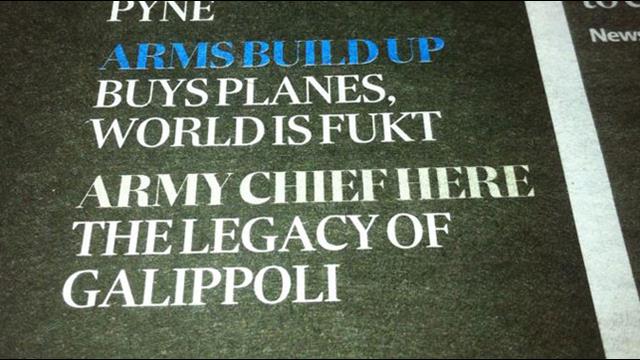
The financial newspaper which accidentally published a front-page headline reading “World is Fukt” apologised today to its readers for the error-ridden edition.
The respected Australian Financial Review, in a message from editor-in-chief Michael Stutchbury, said the mistake was due to a production and printing error.
“The Australian Financial Review apologises to Western Australian readers for the obviously unacceptable state of the newspaper’s front page on Thursday,” he said in an apology in Monday’s newspaper.
The accidental front page quickly found fans on Twitter, who approved of the headline which read in full: “Arms buildup – Buys planes, World is Fukt”.
They also enjoyed the fact that the headline for a story about a major budget speech by Treasurer Joe Hockey was empty of meaning, reading “Three lines to come here”.
H/T to my best source in Oz, Roger Henry.



Powered by WordPress