Quotulatiousness

November 2, 2019

When entertainment morphs into propaganda

Filed under: History, Media, Politics, USA — Tags: , , , , — Nicholas @ 05:00

One of the key elements aiding Hitler and the NSDAP to take power and stay in power in Germany in the 1930s was the constant, ongoing propaganda campaign orchestrated by Joseph Goebbels. Hitler and the Nazi party were lauded as the perfect Germanic solution to every problem and Jews, socialists, homosexuals, and other undesireable elements were belittled and used as targets of hate. A big part of Goebbels’ propaganda revolved around one idea, the “Big Lie”:
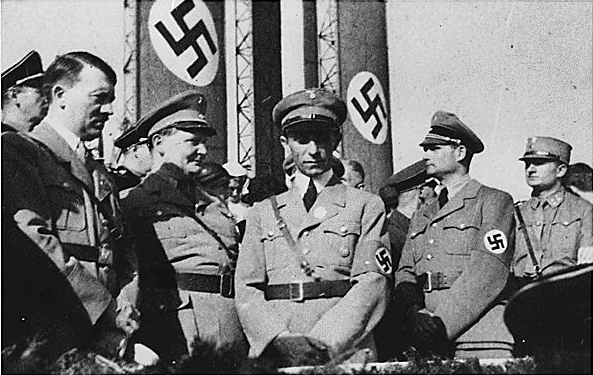
Hitler, Göring, Goebbels and Hess.
Photo via Wikimedia Commons.

If you tell a lie big enough and keep repeating it, people will eventually come to believe it. The lie can be maintained only for such time as the State can shield the people from the political, economic and/or military consequences of the lie. It thus becomes vitally important for the State to use all of its powers to repress dissent, for the truth is the mortal enemy of the lie, and thus by extension, the truth is the greatest enemy of the State.

By suppressing competing voices and having all the methods of reaching the people repeating the same story, the Nazis solidified their control on power in Germany that lasted until 1945, and was only demolished by massive military effort by the United States, the Soviet Union, and the British Commonwealth. Propaganda is a very powerful tool that works distressingly well to implant and nurture evil ideas in a subject population.

Modern propagandists in the west generally don’t have the power of the state aiding them, but if they get enough of the channels of communication — especially the entertainment channels — to co-ordinate the message, the effects can be very strong:

… I perfectly understand the legitimacy of feminist concerns regarding the portrayal of women in the media as consistently demure, retiring, and subservient to men. I grant that, in most of the action/adventure movies that I saw growing up, women would typically twist an ankle or get captured and then require rescuing by the swashbuckling male hero — and I realize how galling this must have been to generations of women. And therefore, a certain correction was undoubtedly in order. But what is problematic now is the Nietzschean quality of the reaction, by which I mean, the insistence that female power has to be asserted over and against males, that there is an either/or, zero-sum conflict between men and women. It is not enough, in a word, to show women as intelligent, savvy, and good; you have to portray men as stupid, witless, and irresponsible. That this savage contrast is having an effect especially on younger men is becoming increasingly apparent.

In the midst of a “you-go-girl” feminist culture, many boys and young men feel adrift, afraid that any expression of their own good qualities will be construed as aggressive or insensitive. If you want concrete proof of this, take a look at the statistics contrasting female and male success at the university level. And you can see the phenomenon in films such as Fight Club and The Intern. In the former, the Brad Pitt character turns to his friend and laments, “we’re thirty year old boys;” and in the latter, Robert De Niro’s classic male type tries to whip into shape a number of twenty-something male colleagues who are rumpled, unsure of themselves, without ambition — and of course under the dominance of an all conquering female.

It might be the case that, in regard to money, power, and honor, a zero-sum dynamic obtains, but it decidedly does not obtain in regard to real virtue. The truly courageous person is not threatened by another person’s courage; the truly temperate man is not intimidated by the temperance of someone else; the truly just person is not put off by the justice of a countryman; and authentic love positively rejoices in the love shown by another. And therefore, it should be altogether possible to hold up the virtue of a woman without denying virtue to a man. In point of fact, if we consult the “all conquering female” characters in films and TV, we see that they often exemplify the very worst of the traditional male qualities: aggression, suspicion, hyper-sensitivity, cruelty, etc. This is what happens when a Nietzschean framework has replaced a classical one.

My point is that it is altogether possible — and eminently desirable — to say “you go boy” with as much vigor as “you go girl.” And both the boys and the girls will be better for it.

November 1, 2019

“Unbreakable” – Guerrilla Warfare – Sabaton History 039 [Official]

Filed under: China, History, Media, Military, Russia, WW2 — Tags: , , , , , , — Nicholas @ 06:00

Sabaton History
Published 31 Oct 2019

The exact topic of Sabaton’s song “Unbreakable” will forever be a mystery. But we do know that it has to do with guerrilla warfare, which is what Indy will dive into in this episode.

Support Sabaton History on Patreon: https://www.patreon.com/sabatonhistory

Listen to The Art of War (where “Unbreakable” is featured):
CD: http://bit.ly/TheArtOfWarStore
Spotify: http://bit.ly/TheArtOfWarSpotify
Apple Music: http://bit.ly/TheArtOfWarAppleMusic
iTunes: http://bit.ly/TheArtOfWariTunes
Amazon: http://bit.ly/TheArtOfWarAmz
Google Play: http://bit.ly/TheArtOfWarGooglePlay

Listen to Sabaton on Spotify: http://smarturl.it/SabatonSpotify
Official Sabaton Merchandise Shop: http://bit.ly/SabatonOfficialShop

Hosted by: Indy Neidell
Written by: Indy Neidell, Spartacus Olsson and Markus Linke
Directed by: Astrid Deinhard and Wieke Kapteijns
Produced by: Pär Sundström, Astrid Deinhard and Spartacus Olsson
Creative Producer: Joram Appel
Executive Producers: Pär Sundström, Joakim Broden, Tomas Sunmo, Indy Neidell, Astrid Deinhard, and Spartacus Olsson
Post-Production Director: Wieke Kapteijns
Maps by: Eastory
Edited by: Iryna Dulka
Sound Editing by: Marek Kaminski

Eastory YouTube Channel: https://www.youtube.com/channel/UCEly…
Archive by: Reuters/Screenocean https://www.screenocean.com
Music by Sabaton.

Sources:
– RIA Novosti archive
– Colorization of Mao Zedong by Olga Shirnina a.k.a. Klimbim
– IWM: NA 15129
– Water splash sound effect – littlerobotsoundfactory

An OnLion Entertainment GmbH and Raging Beaver Publishing AB co-Production.

© Raging Beaver Publishing AB, 2019 – all rights reserved.

From the comments:

Sabaton History
2 days ago
There are many examples where guerrilla warfare was used in an attempt to force out or at least harass a foreign invader or domestic military power. Partisan movements are almost always connected to a certain ideology or party — after all, they rebel against a power they disagree with. We haven’t mentioned a lot of different movements and causes in this episode, not because we don’t value or support them or their cause, but because we have a limited amount of time to cover a general topic in. As Indy also states in the video, we have picked several examples to describe what guerrilla warfare was. Please share any additional groups or events that are relevant for this episode, but keep it civil and keep your political thoughts to yourself.
Cheers, The Sabaton History team

Why All Germans Were Nazis – How Hitler Created the Third Reich | BETWEEN 2 WARS I 1934 Part 1 of 4

TimeGhost History
Published 31 Oct 2019

After Hitler seized power in Germany in January 1933, he rapidly transformed the Democratic Weimar Republic into a repressive, totalitarian and racist state. In 1934, Germany became Nazi Germany.

Join us on Patreon: https://www.patreon.com/TimeGhostHistory

Subscribe to our World War Two series: https://www.youtube.com/c/worldwartwo…

Hosted by: Indy Neidell
Written by: Spartacus Olsson and Francis van Berkel
Directed by: Spartacus Olsson and Astrid Deinhard
Executive Producers: Bodo Rittenauer, Astrid Deinhard, Indy Neidell, Spartacus Olsson
Creative Producer: Joram Appel
Post-Production Director: Wieke Kapteijns
Research by: Francis van Berkel and Spartacus Olsson
Edited by: Wieke Kapteijns
Sound design: Marek Kamiński

Image sources: Bundesarchiv, Bundesarchiv, Bild 102-15282A / Georg Pahl, Heinz Bergschicker Deutsche Chronik 1933-1945 – Ein Zeitbild der faschistischen Diktatur

Icons from the Noun Project: Police by IconTrack, soldier by Simon Child, police man by Gregor Cresnar, hello by Universal Icons.

A TimeGhost chronological documentary produced by OnLion Entertainment GmbH.

From the comments:

Spartacus Olsson
2 hours ago
Now, this episode explains the measures that the Nazis used to gain control over the German people. It is not an attempt to justify, or be apologetic of the responsibility for the horrors committed during the Nazi regime. But it is also not a blanket condemnation of Germans. What happened in Germany starting in 1933 should serve us all as a warning to what can happen when you let loose authoritarian power, normalize lies as an acceptable part of political discourse, and make mainstream the disregard of basic human values. We should all think of that although the Nazis were especially efficient in their implementation of an authoritarian system, they are by far not the only ones that have succeeded in seducing whole a nation into blind hatred and acceptance of the suffering and death of others to forward an ideology. We should remember that freedom and democracy is essential, but also that words matters. The beginning of oppression starts with an endless stream of lies that confuse public discourse to the point that facts don’t matter anymore and truth becomes fiction. This video shows us what can happen next. Our mantra as a channel is to focus on the facts, not our opinions, not our ‘truth’ — just the facts m’am — and that is what we have presented here, for better or worse.

October 30, 2019

Shakespeare Summarized: Julius Caesar

Overly Sarcastic Productions
Published 1 Dec 2013

Here we go again! It’s only taken me several months…

Sarcastified Shakespeare returns, this time with a look at that historical tragedy we all love to write essays about, Julius Caesar!

I think the real main character here was Brutus’s crippling self-esteem issues…

October 27, 2019

QotD: Hating jazz

Filed under: Humour, Media, Quotations — Tags: , , , — Nicholas @ 01:00

“Jazz is for people who don’t like music,” says GQ‘s Deputy Editor; it must be fun to play, he says, because it sure ain’t fun to listen to. (“I remember this tune,” he’ll say, “which is more than the guy playing it does.”) It is, in the words of some forgotten Eighties comedian, six guys on stage playing different tunes. GQ even ran a joke about it a few years ago: “Q: Why do some people instantly hate jazz?” “A: It saves time in the long run.” Even my youngest daughter hated it at the time. Aged five, after being subjected to hours of Charlie Parker in the car one weekend, she said, “I don’t like this music. There are no songs for me to sing to.” (The only jazz tune she liked is “Everybody Want To Be A Cat” from Disney’s The Aristocats.) Unbeknown to her, she was echoing John Lennon’s little-known jibe: “Jazz never does anything.”

Some people’s innate hatred of jazz is simply the result of an unfortunate experience, but then anyone who’s witnessed Art Blakey performing a three-and-a-half hour drum solo is entitled to feel a little peeved (and I speak as someone who has seen one at close quarters). On top of this, some people just don’t get it. Like the later work of James Joyce, the films of Tarkovsky and “tax harmonisation”, the fact that some things will always lie just beyond the common understanding is something jazz enthusiasts must learn to live with.

Also, jazz has often been victim to the vagaries of fashion, destined to be revived at the most inappropriate moments. The last time jazz was really in the limelight was back in the mid-Eighties, when it became the soundtrack du jour in thousands of matt-black bachelor flats all over designer Britain and when every style magazine and beer ad seemed to look like a Blue Note album cover. Jazz went from being a visceral, corporeal music to a lifestyle soundtrack. This was the age of Style Council, of Absolute Beginners … of Sting. Buying into jazz was meant to lend your life a patina of exotic sophistication and was used to sell everything from Filofaxes and coffee machines to designer jeans and sports cars.

Dylan Jones, “The 100 best jazz albums you need in your collection”, GQ, 2019-08-25.

October 25, 2019

“Rorke’s Drift” – The Anglo-Zulu War – Sabaton History 038 [Official]

Filed under: Africa, Britain, History, Media, Military — Tags: , , , — Nicholas @ 06:00

Sabaton History
Published 24 Oct 2019

The Battle of Rorke’s Drift was the last stand for the British defenders, facing thousands of Zulu fighters with only a few hundred of their own.

Support Sabaton History on Patreon: https://www.patreon.com/sabatonhistory

Listen to The Last Stand where “Rorke’s Drift” is featured):

CD: http://bit.ly/TheLastStandStore
Spotify: http://bit.ly/TheLastStandSpotify
Apple Music: http://bit.ly/TheLastStandItunes
iTunes: http://bit.ly/TheLastStandItunes
Amazon: http://bit.ly/TheLastStandAmz
Google Play: http://bit.ly/TheLastStandGooglePlay

Watch the official lyric video of “Rorke’s Drift” here: https://www.youtube.com/watch?v=i9Bup…

Hosted by: Indy Neidell
Written by: Markus Linke and Indy Neidell
Directed by: Astrid Deinhard and Wieke Kapteijns
Produced by: Pär Sundström, Astrid Deinhard and Spartacus Olsson
Creative Producer: Joram Appel
Executive Producers: Pär Sundström, Joakim Broden, Tomas Sunmo, Indy Neidell, Astrid Deinhard, and Spartacus Olsson
Post-Production Director: Wieke Kapteijns
Maps by: Eastory
Edited by: Iryna Dulka
Sound Editing by: Marek Kaminski

Eastory YouTube Channel: https://www.youtube.com/channel/UCEly…
Archive by: Reuters/Screenocean https://www.screenocean.com
Music by Sabaton.

Sources:
– The National Archives UK
– A group of Zulu men in war dress, a photograph by Robert Harris. Credit: Wellcome Collection.
– Episodes in the Zulu wars, Credit: Wellcome Collection
– Field ambience by dobroide from freesound.org

An OnLion Entertainment GmbH and Raging Beaver Publishing AB co-Production.

© Raging Beaver Publishing AB, 2019 – all rights reserved.

From the comments:

Sabaton History
2 days ago (edited)
One nation’s heroic history is another’s national tragedy. In academia, the horrors of imperialism get more and more attention each year. In this episode, besides covering the events that unfolded during the Battle of Rorke’s Drift, we try to capture the ambiguous nature of colonial history. Yes, the last stand of the British soldiers against an overwhelming Zulu force is impressive, but whether or not it should be celebrated is open for debate. We would like to have this conversation in the comments down below, but keep it civil. Any racist, apologist or revisionist comments can lead to a ban.
Cheers, The Sabaton History Team.

October 24, 2019

QotD: “Binders full of women”

Filed under: Media, Politics, Quotations, USA — Tags: , , , , — Nicholas @ 01:00

Which brings me to another Mitt Romney debate comment that received similar mockery and self-flattering giggling. During the second presidential debate in 2012, Romney was asked about pay equity. In the course of his answer, he said:

    I had the chance to pull together a cabinet, and all the applicants seemed to be men … I went to a number of women’s groups and said, “Can you help us find folks?” and they brought us whole binders full of women.

Now, I’ll happily grant that the phrase “binders full of women” is an awkward one. It sounds like the menus they bring out on Jeffrey Epstein’s plane when Bill Clinton and Harvey Weinstein settle in for a weekend getaway.

But here’s the thing: What Romney did was exactly what feminist groups insist elected politicians should do. He saw that there were “too many” men in the applicant pool, so he reached out to some feminist groups and asked for help. Some feminist groups reached out to him — and he listened to them, too. And then he hired more women.

The monster!

Here’s Jon Stewart mocking him for it. Here’s Ronan Farrow. And here’s Bill Maher, a man who must be sweating like a hooker in church over Hollywood’s post-Weinstein zero-tolerance for piggishness toward women.

Jonah Goldberg, “Binders Full of Asininity”, National Review, 2017-10-13.

October 22, 2019

Shakespeare Summarized: Hamlet

Filed under: Humour, Media — Tags: , , , , , — Nicholas @ 02:00

Overly Sarcastic Productions
Published 13 April 2013

Well, this one is longer than the last one, but in fairness it’s 2000% shorter than the actual movie.

Continuing the trend, this video summarizes THE TRAGEDIE OF HAMLET PRINCE OF DENMARK, commonly known as Hamlet.

Goodness, he really is a whiner, isn’t he? And he’s supposed to be the sympathetic character!

Note: This is the second version of Hamlet Summarized, because I made the mistake of using a copyrighted song in the last one. Oops.

October 21, 2019

QotD: Poverty versus relative poverty

Filed under: Britain, Economics, Media, Quotations — Tags: , , , — Nicholas @ 01:00

A family-of-four who live on a council estate in Southampton were given a taste of a different life by swapping with a millionaire couple from Wiltshire for a week. The Leamon and the Fiddes families are participants in a new series of Channel 5’s Rich House, Poor House, which sees a family from the richest ten per cent of British society swap homes (and lives) with a family from the poorest ten per cent.

However, viewers took to Twitter to insist that Andy and Kim Leamon and their two children from Southampton who have £170 a week to spend on food, clothes and socialising after paying their mortgage and bills are certainly not struggling.

It’s not, by local standards, exactly great riches, to be sure. But that is £2,210 of disposable income per person per year. That’s on the fringes of the top 30% of all global incomes. 70% or so are poorer.

Note again, this is their disposable income, after housing, bills and taxes, the global income number is before all of that. Or, as we might also put it, this is unimaginable riches by global or historical standards.

Tim Worstall, “Well, yes, there’s a point here”, Tim Worstall, 2017-10-20.

October 20, 2019

The conspiracy theorists appear to have been right about this one – “Project Cactus”

Filed under: Cancon, Media, Politics — Tags: , , , — Nicholas @ 05:00

Maxime Bernier and the PPC would have had a tough time getting much attention in this election campaign anyway, but the Laurentian Elite were apparently scared enough to sponsor underhanded actions to keep him and his party out of the debates and on the defensive on social media:

Warren Kinsella’s Daisy Group consulting firm was behind a social media campaign to put the People’s Party of Canada on the defensive and keep leader Maxime Bernier out of the federal leaders’ debates, according to documents provided to CBC News.

The documents outline the work done by several employees of Daisy on behalf of an unnamed client. A source with knowledge of the project told CBC News that client was the Conservative Party of Canada.

The plan was first reported Friday night by the Globe and Mail.

According to a source with knowledge of the project, who spoke to CBC News on condition they not be named, the objective of the plan, dubbed “Project Cactus,” was to make the Conservative Party look more attractive to voters by highlighting PPC candidates’ and supporters’ xenophobic statements on social media.

The source added that Daisy employed four full-time staffers on Project Cactus at one time.

Kinsella is a lawyer, anti-racism activist and former Liberal strategist who has been a vocal critic of Liberal Leader Justin Trudeau.

[…]

In a statement to CBC News on Friday, the executive director of the PPC said “It hardly comes as a surprise that the Conservative Party of Canada would be behind such disgraceful and cowardly tactics.”

“As our Leader Maxime Bernier stated when he left the CPC and repeated on numerous occasions since then, they are ‘morally and intellectually corrupt.’ And today, this story proves it without a doubt,” Johanne Mennie said in an email.

October 19, 2019

Remy: Horrifying Tweets Resurface

Filed under: Humour, Media — Tags: , , , — Nicholas @ 04:00

ReasonTV
Published 17 Oct 2019

Remy returns to the news desk to bring you what passes for journalism these days.

Written and Performed by Remy.
Music tracks mastered by Ben Karlstrom.
Produced and Edited by Austin Bragg.

LYRICS:

Trudeau denies the report. Ed?
A rough week for Canada’s first black prime minister. Thanks, Tim.

A problem long posed, now finally an answer
A cure has been found to a rare form of cancer.
We’ll tell you who found it, what he thinks this means,
And dig up some tweets from his early teens.

Plus the Good Samaritan, whose quickness and breadth
Saved a family of four from a fiery death.
We’ll ask how he did it, how he made it in time,
And why he tweeted this back in 2009.

Uh, Ed? Yes, Tim. Forgive the defiance
But I think we should focus on the news part, the science
And not what they tweeted back when they were 10
The science, hmm. I’ll try it again.

Archaeologists have unearthed a series of tweets
Made by this local hero when he was 13.
Will this middle-school tweet soon mean his demise?
Our report might just win the Pulitzer Prize.

Pulitzer Prize? In what? Scrolling down?
We found immature things immature people wrote down.
Our country’s at war and that’s the story we sought?
War coverage, yes—I’ll give it a shot.

This Navy SEAL unit is now under fire
For a series of tweets, we’ll take our magnifier
And pay no attention to how their recent life’s been
And tell you what you should think that says about them.

Says about them? What’s it say about us?
That the first thing we do after someone’s discussed
Is comb through their childhood looking for dirt.
OK, I can do this, I assure you I’m cured.

Well she’s the first woman to serve on the board
Of our town’s city council—and she just signed an accord.
We’ll comb through the details of what she did write
And through years of her tweets in hopes of wrecking her life.

OK, see, I hate this, this is just what we do
Make things controversial for clicks and for views.
When we’re covering news, should our first thought each time
Be “Let’s find what they tweeted back when they were nine”?

Finally, millions can now walk thanks to his prosthesis
But a hateful hand signal when he was a fetus
Leads many to now question what he promotes.
We’ll toss him in a well and see if he floats.

QotD: Writing to length

Filed under: Education, Media, Quotations — Tags: , , — Nicholas @ 01:00

Having spent a good deal of my life writing short pieces on serious subjects for newspapers and magazines, I’ve learned from experience to write organically short – that is, to write a five-hundred-word draft of a five-hundred-word piece instead of writing a thousand-word draft and cutting it in half. Not only does this reduce waste motion, but the finished product is almost always better. When you write a long piece and chop it down to size, it tends to read … well, choppily.

So why do inexperienced authors write long? I suspect it’s because they assume that they’ll get only one chance to impress the editor, which causes them to empty their bag of tricks every time they write a piece. (This reminds me of another of my critical commandments: Don’t tell everything you know.) Flashiness is a sin of youth. The older and more self-assured a writer is, the more likely he is to appreciate the virtues of simplicity and economy.

I don’t know whether it’s possible to teach this lesson to young writers. The older I get, the more I wonder whether anything can be taught to anyone. Still, I did my best to get it across to my students, and I like to think that at least some of them were paying attention.

Terry Teachout, “To the point”, About Last Night, 2007-06-01.

October 18, 2019

“Angels Calling” – Trench Warfare – Sabaton History 037 [Official]

Filed under: History, Media, Military, WW1 — Tags: , , , — Nicholas @ 06:00

Sabaton History
Published 17 Oct 2019

Trench Warfare was the reality for countless soldiers fighting on the the fronts of World War One. It was a hell on earth. Soldiers had to endure mud, cold, stench of decaying bodies, endless artillery and gas barrages and enemy raiding parties. The Sabaton Song “Angels Calling” is about daily life on the frontlines of The Great War.

Support Sabaton History on Patreon: https://www.patreon.com/sabatonhistory

Listen to Attero Dominatus (where “Angels Calling” is featured):
CD: http://bit.ly/AtteroDominatusStore
Spotify: http://bit.ly/AtteroDominatusSpotify
Apple Music: http://bit.ly/AtteroDominatusAppleMusic
iTunes: http://bit.ly/AtteroDominatusiTunes
Amazon: http://bit.ly/AtteroDominatusAmzn
Google Play: http://bit.ly/AtteroDominatusGooglePlay

Check out the trailer for Sabaton’s new album The Great War right here: https://www.youtube.com/watch?v=HCZP1…

Listen to Sabaton on Spotify: http://smarturl.it/SabatonSpotify
Official Sabaton Merchandise Shop: http://bit.ly/SabatonOfficialShop

Hosted by: Indy Neidell
Written by: Markus Linke and Indy Neidell
Directed by: Astrid Deinhard and Wieke Kapteijns
Produced by: Pär Sundström, Astrid Deinhard and Spartacus Olsson
Creative Producer: Joram Appel
Executive Producers: Pär Sundström, Joakim Broden, Tomas Sunmo, Indy Neidell, Astrid Deinhard, and Spartacus Olsson
Post-Production Director: Wieke Kapteijns
Maps by: Eastory
Edited by: Iryna Dulka
Sound Editing by: Marek Kaminski

Eastory YouTube Channel: https://www.youtube.com/channel/UCEly…
Archive by: Reuters/Screenocean https://www.screenocean.com
Music by Sabaton.

Sources:
National Army Museum
National Library of Scotland
Bibliothèque nationale de France
Wellcome Images
Sleeping soldiers courtesy of FORTEPAN/Komlós Péter
Crosshair by DTDesign from the Noun Project
Colorized photos by Alexander Vedel Christensen
IWM: Q 69986, Q 45584, Q 6420, Q 6419, Q 33350, Q 745, Q 6421, Q 24579, Q 10685, Q 445, Q 32420, Q 517, Q 65065, Q 69983, Q 79501, Q 9333, E(AUS) 572, E(AUS) 1497, Q 6969

An OnLion Entertainment GmbH and Raging Beaver Publishing AB co-Production.

© Raging Beaver Publishing AB, 2019 – all rights reserved.

From the comments:

Sabaton History
2 days ago
What? The Sabaton History special editions of EVERY album? Nooo.. Really? Sounds awesome! And.. How can I get those? … As a reward for supporting Sabaton History on Patreon? Get out of here! .. Oh.. I should head over to https://www.patreon.com/sabatonhistory to check it out? Gotcha! Cheers!

October 15, 2019

QotD: Over-protected children become insecure adults

Kids need conflict, insult, exclusion – they need to experience these things thousands of times when they’re young in order to develop into psychologically mature adults. Every adult has to learn to handle these things and not get upset, especially by minor instances. But in the name of protecting our children we have deprived them of the unsupervised time they need to learn how to navigate conflict among themselves. That is one of the main reasons why kids and even college students today find words, ideas and social situations more intolerable than those same words, ideas and situations would have been for previous generations of students.

Jonathan Haidt, quoted by Naomi Firsht, “The Fragile Generation”, Spiked, 2017-08-31.

October 13, 2019

Sesame Street finally gets real

Filed under: Media, USA — Tags: , — Nicholas @ 05:00

I think we can all agree that the problem with children’s TV is that it’s not gritty and realistic enough for the children of today. Well, the situation is being addressed by those brave folks who produce Sesame Street:

Sesame Street has introduced Karli, a puppet whose mother is addicted to opioids. I applaud them. For too long, children’s shows have been bright, happy, colourful and filled with problems that can be easily resolved. It’s time we saw the alleys and overflowing gutters behind the buildings of Sesame Street — the suicides, prostitution and addictions that run rampant after the sun sets. It’s time children learned about real life. It’s time children learned about flesh-eating diseases, absent fathers, and the unforgiving cycle of life. That their heroes are frauds and everyone dies, including their favourite pets and all their hopes and dreams.

It’s time children learn why people are drawn to heroin in the first place. That life can be so crushing and hopeless that the only other answer is death. It is time children learn that although on the outside the heroin addict may look sick, miserable, terrifying and disgusting, inside they feel better than you will ever know. That the feeling is so good inside, the addict forgets about the vessel and the outer part of the body slowly begins to slip away. From the outside it is hard to watch a heroin addict slowly deteriorate, and even harder to imagine how someone could let themselves fall into that state. But inside they feel perfect. Religion, spirituality, and gurus have often spoken of finding inner peace and joy, and there is no peace within as perfect as the high of heroin.

It is a feeling so good it makes parents neglect their children, as in Karli’s case. A feeling so good the user forgets everything — everything bad, and everything good. It is better than the feeling of accomplishing goals, of success or love. It is perfect — that is until it fades away. So, you chase that perfect feeling for the rest of your life, getting close, but never quite attaining it again. You chase forward, day after day, as everything around you slowly slips away, your youth, your family, your hopes and your dreams.

« Newer PostsOlder Posts »

Powered by WordPress