
Margaret Thatcher had a great deal of time for Andrew Lloyd Webber. In August 1978, while she was still Leader of the Opposition, her speechwriter Ronnie Millar took her to see Evita. “It was a strangely wondrous evening yesterday leaving so much to think about,” she wrote to Millar the next day. “I still find myself rather disturbed by it. But if they [the Peronists] can do that without any ideals, then if we apply the same perfection and creativeness to our message, we should provide quite good historic material for an opera called Margaret in thirty years’ time!”
Dominic Sandbrook, The Great British Dream Factory, 2015.
July 29, 2021
QotD: An opera called Margaret
Comments Off on QotD: An opera called Margaret
July 27, 2021
Kurt Schlicter on the gimps of the White House press corps
At TownHall, Kurt Schlicter expresses his disregard for the media who are supposed to be covering the White House and are voluntarily muzzling themselves and acting more like the ministry of propaganda than the free press. At least in Canada, they have the excuse that they’re paid prostitutes for whatever their federal pimps want them to say … in the United States that’s not (yet) the case:
You gotta love the lib reporters meekly accepting the delicious iron discipline of black-clad Mistress Psaki as she demands “Why do you need to have that information?” when asked about the number of infectos in the petri dish that is the * White House. The only way that kink-fest could have been more on the nose with regard to who our esteemed journalismers actually are is if her severe black outfit was vinyl. Apparently, getting flogged by the Democrat dominatrix turns their collective crank because they just took it. They always just take it. And our Fourth Estate will eagerly beg for more.
Now, it’s not even the gross double standard at play here that’s significant – imagine the fussy fury of the lib-simps if one of Trump’s vanilla spokespeople publicly abused them like that. We’ve learned that the lib-press is immune to shame, at least the kind that comes from having their rank hypocrisy exposed by conservatives. No, it’s that when their Dem domme cracks the whip, they just take it, meekly, obediently, like the groveling submissives they are.
Someday, someone will look back on this pathetic abdication of the media’s dignity and write a history of how the ink-stained wretches of the past became the craven conformists of today, and how now they revel in their own subjugation. Call it 50 Shades of the Gray Lady; when you read the hot scene in the forbidden White House press playroom at page 247, you’ll want to draw a warm bubble bath, light a lavender-scented candle, and pour yourself a goblet of Trader Joe’s screw-top chardonnay. Grrrrrrrr.
Imagine being these people. You can’t? Okay, then take a shot of Dickel Rye and try again to imagine being these people. They all grew up wanting to be the crusading Woodward and/or Bernstein – who themselves were less ace reporters than eager conduits for a disgruntled bureaucrat hack who exploited the callow correspondents to settle his personal scores – and instead they grew up to be the Gimp in the less interesting version of Pulp Fiction that is the DC milieu.
They aren’t breaking stories. They aren’t uncovering wrongdoing. They certainly are not comforting the afflicted or afflicting the comfortable. They are the ruling caste’s janitors. They are drones, thralls to their elite masters, marching in grim conformity in step to the official narrative, never complaining, never questioning, never dissenting. These are licensed, registered, regime journalists.
Comments Off on Kurt Schlicter on the gimps of the White House press corps
QotD: Walter Duranty’s Pulitzer
He won the Pulitzer Prize in 1934 for his reporting, but ever since 1990, when a biography of him was published that emphasized the extent of his mendacity, there have been efforts to have the prize symbolically rescinded (Duranty died in 1957).
A man may be honestly mistaken, but Duranty had knowingly and persistently lied about matters of world importance. At the very least he deserved the sack rather than a prestigious award, but was never called to account during his lifetime; and the Pulitzer committee has twice decided that the award should not be withdrawn.
I can see the argument for rescinding the prize because Duranty’s conduct was truly despicable, and the prize had been for what, morally, was a great crime.
But there is also an argument for not rescinding it, for the posthumous withdrawal of an award can look like an attempt to rewrite the history of the awarding authority by an act of auto-absolution. An admission that the Pulitzer committee had made a terrible error of judgment might have been sufficient.
Theodore Dalrymple, “Richard Dawkins Punished for Inviting Us to Think”, The Iconoclast, 2021-04-24.
Comments Off on QotD: Walter Duranty’s Pulitzer
July 25, 2021
QotD: The Two Rules of Modern Journalism
RULE # 2: Rule # 1 only applies to Republicans.
(And to anybody leaning conservative.)
For Democrats and leftists, the typical query is more along the lines of “pray enlighten us to your glorious plans for fundamentally transforming the United States of America (we will be quiet now).” (Close second: “kindly tell us how much people have suffered, and are still suffering, in this dreadful country of ours.”)
Erik, “The Two Rules of Modern Journalism”, ¡No Pasarán!, 2021-04-16.
Comments Off on QotD: The Two Rules of Modern Journalism
July 24, 2021
Boris Johnson as a character-brought-to-life from Evelyn Waugh’s Scoop
In The Critic, Robert Hutton explains why so many members of the British press find Waugh’s satire of their trade so compelling:

Boris Johnson, Secretary of State for Foreign and Commonwealth Affairs at an informal meeting of the Foreign Affairs Council on 15 February 2018.
Photo by Velislav Nikolov via Wikimedia Commons.
For a British reporter, Scoop is the holy text of the job. One of the enduring mysteries of journalism is that a trade which employs large numbers of skilled writers, and puts them into interesting situations every day, has been the subject of so few really good novels. Scoop was written as satire, but eight decades after it was published, and after the industry has gone through two technological revolutions, it remains the best description of UK journalistic life.
While parts of the job have changed — copy is no longer filed in an abbreviated telegramese to reduce transmission costs — much remains the same. Anxious newspaper executives still live in terror of capricious proprietors. Reporters still enjoy a strange fellowship of simultaneous competition and cooperation. Entertaining readers remains as important as informing them.
So how does the current British PM fit into all of this? Well, Boris had been a journalist:
Which brings us to Boris Johnson. As well as being Britain’s most successful politician, the prime minister has long been one of the country’s highest-paid journalists, a job he did entirely in the Scoop mould. His sympathetic biographer, Andrew Gimson, describes how, posted to Brussels, Johnson delighted in producing stories that were more entertaining than accurate. It was not that he was opposed to writing accurate stories, but he didn’t see it as in any way essential.
The Scoop character Johnson most resembles isn’t the hero — Boot is too naïve, his reports too close to reality. Nor is the press corps regulars, Corker, Shumble, Whelper and Pigge, who huddle in the same hotel, lest they will be beaten on a story. Johnson, both as journalist and politician, has generally preferred to hunt alone. We must look to the man Boot replaced at the Beast, foreign correspondent Sir Jocelyn Hitchcock.
Like Johnson, who was hazy on the outcome of the Battle of Stalingrad, Sir Jocelyn is more confident than he should be about history (“He was wrong about the Battle of Hastings,” says Lord Copper. “It was 1066. I looked it up”). He hides in his hotel room before filing an entirely imaginary interview — something else for which Johnson has form. Sir Jocelyn was, pleasingly, modelled on Sir Percival Phillips, a correspondent for the Daily Telegraph, which would later employ Johnson.
Sir Jocelyn’s fabrications didn’t hold him back, and Johnson’s propelled him to the front rank of journalism, then into politics, where he exhibits the same behaviour: the pursuit of a higher “truth” unburdened by facts, the deadline mentality, the reluctance to correct mistakes, the assumption that someone else should pick up the bill. Johnson was neither the kind of journalist nor a prime minister who would read a study on, say, pandemic preparedness. A leaked document from his first months in the job showed him describing Cameron as a “girly swot” for wanting to show that MPs were hard at work.
Comments Off on Boris Johnson as a character-brought-to-life from Evelyn Waugh’s Scoop
July 23, 2021
Panic is infectious, and the dying media are a primary vector
In City Journal, John Tierney looks at the two lethal waves of contagion the world has suffered since 2019, the Wuhan Coronavirus itself and the media-driven panic that almost certainly resulted in far more deaths than the disease that triggered it:

Wuhan Institute of Virology.
Wikimedia Commons.
Instead of keeping calm and carrying on, the American elite flouted the norms of governance, journalism, academic freedom — and, worst of all, science. They misled the public about the origins of the virus and the true risk that it posed. Ignoring their own carefully prepared plans for a pandemic, they claimed unprecedented powers to impose untested strategies, with terrible collateral damage. As evidence of their mistakes mounted, they stifled debate by vilifying dissenters, censoring criticism, and suppressing scientific research.
If, as seems increasingly plausible, the coronavirus that causes Covid-19 leaked out of a laboratory in Wuhan, it is the costliest blunder ever committed by scientists. Whatever the pandemic’s origin, the response to it is the worst mistake in the history of the public-health profession. We still have no convincing evidence that the lockdowns saved lives, but lots of evidence that they have already cost lives and will prove deadlier in the long run than the virus itself.
One in three people worldwide lost a job or a business during the lockdowns, and half saw their earnings drop, according to a Gallup poll. Children, never at risk from the virus, in many places essentially lost a year of school. The economic and health consequences were felt most acutely among the less affluent in America and in the rest of the world, where the World Bank estimates that more than 100 million have been pushed into extreme poverty.
The leaders responsible for these disasters continue to pretend that their policies worked and assume that they can keep fooling the public. They’ve promised to deploy these strategies again in the future, and they might even succeed in doing so — unless we begin to understand what went wrong.
The panic was started, as usual, by journalists. As the virus spread early last year, they highlighted the most alarming statistics and the scariest images: the estimates of a fatality rate ten to 50 times higher than the flu, the chaotic scenes at hospitals in Italy and New York City, the predictions that national health-care systems were about to collapse. The full-scale panic was set off by the release in March 2020 of a computer model at the Imperial College in London, which projected that — unless drastic measures were taken — intensive-care units would have 30 Covid patients for every available bed and that America would see 2.2 million deaths by the end of the summer. The British researchers announced that the “only viable strategy” was to impose draconian restrictions on businesses, schools, and social gatherings until a vaccine arrived.
This extraordinary project was swiftly declared the “consensus” among public-health officials, politicians, journalists, and academics. Anthony Fauci, director of the National Institute of Allergy and Infectious Diseases, endorsed it and became the unassailable authority for those purporting to “follow the science”. What had originally been a limited lockdown — “15 days to slow the spread” — became long-term policy across much of the United States and the world. A few scientists and public-health experts objected, noting that an extended lockdown was a novel strategy of unknown effectiveness that had been rejected in previous plans for a pandemic. It was a dangerous experiment being conducted without knowing the answer to the most basic question: Just how lethal is this virus?
The most prominent early critic was John Ioannidis, an epidemiologist at Stanford, who published an essay for STAT headlined “A Fiasco in the Making? As the Coronavirus Pandemic Takes Hold, We Are Making Decisions Without Reliable Data.” While a short-term lockdown made sense, he argued, an extended lockdown could prove worse than the disease, and scientists needed to do more intensive testing to determine the risk. The article offered common-sense advice from one of the world’s most frequently cited authorities on the credibility of medical research, but it provoked a furious backlash on Twitter from scientists and journalists.
Comments Off on Panic is infectious, and the dying media are a primary vector
July 22, 2021
Conservative cancel culture?
Kurt Schlichter addresses the notion that “cancel culture” is alive and well among conservatives as much as it is among progressives:

“A little Black Rifle Coffee pour over this morning.” by jonmrogers is licensed under CC BY 2.0

Is there a conservative cancel culture? No. What there is now is a consensus among conservatives that we will refuse to subsidize institutions and entities that hate us. “Cancel culture,” properly understood – in this time of words meaning whatever they need to mean at any given moment, I’m going to have to insist on fixed definitions – is the attempt to use formal and informal sanctions to stop people from expressing dissenting views. But conservatives don’t care what the conservatives who cry about it when they are caught shafting us – hi Kristi! – think; conservatives care about what these people do or don’t do. Labeling our rejection of squishes and RINOs as “cancel culture” is a cheesy attempt to stop us from insisting that conservatives actually conserve. If the left, and the GOPuffballs, want to call this act of self-preservation “cancel culture” and shame us into unilateral disarmament in the name of some sort of pseudo-consistency, let them try. We’re not tying ourselves up with alleged “principles” anymore; ideological bondage is not our scene.
[…]
There was a certain coffee company created by vets that embraced a kind of vet-bro/gun vibe and it worked hard to cultivate a following in the conservative community. And then they stamped their combat boots hard on their own tender beans. Black Rifle Coffee Company’s problem provides an important lesson not just for companies seeking to operate on the conservative tip, but for GOP politicians as well.
What happened? BRCC gave an interview to The New York Times that many cons saw as taking sides against us conservatives. Did it or didn’t it take sides against us? The company denies it and is trying to repair the damage, but the facts of the case are not the point we are discussing here – the point is how conservatives, the cheated-on wives of American politics, reacted when they felt, rightly or wrongly, betrayed.
The conservatives went nuclear. Here’s the thing a lot of people seem to not understand. No faction has been screwed over by its own side more than conservatives. How many politicians, when they had the power to do the conservative things they ran on, opted for favorable WaPo coverage over keeping their promises? The incentives to cooperate are huge … like coverage in the DC paper of record explaining how one has “grown”. But we’re done with the bait-and-switch. We’re super-sensitive and super-suspicious, because we’ve been burned before.
So, conservatives have a hair trigger for perceived betrayal – if they even suspect it, they go off. Those seeking our support should act accordingly, as cons have been serially betrayed for decades. Take W, please, back to his ranch to paint his paintings. But before you do, remember what he did to all of us who defended him when he refused to defend himself – he talked smack about us as he partied with his new pals the Clintons and Obamas.
The Ahoy Crew used to at least pretend to be with us – Cap’n Bill Kristol, David Aptly-Named French, Jonah Heavy G Goldberg, and the rest turned on us the second they perceived their sinecures were in peril due to our swelling demand for actual victory.
Them or us. Pick one. But you can’t choose both, or neither.
Update: The CEO of the company is either in desperate damage control mode or genuinely upset at the misrepresentation of his views by the New York Times:
Let’s get the air cleared right away. Black Rifle Coffee’s founder and CEO has spoken out and is disputing how his comments were presented by the New York Times and represented by those reacting to the article, who were led to believe that Black Rifle Coffee bashed conservatives.
Evan Hafer decided to set the record straight regarding the “significant amount of misinformation being put out on the internet” about Black Rifle Coffee and about statements that he has made.
Hafer quickly debunked the notion that he made derogatory remarks about BRCC’s customers or conservatives and then proceeded to explain how the New York Times deliberately twisted his words and took them out of context. According to Hafer, his conversation with the NYT Magazine reporter was in the context of racism and anti-Semitism in America in light of Hafer being the target of an organized attack last year because of “my last name and my heritage.”
“We were purely discussing that,” Hafer says, and he was not conflating those groups with conservatives.
“The New York Times, as we know, the chances of them being objective were fairly slim, but we gave them the opportunity,” he added. He went on to mention veterans issues he hoped to bring attention to. But, unfortunately, the New York Times chose to go with “the salacious headline” about the company instead.
Hafer reiterated that racists and anti-Semites have no place in his company.
Comments Off on Conservative cancel culture?
July 20, 2021
Kurt Westergaard, RIP
Mark Steyn on the life and work of cartoonist Kurt Westergaard:
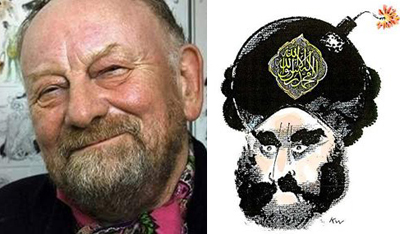
Kurt Westergaard and I were successive winners of the Danish Free Press Society’s Sappho Award. I was very flattered to find myself in his company, but couldn’t honestly say I deserved to be. Kurt was one of the bravest men of our time – not because he was inclined to bravery, but simply because, when it was required, he met the challenge and never backed down.
Sixteen years ago Flemming Rose of the Danish newspaper Jyllands-Posten decided to conduct a thought experiment in public after an author casually revealed that he couldn’t find any Danish artist willing to illustrate his book about “the Prophet Mohammed” (as the BBC now routinely styles him). So Flemming called twelve cartoonists and invited them to depict the late Prophet. Kurt Westergaard’s cartoon was the memorable one, and the one you recall as the years roll by. It was a pithy visual jest: Mohammed’s turban as a bomb with a lit fuse. See picture at top right.
“I attempted to show that terrorists get their spiritual ammunition from parts of Islam, and with this spiritual ammunition, and with dynamite and other explosives, they kill people,” Kurt told my old newspaper The National Post a few years back. “I showed this in a cartoon and what happened? They want to kill me, so I think I was right.”
An otherwise courtly, cultured Dane, Kurt Westergaard had a somewhat arresting dress code, preferring le rouge et le noir, the colors of anarchists, although, as a practical matter, it’s hard for a man of advanced years to carry off red trousers, whatever his motivation. He would qualify his pantaloons by explaining that he was not a political anarchist but a cultural one. Still, one can gather from the garb alone that Westergaard was no “right-winger”. Like most of the men and women I have shared a stage with in Europe this century, he was an old Sixties radical sufficiently principled to think the same kind of jokes he’d applied to church, monarchy, parliament and every other societal institution should also be applied to Islam. He never wanted to be a “free speech hero”, but gamely bore the burthen once it had been dropped on him. He certainly never wanted to be world-famous, albeit more so in Mogadishu than Manhattan and Lahore than Los Angeles. It cost him a comfortable retirement, weakened his health, and an ever more craven culture denied him the consolations of monetary exploitation. When I expressed sympathy, he laughed and said he’d do the same cartoon all over again even knowing what he was in for.
The blood lust began with a trio of imams on the make shopping the twelve cartoons (plus three cruder fakes) round the Muslim world, and leaving it to the usual Islamonutters to take it from there: In nothing flat, over two hundred people were dead – which meant that CNN & Co were obliged to cover the story. They did so by modifying Westergaard’s cartoon, with Mohammed’s face pixilated, as if he’d entered the witness protection programme. If only. In reality, it was that dwindling band of people who believe in free speech – and, indeed, free speech itself – that found itself in the witness protection programme.
Comments Off on Kurt Westergaard, RIP
Does Facebook have a war on history?
Study of Antiquity and the Middle Ages
Published 19 Jul 2021Does Facebook have a war on history? The answer is a simple no but the story is complicated.
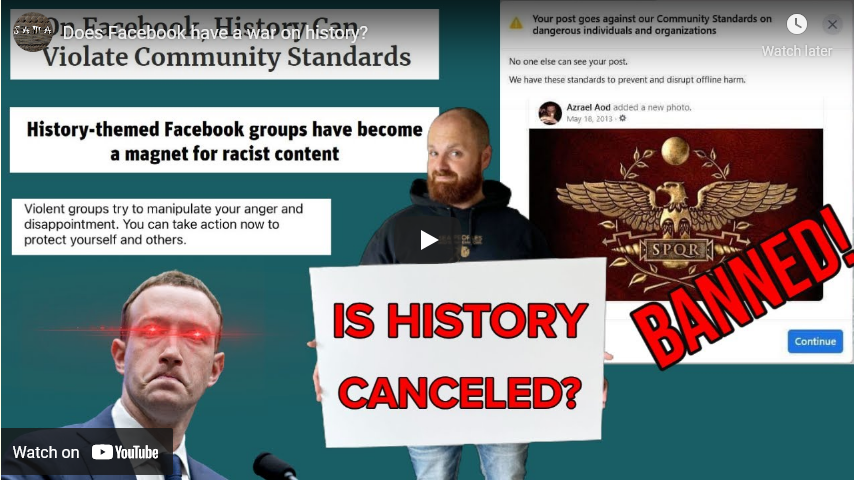
In this episode I am joined by author and reporter Peter Suciu on his article “On Facebook, History Can Violate Community Standards”.
To quote the article * One thing that is often taught to students of history is that “history” didn’t happen. Events happened in the past, but history is just our way of chronicling those events. There is also a saying that history is written by the winners, but that too isn’t entirely accurate – if history were only written by the winners we’d never hear of the setbacks, mistakes made by generals or losses incurred by said winners. History, to put it bluntly, is written by historians and those with knowledge of past events.
On Facebook it now seems that merely writing about – and then sharing those writings – could violate community standards. Even in this era of “fake news” it isn’t so easy to understand why the social network has taken this stance – end quote.
Recently an incident on Facebook lead me to create this video … while scrolling through my Roman themed history groups I noticed a post by a member showing that their history post had been taken down by Facebook for violating community standards. The post was a picture of the Roman Eagle with SPQR under its feet. This particular illustration was actually from the Rome Total War Gaming Franchise and that lead me to wonder more about how and why Facebook targets certain posts?
Is there confusion among Facebook employees and its algorithms involving not just Ancient History but specifically Roman History?
Why are Third Reich posts and photos censored? And why are they censored even if there are no violent images or symbols of hate shown?
Why are militaria groups coming under fire for trading, buying and selling Third Reich memorabilia when other memorabilia such as relating to the USSR or the CCP are deemed acceptable?
Why is Facebook warning me that the history groups I’m in may be exposing me to extremist content?
These are questions that I pondered while making this episode and so I hosted a fellow history buff and militaria collector on whether or not history can violate Facebooks Community Standards?
Support our great guest at all these links below!
On Facebook, History Can Violate Community Standards
https://www.forbes.com/sites/petersuc…Twitter: https://twitter.com/PeterSuciu
Forbes: https://www.forbes.com/sites/petersuc…
National Interest: https://nationalinterest.org/profile/…
His awesome history store: https://www.plundererpete.com/
Reference Links Below!
Facebook warns users they may have been exposed to ‘harmful’ extremists.
https://www.foxnews.com/media/faceboo…Facebook bans historical St. Augustine groups, pages: Is the word ‘militia’ to blame?
https://www.firstcoastnews.com/articl…History-themed Facebook groups have become a magnet for racist content.
https://www.newstatesman.com/science-…An article involving Channel host Nick Barksdale and Facebook.
https://news.law.fordham.edu/blog/202…Inside “Facebook Jail”: The Secret Rules That Put Users in the Doghouse.
https://www.wsj.com/articles/inside-f…
Comments Off on Does Facebook have a war on history?
July 18, 2021
“Yes, we know Facebook is not the only harmful corporation on Earth, but sweet-jeepers-boy-howdy it is a blood-curdling fart in the elevator of existence”
At Damn Interesting, Alan Bellows bids an unfond farewell to Facebook:
For the past few years, we at Damn Interesting have been hearing from scores of long-time fans who were under the mistaken impression that we had ceased all operations years ago. These fans are typically delighted to hear that a) we are still writing and podcasting; and b) there is a wealth of new content since they last visited. When we ask them what caused the assumption of our demise, they invariably cite the fact that our posts disappeared from their Facebook news feeds.
I never had anything like the number of contacts on Facebook that Damn Interesting had, but I had the same experience with people contacting me to ask if I’d given up blogging because none of my posts were showing up in their timelines any more. As more information came out about just how creepy Facebook’s activities are, I stopped even trying to share to that site and eventually stopped linking to any content hosted there. For video credits where the only link for a creator is their FB page, I choose not to make it an active link (although I don’t remove the text). The only use I had after that was for keeping in touch with a few family members who only use that platform, and even that went away after I got locked out of my personal account anyway.
This trend roughly coincides with Facebook’s introduction of “boosting” for pages; in this new model, according to the stats we can see, Facebook stopped showing our posts to approximately 94% of our followers, demanding a fee to “boost” each post into an ad, which would make it visible to more of our audience. We lost contact with tens of thousands of fans practically overnight. We don’t mind paying for a service if it is valuable, but we absolutely don’t want to reach our audience by buying ad space on Facebook. Yuck. But no other option is given to reach the many people who previously followed our posts, and who presumably want to continue to do so.
[…] In a move that feels long overdue, we at Damn Interesting are abandoning all interactions and connections with Facebook.
We really should have done this back when it was revealed that Facebook used the ubiquitous embedded “Like on Facebook” buttons to follow people’s movements around the web without their knowledge or consent.
This bit of belated information prompted me to check the settings on the Share This plug-in I’ve been using for several years and yes, all this time I’ve been inadvertently enabling FB to track anyone on my blog who uses that button (and possibly any other sharing button — that isn’t quite clear). I’ve eliminated that plug-in just in case.
Our reasons for leaving are not entirely abstract. We’re sure many of you, like us, have experienced first-hand how Facebook gives people license to be their worst selves. It can elevate mere differences of political opinion into anger and hostility, pushing friends and family into extreme views, turning loved ones into ugly caricatures of their former selves. Perhaps you have even regretted some of your own posts there; the Facebook interface is designed to make it difficult to engage in good-faith disagreements. It gives undeserved forum to misinformation, disinformation, and hate. Using Facebook has been scientifically demonstrated to cause depression. Facebook subtracts from the quality of the world at a magnitude seldom seen in history, and we’ll all be better off when it goes away.
H/T to Robert Swanson (@WWI) on Gab for the link.
Comments Off on “Yes, we know Facebook is not the only harmful corporation on Earth, but sweet-jeepers-boy-howdy it is a blood-curdling fart in the elevator of existence”
July 17, 2021
“Now I am become Twitter, the destroyer of worlds”
In UnHerd, Douglas Murray remembers what it was like before Twitter ruined everything:
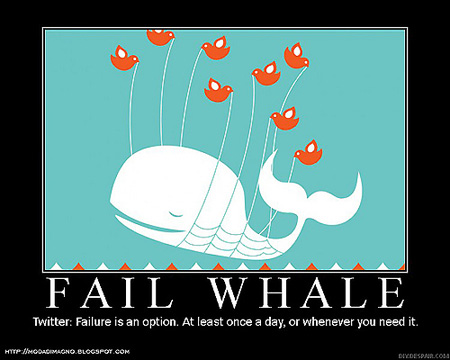
Fifteen years ago today, an innovation was unveiled that has probably changed our lives as much as any other this century. It was on 15 July 2006 that software developer Jack Dorsey and his team launched an online platform where text messages of 140 characters could be shared in a group; six days later Dorsey sent his first tweet, launching a new age of reasoned debate and engagement.
There are some who want to celebrate today — principally Dorsey, along with the small number of other people who have become unimaginably rich off the platform. But for everybody else on the planet, I suspect we should welcome the anniversary with roughly the same enthusiasm that we would the emergence of the Ebola virus. For the further away we have come from Twitter’s birth, the clearer it has become that the platform is a source of unimaginable harm to almost every aspect of society.
In the early days, it didn’t feel like this. Like Facebook, Amazon, Google and the other Big Tech monoliths, it all started out so well. Twitter was actually fun back then. People said whacky things. There were cat videos. There was Follow Friday and friendships were made. As professional and amateur newshounds took to the platform, it became the fastest way to learn about any developing story.
If something was going on, Twitter was there first, certainly ahead of the BBC or any of the other news establishments who had to lumber through the old legal and editorial hurdles, rather than enjoying the lightning-quick response time of social media. Politics is a drug, and the most successful drugs provide an instant hit. But they are also the most dangerous, and the downsides soon started to assert themselves.
Soon many started using the site in a game of competitive grievance, or competitive sanctimony. They took obvious glee in targeting victims who had transgressed some moral code; the obvious righteousness of these online crusaders meant they rarely recognised themselves as the aggressors or bullies.
And soon it became apparent that, while everyone was on the site, everyone also hated it. Those on the ideological Left began to turn against the platform when it became clear that it allowed their opponents on the Right to spread “hate”, a scourge which they defined generously. Just as they used it themselves to spread their message.
This all reached its nadir with Donald Trump, whose presidency is to many people the most concrete result of Twitter. The world watched aghast as Trump was able to say often the craziest of things to millions upon millions of followers, speaking unfiltered and directly — in a way the old news media would never have allowed. When he won the presidency and then thanked Twitter for the helping him to get it, many of these natural Twitter followers lost their faith in the platform. How could they have let it happen? It was their platform, after all, this noisy minority of the American and British electorate. Indeed, if you had read UK Twitter ahead of the 2019 election, you would have been absolute certain of a Jeremy Corbyn landslide. Where were these millions of Tory voters who didn’t like Jeremy?
Comments Off on “Now I am become Twitter, the destroyer of worlds”
July 16, 2021
Do US intelligence agencies only work on domestic surveillance these days?
Matt Taibbi discusses the (recent?) US intelligence agencies’ apparent concentration on domestic “enemies” like Republicans, Jewish organizations, conservative broadcasters, and US Presidents and their appointed officials:

The scene was perfectly representative of what the erstwhile “liberal” press has become: collections of current and former enforcement types, masquerading as journalists, engaged in patriotic denunciations of critics and rote recitals of quasi-official statements.
Not that it matters to [Fox TV host Tucker] Carlson’s critics, but odds favor the NSA scandal being true. An extraordinarily rich recent history of illegal, politically-directed leaks has gone mostly uncovered, in another glaring recent press failure that itself is part of this story.
It’s admitted. Go back to December, 2015, and you’ll find a Wall Street Journal story by Adam Entous and Danny Yadron quoting senior government officials copping to the fact that the Obama White House reviewed intercepts of conversations between “U.S lawmakers and American-Jewish groups.”
The White House in that case was anxious to know what congressional opponents to Obama’s Iran deal were thinking, and peeked in the electronic cookie jar to get an advance preview at such “incidentally” collected info. This prompted what one official called an “Oh, shit” moment, when they realized that what they’d done might result in “the executive branch being accused of spying.”
After Obama left office, illegal leaks of classified intercepts became commonplace. Many, including the famed January, 2017 leak of conversations between Michael Flynn and Russian ambassador Sergei Kislyak, were key elements of major, news-cycle-dominating bombshells. Others, like “Russian ambassador told Moscow that Kushner wanted secret communications channel with Kremlin,” or news that former National Security Adviser Susan Rice unmasked the identities of senior Trump officials in foreign intercepts, were openly violative of the prohibition against disclosing the existence of such surveillance, let alone the contents.
These leaks tended to go to the same small coterie of reporters at outlets like the Washington Post, New York Times, and CNN, and not one prompted blowback. This was a major forgotten element of the Reality Winner story. Winner, a relatively low-level contractor acting on her own, was caught, charged, and jailed with extraordinary speed after leaking an NSA document about Russian interference to the Intercept. But these dozens of similar violations by senior intelligence officials, mainly in leaks about Trump, went not just unpunished but un-investigated. As Winner’s lawyer, Titus Nichols, told me years ago, his client’s case was “about low-hanging fruit.”
Comments Off on Do US intelligence agencies only work on domestic surveillance these days?
July 15, 2021
Goodbye Lenin, Hello Jazz! | B2W:ZEITGEIST! I E.22 Winter 1924
TimeGhost History
Published 14 Jul 2021The winter of 1924 sees the death of not only Vladimir Lenin but also the Ottoman Caliphate. However, it also sees something fresh and completely unique enter the American mainstream. George Gershwin has given the Jazz Age a soundtrack.
(more…)
Comments Off on Goodbye Lenin, Hello Jazz! | B2W:ZEITGEIST! I E.22 Winter 1924
July 14, 2021
QotD: The unlikely hermaphrodites in The Left Hand of Darkness
Let me start by saying that I LIKED the book. Loved it even. Mostly because it was different and it made me think. (Like other books of the time, it didn’t age well, mostly on language, but also structure, which I guess was innovative and daring at the time, but strikes me as “too early seventies” for words. Now this might be JUST ME but there’s a whole batch of books — one Heinlein — I can’t stand to re-read. I came of age in the seventies and eventually grew to loathe that false-craft feel of art at that time. No one else is forced to agree with me.)
But part of what made me think — because my relaxing reads are books on evolution and animals and their biology and behavior (guys, I read Konrad Lorenz for fun) is that the left (and at the time anyone with even vague intellectual pretensions was at the very least soft left, because the zeitgeist was) was very funny about humans.
They often opened their books on humans by gesticulating broadly at imaginary religious fanatics and rubbing said fanatics’ noses in the fact that “we are animals. No, we’re really animals.” And then proceeded to go a little bananas, sometimes in supposed non-fiction, like Desmond Morris in The Naked Ape, which assured us only humans killed their own species, or something equally ridiculous (I read it at around 14 or 15, I just remember his thesis that humans were uniquely vile made me snort-giggle at the time. Because, you know, you can sustain that if you’re religious, and say humans should aspire to the divine image, but if we’re really just animals, there is NO vile. We do what instinct and nature tell us, no judgement, right?)
But mostly this dysfunction showed in science fiction, particularly at the time. “We’re just animals. If we just changed/removed/tweaked x y z we’d be communitarian, sharing, no war animals.”
The way hermaphrodites behave in TLHOD made me snort/giggle too for various reasons, the first being that hermaphrodite species on Earth (granted mostly very small) have some of the most violent mating behaviors in the world. Makes sense since at least in live-bearing, or for that matter those who care for eggs, species, the cost falls on the one who carries young or sits on eggs. The other one just goes off, whistling his merry way and lives to mate another day. So in a species where either of the couple can bear, there would be a “war” (There are several books on war of the sexes in various species, which has led to things like praying mantises and duck penises.) to determine who bears. And yes, she did get right that in an intelligent species, value would have to be put on children-of-the-body or no one would want to do it. (Or most children would be conceived by rape. Which to be fair, is most hermaphrodite species on Earth.)
What she got wrong, related to that, is then having the kids raised in some sort of hippie dippie commune.
In fact, the whole setup makes perfect sense as a professional woman’s fantasy. “I want to have kids, but someone else raises them, and it will be the perfect communitarian family and no one will think it’s bad if I’m not there, or take no more interest in them than in any of the family kids.”
In point of fact, from evolutionary POV, an hermaphrodite species would have a hell of an attachment to their own biological “of the body” kids, for the simple reason that otherwise, being intelligent and able to circumvent instinct, no one would have kids “of the body” and those born of rape would be abandoned to die. World’s shortest species/race/breed.
Yes, I’m sure that some human (and these were supposed to be modified humans) tribes have done the communitarian child raising, but it’s not the norm, it’s not usually as communitarian as it looks and … oh, heck, even extended family raising the kids, which it sort of is, is nowhere nearly what US leftists think it is. There’s squabbles, politics, and the mothers very much care and “pull” for their own kid.
Anyway, it amused me because it was nowhere near the only. There was this trend back then for hermaphrodite modified humans that somehow made them more cooperative/better at not warring, etc, which I found absolutely mind bogglingly bizarre and made me wonder why people thought injecting the fierce young-protecting instinct of the female into a species at large would make it more sharing and caring, not the other way around. (And lord, study any society with multiple concubines and wives. Women protect THEIR children, there is no sisterhood or love all babies, when yours is in the mix. Some of the most horrific tales of mankind are the vengeance wrought by a woman on rival women AND THEIR BABIES.)
Sarah A. Hoyt, “Remaking People”, According to Hoyt, 2018-11-19.
July 13, 2021
Is the PRC really a paper dragon?
Sarah Hoyt is tired of finding posts on MeWe that fluff up the ChiComs as a way of “conservatives” scoring points against “progressives” in the US political context:
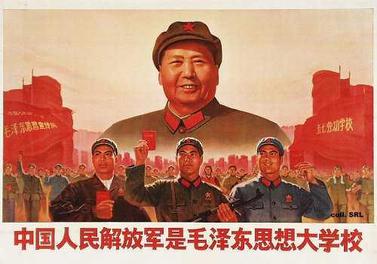
“The Chinese People’s Liberation Army is the great school of Mao Zedong Thought”, 1969.
A poster from the Cultural Revolution, featuring an image of Chairman Mao, published by the government of the People’s Republic of China.
Image via Wikimedia Commons.
What bilge? Oh, memes extolling the Chinese in relation to us. And all conservatives pick this crap up and echo it, because it happens to “side rail” against things they hate (and which it’s valid to hate.)
But the memes are crap. The aggrandizing of the Chinese bastards is crap. They’re either outright lies or laughable lies. And the memes, somehow, never hit the Chinese where it hurts: the fact their economy is so f*cked most of their people live like Medieval peasants; the fact their army of little emperors cried when they went up against India; the fact that they are having trouble feeding their own population; the crumbling empty cities they think are “investments”; their population collapse; Xi’s pretensions to world leadership; their slave camps. Which you know, tells you exactly where the meme factory is and who is propagating it.
The problem being when conservatives seize the memes and distribute, they are actively collaborating in the aggrandizing of China and putting down the US. They are also convincing the Chinese their victory over us will be easy. (This is good and bad, but if you have friends and relatives in large cities, think about the chances of it ending up with one of those catching a nuke because the idiots get cocky, okay?)
Chinese are masters of propaganda and psychological warfare, while Americans are so bad at it that it hurts. If you loved 2020 keep collaborating with the enemy.
If not, listen up:
Yeah, sure, the fact that the usurpers of our governmental institutions are making our armed forces participate in inclusivity and CRT training, and prioritizing bullshit SJW goals over preparedness IS a problem. But that doesn’t mean we’re not still the best fighting force in the world. Sure, it’s damning with faint praise, but comparing us to China and saying they’re “prepared for war” and “will win” is bullshit. You know it’s bullshit, I know it’s bullshit. It’s bullshit so rank I can smell it through the internet.
The Chinese have Little Emperors — single descendants of multiple families — who are no more prepared to risk themselves in war than I’m prepared to fly unassisted. Their army is bullshit.Why is it bullshit? Because they don’t have a fighting force. The only fighting strength they ever had was the ability to submerge any enemy in a wave of people. But they can’t. Because the communists destroyed that too.
Their weapons are bullshit. I’d like independent confirmation of their “achievements in space”. Why? Because, well, the USSR achievement in space was a) what they could steal from us b) flimsy and c) mostly trumped up. In the sense that they only publicized their wins, while it might be one in ten that succeeded.
Look, by definition an authoritarian regime sucks at tech. I’m not saying anything about “capabilities of the people” (duh) but seriously? If you can’t report failed experiments, failed assemblies or builds that need to be improved, you’re going to have crappy tech. And you can’t report any of that, because in a centralized authoritarian regime you’ll be punished for failure, even if it’s not your fault. And you might get accused of doing it on purpose.
When nothing less than 100% success is allowed, the process is corrupt and the result is excrement. (Look at our “science” right now. No, seriously. We’re sliding that way.)
So, no matter how made you are at what the army and our government is doing, stop echoing Xi’s bullshit. And counter it every time you see it. This is war by other means, or in the ancient Chinese tradition, softening the enemy so they’ll surrender at first attack.
Comments Off on Is the PRC really a paper dragon?


