Quotulatiousness

August 14, 2024

Premier Doug Ford’s weird plan to hold the justice system to account

Filed under: Cancon, Law — Tags: , , , , , — Nicholas @ 03:00

The problem with Premier Ford’s as-yet-unelaborated plan to collect formal statistics on the products of the criminal justice system is that it’s weird. And Canadians don’t like weird things because something something Donald Trump something something Hitler. Despite that, Colby Cosh thinks it’s a good idea:

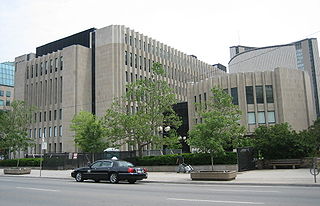
Superior Court of Justice building on University Avenue in Toronto (formerly the York County Court House).

… the very idea of addressing a social problem by gathering quantitative information is so un-Canadian as to seem radical and startling. It certainly seemed that way to the lawyers and civil libertarians who freaked out at Ford’s mention of “accountability” for judges who fail to protect the public from criminal predators.

Judicial independence is an axiom of our constitution — but to the degree that judges become policymakers, which is perpetually increasing as they discover creative new applications of the Charter, their lack of oversight by elected legislators and by the voting public is also a serious and obvious problem, purely in principle. It is no wonder the legal guild takes fright at the notion of “accountability” if it is interpreted to mean that judges might be subject to enforceable performance measures or firing by a minister.

But, of course, the word “account” is visible in there, and measurement of a social crisis is necessary to establish that one exists, even if almost everybody believes it to exist. Our courts are the first to castigate a government that makes some legislative change affecting individual rights without an attempt at inquiry into its reasonability and urgency. Ford, in proposing to establish the dimensions of preventable re-offending, is doing exactly what a legislator hoping to reduce crime ought to do: gather numbers. Collect and publish information. And let us specify that we mean publish publish, in an open, dependable, accessible way, with maximum detail.

Frankly, Ford’s announcement seems as much as anything like a reaction to being backed into a corner by an unresponsive Liberal government, which controls bail policy and the content of the Criminal Code, and by judges, whose irrational bail and sentencing decisions flood what’s left of our news media. Provincial politicians are bound to be judged by voters on the perceived prevalence of crime, but about all they can actually do about it is to, well, buy more choppers for the coppers and start collecting local data about revolving-door justice.

Update: Fixed broken link.

July 23, 2024

The next phase of the campaign to replace “Orwellian” with “Trudeaupian”

On the Fraser Institute blog, Jake Fuss and Alex Whalen outline the Trudeau government’s latest attempt to drive the word “Orwellian” out of common usage by making “Trudeaupian” the more authoritarian descriptor:

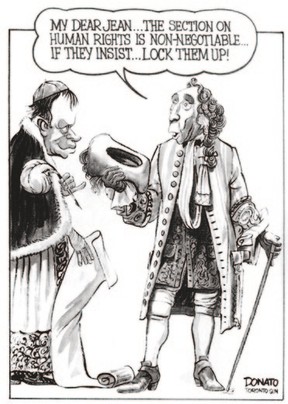
A Toronto Sun editorial cartoon by Andy Donato during Pierre Trudeau’s efforts to pass the Canadian Charter of Rights and Freedoms. You can certainly see where Justin Trudeau learned his approach to human rights.

This year marks the 75th anniversary of George Orwell’s classic novel 1984 (and it’s been 40 years since the actual year 1984). In the novel, Orwell explains the dangers of totalitarianism by exploring what happens when government exercises extreme levels of control over citizens including censoring and controlling language. While Canada is a relatively free country in 2024, there are aspects of Orwell’s world reflected in government policy today.

The Human Freedom Index, published annually by the Fraser Institute and Cato Institute, defines freedom as a social concept that recognizes the dignity of individuals by the absence of coercive constraint. In a free society, citizens are free to do, say or think almost anything they want, provided it does not infringe on the right of others to do the same.

Canada currently fares relatively well compared to other countries on the Human Freedom Index, placing 13th out of 165 countries. However, our score has dropped six spots on the index since 2008 when Canada recorded its highest ever rank.

This is not surprising given the Trudeau government’s recent efforts to control and manage the free exchange of ideas. The recent Online Streaming Act imposes various content rules on major streaming services such as Netflix, and requirements to extract funds to be redirected toward favoured groups. The Act seemingly seeks to bring the entire Internet under the regulation of a government body.

In another piece of recent legislation, the Online News Act, the government attempted to force certain social media platforms to pay other legacy news outlets for carrying content. In response, the social media platforms chose simply not to allow content from those news providers on their platforms, resulting in a dramatic reduction of Canadians’ access to news.

Now, a new piece of federal legislation — Bill C-63, the Online Harms Act — seeks to control language and grant government power to punish citizens for what the government deems to be unfavourable speech.

The government has sold Bill C-63 as a way to promote the online safety of Canadians, reduce harms, and ensure the operators of social media services are held accountable. In reality, however, the bill is Orwell’s Big Brother concept brought to life, where government controls information and limits free exchange. The legislation seeks to punish citizens not just for what the governments deems as “hate speech” but also grants the state power to bring Canadians before tribunals on suspicion that they might say something hateful in the future. Not surprisingly, many have raised concerns about the constitutionality of the Bill, which will surely be tested in court.

July 20, 2024

QotD: Comparing gun crime in Canada and the United States

Filed under: Cancon, Law, Quotations, USA, Weapons — Tags: , , , , , — Nicholas @ 01:00

That may explain the extraordinary amount of sucking up to Canada in this movie [Bowling for Columbine], which, while gratifying to insecure Canucks and self-loathing Americans, may be of less interest to third parties. Moore’s thesis, such as it is, is that America’s murder rate is the consequence not just of the country’s love of guns but of deeper currents of paranoia and fear in the American psyche. To that end, he crosses the Michigan border into Ontario, where one Canadian after another tells him that they don’t lock their doors. The level of guns per capita in Canada is similar to America but the murder rate is much, much lower. Ergo, it must be because Americans are living in fear while Canadians are much more socially progressive.

Whatever, dude. Unlike Moore, I have homes on both sides of the border and it’s the Quebec one I keep locked. By the time you read this, I’ll be in New York, but my home in New Hampshire will be unlocked, and so will my car at the airport, the key in the ignition, so I’ll know where to find it. By contrast, in Quebec it’s illegal to leave your car unlocked, even if you stop for a pee on an ice floe up by Hudson’s Bay. Pace Moore, Canada has vastly lower rates of handgun ownership. Long-gun ownership is much closer, but, statistically, Canadians are slightly more murderous than Americans in this sphere: in the US, there are 1.7 homicides per 100,000 long guns; in Canada, it’s 1.9. So European visitors to North America should be aware they’re more likely to be killed by a homicidal Canadian rifleman than an American one.

On the overall murder rate, if Moore’s interested in “cultural differences”, it seems odd that he should avoid the most obvious one. Alberta Report‘s Colby Cosh, a braver man than I, points out that black Americans are 13 per cent of the US population but commit over half the murders. Once you factor those out, non-black Americans murder at about the same rate as Canadians.

Mark Steyn, “Bowling for Columbine”, Steyn Online, 2002-11-30.

July 12, 2024

The British prison system is over-capacity, and Starmer’s new government has a plan

Filed under: Britain, Government, Law, Politics — Tags: , , , — Nicholas @ 10:05

As Ed West points out, the new Labour government’s plan is to move in a different direction than most Britons were hoping:

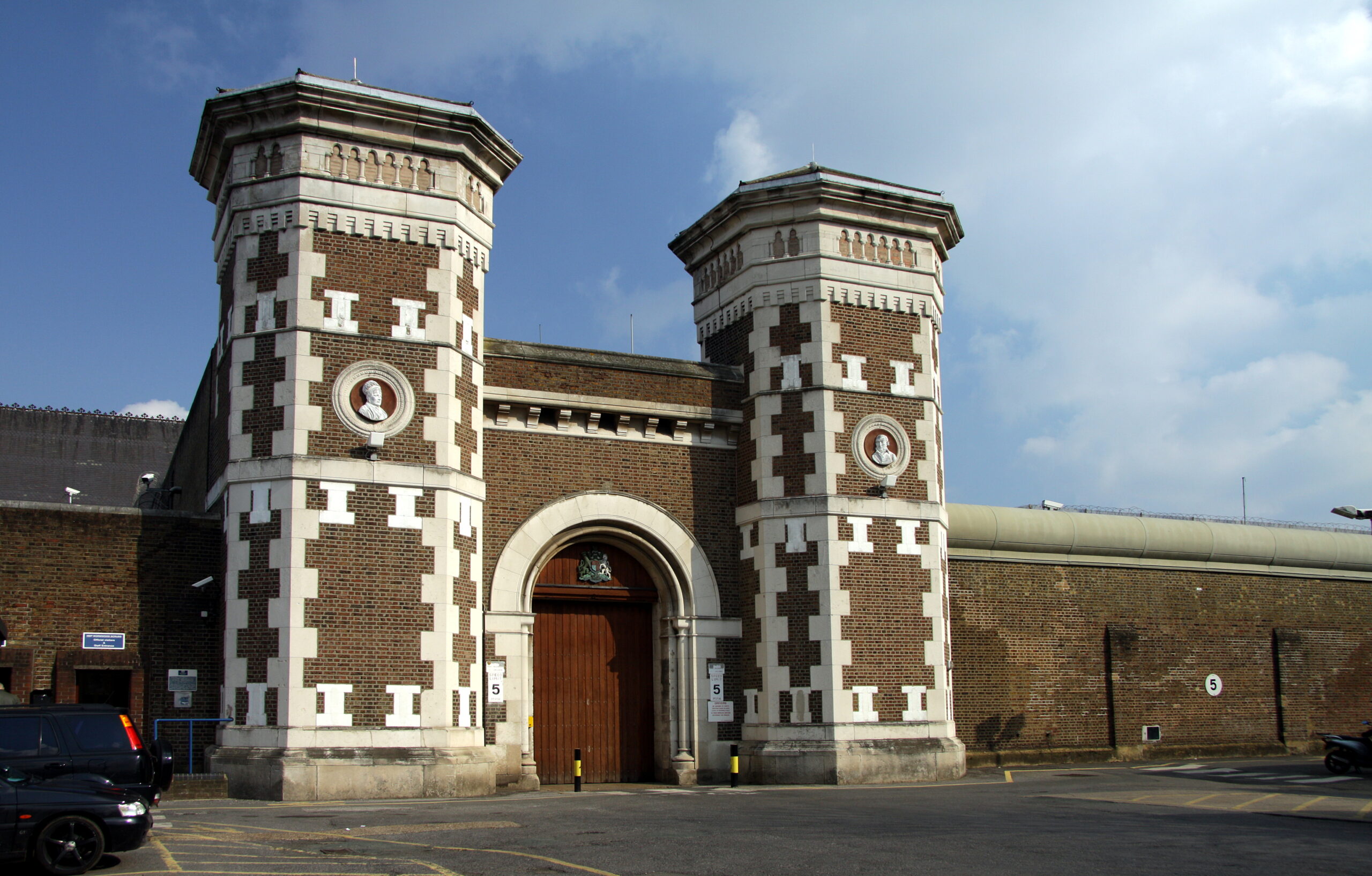
“Main gate to the HM Prison Wormwood Scrubs in spring 2013” by Chmee2 is licensed under CC BY-SA 3.0 .

Britain’s prisons are desperately overcrowded and morale among staff at an all-time low, following years of underfunding by the Conservative government and the inability of the state to build new jails against local opposition.

Now the incoming prime minister says that we have too many prisoners, while new prison minister James Timpson believes the British justice system is “addicted to punishment”, stating that only a third of inmates should be in jail.

The justice secretary, meanwhile, is considering “lowering the automatic release point for prisoners to less than 50 per cent through their sentence”. While currently prisoners serve half their sentences, or two-thirds for some sexual, violent or terror-related offences, the government plans to push the automatic release point to 40 per cent of their terms for those serving less than 4 years, benefitting 40,000 inmates — but not necessarily benefitting the rest of us.

This would be a very unwise move. The majority of prisoners are inside for sexual or other violent crimes, and even restricting early releases to those serving under four years would set free some very dangerous individuals, while previous amnesties of this type have led to huge increases in crime.

The idea that Britain “is addicted to punishment” jars with the sentences regularly handed out even for the most horrendous crimes, and the way that incorrigible criminals are allowed to offend again. This is the subject of a Twitter thread which I began six years ago, in order to highlight how the common belief in the punitive state was mistaken.

As an illustration, and bear in mind that their “sentences” are often twice what they actually served, here are a few cases:

A man who killed his wife in 1981, who was released after a few years and went on to strangle a girlfriend 12 years later, was subsequently freed — and ended up killing a third woman.

There was serial rapist Milton Brown, who was sentenced to 21 years for raping three women – one of whom took her own life – and was released early, only to rape again.

Or Joshua Carney, 28, freed on licence from prison and who just five days later brutally raped a mother and her 14-year-old daughter. He was allowed out despite 47 previous convictions, and now having been convicted of “13 charges including rape, attempted rape, actual bodily harm and theft” he is still eligible for parole in 10 years. Doesn’t sound like a country addicted to punishment.

There was John Harding, who treated a woman “like a rag-doll” when he beat and threatened to kill her after she told him she didn’t want a relationship. Despite terrorising his victim, including wrapping a sheet around her neck, and being in breach of a 30-month community order for a number of offences, including assault and threatening to kill another woman, and having other convictions for theft and criminal damage, he received a sentence of 21 months. As a result, in 2023, Harding was free to rape two women. Now convicted of rape, actual bodily harm, false imprisonment, strangulation and threats to kill, his sentence of 15 years means he could be out in 10.

If you believe that criminals only behave that way because of “systemic racism” or “poverty” or some other form of impersonal forces, you’ll likely also believe that punishment therefore serves no useful purpose and be in favour of all sorts of alternatives. At least until you or someone close to you is a victim of violent crime …

July 10, 2024

The four horsemen of cultural collapse

Filed under: Law, Liberty, Media, Politics, USA — Tags: , , , , — Nicholas @ 05:00

Chris Bray provides yet more examples of cultural decay and the collapse of law and order in America’s Trudeaupia, California under the loving care of Justin Trudeau’s spiritual twin, Gavin Newsom:

Today tells you about next year.

In a long history of murder in America, the historian Randolph Roth argued that violence follows other losses of trust and order. The murder rate surges in the face of “four distinct phenomena: political instability; a loss of government legitimacy; a loss of fellow-feeling among members of society caused by racial, religious, or political antagonism; and a loss of faith in the social hierarchy”.

Read that list carefully, because it should sound familiar.

Similarly, the originators of the theory of “broken windows policing” argued that peace and order grow from peace and order; neighborhoods are more likely to be calm when they’re “places where people are confident they can regulate public behavior by informal controls”. Crime follows crime; vandalism, for example, “can occur anywhere once communal barriers — the sense of mutual regard and the obligations of civility — are lowered by actions that seem to signal that ‘no one cares'”. The police commissioner William Bratton famously reduced all categories of crime in New York City subways by assigning officers to arrest turnstile jumpers who entered the system without paying. He sent a signal at the front gates.

“Broken windows” is a much-criticized theory: “He contended that the very notion of ‘disorder’ is subjective and racially fraught”. But the criticisms tend to reduce the complexity of the theory in order to “debunk” it.

Decay communicates. Disorder is a message.

July 5, 2024

“Private property rights? How do they work?” (U of T students, probably)

Filed under: Cancon, Education, Law, Middle East, Politics — Tags: , , , , , — Nicholas @ 04:00

In The Line, Josh Dehaas rounds up the concept of private property rights for the University of Toronto students (and non-student antisemitic fellow occupiers) who have been squatting for Palestinian terrorists on university property for the last while:

University College, University of Toronto, 31 July, 2008.
Photo by “SurlyDuff” via Wikimedia Commons.

After Justice Koehnen delivered his ruling Tuesday ordering the occupiers to dismantle the People’s Circle for Palestine at the University of Toronto, one of the protesters accused the school of hypocrisy.

“It’s quite interesting that a university that claims to practice decolonization is falling back on this claim of private property,” master’s student Sarah Rasikh told a journalist on the day before the students began taking down their tents.

“U of T and the Court more specifically is quite literally telling Indigenous students to leave and get off of their own land,” she added.

Rasikh has a point, sort of.

As someone who did law school relatively recently, I can attest that many university professors are downright hostile to the concept of private property. They commonly claim that all of Canada belongs to Indigenous people and that Indigenous peoples don’t believe in private property. Rather, they believe in “sharing”. Decolonization therefore requires that land be treated communally, or so the theory goes. University administrators who pay lip service to the concept of decolonization shouldn’t be surprised when students try to turn theory into action.

Thankfully the law still protects private property rights. Students who didn’t get taught how that works by their professors ought to give Justice Koehnen’s decision a read.

As Justice Koehnen explained, “in our society we have decided that the owner of property generally gets to decide what happens on the property”.

“If the protesters can take that power for themselves by seizing Front Campus, there is nothing to stop a stronger group from coming and taking the space over from the current protesters,” he went on. “That leads to chaos. Society needs an orderly way of addressing competing demands on space. The system we have agreed to is that the owner gets to decide how to use the space.”

“If it is not the owner who gets to determine what happens on the property it will become a brutal free-for-all,” Justice Koehnen added.

July 2, 2024

The Chevron decision

Filed under: Bureaucracy, Business, Law, Politics, USA — Tags: , , , — Nicholas @ 03:00

On his substack, Glenn “Instapundit” Reynolds discusses the recent US Supreme Court decision on “Chevron deference” and how it is going to impact the administrative state (and their business victims) going forward:

Goodbye, Chevron deference. Larry Tribe is already mourning the Supreme Court’s overturning of NRDC v. Chevron, in the Loper Bright and Relentless cases, as a national catastrophe:

Oh, the humanity!

Well, speaking as a professor of Administrative Law, I think I’ll bear up just fine. I’ve spent the last several years telling my students that Chevron was likely to be reversed soon, and I’m capable of revising my syllabus without too much trauma. It’s on a word processor, you know. As for those academics who have built their careers around the intricacies of Chevron deference, well, now they’ll be able to write about what comes next. And if they’re not up to that task, then it was a bad idea to build a career around a single Supreme Court doctrine.

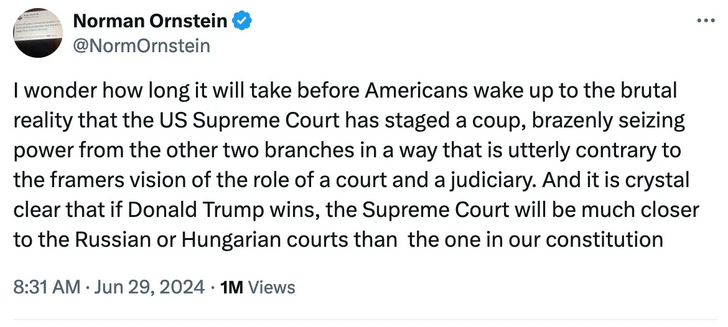
And that wasn’t the only important Supreme Court decision targeting the administrative state, a situation that has pundit Norm Ornstein, predictable voice of the ruling class’s least thoughtful and most reflexive cohort, making Larry Tribe sound calm.

Sure, Norm, whatever you say.

But how about let’s look at what the Court actually did in Chevron, and in the Loper Bright and Relentless cases that overturned it, and in SEC v Jarkesy, where the Court held that agencies can’t replace trial by jury with their own administrative procedures, and in Garland. v. Cargill, where the Court held that agencies can’t rewrite statutes via their own regulations. I don’t think you’ll find the sort of Russian style power grab that Ornstein describes, but rather a return to constitutional government of the sort that he ought to favor.

At root, Chevron v. Natural Resources Defense Council is about deference. Deference is a partial abdication of decisionmaking in favor of someone else. So, for example, when we go out to dinner, I often order what my son-in-law orders, even if something else on the menu sounds appealing. I’ve learned that somehow he always seems to pick the best thing.

Deference doesn’t mean “I’ve heard your argument and I’m persuaded by it”, (though something like that is misleadingly called “Skidmore deference”, but isn’t actually deference at all). Deference means “even if I would have decided this question differently, I’m going to go with your judgment instead”.

Under Chevron deference, when an agency interprets a statute it administers (e.g., the EPA and the Clean Air Act), a court will uphold its interpretation so long as it is (generously assessed) a reasonable one, even if it is not the interpretation the court would have come up with on its own. As you might imagine, this, at least potentially, gives agencies a lot more leeway, particularly when, as is often the case, Congress has drafted the statute ambiguously.

With Chevron overturned, courts will now apply their own judgment instead of deferring to agencies. Of course, this isn’t as big a deal as Larry and Norm seem to think, because Chevron has been dying the death of a thousand cuts for a while. Under the “major questions doctrine”, courts already decline to defer to agency interpretations where the issue has major social or economic ramifications.

June 30, 2024

California’s politics are so weird that Justin Trudeau is frantically taking notes

Filed under: Government, Law, Liberty, Media, Politics, USA — Tags: , , , , , — Nicholas @ 05:00

Chris Bray pays attention to California politics … and we should all pray for his long term mental health: that place is insane!

What’s happening in California isn’t politics in any conventional sense. No debate is underway, and no policy choices are being hashed out. We’re in the land beyond. In Our Democracy™, declarations are made, and then they are to be received in a spirit of quiet submission. Your failure to submit is disallowed, and the reason it’s been disallowed is that it’s been disallowed. Were it allowed, it would not be disallowed, but it is, in fact, disallowed, so therefore it is not allowed, you see? All “political” discussion is a circle, eating its own tail. I’ve been trying to figure out how to explain this, but the Sacramento Bee just did it for me. (Paywall-evading version here.)

The Bee is explaining — or “explaining” — what happened on the floor of the state Assembly yesterday, when a Republican was not permitted to argue against a bill, and a Democrat stood up to threaten him for trying. I encourage you to read the whole self-refuting thing. What happened, it turns out, is that the Republican was preventing debate by engaging in debate, which meant that he had to be silenced and threatened so debate could continue, which required that no one express opposing views, which is an act of anti-debate aggression. Debate is agreement, and not agreeing is preventing debate.

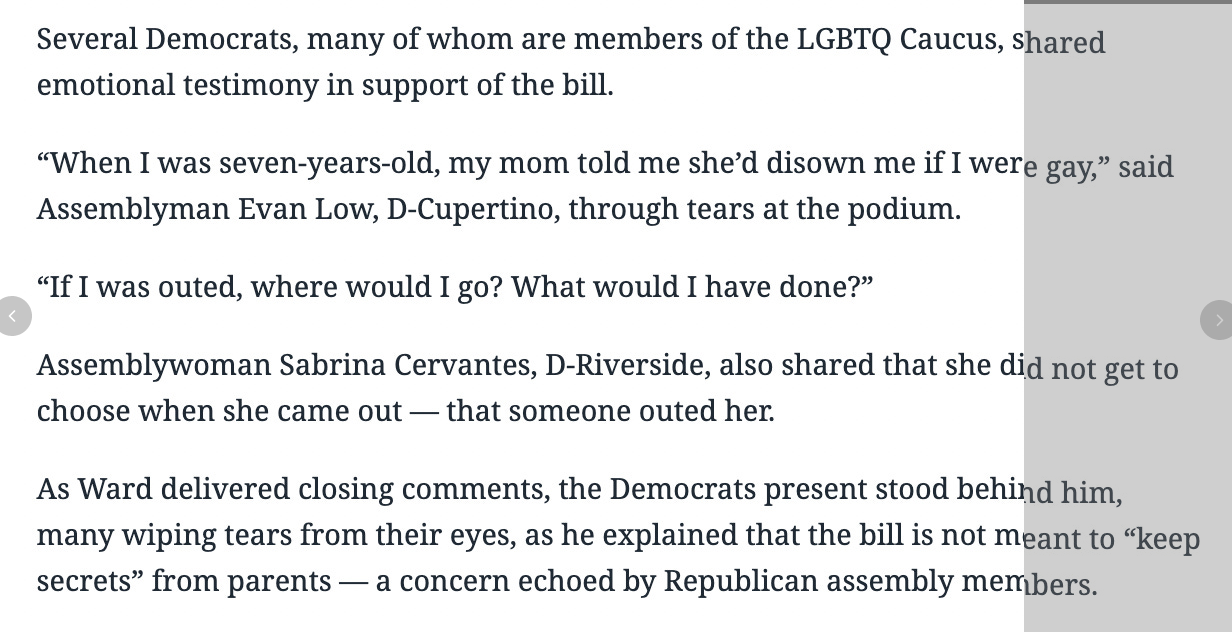
The “forced outing” debate was a discussion about AB 1955, which proposes to forbid schools to inform parents of discussions between children and school officials about sexual orientation and sexual behavior. It’s important that parents not be told about sexually themed discussions happening between children and the adults in their schools, because not telling mommy and daddy about sexual discussions is being safe and warm. But watch the casual turn of logic in the last paragraph of this screenshot:

  1. Evan Low said the bill is important because it’s good that parents not be told, and the bill makes sure parents aren’t told.
  2. Sabrina Cervantes said she didn’t have this bill when she was young, which would have forbidden telling, so someone told.
  3. Democrats explained that the bill is not meant to keep secrets from parents.

See, AB 1955 isn’t about keeping secrets from parents — it’s about not allowing schools to tell parents. Not being allowed to tell parents is different than keeping secrets from parents. The story doesn’t go on to explain the distinction between keeping secrets and not telling, but under Jacobin cultural rules, the distinction is that shut up. The distinction is presumptive, and so doesn’t require explanation.

Now, here’s the way the Bee characterizes Assemblyman Bill Essayli’s arguments during the debate that he derailed by not agreeing:

    Essayli has exhibited a consistent pattern of publicly disparaging advocacy groups and fellow lawmakers in an attempt to garner attention for conservative causes. On Thursday, he interrupted colleagues’ testimony and expressed frustration over Wood cutting his microphone and shutting down his comments when they veered away from AB 1955 and toward the issue of forced outing, in general.

His comments about the forced outing bill weren’t about the bill — they were about forced outing. What a bastard! Mister Speaker, he’s not debating the highway funding bill, he’s debating highway funding. Again, why does this distinction make sense? Because shut up. It makes sense declaratively: X is true because they said X.

And Essayli has a “consistent pattern” of saying disparaging things, which the Bee knows through mindreading is a maneuver to “garner attention” rather than an attempt to express his views. He disagreed, which is a very cynical and manipulative thing to do during a debate. He has a pattern of it!

And also Essayli is so rude that he interrupted colleagues when they spoke, and then had the nerve to object when his microphone was turned off. It’s rude to stop someone from speaking, and it’s rude to object to being stopped from speaking. You should never interrupt people, and you should always allow other people to interrupt you. They’re playing partisan Calvinball under the dome, and all moves lose.

June 29, 2024

“So, as the pundits say, everywhere is warming faster than everywhere else”

Terry Etam on the totalitarian controls being imposed on citizens in Canada where under yet another censorship bill being pushed out to ensure that nobody says anything that contravenes some yet-to-be-determined “internationally recognized methodology”:

And then, as a final but impressive gasp of inept state control, witness Canada’s frantic flailing to control the situation by …

Send in the goons: Canada cracks down on any speech it doesn’t like, with sweeping rules measured against undefined regulations, and enters the historical pantheon of legendarily badly run states

We’ve all heard about bill C-59 by now, the government of Canada’s crackdown on any comments related to emissions reduction mitigation efforts that do not adhere to “internationally recognized methodology”. It’s a Soviet-style attempt to crack down on any talk about what companies are doing to reduce emissions, or anything they do that is an attempt to reduce “the environmental, social and ecological causes or effects of climate change”.

The apes in charge, and their sycophants, say hey, it’s not censorship at all, you can talk about emissions reduction all day long, so long as it meets some undefined international standard, and the onus of proof is on anyone making the statement to show that they are not violating some “internationally recognized methodology” that does not exist.

This whole fiasco is of course a one way street; the freedom to say anything that cements the climate emergency narrative remains gloriously unchecked. For example, energy commentator David Blackmon recently catalogued on LinkedIn the number of countries/regions that claim to be warming faster than the global average: Canada, Mexico, Latin America and Caribbean, Arctic, Asia, Africa, the US, Europe, Russia, Australia, China, and Finland all claim to be warming faster than the global average. The high priest of modern politicized science, Scientific American, says that oceans are also warming 40 percent faster than expected, and that oceans absorb up to 90 percent of the warming caused by human carbon emissions, and SA also notes that the South Pole is warming “three times faster than the global average”. So, as the pundits say, everywhere is warming faster than everywhere else.

Extrapolating from this, in keeping with necessary mathematical precedents such as how averages work, then the few remaining regions not mentioned must be plummeting in temperature, because that’s how averages work. And I mean plummeting, if it alone is offsetting the above-average gains in the rest of the world. Strange indeed how not a single headline can be found to that effect.

The speech police have no problem with such math crimes, because the asinine claims are put forth under the banner of “science”. It must be concluded then that math is not one of the “internationally recognized methodologies”.

No matter. The point is, as always, to silence discussions and ram through whatever ideological junk they can while still clinging to power like a bee holding onto an accelerating windshield.

Welcome to Canada, where if global embarrassment were an Olympic sport we’d be wearing perma-gold. Joke’s on us though; we elected these people. We should now clearly understand why Canada’s status as an investment haven is plummeting like a shot duck. (Do not point me towards legendary genius Warren Buffett who says he is comfortable investing in Canada; Buffett buys existing businesses, with moats, and the government of Canada is working to build those moats as fast as it can. Remember this investing rule for the foreseeable future: existing infrastructure is getting more valuable, because building anything gets harder by the day.)

It is probably unfair to single out Canada for such withering criticism when other western countries are on similar energy suicide missions. Australia, England, Germany … all under the spell of radicals that will accept nothing other than total nihilistic energy “victory”, a crown that seems to mean de-industrialization and subjugation of citizens in autos they don’t want, doing things they don’t want to, and not being permitted to say what they want to. (New Zealand was in that club as well, but has recently repealed a ban on oil & gas exploration when it dawned on them that fields decline, and do not produce at flat levels in perpetuity without investment. Yes, western governments really have enacted such legislation while simultaneously holding an astonishing ignorance about how energy really works.)

As far as Canada’s hydrocarbon sector goes, the most important thing to do at this stage is to keep our heads [down] and carry on providing the energy the world desperately needs. And that means every single person, right down to Guilbeault’s Greenpeace and the soup throwing fools of Just Stop Oil. If the feds are going to outlaw emissions talk, let them … the rotten foundations of their world can’t stand for much longer.

No one should stand taller than one that provides reliable and affordable energy for the globe’s citizens. Go back to work, and patiently wait until the inevitable happens, the day when governments are no longer able to pretend they can’t see reality. It’s going to be epic.

June 27, 2024

The Toronto Star wants Ontario to adopt Scottish booze regulation (but ignore the failure)

Filed under: Britain, Cancon, Government, Law, Liberty, Media, Politics, Wine — Tags: , , , , , — Nicholas @ 05:00

The Toronto Star always loves a good moral crusade, and if it also happens to fly in the face of whatever Premier Ford wants to do, then so much the better:

The Toronto Star is looking to Scotland to teach it how to reduce alcohol-related deaths. In an article titled “How Scotland started to kick its alcohol problem — and what Ontario could learn from it“, it pushes back on plans to liberalise Ontario’s state monopoly on alcohol retail, saying:

    Ontario officials say they are fulfilling a 2018 election promise to increase “choice and convenience for shoppers and support Ontario retailers, domestic producers and workers in the alcohol industry”.

    But Scotland has cut alcohol-related hospital admissions by 40 per cent and deaths by almost half. While in Ontario, alcohol-related admissions have risen by a third and deaths by almost half, according to the Canadian Centre on Substance Use and Addiction.

How did Scotland supposedly achieve this public health miracle?

    The key part of Scotland’s landmark policy was aimed at reducing drinking by introducing minimum unit prices to make drinking more expensive.,/p>

Ontario already has minimum pricing and Scotland doesn’t have a state alcohol monopoly, so it is not obvious what lessons Ontarians are supposed to be learning, but put that to one side for a moment and consider the main claim.

Anyone who has been following events in Scotland knows that alcohol-specific deaths have risen since minimum pricing was introduced in 2018 and have generally risen since 2012 following a significant downturn in the years prior.

It is that drop between 2006 and 2012 that the Toronto Star must be referring to when it claims that deaths fell by “almost half” (actually a third). But the Scottish government didn’t pass any anti-alcohol legislation in those six years and it certainly didn’t have minimum pricing. The newspaper mentions that the drink-drive limit was cut, but that didn’t happen until 2014 and the evidence is clear that it had no effect on road accidents.

Since the Toronto Star doesn’t mention when the decline in alcohol-specific deaths took place, it is leading its readers to believe that it coincided with the introduction of minimum pricing and the lowering of the drink-drive limit. I call that lying.

It is strangely fitting that Canadians are being lied to about the “success” of Scotland’s alcohol strategy since the Scottish public were conned into accepting minimum pricing, in part, on the basis of lies told about the “success” of minimum pricing in Canada. The neo-temperance academic Tim Stockwell, who is quoted in the Star article, published a series of studies in the 2010s making some absurd claims about minimum pricing that were parroted by campaigners in the UK.

June 24, 2024

Justin Trudeau’s Ominous Online Harms Act: Minority Report Comes to Canada: Conor Friedersdorf

Quillette
Published Jun 19, 2024

Jonathan Kay talks to Atlantic Magazine staff writer Conor Friedersdorf about a censorious government bill that would allow officials to investigate Canadians for things they haven’t done yet.

https://quillette.com/2024/06/19/just…

——

Quillette is an Australian-based online magazine that focuses on long-form analysis and cultural commentary. It is politically non-partisan, but relies on reason, science, and humanism as its guiding values.

Quillette was founded in 2015 by Australian writer Claire Lehmann. It is a platform for free thought and a space for open discussion and debate on a wide range of topics, including politics, culture, science, and technology.

Quillette has gained attention for publishing articles and essays that challenge modern heterodoxy on a variety of topics, including gender and sexuality, race and identity politics, and free speech and censorship.
(more…)

Raise a glass of your favourite microbrew to … Jimmy Carter?

Filed under: Bureaucracy, Business, Government, Law, USA — Tags: , , , , , — Nicholas @ 03:00

Glenn “The Instapundit” Reynolds visits a local brewing festival in Knoxville and remembers what it was like before — of all people — Jimmy Carter began the process of deregulating the beer industry by legalizing homebrewed beer in 1978:

The Instapundit models his Hamm’s Beer Hawaiian shirt at a recent Knoxville beer festival.

This weekend I want to the Knox Brewfest at the Knoxville World’s Fair Grounds. As the name suggests, it was a collection of most of the local micro-breweries, each with a booth offering samples. (There were also a few bigger operations, like Sierra Nevada, Abita, and Paulaner). I wore my Hamm’s Beer Hawaiian shirt, which was a surprisingly big hit.

And there were some lessons, about which more later.

Hamm’s doesn’t really exist anymore except as a sometimes-produced minor product of Coors, which bought the trademark after it passed through the hands of numerous other companies. But it’s not forgotten!

The beer was good and the crowd was cheerful.

Mostly me, and my friend Jim (who I’ve known since junior high) were reflecting on the vast improvement in the world of beer in America, and particularly in Knoxville. As late as, oh, 1990 or so, you could go into almost any bar in Knoxville and if you asked what kind of beer they had you’d get an answer like this: “We’ve got everything! Bud, Bud Light, Miller, Miller Light, Coors, Coors Light – anything you want!”

It’s easy to take the craft-brewing revolution for granted, but it brought about huge changes and for the better. Nowadays, the beer scene in America tends to be better than that in Europe. No, really. In fact, one of my former research assistants, who practices law in Belgium now, brought over a couple of Belgian friends who wanted to see Tennessee. I met them for lunch at Barley’s in the Old City, to hear a bluegrass show and eat pizza and drink beer. They were very impressed with the fifty or so taps that Barley’s offers.

Back home they said, the bars are usually owned by the breweries and only sell their own brews, so you might have only three or four varieties, all from the same label. Nothing like this.

[…]

This deregulatory story started (like airlines and trucking deregulation) with Jimmy Carter of all people. Despite his (often true) reputation as a bossy micro-manager, he was an engineer and a rationalist. That worked out poorly in foreign policy, but led him to undo a number of irrational regulatory structures, one of which was the limit on home beer production. Carter signed a bill legalizing homebrewing in 1978, and those homebrewers were the nucleus of the craft beer movement a decade or so later.

June 23, 2024

California has “a governing class that wants you to give them power, then shut up and go away”

Filed under: Government, Law, Liberty, Media, Politics, USA — Tags: , , , , — Nicholas @ 05:00

Chris Bray illustrates some of the many ways that California’s elected politicians are working to ensure that mere voters won’t interrupt their urgent and necessary work:

The Taxpayer Protection Act, a proposed referendum that got enough signatures to qualify for the November ballot, would have required voter approval for all new state and local taxes. State election officials agreed that it met the qualification threshold, and planned to put it before the voters. Democratic officeholders sued, with considerable support from public employee unions and interest groups, and the California Supreme Court ruled this week that the measure may not be placed on the ballot — because it improperly proposes to revise the state constitution, rather than merely amending it. You can watch them try to parse that distinction here, for seventy murky pages. You can change the state constitution through the referendum process, but you can’t change the state constitution through the referendum process. See, totally clear.

At the same time, California Governor Patrick Bateman is telling the organizers of a ballot measure that would increase penalties for drug and theft crimes — after a decade of sharply reduced penalties — that he’ll punish them by blocking criminal justice reform measures in the legislature unless they pull their measure from the ballot. The intended message is a very clear threat: If you insist on your ballot measure and lose at the polls, you’ll be punished with a complete blockade on your agenda through legislative means, for as long as we can manage it.

And a parental rights proposition that aimed for a place on the November ballot — falling short in its efforts to gather enough signatures — ran into a wall when the attorney general’s office assigned it a misleading label that would have described it to voters as a repressive measure that was intended to hurt children.

So a Progressive reform, the great 20th-century transition to direct democracy, is running into a progressive wall of resistance in the 21st century. California Democrats are fighting to limit the likelihood that voters will interfere with their agenda.

People outside California often shrug at the decline of the state, because Californians are just getting what they voted for. But that view misses a bunch of strangeness and ambiguity in a place that has tended to put Democrats in office, then limit their efforts with an ideologically inconsistent hodgepodge of conservative and libertarian ballot measures. The governor and the state legislature just sued to prevent their own voters, the people who sent them to public office, from voting on the new taxes they create. Democrats against direct democracy — a governing class that wants you to give them power, then shut up and go away.

This is not merely a California problem. I wrote a few days ago about the scumbag Robert Kagan and his idiotic book warning that America is facing a rebellion. Here’s the back cover of the book, and I’ve used sophisticated media software to circle the important part:

“The problem is and has always been the people and their beliefs.” This is what the American governing class believes, now. See also the pro-democracy warrior Tom Nichols and his recurring theme about the repulsive people of an ignorant country. We need to protect democracy by getting all the trash that makes up the population to somehow go away and stop bothering their wise and benevolent betters.

The great point of cognitive slippage in American governance has been the degree to which Americans have been willing to vote for officeholders whose agendas they then try to block through lawsuits, referendums, and popular resistance. We’ve voted for shit sandwich over and over again, then declined to eat the whole sandwich. The governing class is now announcing that we’re no longer allowed to refuse the complete meal. You may not have a ballot measure on that.

In the near term, and in the medium term, that pivot leads to greater friction and accelerated decline. In the longer term, preventing people from limiting the aggressive failure of the governing class can only make that failure more apparent. Geological faults that have a lot of small movements release tension in a series of minor earthquakes; faults that can’t release tension through small movements eventually have one big one. We’ll eventually recognize the California Supreme Court’s decision this week as a Pyrrhic victory. There will be more of these, in a political system of increasing brittleness.

June 18, 2024

US “birthright citizenship”

Filed under: Government, History, Law, USA — Tags: , , , — Nicholas @ 03:00

Theophilus Chilton argues against the legality of “birthright citizenship”:

“American Flag” by JeepersMedia is licensed under CC BY 2.0

One of the benefits of Donald Trump’s involvement in politics over the last ten years has been that it opened up a robust national discussion about an issue that up until recently had been largely ignored by the political class. This discussion is about so-called “birthright citizenship”, the idea that whenever a foreign national (regardless of legal status and with a very few exceptions) has a child on American soil, this child automatically becomes an American citizen from birth. This approach to citizenship has been the de facto (though not de jure) approach to the issue of “anchor babies”, the children of illegal aliens who come to the United States so that they can have their children here, thus allowing the parents to remain as well, usually helping themselves to generous American benefit monies.

Defenders of unrestricted birthright citizenship – primarily found among liberals, establishment GOP types, and the more uninformed types of libertarians – adamantly argue from the 14th amendment’s Citizenship Clause that birthright citizenship is not only legal, but is in fact constitutionally protected, and is what the 14th amendment has meant all along. They often try to buttress their arguments by appealing to English common law with its historical provisions for birthright citizenship. However, is this sort of “swim a river, fill our quiver” approach really what the 14th amendment meant? Is it really what English common law, which forms the basis for much of our own law and constitutional interpretation, historically upheld? The answer to these questions is, “No”. Let’s look at some of the history behind this issue.

The crux about which the discussion revolves is the Citizenship Clause found in the 14th amendment, Section 1,

    All persons born or naturalized in the United States, and subject to the jurisdiction thereof, are citizens of the United States and of the State wherein they reside.

More specifically, what is at issue is the phrase, “and subject to the jurisdiction thereof”. Clearly, the clause was not intended to convey American citizenship to an unlimited pool of children born to aliens on American soil. If this had been the case, then the phrase under discussion would not have been included. Obviously, some limits were intended, those circumscribed by the intent of being “subject to the jurisdiction thereof”.

So what were these limits? Typically, it will be pointed out that the limits due to this jurisdictional issue were that citizenship was not being conveyed to children born of ambassadors and others aliens employed by their foreign governments, nor was it being conveyed to members of various Indian tribes which exercised sovereign powers within their own territories (this latter was rescinded by an act of 1924 which granted Indian tribes full American citizenship). Were these the only restrictions on birthright citizenship intended by the author and debaters of the 14th amendment?

No, actually. Let’s understand what the original intention of the 14th amendment was, which was to grant American citizenship to former black slaves and their children, and to prevent these newly freed citizens from being denied citizenship rights by certain of the southern states. That’s it. This was made clear by Sen. Jacob Howard, who authored the amendment in 1866, who clearly provided the intent for this section of the amendment,

    Every person born within the limits of the United States, and subject to their jurisdiction, is, by virtue of natural law and national law, a citizen of the United States. This will not, of course, include persons born in the United States who are foreigners, aliens, who belong to the families of ambassadors or foreign ministers accredited to the government of the United States, but will include every other class of persons. It settles the great question of citizenship and removes all doubt as to what persons are or are not citizens of the United States. This has long been a great issue in the jurisprudence and legislation of this country.

Clearly, other classes of foreign citizens were intended besides the children of ambassadors and other diplomatic personnel. Indeed, Howard’s statement appears to be quite all-encompassing – if taken at face value, it would appear that he did not even intend the 14th amendment to grant citizenship to the children of foreign nationals here legally, much less to those here illegally.

June 17, 2024

For want of a security clearance, the (potential) traitors escaped scot-free

In the free-to-cheapskates section of this week’s Dispatch from The Line, we get a summary of the state of brain-freeze in Parliament over the NSICOP (National Security and Intelligence Committee of Parliamentarians) report, that in a functioning state would have triggered much more action than it has in the dysfunctional Dominion:

The cover of the NSICOP special report on foreign interference (PDF – https://nsicop-cpsnr.ca/reports/rp-2024-06-03/special-report-foreign-interference.pdf )

The lead story this week, clearly, was the continuing fallout from the NSICOP report last week. Because of this report, even though there is much that we do not know, there are absolutely some things that are clearly established. Let’s run through some of the key points that are uncontested and draw some very modest and safe conclusions from them.

Here are facts.

  • There are multiple parliamentarians, meaning members of the House of Commons and the Senate, who have been deemed by eight of their colleagues to be engaged in activities with hostile foreign powers on either a witting or semi-witting basis.
  • The prime minister and the PMO have been aware of who these individuals are for at least a month, if not longer. That is when NSICOP filed its unredacted report to them for review, as required.

The above facts are unchallenged. Now let’s draw a few conclusions.

The phrasing of the NSICOP report, as well as both Elizabeth May’s and Jagmeet Singh’s press conferences this week, led us to believe some of these individuals are still sitting in both the House of Commons and the Senate. We acknowledge that Elizabeth May and Jagmeet Singh differ considerably on the severity of what these individuals are alleged to have done, but both seem to agree that the relevant parties, in at least some cases, remain in Parliament.

The prime minister, as the person responsible for the administrative and legal apparatus of government, could call the Clerk of the Privy Council, the Director of CSIS, the minister of public safety and others as necessary into his office today, and inform them that he would be making the names public, and that it would be the responsibility of those individuals to figure out how that could be accomplished while protecting intelligence sources and methods. At this time, there is no indication that he has done so, or has any interest in doing so.

So we got the grotesque theatre that was the House of Commons this week. The government has spent the last week and change challenging various opposition leaders to obtain security clearances so that they could view information that the prime minister has had for at least a month, and perhaps longer, even though both the Security of Information Act and the National Security and Intelligence Committee of Parliamentarians Act (depending on the auspices under which their security clearances were issued) prevents them from disclosing what they read.

And, therefore, doing anything about it. Because to remove a caucus member would be to reveal it, and if a leader has no caucus members that are implicated, there is no urgency to their reading the report.

Protecting the national security of Canada, and the democratic institution of parliament itself, is the prime minister’s job before it is anyone else’s. And the prime minister has had this information for at least a month.

It’s worth repeating that because we want you to envision something. Imagine there are three U.S. Senators accused of aiding and abetting a foreign power, and Joe Biden knew about it for a month.

When do you think impeachment proceedings would start?

Boris Johnson was unceremoniously dumped by his party for lying about throwing a party during COVID lockdowns (and we have no problem with that). Our prime minister has known that there are people currently sitting in parliament that have turned themselves into intelligence assets for hostile foreign powers for a month, and …

… the government would like you to know that it thinks Pierre Poilievre should get a security clearance so that he can read the documents.

We think Poilievre should, too. Because here’s the thing. The Security of Information Act says right there in Section 24 “No prosecution shall be commenced for an offence against this Act without the consent of the Attorney General”.

That reads to us like so: Pierre Poilievre can read those documents, release the names, and then dare Justin Trudeau to prosecute him. Indeed, anyone with the names could.

Your Line editors have raised this before on the podcast, but it bears repeating. Canada’s international reputation has taken a lot of hits lately. So imagine if you would, gentle reader, a situation where Justin Trudeau’s Attorney General signs off on having his political opponent arrested for revealing that hostile foreign powers have coerced sitting MPs into becoming intelligence assets … especially if one or more of those MPs is revealed to be a Liberal.

That’s a front page international news story. We’d look like a banana republic. Our international reputation would take decades to recover.

Spoiler: we already do look like a banana republic and our international reputation is lower than it has ever been. Trudeau isn’t a dummy: he figures that our reputation literally can’t get much worse no matter what he does, so he’s choosing to protect … someone … and what’s Poilievre going to do? He proved during the lockdowns that he’s not willing to get arrested on a matter of principle (unlike Maxime Bernier), so he’s likely to just posture endlessly until something new pops up in the silly season news rotation.

« Newer PostsOlder Posts »

Powered by WordPress