Quotulatiousness

November 12, 2024

Canada in the news … for all the wrong reasons

In the National Post, Tristin Hopper explains why your non-Canadian friends may be finding their opinions on the dysfunctional Dominion getting more and more sour in recent years:

… within just the last few years, multiple foreign outlets have profiled Canada for the singular purpose of asking what happened to it, and worrying if Canada’s ills will soon be their own. What’s more, these articles are not limited to a single topic; so much is going sideways in Canada right now that everything from our assisted-suicide regime to our economy to our internet legislation is attracting overseas notice like never before.

Below, a cursory guide to some of them. If you’re noticing that your non-Canadian friends suddenly have a darker picture of your home country than they used to, here’s a clue as to why.

“Justin Trudeau is killing Canada’s liberal dream”

Ever since the 2019 federal election, The Economist‘s coverage of Prime Minister Justin Trudeau has usually followed a general theme of noting that the bloom is off the rose of his photogenic ascendancy to power in 2015. But in a trio of articles published last month, the publication laid into the Canadian leader as an icon of what not to do.

Justin Trudeau is killing Canada’s liberal dream, published on Oct. 14. Canada’s Trudeau trap, published on Oct. 17. And then, just for good measure, Justin Trudeau is paying for solar panels in the cold, dark Arctic.

[…]

“Canada Is Disintegrating”

The Telegraph in the U.K. ran an entire series of essays last week on the topic of Canada taking it to the limit on progressive laws covering everything from drugs to national identity.

[…]

“Canada’s Extremist Attack on Free Speech”

The June tabling of the Online Harms Act prompted a wave of foreign coverage unlike few pieces of Canadian legislation. Although virtually every non-U.S. country has legislated controls on extreme speech, the Online Harms Act went noticeably farther than its peer countries in two respects: It prescribes a life sentence for the speech crime of “advocating or promoting genocide”, and it authorizes pre-emptive custody for anyone suspected of committing hate speech in future.

November 9, 2024

Bill C-413 “is aimed at preventing her fellow Canadians from saying anything positive about Indian residential schools”

Filed under: Cancon, History, Law, Liberty — Tags: , , , , — Nicholas @ 03:00

Nina Green suggests that Bill C-413’s sponsor might be the first person in Canada to face criminal charges in that piece of legislation if her private member’s bill gets Royal Assent:

On 31 October 2024 Member of Parliament Leah Gazan called a press conference to lobby for Bill C-413, her private member’s bill designed to criminalize her fellow citizens for disagreeing with her views.

Gazan led off the press conference with this statement:

    Good morning, everybody. I’m Leah Gazan, and I’m the Member of Parliament from Winnipeg Centre, and we’re here to discuss support of Bill C-413 to amend the Criminal Code to include the willful promotion of hate against Indigenous peoples by condoning, downplaying, justifying the residential schools.

To evoke an emotional response, Gazan used the word “violence” a dozen times during her press conference, falsely equating speech with violence, although violence by definition involves physical force.

Gazan’s bill is obviously not aimed at preventing physical violence against Indigenous people. It is aimed at preventing her fellow Canadians from saying anything positive about Indian residential schools.

Earlier, on 27 September 2024, Gazan made the bill personal, telling CTV News that “my family has been impacted by residential school”, implying that she had been motivated to introduce her bill because of the serious harm residential schools had inflicted on her own family.

In fact, the exact opposite is true. Residential schools had a positive effect on Leah Gazan’s family.

On her father’s side, Gazan is Jewish, and her maternal grandfather was Chinese. Thus her only possible connection to Indian residential schools is through her maternal grandmother, Adeline LeCaine, the daughter of Leah Gazan’s great-grandfather, John LeCaine (1890-1964).

What we learn about John LeCaine turns out to be surprising. He was the son of a white North West Mounted Police officer, William Edward Archibald LeCain (1859-1915), and Emma Loves War, whose Lakota Sioux family sought refuge in Canada with Chief Sitting Bull and 5000 of his people after the massacre of Custer and his men at the Battle of the Little Big Horn. […]

Since he had a white father and an American Indian mother, John LeCaine was, in the terminology of the day, a half-breed, and ineligible to attend a residential school since federally-funded Indian residential schools were reserved for status Indians under the Indian Act. However an exception was made, and both John LeCaine and his sister Alice LeCaine (1888-1976) were admitted to the Regina Industrial School. John LeCaine attended for seven years, from 1899 to 1906 when he was 9 to 16 years of age. While there he learned to read and write English proficiently, and mastered agricultural and carpentry skills which equipped him to apply, like white settlers at the time, for a homestead, which he proved up in 1913. In 1914 he wrote to the Department of the Interior asking for a ruling on whether his two half-brothers — who were full-blooded Sioux — could also apply for homesteads.

The proficiency in English he acquired at the Regina Industrial School enabled John LeCaine to became a writer and a historian of the Lakota people. In later years he mapped the places he and his stepfather, Okute Sica, had visited on a journey to the Frenchman River in 1910, and wrote a collection of stories told to him by Sioux Elders, Reflections of the Sioux World, as well as other articles, including some published in the Oblate journal, The Indian Record.

November 8, 2024

The McDonald’s ice cream machines are always broken because of bad IP laws

Even if you never to to a McDonald’s yourself, you’ve undoubtedly heard that the ice cream machines are always broken. I hadn’t really given it any thought — it’s been years since I visited one of the restaurants and I don’t eat much ice cream — but Peter Jacobsen explains the weird and infuriating reason for the phenomenon:

Image Credit: Magnus D via Wikimedia | CC BY 2.0

How could it be that the ice cream machines at McDonald’s are so consistently broken? It turns out that, until just recently, it was illegal to hire most people to fix them. To understand why, we’re going to have to take a detour into the world of intellectual property.

DMCA Woes

So why has it been illegal for McDonald’s to hire people to fix their ice cream machines? Well, that’s where the Digital Millennium Copyright Act (DMCA) comes in. If you’re familiar with the DMCA, this is probably confusing to you.

Generally the DMCA is a big concern on content creation platforms like YouTube. If someone uses copyrighted music, he or she gets DMCAed. This is slang for when a video gets its monetization redirected to the owner of whatever copyrighted content was used.

DMCA takedowns draw a lot of ire, because the law is clumsily applied and often even legitimate uses of copyrighted content (e.g., fair use) are punished.

But the DMCA extends beyond content creation, as chronicled by Elizabeth Chamberlain of iFixit, an organization dedicated to ensuring that product owners have the right and ability to fix their property. Many machines ranging from phones to ice cream machines utilize copyrighted software to function. Sometimes, this software limits product users more than they’d like.

For example, iPhone software locks users into particular user interfaces. If a user wants to customize past some point, he’s going to have to modify the software more than the company intends. This process, called jailbreaking, involves breaking through “digital locks”. The DMCA often interprets breaking these locks as a violation of the intellectual property of the copyright holder.

The problem gets even worse when you recognize that fixing things — say, McDonald’s ice cream machines — means breaking past those digital locks. This means anyone hired to repair the machine would need an official blessing from the manufacturer.

However, things have changed. As of October 18th, the opening of digital locks for “retail-level commercial food preparation equipment” is now exempt from this DMCA rule. McDonald’s will now be able to hire from a larger group of people to fix their ice cream machines.

DMCA has allowed a lot of intellectual property owners to collect unearned rents while neglecting the needs of the customers who’ve bought, leased, or rented things that incorporate their IP.

Note, this is only an exemption to the rule. The rule itself has not changed. Second, other regulations still hamper McDonald’s franchise owners from fixing their own machines. As Chamberlain points out:

    While it’s now legal to circumvent the digital locks on these machines, the ruling does not allow us to share or distribute the tools necessary to do so. This is a major limitation … few will be able to walk through it without significant difficulty.

    It is still a crime for iFixit to sell a tool to fix ice cream machines, and that’s a real shame … Without these tools, this exemption is largely theoretical for many small businesses that don’t have in-house repair experts.

So your chance of getting a McFlurry has improved, but you can’t quite celebrate a total win yet.

The battle against these DMCA laws isn’t limited to ice cream machines. The “right to repair” movement spearheaded by organizations including iFixit has already battled for exemptions for medical devices, consumer devices like phones and tablets, vehicles, and assistive technologies for people with disabilities.

November 2, 2024

The mirage of Trudeau’s mediagenic gun control efforts

Filed under: Cancon, Law, Weapons — Tags: , , , , — Nicholas @ 03:00

To hear the Prime Minister talk about his gun control strategy, it’s been a stunning success. Many police chiefs’ responses thoroughly denounce this as, at best, self-serving spin:

As police unions pillory federal gun bans for doing nothing to address skyrocketing gun crime, an Ontario police department revealed this week that virtually all its crime guns are now illegal imports from the United States.

“Approximately 90 per cent of (the) firearms that we seize are directly traced back to the U.S. And I can say in reality the remaining 10 per cent are likely also from the U.S.,” Peel Regional Police Chief Nishan Duraiappah said at a Monday press conference. The 10 per cent referred to guns that have been modified or had their serial numbers removed, making them harder to trace.

Duraiappah was announcing the results of Project Sledgehammer, the breakup of a gun smuggling ring that included the seizure of a shipment of so-called “giggle switches” — black market devices that can turn a regular handgun into an automatic machine pistol.

But during the press conference, police revealed that both gun crime — and the number of illegal guns in the community — is unlike anything they’ve ever seen.

The Peel Regional Police cover an area immediately to the west of Toronto that includes Mississauga and Brampton. Duraiappah said that only 10 years ago, if a criminal in the Peel Region wanted an illegal gun, “it was doable, but it required a lot of work.”

Now, Peel Police are seizing an illegal gun about once every 30 hours — an 87 per cent increase over the year prior. Illegal guns are now so ubiquitous that they often show up in unrelated investigations, such as an impaired driver having one in his glove compartment.

“The availability of firearms has just saturated the community,” said Duraiappah.

This has all occurred in tandem with a nationwide spike in gun crime, including fatal shootings.

Earlier this year, Statistics Canada published 2022 data showing that “firearm-related violent crime” was at the highest rate recorded since they started tracking it in 2009.

October 12, 2024

Government-mandated backdoor access – “weakening security for anybody weakens it for everybody”

Filed under: China, Government, Law, Technology, USA — Tags: , , , — Nicholas @ 03:00

After all this time, it’s no surprise to discover that unlike the police — who theoretically only use these government-required “backdoors” with a legal warrant — foreign hackers have been merrily using these “law enforcement tools” for their own purposes:

“I Hear You wiretapping poster, Mad Magazine, NYC” by gruntzooki is licensed under CC BY-SA 2.0 .

For as long as law enforcement has sought a way to monitor people’s conversations — though they’d only do so with a court order, we’re supposed to believe — privacy experts have warned that building backdoors into communications systems to ease government snooping is dangerous. A recent Chinese incursion into U.S. internet providers using infrastructure created to allow police easy wiretap access offers evidence, and not for the first time, that weakening security for anybody weakens it for everybody.

Subverted Wiretapping Systems

“A cyberattack tied to the Chinese government penetrated the networks of a swath of U.S. broadband providers, potentially accessing information from systems the federal government uses for court-authorized network wiretapping requests,” The Wall Street Journal reported last week. “For months or longer, the hackers might have held access to network infrastructure used to cooperate with lawful U.S. requests for communications data.”

Among the companies breached by the hacker group, dubbed “Salt Typhoon” by investigators, are Verizon, AT&T, and Lumen Technologies. The group is just one of several linked to the Chinese government that has targeted data and communications systems in the West.

While the Journal report doesn’t specify, Joe Mullin and Cindy Cohn of the Electronic Frontier Foundation (EFF) believe the wiretap-ready systems penetrated by the Chinese hackers were “likely created to facilitate smooth compliance with wrong-headed laws like CALEA”. CALEA, known in full as the Communications Assistance for Law Enforcement Act, dates back to 1994 and “forced telephone companies to redesign their network architectures to make it easier for law enforcement to wiretap digital telephone calls,” according to an EFF guide to the law. A decade later it was expanded to encompass internet service providers, who were targeted by Salt Typhoon.

“That’s right,” comment Mullin and Cohn. “The path for law enforcement access set up by these companies was apparently compromised and used by China-backed hackers.”

Ignored Precedents

This isn’t the first time that CALEA-mandated wiretapping backdoors have been exploited by hackers. As computer security expert Nicholas Weaver pointed out for Lawfare in 2015, “any phone switch sold in the US must include the ability to efficiently tap a large number of calls. And since the US represents such a major market, this means virtually every phone switch sold worldwide contains ‘lawful intercept’ functionality.”

October 11, 2024

German free speech – only applicable when used to criticize the “far right”

Filed under: Books, Germany, Government, Law, Liberty, Media, Politics — Tags: , , , , — Nicholas @ 03:00

C.J. Hopkins discovers the stark contrast between actual freedom of speech and German freedom of speech:

The first rule of New Normal Germany is, you do not compare New Normal Germany to Nazi Germany. If you do that, New Normal Germany will punish you. It will sic the Federal Criminal Police on you. It will report you to its domestic Intelligence agency. It will ban your books. It will censor your Tweets. It will prosecute you on fabricated “hate-crime” charges.

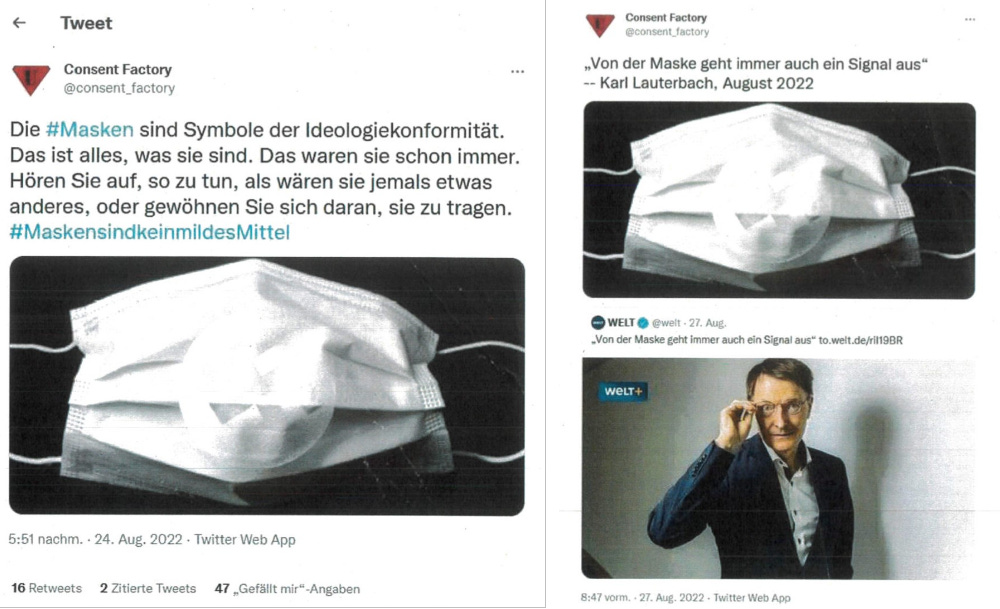
I know this, because that’s what happened to me. I broke the first rule of New Normal Germany. I compared New Normal Germany to Nazi Germany. I did it with the cover artwork of my book.

Yes, that’s a swastika on the cover. A swastika covered by a medical mask. I tweeted that artwork in 2022. The German authorities prosecuted me for that, and convicted me for that. So, now I’m a “hate criminal”, and an “anti-Semite”, and a “trivializer of the Holocaust”.

That’s the second rule of New Normal Germany. You never, ever, display a swastika. Displaying a swastika is not “in Ordnung“. Displaying swastikas is totally “verboten“.

Unless you are the Health Minister of New Normal Germany, and you’re comparing your political opponents to the Nazis. Or unless you are a popular German celebrity, and you’re comparing the Russians and their supporters to the Nazis. Or unless you are a mainstream magazine, and you’re comparing German populists to the Nazis.

In which case, displaying a swastika is fine. And is not “verboten“. And definitely not a “hate crime”.

And that’s the third rule of New Normal Germany. If you agree with the government, obey their orders, and parrot their propaganda, you are not a “hate criminal”. If you are the government, like an actual minister in the government, like the Minister of Health, you’re definitely not a “hate criminal”. And, if you are part of government’s propaganda apparatus, needless to say, you’re also not a “hate criminal”.

However, if you criticize the government, or if you compare the government to Nazi Germany, and if you do that using your book-cover art featuring a swastika behind a Covid mask, then you’re absolutely officially a “hate criminal”, and an “anti-Semite”, and a “trivializer of the Holocaust”.

October 3, 2024

Refuting one old myth about “shouting ‘fire’ in a crowded theatre”

Filed under: Law, Liberty, Media, Politics, USA — Tags: , , , , , — Nicholas @ 03:00

In the visible portion of a pay-walled post, Andrew Doyle explains why we should stop using the hoary old anti-free speech cliché that was refuted nearly 50 years ago by the US Supreme Court:

There are few people who are courageous enough to openly admit that they oppose freedom of speech, and so we would be forgiven for thinking that the authoritarian mindset is rare. In truth, those who believe that censorship can be justified typically resort to a set of hackneyed and specious arguments. It doesn’t seem to matter how often these misconceptions are conclusively rebutted, they continue to be trotted out with depressing regularity.

Take yesterday’s Vice Presidential debate between JD Vance and Tim Walz, in which one of these very misconceptions was parroted once again. This is how it happened:

    JD Vance: You guys attack us for not believing in democracy. The most sacred right under the United States democracy is the First Amendment. You yourself have said there’s no First Amendment right to misinformation. Kamala Harris wants to

    Tim Walz: Or threatening, or hate speech

    JD Vance: … use the power of government and big tech to silence people from speaking their minds. That is a threat to democracy that will long outlive this present political moment. I would like Democrats and Republicans to both reject censorship. Let’s persuade one another. Let’s argue about ideas, and then let’s come together afterwards.

    Tim Walz: You can’t yell fire in a crowded theatre. That’s the test. That’s the Supreme Court test.

The cliché that “you can’t shout ‘fire’ in a crowded theatre” originates in the 1917 United States Supreme Court ruling against Charles Schenck, a socialist who had issued a broadside calling for young men to refuse military conscription and was convicted under the Espionage Act. These were the circumstances under which Justice Oliver Wendell Holmes wrote the statement: “The most stringent protection of free speech would not protect a man in falsely shouting ‘Fire!’ in a theatre and causing a panic”. Note that the word “falsely” is invariably dropped when quoted by advocates for censorship.

Leaving that telling little edit aside, it should be remembered that this was never a legally binding statement. Walz maintains that this is “the Supreme Court test”, but Holmes merely used the analogy to justify upholding Schenck’s prosecution. In fact, the decision of the court in Schenck v. United States was overruled in 1969.

Do I need to say that I didn’t watch the debate? I don’t even watch the debates when I actually have a vote to cast, so I’m going on highly selective sources to at least pretend to care about the VP debate. I do like a waspish line on almost any politician, so Bridget Phetasy’s description gave me a mental image of the event that seems highly truthy: “The vibe of this debate is adult confronting the coach who molested him”. J.D. Tuccille has more:

To illustrate the contrast between the recent presidential debate and this week’s vice-presidential match, I’ll say that I dread either Donald Trump or Kamala Harris taking office as president, but I fear the policies of veep hopefuls J.D. Vance and Tim Walz. At the top of both party’s tickets are individuals of uncertain competence and shaky basic decency, while their sidekicks come off as the designated adults, ready to step in if the winning presidential candidate falters, and more than excited to implement their chosen programs, God help us. That said, Vance had a much better night than Walz.

From the very beginning, J.D. Vance gave us a glimpse of what Trump might be like minus a personality disorder and with focus. He looked cool and collected, with his arguments organized in his head. He was also able to quickly pivot to address — or dodge (this is politics, after all) — the CBS moderators’ questions.

By contrast, Walz appeared like he was sweat-soaking his notes into illegibility as he tried to remember which part of the previous night’s memorized cram session he should spit out. He eventually regained some of his footing, though he generally seemed nervous and unprepared.

“The vibe of this debate is adult confronting the coach who molested him,” quipped podcaster and writer Bridget Phetasy, who isn’t known for being merciful.

The Democrat’s discomfort probably came to a head when he was asked to explain why he long claimed to have been in Hong Kong in 1989, with front-row seats to the Tiananmen Square massacre, when news reports and photographic evidence showed he was at home in Nebraska. Much hemming, hawing and references to a small-town upbringing ensued, which was painful to watch. The closest he came to admitting he lied was conceding, “I’m a knucklehead at times” and that he “misspoke.”

September 30, 2024

Saving German democracy seems to require not following the law for some reason

Filed under: Germany, Government, Law, Media, Politics — Tags: , , , , — Nicholas @ 03:00

[Update below] I’m sure that Germany is being well-served by their politicians who only seem to want to obey the law when it suits them. I mean, that’s how you save democracy, right? By ignoring democratic laws for a “higher good” every now and again?

Jürgen Treutler, the supergenius fascist who discovered that all you need to do to establish fascism is follow all democratic laws and procedures rigorously and to the letter.

They never tire of telling us that we live in a democracy.

This means that that dreaded mass known as “the people” are permitted – with however much groaning and reluctance – to present themselves every four years to choose their representatives. These representatives then betake themselves to the parliament, where they form some manner of government, which proceeds to rule us in highly democratic ways. This is is literally the best thing ever, except for the fact that “the people”, in their profound stupidity, cannot always be relied upon to vote for the right parties. Sometimes they vote for the wrong ones, and in these cases democratic solutions must be found to rein in the rabble’s undemocratic exercise of democracy.

The people of Thüringen have proven themselves particularly inconvenient to democracy, in that they have exercised their democratic rights to vote overwhelmingly for the evil, fascist and antidemocratic party known as Alternative für Deutschland. What makes the AfD so evil and fascist is never quite explained, but we hear all the time that they are very bad so the point must be beyond question. The people of Thüringen transgressed against democracy so powerfully, that they gave the AfD 32 seats of their 88-seat state parliament – far more than they granted to any of the upstanding, democratic parties. These parties include such paragons of democratic virtue as Die Linke (the Left Party), which somehow manages to be both officially democratic and also the direct successor to the DDR-era Socialist Unity Party (they got a mere 12 seats); the Linke-offshoot party known as the Bündnis Sahra Wageknecht (they got 15 seats); the Christian Democrats (they got 23 seats); and the Social Democrats (they got 6 seats, lol).

Now, a naive person might think that the AfD, being the party most favoured by the people of Thüringen, should enjoy certain parliamentary prerogatives. Existing procedures, for example, grant the strongest party the right to propose candidates for the office of parliamentary president. The president is the person who presides over the meetings of the parliament; he is like a glorified committee chair and his powers are not all that great. The very idea that the AfD might have the right to suggest their own candidates for president, however, strikes enormous fear into the hearts of the “democratic” parties, who are determined to save Thuringian democracy by all the antidemocratic means at their disposal. If necessary, we must destroy democracy itself, to save the Thuringian parliament from the spectre of a democratically elected AfD president.

This brings us to the absolute unprecedented clownshow that unfolded yesterday at the Thuringian parliament in Erfurt. It was set to be a day of boring, routine procedure, when the newly elected parliament would constitute itself and elect a president. Thüringen is anomalous, in that this state – alone of all the federal states of Germany – has a specific law mandating adherence to parliamentary procedures. New parliaments cannot just change these procedures on the fly; they have to be officially constituted as a legislative body first. These legally mandated procedures require that an acting “senior president” preside over the first meeting of the new parliament. This senior president is simply the oldest member of the dominant party – in this case an affable rotund AfD politician named Jürgen Treutler.

Update: eugyppius updates the state of play in Thuringia after the relevant court rules that the law can be set aside in this case:

In not-so-good news (but as I predicted), the state constitutional court in Thüringen ruled in favour of the CDU last Friday. The other parties were able to change the procedural rules in the Thuringian parliament and exclude the AfD not only from the office of president, but also from the entire executive committee of the Landtag. The “democratic” parties have also altered procedural rules to reduce AfD representation on parliamentary committees, effectively preventing the strongest party in the Landtag from exercising their blocking minority there.

They really are determined to destroy the democracy to save it.

September 19, 2024

We’re approaching Halloween … expect the offensensitive inquisition!

Filed under: Britain, Law, Liberty, Politics — Tags: , , — Nicholas @ 05:00

Andrew Doyle with a timely reminder that Brits can — and have been — arrested, prosecuted, and (potentially) even imprisoned for wearing “offensive” Halloween costumes, and it’s likely to get worse:

The novelist Simon Raven once received a telegram from his wife which read: “Wife and baby starving send money soonest”. He replied: “Sorry no money suggest eat baby”. At the risk of sounding callous, I must admit that my first reaction on reading this was to laugh. It was involuntary, like the best of laughter. The reader should rest assured that this does not mean that I in any way approve of cannibalism and infanticide.

There is a brand of humour which relies on its sheer inappropriateness. It’s why we can find ourselves laughing during funerals or other solemn occasions. The social responsibility to take the matter seriously nags at our senses and dares us to rebel. John Cleese understood this all too well when he delivered the eulogy at Graham Chapman’s funeral and noted that his deceased friend would obviously have liked him to say: “Good riddance to him, the freeloading bastard. I hope he fries.”

The same principle applies, albeit in a cruder manner, to the convention of Halloween costumes that are intended to shock. It might seem puerile, but rather than donning the costume of a ghost or a vampire, many partygoers now celebrate this season of horror by dressing up as the most appalling human beings in history, such as Adolf Hitler, Myra Hindley, or Jedward.

The “gross out” is the whole point. The more outrageous the better, and the guest who displays the worst taste sometimes wins a prize. This is precisely what happened to David Wootton, who dressed as an Islamic terrorist, complete with Arabic headdress, and a t-shirt bearing the words “I love Ariana Grande”. To top it all, he carried a rucksack with “TNT” and “boom” written on it. This was in reference of course to the horrendous terrorist attack at an Ariana Grande concert at Manchester Arena in 2017 that killed twenty-two people, including many children, and injured a further thousand.

Bad taste? Offensive? Juvenile? I would agree with all of these assessments. But the partygoers understood the rules of the game, and Wootton later claimed to have been awarded the prize for Best Costume. Once his image was posted online, however, it became a police matter, and he was quickly arrested. He pleaded guilty and now faces up to two years in prison. He has also relocated and changed his name.

I have complete sympathy for anyone who found the images upsetting, grotesque, and not remotely funny. Nobody worth knowing would deny that the terrorist had committed an unforgivable crime. I find it particularly shocking that so many of us seemed to forget all about it with ease, as though we should accept that this kind of atrocity is simply an occasional aspect of living in modern Britain. Personally, I find this far more offensive than any tasteless Halloween costume.

September 10, 2024

QotD: Contempt of court

Filed under: Law, Liberty, Quotations, USA — Tags: , — Nicholas @ 01:00

It’s a funny thing — or not — but due to the sad state of prison security in this country, a judge can essentially threaten a person with rape and severe beatings. How about that? One more reason to live clean and avoid making waves.

Steve H., “Was I Wrong About Cooper? Don’t Think So”, Hog On Ice, 2005-07-06.

September 3, 2024

Second Amendment case involving switchblades in Massachusetts

Filed under: Government, Law, Liberty, USA, Weapons — Tags: , , — Nicholas @ 03:00

J.D. Tuccille summarizes a (surprising) court decision in Massachusetts which struck down a state law banning switchblade knives:

“IMGA0174_tijuana” by gregor_y is licensed under CC BY-SA 2.0 .

The Second Amendment to the United States Constitution undisputedly protects the individual right to own and carry firearms for self-defense, sport, and other uses. But the amendment actually says nothing about guns; it refers to “the right of the people to keep and bear Arms”, of which firearms are just one example of what dictionaries define as “a means (such as a weapon) of offense or defense”. In Massachusetts, last week, that resulted in a decision by the state’s highest court striking down a law against switchblade knives.

Protected by the Second Amendment

“We conclude switchblades are not ‘dangerous and unusual’ weapons falling outside the protection of the Second Amendment,” wrote Justice Serge Georges Jr. for the court in an opinion in Commonwealth v. Canjura that drew heavily on two landmark U.S. Supreme Court cases: Bruen (2022) and Heller (2008). The decision found the state’s ban on switchblade knives unconstitutional and dismissed charges against the defendant.

The case involved a 2020 dispute between David E. Canjura and his girlfriend, during which Boston police officers found a switchblade knife on Canjura while searching him. As is often noted, “everything is illegal in Massachusetts” and “a switch knife, or any knife having an automatic spring release device” is only one of a long list of weapons proscribed under state law. Canjura was accordingly charged.

Such absolute prohibitions on arms aren’t permitted in the wake of the Heller decision, so Canjura and his public defender, Kaitlyn Gerber, challenged the ban on switchblades, citing the federal decisions. They also relied on Jorge Ramirez v. Commonwealth (2018) in which the Massachusetts Supreme Judicial Court overturned a similar prohibition on stun guns on Second Amendment grounds.

“We now conclude that stun guns are ‘arms’ within the protection of the Second Amendment. Therefore, under the Second Amendment, the possession of stun guns may be regulated, but not absolutely banned,” the court found in that case.

Canjura required similar analysis based on the same earlier decisions, this time with Ramirez in the mix.

The Second Amendment Protects All “Bearable Arms”

Citing Heller, Justice Georges pointed out, “the Second Amendment extends, prima facie, to all instruments that constitute bearable arms, even those that were not in existence at the time of the founding”. Importantly, though, knives and other bladed weapons have a long history, extending back well before the birth of the country.

“A review of the history of the American colonies reveals that knives were ubiquitous among colonists, who used them to defend their lives, obtain or produce food, and fashion articles from raw materials,” commented Georges. Folding knives, in particular, grew in popularity to the point they became “almost universal”. The court saw no significant difference between the many types of folding knives used over the centuries and spring-assisted varieties developed somewhat more recently, finding “the most apt historical analogue of a modern-day switchblade is the folding pocketknife”.

August 31, 2024

Britain’s police double down on “non-crime hate incidents” as a tool of repression

Filed under: Books, Britain, Government, Law, Liberty — Tags: , , , , — Nicholas @ 03:00

Andrew Doyle admits he was over-optimistic by predicting that the British police forces’ use of “non-crime hate incidents” — after court judgments and Home Office instructions to stop using them — would not last for much longer. That was in 2022:

“Metropolitan Police London England” by William Mewes is marked with CC0 1.0 .

I have a tendency to be over-optimistic. In my 2022 book The New Puritans, I wrote about “non-crime hate incidents” and how they were still being recorded by police, in spite of the Court of Appeal’s ruling that they were “plainly an interference with freedom of expression” and direct instructions from the Home Office that the police must stop this illiberal and unethical practice. However, I concluded that ultimately “it seems unlikely that ‘non-crime hate incidents’ will last for much longer”.

Of course I was wrong, because I had not counted on just how authoritarian a new Labour government might be. It was bad enough that the Education Secretary Bridget Phillipson scotched the Higher Education (Freedom of Speech) Act just one day before parliament went into recess — presumably to avoid having to debate the matter — but now the Home Secretary Yvette Cooper has reversed the Conservatives’ pledge to limit the recording of “non-crime”. Labour is bringing back this absurd policy, and has convinced itself that this is somehow a progressive measure.

It should go without saying that the police have no business recording “non-crime”, particularly when such records are based on accusations alone (that is to say, the “perception” of the “victim” is what counts, rather than actual evidence of hatred). The Tory government should have eliminated the entire practice in its entirety, but instead decided that such “incidents” ought to stay on record if there was a “real risk of escalation causing significant harm or a criminal offence”. The science fiction writer Philip K. Dick had a phrase for this: “pre-crime”.

So let’s leave aside the woefully inadequate restrictions put in place by the Tories. Let’s also leave aside the obvious point that hatred, along with all other emotions, will never be eradicated through legislation and that the state is wasting its time trying to alter human nature. Let’s focus instead on why the Labour government is so determined to control the speech and thought of its citizens.

How does it help anyone for the name of the schoolboy who accidentally scuffed a copy of the Koran at a school in Wakefield to be on police records? His “non-crime” was duly recorded after the event, but why? Does the government really suppose that this child is one step away from torching a mosque? Even if he had deliberately scuffed the Koran, what has this to do with the police? I don’t much approve of defacing books, but vandalism of one’s own property is a matter for individual conscience.

Of course, Labour will say that the recent riots have proven the necessity for cracking down on the private thoughts of citizens. In truth, these acts of violence are being exploited to justify further authoritarian policies. We have seen how quick our politicians are to seize upon these moments to advance their own goals. The murder of Sir David Amess had precisely nothing to do with social media, and yet politicians immediately began to argue that his death was evidence of the need to curb free speech online. This was grotesque opportunism from a political class that does not trust the public.

August 29, 2024

How activists used lawfare to force the Boy Scouts to go woke (and then go broke)

Filed under: Law, Liberty, Media, Politics, USA — Tags: , , , , — Nicholas @ 04:00

A guest post from Cole Noble at Postcards From Barsoom discusses how progressive organizations and political activists have managed an immense take-over of the great outdoors, not least of which were the legal and political efforts to force the Boy Scouts of America to accept gay scouts and scout masters:

[…] This entertainment ecosystem, increasingly infested with culture warriors, also started chipping away at the longstanding prestige of organizations like the BSA [Boy Scouts of America]. Depicting someone as a scout became a kind of character development shorthand, signalling them as uncool.

The targeting wasn’t incidental; the existence of the pre-centennial BSA was a serious problem for the ruling class. Their organization’s commitment to values-based conservation served as living proof that going along with society’s adoption of critical theory was completely optional. If the BSA was free to refuse the push, others might start getting ideas.

Lawfare was inevitable.

In 2000, the United States Supreme Court heard Boy Scouts of America v. Dale. In one corner you had James Dale, an avowed gay rights activist, co-president of the Rutgers University Lesbian/Gay Alliance, and outspoken advocate for gay teens having gay role models. In the other, you had the BSA, who didn’t want someone like Dale around its young, impressionable members.

The BSA won, but there was blood in the water. Culture warriors circled back around, this time employing social pressure. They tried to make their demand sound as reasonable as possible: drop the policy against openly gay members. Just one teeny tiny rule. What’s the point anyway? It’s outdated. No real sense keeping it, right?

Smart members of the program clocked this Trojan Horse from miles away. Alas, the organization’s leadership did not. Possessing both the physique and fortitude of rice pudding, they caved, capitulated, and acquiesced some more — agreeing to an ever-escalating series of demands that hollowed out the once-proud group into an empty vessel for The Current Thing(TM).

The Boy Scouts of America is now all-inclusive! Not just to gay scouts and leaders, but girls too. In a show of solidarity with Black Lives Matter after the riots of 2020, a mandatory DEI merit badge has replaced camping as a requirement to attain the once coveted rank of Eagle Scout.

Let’s not forget the Scout Masters now left to deal with teens using the program’s overnight trips as cover for hookups.

Oh, and they went bankrupt.

The organization agreed to a 2.5 billion dollar settlement over tens of thousands of sex abuse cases perpetuated by adult men, against underage boys.

(data compiled from the BSA’s publicly available annual reports)

Rather than bolster ranks, adopting DEI cost the organization more than 1 million members.

The BSA – sorry, Scouting America1 – didn’t publish annual membership reports from 2020 to 2022, I imagine out of embarrassment. During this time, the Mormons, who used Scouting as a youth program for its boys, took their 400,000 members, and their money, and left.

[…]

Scouting was one of, if not the last bastion of quasi-unstructured outdoor activities. While the death of free-range childhood seems to be commonly understood, there is some debate about the precise cause.

Whatever your opinion on the matter, regime journalists shoulder enormous responsibility for eroding societal trust and inspiring mass paranoia through sensational reporting. Former latchkey kids became hysterical helicopter parents, petrified of letting their children out of sight.

Playing outside became a heavily supervised affair, usually relegated to fenced-in backyards with locking gates.

Kids have been robbed of the experiences that could lead them to develop an organic appreciation for outdoor recreation, and groomed into a hypersexualized version of early adulthood. All the while, the institutions which once taught conservation and virtue now serve as apparatuses of critical theory.


    1. They changed their name in May of 2024, after 114 of being the Boy Scouts. Since they’re no long the Boy Scouts, this is at least honest.

Cole’s own Substack is Quandary Magazine, which you should check out if you’re generally interested in the great outdoors.

August 16, 2024

After the Trump livestream, Elon Musk’s been “charged with coercive chuckling, a legal first”

Filed under: Government, Law, Media, Politics, Technology, USA — Tags: , , — Nicholas @ 03:00

Chris Bray has been following the legal sideshow of the United Auto Workers union filing charges with the US National Labour Relations Board (NLRB), alleging that Trump and Musk made threats against organized labour during the recent livestreamed event:

The UAW complaints against Tesla and Trump for President 2024 have been listed on the NLRB website. They really did it, and I got it wrong. The delay in listing the complaints, and the lunacy of the charges, led me to the wrong conclusion. The complaints are real: there are forms with vague and obviously ridiculous complaints on them, and they filed the things.

But they’re still functionally fake, and they’ll die quickly. Anti-Trump organizations have been doing this for years, without success; this is the third complaint filed with the NLRB against Trump campaign organizations.

In the first of those previous cases, the NLRB raised the obvious question about jurisdiction, expressing doubt (“without deciding”) that they can police presidential campaigns using labor law:

The NLRB has previously declined to pursue labor complaints against Trump for President, and the UAW has filed a labor complaint against Trump for President. We can make educated guesses about what happens next. I’ve emailed professors who teach labor law to ask them if the National Labor Relations Act governs the political speech of presidential candidates, but they haven’t responded.

As for the complaint against Tesla, Elon Musk had a livestreamed discussion with Donald Trump in which Trump said that striking workers should be fired; Musk laughed, but didn’t say anything in response. This news report includes audio of that exchange. The complaint alleges that Musk therefore made coercive statements

August 15, 2024

QotD: The bitter fruit of deinstitutionalization

Filed under: Health, History, Law, Liberty, Quotations, USA — Tags: , , , — Nicholas @ 01:00

In 1963, JFK signed the Community Mental Health Act. Its order to close the state psychiatric hospitals was followed, and hundreds were shuttered; the community mental health centers that were meant to replace them were never built. With far fewer beds for a growing patient population it should not have surprised anyone that the streets gradually filled with the severely ill. But somehow, we were surprised. The state governments were mostly just grateful to save money that had once gone to mental healthcare. The passage of Medicaid two years later deepened the problem. Medicaid’s funding structure presented states with an opportunity to further offload costs, this time onto the federal government. Unfortunately, the private institutions that filled with Medicaid patients were no better than the state facilities that had been closed; often they were worse. And maintaining access to Medicaid funding for such care, in practice, was more complicated and less certain than staying in a state institution. In 1975, the Supreme Court’s O’Connor v. Donaldson decision established a national standard that the mentally ill could only be involuntarily treated if they represented an immediate threat to themselves or others. This completely removed actual medical necessity from the equation, and the standard directly incentivized hospitals to discharge very ill patients, many of whom leave these useless emergency room visits and immediately abuse drugs, self-harm, commit crimes, attack others, or commit suicide. In 1990 the passage of the Americans with Disabilities Act further empowered treatment-resistant patients and created legal incentives that led hospitals to release severely ill people rather than face the burden of litigation. Various state reforms in recent decades have almost uniformly pushed the severely ill out of treatment rather than into it, under the banner of “autonomy”. For sixty years we’ve done everything in our power to make it harder to treat people who badly need care. And here we are.

Freddie deBoer, “We Closed the Institutions That Housed the Severely Mentally Ill and We Made It Dramatically Harder to Compel Them to Receive Care”, Freddie deBoer, 2024-05-14.

« Newer PostsOlder Posts »

Powered by WordPress