
We really do need to be pointing out that the Good Old Days are now. Both technological advance and productivity growth have been driven by that combination of capitalism and markets. Capitalism, in its lust for profits, leading to the invention. Markets and the ability to copy what works being what creates the general uplift in standards by the spreading and wide use of those inventions.
The net effect of this has been, well, it’s been to make women’s lives vastly better. Starting with the point that many women actually have lives as a result. Childbirth has moved from being the leading cause of female death* to a mild risk which kills very few – each one a tragedy which is why we’re so happy that we have reduced that risk. We’ve automated all the heavy lifting in society meaning that women can indeed, with their generally lighter musculature, compete in near all areas of work. We’ve done more automation of household drudgery than we have of anything else too, freeing the distaff side from that chain upon their ambitions.
We’ve even freed all from the child bearing consequences of bonking – much to the great pleasure of man and woman alike.
Women today are the most privileged, richest, group of women who have ever stumbled across the surface of this planet. And in comparison to the men in their society they’re the most equal too. All of which leads to an interesting question. Just why are they whining so much?
*Possibly an exaggeration but not much of one. Certainly not about the mid 19th century before Semmelweiss.
Tim Worstall, “Capitalism Is The Most Feminist Economic System Ever”, Continental Telegraph, 2018-04-30.
May 22, 2018
QotD: Capitalism is the most feminist economic system ever
May 21, 2018
The Empire of Mali – Lies – Extra History – #6
Extra Credits
Published on 19 May 2018History, and the past, can be two different concepts. Is Mansa Musa REALLY that wealthy? Did his son really die of “sleeping sickness”? It’s time for Lies, featuring Robert Rath, Jac Kjellberg, and James Portnow!
“Civil War Uniforms of Blue & Grey – The Evolution” Volume 2
LionHeart FilmWorks
Published on 29 Apr 2018http://www.lionheart-filmworks.com
Volume 2 of 4… A display of some of the more unique and important uniforms to represent the evolution of the American Civil War “Blue and Grey” from just before the spark of the war in 1861 to Union victory and occupation in 1865.
This project is meant to honor men from both the north and the south — now together forever in eternity — who served their countries, their states and their comrades while wearing these uniforms, weapons, and accouterments — during some of the most brutal battles Americans have ever faced. Shot in 4K and featuring nine of the best Living Historians in the country.
As accurately as we possibly could, and one uniform at a time.… telling the story of the 2.75 Million soldiers who once wore these sacks coats, shell jackets and kepis with pride — each soldier earning a debt we should all be duty-bound to continue to honor.
Directed/Produced: Kevin R. Hershberger
Cinematography: Hugh Burruss
Costumers & Featuring: Tyler Grecco, Nathan Hoffman, Connor Timony, Brennan Wheatley, Guy Gane, Eric Smallwood… as well as Mark Aaron, Tr’waan Coles & Justin Young.
Grip / Electric: Brian Lyles
Costumes & Props: Historical Wardrobe – Richmond, VA
May 20, 2018
Black Army of Ukraine – Togoland in WW1I OUT OF THE TRENCHES
The Great War
Published on 19 May 2018Chair of Wisdom Time!
“I grew up in one of the most progressive societies in the history of humanity”
At Quillette, Konstantin Kisin discusses the differences between the utopian ideal and reality:
I grew up in one of the most progressive societies in the history of humanity. The gap between the rich and poor was tiny compared to the current gulf between the ‘haves’ and the ‘have-nots’ we find across much of the West. Access to education was universal and students were paid to study and offered free accommodation. Healthcare was available to all and free at the point of use. Racial tensions were non-existent, with hundreds of different ethnic groups living side by side in harmony under the mantra of ‘Friendship of the Peoples.’ Women’s equality was at the very heart of Government policy. According to the prevailing ideology “all forms of inequality were to be erased through the abolition of class structures and the shaping of an egalitarian society based on the fair distribution of resources among the people.”
You are probably wondering whether the idyllic nation from which I hail is Sweden or Iceland. It was the Soviet Union. In modern Britain the top 10 percent earn 24 times as much as the bottom 10 percent but in the Soviet Union the wealthy and powerful barely made 4 times as much as those at the bottom. The illiteracy rate in late Soviet times was just 0.3 percent compared to 14 percent of the US adult population who cannot read today. University students were paid an allowance to study and those from working class backgrounds were often given preferential treatment to facilitate better access to higher education. Free accommodation was available for students studying outside their home town.
The Soviet Union was a huge country populated by hundreds of ethnic and religious groups that had been slaughtering each other for centuries. In this shining example of a successful multicultural state, Armenians, Azerbaijanis, Ukrainians, Russians, Tatars, Moldovans, Belarussians, Uzbeks, Chechens, Georgians, Kazakhs, Tajiks, Turkmens, Lithuanians, Estonians, Latvians, and dozens of others all lived side-by-side as friends and neighbours.
The USSR actively promoted women’s equality in order to get more women into the workforce, with some of Vladimir Lenin’s first steps after the 1917 Revolution including simplifying divorce and legalising abortion with the stated goal of “freeing women from the bondage of children and family.” Maternity leave was generous and the state provided ample childcare centres, one of which I myself attended.
Unfortunately, despite these facts and the lofty ideals from which they were derived, the reality of life in the Soviet Union was rather different.
May 19, 2018
The Macedonian phalanx – structure and organization
Syntagma
Published on 19 Feb 2018A description of the Macedonian phalanx structure during the Alexander and Diadochi age, based on later written Asclepiodotos and Aelian infantry manuals.
QotD: Operation “keeping up appearances”
It’s hard to blame the Army, and even if it wasn’t not all of even most of the blame can be laid at the Army’s doorstep.
Government, both Conservative and Liberal kept repeating Pierre Trudeau’s lie that “we’re here and we’re doing our full, fair and agreed upon share.” Kudos to Prime Minister Mulroney who, when faced with irrefutable and embarrassingly public evidence that we simply could not deploy and sustain two small brigades in war, cancelled the North Norway brigade commitment and pulled the Germany-based brigade back to Canada.
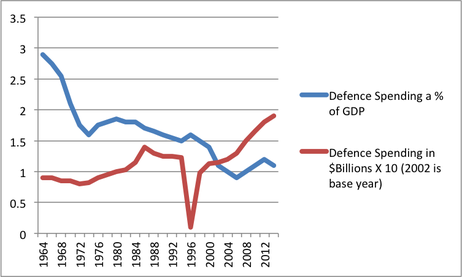
This graph, which is only rough, being drawn from three different sources and “rounded” for ease of plotting, shows, essentially, what happened between 1964 (Prime Minister Pearson) and 2014 Prime Minister Harper). As you can see defence spending as a percentage of Gross Domestic Product ~ a fair measure of our national, political commitment to our defence of Canada and of our allies and neighbours, has declined steadily even though, generally, with one “blip” in the Chrétien era, when he was trying to wrestle with the deficit, the actual dollars spent on defence have grown in number. What it really shows is that our GDP grew a lot in the past 50 years ~ it’s now almost $2.5 Trillion (that’s $2,500,000,000,000.00) ~ but our political willingness (or appreciation of the necessity) to spend 2% of GDP, as we did in about 1970s and as we have, sort of, agreed (in NATO) do aspire to do again, has not kept pace with our increasing prosperity. In fact, while the dollars spend on defence have doubled, in 50 years, the % of GDP spent of defence has fallen to ⅓ of its 1964 level. But ministers’ desires to “talk good fight” remain at historically high levels and even as resources shrink admirals and generals are told to “keep up appearances”. That, keeping up appearances, was what the admirals and generals wanted to do … no one really wanted to go into various international military fora and say “as our resources decline we’re going to have to do less,” instead they went out and said “we’re learning new ways to do more with less,” which is, of course, utter nonsense. Meanwhile more and more quite senior officers came back from tours of duty in the USA and brought with them some very American ideas about organization and management. Now American organizational models might work very well for armies with 1,000,000+ soldiers, or even for those with 495,000, like South Korea’s perhaps, even for those with 100,000+ like the French army, but they are not always or even often suitable for an army with 20,000± regulars and 25,000± reservists. The new organizations might make us look bigger, on paper, but they hide the fact the army has been hollowed out since 1970.
The Army of 1964, the one that consumed its fair share of the 3% of GDP that Canada spent on defence had four brigades, the largest had about 6,500 soldiers in it, the smaller ones had about 5,000 each. That was more men and women in combat units than we have in the entire, top heavy, Canadian Army today in total. But we still have three of the four brigades, we have nine instead of 13 battalions of infantry and three instead of four regiments of artillery … but how? Simple: it’s the Potemkin village, again, battalions that should have 950 soldiers have 500 … if their lucky. In fact there are no combat ready infantry battalions. Any battalion being readied for operations must be reinforced from other infantry battalions … we have nine battalion commanders and nine regimental sergeants major and so on but we only have enough soldiers in rifle platoons to staff five battalions … maybe only four if the battalions are properly equipped with mortars and heavy assault weapons. Why? Because no one, not ministers, not senior civil servants and not the generals want to “cut his coat according to his cloth.”
Ted Campbell, “A Canadian Potemkin Village”, Ted Campbell’s Point of View, 2016-09-15.
May 18, 2018
Deploy scare quotes as required when considering the “cultural” “impact” of the suburbs
Rick McGinnis has a thoughtful piece on the creation and evolution of the modern western suburb, in the context of the ongoing Ontario election:
Maybe it’s some remnant of our tribal past, but it’s hard for us to leave behind some impulse to fear and vilify whoever lives one village over, beyond the river or in the next valley. We might think we’re sophisticated, cosmopolitan people, but this nascent tribalism is never far from the surface, and I saw it re-emerge with a roar during recent municipal elections here in Toronto.
Back when the late Rob Ford won his surprise mayoral victory in 2010 – certainly a surprise for his opponents, who couldn’t imagine how decisively he’d win – the electoral post-mortems painted his triumph as the revenge of the suburbs that once comprised a group of independent townships over the downtown, Toronto’s older urban core.
It was a battle between the suburbs and the city, won this time by the suburbs, who rallied behind various standards – summed up in the media as a love of cars, ethnic and cultural homogeneity and lower property taxes. As with any history written by the losers – the media, for the most part, who identified as urbanite, not suburbanite – it relied on conveniently ignoring facts that didn’t fit, and the deployment of sweeping generalizations, many of them out of date – if they were ever true at all – by decades.
[…]
Up here in Ontario, the imminent provincial election means that the suburbs versus city scenario will be revived, to either apportion blame should Progressive Conservative leader Doug Ford become premier, or get unpacked if he loses and the boogeyman of a monolithic voting bloc needs to be triumphantly debunked.
There remains the small matter that Ford Nation events – held inevitably in the suburbs since the heyday of Doug’s brother Rob – are visibly far more diverse than, say, the average Liberal fundraiser, and Ford opponents have been chewing on that tough gristle for nearly a decade.
Obviously, the suburbs can’t be both a politically, economically and culturally monolithic place, and a diverse, complex collection of communities mysteriously moved to unite during election cycles to oppose the prerogatives of certain political parties and the urbanites who love them. There’s a very complex story about the suburbs dying to be told, but we’re still invested in stereotypes that are decades out-of-date for the purposes of situational political utility. It’s an object lesson that politics, more than anything else, is the enemy of truth.
Diversity has joined “marriage,” “rights,” “privilege” and “family” on that list of words that we’ve come to use without sharing a common meaning, especially when we talk about places like the suburbs, what have come to mean something very different in our imaginations than they exist in reality. For the people living there – whose lived experience has nothing to do with convenient fictions – the suburbs are really just a place where a mortgage might be affordable, where you can have a front and a back yard, and where you don’t share walls with your neighbours.
Rebellion I THE GREAT WAR Week 199
The Great War
Published on 17 May 2018The summer of 1918 saw many ethnic and political groups within the warring empires to openly rebel. The Austro-Hungarian Army saw open mutiny every week, the Irish rebelled against the British, the situation in the newly annexed Eastern European territories that were now part of the German Empire was a powder keg. And in France civilians were sentenced to death for treason.
May 16, 2018
Miracle on the Vistula – Polish Soviet War I BETWEEN 2 WARS I 1920 Part 1 of 4
TimeGhost History
Published on 15 May 2018In 1920 the Bolshevik Russian Red army has more or less routed the Russian counter-revolutionary White armies. Their attention now turns to the West. Lenin wants to take the communist revolution to Germany, France and the United Kingdom. To get there he has to go through Poland though, and he hasn’t counted with Józef Piłsudski, the leader of the Polish Republic.
Most of the amazing colorised pictures in this episode are from Olga Shirnina, who has made a name as one of the best colouring artists there is, especially (but not only) covering Russian historical characters, Check out her website for some amaaaazing eye candy https://klimbim2014.wordpress.com Olga, thanks for letting us use the pictures!
Click here for the rest of the Between 2 Wars series: http://goo.gl/enXJWf
Join the TimeGhost Army at https://timeghost.tv
or on Patreon: https://www.patreon.com/TimeGhostHistoryHosted by: Indy Neidell
Written by Spartacus Olsson and Indy Neidell
Directed by: Spartacus Olsson
Produced by: Astrid Deinhard
Photo Colouring by: Olga Shirnina
Executive Producers: Bodo Rittenauer, Astrid Deinhard, Indy Neidell, Spartacus OlssonA TimeGhost chronological documentary produced by OnLion Entertainment GmbH
Crusader Tank | Animated History
The Armchair Historian
Published on 25 Jun 2016
May 15, 2018
Evolution of French Infantry During World War 1 I THE GREAT WAR Special
The Great War
Published on 14 May 2018The French soldier in 1914 was already very different from the one in 1918 if you looked at his uniform or equipment. Also the combat tactics evolved considerably in four years of war. The Battle of Verdun, the Nivelle Offensive or the Battle of La Malmaison were important steps during that evolution in which the Poilu became a modern French soldier.
French protests over new British submarine in three, two, one…
Gareth Corfield helpfully sums up the reasons for the French to take offence after the Royal Navy chose to name the next Astute-class nuclear submarine HMS Agincourt:
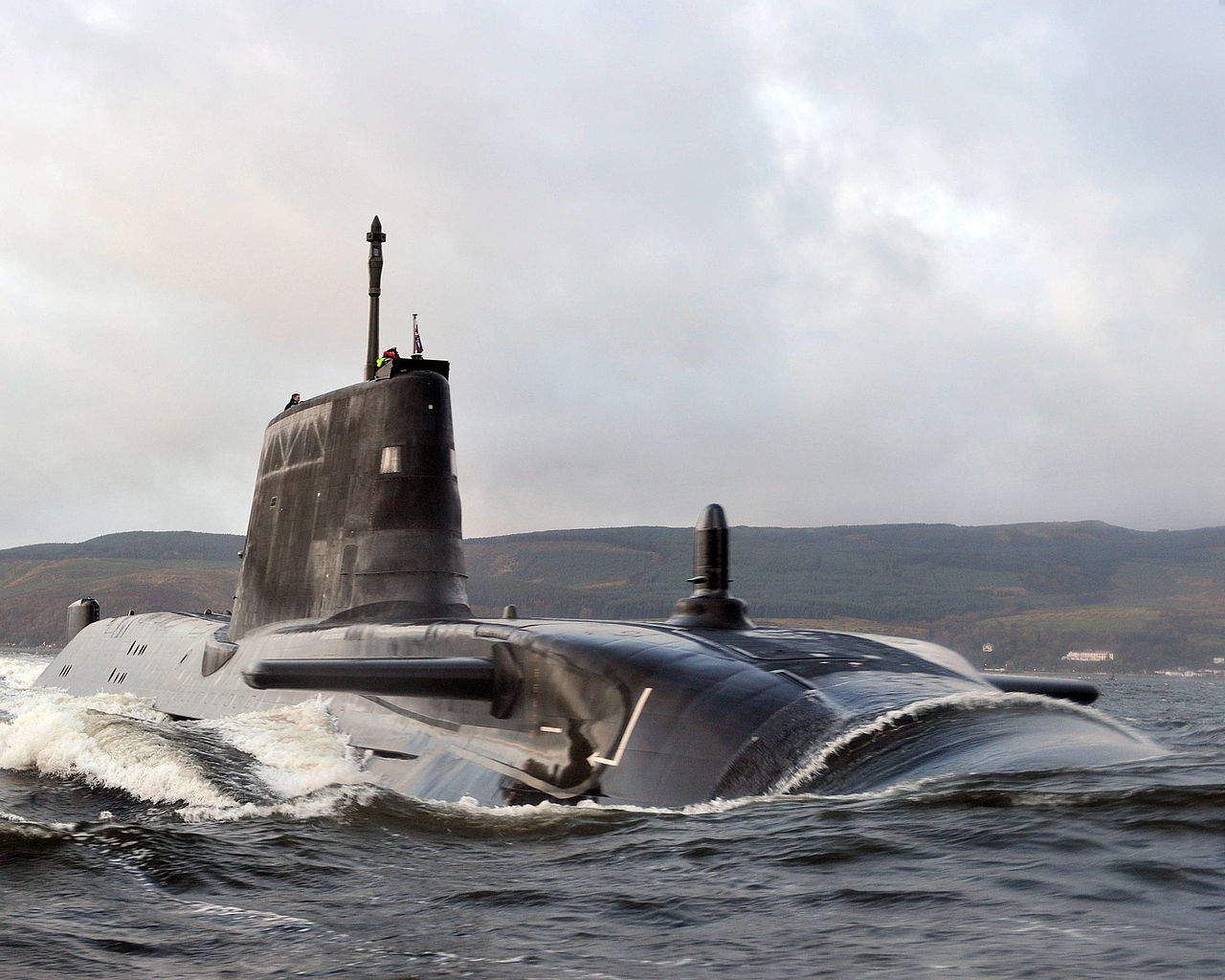
HMS Astute (S119), lead ship of her class, sails up the Clyde estuary into her home port of Faslane, Scotland.
MOD photo, via Wikimedia Commons.
The Royal Navy, always keeping up with the times, has named its newest attack submarine HMS Agincourt, after the 1415 battle where an English army beat French troops led by its nobility.
Agincourt the boat is the seventh and final Astute-class attack sub. The nuclear-powered vessels are used primarily to defend British interests from underwater, including seeing off marauding Russian vessels near British waters and also for sneaky-beaky missions of their own into foreign waters.
The £1.5bn submarine is under construction at BAE Systems’ yard in Barrow-in-Furness, Cumbria. Defence equipment minister Guto Bebb joyously declared: “Today’s announcement includes a £60m contract for Rolls-Royce, supporting over 700 jobs here in Derby as the factory continues to make the reactors that will power our state-of-the-art Dreadnought subs into the 2060s.”
And just to rile up any sensitive French souls, he also gives a thumbnail history of the battle the ship will be named for:
The name Agincourt is mildly controversial, inasmuch as it brings to mind the famous victory of King Henry V over France at a time where the English army, which was blundering around the Pas-de-Calais countryside, was largely thought to be on its last legs and cut off from its chances to retreat back home. In the words of the king’s (fictional, thanks to Shakespeare) eve-of-battle speech, it was “we few, we happy few, we band of brothers” up against the very best France had to offer.
Through “yew bow and cloth yard shaft”, as the chroniclers of the day put it, the English and Welsh longbowmen shot a torrent of arrows into the heavily armoured French knights. The arrows’ steel points penetrated the plate armour of the French nobles and the lightly equipped English then set about the bogged-in Frenchmen, whose weighty suits of armour were totally unsuited to the heavy mud of the battlefield.
In today’s world, where the UK and France are close allies and England has given way to the United Kingdom, naming the submarine Agincourt may be seen by some as a bit of an unintentional snub, bringing to mind Henry V’s slaughter of French prisoners of war and the failed negotiations that preceded the battle over Henry’s disputed claim to the title of King of France.
QotD: The making of Gandhi
As it happens, the government of India openly admits to having provided one-third of the financing of Gandhi out of state funds, straight out of the national treasury — and after close study of the finished product I would not be a bit surprised to hear that it was 100 percent. If Pandit Nehru is portrayed flatteringly in the film, one must remember that Nehru himself took part in the initial story conferences (he originally wanted Gandhi to be played by Alec Guinness) and that his daughter Indira Gandhi is, after all, Prime Minister of India (though no relation to Mohandas Gandhi). The screenplay was checked and rechecked by Indian officials at every stage, often by the Prime Minister herself, with close consultations on plot and even casting. If the movie contains a particularly poisonous portrait of Mohammed Ali Jinnah, the founder of Pakistan, the Indian reply, I suppose, would be that if the Pakistanis want an attractive portrayal of Jinnah let them pay for their own movie. A friend of mine, highly sophisticated in political matters but innocent about film-making, declared that Gandhi should be preceded by the legend: The following film is a paid political advertisement by the government of India.
Gandhi, then, is a large, pious, historical morality tale centered on a saintly, sanitized Mahatma Gandhi cleansed of anything too embarrassingly Hindu (the word “caste” is not mentioned from one end of the film to the other) and, indeed, of most of the rest of Gandhi’s life, much of which would drastically diminish his saintliness in Western eyes. There is little to indicate that the India of today has followed Gandhi’s precepts in almost nothing. There is little, in fact, to indicate that India is even India. The spectator realizes the scene is the Indian subcontinent because there are thousands of extras dressed in dhotis and saris. The characters go about talking in these quaint Peter Sellers accents. We have occasional shots of India’s holy poverty, holy hovels, some landscapes, many of them photographed quite beautifully, for those who like travelogues. We have a character called Lord Mountbatten (India’s last Viceroy); a composite American journalist (assembled from Vincent Sheehan, William L. Shirer, Louis Fischer, and straight fiction); a character called simply “Viceroy” (presumably another composite); an assemblage of Gandhi’s Indian followers under the name of one of them (Patel); and of course Nehru.
I sorely missed the fabulous Annie Besant, that English clergyman’s wife, turned atheist, turned Theo-sophist, turned Indian nationalist, who actually became president of the Indian National Congress and had a terrific falling out with Gandhi, becoming his fierce opponent. And if the producers felt they had to work in a cameo role for an American star to add to the film’s appeal in the United States, it is positively embarrassing that they should have brought in the photographer Margaret Bourke-White, a person of no importance whatever in Gandhi’s life and a role Candice Bergen plays with a repellant unctuousness. If the film-makers had been interested in drama and not hagiography, it is hard to see how they could have resisted the awesome confrontation between Gandhi and, yes, Margaret Sanger. For the two did meet. Now there was a meeting of East and West, and may the better person win! (She did. Margaret Sanger argued her views on birth control with such vigor that Gandhi had a nervous breakdown.)
I cannot honestly say I had any reasonable expectation that the film would show scenes of Gandhi’s pretty teenage girl followers fighting “hysterically” (the word was used) for the honor of sleeping naked with the Mahatma and cuddling the nude septuagenarian in their arms. (Gandhi was “testing” his vow of chastity in order to gain moral strength for his mighty struggle with Jinnah.) When told there was a man named Freud who said that, despite his declared intention, Gandhi might actually be enjoying the caresses of the naked girls, Gandhi continued, unperturbed. Nor, frankly, did I expect to see Gandhi giving daily enemas to all the young girls in his ashrams (his daily greeting was, “Have you had a good bowel movement this morning, sisters?”), nor see the girls giving him his daily enema. Although Gandhi seems to have written less about home rule for India than he did about enemas, and excrement, and latrine cleaning (“The bathroom is a temple. It should be so clean and inviting that anyone would enjoy eating there”), I confess such scenes might pose problems for a Western director.
Richard Grenier, “The Gandhi Nobody Knows”, Commentary, 1983-03-01.
May 14, 2018
The Empire of Mali – The Final Bloody Act – Extra History – #5
Extra Credits
Published on 12 May 2018The Mali Empire comes to an end after the rise of rival powers and weakened by colonial influences, but not without leaving a legacy as a place of wealth and splendor.


