
Of such sorts are the wizards who now run the country. Here is the perfect pattern of a professional world-saver. His whole life has been devoted to the art and science of spending other people’s money. He has saved millions of the down-trodden from starvation, pestilence, cannibalism, and worse – always at someone else’s expense, and usually at the taxpayer’s. He has been going at it over and over again at Washington. And now, with $4,800,000,000 of your money and mine in his hands, he is preparing to save fresh multitudes, that they may be fat and optimistic on the Tuesday following the first Monday in November, 1936, and so mark their ballots in the right box.
H.L Mencken, “The New Deal”, Baltimore Sun, 1935-05-27.
January 25, 2018
QotD: The New Deal
Comments Off on QotD: The New Deal
January 24, 2018
Day 9 Cuban Missile Crisis – Blockade starts and low altitude flybys over Cuba
TimeGhost
Published on 23 Nov 2017On October 24, 1962 the US led blockade on Cuba goes into effect, but it’s not the be the showdown that it looks like! In the same time the US Navy starts flying RF8 Crusader reconnaissance jets 400 feet over the missile sites on Cuba, to see what’s really going on. As the jets roar over the heads of the Cuban and Soviet soldiers, the crisis deepens.
Comments Off on Day 9 Cuban Missile Crisis – Blockade starts and low altitude flybys over Cuba
Peter Jackson to bring modern digital technology to bear on IWM film footage of the Great War
Elizabeth sent me a link to this Daily Mail article on Peter Jackson’s new project:
When you think of First World War footage, chances are you conjure up grainy images of soldiers and jumpy footage of the trenches.
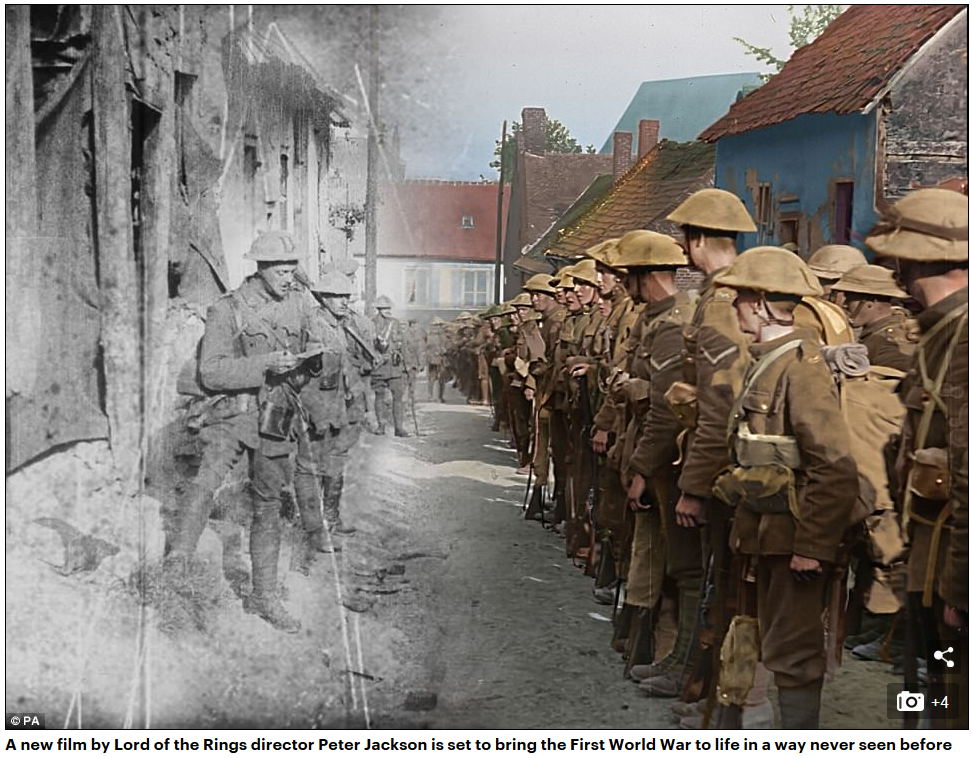
But a new 3D film by Lord of the Rings director Peter Jackson is set to bring the conflict to life in a way never seen before.
The Oscar-winner has restored and colourised 100-year-old footage from the Imperial War Museum’s vast archive, and early photos suggest the results will be remarkable.
One comparison shot shows the dramatic transformation from poor quality black-and-white scenes to clear colour images, while another shows the radically sharpened faces of our troops.
Jackson said he hoped the film, which will premiere at the BFI London Film Festival before airing on BBC1 later this year, will help audiences better connect ‘with the events on screen’.
Explaining the painstaking process of restoring the footage, he said: ‘We started to do some experiments and I was honestly stunned by the results we were getting. We all know what First World War footage looks like.
‘It’s sped up, it’s fast, like Charlie Chaplin, grainy, jumpy, scratchy, and it immediately blocks you from actually connecting with the events on screen.
Comments Off on Peter Jackson to bring modern digital technology to bear on IWM film footage of the Great War
January 23, 2018
British Pistols of World War 1 I THE GREAT WAR Special feat. C&Rsenal
The Great War
Published on 22 Jan 2018Check out Othais’ YouTube channel: https://www.youtube.com/candrsenal
Othais introduces the standard British pistols and revolvers to Indy, including the iconic Webley series.
Comments Off on British Pistols of World War 1 I THE GREAT WAR Special feat. C&Rsenal
Day 8 Cuban Missile Crisis – Kennedy and Khrushchev face reality
TimeGhost
Published on 20 Nov 2017On October 23, 1962 as the blockade on Cuba is being prepared, US President John F. Kennedy and USSR Chairman Nikita Khrushchev question their own actions realising that they might have gone a step too far. By now the dice have been rolled and it’s too late to stop the wheels from spinning. Both leaders try to justify their decisions to maintain their political power.
Comments Off on Day 8 Cuban Missile Crisis – Kennedy and Khrushchev face reality
January 22, 2018
Day 7 Cuban Missile Crisis – USA announces a blockade on Cuba
TimeGhost
Published on 16 Nov 2017On October 22, 1962 the world is shocked to find out that the US and the USSR are facing off with nuclear arms in the Caribbean. In the world’s first televised announcement of an international military crisis, US President John F. Kennedy sets off panic and sudden fear of a third world war, with nuclear arms involved.
Comments Off on Day 7 Cuban Missile Crisis – USA announces a blockade on Cuba
Khosrau Anushirawan: On Top of the World – Extra History – #5
Extra Credits
Published on 20 Jan 2018Plague had brought an end to Khosrau’s war against Justinian, but Justinian’s nephew soon reignited the rivalry. Khosrau was at the peak of his political power and eager to crush this young upstart personally… but old age had also crept up on him.
Comments Off on Khosrau Anushirawan: On Top of the World – Extra History – #5
January 21, 2018
Day 6 Cuban Missile Crisis – Mr. President did you say blockade, or invade Cuba?
TimeGhost
Published on 13 Nov 2017On October 21 1962, politicians and military in both the US and in the USSR seem to have contradictory views on what to do next. The questions on the table; blockade AND invade Cuba, or just a quarantine? Should the Soviet local commanders on Cuba get to play with the little nukes as they like, or rather wait for permission? When it’s only the world as we know it that’s at stake…
Comments Off on Day 6 Cuban Missile Crisis – Mr. President did you say blockade, or invade Cuba?
Central Powers Occupation Of Italy I THE GREAT WAR On The Road
The Great War
Published on 20 Jan 2018Visit the Museum: http://bit.ly/MuseiVittorioVeneto
Indy takes a tour through the Museo della Battaglia Vittorio Veneto and explores the Central Powers occupation of Northern Italy and the set up for the famous Battle of Vittorio Veneto.
Comments Off on Central Powers Occupation Of Italy I THE GREAT WAR On The Road
Sun Tzu – The Art of War l HISTORY OF CHINA
IT’S HISTORY
Published on 8 Aug 2015Sun Tzu’s The Art of War is a book on military strategies written around 500 BC, between the collapse of the Zhou dynasty and the rise of the first emperor of imperial China. Today Tzu’s guidelines are still as applicable as ever. They are still being read by military commanders, politicians and businesspeople all over the world. Also known as “Master Sun’s Military Methods”, the book explains basics like the “Strategy of Attack”, “Moving the Army” and even “Employing Spies” in 13 short chapters, restricting itself to general principles rather than detailed instructions of strategy and tactics. Learn all about this timeless and influential military masterpiece on IT’S HISTORY.
Comments Off on Sun Tzu – The Art of War l HISTORY OF CHINA
January 20, 2018
Day 5 Cuban Missile Crisis – President Kennedy Considers War
TimeGhost
Published on 9 Nov 2017On Saturday October 20th, 1962, US President John F Kennedy moves to side more with the hawks advising a forceful response to the Cuban Missile Crisis. Meanwhile in Moscow, the Soviets now believe that they deterred the Americans from using force.
Comments Off on Day 5 Cuban Missile Crisis – President Kennedy Considers War
January 19, 2018
Assassination Attempt on Lenin – Chaos in Romania I THE GREAT WAR Week 182
The Great War
Published on 18 Jan 2018This week in Russia, Bolshevik leader Vladimir Lenin was almost killed by sharpshooters in Petrograd and the Constituent Assembly meets. Tensions rise as Russia issues an ultimatum to Romania, with an order for their King’s arrest. There are also machinations in Finland and some action on the Western Front.
Comments Off on Assassination Attempt on Lenin – Chaos in Romania I THE GREAT WAR Week 182
Day 4 Cuban Missile Crisis – Soviet nukes ready to strike the US
TimeGhost
Published on 6 Nov 2017On the 19th of October 1962, the Soviet nuclear forces on Cuba are working on getting the warheads for their SS4 missiles combat ready. In Washington, President John F. Kennedy faces off with the Joint Chiefs of Staff, including General Curtis LeMay (his arch enemy), who demand more freedom for military action.
Comments Off on Day 4 Cuban Missile Crisis – Soviet nukes ready to strike the US
What “killed” the most tanks in World War 2?
Military History Visualized
Published on 22 Dec 2017This video discusses what killed the most tanks in World War 2. Was it anti-tank guns, mines, planes, hand-held anti-tank weapons, mechanical breakdowns, etc. Also a short look at the problems of the term “kill”, e.g., mobility, firepower and catastrophic/complete kill.
Original Question by Christopher: “What destroyed the most tanks during WW2: infantry, planes, anti-tank guns, or other tanks (I’m not sure if tank destroyers needs its own category or not).”
Comments Off on What “killed” the most tanks in World War 2?


