
Overly Sarcastic Productions
Published on 5 Apr 2019Everybody loves a good creation myth. The Aztecs loved it so much they did it five whole times! I’d call it “overkill”, but compared to all the other stuff the aztecs believed, four mythical extinction events is actually remarkably tame.
April 9, 2019
Miscellaneous Myths: The Five Suns
Comments Off on Miscellaneous Myths: The Five Suns
Canada and the Battle of the Atlantic, part 8 by Alex Funk
Editor’s Note: This series was originally published by Alex Funk on the TimeGhostArmy forums (original URL – https://community.timeghost.tv/t/canada-and-the-battle-of-the-atlantic-part-3/1442).
Sources:
- Far Distant Ships, Joseph Schull, ISBN 10 0773721606 (An official operational account published in 1950, somewhat sensationalist)
[Schull’s book was published in part because the funding for the official history team had been cut and they did not feel that the RCN’s contribution to the Battle of the Atlantic should have no official recognition. It is very much an artifact of its era, and needs to be read that way. A more balanced (and weighty) history didn’t appear until the publication of No Higher Purpose and A Blue Water Navy in 2002, parts 1 and 2 of the Official Operational History of the RCN in WW2, covering 1939-1943 and 1943-1945, respectively.]- North Atlantic Run: the Royal Canadian Navy and the battle for the convoys, Marc Milner, ISBN 10 0802025447 (Written in an attempt to give a more strategic view of Canada’s contribution than Schull’s work, published 1985)
- Reader’s Digest: The Canadians At War: Volumes 1 & 2 ISBN 10 0888501617 (A compilation of articles ranging from personal stories to overviews of Canadian involvement in a particular campaign. Contains excerpts from a number of more obscure Canadian books written after the war, published 1969)
- All photos used exist in the Public Domain and are from the National Archives of Canada, unless otherwise noted in the caption.
I have inserted occasional comments in [square brackets] and links to other sources that do not appear in the original posts. A few minor edits have also been made for clarity.
Earlier parts of this series:
Part 8 — Expansion problems: not enough men for not enough ships
Marc Milner discusses the RCN’s ongoing manning crisis afloat and ashore in North Atlantic Run:
… it was also necessary to find personnel to man new shore establishments. Indeed, by early 1941 the latter took precedence of the needs of the fleet. Although the navy remained committed to increasing the number of escort numbers assigned to its first operational priority, defence of the North Atlantic trade lanes, the gradual extension of the war underlined the paramount need for bases. “Our primary object from the Naval point of view,” a Canadian Chiefs of Staff “appreciation” of May 1941 observed, “must therefore be the extension of existing facilities and the provision of new ones to meet the ever-increasing demands of the British — and perhaps the United States — Naval forces.” The expansion fleet was then only one part of a much larger plan of support for North Atlantic naval operations. Moreover, actual planning for the commissioning and work-up of the new escorts took place as the fleet assumed new and more demanding tasks.
The concern of the Chiefs of Staff for facilities underlined the fact that even by the second winter of the war the navy’s growth was still held in check by enormous shortages. … The Director of Naval Personnel, Captain H.T.W. Grant, informed the council that the RCN needed three hundred RCNVR executive officers — none of whom had yet been enlisted — if the authorized commitments for the following May were to be met. This was no mean task in itself, but the Naval Council noted that the training establishments needed to prepare the men had to be built first. The final twist occurred when the minister advised that the navy must first make steps to acquire the necessary land!
As Nelles later explained in a personal letter to Admiral Sir Dudley Pound, the First Sea Lord, the RCN was indeed making bricks without straw. … The primary need was now quantity in all aspects of naval endeavour — manpower, ships, and bases.
With existing training establishments choked and new ones still in the planning stages, the provision of personnel for the expanding fleet posed a serious problem. Urgency was to Canadian planning in late 1940, when it became clear that Britain was involved in what Nelles described as “a Naval crisis equal [to] or greater than that which existed in 1917.”
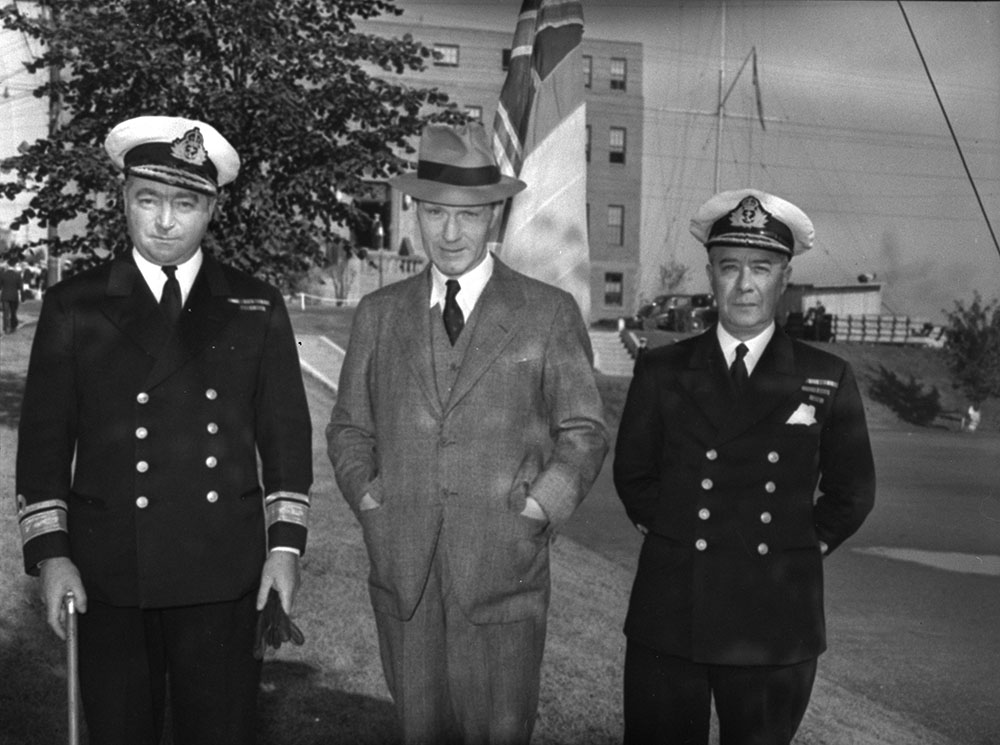
Hon. Angus L. Macdonald, Minister of National Defence for Naval Services, with senior RCN officers, Commodore H.E. Reid and Rear-Admiral P.W. Nelles, September 1940.
Canada. Dept. of National Defence / Library and Archives Canada / PA-104112
To help address the RCNVR officer shortage, a deal was agreed between the RCN and the RN by which RCNVR officers-in-training would travel to England and receive training at HMS King Alfred, the reservist training centre at Hove:
The great irony of the scheme was that it proved virtually impossible to draw on this body of highly trained Canadian naval officers later on, when the RCN was badly in need of qualified personnel. Certainly the King Alfred plan did nothing to resolve the shortage of qualified officers that crippled the fleet in 1941.
Another aspect of proper planning was work-up and operational training facilities for the fleet, particularly with respect to ASW.
Especially considering numerous British complaints of the low quality of Canadian ASW efforts on destroyers operating from UK bases. Canada had possessed no submarines since 1922 and had long since lost the ability to operate them. There was one submarine operating with the RN’s Third Battle Squadron out of Halifax: the Dutch O-15:
At the end of November, the Naval Staff formally requested that O-15 be made available for A/S training. For the moment, the Admiralty refused, although some exercises were conducted with her later in the year.
[Editor’s Note: The Dutch Submarines page on O-15 says “… the RCN was so desperate for ASW training in 1940 that when a Dutch submarine, which had avoided capture when Holland was invaded, fetched up in Halifax en route to England, the navy used it without permission and would not let it go when the Admiralty asked them to relinquish her …”]
Unable to obtain satisfaction from British sources, the RCN turned to the US, where preliminary investigations into acquiring an older USN submarine were made in early 1941. Commodore H.E. Reid, the naval attaché in Washington, raised the matter with the new Permanent Joint US-Canadian Board of Defense and then set about beating the bushes in more obscure parts of the American capital. By the end of January it was clear there were no submarines of any description would be forthcoming from American sources. The only gesture of assistance that the USN made was an offer to send a squadron of submarines (four boats) on a courtesy visit sometime in the summer. The RCN was advised to prepare itself to make maximum use of two to three weeks of free ASDIC training time. It was a generous offer, but it did not provide the RCN with a long-term solution to the pressing problem of providing ASDIC trainees with proper targets. Probably for this reason and because of the fear that acceptance would prejudice negotiations still underway regarding the future of O-15, the RCN politely declined the American offer. A few days later the Admiralty signalled its consent to the use of O-15 for A/S training.
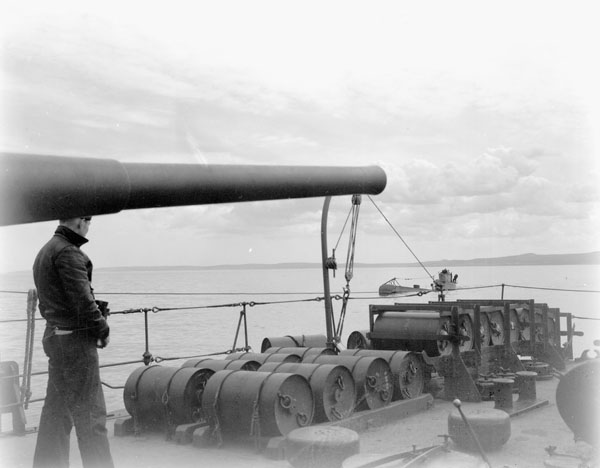
View from HMCS ST Laurent of the submarine O-15 of the Royal Netherlands Navy during an anti-submarine training exercise off Pictou, Nova Scotia, Canada, 20 August 1941.
Canada. Dept. of National Defence / Library and Archives Canada / PA-105491
While extremely useful, one submarine was not sufficient for all training needs and the shortage would continue until 1943 when Italian and Free French submarines became available in the Western Atlantic to help train US-built British destroyer escorts commissioning from US ports.
… having secured the services of O-15, there was no reason not to return to the American offer of training time on US submarines. That the RCN saw fit to reject direct USN assistance was the first sign of what became a curious, closely guarded attitude on the part of the RCN towards the USN. Nor were training submarines the only answer to preparing escorts for battle with the U-boats. Had the RCN — and the RN, for that matter — been more attuned to developments in the war at sea and seen the U-boat pack for what it really was, a flotilla of submersible torpedo boats, motor launches would have formed an essential part of A/S training as well. These small craft offered an excellent substitute for a training submarine in exercises designed to simulate night attacks on convoys, but it was not until 1942 that the RCN would begin to use launches for that purpose. The continuing fixation with submerged targets was understandable, since training on an actual submarine was the only means of attaining and maintaining efficiency among ASDIC operators. …
Aside from the escorts operating from the UK, RCN expansion hung fire during the winter of 1940-1. Obviously it would have been better to commission twenty corvettes into the RCN during 1940, as the Staff had originally planned. But when winter closed its icy grip on the St. Lawrence River, only four were operational.
A few more ships were patrolling and training in Pacific waters, and they would be joined by fresh ships commissioned on the west coast from British Columbian yards over the winter (six ships all told). The last week of April brought the thaw, and with spring came the expected deluge of new ships. Orillia, Pictou, and Rimouski were down the river before the month ended. In May, ten more were accepted into service, three for the west, six for the east. (Including HMCS Baddeck, the ship that Captain Alan Easton, whose firsthand account I find quite fascinating, first commanded.)
In a period of seven months thirty-three warships were added to the Navy List, slightly over half of the 1939-40 construction program.
Had it been possible to build the fleet entirely on the Atlantic or Pacific coasts, the seasonal character of expansion would have been averted. But because of the heavy demand for repair work on east coast yards after the fall of France only three orders for corvettes were ever placed east of the St. Lawrence River. [All at Saint John Shipbuilding.] All of these were much delayed, and the last to commission, Moncton not taken into service until April 1942 — two full years after the commencement of the program.
Lieutenant-Commander Easton described his first look at and first voyage of the Baddeck in 50 North: Canada’s Atlantic Battleground:
She was resting on the blocks of a dry-dock in a shipyard farther up the [St. Lawrence] river when I first saw her. I had stood on the wall and looked down at her sturdy features, the brand new vessel which was to take me many miles over the ocean. HMCS Baddeck was mine; we were to share at least a part of our lives together.
I was elated at being given command. I could not thank anybody because the news came in a naval signal, one of those pieces of paper rather like a telegram, but without the advertising at the top. I just had time to catch the night train from Halifax to Quebec.
When anyone is given an appointment which places him in charge of something which he thinks is pretty important, it generally makes him feel he has been singled out as being above the crowd. But this was not so in my case; the authorities who selected me probably had no alternative. There was no one else handy. In the Royal Canadian Navy during the first half of the war, there were not enough people to go round. Often you got the job whether you deserved it or not.
I could see now that the ship had been built mainly after the fashion of a big steam trawler, but with a longer and sharper bow. From drawings I had seen I knew she was 204 feet long and had a thirty-three-foot beam. Her appearance fitted these dimentions and in her nakedness her fat belly seemed to bulge over the floor of the dry dock, suggesting an ample capacity for, among other things, a large engine. Her rounded stern was inclined to turn up like a duck’s tail.
[…]
The first sight of a ship in which one is going to sail is always exciting, that first intensely interesting glimpse which creates an immediate impression — sometimes of disappointment. […] This time I was not disappointed. And as I stood on her deck, I felt alone with her in the silence of the deserted yard. It was Sunday and everything was quiet — no hammering or riveting, no trail of steam drifting up from the machine shop. Would she stay young like this or grow old quickly? I was glad it was quiet because this was my private introduction and she would try to show me herself — before our exploits began.
Exploits? That was the trouble. She might never be involved in a fight. A corvette, after all, was designed for coastal patrol work. And Canada had a long coastline. The war was on the other side of the Atlantic.
It was a month or more before I had an opportunity to try out her promises of performance on the broad reaches of the St. Lawrence below Quebec. She had been fitted out, her crew had come on board and she had been duly commissioned into the Royal Canadian Navy.
Many men felt strange. But this alien environment was what a good many expected, even sought, when they joined the navy. Stokers looked into the furnaces and felt the burners they would be tending. They looked for a quiet spot in the mess deck to sling their hammocks. They did not know then there would be no quiet spot. Most of them — for most were new to this — felt a twinge of concern and a little ache of homesickness. But these were hidden by an extra swing of the shoulder and more noise than necessary.
There had been no fanfare on leaving. No “off to war” business. Just a farewell hoot of the whistle as we pulled out into the river and headed down-stream for the coast. […] Of the three officers, only the navigator had been in a ship before. He had been twenty-five years at sea in all sorts of small vessels. He had started to sea in fishing vessels when he was twelve, and had gone on from schooners to small steamers to become master of a coastal tanker. He was a rough and readly little man and a rule-of-thumb navigator, I suspected; not that I was disinclined to be one myself. Of the 50 men, about five had been professional sailors or fishermen and, below, no more than six were experienced with engines and boilers. So with more than three-quarters of the complement as fresh to the sea as the ship herself, it was hard to perform our simple task; hard to keep steam up, avoid the shoals or even to steer a straight course. Had anything warlike occurred there would have been a shambles.
Thus, while we were on patrol, the few who knew their profession taught the others. The principles had been explained to them ashore and our specialists had been well instructed, but when they came to supply their knowledge in the ship, a place where discomfort alone had a dazing effect on the mind as well as the stomach, it did not always work out as expected.
We went at it systematically. I had been back at sea almost continuously since the beginning of the war. I was, therefore, in a fair position to know what was needed to develop the crew.
Boats were lowered many times and rowed and then hoisted; men swung the lead for soundings; they put out fires; they were taught lookout-keeping; they learned to read a swinging compass and compensate with the wheel; to stoke the furnaces without belching smoke; handle guns in a choppy sea and to throw a heaving line. But all of this was not learned easily.
Coming in from one of the patrols we were going alongside a jetty, which was overlooked by the admiral’s office; the admiral was known to be fond of observing his ships docking. A strong offshore wind was blowing. It was now or never with the heaving line as the bow of the ship drew parallel to the jetty at a nice throwing distance. An able seaman heaved but his line went up like the first act of the Indian rope trick instead of across the gap. It came down in the water on the lee side. The gap widened but another man standing by with a spare coiled line, in case the first man missed, heaved. It reached the jetty and was caught but the thrower was empty-handed. The end of the rope had gone too! The ship drifted away. And the admiral looked down from his window on the performance.
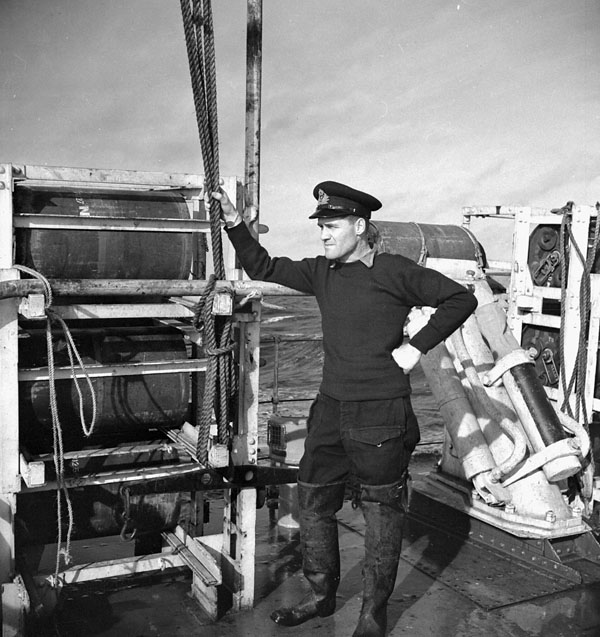
Lieutenant-Commander Alan H. Easton, DSC, Commanding Officer of the frigate HMCS Matane, Halifax, Nova Scotia, Canada, January 1944.
Lt. Gilbert A. Milne / Canada. Dept. of National Defence / Library and Archives Canada / PA-206442
Marc Milner, North Atlantic Run:
Staff preoccupation with a myriad of apparently non-essential matters also stemmed from the lack of any sense of urgency over the commissioning of the corvette fleet, at least for operational purposes. Despite Nelles’ stated concern over a possible repeat of 1917, even the Admiralty advised in February 1941 that the RCN could accept a delay in the attainment of competence by its own corvettes. Further, although the navy ardently desired to play a full role overseas in what Nelles described as the “theatre of active operations”, the Naval Staff decided in October 1940 that the products of the first construction program would go to meet home requirement first. Once fifty per cent of the latter were met, escorts would be sent to the Eastern Atlantic — the war zone — on an equal priority basis.
Despite the policy of sending auxiliaries overseas and the sure knowledge that the RN was already using its own corvettes as ocean escorts, there is no indication that the RCN believed either that its corvettes would be called up for similar activities or that they required modification to make them more suited to an ocean escort role. In fact, Canadian escorts were primarily intended for inshore duty, as had been the original intentions of the British as well. But the inshore role of Canada’s corvettes was reinforced by defense arrangements made between the US and Canada after the fall of Western Europe. In August 1940 the new Canadian-American Permanent Joint Board of Defence produce its first basic defence plan (Number 1) for North America. It adopted a worst-case scenario, the defeat of Britain by Germany, followed by a contined state of war between Germany and the Commonwealth, from which it took its sobriquet, Plan “Black”.
Canadian corvettes under Plan Black were to be formed into five-ship ASW strike forces that would hunt down and destroy U-boats for the RCN’s system of defended ports. Primarily hunting in the approaches to harbours or at the focal points of trade. “It was expected that in some cases, notably off Halifax and Sydney, corvettes would conduct some local escort, though for Canadian purposes this was not their primary role.”
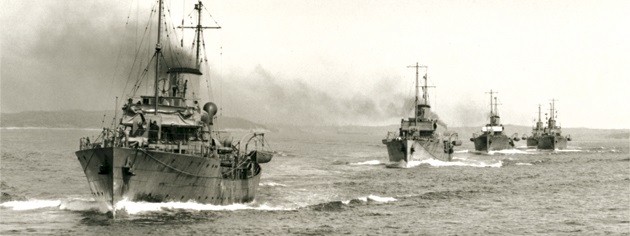
A line of corvettes departing Halifax, April 1941.
Source: Library and Archives Canada – PA105334
In addition to this offensive use of corvettes, the navy also looked forward to the commissioning of the first construction-program ships in order to proceed with many aspects of expansion, such as training. For the professional navy at least the corvette fleet was not the embodiment of naval expansion. Rather it was, as Nelles described it, a “stepping stone”. Events at sea would soon change this, but it would take some time before that change affected attitudes in Ottawa.
On the ocean, as the war at sea intensified it pushed further westward. Over the winter the dispersal points under British ASW escort had moved steadily into the mid-Atlantic. The bases in established in Iceland in April 1941 allowed escort to roughly 35 degrees west.
This move, in conjunction with a similar extension of air escort, proved initially successful. During April three convoys were attacked in the area that had previously uncovered by A/S escorts, and three U-boats were sunk in the ensuing actions. The Germans, once again finding the climate around defended trade too unhealthy, simply pushed farther west. In May they struck at Halifax-to-UK convoy HX-126 as it approached the limits of A/S cover. Before the escort could join, a U-boat pack of six attackers sank five ships. In the face of a continued threat, the convoy was dispersed, which led to further losses. To forestall further German success, the gap in continuous A/S escort of convoys between the limits of local Canadian escorts and those of the RN based in Iceland needed to be filled.
Comments Off on Canada and the Battle of the Atlantic, part 8 by Alex Funk
Siege of Vienna – Opening Bombardment – Extra History – #1
Extra Credits
Published on 6 Apr 2019Mehmed IV wanted to live up to, and even surpass, the legacy of his forefather Mehmed II, who had secured the Ottomans’ inheritance to the Roman Empire through his conquest of Constantinople. So the current Mehmed decided to target Vienna — but Emperor Leopold dismissed these threats…
Over a hundred thousand Ottoman troops are heading for Vienna. Only 15,000 men defend the walls. They have only six days to prepare the city. How long can they hold?
Join us on Patreon! http://bit.ly/EHPatreon
Comments Off on Siege of Vienna – Opening Bombardment – Extra History – #1
Blue’s Dumb History Tales
Overly Sarcastic Productions
Published on 8 Mar 2019Please check out That Works for the best blacksmithing on YouTube: https://goo.gl/vXsuFt
What do you get when you cross a month that has 5 Fridays with a historian who can’t do math? This nonsense, apparently.
PATREON: https://www.patreon.com/OSP
Comments Off on Blue’s Dumb History Tales
April 8, 2019
Canada and the Battle of the Atlantic, part 7 by Alex Funk
Editor’s Note: This series was originally published by Alex Funk on the TimeGhostArmy forums (original URL – https://community.timeghost.tv/t/canada-and-the-battle-of-the-atlantic-part-3/1442).
Sources:
- Far Distant Ships, Joseph Schull, ISBN 10 0773721606 (An official operational account published in 1950, somewhat sensationalist)
[Schull’s book was published in part because the funding for the official history team had been cut and they did not feel that the RCN’s contribution to the Battle of the Atlantic should have no official recognition. It is very much an artifact of its era, and needs to be read that way. A more balanced (and weighty) history didn’t appear until the publication of No Higher Purpose and A Blue Water Navy in 2002, parts 1 and 2 of the Official Operational History of the RCN in WW2, covering 1939-1943 and 1943-1945, respectively.]- North Atlantic Run: the Royal Canadian Navy and the battle for the convoys, Marc Milner, ISBN 10 0802025447 (Written in an attempt to give a more strategic view of Canada’s contribution than Schull’s work, published 1985)
- Reader’s Digest: The Canadians At War: Volumes 1 & 2 ISBN 10 0888501617 (A compilation of articles ranging from personal stories to overviews of Canadian involvement in a particular campaign. Contains excerpts from a number of more obscure Canadian books written after the war, published 1969)
- All photos used exist in the Public Domain and are from the National Archives of Canada, unless otherwise noted in the caption.
I have inserted occasional comments in [square brackets] and links to other sources that do not appear in the original posts. A few minor edits have also been made for clarity.
Earlier parts of this series:
Part 7 — The end of 1940, rise of the U-boat threat, the corvette waddles into the war, and expansion headaches at every turn
In North Atlantic Run, Marc Milner outlines some of the challenges being faced by the escort fleet in the changing conditions of the Battle of the Atlantic:
The fall and winter of 1940-1 was a peculiar time for escort operations, and pre-war concepts of trade defence and ASW were under strain. Losses to convoys were high, and authorities were baffled about effective countermeasures. There was a strong lobby within the RN, supported by Churchill while he was First Lord of the Admiralty and after he became prime minister, that favoured offensive action against U-boats by even the slenderest of escorts. The two schools of thought, one favouring an active pursuit of the enemy and the other the primacy of escort, were still matters for debate when the Canadians joined the Clyde Escort Force in late 1940. Through the winter the issue was finally resolved in favour of defence as the first priority. However, in light of the subsequent Canadian tendency to pursue even the most tenuous contacts with zeal, it is questionable if this exposure to nascent British escort tactics did the RCN much good. … By January all the River-class ships and four of the Towns — two having been held back by defects — were operating from the Clyde. During this second winter of the war there were also Canadian corvettes in the Clyde Escort Force participating in the crucial battles of the first phase of U-boat pack attacks. These corvettes were actually the ten of their class built in Canada to British accounts. All were completed before the freeze-up of late 1940, and the RCN assumed responsibility for their acceptance from the builders, commissioning into the RN, and manning for passage to the UK. Once in England the ships were to be handed over to the Admiralty. Unfortunately things did not go as planned, and the RCN ended up taking all ten of these corvettes into Canadian service.
The story of the “British” corvettes and their transfer to the RCN is an important one, for it illustrates the kinds of problems the RCN had when dealing with the RN. Because the ships were manned for passage only, their crews were the barest minimum, roughly assembled from spare hands, all of whom were designated for other duties upon completion of the crossing. Personnel from the first corvettes to go, for example, were assigned to HMCS Dominion, the RCN’s depot in Britain [Dominion was designated as a ship for administrative purposes, there was no actual physical vessel]. They were to form a manning pool for the destroyers already on operations in British waters. Those from the later passages were to return immediately to commission new RCN corvettes. All ten “British” corvettes were in the UK by early 1941 (the ships were named after flowers, following the Admiralty practice: Arrowhead, Bittersweet, Eyebright, Fennel, Hepatica, Mayflower, Snowberry, Spikenard, Trillium, and Windflower), but from the outset it proved impossible to obtain the release of their crews. As early as October of 1940, Dominion requested, on behalf of the Admiralty, that the crews of three recently arrived corvettes be allowed to remain aboard until the end of November. Reliefs for destroyer personnel, it was explained, could be drawn from the smaller ships (in the form of a “floating” pool) and the ships turned over to the RN in piecemeal fashion. NSHQ concurred, but no British replacement crews were forthcoming, and the issue remained unresolved. The corvettes, meanwhile, began escort operations with the Clyde force.
By February 1941 the delay in the release of men from the British corvettes began to affect planning of the RCN’s own expansion. Commodore G.C. Jones, RCN, commanding officer, Atlantic Coast (COAC) complained that the men should be returned to Canada before the opening of navigation on the St Lawrence River deluged the navy with new ships. “If our present commitments are to be met,” Jones observed, “it is essential this personnel be available.” He was advised by NSHQ that the matter was under review and that a decision was pending. Yet the issue lingered. In April the Admiralty petitioned the RCN to allow Canadian crews to remain aboard “so as to avoid impairing their efficiency by having to recommision them”. Since the ships were now operational, concern for their efficiency was justifiable. That escorts manned by skeleton crews and lacking many essential stores should have been committed to operations says a great deal about the tremendous need for escorts of any kind. It also suggests that communications between the RCN and RN were not what they should have been.
The misunderstanding over the nature of the RCN’s commitment to the ten British corvettes was to have long and serious repercussions. For the moment, the Admiralty’s concern for the efficiency of escorts operating in the embattled Western Approaches took precedence over all else. The Canadians were advised not to worry about the effect that losing these men would have on the buildup of the RCN’s own forces in the Western Atlantic. “It is considered,” the Admiralty’s signal went on to read, “that present circumstances justify some delay in these becoming effective.” Faced with the inevitable, the RCN acquiesced, so long as the ten corvettes were commissioned HMC ships. The Admiralty agreed and undertook to cover the costs and arrangements for refits, maintenance, and alterations and additions to equipment. The RCN was to look after running costs, pay, victuals, and the like (a similar arrangement existed with other Allied navies that undertook to man British warships fully themselves).
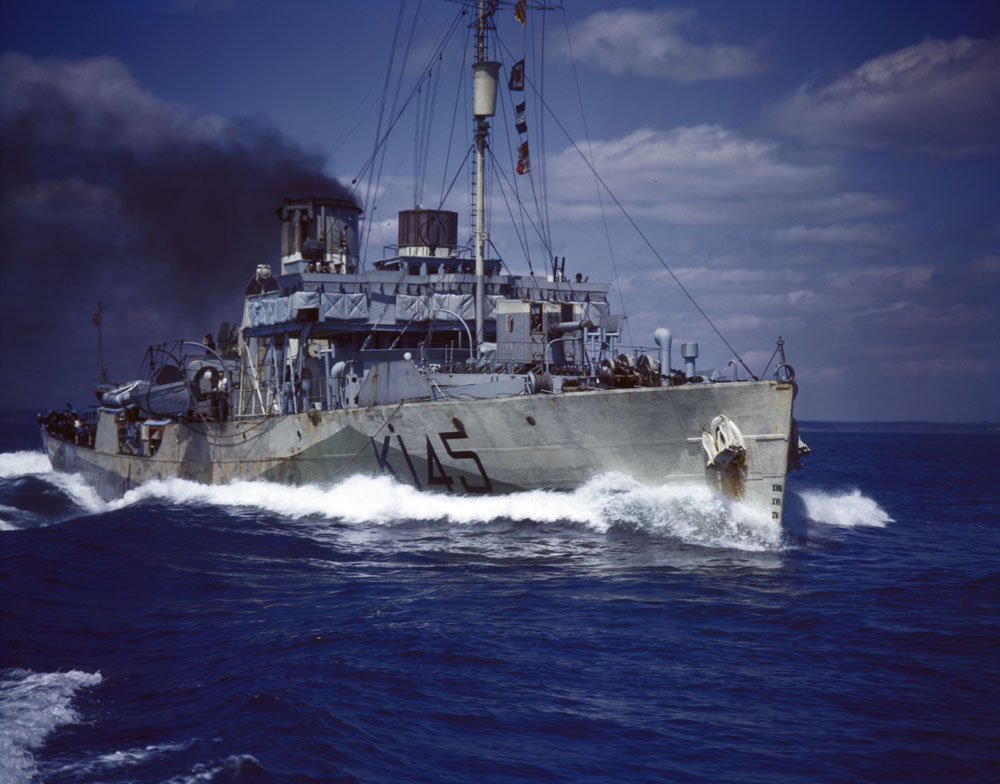
HMCS Arrowhead, one of the ten “British” corvettes built in Canada for the Royal Navy. Photo taken much later in the war, probably 1944-45.
Canada. Department of National Defence / Library and Archives Canada / ecopy
Speaking of the corvettes themselves, the little vessels were 205 feet in length, 33 feet in beam, with a draught of 11.5 feet, a top speed of sixteen knots and a planned armament of one four-inch deck gun, a stock of depth charges, and a lone QF 2-Pounder Pom-Pom gun mounted on the “bandstand” above the engine room, with a planned crew of 80-90 men.
[Editor’s Note: The original design called for a crew about half this size, which translated into terribly overcrowded conditions aboard mid- to late-war corvettes. Adding new weapons, new communications and detection equipment, and miscellaneous additional gear, plus the added food and water for the larger crew meant these little ships were packed as densely as possible.]
Out of necessity, the ships’ armament would grow and change over the years. Many of the original RCN corvettes were also fitted with minesweeping gear. Shortages meant that many would forego the 2-Pounder Pom-Pom, instead receiving two Lewis guns (what these were supposed to do in the event of modern air attack was unknown.) [All allied navies were under-prepared for the risks of air attack early in the war, and it would take time — and significant losses — for that painful lesson to be learned.] Thankfully, most of them would never get within range of Luftwaffe bombers. The few of their own corvettes that the RN assigned to the Mediterranean all received significant anti-aircraft armament augmentation. The use of triple-expansion machinery instead of steam turbines meant the largely reserve/ex-merchant crewmen had an easier time working below. Underwater detection capability was provided by a fixed ASDIC dome; later modified to be retractable. Subsequent technological developments; like the High Frequency Radio Detection Finder or “Huff-Duff” would be added along with a number of different radar systems. More men would be added to crew these systems, putting additional demand on a ship where space was already at a premium.
The Flowers could be serviced by practically any small dockyard or naval station so many ships came to have a variety of different weapons systems and design modifications depending upon when and where they were refitted; there was really no such thing as a “standard” Flower-class corvette. The major changes could include:
- Original twin mast configuration changed to a single mast in front of the bridge, which was then often moved behind the bridge for improved visibility for bridge crew.
- Minesweeping gear removed to improve the ship’s range.
- Galley relocated from the stern to midships.
- Extra depth charge stowage racks added to the stern. Later even more storage was added along the walkways.
- Hedgehog anti-submarine weapons system fitted near the main gun platform.
- Surface radar fitted [in various marks, including some early, relatively primitive Canadian sets or more sophisticated British equipment].
- Forecastle lengthened to midships to provide more accommodation and better seaworthiness. Several vessels received a “3/4 length extension”.
- Increased flare at the bow. This and the forecastle lengthening would become standard features on later ships.
- Various changes to the bridge, typically lowering and lengthening it. Original enclosed compass house removed.
- Extra Lewis guns mounted on the bridge or engine room roof.
- Oerlikon 20-mm cannons fitted, usually two on the bridge wings, but sometimes as many as six spread out across the ship.
Any particular ship could have could have any mix of these, as well as other specialist one-off modifications.
A major difference between the RN vessels and the RCN, later USN, and other navies’ vessels was the provision of upgraded ASDIC and radar. The RN was a world leader in developing these technologies, and thus RN corvettes were often better-equipped for remote detection of enemy submarines than Canadian corvettes. A good example of this is the difficulty that RCN corvettes would have in intercepting U-boats with their Canadian-designed SW1C metric radar, while the RN vessels were equipped with the technologically advanced Type 271 centimetric sets. In addition, RCN corvettes were not initially equipped with gyrocompasses making ASDIC attacks more difficult.
The corvettes would never be handsome or comfortable ships. They would, as some cracked, “roll even on wet grass”. The captains who took them over were mostly ex-merchant officers, and while they were unpleasant commands, many developed a grudging respect for them. On the slipways of the Canadian coasts and the Great Lakes, the rest of the corvette fleet construction program was continuing on schedule.
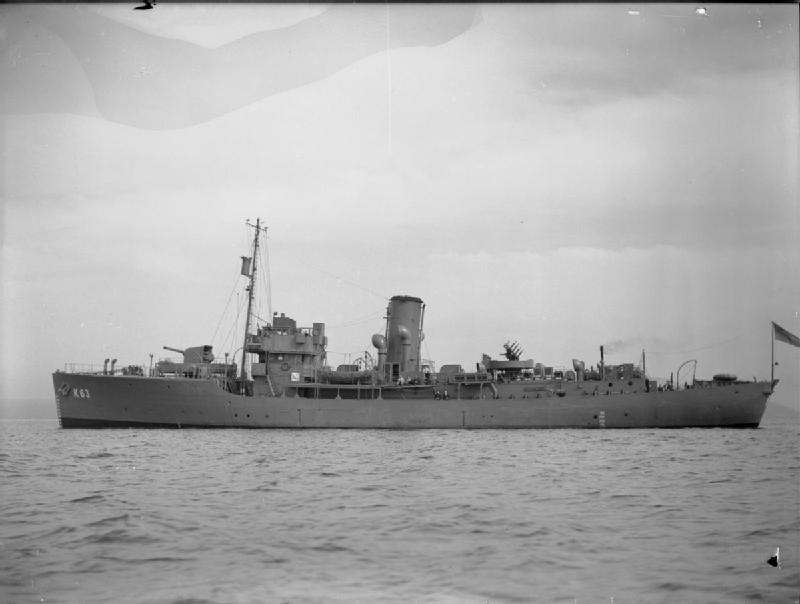
Royal Navy Flower-class corvette HMS Picotee, pennant K63, shortly after being commissioned before modification, showing a number of original design features, including a much shorter bow and forecastle and a mast in front of the bridge, although the second mast has been removed.
Imperial War Museum photo by Lt. H.W. Tomlin, Royal Navy official photographer, via Wikimedia Commons.
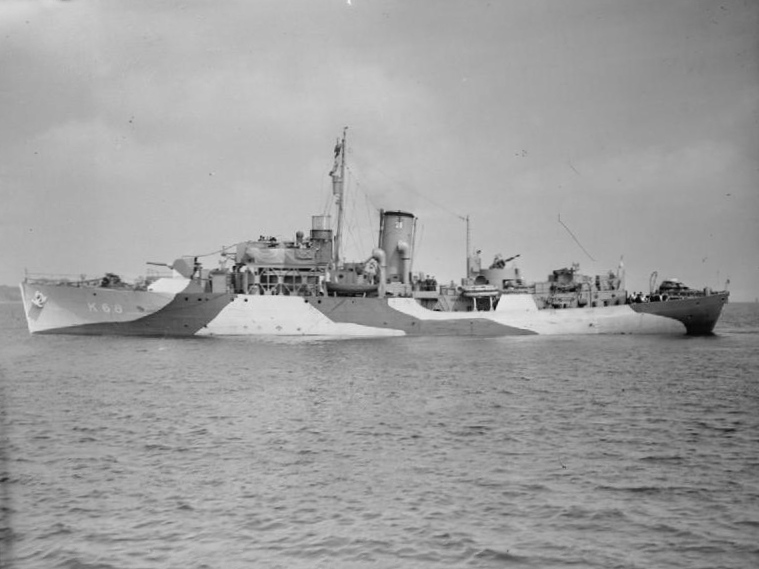
Royal Navy Flower-class corvette HMS Jonquil later in the war showing the changes to the bow and forecastle.
Imperial War Museum photograph FL 22394, via Wikimedia Commons.
Terrence Robertson described for Maclean’s the first time he saw a RCN corvette at sea:
She was Canadian-built, Canadian-manned and named Windflower (incidentally one of the ten built for British use, then “returned” to the RCN). When the destroyer on which I was serving met this newcomer to the Atlantic battlefield in January 1941, we not unnaturally approached for a closer look. We saw on her foredeck a four-inch gun with a wooden barrel that drooped. Then we were warned to keep clear of her stern with the immortal signal: “If you touch me there, I’ll scream.”
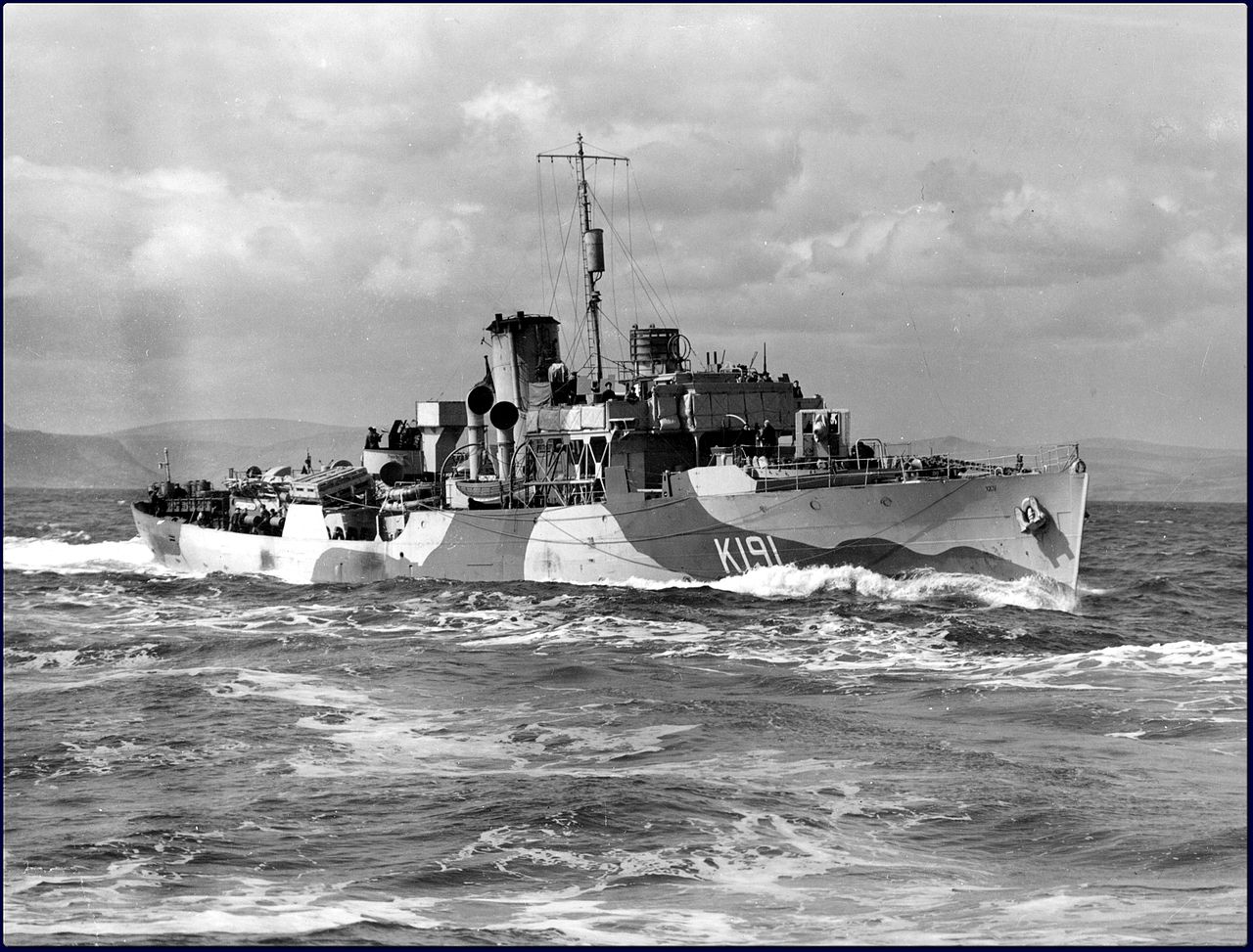
HMCS Mayflower in 1942, one of the first ten corvettes built in Canada like her sister Windflower.
Photo from the Canadian Navy Heritage website, Image Negative Number MC-2589, via Wikimedia Commons.
Marc Milner continues:
The ten British corvettes were the second group of ships thrust upon a reluctant RCN by the British in less than a year. By RN standards the manpower requirements for the sixteen ships was not very large (about 1200 all ranks), but their acquisition represented a major expansion for the RCN. The means whereby the corvettes came into Canadian service also illustrates what was for the RCN a recurrent problem, that of obtaining the release of both men and ships lent to the RN. The first incident may well have been an absent-minded assumption on the part of many British officers that the RCN was committed to some form of Commonwealth navy. … In the event, the RCN put up an honourable fight, better than any of its later attempts. But once committed to the common cause, it had little choice but to turn in the direction where the powers that be deemed its efforts would achieve the most good. Perhaps more serious, with respect to the pending struggle for efficiency in the RCN’s own corvette fleet, was the Admiralty’s insistence that the Canadian navy could accept a delay in developing that efficiency. Ironically, a few short weeks later the British urgently requested that RCN corvettes be committed to convoy operations in the Northwest Atlantic. If Canada’s naval expansion seemed to lack direction, it is small wonder.
Provision of officers and men for the navy’s new ships was of course a primary concern as 1940 drew to a close. Much of the RCN’s disposable manpower went into commissioning the six Town class destroyers and ten corvettes taken over from the Admiralty — sixteen warships for which the navy had made no provision mere months before. Naturally this meant that the planning and assignment of personnel for the first wave of RCN corvettes was set back. Further, with virtually the whole fleet on active duty on the other side of the Atlantic, the navy had no ongoing access either to experienced personnel or to berths on operational warships which could serve as training posts for new officers and key non-substantive ratings. With proper management (by no means guaranteed), a modest interchange of new drafts and experienced personnel would have permitted a more orderly expansion of the fleet and shore establishments and would have softened the devastating impact of expansion in 1941. The navy considered this problem, and the Staff discussed the possibility of routing the occasional destroyer to a Canadian port where personnel could be exchanged. But the Naval Staff concluded that “it would be a most unwise policy to relieve any large percentage of a ship’s company when that vessel was acting in a War Zone.”
The first RCN corvettes to become operational therefore were commissioned with scratch crews. Although the navy kept its sound policy of not tampering with escorts in a war zone, the conditions which obtained over the winter of 1940-1 changed by the following spring. By then the fleet was operational closer to home and, technically at least, no longer in a war zone.
In late 1940 the RCN was faced with building up manpower needed to commission fifty-four corvettes, twenty-five minesweepers, and small numbers of motor launches — about seven thousand officers and men.
Windflower and Mayflower were the first two Canadian-built corvettes to make the passage to England. The navy was short of suitable weapons, so both had been fitted with dummy guns. The irrepressible pair were the first two of an eventual one hundred and twenty-two corvettes which, in the next four years, would carry thousands of pre-war farmers, miners, students, and white-collar workers into battle against the U-boat fleet. Their exploits were rarely spectacular, almost never heroic. But in the Battle of the Atlantic, the words “Canadian” and “corvette” became almost synonymous and the little ships created legends of courage and endurance.
They were needed more and more with each passing month. During the last week of February 1941, 150,000 tons of Allied merchant shipping was sunk; in the first two weeks of March, 245,000 tons; and this rate of loss continued into April and May. Three or four ships and their cargoes were being sunk daily.
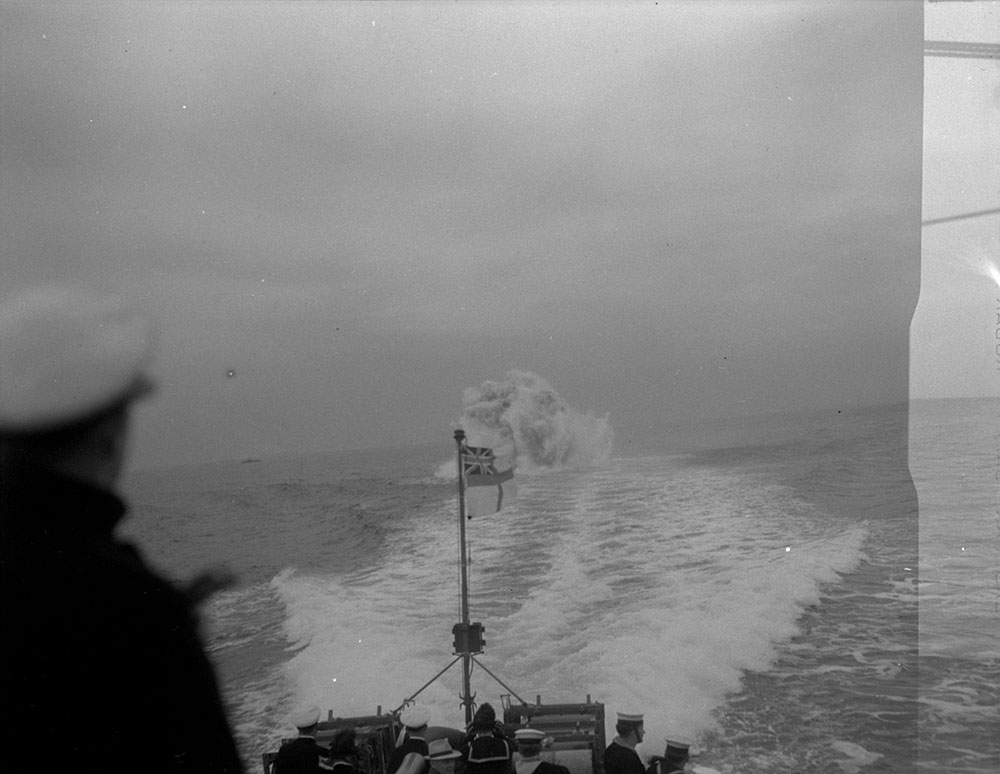
Explosion of a depth charge astern of HMCS Hamilton, August 30th, 1941.
Canada. Dept. of National Defence / Library and Archives Canada / PA-104150
Comments Off on Canada and the Battle of the Atlantic, part 7 by Alex Funk
Why Don’t Trains Have Cabooses Anymore?
Today I Found Out
Published on 7 Sep 2016Never run out of things to say at the water cooler with TodayIFoundOut! Brand new videos 7 days a week!
In this video:
Carrying a brakeman and a flagman back when brakes were set by hand, when it was time to slow the train, the engineer would blow the whistle. This signaled to the brakemen, and one would emerge from the caboose and work his way toward the engine, while another would leave the engine and work his way back toward the caboose. At each car, the brakemen would stop and turn its brakewheel with a club. Once the train stopped, the flagman would leave the caboose with a flag, lantern or other visual display and walk back down the track to warn any approaching trains.
Want the text version?: http://www.todayifoundout.com/index.p…
Comments Off on Why Don’t Trains Have Cabooses Anymore?
April 7, 2019
Germans and British make their way to the North – WW2 – 032 – April 6 1940
World War Two
Published on 6 Apr 2019While China gets a new government, or at least in the eyes of Japan, the British are trying to cope with the rationing of meat and dairy products by trying out some new recipes. More importantly, Germany seems to be very serious about invading Norway. However, the British also plan to move closer to Norway.
Join us on Patreon: https://www.patreon.com/TimeGhostHistory
Or join The TimeGhost Army directly at: https://timeghost.tvFollow WW2 day by day on Instagram @World_war_two_realtime https://www.instagram.com/world_war_t…
Join our Discord Server: https://discord.gg/D6D2aYN.
Between 2 Wars: https://www.youtube.com/playlist?list…
Source list: http://bit.ly/WW2sourcesWritten and Hosted by: Indy Neidell
Produced and Directed by: Spartacus Olsson and Astrid Deinhard
Executive Producers: Bodo Rittenauer, Astrid Deinhard, Indy Neidell, Spartacus Olsson
Creative Producer: Joram Appel
Research by: Indy Neidell
Edited by: Iryna Dulka
Map animations: EastoryColorisations by Norman Stewart
Eastory’s channel: https://www.youtube.com/channel/UCEly…
Archive by Screenocean/Reuters https://www.screenocean.comA TimeGhost chronological documentary produced by OnLion Entertainment GmbH.
From the comments:
World War Two
2 days ago (edited)
The war seems to be heating up. As both the Germans and the Allies move towards Norway, the Soviets commit a big war crime in Katyn. We have made a ‘War Against Humanity’ episode in which we explain how Stalin and Beria ordered the mass murder. You can see that right here: https://www.youtube.com/watch?v=gd5YhhNcC44 And a friendly reminder for the existence of our own discord server: https://discord.gg/D6D2aYN.Cheers!
Comments Off on Germans and British make their way to the North – WW2 – 032 – April 6 1940
Rubin “Hurricane” Carter and the murders at the Lafayette Bar and Grill in Paterson, New Jersey
I was too young to know anything about Rubin “Hurricane” Carter except what I “learned” from listening to Bob Dylan’s “Hurricane” long after the events. In Quillette, Lona Manning recounts the story, which doesn’t agree with Dylan’s interpretation (but Dylan was far from the only journalist or celebrity to be fooled):
How many people who followed the BBC Radio 4 podcast series about Rubin “Hurricane” Carter were startled — or even outraged — when Carter was not triumphantly vindicated in the final episode?
In the small hours of June 17, 1966, two black men walked into a late-night Bar and Grill in Paterson, New Jersey and opened fire on the occupants. They left bartender James Oliver and patron Fred Nauyoks dead at the scene and mortally wounded a woman named Hazel Tanis, who would succumb to her injuries a month later. Another customer named Willie Marins lost an eye in the shooting but survived. Neighbors Patty Valentine and Ronald Ruggiero told police that they had seen two black males flee the scene in a white vehicle. This testimony was corroborated by petty thief Alfred Bello who walked past the dead and the dying to empty the cash register after the shooters had fled.
Half an hour later, Paterson police stopped middleweight boxer Rubin Carter and his companion John Artis in a car bearing out-of-state plates that matched the eyewitnesses’ description. A search of the car yielded a .32 and a 12 gauge shotgun, the weapons police later determined had been used in the shooting. Carter and Artis were eventually indicted by a grand jury and convicted of the Lafayette murders in 1967. Carter vehemently protested his innocence and his case became a cause célèbre after his 1975 autobiography found its way into the hands of Bob Dylan. Carter was retried in 1976, after the New Jersey Supreme Court ruled that the first conviction had been unsafe. Despite support from Dylan, Muhammad Ali and the New York Times, the two were convicted again. John Artis was paroled in 1981, and Carter was finally released in 1985 after the second conviction was overturned and prosecutors declined to try him a third time.
Sports reporters Joel Hammer and Steve Crossman spent 18 months researching and reinvestigating the case and promised listeners of the BBC’s podcast that they would provide the “full” and “true” story. Their in-depth look at the crime provides far more detail about the murders than can be gleaned from Bob Dylan’s 1975 protest song or the hagiographic 1999 Norman Jewison film starring Denzel Washington. Dylan accused the prosecution team of framing Carter for the slayings and called them “criminals in their coats and their ties” who were “free to drink martinis and watch the sun rise.” Crossman and Hammer are likewise very critical of the prosecution; for example, they think that Alfred Bello should never have been allowed to testify. How could the life of such a man, be in the palm of some fool’s hand? And they argue that the prosecution ignored — or perhaps even suppressed — an investigation into a very plausible suspect, Eddie Rawls (who is now deceased). But they stop short of calling it a frame-up and an attempt at judicial murder.
On the other hand, Crossman and Hammer think the “racial revenge motive” was a reasonable one. The very first newspaper accounts of the slaughter at the Lafayette Grill included the speculation that the murders were committed in revenge for the slaying, earlier that night, of black bartender Roy Holloway and this would also be the prosecution’s contention. That Crossman and Hammer now accept the plausibility of this theory is a significant concession to the prosecution’s version of events, not least because it was Judge Lee Sarokin’s rejection of this motive which led him to overturn the second conviction—the prosecution’s case, he ruled, had been based on “racism rather than reason.”
Coincidentally, on the front page of the East Bergen Record, under the murder story, there was a wire service article about Stokely Carmichael proclaiming “Black Power” at a rally in Mississippi, an event which marked the transition from the peaceful civil rights tactics of Dr. Martin Luther King to the radical activism of the Black Panthers. These two articles encapsulated all the elements of the Lafayette Grill case that continue to be debated over 50 years later. Why did someone walk into a working-class bar and slaughter the occupants? Was the black community in Paterson in a ferment that night because a white man blew off Holloway’s head with a shotgun? And what, if anything, did this have to do with the state of race relations in America at the time?
Comments Off on Rubin “Hurricane” Carter and the murders at the Lafayette Bar and Grill in Paterson, New Jersey
Epic Moments in History – The 9 Lives of Alexander the Great
Invicta
Published on 4 Sep 2017Alexander the Great is one of the most famous historical figures of all time. Yet many are unaware of the 9 times he cheated death over the course of his epic campaigns into the east!
Support future documentaries: https://www.patreon.com/InvictaHistory
Twitter: https://twitter.com/InvictaHistoryVideo Credits:
Research – Invicta
Script: Invicta
Narration – Invicta
Artwork – Robbie McSweeney (https://www.artstation.com/artist/rob…)Bibliography:
Alexander the Great by Phillips Freeman
The Campaigns of Alexander by ArrianMusic: “Rome: Total War OST” by Jeff van Dyck
“Total War: Rome II OST” by Richard Beddow
Comments Off on Epic Moments in History – The 9 Lives of Alexander the Great
April 6, 2019
Springfield Arms Double Trigger Navy Revolver
Forgotten Weapons
Published on 6 Mar 2019http://www.patreon.com/ForgottenWeapons
Cool Forgotten Weapons merch! http://shop.bbtv.com/collections/forg…
The Springfield Arms Company existed only for a brief period in 1850 and 1851, making revolvers designed by its chief engineer, James Warner, before being driven out of business by Colt patent lawyers. During that time, Springfield (no relation to the arsenal) made a variety of models in .28, .31, and .36 caliber and with a variety of barrel lengths and other features (including a well-designed safety notch to allow the guns to be carried fully loaded safely). In an attempt to avoid patent infringement, Warner separated the cylinder rotation and firing mechanisms into two different triggers on some models, including this Navy pattern example. The front trigger would rotate and lock the cylinder, and then it would trip the rear trigger which released the sear and fired the gun. This was not sufficient to save him from copyright infringement suits, though, and only about 125 of the double-trigger Navy revolvers were made.
Contact:
Forgotten Weapons
PO Box 87647
Tucson, AZ 85754
Comments Off on Springfield Arms Double Trigger Navy Revolver
QotD: Truth and propaganda in the Spanish Civil War
The struggle for power between the Spanish Republican parties is an unhappy, far-off thing which I have no wish to revive at this date. I only mention it in order to say: believe nothing, or next to nothing, of what you read about internal affairs on the Government side. It is all, from whatever source, party propaganda — that is to say, lies. The broad truth about the war is simple enough. The Spanish bourgeoisie saw their chance of crushing the labour movement, and took it, aided by the Nazis and by the forces of reaction all over the world. It is doubtful whether more than that will ever be established.
I remember saying once to Arthur Koestler, ‘History stopped in 1936’, at which he nodded in immediate understanding. We were both thinking of totalitarianism in general, but more particularly of the Spanish civil war. Early in life I have noticed that no event is ever correctly reported in a newspaper, but in Spain, for the first time, I saw newspaper reports which did not bear any relation to the facts, not even the relationship which is implied in an ordinary lie. I saw great battles reported where there had been no fighting, and complete silence where hundreds of men had been killed. I saw troops who had fought bravely denounced as cowards and traitors, and others who had never seen a shot fired hailed as the heroes of imaginary victories; and I saw newspapers in London retailing these lies and eager intellectuals building emotional superstructures over events that had never happened. I saw, in fact, history being written not in terms of what happened but of what ought to have happened according to various ‘party lines’. Yet in a way, horrible as all this was, it was unimportant. It concerned secondary issues — namely, the struggle for power between the Comintern and the Spanish left-wing parties, and the efforts of the Russian Government to prevent revolution in Spain. But the broad picture of the war which the Spanish Government presented to the world was not untruthful. The main issues were what it said they were. But as for the Fascists and their backers, how could they come even as near to the truth as that? How could they possibly mention their real aims? Their version of the war was pure fantasy, and in the circumstances it could not have been otherwise.
The only propaganda line open to the Nazis and Fascists was to represent themselves as Christian patriots saving Spain from a Russian dictatorship. This involved pretending that life in Government Spain was just one long massacre (vide the Catholic Herald or the Daily Mail — but these were child’s play compared with the Continental Fascist press), and it involved immensely exaggerating the scale of Russian intervention. Out of the huge pyramid of lies which the Catholic and reactionary press all over the world built up, let me take just one point — the presence in Spain of a Russian army. Devout Franco partisans all believed in this; estimates of its strength went as high as half a million. Now, there was no Russian army in Spain. There may have been a handful of airmen and other technicians, a few hundred at the most, but an army there was not. Some thousands of foreigners who fought in Spain, not to mention millions of Spaniards, were witnesses of this. Well, their testimony made no impression at all upon the Franco propagandists, not one of whom had set foot in Government Spain. Simultaneously these people refused utterly to admit the fact of German or Italian intervention at the same time as the Germany and Italian press were openly boasting about the exploits of their’ legionaries’. I have chosen to mention only one point, but in fact the whole of Fascist propaganda about the war was on this level.
This kind of thing is frightening to me, because it often gives me the feeling that the very concept of objective truth is fading out of the world. After all, the chances are that those lies, or at any rate similar lies, will pass into history. How will the history of the Spanish war be written? If Franco remains in power his nominees will write the history books, and (to stick to my chosen point) that Russian army which never existed will become historical fact, and schoolchildren will learn about it generations hence. But suppose Fascism is finally defeated and some kind of democratic government restored in Spain in the fairly near future; even then, how is the history of the war to be written? What kind of records will Franco have left behind him? Suppose even that the records kept on the Government side are recoverable — even so, how is a true history of the war to be written? For, as I have pointed out already, the Government, also dealt extensively in lies. From the anti-Fascist angle one could write a broadly truthful history of the war, but it would be a partisan history, unreliable on every minor point. Yet, after all, some kind of history will be written, and after those who actually remember the war are dead, it will be universally accepted. So for all practical purposes the lie will have become truth.
George Orwell, “Looking back on the Spanish War”, New Road, 1943 (republished in England, Your England and Other Essays, 1953).
Comments Off on QotD: Truth and propaganda in the Spanish Civil War
April 5, 2019
The Carolean’s Prayer – Soldiers of the Swedish Kings – Sabaton History 009
Sabaton History
Published on 4 Apr 2019The Swedish Kings had to rely on the quality of their armies, often facing foes that had superior numbers. A special soldier class was created. Admired in Sweden and feared on the battlefield, the Caroleans were the secret weapon of the Swedish army. The Sabaton song “The Carolean’s Prayer” is about these remarkable soldiers and their heroic status.
Check out the trailer for Sabaton’s new album The Great War right here: https://www.youtube.com/watch?v=HCZP1…
Support Sabaton History on Patreon (and possibly get a special edition of The Great War): https://www.patreon.com/sabatonhistory
Listen to Sabaton on Spotify: http://smarturl.it/SabatonSpotify
Official Sabaton Merchandise Shop: http://bit.ly/SabatonOfficialShopHosted by: Indy Neidell
Written by: Markus Linke and Indy Neidell
Directed by: Astrid Deinhard and Wieke Kapteijns
Produced by: Pär Sundström, Astrid Deinhard and Spartacus Olsson
Creative Producer: Joram Appel
Executive Producers: Pär Sundström, Joakim Broden, Tomas Sunmo, Indy Neidell, Astrid Deinhard, and Spartacus Olsson
Maps by: Eastory
Edited by: Iryna Dulka
Sound Editing by: Marek KaminskiEastory YouTube Channel: https://www.youtube.com/channel/UCEly…
Archive by: Reuters/Screenocean https://www.screenocean.com
Music by Sabaton.An OnLion Entertainment GmbH and Raging Beaver Publishing AB co-Production.
© Raging Beaver Publishing AB, 2019 – all rights reserved.
Comments Off on The Carolean’s Prayer – Soldiers of the Swedish Kings – Sabaton History 009


