
Forgotten Weapons
Published on 13 Apr 2019This Bren is lot #1013 at Morphy’s April 2019 auction:
https://www.forgottenweapons.com/shoo…The Bren gun is widely regarded as one of the best light machine guns ever built, but that reputation is based on the British .303 caliber version. How does the design perform in 8mm Mauser? Today I am going to find out, using one of the John Inglis “sterile” 8mm Brens.
http://www.patreon.com/ForgottenWeapons
Cool Forgotten Weapons merch! http://shop.bbtv.com/collections/forg…
Contact:
Forgotten Weapons
PO Box 87647
Tucson, AZ 85754
April 14, 2019
Shooting the Inglis 8mm Bren Gun
Comments Off on Shooting the Inglis 8mm Bren Gun
British diplomatic blunders in history – German unification
An interesting article in Vox, suggesting that the gradual unification of all the German principalities, electorates, duchies, counties, bishoprics, free cities, and miscellaneous other semi-independent bits and bobs of the Holy Roman Empire was not inevitable and that — absent British blundering after the Napoleonic wars — it would have produced a very different 20th century:
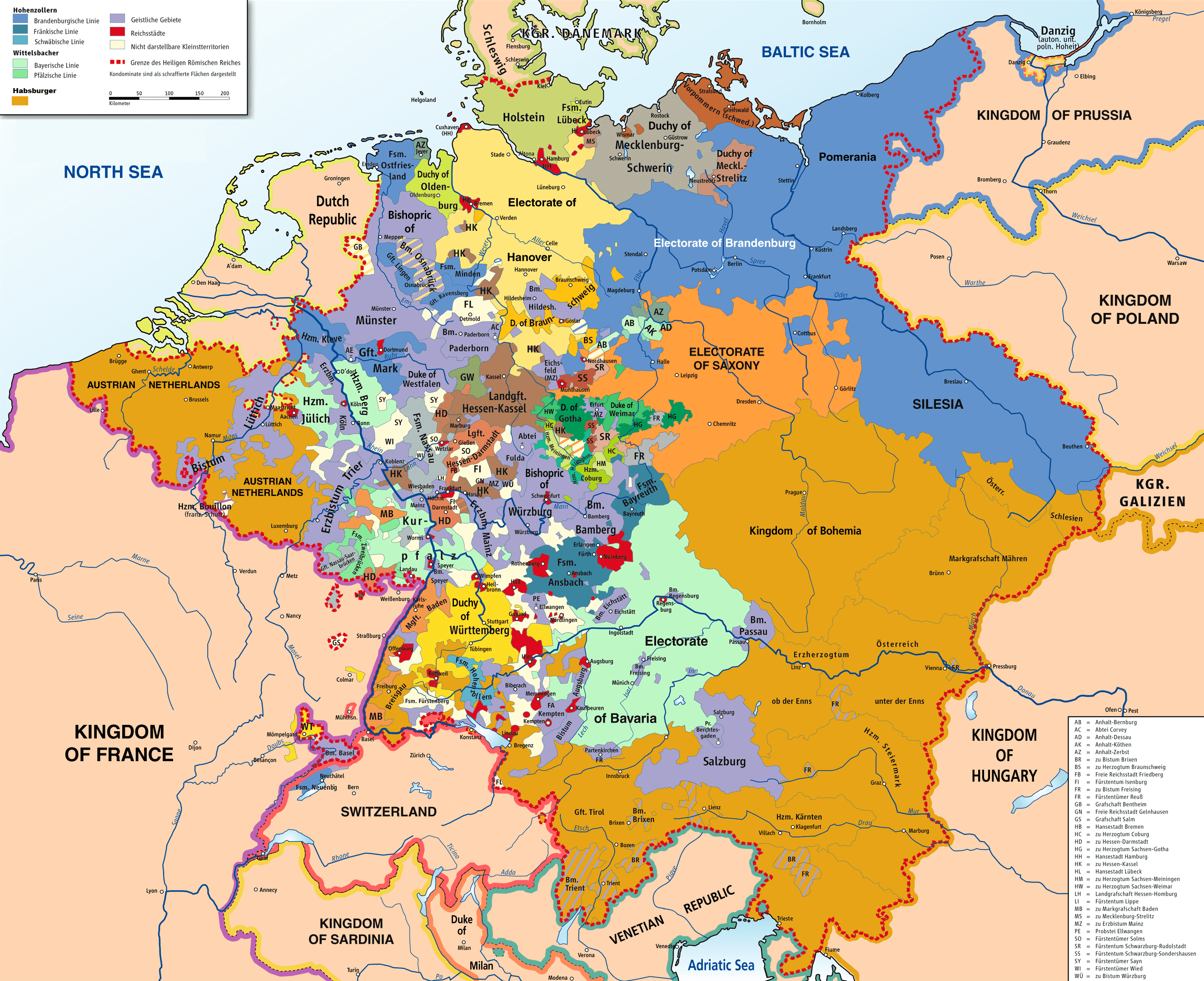
The Holy Roman Empire in 1789, before Napoleon “rationalized” hundreds of smaller entities into the Confederation of the Rhine.
Image from Wikimedia Commons.
The boundaries of states are the heart of many recent debates, be it the European refugee crisis, the Transatlantic Trade and Investment Partnership (TTIP), or Brexit (Snower and Langhammer 2019). After decades of stability, today we are again seeing heated discussions about the shape and extent of political borders. Clearly, borders are neither naturally given nor random. In Europe and elsewhere, the current state borders have been formed and changed over centuries, sometimes peacefully, often in bloody wars. In Huning and Wolf (2019), we look at the formation of the German nation state led by Prussia and trace it back to a change in borders decided at the Congress of Vienna in 1814/15.
In a nutshell, we have two findings:
- First, the geographic position of a state can be a crucial factor for institutional change and development.
- Second, the formation of the German Zollverein in 1834 under Prussian leadership was a truly European story, involving Britain, the Russian Empire, and the Belgian revolution of 1830/31. We show in particular that the Zollverein formed as an unintended consequence of Britain’s intervention in 1814/15 to push back Russian influence over Europe.
In theory, why would the geographic position of a state relative to that of other states matter? Intuitively, it should matter as long as the costs of trade and factor flows depend on their routes. If a large share of my trade has to pass the territory of one or several neighbours, my trade and trade policy will depend on the trade policy of my neighbours. Moreover, if tariffs are levied not only on imports but also on transit trade, as was general practice until the Barcelona Statute of 1921 (Uprety 2006), policymakers face the problem of multiple marginalisation, which is well known from the literature on supply chains. In our work, we provide a simple theoretical framework (in partial equilibrium) to show how the location of a revenue maximising state planner will affect its ability to set tariffs. Some states can increase their tariff revenue at the expense of their hinterland. Next, we show that a customs union can be beneficial for a group of states exactly because it solves the problem of multiple marginalisation.
A major challenge to testing our idea empirically is that a state’s political boundaries (and hence its location) do not change very often, and if they do, the change is unlikely to be unrelated to trade or factor flows. However, the formation of the German Zollverein in 1834 can be considered as a quasi-experiment. Let us briefly revisit this historical episode. At the end of the Napoleonic wars of 1792-1814/15, only Russia and the UK were left as major military powers. Habsburg, Prussia, and the defeated France attempted to consolidate their positions at the expense of the many smaller states that had just about survived the wars, notably the former allies of Napoleon such as Saxony and Poland. Overall, the negotiations at the Congress of Vienna in 1814 were dominated by military-strategic considerations between the two great powers. Russia wanted to expand westwards, Prussia was desperate to annex the populous Kingdom of Saxony, which bordered Prussia in the south and would create a large and coherent territory. To this end, Prussia was willing to give up not only her Polish territories to Russia, but also her positions and claims on the Rhineland (Müller 1986). This met stiff resistance from Britain, joined by Habsburg and France, which feared a new Russian hegemony on the continent – the ‘Polish Saxon question’. After weeks of diplomatic struggle, the outcome was a division of Saxony, another division of Poland and Prussia being established as the “warden of the German gate against France” (Clapham 1921: 98). Figure 1 shows the result of these negotiations.
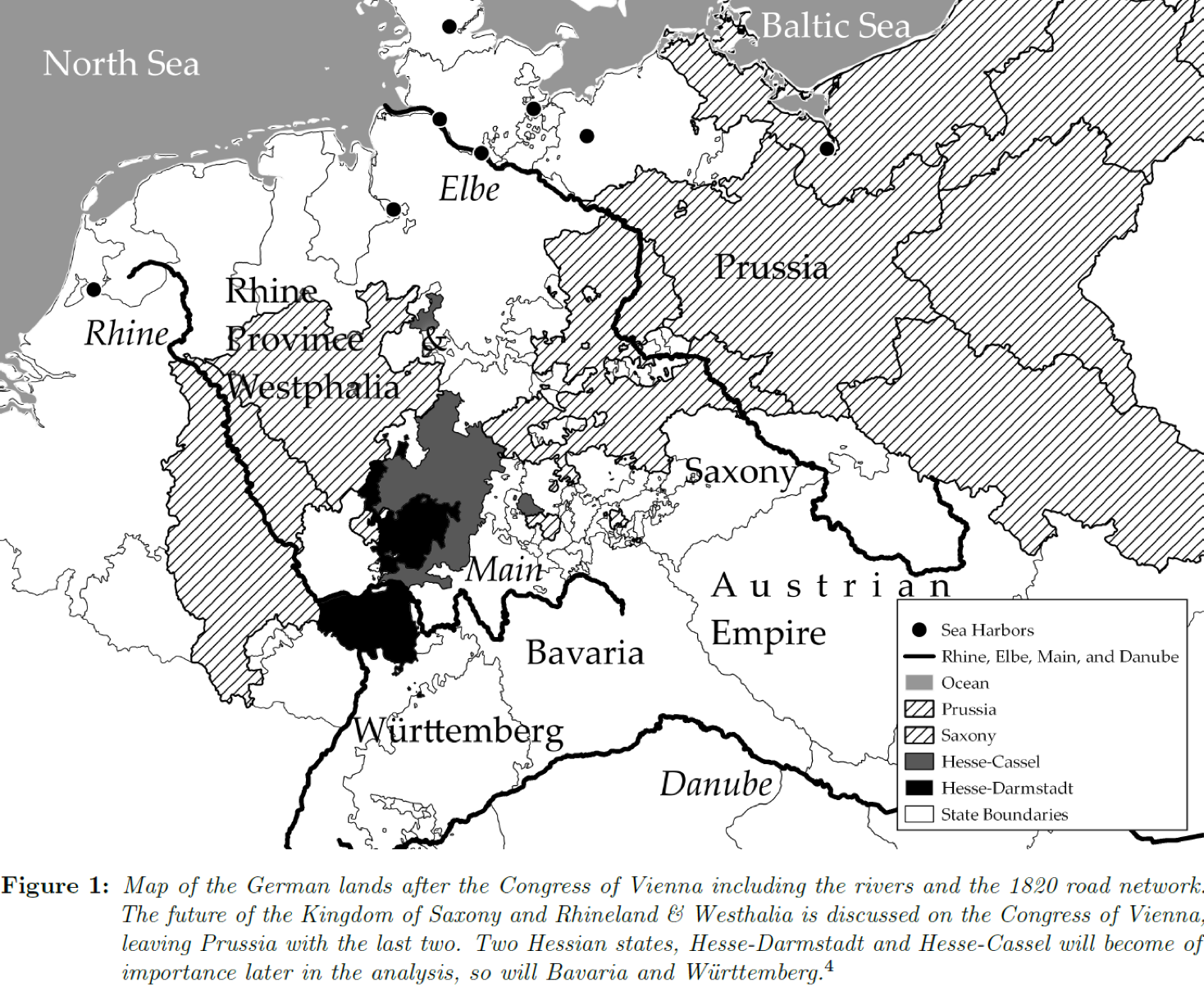
H/T to Continental Telegraph for the link.
Comments Off on British diplomatic blunders in history – German unification
The Invasion of Norway and Denmark – WW2 – 033 – April 13 1940
World War Two
Published on 13 Apr 2019This week, the Phoney War seems to come to an end when Germany invades Denmark and Norway. The Allies seek confrontation with Germany in the hope to at least deny them full access to the Swedish iron mines. Nevertheless, the Germans are prepared and have been planning this for weeks. It looks like it will cost a lot to put a stop to it.
Join us on Patreon: https://www.patreon.com/TimeGhostHistory
Or join The TimeGhost Army directly at: https://timeghost.tvFollow WW2 day by day on Instagram @World_war_two_realtime https://www.instagram.com/world_war_t…
Join our Discord Server: https://discord.gg/D6D2aYN.
Between 2 Wars: https://www.youtube.com/playlist?list…
Source list: http://bit.ly/WW2sourcesWritten and Hosted by: Indy Neidell
Produced and Directed by: Spartacus Olsson and Astrid Deinhard
Executive Producers: Bodo Rittenauer, Astrid Deinhard, Indy Neidell, Spartacus Olsson
Creative Producer: Joram Appel
Research by: Indy Neidell
Edited by: Iryna Dulka
Map animations: EastoryColorisations by Norman Stewart and JuliusJaa (https://www.flickr.com/photos/juliusjaa/)
Eastory’s channel: https://www.youtube.com/channel/UCEly…
Archive by Screenocean/Reuters https://www.screenocean.comSources:
Riksarkivet
File reference: RA/PA-1209/U/Uj/L0203
Author: unknown
File reference: RA/PA-1209/U/Uj/L0203
Author: unknownA TimeGhost chronological documentary produced by OnLion Entertainment GmbH.
From the comments:
World War Two
1 hour ago
Hey all! The Phoney war is over, and although we have learned in the last months that it wasn’t as uneventful as is generally believed, the war really takes off here. While this is going live, we are in France to film future events, which I won’t spoil in this video. If you don’t mind too much, do check out our road trip vlogs (the many specials we shot here will have to be edited and will be published over the spring). We have seen very interesting things and we will challenge many misconceptions and myths about the upcoming events of World War Two. Thank you all for your ongoing support!Cheers,
Joram
Comments Off on The Invasion of Norway and Denmark – WW2 – 033 – April 13 1940
Model 1927 Thompson Semi Automatic Carbine
Forgotten Weapons
Published on 13 Mar 2019Note: Rock Island has not yet posted the catalog for this auction – I will replace this note with a link when they do.
http://www.patreon.com/ForgottenWeapons
Cool Forgotten Weapons merch! http://shop.bbtv.com/collections/forg…
One of the rarest versions of the Thompsons Submachine Gun is the Model of 1927 Thompson Semi Automatic Carbine. These were regular 1921 machine guns that had their fire control groups slightly modified to only firm in semiauto and their receivers remarks to show Model 1927 instead of 1921. The rationale was a number of requests Auto Ordnance received from potential customers who wanted the look of a Thompson, but not an actual machine gun – mostly police and prison agencies that did not want to entrust their officers will fully automatic arms. Only about 100-150 1927 model guns were sold (and there is no specific serial range, they were simple converted one at a time as ordered). Of that very small number, only a very small percentage survive intact today, as most were converted back to fully automatic by later owners. Note that because the receiver is basically identical to a standard Thompson SMG receiver, these are considered machine guns under US law despite being factory semiauto carbines. However, this does mean that they can be legally converted to fully automatic (as, in fact, most have been).
Contact:
Forgotten Weapons
PO Box 87647
Tucson, AZ 85754
Comments Off on Model 1927 Thompson Semi Automatic Carbine
April 13, 2019
Canadian 8mm “Sterile” Bren Gun
Forgotten Weapons
Published on 12 Apr 2019This Bren is lot #1013 at Morphy’s April 2019 auction:
https://www.forgottenweapons.com/cana…The John Inglis company in Toronto first opened in 1859 as a metalworking shop, and grew steadily over the decades under first John Inglis, and then later his sons. Inglis did substantial amounts of military work during World War One, but the Great Depression hit it hard, and both William and Alexander Inglis died in 1935 and 1936 respectively. The company went into receivership but was purchased by one Major James Hahn (DSO) and a group of business partners in November of 1936. Hahn and his associates saw an opportunity to use this large manufacturing facility to make machine guns for the military, and they were successful – in October 1938 they were awarded a contract to make 5000 MkI Bren guns. More contracts would follow, and by the height of World War Two the company had some 15,000 employees and more than a million square feet of floor space.
Among many other projects, Inglis was contracted to make small arms for sale to the Nationalist Chinese government under Chiang Kai Shek – both High Power pistols and Bren guns in 8mm Mauser (to fit the Chinese standardization on that cartridge). A batch of 8mm ZB-30 light machine guns were brought in from the Far East to use as a pattern, and Inglis engineers were able to successfully redesign the Bren to use that cartridge and magazine.
Where the story gets hazy is in trying to determine how many were made and for whom. The Chinese guns are marked in Mandarin on the receivers, and have “CH” prefix serial numbers, like the Chinese contract High Power pistols. However, two additional variations exist without those Chinese markings. Some are marked “7.92 Bren MkI” and “Inglis 1943” (or 44 or 45), and others – like this one – are just marked “7.92 Bren MkI”. The dated ones are typically referred to as Resistance guns, intended to be supplied to European resistance units for whom 7.92mm ammunition was more readily available than .303 – although information on how many guns were supplied in this way (if any) is difficult to find. The last group is generally called “sterile”, and it is not clear what their purpose is. This particular example is one of 23 that were registered in the US in the early 1960s to Interarms, and it does appear that they were associated with some clandestine US military activities. The serial numbers of those 23 Interarms guns range from 1-5343 to 2-8045, suggesting a production of 13,000 or perhaps as many as 28,000 guns – that is quite a lot to be undocumented and missing.
Hopefully, more information will turn up in the future to shed light on the purpose and use of these 8mm Brens. We do know for sure that many thousands did go to Chinese forces, and some were brought into the UK, where in the 1960s they were used in the development of the 7.62mm NATO L4 version of the Bren.
http://www.patreon.com/ForgottenWeapons
Cool Forgotten Weapons merch! http://shop.bbtv.com/collections/forg…
Contact:
Forgotten Weapons
PO Box 87647
Tucson, AZ 85754
Comments Off on Canadian 8mm “Sterile” Bren Gun
Canada and the Battle of the Atlantic, part 11 by Alex Funk
Editor’s Note: This series was originally published by Alex Funk on the TimeGhostArmy forums (original URL – https://community.timeghost.tv/t/canada-and-the-battle-of-the-atlantic-part-4/1447/3).
Sources:
- Far Distant Ships, Joseph Schull, ISBN 10 0773721606 (An official operational account published in 1950, somewhat sensationalist)
[Schull’s book was published in part because the funding for the official history team had been cut and they did not feel that the RCN’s contribution to the Battle of the Atlantic should have no official recognition. It is very much an artifact of its era, and needs to be read that way. A more balanced (and weighty) history didn’t appear until the publication of No Higher Purpose and A Blue Water Navy in 2002, parts 1 and 2 of the Official Operational History of the RCN in WW2, covering 1939-1943 and 1943-1945, respectively.]- North Atlantic Run: the Royal Canadian Navy and the battle for the convoys, Marc Milner, ISBN 10 0802025447 (Written in an attempt to give a more strategic view of Canada’s contribution than Schull’s work, published 1985)
- Reader’s Digest: The Canadians At War: Volumes 1 & 2 ISBN 10 0888501617 (A compilation of articles ranging from personal stories to overviews of Canadian involvement in a particular campaign. Contains excerpts from a number of more obscure Canadian books written after the war, published 1969)
- All photos used exist in the Public Domain and are from the National Archives of Canada, unless otherwise noted in the caption.
I have inserted occasional comments in [square brackets] and links to other sources that do not appear in the original posts. A few minor edits have also been made for clarity.
Earlier parts of this series:
Part 1 — Canada’s navy before WW2
Part 2 — The Admiralty takes control
Part 3 — The professionals and the amateurs
Part 4 — 1940: The fall of France, the battle begins, and the RCN dreams of expansion
Part 5 — The RCN’s desperate need for warships
Part 6 — New ships, new challenges
Part 8 — Expansion problems: not enough men for not enough ships
Part 9 — Early-to-mid 1941, The Rocky Isle in the Ocean
Part 10 — The Newfoundland Escort Force and the Canadian corvettes
Part 11 — “Chummy” Prentice and the NEF
One of the most colourful men to serve in the Newfoundland Escort Force was Commander J.D. Prentice. He had taken early retirement from the RN in 1934 and in 1939, at age 41, he returned to sea. Marc Milner outlines Prentice’s career in North Atlantic Run:
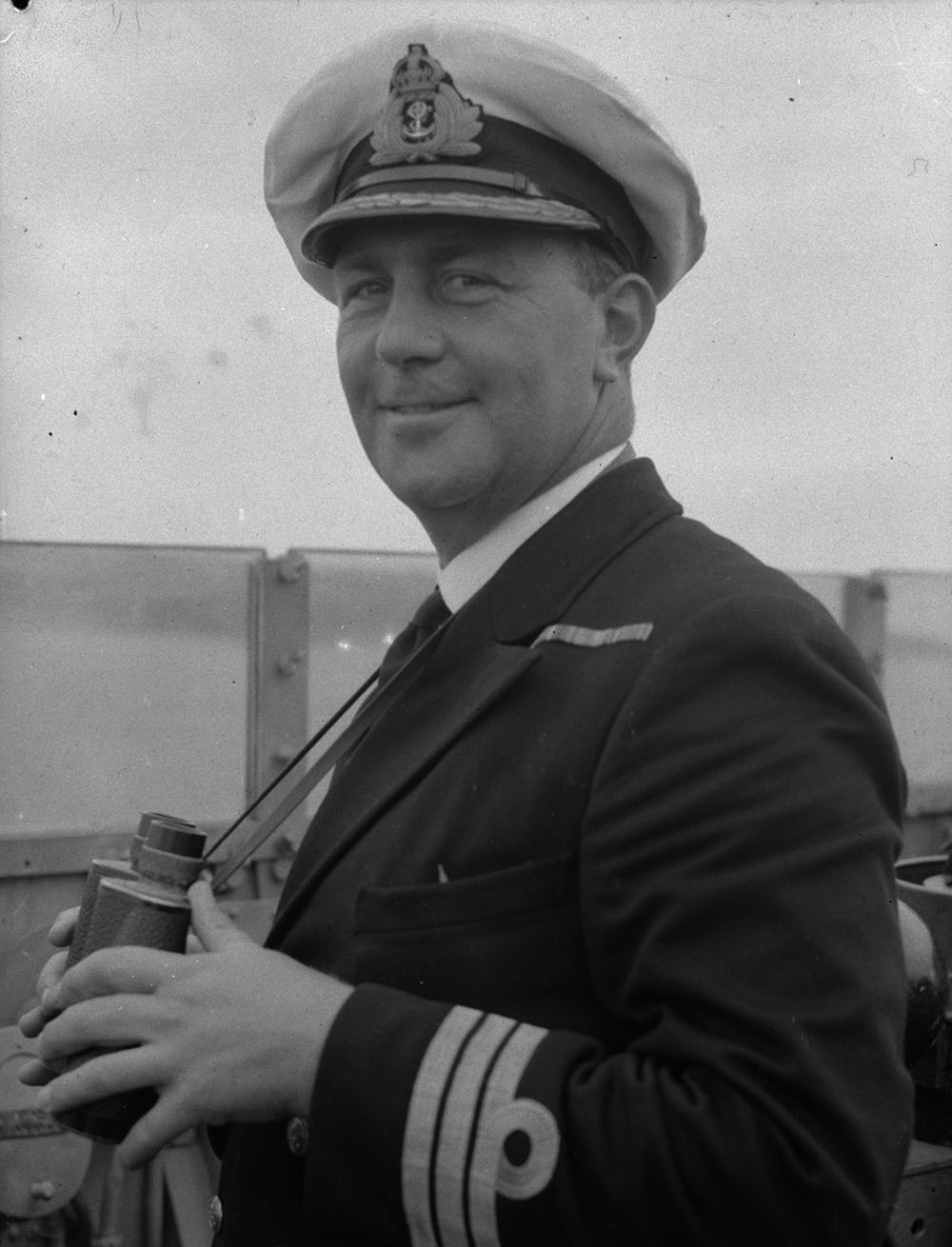
“Chummy” Prentice, as his friends called him, was one of the real characters of the war and a driving force behind the RCN’s quest for efficiency. Born in Victoria, BC, of British parents in 1899, Prentice had decided on a naval career by the tender age of thirteen. He wanted to join the infant RCN, but his father believed that the new naval service of Canada would become little more than another avenue for political patronage. If Prentice was to join the navy it had to be the RN, so in 1912 he entered the Royal Naval College, Dartmouth, and later in the same year joined the RN as a cadet. His twenty-two years of service in the RN were undistinguished, the pinnacle had been serving as first lieutenant commander of the battleship Rodney. When passed over for promotion to commander in 1934, Prentice realized that his future in the RN was limited, and he therefore took an early retirement. He returned to BC in 1937 to take a position as financial secretary of the Western Canada Ranching Company, and there he stayed until the outbreak of war in 1939.
The RN having no immediate employment for him, Prentice was placed on the list of officers at the disposal of the RCN. When the RCN mobilized, Prentice was offered a commission at his old RN rank, an offer he eagerly accepted, and he was posted to Sydney, Cape Breton, as staff officer to the Naval Officer in Charge. Although content with his lot, Prentice was rescued from this important but otherwise colourless duty in July 1940, when he was transferred to Halifax pending the commissioning of the corvette HMCS Lévis, which he was to command. In Halifax, Prentice came in contact with Commodore L.W. Murray, then Commodore Commanding Halifax Force, whom Prentice had first met at the RN’s staff college. The two men shared many ideas and interests, and became fast and lifelong friends. Prentice soon found himself attached to Murray’s staff as Senior Officer, Canadian Corvettes [the command of Lévis went to Lieutenant Charles Gilding, RCNR]. It was a curious post, one which never fit into the organizational structure of any command and soon became little more than titular. However, it did provide Prentice with a legitimate priority of interest in the affairs of the little ships, which he was to exercise consistently over the next three years.
Murray and Prentice were separated when Murray left for Britain to take command of Canadian vessels overseas through the summer of 1940, and Prentice spent the winter of 1940-41 working up the few Canadian corvettes had been launched before the freeze up. What was to become “The Dynamic Duo” of the east coast was not to be broken up for long. March 1941 saw Prentice finally given his first command, the corvette HMCS Chambly. Milner continues:
All of this gave his fertile and often over-active imagination an opportunity for expression, for Prentice was an innovator and an original thinker. During his service in the RN he had produced numerous papers and essays for publication and competitions on a myriad of topics. Not surprisingly, he quickly developed ideas of what corvettes were capable of, how they could be used, and how their efficiency could be improved.
As a fairly senior officer in a rather junior service, one in which he had no long-standing presence or long-term ambitions, Prentice allowed his concern for efficiency to dominate his work. His combination of experience, seniority, and lack of vested service interest gave Prentice a freedom of expression which few if any other RCN officers enjoyed. By all accounts he used his position and influence wisely. In any event, Murray was always interposed between Prentice and more senior (and, one might assume, less tolerant) officers and was therefore able to direct some of the heat generated by Prentice into more useful, if not always successful, directions. In many ways Prentice was Murray’s alter ego, an energetic innovator paired to an efficient but somewhat uninspired administrator.
Prentice’s eccentricities apparently did not keep him at arm’s length from his fellow officers. More importantly, perhaps, his cigars, monocle, English accent, and sense of fairness positively endeared him to the lower decks. The story of Chummy Prentice and the monocle is probably apocryphal, but it illustrates the type of rapport he apparently had with the other ranks. It is said that once a whole division of Chambly‘s company paraded wearing monocles. Without saying a word or altering his expression Prentice completed his rounds and then took a position in front of the jesting crewmen. After a moment’s pause, and while the whole crew waited for the dressing down, Prentice threw his head back, flinging his monocle into the air. As the glass fell back he caught it between his eyebrow and the bottom lid, exactly in the place from whence it had been ejected. “When you can do that,” Prentice is reputed to have said, “you can all wear monocles.” Whether it is a true story or not, it makes the point. Prentice was an ideal commanding officer and admirably suited for the posts which he held. He was ruthless in his quest for efficiency at all levels of shipboard life, from gunnery to the welfare of the lower decks. A good measure of fairness and a well-developed sense of propriety seem to have governed his treatment of subordinates. He was, above all, enthusiastic about his work, and much of this rubbed off on those who came in contact with him. Although the RN apparently felt he had little to offer them, Prentice clearly found his calling with the small ships of the RCN.
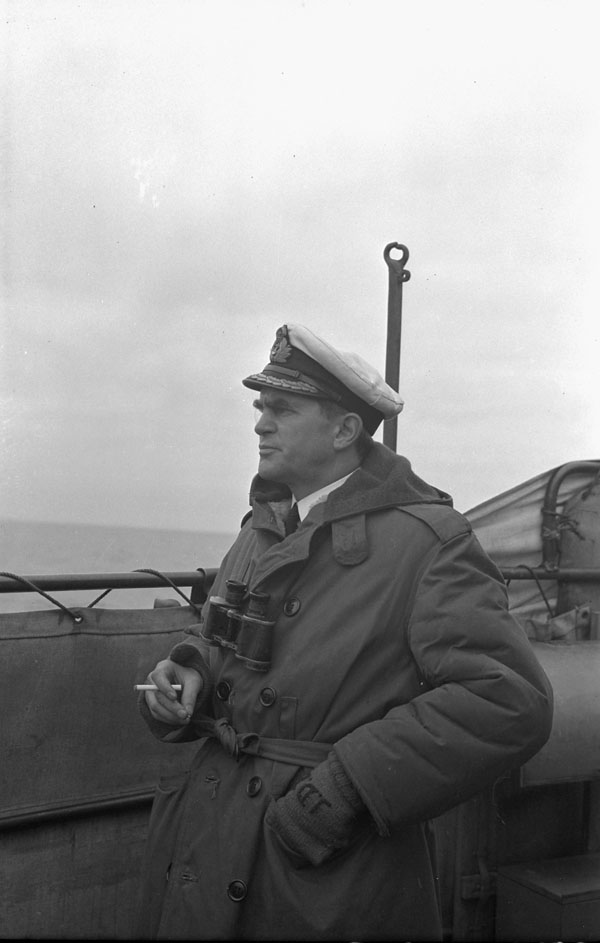
Commander J.D. Prentice, Commanding Officer, on the bridge of the corvette HMCS Chambly at sea, 24 May 1941.
Canada. Dept. of National Defence / Library and Archives Canada / PA-151743The first task assigned to Prentice and the embryonic NEF was screening the battle-cruiser Repulse as that great ship lay in Conception Bay following the hunt for the Bismarck. Screening Repulse was good basic exercise if nothing else, and the clear, unstratified waters of the bay returned good ASDIC echoes. The real work of NEF began shortly thereafter. Pending the arrival of a Canadian commanding officer for NEF, the escorts were placed under Captain C.M.R. Schwerdt, RN, the Naval Officer in Charge, St John’s (whose establishment had in fact only just been transferred to the RCN). Schwerdt, in consultation with his trade officers, determined that NEF should attempt its first escort of an eastbound convoy in early June. The date of sailing, course, and so on could all be obtained through local trade connections, and a rendezvous with HX-129 was worked out by Schwerdt’s staff. Word-of-mouth orders were passed to Prentice advising him of this plan and of the likelihood of very poor weather. The orders, which in effect stated “If you have any reasonable hope of joining the convoy, proceed to sea.” gave Prentice the carte blanche he thrived on; foul weather only added to the challenge.
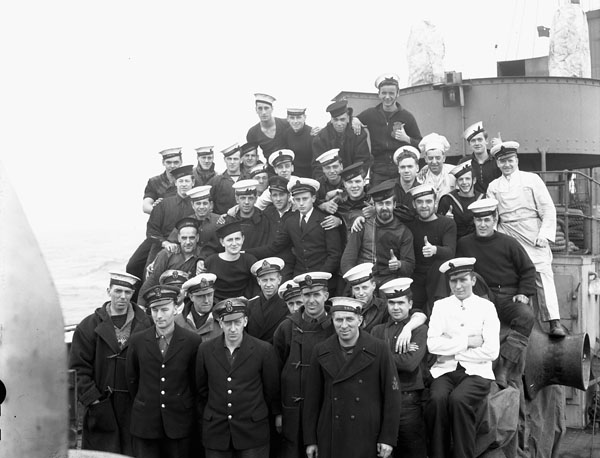
Members of the ship’s company, HMCS Chambly, St. John’s, Newfoundland, May 1941.
Canada. Dept. of National Defence / Library and Archives Canada / PA-115351On 2 June, the first NEF escort group to sail on convoy duty put to sea. The escorts Chambly, Orillia, and Collingwood rendezvoused with HX-129 within an hour of their estimated position. Although the convoy was not attacked, many stragglers and independents nearby were lost to enemy action, and the Canadians soon found themselves busy with rescue work. Two ASDIC contacts were made, one each by Collingwood and Chambly while operating in company. Unfortunately, co-ordination of searches was hampered by the failure of visual-signaling (V/S) equipment in Chambly. The latter also had to stop engines twice to repair defects. Despite the breakdowns, lost opportunities, and general mayhem of this first operation, Prentice’s spirits were extremely buoyant. “The ships behaved extremely well,” he wrote in his report of proceedings. Certainly all the COs in question, Acting Lieutenant Commander W.E.S. Briggs, RCNR, of Orillia, and Acting Lieutenant Commander W. Woods, RCNR, of Collingwood, went on to do well in the RCN. But one cannot help but feel that Prentice was writing about the corvettes themselves.
The first operation of NEF pointed to the many problems which beset the expansion fleet, and yet Prentice was pleased with the group’s performance. Having participated directly in the commission and workup of these first seven RCN corvettes, the SO, Canadian Corvettes, could be excused his pride in their initial foray into troubled waters. Other RCN officers maintained similar limited expectations of the expansion fleet. The British, on the other hand, entertained little sympathy for struggling civilian sailors. From the outset, RCN and RN officers displayed a tendency to view the expansion fleet from vastly different perspectives. To use an analogy, the RCN was, through the period of 1941-43, like half a glass of water. From the Canadian perspective the glass was half full; the RN always considered it half empty. Though the Naval Staff was apparently informed of how ill-prepared the early corvettes really were, this came as a rude shock to the more staid RN. Moreover, shortcomings manifested themselves even before the first major Canadian convoy battle.
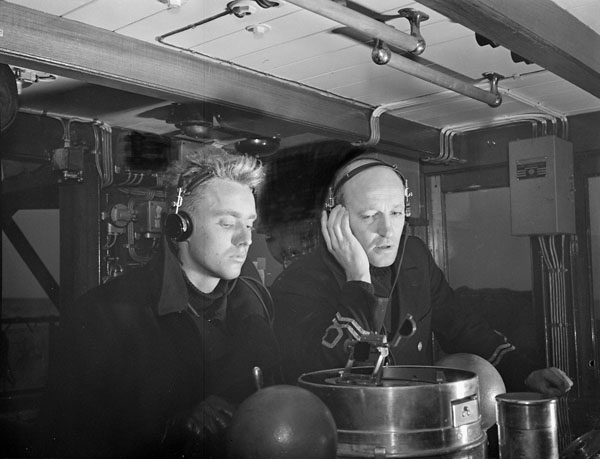
R. Cosburn and Lieutenant F.A. Beck (right) at the ASDIC set on the bridge of HMCS Battleford, Sydney, Nova Scotia, November 1941.
Canada. Dept. of National Defence / Library and Archives Canada / PA-184187
Comments Off on Canada and the Battle of the Atlantic, part 11 by Alex Funk
TAB Episode 43: QF 2pdr Anti-Tank Gun
The Armourer’s Bench
Published on Mar 10, 2019Introduced just before the beginning of WW2 the 2pdr AT Gun was more than capable of dealing with Axis tanks at the beginning of the war but as tank armour got thicker it became outgunned. Despite this the 2pdr remained in service and equipped a plethora of tanks and armoured cars including the Valentine and Matilda.
The 2pdr performed well during the Battle of France, in North Africa and during the defence of Malaya against the Japanese but it was eventually replaced by bigger and better guns. In this video Matt looks at the history, development and use of Britain’s first anti-tank gun.
Check out our accompanying blog on the 2pdr AT Gun over at: https://armourersbench.com
If you enjoyed the video please consider supporting our work via Patreon, TAB is a viewer supported, non-monetised channel and any help is very much appreciated!
Check out our Patreon page here: https://www.patreon.com/thearmourersbench
Comments Off on TAB Episode 43: QF 2pdr Anti-Tank Gun
April 12, 2019
Fields of Verdun – The Battle of Verdun – Sabaton History 010
Sabaton History
Published on 11 Apr 2019One of the bloodiest battles in the history of humankind was fought out on the hills in Northern France. Verdun was a tactical and symbolical city with great value to France. In 1916, the German army launched a massive attack, accompanied by a tremendous artillery bombardment, upon which the French defenders put their foot down, stating that “on ne passe pas!” — they shall not pass.
Check out the trailer for Sabaton’s new album The Great War on which “Fields of Verdun” will be featured right here: https://www.youtube.com/watch?v=HCZP1-JsD0M
Support Sabaton History on Patreon (and possibly get a special edition of ‘The Great War): https://www.patreon.com/sabatonhistory
Listen to Sabaton on Spotify: http://smarturl.it/SabatonSpotify
Official Sabaton Merchandise Shop: http://bit.ly/SabatonOfficialShopHosted by: Indy Neidell
Written by: Markus Linke and Indy Neidell
Directed by: Astrid Deinhard and Wieke Kapteijns
Produced by: Pär Sundström, Astrid Deinhard and Spartacus Olsson
Creative Producer: Joram Appel
Executive Producers: Pär Sundström, Joakim Broden, Tomas Sunmo, Indy Neidell, Astrid Deinhard, and Spartacus Olsson
Maps by: Eastory
Edited by: Iryna Dulka
Sound Editing by: Marek Kaminski© IWM (Q 56546), (Q 23760), (Q 23892), (Q 69971), (Q 87751), Q 87757), (Q 23878).
Battle Of Verdun, Uploaded by RV1864 on Flickr.Eastory YouTube Channel: https://www.youtube.com/channel/UCEly…
Archive by: Reuters/Screenocean https://www.screenocean.com
Music by Sabaton.An OnLion Entertainment GmbH and Raging Beaver Publishing AB co-Production.
© Raging Beaver Publishing AB, 2019 – all rights reserved.
From the comments:
Sabaton History
1 day ago (edited)
Last week we announced our upcoming album The Great War which will release on July 19 this year. This week, we’re covering a song from that album. “Fields of Verdun” is about the Battle of Verdun 1916 and will be featured on the new album. Since Indy hosted “The Great War” for over four years, the episode is very personal for everyone involved. Thank you all very much for your support and positive reactions to the trailer release. Haven’t seen the trailer? You can find it here: https://www.youtube.com/watch?v=HCZP1-JsD0MCheers and Rock on!!
Comments Off on Fields of Verdun – The Battle of Verdun – Sabaton History 010
Canada and the Battle of the Atlantic, part 10 by Alex Funk
Editor’s Note: This series was originally published by Alex Funk on the TimeGhostArmy forums (original URL – https://community.timeghost.tv/t/canada-and-the-battle-of-the-atlantic-part-4/1447/3).
Sources:
- Far Distant Ships, Joseph Schull, ISBN 10 0773721606 (An official operational account published in 1950, somewhat sensationalist)
[Schull’s book was published in part because the funding for the official history team had been cut and they did not feel that the RCN’s contribution to the Battle of the Atlantic should have no official recognition. It is very much an artifact of its era, and needs to be read that way. A more balanced (and weighty) history didn’t appear until the publication of No Higher Purpose and A Blue Water Navy in 2002, parts 1 and 2 of the Official Operational History of the RCN in WW2, covering 1939-1943 and 1943-1945, respectively.]- North Atlantic Run: the Royal Canadian Navy and the battle for the convoys, Marc Milner, ISBN 10 0802025447 (Written in an attempt to give a more strategic view of Canada’s contribution than Schull’s work, published 1985)
- Reader’s Digest: The Canadians At War: Volumes 1 & 2 ISBN 10 0888501617 (A compilation of articles ranging from personal stories to overviews of Canadian involvement in a particular campaign. Contains excerpts from a number of more obscure Canadian books written after the war, published 1969)
- All photos used exist in the Public Domain and are from the National Archives of Canada, unless otherwise noted in the caption.
I have inserted occasional comments in [square brackets] and links to other sources that do not appear in the original posts. A few minor edits have also been made for clarity.
Earlier parts of this series:
Part 1 — Canada’s navy before WW2
Part 2 — The Admiralty takes control
Part 3 — The professionals and the amateurs
Part 4 — 1940: The fall of France, the battle begins, and the RCN dreams of expansion
Part 5 — The RCN’s desperate need for warships
Part 6 — New ships, new challenges
Part 8 — Expansion problems: not enough men for not enough ships
Part 9 — Early-to-mid 1941, The Rocky Isle in the Ocean
Part 10 — The Newfoundland Escort Force and the Canadian corvettes
Returning to the corvettes themselves for a moment, while I have already spoken of the diversity of the modifications that they would receive [in Part 7], it is important to discuss the modifications that Canadians gave to their own corvettes in comparison to those made to Royal Navy ships. The RN used its corvettes for ocean escort and had begun to implement some of the modification to individual ships of the class to make the vessels more suitable for work on the open sea. The lengthened forecastle increased available crew space (required as ships’ crews were augmented with extra ratings for the newer equipment being fitted) and helped to make the ships’ interior spaces significantly drier. The bows were also strengthened to take the pounding of the heavy seas typically encountered in the North Atlantic. The first Canadian-built corvettes could have been delayed in order to incorporate these changes while still in the builders’ hands, but the shortage of ships meant that they went ahead largely as originally planned. The major Canadian alteration of the original design reflected the corvettes’ intended coastal operational role: minesweeping gear. The alterations to the original design, involving modification of the quarter-deck, cutting back the engine-room casing to accommodate a steam winch, broadening the stern to fit both the minesweeping wires and the depth charge rails, and the extra storage for the minesweeping gear when not in use, had already delayed the delivery of the ships to the navy.
[Editor’s Note: Minesweeping, while not the primary intended role for the Flower-class corvettes (especially without gyrocompasses!), was a viable alternate task. Here’s a post-war diagram of how WW2 minesweeping was done (from History on the Net‘s Minesweepers of WW2 page)]:
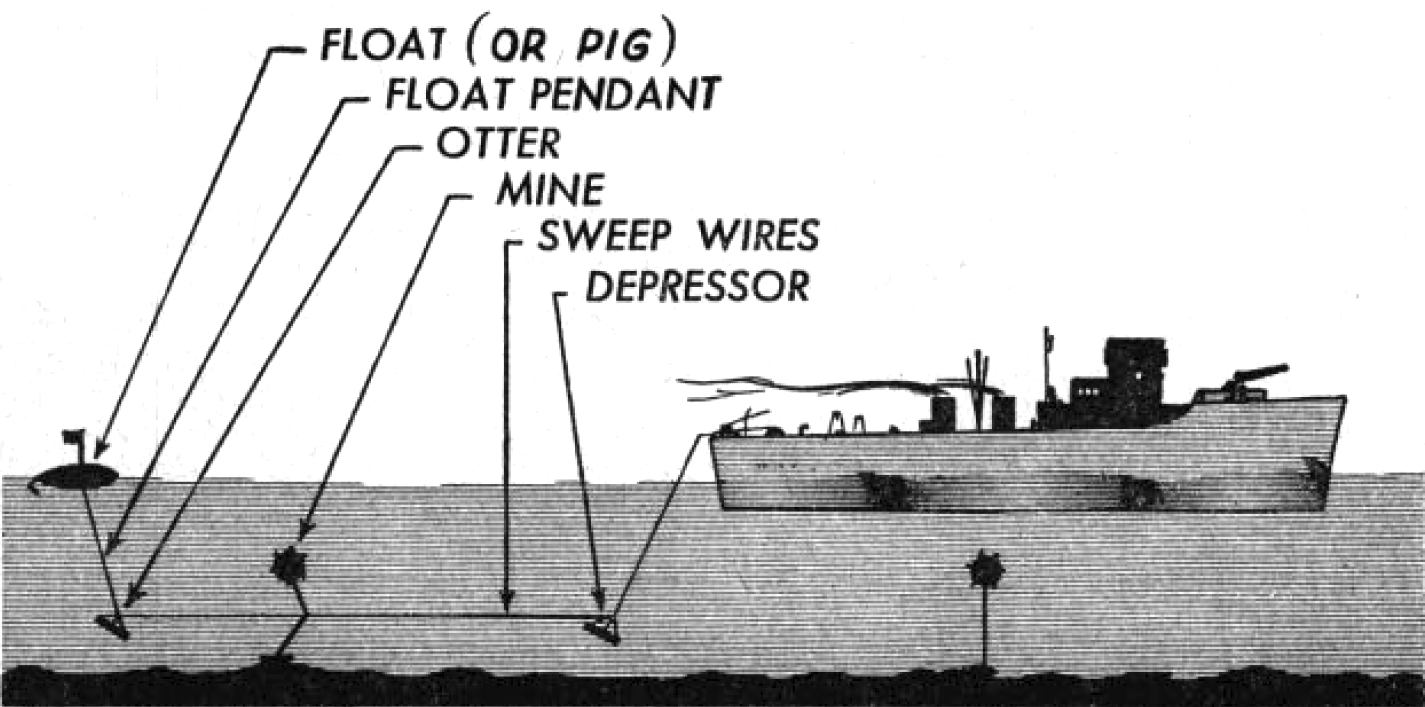
[Minesweeper-equipped ships would] “sweep” anchored mines by cutting their mooring ropes or chains, permitting the mines to float to the surface where they could be destroyed by gunfire.
Magnetically activated “influence” mines were defeated with a strong electrical current passed through a loop of cable, neutralizing the detonator. Acoustic mines, which responded to the noise of a ship’s engines and propellers, were prematurely detonated by underwater noisemakers operating on suitable harmonic frequencies.
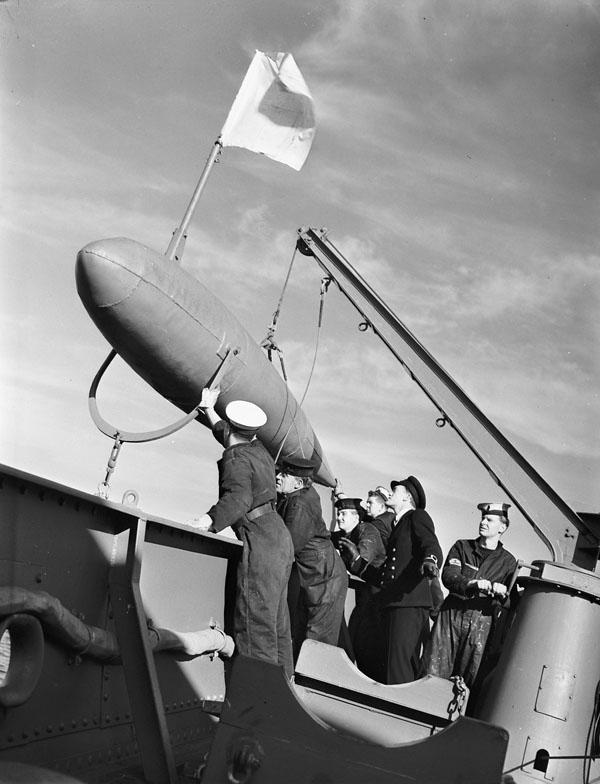
RCN personnel preparing to launch a minesweeping float from HMCS Alberni off the coast of British Columbia, March 1941.
Canada. Dept. of National Defence / Library and Archives Canada / PA-179942
Marc Milner, North Atlantic Run:
All of this delayed completion and may have hardened the Staff to any further delays occasioned by major alterations. Moreover, that the Naval Staff was not unduly concerned about the A/S performance of the corvettes is evidenced by the fact that the addition of a full minesweeping kit “had an adverse effect on the operations of the A/S gear”. The latter, as the Staff went on to observe, was carried forward and was affected by the corvette’s tendency to trim by the stern when fitted for minesweeping. In practice, however, the original corvette design, when fully stored and armed, tended to trim by the bows, which also affected A/S efficiency. The addition of extra weight in the stern may unwittingly have compensated for the design fault.
More important in terms of sea-keeping and habitability in deep-sea operations was the extension of the foc’sle. News of this major alteration reached NSHQ while most of the vessels of the first program were still in the builders’ hands. Although the RCN would make allowances for more crewmen, better refrigeration, a more powerful wireless set, and more depth charges — all indications that corvettes were expected to go farther afield and stay longer — the navy did not act on this fundamental alteration in basic structure of its first sixty corvettes. However, the Staff did recognize the value of the design improvements. … In the meantime, the RCN plodded along with escorts which, as late as the end of 1940, the navy still considered inshore auxiliaries. In any event, corvettes were still tied closely to the defended-port system under the terms of Plan Black. It is also arguable that the Staff’s failure to extend the foc’sles of corvettes when it had the chance stemmed from the navy’s need of ships to permit expansion really to begin, or from the increasing gravity of the war at sea. Whatever the case, it was a lost opportunity that would come to haunt the navy.
The forecastle extension (or lack thereof) would come to be the norm for the RCN and NSHQ: certain trivial modifications seemingly at random, major ones delayed exponentially. The after gun platform (for the Pom-Pom) was moved further to the rear of the ship so that it was not in danger of blowing away the mainmast, and would remain further to the rear long after the secondary mast was discarded. Shortage of primary AA armament saw a number of .5-inch Colt and Browning machine guns acquired from the U.S. and fitted in twin mounts (two in the aft gun position and one twin-mount on either side of the bridge). Inability to acquire sufficient Colt or Browning machine guns meant the return of the Lewis guns.
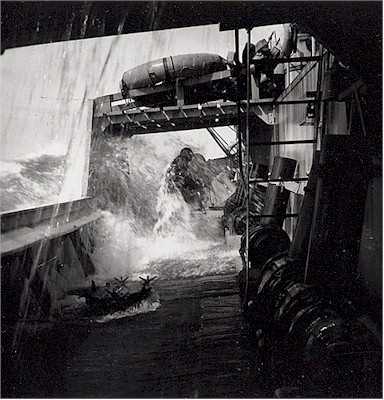
Other differences between RN and RCN corvettes were much less noticeable, but had a more important effect on the performance of the ships as deep-sea escorts. There was, for example, no provision in Canadian plans for a breakwater on the foc’sle of original corvettes. Without it, water shipped forward was able to run aft and pour into the open welldeck — the crew’s main thoroughfare. The British soon corrected this, but the RCN moved with incredible slowness on this simple matter, and as a result Canadian corvettes were unnecessarily wet. Canadian corvettes were also completed without wooden planking or some form of synthetic deck covering to prevent slipping in the waist of the ship, where the depth-charge throwers were fitted. Since this area was also constantly wet, the difficulties of loading charges can be imagined.
The most telling shortcoming of Canadian corvettes, and the one that was to cause the most difficulty in the struggle for efficiency, was the lack of gyro-compasses. The latter were at a premium in Canada, so the Naval Staff decided to fit them to the Bangor minesweepers, whose need for accurate navigation was paramount. The first Canadian-built corvettes (including those built to Admiralty accounts) were equipped with a single magnetic compass and the most basic of ASDIC, the type 123A. Even by 1939 standards the 123A was obsolete and in the RN was considered only suited to trawlers and lesser vessels. The 123A’s standard compass, graduated in “points” and not in degrees, made it equally hard for captains to co-ordinate operations between two ships or to undertake accurate submarine hunts and depth-charge attacks. The single binnacle and its attendant trace recorder were mounted in a small hut, above the wheelhouse. During an action it was impossible for a captain to be both in the ASDIC hut and outside on the bridge wings, the only place from which he could obtain an overall perspective on the situation. Nor was the needle of the standard compass properly stabilized, a deficiency particularly noteworthy in such lively ships as corvettes. … As a final point, it should be noted that compasses were also susceptible to malfunction from the shock of firing the main armament, exploding depth charges, or simply from the pounding of the ship at sea. The tendency of Canadians to launch inaccurate depth charge attacks proved a source of continuous criticism from British officers.
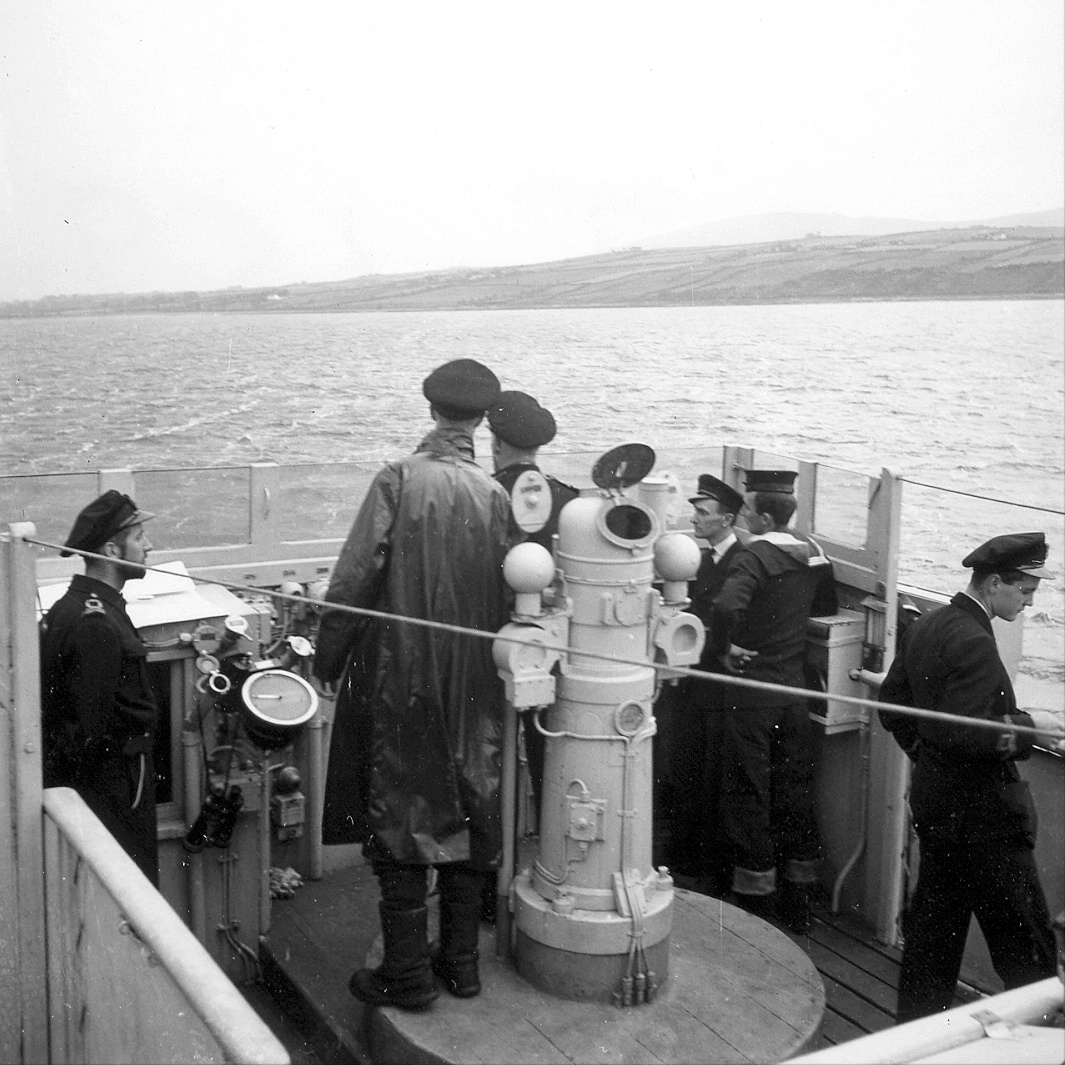
Officers on the bridge of Canadian Flower class corvette HMCS Trillium, circa 1940-42.
Image from the Canadian Navy Heritage website, Image Negative Number JT-159, via Wikimedia Commons.
Partly because of a disparity of resources, partly because there was still a lot of ambiguity concerning the role that the corvettes (and the RCN) would play in the war in general, the RN corvettes outclassed RCN corvettes when it came to performance at sea. Misapplication of Staff energies also played a role.
Instead of laying down a basic policy for the engineer-in-chief to follow, the Staff haggled over every conceivable alteration to their corvettes. They insisted, for example, that inclining tests be done before .5-inch machine guns were authorized for the bridge wings, even though they knew full well that this practice had already been adopted for comparable British ships. In the final analysis it would have been much better had the RCN continued its initial practice of calling its own corvettes “Town class”, after its policy of naming them for small Canadian communities. Instead the practice was abandoned in deference to the Admiralty’s choice of “Town class” for the ex-American destroyers, and the RCN applied the British class name of “Flower” to its corvettes. Had the RCN stuck to its distinctive class name, the tremendous differences which were to prove so very important by 1942-43, might have been as apparent as they were real.
Deck awash on HMCS Trillium, circa 1943
National Archives of Canada PA-037474, via HMCS Trillium page of the For Posterity’s Sake website – http://www.forposterityssake.ca/Navy/HMCS_TRILLIUM_K172.htmNSHQ’s notion that the RCN was to provide convoy escorts for the Newfoundland focal area suggests that the Naval Staff had not made the mental leap from the concept of locally based “strike forces” to the idea of a regional escort force. In this they were not alone. The distinction between two types of operation — one searching for submarines where shipping was plentiful, the other actually protecting the ships towards wich the submarines were drawn — was never very clear in the early days. NEF was, none the less, admirably suited to RCN capabilities. It also met two other vitally important criteria: it supported the government’s geopolitical aspirations and was at the same time fundamental to the war effort.
The war was entering what Churchill called “one of the great climacterics”. On June 22nd, Hitler would invade Russia and soon had her reeling. A Soviet collapse would give Hitler access to enormous resources. Even if Russia could fight them to a stalemate, there could be no Allied victory without an attack supplied by sea and mounted from the British Isles. Whether for the ultimate defence against a stronger Germany or for our own seaborne assault, Allied resources had to be turned into munitions of war and stockpiled in the UK. The resources were more than sufficient, but between the promise of the future and the need of the present lay a perilous gap of space and time that could only be bridged by ships, all the ships now available and hundreds more. Many convoys arrived at British ports each week and the tonnage unloaded was enormous. Yet a great percentage of it was what the island required simply to exist. Only the margin above that daily necessity represented the power to wage war. Munitions, aircraft, guns, tanks, and above all, aviation gasoline and fuel oil. If oil stocks fell below the point of safety, the operation of ships and planes would have to be curtailed. If U-boat attacks could not be met effectively, more ships would be lost, creating further shortages which would again reduce operations. The increasing demands of the war had to be met by a corresponding increase in the flow of cargo.
The U-boats imposed a steady drain: three merchant ships were going down for every one replaced. Eight submarines were coming into operation for every one sunk. U-boats swarmed in the Mediterranean. They were off Gibraltar, off the Cape Verde Islands at the bulge of Africa, off Cape Town far to the south. By the virtue of St John’s position alone, it bridged nearly a quarter of the gap between the Canadian seaboard and Iceland. June 1941 would also see Canada’s Commodore Murray return from Britain to become Commodore Commanding Newfoundland Escort Force. From Liverpool, the RN’s Commander-in-Chief Western Approaches, Admiral Sir Percy Noble, directed the whole Atlantic battle, but Commodore Murray exercised autonomy within his own war zone. The Newfoundland Escort Force was made up of six Canadian destroyers and seventeen corvettes, plus seven destroyers, three sloops and five corvettes of the RN. Soon more ships, French, Norwegian, Polish, Belgian and Dutch, were allotted to Commodore Murray. His authority extended to all local escorts operating from St. John’s and to convoys and their escorts while in Newfoundland waters.
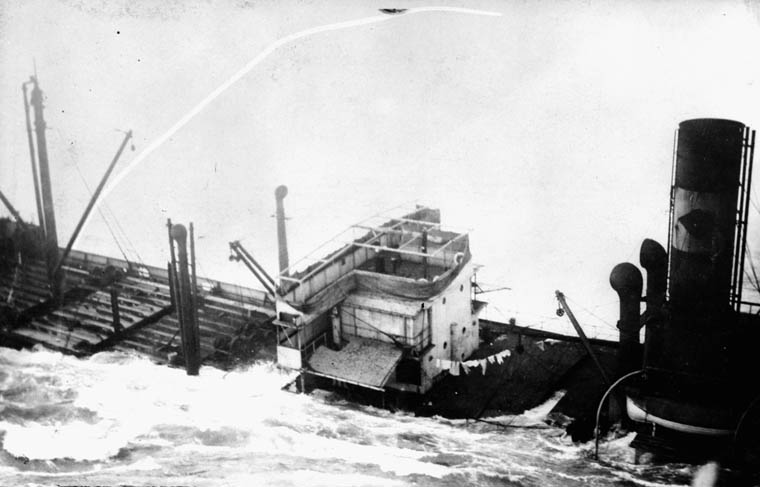
SS Rose Castle sinking and decks awash, 2 November, 1942. The original description for this item gives the date October 1942 as the date of the sinking, but according to eyewitness and survivor Gordon Hardy, the Rose Castle sank at 3:30 AM, November 2, 1942. On Oct 20, 1942, the Rose Castle was hit by a dud torpedo but was not damaged.
Library and Archives Canada/PA-192788
Comments Off on Canada and the Battle of the Atlantic, part 10 by Alex Funk
Machine-guns: light, medium, heavy, or sub?
Lindybeige
Published on 2 Mar 2016Machine-guns – do you know the difference between light, medium, and heavy? What is a ‘submachinegun’?
Support me on Patreon: https://www.patreon.com/LindybeigeMany people are hazy over the differences between the various types of machine-gun, and here I ramble on for ten whole minutes about the distinctions. It is a bit of a moving target, as terminology alters as technology does, but the terms used in World War Two are still reasonably current.
Lindybeige: a channel of archaeology, ancient and medieval warfare, rants, swing dance, travelogues, evolution, and whatever else occurs to me to make.
For the detail-minded, don’t panic: he’s taken to task in the comments on this video for a few of the howlers you may have noticed on the way by.
Comments Off on Machine-guns: light, medium, heavy, or sub?
April 11, 2019
Modern History: A Funny Thing About Medieval Hoods
Modern History TV
Published on 7 Mar 2019A look at medieval hoods, how they’re used, how they’re worn and something you probably didn’t know about them.
Credits
Direction, Camera, Editing, Sound Kasumi
Presenter Jason Kingsley OBEMusic licensed from PremiumBeats
Comments Off on Modern History: A Funny Thing About Medieval Hoods
April 10, 2019
Canada and the Battle of the Atlantic, part 9 by Alex Funk
Editor’s Note: This series was originally published by Alex Funk on the TimeGhostArmy forums (original URL – https://community.timeghost.tv/t/canada-and-the-battle-of-the-atlantic-part-4/1447/3).
Sources:
- Far Distant Ships, Joseph Schull, ISBN 10 0773721606 (An official operational account published in 1950, somewhat sensationalist)
[Schull’s book was published in part because the funding for the official history team had been cut and they did not feel that the RCN’s contribution to the Battle of the Atlantic should have no official recognition. It is very much an artifact of its era, and needs to be read that way. A more balanced (and weighty) history didn’t appear until the publication of No Higher Purpose and A Blue Water Navy in 2002, parts 1 and 2 of the Official Operational History of the RCN in WW2, covering 1939-1943 and 1943-1945, respectively.]- North Atlantic Run: the Royal Canadian Navy and the battle for the convoys, Marc Milner, ISBN 10 0802025447 (Written in an attempt to give a more strategic view of Canada’s contribution than Schull’s work, published 1985)
- Reader’s Digest: The Canadians At War: Volumes 1 & 2 ISBN 10 0888501617 (A compilation of articles ranging from personal stories to overviews of Canadian involvement in a particular campaign. Contains excerpts from a number of more obscure Canadian books written after the war, published 1969)
- All photos used exist in the Public Domain and are from the National Archives of Canada, unless otherwise noted in the caption.
I have inserted occasional comments in [square brackets] and links to other sources that do not appear in the original posts. A few minor edits have also been made for clarity.
Earlier parts of this series:
Part 1 — Canada’s navy before WW2
Part 2 — The Admiralty takes control
Part 3 — The professionals and the amateurs
Part 4 — 1940: The fall of France, the battle begins, and the RCN dreams of expansion
Part 5 — The RCN’s desperate need for warships
Part 6 — New ships, new challenges
Part 8 — Expansion problems: not enough men for not enough ships
Part 9 — Early-to-mid 1941, the Rocky Isle in the Ocean
Marc Milner continues the story in North Atlantic Run:
The problem of providing end-to-end A/S escort in the North Atlantic was discussed by British and Canadian authorities during the winter. These talks were the first sure indication that RCN corvettes were likely to be used as ocean escorts (what the navy thought corvettes earmarked for the Eastern Atlantic were initially expected to do remains uncertain). In any event, the Anglo-Canadian discussions identified three factors crucial to the establishment of end-to-end A/S escort: the escorts must be available; they must have reached a reasonable state of individual and escort-group training, and the necessary bases must be available. In May 1941 none of these factors obtained in the Western Atlantic. An insufficient number of new corvettes were in commission, and most of these only recently. The development of facilities was now a top priority, but support facilities outside of Halifax were virtually non-existent, and the standard of training was to prove inadequate, to say the least.
The natural place from which to stage escort operations in the Northwest Atlantic was Newfoundland.
To briefly discuss Newfoundland’s role so far, when Canada declared war on September 10th, Newfoundland had already been at war for seven days. As a British dominion [under direct rule from London since 1934] ten years before joining Confederation, the mainland declaration of war received modest space on page four of the St. John’s Evening Telegram. They had participated in the first “hostile” act in North America: a German merchant vessel had been seized and thirty prisoners taken. The local YMCA was converted into a prison. Rationing and dim-outs took effect instantly. Private radio stations were silenced, mail and cables censored, aliens registered and controlled. Insurance premiums on waterfront property had gone up in less than a week from $1.00 to $5.00 for each $1000 of coverage.
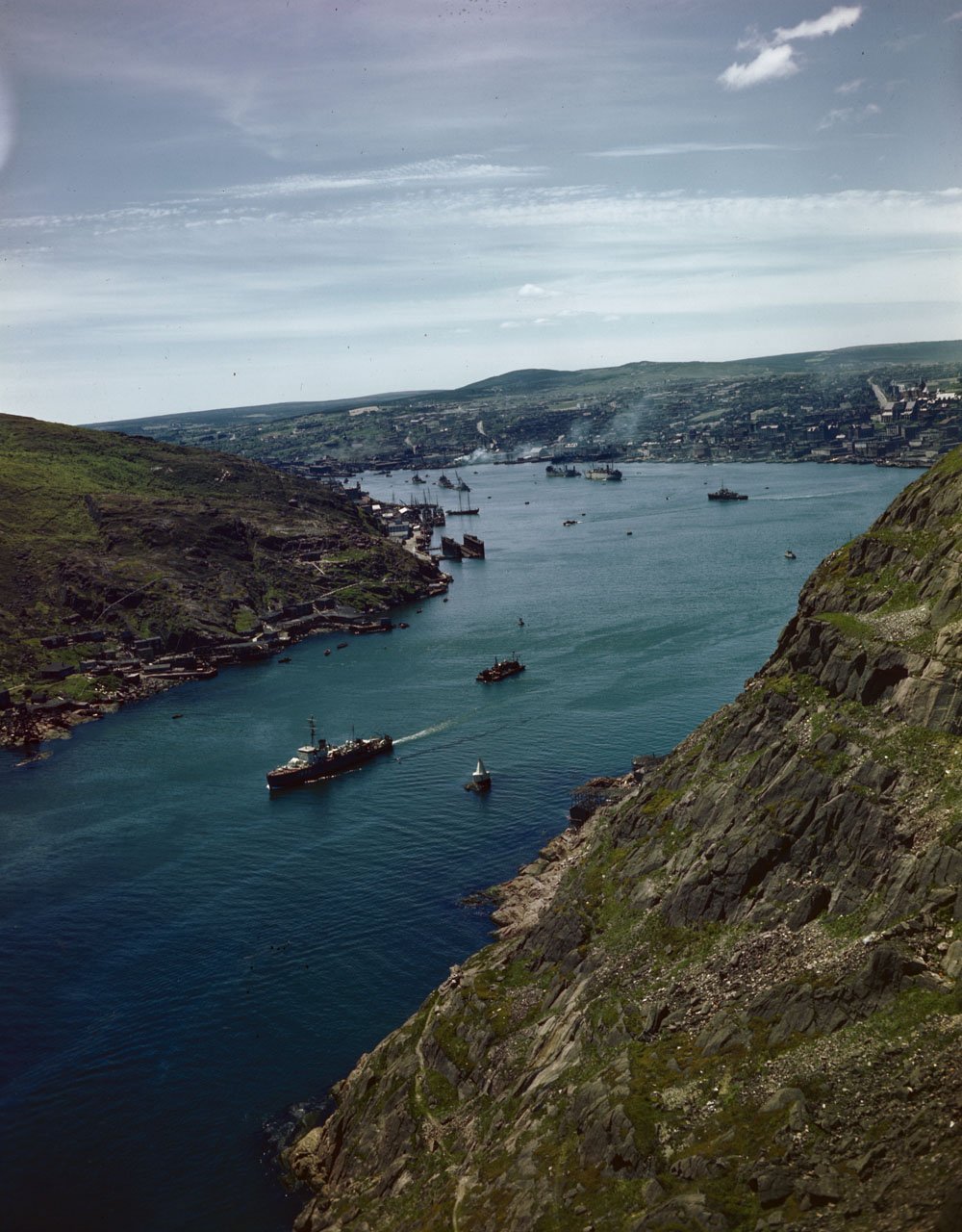
View of the entrance to St.John’s harbour and port facilities, Newfoundland, taken from Signal Hill, 1942. A minesweeper is leaving port.
Canada. Department of National Defence / Library and Archives Canada / ecopy
Milner continues:
Although not yet part of the Dominion of Canada, the island was integral to Canadian defence, and its protection was assumed, in consultation with the British, as a Dominion responsibility in 1939. By early 1941, however, the Canadian armed forces had made only a modest contribution to Newfoundland’s security, though more was planned under the terms of Plan Black. During 1940 the RCN had surveyed the coast for possible base sites and fleet anchorages and ordered a further ten corvettes for local defence. The navy had also seconded personnel to the Naval Officer in Charge, St John’s, Captain C.M.R. Schwerdt, RN, the only naval establishment on the island. Until the latter was turned over to the RCN in early May 1941, the Canadian navy had no permanent presence in Newfoundland. For a number of reasons, not all of them enemy inspired, this low level of activity was destined to change. The absorption of Schwerdt’s command into the RCN came as part of the integration of Newfoundland into the Canadian east-coast command system, and it mirrored similar army and air force arrangements. But Canada was also engaged in an embryonic war of influence with the U.S. over the old colony. The establishment of American bases on the island, as a result of the destroyers-for-bases deal with the British, was attended by an agreement granting the U.S. rights to defend its new bases by operations in adjacent territory. The agreement was concluded despite strong protests from Canada and in spite of the prior Canadian acceptance of responsibility for Newfoundland’s defence.
The anxiety Canada felt over her position in Newfoundland was exacerbated by joint Anglo-American planning of a combined strategy for the defeat of Germany should the U.S. enter the war. For several weeks in early 1941 senior American and British staffs met in Washington to discuss a co-ordinated Commonwealth and U.S. plan. Neither Canada nor any of the other Dominions was accorded official representation, although British delegates kept their Commonwealth allies informed of proceedings. The result of these meetings was an agreement, American-British Conference 1 (ABC 1), whereby the world was divided into two basic strategic zones. The Americans were to assume responsibility for most of the Pacific and for the Western Atlantic, with the exception of waters and territory assigned to Canada “as may be defined in United States-Canada joint agreements”.
The Canadians were not pleased with their treatment in the Anglo-American discussions, and the Chiefs of Staff feared that ABC 1 was intended to oust them from Newfoundland. The issue was somewhat problematical, since the implementation of ABC 1 was dependent upon U.S. entry into the war. However, the resolution of such issues, which had a direct bearing on Canada’s responsibilities as a sovereign state, did not accord with the national view of Canada as a full and independent partner in the war against Germany. Canada was already attempting to force recognition of that claim, at least with respect to North American defence, by the establishment of a Canadian Staff mission in Washington. While the battle to be heard and recognized went on, Canadian responsibilities under under the terms of ABC 1 were worked out by the Permanent Joint Board on Defence. These agreements, styled Joint Canadian-United States Basic Defense Plan No. 2 (Short Title ABC-22) and appended to ABC 1, acknowledged Canada responsibility for her own coastal waters (within the customary three mile limit) and for the commitment of five destroyers and fifteen corvettes to supplement USN forces in the Western Atlantic. Under the terms of ABC 22 the balance of Canadian naval forces was to be sent overseas.
[Editor’s Note: The actual wording of Annex 1 to ABC 22 isn’t quite as restrictive as far as available naval forces are concerned, and the inventory of USN and RCN forces is interesting in itself:]
ANNEX I-MILITARY FORCES
In view of the uncertainties which exist as to the stability of the strategic situations in various theatres, and as to the date on which the United States may enter the war, the strengths of forces listed below must be regarded as subject to change in the light of the strategic situation which may exist when the plan is placed in effect. The forces now estimated to be initially available for the operations required by this plan as of 15 July, 1941, are:
(A) ATLANTIC

    Ocean Escorts United States Atlantic Fleet
      6 Battleships
      5 8" Cruisers
     54 Destroyers
      4 Mine Sweepers (destroyer type)
     54 Patrol Planes

    North Atlantic Naval Coastal Force (U. S. N.)
      5 Eagle Boats
      3 Gunboats
      4 Patrol Yachts
     18 Patrol Planes

Page 1591

    Newfoundland Force (R. C. N.) (Allocated to operate with Ocean
      Escorts, U. S. Atlantic Fleet)
      5 Destroyers
     15 Corvettes

    Atlantic Coast Command (R. C. N.)
      8 Destroyers
     28 Corvettes
      4 Mine Sweepers
      4 Magnetic Mine Sweepers
     11 Armed A/S Yachts
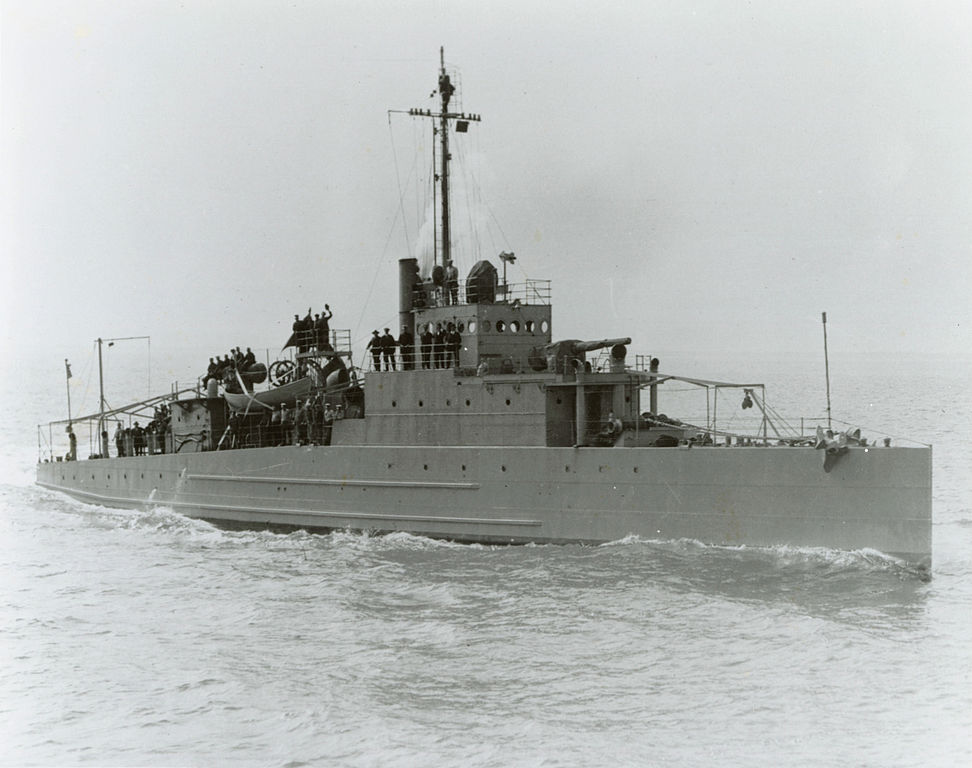
USS Eagle 2 (PE-2) on builder’s trials in 1918.
US Navy photo via Wikimedia Commons.
[Editor’s Note: I’d never heard of “Eagle Boats” before, so here’s what Wikipedia has to say about them: “The Eagle class patrol craft were a set of steel ships smaller than contemporary destroyers but having a greater operational radius than the wooden-hulled, 110-foot (34 m) submarine chasers developed in 1917. The submarine chasers’ range of about 900 miles (1,400 km) at a cruising speed of 10 knots (19 km/h) restricted their operations to off-shore anti-submarine work and denied them an open-ocean escort capability; their high consumption of gasoline and limited fuel storage were handicaps the Eagle class sought to remedy. […] The term “Eagle Boat” stemmed from a wartime Washington Post editorial which called for “…an eagle to scour the seas and pounce upon and destroy every German submarine.” However, the Eagle Boats never saw service in World War I. […] A number of the Eagle Boats were transferred to the United States Coast Guard in 1919, and the balance were sold in the 1930s and early 1940s. Eight Eagle boats saw service during World War II. One was stationed in Miami as a training vessel. After the war, seven were decommissioned, while one was sunk by a German submarine.”]
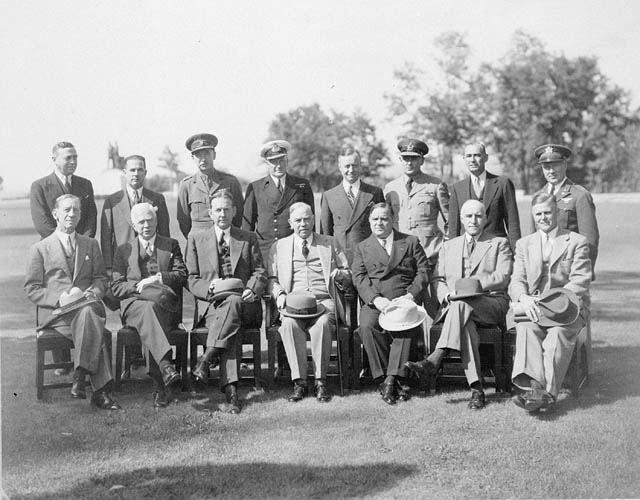
Members of the Permanent Joint Board on Defence, August 1940.
Library and Archives Canada / C-005767
Milner continues:
In the strictest sense, should the U.S. enter the war, Canada had lost the battle for Newfoundland. But though the Canadians had earlier been prepared to place their forces unreservedly under U.S. strategic direction in the worst-case scenario of Plan Black, they considered ABC 1 and ABC 22 offensive plans. The Canadians therefore clung firmly to their right to exercise command and control of Canadian forces in Canada and Newfoundland, even should ABC 1 come into force. Further, actual command of forces, despite a strong American sentiment to the contrary, was to remain with the respective nations. Co-ordination of the military effort in a given area was to be by “mutual co-operation”. Unified command of all forces under a single officer was allowed for upon agreement by the officers in the field or the Chiefs of Staff. The criteria for determining who was to command under such conditions were never clearly defined; however, the Canadians at least considered that the size of national contingent and the rank and seniority of its commanding officer were the governing elements. It was Canadian practice, therefore, throughout the joint American-Canadian occupation of Newfoundland to keep Canadian strength above that committed by the U.S. and to ensure that the senior Canadian present outranked his American counterpart. All of these considerations were foremost in the minds of the Canadian government and Staffs when Canada was asked by the British to base large escort forces at St John’s in the spring of 1941.
Thus, aside from the very real operational importance of the task, it was not surprising that the RCN responded enthusiastically to the Admiralty’s request of 20 May that the navy begin the escort of convoys from a base at St John’s. NSHQ responded by declaring that it was prepared to commit all of its new construction and its destroyer forces as well — virtually the entire navy. “We should be glad,” the Canadian reply read, “to undertake anti-submarine convoy escort in the Newfoundland focal area.” Naturally, command of the forces would rest with an RCN officer, and NSHQ suggested Commander E.R. Mainguy, RCN, an officer with experience in the Western Approaches who would be promoted to Captain for the task. However, the Canadians agreed that the Admiralty, through the Commander-in-Chief, Western Approaches (C-in-C, WA), would assume “direction of this force when necessary to coordinate its cooperation with those of the Iceland force.”
Commander E.R. Mainguy, Commanding Officer, HMCS Ottawa, off Botwood, Newfoundland in June, 1940. Botwood was being scouted as a potential seaplane base at the time, and would eventually become home to two RCAF Canso squadrons and a full Canadian Army detachment.
Canada. Dept. of National Defence / Library and Archives Canada / PA-104029Whether Canadian enthusiasm for the Newfoundland Escort Force (NEF) stemmed from a belief that a permanent, military and politically acceptable role for the burgeoning corvette fleet had been found remains a mystery. What is patently clear, however, is that both the British and the Americans considered the NEF a stopgap measure. By the summer of 1941 it was becoming increasingly evident that the U.S. would get involved in the Atlantic battle under the guise of defending the neutrality of the Western Hemisphere. When that happened, the role of the RCN in the Western Atlantic would be governed by the accords of ABC 1.
Whatever the final outcome of NEF, the commitment of the corvette fleet to ocean escort work marked a radical departure from the intended use of such vessels.
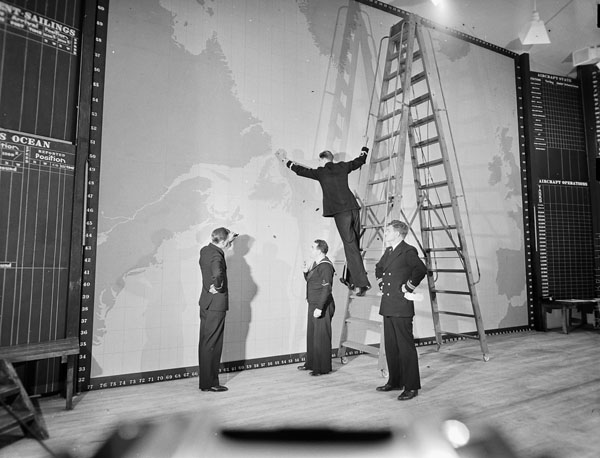
Royal Canadian Navy Operations Room, St. John’s, Newfoundland, 24 September 1942.
Lt Gerald M. Moses / Canada. Dept. of National Defence / Library and Archives Canada / PA-180609
Comments Off on Canada and the Battle of the Atlantic, part 9 by Alex Funk
Zahhak the Demon King – Persian Myth #1 – Extra Mythology
Extra Credits
Published on 8 Apr 2019Join the Patreon community! http://bit.ly/EMPatreon
Zahhak was not always a demon king — but, deceived by a young man named Iblis, he was motivated to slay his father to obtain world power. His pride would cause him to turn into a monstrous demon king, with serpents on his shoulders that fed on the Arabian people, for a thousand years… until Feraydun showed up…
Comments Off on Zahhak the Demon King – Persian Myth #1 – Extra Mythology
M37: The Ultimate Improved Browning 1919
Forgotten Weapons
Published on 8 Mar 2019http://www.patreon.com/ForgottenWeapons
Cool Forgotten Weapons merch! http://shop.bbtv.com/collections/forg…
In November of 1950, the US Ordnance Department requested an improved version of the Browning 1919 air cooled machine gun for use in tanks. The new version was to be able to feed from either the left or right, a feature which was unimportant for an infantry gun but much more relevant when mounting guns into the tight spaces of an armored vehicle. An interim conversion of existing guns to the M1919A4E1 pattern came first, followed by manufacture of all-new guns by the Rock Island Arsenal and Saco-Lowell company from 1955 until 1957.
The design of the gun fell to Bob Hillberg at High Standard. He came up with a clever set of reversible plugs to change the bolt between left and right hand feed, as well as a captive recoil spring, manual safety, improved top cover and rear cover latches, and several other strengthened parts. He also incorporated a charging handle extension with integral manual hold open and a link ejection chute that could be mounted to either side of the gun. His T153 design was formally adopted as the M37, in caliber .30-06. A 7.62mm NATO version (the M37E1) followed as well. The M37 would serve into the late 1960s on the M48 and M60 tanks as well as several helicopters.
Contact:
Forgotten Weapons
PO Box 87647
Tucson, AZ 85754
Comments Off on M37: The Ultimate Improved Browning 1919


